The DOJ Fraud Division, U.S. Attorney’s Office, and Pennsylvania Attorney General today announced criminal charges against 19 defendants, including owners and employees of home care companies, for their alleged participation in various fraud schemes involving over four million dollars in claims to Medicare and Medicaid.
The Pennsylvania Attorney General also announced a plea agreement involving the final defendant in a previously-charged 21 defendant case involving over $1.7 million in claims.
Assistant Attorney General Colin M. McDonald of the Justice Department’s National Fraud Enforcement Division, Dr. Mehmet Oz, Administrator for the Centers for Medicare & Medicaid Services, U.S. Attorney David Metcalf for the Eastern District of Pennsylvania, and senior federal and state officials hold a press conference announcing a significant health care fraud takedown and a new Anti-Fraud Initiative in the Eastern District of Pennsylvania.
To emphasize the scope of the fraud in California and New York Dr Oz notes, “the number one job in the entire state is personal care services.” (WATCH – prompted):
DOJ Press Release – […] The defendants’ conduct was characterized by extraordinary greed. In one case, the Pennsylvania Attorney General charged a purported home health aide who claimed to have provided services to up to seven Medicaid recipients at once. On over 1,100 occasions, the defendant allegedly claimed to have provided care for more than 24 hours in a single day, totaling over 64,000 hours that could not have been worked.
As alleged, Medicaid paid over $1.2 million as a result of the scheme. Another defendant who was charged in today’s announcement, a purported aide, claimed to have worked over 8,700 overlapping hours. As alleged, there were nearly 400 days on which the defendant claimed to be working for more than 24 hours in a day. The defendant allegedly caused over $180,000 in loss to Medicaid. In another case, a defendant was charged who claimed to have provided over 1,300 hours of home care services for a Medicaid recipient who was himself incarcerated on state drug charges. A defendant in one case was captured on a recorded conversation stating that “this home health care is the best kept secret . . . I made a buck plus [each of] the last five years, that’s, that’s a half a million dollars . . . I ain’t checking on nobody.” (read more)
Posted originally on CTH on August 4, 2026 | Sundance
Senators Thom Tillis and John Cornyn finally dropped their opposition to Acting Attorney General Todd Blanche advancing the nomination with a judiciary committee vote 12-10 along party lines.
Senator Chuck Grassley navigated a pathway out of the committee with an agreement by AAG Blanche that an IRS lawsuit settlement agreement between the DOJ and Trump attorneys would not create a J6 victim’s compensation fund.
The $1.8 billion settlement between the IRS and lawyers representing President Trump for leaking the candidates’ personal tax returns still remains at the heart of the matter. What Donald Trump and the Trump Organization plan to do with the settlement is unknown, hence the political consternation about the settlement remains in place.
WASHINGTON DC – […] Judiciary Chair Chuck Grassley (R-Iowa) said ahead of the vote that Cornyn and Tillis’ concerns about the fund “and the IRS settlement were shared by many, including this senator.” He added that the changes Blanche made “put this issue to bed once and for all.”
Democrats lambasted the deal Cornyn and Tillis struck, saying it would not meaningfully bind Trump from eventually resurrecting the payout fund and using his to enrich his political allies, including participants in the Jan. 6, 2021, Capitol riot.
“To state the obvious, Mr. Blanche’s statement on the slush fund and the IRS immunity agreement are not signed by the parties to the settlement agreement and are therefore unenforceable,” said Sen. Dick Durbin of Illinois, the top Democrat on the panel. “The parties could still sue to enforce the agreement and the cop-beaters fund can easily be revived with a new order from the Department of Justice 15 minutes after Mr. Blanche is confirmed as attorney general.” (read more)
The bottom line is that President Trump had already told the Senate he was going to continue the use of previously confirmed Deputy AG Todd Blanche as the leader of the DOJ regardless of their opposition to his “Acting AG” status.
Tillis and Cornyn are both leaving the Senate at the conclusion of this term in January. As they depart, they stand as physical embodiment of the elite and detachment mindset within the Senate that believes they are the source of omnipotent power from the upper chamber.
Democrats thirst power and use money to achieve influence.
Republicans thirst money and use power to achieve affluence.
This dynamic represents the ideology behind both wings of the UniParty in Washington DC.
Posted originally on CTH on August 3, 2026 | Sundance
Olha Stefanishyna says she resigned. Volodymyr Zelenskyy says she was removed. Regardless of which storyline is accurate, the Ukraine Ambassador to the United States is no longer in position. There is no replacement.
Stefanishyna is also under investigation for her connection with financial irregularities involving the Asset Recovery and Management Agency, although she has not been formally charged, yet.
The Western narrative, which has continuously looked like an intelligence community shaping, says that U.S. relations with the government of Ukraine have never been stronger. The reality seems to be something else entirely.
Aug 3 (Reuters) – President Volodymyr Zelenskiy dismissed Ukraine’s ambassador to the United States, Olha Stefanishyna, in a decree published on Monday.
Stefanishyna had been in her job for nearly a year. Her departure had been expected for several weeks.
Her departure coincides with a shake-up in recent weeks of top officials, including the replacement of the prime minister and defence minister. A reshuffle of Ukraine’s diplomatic and ambassadorial appointments is also expected.
Stefanishyna, writing on Facebook, said the decision to leave her post was “my own decision, driven by personal circumstances … ” and said she had accomplished much during her time in the post. (read more)
I am not going to belabor the points, because I’m told by most my review of the data is incorrect. However, once again, I would simply point out the distinct difference between the preferred Western narrative and the reality of events as they unfold.
From the June 11th London visit that preceded the G7 assembly in Paris, things have not made sense when you compare Western narrative to the reality of events. The removal of Stefanishyna is simply just another datapoint.
Western media say Ukraine has turned the tide on the war against Russia. Reality – Russia has methodically gained ground in Eastern Ukraine.
Western media say Ukraine has exceptional drone building and technological capabilities to share with allies. To highlight this expertise Ukraine held a drone exposition in Kiev; Russia blew it up killing hundreds of contractors. Media went silent.
Ukraine drones attack Wildberries warehouses. Russia blows up drone manufacturing factories.
Western media say Ukraine drone capabilities are the most remarkable testimonial to their military effectiveness. Zelenskyy fires the Minister of Defense responsible for the drone capabilities.
Western media say Ukraine is effective in stopping the Russian advancements in the Donbas region. Zelenskyy fires the military general in command of the Ukraine military in the Donbas.
Western media say Ukraine long-range drones are striking deep into Russian oil refining capacity. Zelenskyy says he needs to build drone and missile factories in Great Britain.
If you want to evaluate the war, go back to the timing of events right after Zelenskyy last went to London and met with King Charles. It was a few days before the G7 summit in Paris. Go back to that exact date and then read the headlines on Ukraine/Russia from that date to today.
If you can be emotionally disconnected from the spin, and just focus on what the headlines would mean in every other timeframe, what you will notice is that Ukraine is panicking. Every move is a panic move from that London visit to today.
Every Russian move exists silently, almost in isolation from Western media. Every Ukraine move exists loudly, coordinated and promoted for maximum media value. It looks like an intelligence influence operation.
Go look.
The recently organized U.S. Senate sanctions against Russia are mostly directed toward China and India, while framing censorship in the form of punishment against any action that might “undermine” the government of Ukraine. It’s the ‘be careful what you say’ sanctions.
Russia is methodically destroying Ukraine defenses, and the only response Zelenskyy has put together is flashy political promotion and media headlines to hide a reality that Russia is methodically destroying Ukraine defenses.
Western media says one narrative; the datapoints show something entirely different.
I give it four months, and it’s over.
Perhaps, that’s why President Trump: (A) pulled back from Patriot and Tomahawk missile sharing; and (B) has told his team to reengage both sides in peace negotiations now.
Posted originally on CTH on August 3, 2026 | Sundance
During an oval office event to support military families and servicemembers, President Trump took questions from the assembled press pool. The questioning begins at 23:19 (prompted):
Posted originally on CTH on August 3, 2026 | Sundance
The young man who boosted the public perception surrounding welfare, HHS and Medicare fraud in Minnesota, has travelled to Ceuta, Spain, to see for himself what exactly is going on.
There are various claims about causation and accusations surrounding the horde of 60,000 young male migrants who have swamped the city and created chaos. However, Mr Shirley asks them directly why they came and in general they say they just want a better life with the opportunity to reach mainland Spain. It seems like the average age is 14 to 17-years old.
One of the interesting notes is with the Spanish man who helped to escort and guide Shirley. At 14:50 when asked why Spanish politicians allow the border crisis and mass illegal migration, the man answers, in essence, 3rd world dictators have more absolute power than 1st world democracies. As a consequence, far-left ideologues who rise as leaders in politics see a greater value in having a subservient population for them to rule. Leftists don’t succeed in true democracies, so they need to create the new version of democracy where they can devolve the social structures of the nation and gain power.
Chapters:
00:00 What happened to Ceuta Spain? 1:38 Current situation with Spain vigilante 3:22 Spain-Morocco Border 4:28 Moroccan migrants returning to Morocco 5:42 Was this a setup by Spain? 7:33 Moroccan Migrants inside the city, where are they going? 10:20 Spaniards feel unsafe… vigilante speaks out 12:15 Finding migrants hiding in the mountains 14:47 Why is Spain turning into the 3rd world? 17:19 Migrants showering on the graves of Spaniards 18:12 Spain begins to take action 19:03 Inside the PACKED migrant camp 23:35 Migrants thank Pedro Sanchez 24:00 Interview with Moroccan migrant in English 27:12 Chased with knife by Muslim man
Posted originally on CTH on August 3, 2026 | Sundance
What we can take away from the Institute for Supply Management (ISM) index on manufacturing [Data Here]: overall, the U.S. manufacturing sector is continuing to expand significantly. The current index of 55.6 percent in July is 2.3 percentage points above the June figure and the highest reading since May 2022 (55.9 percent), when we were trying to recover from the COVID-19 shutdowns and supply chain problems.
PMI – The overall economy continued in expansion for the 21st month in a row. (A Manufacturing PMI® above 47.5 percent, over a period of time, generally indicates an expansion of the overall economy.) The New Orders Index expanded for the seventh consecutive month after four straight readings in contraction, registering 56.7 percent, up 0.7 percentage point compared to June’s figure of 56 percent.
The July reading of the Production Index (58.5 percent) is 6.3 percentage points higher than the 52.2 percent recorded in June and the highest figure since November 2021 (60.5 percent). The Prices Index remained in expansion (or ‘increasing’ territory), registering 71.1 percent, a 1.9-percentage point decrease from June’s reading of 73 percent. The Backlog of Orders Index registered 55 percent, up 4.5 percentage points compared to the 50.5 percent recorded in June.
The Employment Index reading of 52.8 percent is up 3.1 percentage points from June’s figure of 49.7 percent, putting the index in expansion territory for the first time in 33 months.” (source)
All that data and a couple of bucks will buy you a cup of coffee, but here’s what it means in common speak.
Overall, companies wanting to make products in the United States are expanding the manufacturing sector. However, they are running into a problem when trying to source the component goods and/or raw materials. The resource goods they need are constantly in a status of flux and the prices are unstable.
For large companies their supply chain management can deal with the short inventory issue through various sourcing networks using multiple suppliers. However, for smaller companies this is frustrating.
The manufacturing system is a network of complex suppliers who make component materials needed for the core product. In order to get really successful, the smaller manufacturing component goods need to start up inside the USA just like the larger companies who are producing a finished product.
This is why even during a manufacturing surge we end up importing a lot of goods on the front end of the transition. Absent a domestic supplier, industrial component products are heavily imported in order to manufacture the finished durable good.
It takes time, well, technically its never been tried – so, no one is sure, but it takes time for all of the component manufacturing to establish inside the USA in order to feed the component parts to the various manufacturers who depend on the sub-sourcing. This is the period we are in at the moment, and prices are fluctuating as people try to get their arms around costs here and abroad.
The 15 manufacturing industries reporting growth in July — listed in order — are: Printing & Related Support Activities; Apparel, Leather & Allied Products; Electrical Equipment, Appliances & Components; Primary Metals; Nonmetallic Mineral Products; Transportation Equipment; Miscellaneous Manufacturing; Textile Mills; Machinery; Computer & Electronic Products; Food, Beverage & Tobacco Products; Wood Products; Plastics & Rubber Products; Furniture & Related Products; and Fabricated Metal Products. The only industry in contraction was Chemical Products.
[…] Commodities Up in Price Acrylonitrile Butadiene Styrene (ABS); Aluminum* (32); Copper (13); Corn; Corrugated Products (4); Electrical Components (2); Electronic Components (7); Freight (5); Fuel* (5); Integrated Circuits; Memory Components (5); Metal Products (4); Ocean Freight (3); Oil Based Products (4); Paper Products (4); Plastic Based Products (4); Plastics (5); Printed Circuit Boards; Resin Based Products; Resins (6); Semiconductors (2); Soybean Meal; Steel (9); Steel — Cold Rolled; Steel — Hot Rolled (7); Steel — Stainless (6); Steel Products (8); and Sulfur Products (4).
Commodities Down in Price Aluminum*(2); Fuel* (2); and Polypropylene Resin (2).
Commodities in Short Supply Aluminum; Copper; Electrical Components (13); Electronic Components (17); Integrated Circuits; Memory (7); Oil Based Products; Printed Circuit Boards; Rare Earth Components; Semiconductors (5); Steel; Steel — Hot Rolled (2); and Tungsten Products.
The blue-collar jobs are expanding significantly. There is massive upward pressure on wages for blue collar workers as the manufacturing sector continues to expand.
Posted originally on CTH on August 2, 2026 | Sundance
Several people sent me this video with comments about DHS Secretary Markwayne Mullin appearing to be hesitant on deporting illegal aliens. I watched ready to chew (in typeset) his head off. However, I don’t see that amnesty aspect as part of his commentary.
On the illegal alien workers, I structurally disagree with every single person who have used that argument for the past 20 years. We do not need illegal alien workers, not even in the agricultural sector. The illegal farm worker argument is a ruse, created by Big Ag, and promoted by smaller Ag to protect their bottom line and themselves from criticism.
Remove all illegal alien farm workers, deport them. Big Ag will handle it the same way Big Tobacco did and Big Cotton did before them. A combination of higher wages, extended farm worker visas and technology will bridge the gap. We do not need illegal alien workers in any sector; the issue drives illegal trafficking and underground criminal activity. Deport all illegal aliens.
We need 1 million+ deportations every month. Cut illegal aliens off from every subsidy program, enforce employment law with jail time for corporate executives, remove banking activity and block transfer remittances without legal and verified ID.
Deport all illegal aliens, cancel all H1B visas and watch Generation Z thrive and afford homes etc. Deport all illegal aliens.
Posted originally on CTH on August 2, 2026 | Sundance
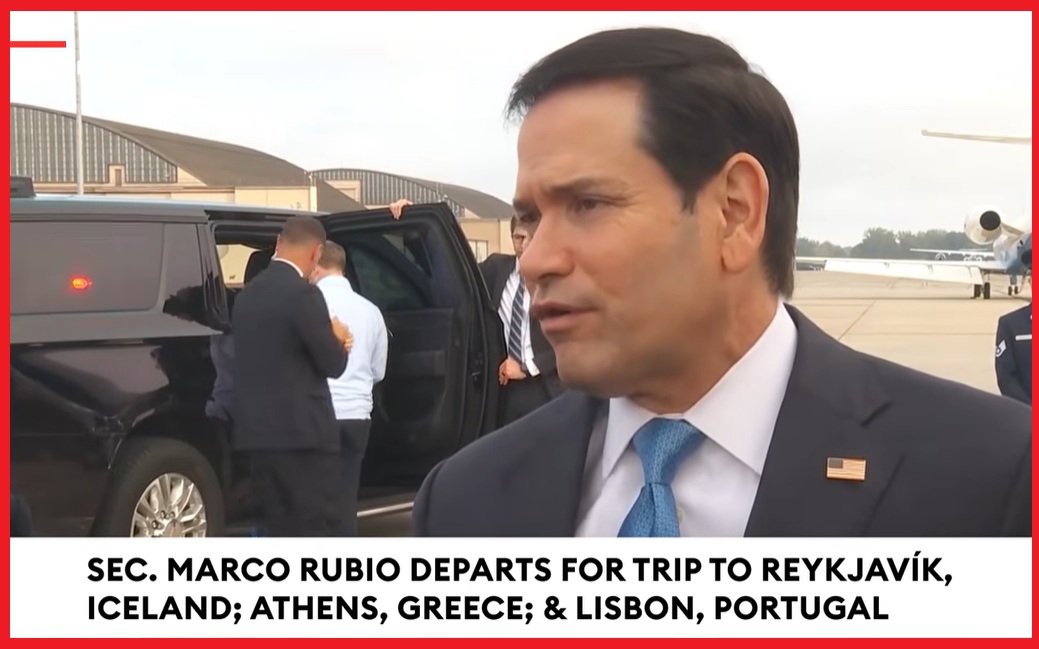
Secretary of State Marco Rubio sat down with Fox News Lara Trump for an extensive discussion on his role and responsibilities in the Trump administration.
In the second segment, Rubio actually touched on something many have been curious about regarding his changed perspectives and positions. It is still annoying that no one has ever asked him directly, ‘why have your views changed so dramatically in the past two years, and/or are you just playing a role.‘
The two video segments and transcript are below:
[Transcript] – QUESTION: Secretary, great to have you back. Thank you so much.
SECRETARY RUBIO: Glad to be back. It’s been a while.
QUESTION: Yeah. There’s so much to talk about, but I want to start with Cuba.
SECRETARY RUBIO: Yeah.
QUESTION: This has been of particular interest to the State Department right now. You guys released a 100-page report on Cuba, calling it, “The Capital of 21st Century Communism.” And this report talks about the fact that Cuba’s goal essentially is to erase the United States from the Earth. It also details a Cuban spy network that’s been undermining American interests. How did we get to a place where Cuba has become so much of a threat – it feels like again – to the United States?
SECRETARY RUBIO: I think for those who have followed the issue of Cuba, this is not unfamiliar to us. But to the average American, you see Cuba, a small country 90 miles off our shores, nine and a half million people population. But people forget that when it comes to things like espionage and influence operations, they actually are an influence and espionage superpower. If you look at the history of espionage in the United States, Cuba is the only country that consistently has implanted and embedded spies in our system without even paying them.
We had an ambassador, a U.S. ambassador, who ended up being a Cuban spy and was recently convicted. We’ve had them penetrate the highest levels of the Defense Intelligence Agency. Ana Belén Montes was one of the single biggest intelligence failures on the part of the United States and one of the biggest penetrations we ever had in our system.
So – and then on the influence front, if you look all throughout Latin America, every communist left-wing insurgency that’s destabilized governments across the region, every single one of them over the last 40, 50 years has found its support, its help, in many cases its birth, from a Cuban influence operation. So, it was an important report just to highlight the role they play in our country, a very negative role.
QUESTION: The report also links Cuban influence to the rise in Antifa, the riots that we saw in 2020, as well as the surge of radical activism that we’ve seen all over these college campuses. To the average person, those things, I think, feel generally organic, but it turns out there are a lot of different powers – Cuba being one of them – that are influencing all of these things day to day.
SECRETARY RUBIO: It’s the same network of protesters around the country. They were the same people you saw on the streets burning things in 2020. They then flip it around and they become the pro-Hamas protesters, then they flip it around and within 48 hours of Maduro’s arrest have preprinted signs outside the courthouse demanding his release. And then they’re out there doing the ICE stuff, attacking ICE agents.
There’s nothing organic about it. It is funded, it is organized, and Cuba is a part of that network, and in some cases a critical part of that network. And it’s a network they will weaponize against us, and they talk about it openly, about how they will use that network to pressure American policymakers – not just here in the United States, like Code Pink, but all over the world.
QUESTION: Critics of this report, of course, are saying, oh, well, these are scare tactics to potentially justify some U.S. military action against Cuba. It sounds like this is something we should take seriously, and this report sounds very real.
SECRETARY RUBIO: Everything in there is factual. And frankly, I don’t think they can dispute it. People can argue that we shouldn’t do with it, and I know there are plenty of people in American academia – and frankly in American press – that sympathize with the Cuban regime and have for a very long time. Part of it is motivated by their anti-Americanism, and part of it is motivated by ideological affinity. There are plenty – there are enough people in key nodes of our society, including professors, but frankly, in the past we’ve seen people within our own government, that sympathize with the Cuban regime. It’s the way they get spies without paying them. But it doesn’t mean we can ignore this threat.
Put aside for a moment my history, the fact that I’m Cuban American, the fact that I grew up in Miami. This is 90 miles from our shores. A failed state 90 miles from our shores that happens to be aligned with adversaries to the United States is a national security threat to our country.
QUESTION: I want to move quickly to Venezuela. The interim government and opposition leaders there are taking steps towards a possible future with democratic elections. What role is the United States currently playing, and what can you tell us about Venezuela?
SECRETARY RUBIO: Well, the first thing about Venezuela is I know we’re not in the era of patience and persistence, but these things take time. You’re dealing with a system that’s been in place for over a quarter-century, so those are deep roots that you have to deal with. It’s also a country that faces a lot of problems, I mean a lot of economic problems, not to mention now they’ve had an earthquake.
So, that’s why we’ve always talked about phase one, where our priority was stabilization. We didn’t want the country devolving into civil war, mass migration, civil unrest, and so forth. Step two is a recovery phase, which I think we’re into. Obviously, the earthquake adds complexity to it. You’ve got to have a functioning economy. You need to have laws and rules and regulations in place so that investors from America and around the world can go in and safely invest and create prosperity.
Ultimately, you have to have transition. At some point in time there has to be legitimate elections at every level so that people know that the government that’s there is a legitimate government chosen by their people. Step one towards that is a national reconciliation. This is a people that have been divided politically for a very long time against each other, and you’re going to have to look at models like what you saw happen in Eastern Europe after the fall of the Soviet Union. I think the role the U.S. Government can continue to play is as a facilitator of all of this.
QUESTION: You’ve been outspoken for many years about the threat from China. President Xi, of course, is going to come visit here in Washington, D.C., in September. You’ve had to sit across the table, though, from China’s foreign minister. You’ve had to negotiate and talk on America’s behalf. How have you found, in this role, negotiating with Beijing?
SECRETARY RUBIO: On the one hand, all the things that China wants to become the most powerful country in the world, and they want to do so at our expense. Obviously, we are Americans; we’re not going to allow that to happen.
At the same time, they are the two most powerful economies in the world, probably the two most powerful militaries in the world, though ours is further along than theirs, but nonetheless. And I think it’s important for two big countries like this, the two most powerful countries in the world, have to have a relationship, have to have the ability to speak to one another and try to deconflict where possible, because it could lead to some really bad things. The foundation of that is the relationship that President Trump has with President Xi, which is a relationship of mutual respect and they get along. And that really is important that our two presidents can speak to one another, and it’s okay. I think it’s almost irresponsible, by the way, to not have direct communications with the Chinese.
We want stability in our relationship. Both sides, I think, recognize that there are areas where we’re not going to agree, and including areas where we’re going to have to compete. Now, there are areas we can work together on. That’s phenomenal, fantastic for the world. But I think there’s going to be a lot of areas of friction and competition, and we have to manage that at the same time as we have to have a relationship with them, but we always have to look out for what’s best for America.
QUESTION: Well, it seems like China has been on their best behavior knowing that President Trump is in the White House, but a lot of people believe that they may just be biding their time in terms of possibly taking over Taiwan. What do you say to that?
SECRETARY RUBIO: Well, I can’t speak 20 or 30 years from now. I can say that our position is we support – we don’t support any change to the current status quo that exists there right now. We would be against any sort of compelled or coerced change in status. That point was made very clear in our meetings with the Chinese. Obviously, they have a very different point of view; it’s a very sensitive issue for them.
So, again, it’s part of that delicate balancing act. Because look, any conflict between the U.S. and China, be it economic or be it military, God forbid, would be catastrophic for both countries and for the world. So, we have to manage that, but we can’t walk away or forfeit our national interests. So, this is the hard work of foreign policy, and it requires every administration to sort of balance these two competing tugs against us.
QUESTION: Well, we hear a lot about tensions with China. We hear a lot about tensions with Russia, with Iran daily. I think Americans probably at some point get very overwhelmed because, unfortunately, the good stuff doesn’t make it out there often enough. What would you say, though, about the stability of the world right now given you’re in your position and the President is who he is?
SECRETARY RUBIO: I think the world has always been complicated and tricky. I think the difference now is if something happens halfway around the world in a place you’ve never heard about before, and it’s really dramatic, you’re going to hear about it almost instantaneously.
I think the world is also going through a period of rapid transformation. I mean, there is clearly a geopolitical reordering that is occurring, and I’ve talked about this repeatedly. We are – after the end of the Cold War, everybody thought the whole world was just going to become free-enterprise democracies and everyone would get along and nation-states would no longer matter. And unfortunately, we made decisions in our foreign policy on that ridiculous basis that actually caused us to hurt our country. We started saying things like we don’t care where things are made, let it be made in another country as long as it’s cheaper prices for America. And it ended up deindustrializing our country and costing us millions of jobs.
So, what you see President Trump doing now is rebalancing those things on the economy using tariffs, on geopolitics using our presence in the world, especially in the Western Hemisphere, our own area neighborhood that we live in.
And then of course there are legacy threats like the Iranian threat of a nuclear program, which can never happen. The President’s been very clear about that. So, you have all the old threats plus the emerging new ones, and they’re all happening at the same time, and they’re happening faster than they ever have before. And it’ll be the work of this administration, but it’ll be the work of future administrations. Some of these things are going to take decades to work themselves out.
(Break.)
QUESTION: And we’re back with more of our exclusive sit-down with Secretary of State Marco Rubio as the ongoing conflict in Iran remains top of mind for the American people.
SECRETARY RUBIO: I don’t think the Iranian regime has ever faced a president like President Trump, which is someone that actually takes action. They got used to for 20 or 30 years not just the U.S. but the broader world allowing them to get away with things like lying, breaking deals, tricking people into agreements, and so forth.
In this particular case, it was pretty straightforward. Iran wants a nuclear weapon, and they were building a conventional missile shield that they were going to hide behind. In essence, they wanted to be in a position a year and a half from now to be able to say: We have so many drones and so many missiles, you can’t possibly defend against them.
That’s the place they wanted to get to. President Trump said we’re not – I’m not going to let you get to that place, and he went after – wiped out their navy, wiped out their air force, wiped out their missile defenses, wiped out their launchers, wiped out their factories that make all of these things, and severely degraded their defense capabilities.
Now, they still have missiles and they still have drones and they can still do damage, but they no longer have that shield, that conventional shield that they could hide behind, and that’s changed the whole dynamic. It’s the only reason why they are now willing and in some cases seem eager to do a deal on denuclearization, to do a deal on the straits. Because we’re now approaching them from a position of strength, not from a position of weakness, which is what they perceived from previous administrations and, frankly, from the world writ large.
QUESTION: The regime change has never been the goal, though. As you say, it has been denuclearization. Can you have one without the other, though?
SECRETARY RUBIO: I think what does – the regime has to change. You might not have a regime change, but the regime has to change. The Iranian regime traditionally has been expeditionary. In essence, their view is they don’t want to just govern Iran; they want to govern the region. They view them – they want to export the revolution. That does have to change, and the only way you’re going to change that is if you make the price of it too high for them to be able to pay.
QUESTION: The fact that so many of these Gulf Arab nations have all kind of aligned against Iran, that must be important.
SECRETARY RUBIO: I would say two things about the Middle East and the Gulf – I mean, they’ve always understood who Iran was and the threat they posed. That threat has now become reality. They have now seen Iranian drones and Iranian missiles launched into their cities and against their energy infrastructure.
The other thing that’s changed is I think you’re going to see more and more energy diversifying outside of the Straits of Hormuz, because from a geographic standpoint Iran will always be on the straits, whether they’re governed by this regime or a future government. But that’s going to be two permanent features that are going to emerge from this: You’re going to see the realignment in how energy flows, less reliant on the Straits of Hormuz; and you’re going to countries in the region that are no longer – now understand that Iran is no longer a theoretical threat. As long as this clerical regime remains in place, they are a real threat and a direct threat to their – not just to their economic interests but their security interests.
QUESTION: Well, President Trump says he is going to confront Valdimir Putin regarding reports that Russia helped Iran target U.S. bases. How much does that relationship concern you?
SECRETARY RUBIO: With Russia?
QUESTION: Between Russia and Iran.
SECRETARY RUBIO: Look, unfortunately, I think you’ll find in the world that there are countries, or at least companies within countries, that work with adversaries of ours. And when we identify it, we raise it, and in some cases very successfully.
Nothing we have wanted to do in the Middle East – none of the actions we’ve taken, none of our successes – have in any way been impeded by anything that any other country in the world did against us. There are things that might be irritants, there are things that might be concerning, but there is nothing any other country is doing that in any way is standing in the way of us achieving the things we want to achieve or the objectives we want.
QUESTION: Just to finish with the situation in Russia and Ukraine, is there anything at this point that the U.S. can realistically do to help bring talks together, bring this to an end?
SECRETARY RUBIO: The President has made very clear if United States can play a role in bringing about an end to that war, we’re going to continue to explore it. We spent a lot of time on it in the first year. There came a point where it got to, like, stalemate, but we always stood willing and ready to play a constructive role.
We’re the only country in the world, and President Trump’s the only leader in the world, that can bring the Russian side and the Ukrainian side to begin to talk about how you end it. The reality is that dynamics have changed just a little bit in that conflict over the last few months. The Ukrainians now are able to conduct long-range strikes deep into Russia, bringing the war toward – to the Russian people.
What we are willing to explore is whether that new dynamic has in any way opened the door to some negotiated settlement. I know there’s going to be – you’re going to see some efforts over the next few weeks to see if we can’t restart talks between the two sides and bring this war to an end. But we also understand that both sides have some pretty strong red lines; and until we can bring those red lines a little closer together, we’re not going to be there yet. But we’re ready to go, and the President’s told his team if you see an opportunity to be a force that brings about some momentum behind peace talks, let’s do it. So, he always prefers diplomacy over war and peace over combat.
QUESTION: Americans have seen so many versions of you, I think. We know Senator Rubio, we know candidate Rubio, now Secretary Rubio. Have you changed throughout the course of all of these different kind of phases of your life? And how do you think the American people’s perception of you has changed? Because you are memes everywhere – I think everybody loves to see all the different sides of you.
SECRETARY RUBIO: Yeah, well, the meme thing, it was interesting because when it first came out, I hated that picture. (Laughter.) Because what happened is in that couch, if you don’t have a pillow behind your back, you kind of sink. So, I looked at the picture; I said, oh, this is terrible, I looked like whatever. And then it turned into this other thing. And it was fine, and it’s funny. I don’t really follow it very closely, but people have shown me pictures out there. We have a good friend here that works at the White House, Dan Scavino, made a nice board for me. (Laughter.) And even since he made that board, we had to update it, so – of all the different pictures. So that stuff is funny.
You asked me if you’ve changed. I think everybody – you go through life, right? And as you go through life you learn new things, you see things you hadn’t seen before, you hear things you haven’t heard before. Certainly, I am a different person at 55 than I was at 25 or even 35 because I have 20 and 30 years of experience in between – in life and in work – that inform that.
I think at your core you always want to remain the same person, though, right? And that is what are your priorities in life and what are the values that sort of drive you to do what you do, and I hope that hasn’t changed. And by the way, the world changes too. There are things that are true today that weren’t true 10 years ago. So, I think that – that’s true for all of us, not just me.
QUESTION: I feel like you’ve been busier than ever. You’ve been traveling all over the place. But you’re doing all of that while being a husband, while being a father. Maybe talk about how that is, because I know for every kind of working parent out there, working spouse, it’s hard to take time, but I am sure your family keeps you very active.
SECRETARY RUBIO: Yeah, it is, and I’m in an interesting season in life. For most of my time in public service, I had very young children or children that were still growing up. Now all four of my children are adults. My youngest graduated high school this year. I have a 26-year-old, a 24-year-old, a 21-year-old, and an 18-year-old. So, they have lives. They don’t just have – when you’re 15 or 16, you have opinions. When you get to 20, 24, 26, you have lives and you have stuff going on. I still look back at the time that they were young and wish I could have one more day with them when they were little, but you also appreciate the moment you live in.
And then as far as being a husband, I think what’s happened is, because your kids are a little older and they have more time doing their own things, whether their school or their career, you spend more time with your – you almost, like, get back to where you were when you first started dating in some ways. So, you get to spend more time with my wife and sort of rediscover. So, it’s the second phase of that relationship, I guess, after all these years.
So it’s an interesting season in life that I think we’re – mixing with what we’re doing here now – and find it pretty fulfilling and pretty happy.
QUESTION: Well, when you go home, I’m curious: What is the first thing you do when Marco Rubio gets home? Do you sleep? What happens?
SECRETARY RUBIO: (Laughter.) No, not when I get home. I don’t go right to sleep. Of course not. Usually, I mean, if you can – you really can’t in this job, and you certainly can’t working for this administration and this President, who never stops working, but I think it is good to try to disconnect for some period of time from your job or from your work. It could be watching a sporting event, it could be watching a movie, just anything that allows you to sort of disconnect and play the reset button.
It’s harder – it was a lot easier to do that when you’re a senator. It’s much harder when you’re in this role and in this job, because the world isn’t going to stop and wait for you. Like, you may want – you may have made a plan tonight to watch a movie, but in the middle of that movie something blows up somewhere in the world, and you’ve got to know about it and you may have to do something about it. So, it’s harder, but it’s not forever, and it’s fulfilling to be in that role.
QUESTION: So, if you could get a full week off without having anyone access you, what would you do?
SECRETARY RUBIO: If I had a full week off, I’d be wondering what was going on. I’m being honest, and maybe that’ll change when I’m out of this job. But if I could – like, if I could make the world stop for a minute and have nothing going on, I’d love to –
QUESTION: Yeah, (inaudible).
SECRETARY RUBIO: Well, my wife’s going to hate this answer, but I’d love to sit down and, like, watch, like, every college football game starting at noon Eastern until one – when the West Coast games end at 2:00 a.m. our time Eastern. I’d love to be able to do that at least one weekend. I doubt I’ll be able to do that anytime soon.
QUESTION: Okay. Final question: Is this going to be the Miami Dolphins season? What do we think?
SECRETARY RUBIO: No.
QUESTION: (Laughter.)
SECRETARY RUBIO: No, they’re in massive rebuilding mode, but I think the needle is pointing in the right direction, but they need a couple years to rebuild that roster.
QUESTION: Okay. We’re always looking to future seasons.
SECRETARY RUBIO: Yeah, that’s right.
QUESTION: Well, Secretary Marco Rubio, you are great.
SECRETARY RUBIO: Thank you.
QUESTION: Thanks for all you do for our country, and thank you so much for your time.
Posted originally on CTH on August 2, 2026 | Sundance
CNN propagandist Dana Bash had a full mask down episode today while trying to deny the truth about COVID-19 (all aspects) and defend Anthony Fauci (who she frequently text with according to Fauci’s diary).
HHS Secretary Robert F Kennedy Jr was not going to allow CNN to fraudulently present nonsense claims under the guise of “settled science,” and he pushed back hard against her claims. At one point Bash notes she didn’t want to litigate the COVID-19 outcomes and RFK Jr appropriately pushed back saying the experiences need to be relitigated because Americans were censored, shut down, lied to and had liberty destroyed by a political health system devoid from science.
Things became even more heated as Bash was staring at the multi-page talking points prepared for her by corporate advertisers and Kennedy was systematically destroying them. Bash doubled, tripled and quadrupled down with the manipulative and combative questioning, ultimately removing any facade of journalism in the process. WATCH:
Posted originally on CTH on August 1, 2026 | Sundance
From independent reporting on the ground, CTH has established an upscale Italian dining restaurant in Moscow, Balzi Rossi, was hosting a private dining event (at least in most of the facility) when a female Ukrainian terrorist attempted to gain entry carrying a bomb.
The woman terrorist was intercepted by a security member and denied entry to the facility; however, during the stop the woman detonated the IED which was filled with nails and ball bearings. The bomber and the security guard were killed instantly as well as one of the people attending the venue.
Dozens more people were injured by the shrapnel, nails and ball bearings. The security guard is being heralded as a hero for stopping what would have been a much more deadly attack. Reports are now beginning to surface on western media outlets.
MOSCOW – A bomb detonated at a restaurant Saturday in central Moscow killing at least three people, including the bomber, Russian state media said, citing local officials.
At least 21 people were also injured when the explosive device detonated at the restaurant on Kudrinskaya Square in Moscow, the National Anti-Terrorism Committee said, quoted by Russian state news agency RIA Novosti.
An unidentified woman who attempted to carry the explosive device into the restaurant died in the blast as did a security guard and a patron, the news agency said.
Ria Novosti reported the woman attempted to smuggle the bomb into the establishment but the security guard refused to let her in before the bomb exploded.
The attack was still being investigated, the Moscow Investigative Committee told the news agency. (more)
Ukraine has been using female terrorists to carry bombs targeting Russians for several years. However, the target of this specific bombing in Moscow is not yet identified.
In April 2023, a Ukraine woman carried a bomb into a café in Saint Petersburg, Russia, killing military blogger Vladlen Tatarsky. More recently on June 29th in Monaco Ukrainian terrorist Anastasiia Berezovska, working for Ukraine intelligence, used a parcel bomb to target Vadym Iermolaiev.
I have created this site to help people have fun in the kitchen. I write about enjoying life both in and out of my kitchen. Life is short! Make the most of it and enjoy!
This is a library of News Events not reported by the Main Stream Media documenting & connecting the dots on How the Obama Marxist Liberal agenda is destroying America