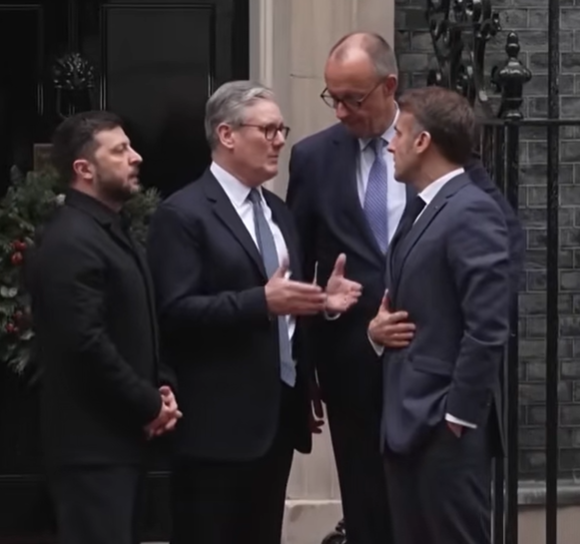
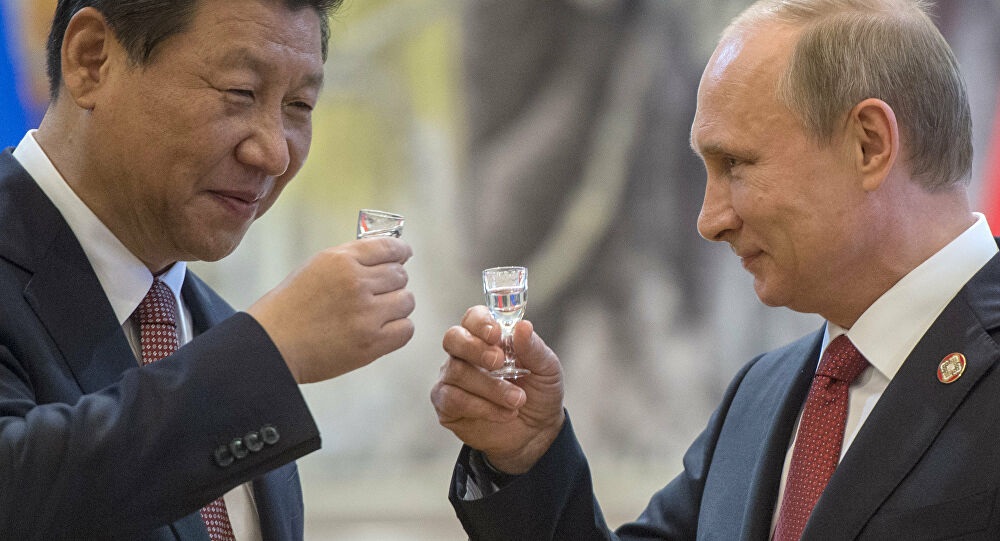
President Trump Responds to the 91-Drone Attack on Putin’s Residence in Novgorod region


Posted originally on CTH on December 30, 2025 | Sundance

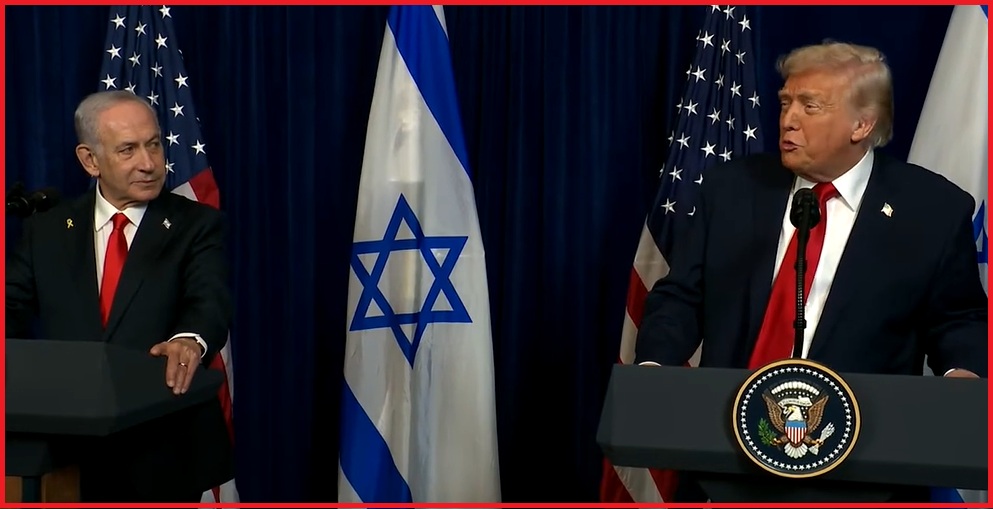
During an impromptu press availability beside Israeli Prime Minister Benjamin Netanyahu, President Trump responded to a question about a drone attack against the personal residence of Russian President Vladimir Putin.

President Trump noted that he was informed of the attack by President Putin during an early Monday phone call between the two leaders.

According to Russian media, confirmed by Russian foreign Minister Sergey Lavrov, Putin’s presidential residence in the Novgorod region, more than 400 kilometers (249 miles) northwest of Moscow, was targeted by 91 drones. Russia has vowed retaliation saying, “targets had already been selected.” President Trump’s response is prompted below:

Ukraine President Volodymyr Zelenskyy has denied the accusation that Ukraine carried out this particular attack.  The attack took place while Zelenskyy was in Florida meeting with President Trump.

In context, there have been several attacks against Russia timed with negotiations.  CTH has noted that each instance of closer agreement during Russia/Ukraine negotiations (Turkey) or U.S/Ukraine negotiations (Turkey and Paris) there have been attacks into Russia that seemed to carry a motive from an external third party.

U.S. media have said the attack on Putin may be a lie; however, with physical evidence from the defense operation, it is less likely Russia just made up the attack.  At this moment in the conflict, Putin doesn’t need domestic propaganda.

CONTEXT: British intelligence previously confirmed their participation in the successful Ukraine drone attack against long-range Russian bombers.  That operation, highly controversial at the time, was previously confirmed by President Trump saying the U.S. was not informed in advance.

The “coalition of the willing” has also expanded.  Outside the Ukraine regime, the current group making up the “coalition of the willing” includes: the U.K, France, Germany, Canada and Australia.  It is worth noting the additions are all part of the British commonwealth (U.K, Canada, Australia).

Most observers note that Ukraine President Zelenskyy is not an independent actor in the warfare decisions as carried out from within Ukraine itself. In fact, British intelligence has now replaced U.S. intelligence for providing the majority of the satellite guidance systems, targeted systems and missile operations.  German and French intelligence have been closely coordinating with the U.K. on behalf of European Union stakeholders.
Europe, specifically the British MI6 intelligence service, have recently espoused their #1 priority is to defeat Russia using the proxy that Ukraine provides.

So, with full context applied it is entirely likely that both Vladimir Putin and Volodymyr Zelenskyy are not lying.

The most likely scenario is that U.K elements inside Ukraine again used the opportunity of the Trump-Zelenskyy negotiation meeting to carry out the attack against Russian President Putin.  The motive is obvious.

Beyond the ideological component, the economies of the U.K/EU are now increasingly dependent on their defense spending as was recognized yesterday with the severe contraction of the German economy in almost all sectors except those supported by defense spending.

An end to the Russia/Ukraine conflict is against the interests of the “coalition of the willing.”   Additionally, an ancillary motive for the U.S. group who support the EU effort is to keep President Trump bogged down.

(Bloomberg) — President Donald Trump’s campaign to end the war in Ukraine faced new complications on Monday when Vladimir Putin said he would revise his country’s negotiating position after the Russian leader claimed Ukrainian drones targeted his residence.

Putin told Trump of his decision in a call Monday, according to the Kremlin, even as Kyiv cast the Russian allegations as a fabrication aimed at derailing the peace process.

Trump addressed the dispute while speaking to reporters in Florida, saying that Putin had told him about the purported attack during their discussion. The US president, seeming to side with Putin, said he was “very angry.”

“It’s one thing to be offensive, because they’re offensive,” Trump told reporters in Florida. “It’s another thing to attack his house. It’s not the right time to do any of that.”

Ukrainian President Volodymyr Zelenskiy has dismissed the Russian claims as a “new lie” and warned that Moscow could be using it as an excuse to prepare an attack on government buildings in Kyiv.

Putin said Moscow intends to work closely with the US on peace efforts but would reconsider a number of previously reached agreements, Kremlin aide Yuri Ushakov told Russian newswires. Ushakov added that Putin assured Trump that Moscow would look to continue working with American partners to achieve peace and that the two leaders agreed to maintain their dialogue. (more)

I suspect the British did it.
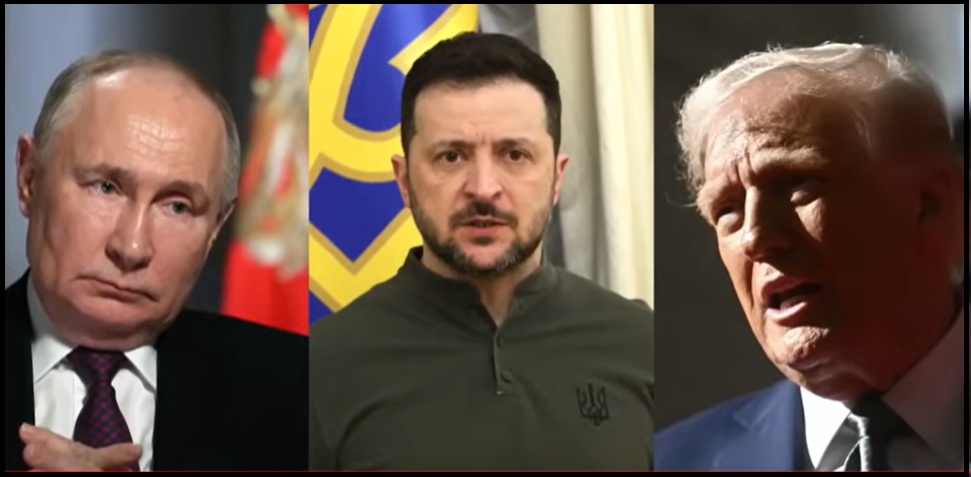
Nervous Netanyahu and President Trump Hold Press Availability: …”If you don’t have Trump”…


Posted originally on CTH on December 29, 2025 | Sundance

The sense you get from reviewing the interactions is that Israeli Prime Minister Benjamin Netanyahu is nervous in his need to maintain very close support from U.S. President Donald Trump.  When we review the interaction, we see Netanyahu’s praise of President Trump through a prism of tenuous dependency.

Netanyahu needs to retain a close and favorable position of influence; yet there is something in the engagement that seems to indicate an unease, a nervousness visible within the Prime Minister of Israel.

The moment at 10:48 is important, “Someone said in the room: if you don’t have Trump“… and the U.S. President strategically decided to let that thought trail off without finishing.  However, in context it was very clear what would have come next if Trump didn’t restrain himself.  “Someone said in the room: if you don’t have Trump”… you don’t have Netanyahu, was likely the end of that thought, and Trump isn’t wrong.  Benjamin Netanyahu’s body language, facial expressions and overall demeanor imply agreement.

Bibi knows the unspoken words are accurate, so does everyone who supports Bibi – especially those pro-Israel voices inside the USA.  Also, within that geopolitical dynamic, you will find President Trump’s leverage and an understanding of the behavior for those who support Netanyahu’s government.  WATCH:

The non-pretending review of Netanyahu’s purpose for the visit, is to get additional support from President Trump for more military action against Iran.  President Trump knows the intents and motives behind the shaped information from Netanyahu, the Israeli government and U.S. donors and voices.

President Trump emphasized strongly how the Arab coalition supports the elimination of Hamas as a terrorist threat, not just the United States.  This emphasis on retaining the original peace agreement continues to pull the narrative away from the U.S. having to give support to ongoing Israel military action in Gaza.   “If Hamas doesn’t disarm voluntarily” the Arab countries will disarm them President Trump suggested.

Benjamin Netanyahu is not going to be able to pull the Trump administration into military engagement in Iran.  That part is clear from the tone and presentation of Netanyahu as well as the space between the words of Trump.

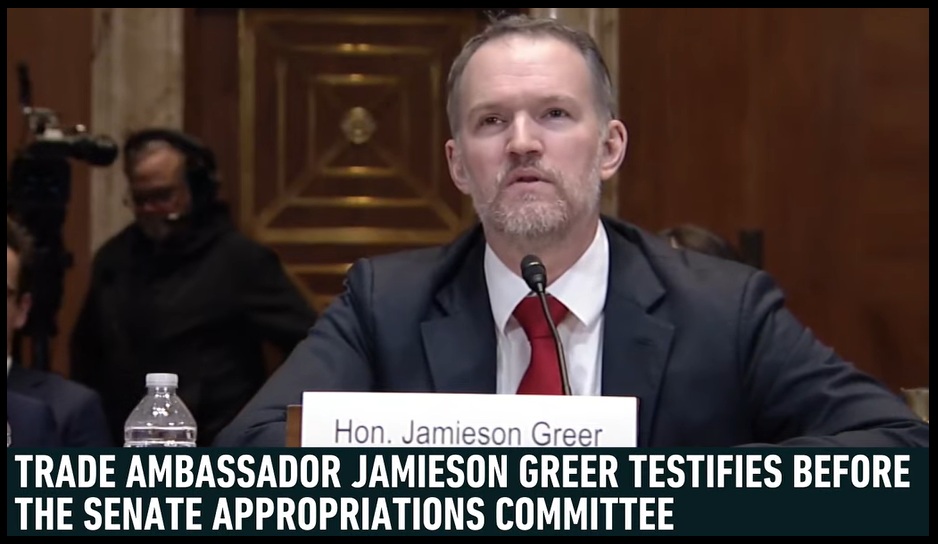
U.S. Trade Representative Jamieson Greer Gives Strong Recap of President Trump Trade Policy


Posted originally CTH on December 29, 2025 | Sundance

Outlining why there literally is not enough time for a lengthy dual-track legislative trade policy to be constructed, Ambassador Jamieson Greer gives a great encapsulation of the urgency behind the trade policies, tariffs and negotiations between the U.S. and trade partners.

If President Donald Trump did not win in 2024, another four years of parasitic trade policy would have crossed the Rubicon of U.S. manufacturing recovery.   The urgently applied tariff strategy gave the administration breathing room to reestablish domestic economic growth.  USTR Greer and President Trump are now fine-tuning the tariffs country by country, sector by sector, to achieve ultimate economic benefit.  WATCH:

.

Memos of Conversations Between George W. Bush and President Vladimir Putin Are Released


BUMPED Due to Importance:

Posted originally on CTH on December 29, 2025 | Sundance |

Following a series of FOIA lawsuits, memos from conversations between Russian Federation President Vladimir Putin and former US President George W. Bush have been released online by the National Security Archive. [Original Source Here]

I know it’s Christmas, but bookmark or review as time allows, because the content is very interesting and very important. As early as 2001 and 2008, President Putin clearly told President Bush of his opposition to Ukraine’s accession to NATO, along with other key positions.

Despite what popular media might say, these are NOT full transcripts. Rather, they are memos containing quotes from both leaders as they discuss geopolitical relations between the U.S. and Russia. [SOURCE HERE]

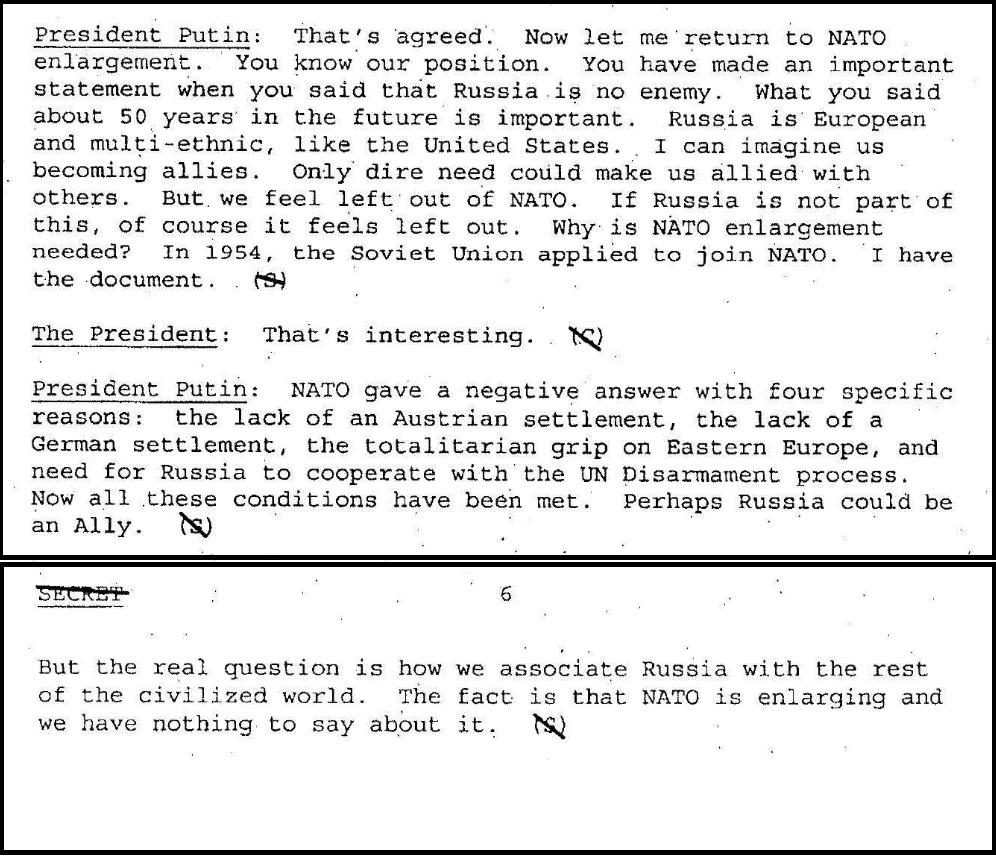
♦ June 16, 2001 – Memorandum of Conversation. Subject: Restricted Meeting with Russian President Vladimir Putin. [LINK HERE] In this first personal meeting at the Brno Castle in Slovenia Vladimir Putin and George W. Bush express respect for each other and desire to establish a close relationship. Putin tells Bush about his religious beliefs and the story of his cross that survived a fire at his dacha. In a short one-on-one meeting they cover all the most important issues of U.S.-Russian relations such as strategic stability, ABM treaty, nonproliferation, Iran, North Korea and NATO expansion. Bush tells his Russian counterpart that he believes Russia is part of the West and not an enemy, but raises a question about Putin’s treatment of a free press and military actions in Chechnya. Putin raises a question of Russian NATO membership and says Russia feels “left out.” [READ MEMO HERE]

♦ September 16, 2005: Document 2 – Memorandum of Conversation. Subject: Vladimir Putin, President of the Russian Federation: [LINK HERE] Putin meets the U.S. President in the Oval Office for a plenary that covers mainly issues of nonproliferation and U.S.-Russian cooperation on Iran and North Korea. The conversation shows impressively close positions on Iran and North Korea, with Putin presenting himself as an eager and supportive partner. Bush tells Putin “we don’t need a lot of religious nuts with nuclear weapons” referring to Iran. Putin said that Ukraine’s accession to NATO would, in the long term, create a field of conflict between Russia and the United States, adding that internal divisions within Ukraine could lead to its fragmentation. [READ MEMO HERE]

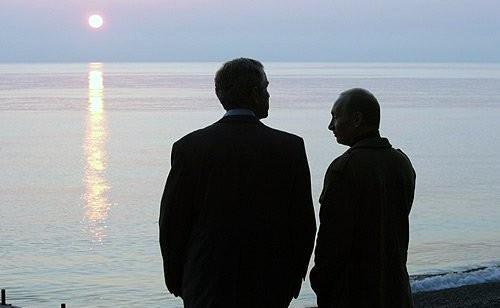
♦ April 6, 2008 – Document 3: Memorandum of Conversation. Subject: Meeting with President of Russia [LINK HERE] This is the last meeting between Putin and Bush, taking place at Putin’s residence in Bocharov Ruchei in Sochi on the Black Sea. The tone is strikingly different from the early conversations, where both presidents pledged cooperation on all issues and expressed commitment to strong personal relationship. This meeting takes place right after the NATO summit in Bucharest where tensions flared about the U.S. campaign for an invitation to Georgia and Ukraine to join NATO. Turning to conversations in Bucharest, Putin states his strong opposition to NATO membership for Ukraine and Georgia and says that Russia would be relying on anti-NATO forces in Ukraine and “creating problems” in Ukraine “all the time,” because it is concerned about “threat of military bases and new military systems being deployed in the proximity of Russia.” Surprisingly, in response, Bush expresses his admiration for the Russian president’s ability to present his case: “One of the things I admire about you is you weren’t afraid to say it to NATO. That’s very admirable. People listened carefully and had no doubt about your position. It was a good performance.” [READ MEMO HERE]

2001 –  Putin raises a question of Russian NATO membership and says Russia feels “left out.”

As noted by The Islander (Via Twitter) –  “The 2001 Memo That Should Have Ended the Cold War 2.0 and Instead Helped Write the Preface to Ukraine. There are documents that don’t merely record history, they expose it. This is one of them.

June 2001. A “restricted meeting” between President George W. Bush and President Vladimir Putin. Not a podium performance, not a television soundbite, not a speech crafted for domestic applause. A private conversation, the place where empires are supposed to speak plainly, where leaders test ideas that could reroute decades.

And what does the memo show?

Putin raises the idea that Russia could eventually join NATO. He says Russia feels “left out” by NATO enlargement. He points to an older fact most Western publics were never meant to internalize: the Soviet Union applied to join NATO in 1954. He argues the reasons for rejection no longer apply. He suggests, almost clinically, that perhaps Russia could be an ally — “European and multi-ethnic,” comparable in character to the United States.

Read that again slowly.

Because the propaganda version you’ve been fed for years requires amnesia: it requires you to believe Russia woke up one morning and decided to be “a threat,” as if geopolitics is a mood swing and security architecture is irrelevant.

But here is the declassified record: Russia was probing for an exit ramp. A pathway into a shared system. A new security architecture. A post–Cold War settlement that could have turned the 1990s from a hollow victory lap into a durable peace.

And it didn’t happen.

Not because it was impossible. Not because Russia “never wanted it.” Not because “the West tried everything.”

It didn’t happen because NATO, as an institution, does not know how to live without a frontier. It does not know how to justify itself without an adversary. It does not know how to maintain internal cohesion without a map that points east and says: there.

The 1954 Ghost: the offer the West never wanted to remember

The most important part of this memo is not the 2001 line, but the 1954 reference.

Because it collapses the morality play.

If the Soviet Union, a state the West defined as the existential enemy, floated the notion of joining NATO in 1954, that means something profound: the idea of Russia being inside the European security architecture is not a “Putin-era trick.” It is a recurring historical proposal, returning whenever Moscow believes there may be a rational way to avoid permanent confrontation.

And what happened then? It was refused.

Which is exactly the point: NATO was never simply a “defensive alliance.” Even in 1954, It was a structure. A protection racket. A way to organize Europe under an American strategic roof and to keep it there. If Russia enters that roof as an equal, the architecture changes. Budgets decrease, with less money for the MIC. Threat perceptions change. The entire postwar hierarchy changes.

So the West did what empires do when presented with a peace that would reduce their leverage:

It smiled, took notes, and kept moving.

“Join NATO” was never a plea, it was a test.

Some people still misunderstand the early Putin posture. They interpret it as naivete, or worse, submission.

Wrong.

This was not Russia begging to be absorbed. The consistent theme in contemporaneous accounts is conditionality, that Russia could consider joining if treated as an equal partner, but not as a defeated province invited into the emperor’s club after proving it can submit.

That distinction matters.

Because it reveals the real incompatibility:
•Russia wanted a security system where it is a partner of European security, not an object to be managed.
•The Atlantic system wanted Russia as a managed periphery, permanently “integrating,” permanently reforming, permanently conceding, never truly sovereign in security decisions.

You can’t fuse those visions. One side must yield.

So the Atlantic system chose the only thing it has ever really chosen, expansion.”

A quarter century has passed since that original outreach by Russian Federation President Vladimir Putin in 2001.  It was rejected by President George W Bush and all presidents thereafter.  In 2025, we are in the phase of consequence.

This public release just happened on December 23, 2025.

Perhaps, just perhaps, this release can change the conversation in the United States.  Perhaps, just perhaps, President Trump, Secretary Rubio and Emissary Witkoff can reverse the course, and change the arc of history toward peace and a strategic alliance.

The timing of the release inspires hope, but the opposition to peace is extreme.

Half of Germany’s Manufacturing Sectors Anticipate Significant Layoffs and Job Losses in 2026


Posted originally on CTH on December 29, 2025 | Sundance 

In addition to being the main economic engine in Europe, Germany is the epicenter of the European Union’s overall goal to chase the green energy agenda.

For the past several years Germany has been deconstructing their fossil fuel energy production and replacing it with far more expensive alternatives.  This has led to large increases in overall energy prices, and downstream increases in manufacturing costs.

The consequences have been snowballing throughout 2025, while cheap competitive alternatives coming into the EU from China have compounded their problem.  Recently a survey of major industries was conducted in Germany to determine the forecast for 2026, the results are not good.

Approximately half of the industrial sectors in Germany are anticipating job losses, cuts or layoffs this year.

22 out of 46 business associations are preparing to downsize their labor force.  Only 9 of the 46 are expected to increase hiring.

At a top-line this looks bad.  However, when you look at the sectors contracting versus the sectors stable or expanding, you suddenly realize there is a bigger geopolitical problem within the forecast.

Job losses are expected in auto manufacturing, the textile sector, wood and paper fabrication.  Job gains are expected in aerospace, shipbuilding and defense production – i.e. the war machinery.

When the largest and most developed industrial economy in Europe is pinning its economic survival on war machinery, a particular momentum is created.  It is never a good outcome for Europe when Germany becomes reliant on war to maintain employment.

Unfortunately, that economic forecast does provide context to the German position for continued Ukraine/Russia conflict.  You might say that without a war, Germany could slip into a severe economic contraction; not good.

BERLIN, Dec 29 (Reuters) – A majority of German business associations expect job cuts in 2026 as the country’s economic crisis persists, with industry hit hardest by global protectionism and weak exports, a survey by the German Economic Institute IW showed on Monday.

Of 46 business associations surveyed, 22 anticipate workforce reductions next year. Only nine expect to increase hiring and 15 foresee stable employment levels.

[…] Some bright spots emerged in sectors benefiting from increased defense spending, including aerospace and shipbuilding. (read more)

We will keep watching with additional background context for the Ukraine/Russia negotiations.

Chloe Cole: Gender Dysphoria Is a Mental Illness, Not a Disability


Posted originally on Rumble on Bright Bart News Network on: December 28, 2025

Hawkins: Ending Filibuster Can Defund Planned Parenthood Permanently


Posted originally on Rumble on Bright Bart News Network on: December 28, 2025

Hawkins: 700,000 out of 1,000,000 Abortions Are Done with Chemical Pills


Posted originally on Rumble on Bright Bart News Network on: December 28, 2025

Blue States Are Sending Abortion Pills Into Red States


Posted originally on Rumble on Bright Bart News Network on: December 28, 2025

Cooke: Rent Is Coming Down as Illegals Are Leaving the U.S.


Posted originally on Rumble on Bright Bart News Network on: December 28, 2025