
The story of what it is like to be WIA
The night of 7 December 1967 was an eventful one for me because of what would happen over the next six hours. It all began at about 2100 hours when the VC/NVA launched another rocket and mortar attack against Bu Dop and the 1-28th infantry that was deployed adjacent to us on our north. While my normal alert position, when the CO was in camp, was in the commo bunker (a strongly protected bunker with all the radio equipment in it) we had received so many replacements over the past several weeks, due to casualties, that we had lost continuity. Therefore, I went with the new Heavy Weapons Sergeant, SFC Ernest O. Broom and another SF trooper, SP4 Gerry D. Schroeder (I can’t remember his specialty now) to their assigned post at the 4.2″ mortar position. Both had just arrived in camp and were unfamiliar with anything relating to Bu Dop operations and so it made no sense to send them out into a potential combat situation without help. Especially, as the 4.2″ mortar position was a key spot, since we used it to illuminate the area around Bu Dop so that we could see any enemy troop movement near the camp. I went there to show them where we fired the illumination rounds and also where the HE was to be fired, if required. The 4.2″ mortar couldn’t fire in close on attacking troops (for technical reasons beyond the scope of this story) but it could fire on suspected staging areas and routes of withdrawal and we used it extensively for this purpose.
Over the next several hours we continued to receive sporadic incoming mortar rounds from the Northeast; probably from somewhere near Ap Phuc Tien as in most of all the past mortar attacks, I don’t remember any rockets being fired at or hitting the camp. There was also some small arms fire but no signs of any kind of ground assault. It appeared that this time we were just being harassed or probed and not attacked as they had just recently done and been repulsed. As I remember it about 20 or 30 mortar rounds were fired at Bu Dop and the 1-28th infantry positions during the night, more to keep us from sleeping than to inflict major damage, I would guess. The 1-28th infantry was taking some casualties from shrapnel but I don’t think they had any KIA’s during this mortar bombardment. We fired counter mortar fire from our attached 105 mm Howitzer pieces (artillery) as did the 1-28th infantry but I don’t think any of us hit the VC/NVA mortar positions. They were probably just moving around firing a few rounds from one position and than a few rounds from another nearby position.
However, at about 0300 hours early in the morning of 8 December 1967 one of these incoming rounds landed either: near the 4.2″ pit sending hot shrapnel into the ammo bunker; or it landed directly on the ammo bunker itself penetrating it with flash or hot shrapnel (There was no way for me to know then or now). In either case it didn’t matter for it ignited the charges on the staged illumination rounds (on the back of mortar rounds are placed propellant charges “explosives” that fire when the round is dropped in the tube. That’s what propels the round to the target). Maybe even some of the illumination rounds themselves that we were getting ready to fire were set off. I do remember that there was a dull explosion and then several very intense waves of heat that went through the position igniting everything that could burn. Fortunately we had used up all the HE rounds that night and only a few illumination rounds were left unfired. If there had been any HE rounds in the pit and they had gone off when the incoming round hit they wouldn’t have found much if any of us. Just a few pieces and parts here and there scattered around the camp. For sure I wouldn’t be here writing this book now.
I had on a standard issue steel pot, a nylon flack vest, jungle fatigue pants and jungle boots, your basic standard uniform for combat in Vietnam. Because we were in camp I did not have on any web gear and I wasn’t carrying a side arm (45 caliber pistol). My CAR-15 was in the pit with me but I did not have it in my actual possession. Most of us didn’t wear socks or underwear to try and prevent getting fungus infections from the heat and moisture that was always present. The heat from the blast hit me from the right rear while I was talking on the PRC-25 radio. I remember being engulfed by the flames as the fire ball rolled past me in several intense waves (I could feel the pressure as they hit me) of heat hitting me on the back and right side. These blasts or waves of heat were extremely hot such that the intensity of them melted the nylon flak vest completely off me as well as instantly setting fire to my pants and jungle boots. I must have instinctively closed my eyes as the fireball engulfed me and then there were a few seconds where I don’t remember what happened. The blast either blew me out of the pit or I crawled out (I’m not sure which), the next thing I do remember a few seconds later was that I was laying on the ground just outside the pit and seeing that I was on fire.
My first action was to put out the flames that were still consuming what was left of my clothes and flack vest. That probably took 20 or 30 seconds and while I was doing that I also saw there was an intense fire still burning in the 4.2″ mortar pit. After I put out the flames with dirt I got up and saw that SFC Broom and SP4 Schroeder were down on the ground in the pit and still burning, I think they were both unconscious. They were behind me when the blast hit and so this was the first I saw of them after the fireballs rolled over us. I was in the process of climbing into the pit to help them when some of the other team members showed up. They stopped me and took care of the other two guys in the pit. I don’t remember which team members helped me (If ever any of them read this thanks for what you did) besides that being a long time ago I probably wasn’t in the best state of mind.
I knew I was injured and burned but I had no sense that I might be seriously or even mortally wounded. I was placed on a stretcher and I do remember getting a shot of morphine. A Dustoff was called (call name given for a MEDEVAC helicopter mission normally a Huey UH-1D) and by 0400 hours we were loaded in it and we left Bu Dop for the last time. It was still dark and as we left I could see the camp and 1-28th positions dropping away as the chopper rose into the dark night sky. Still, not realizing the extent of my injuries I was concerned over my team and that I needed to get back right away, they needed my experience. I was thinking that I’d be gone for a few days, get some rest and then join my team in a week or so. I was very wrong in this assessment of the situation.
When doing the research for this book one of the documents I was able to get from the National Archives was the 1st Division radio logbook for the period November 25, 1967 through December 8, 1967. When going through it to check the accuracy (dates and times) of what I was writing I found on two of the pages the references to my MEDEVAC. It wasn’t my name (names were not used in most cases) but it was the right date, time and place and I know it was me. It was a very eerie feeling reading about your own MEDEVAC and also knowing that later you would almost die from those wounds. It was almost like reading your own obituary, a very strange feeling indeed.
1st Division Log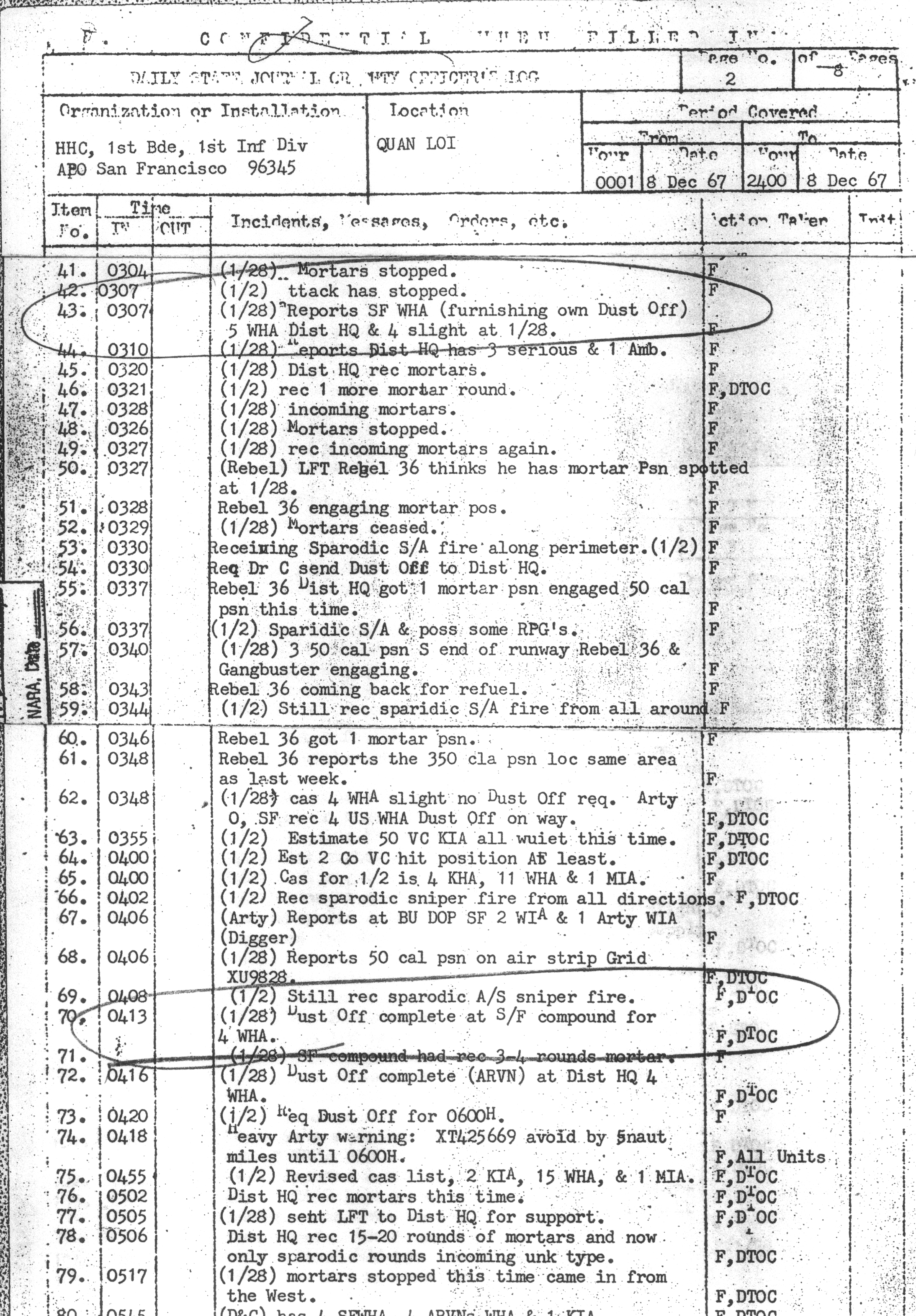
We were all MEDEVACed to the 24th Evacuation Hospital in Long Binh for emergency treatment (see copy of emissions report on next page). I can remember going into the triage room (place were the doctors made decisions as to what to do and how serious the injuries where) and answering a few questions but then my memory starts to get fuzzy. Probably by that time shock was setting in as the next several days were very disjointed and what I can remember is only a few images and feelings. At some point I remember being loaded on a medical transport and then being moved to the 106th army hospital in Japan on 9 December 1967.
Copy Emissions Report, 24th Evacuation Hospital, Long Bin Vietnam.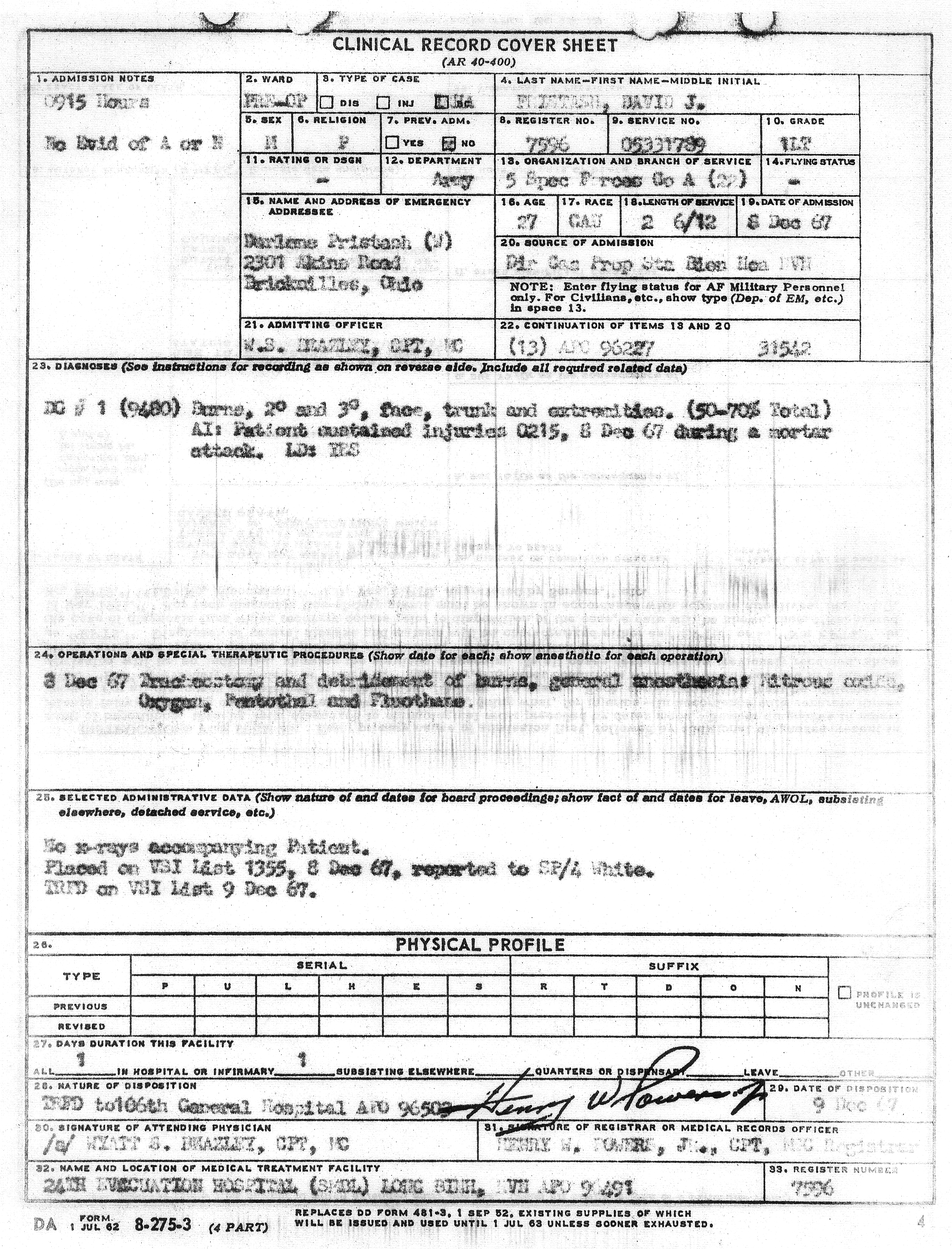
I spent several days in Japan, of which I remember almost nothing but a few images of being in a hospital ward that I remember as being dark (however, I was experiencing shock by this time and so I can’t really rely on anything I remember as being absolutely true). Then all three of us were placed on a military hospital plane (we were all on stretchers, stacked maybe three high and on both sides of the plane, in any case there were a lot of us, but I don’t think we were all burn patients) and flown back to the states. The ride back was one of constantly dropping in and out of consciousness and blurred images of patients, nurses IV’s and being very cold. I think there was a plane transfer somewhere in this process (in Hawaii or maybe California) and then we (the three of us from Bu Dop) were taken to the Brooke Army Medical Center in San Antonio, Texas. I remember very little of that plane ride from Japan but I do remember the airfield in the states and the ambulance ride to the hospital when we arrived there on 11 December 1967. This was the last planeload out before Christmas that year (I was told that later by my wife). If I had missed that plane I would not have gotten to Brooke until sometime in January and by then I may not have been alive.
Telegram telling My Family I was Severely Wounded
Brooke Medical Center was then (I think it still is) the premier center, in the world, for treatment of burns, so if you were going to be burned this was where to be. I had 3rd degree burns (all skin burned away) on my legs (23% of body area) and 2nd degree burns on my arms, back, neck and face (44% of body area). I had also inhaled hot burning gases in the pit when the fire balls rolled over me which had burned the inside of my mouth, tongue and my lungs. Besides that I had some shrapnel wounds and was experiencing a sever loss of body fluids. Generally I was in very, very bad shape
Much later, when I was discharged from Brooke Medical Center, the Doctors told me that when I reached the hospital in December they had given me only a 10% chance of living through this severe trauma. There had been so much physical damage to my body that they just didn’t think I would be strong enough to make it. However, I’m certainly glad they didn’t give up and that they did still tried to save me despite their doubts. As I contemplated this brush with death a few years later I came to the conclusion that my life after 1968 was a gift and that since I should have died then, but instead I had lived, that I would do something before I died to justify my existence. As a result I have been driven to accomplish something ever since and what I’ll do if I’m ever successful I don’t know.
Being burned extensively is not pleasant and the burned person’s body reacts to this, in part, by allowing the mind to hallucinate. I guess the hallucinations allow time to pass without direct knowledge of the pain the body is going through. I was no exception to this developing situation even when I knew what was happening to me. However, to me going into the hallucinatory state was a very frightening situation, much more so than the burns and associated pain (most people would not understand this nor agree with me). The pain, I could control mentally to the point of being the only patient (during that period) in the ward that didn’t scream or in any way get violent during the treatments. That’s not to say that I in any way enjoyed it but only that between the two at least the pain was real. The real I could deal with but the lose of reality was frightening to me. I’ll write more on this later in this chapter, but now I’m talking more about the treatment.
For example, there was a daily treatment where the burned patient taken to a special room and was placed in a tank (called a Hubbard Tank) full of water with cleansing and disinfectant soaps. This treatment was given each and every morning whether you wanted it or not. A doctor would then proceed to scrape away all the dead skin with a scalpel. In effect a person was being skinned alive and I can tell you with a great deal of certainty that it did hurt. I was always able to bear this without any screaming or hollering. Also, since everyone could not be treated at once, you could hear the ones that went before you hollering and screening as they got their daily skinning treatment. That preconditioning was almost as bad as the treatment itself for you knew your turn was coming. After you turn in the “TANK” all the raw areas were coated with a white cream (silver sulfadiazine?). In 1967/68 this was a new treatment and it prevented infections from getting into the large open areas of the body. Unfortunately, it had a side effect in that it burned worse than the original burns when placed on the raw flesh of the burned areas. Since this one two punch was given to us each morning we didn’t have a lot to look forward to when waking up each day.
I had always prided myself in being in control of my internal self (I recognized that I could not control the external world in any way) to the point that I really never allowed myself to even get drunk (I could act totally rational even after quite a bit to drink). This pain and shock induced hallucinatory state beat me, however, and as I would go in and out of this dream world I found that I could not stop it from happening nor recognize that I was in this state after it happened (Very different from being drunk and at least knowing you were high). While in these dream states I actually believed that what I was hallucinating was real no matter how bizarre the situation I was experiencing. After this hallucinatory state had happened to me a few times I could sense it was coming on but it was too powerful a force to fight, as much as I tried to stop it from happening, it would take control of me at will. Note hospital policy (at Brooke in 1968) in regards to burn patients is that no painkillers are given. The logic was that since the time of treatment was so long, no matter what painkiller was given or what the dose was the person would become addicted.
I can remember lying in the circle bed and feeling reality shifting and changing on me. As I was watching the room or something in it, my perception would blur and I would lose focus then I would be somewhere else. I guess it’s kind of like a dream or maybe what it is to experience drugs like LSD (I have never taken any drugs nor smoked any marijuana so I have no direct knowledge) as we have all seen in movies or as we have read about in books. It’s very strange to be one place and then all of a sudden somewhere else. These spells lasted from a few minutes to several hours (I’m really not sure and I was in no state to time them) and they would center on some situation. Sometimes they seemed to relate to experiences that I had in Vietnam and other times they related to what I was currently experiencing in the hospital. The specifics are now vague and so I can’t relate any of the situations except that as I remember it they were quasi real like animation characters (The Disney film of a few years ago “Roger Rabbit” might be a good example). I do remember that as I came back into this reality I knew what had happened. I could remember being in the state when I was out but I could not tell when I was in one of these states that it was not real.
Later after leaving the hospital and thinking about what had happened I realized how dependent our beliefs and actions are on what our sensory input tells our brain. If the input says one thing no amount of logic and intelligence can overcome that for long. We are therefore captives of what we perceive, whether it is right or wrong or whether it is true or not. This taught me the importance of analyzing a situation for the root causes and even to question supposed facts. However, I will never forget how when I was in this state I was fooled into believing something that was not true.
During the initial period of my treatment at Brooke I dropped from over 180 pounds to under 100 pounds (98 pounds if I remember correctly). As I started my recover (probably in mid January) I started to gain weight back and also to have fewer and fewer hallucinatory states. After getting skin grafts from by chest to my legs where the skin had been completely burned off and healing some from those operations I had to learn to walk again. That was a task, as the grafted areas would quickly swell up when standing as well as be very uncomfortable. It was probably five or six years later before I really felt comfortable walking and I was never able to run again for any length of time. Now, thirty three years later I probably could start running again if I tried as I can still feel my body recovering from that period, and I no-longer need support socks to keep my legs from swelling up with fluids.
While I was recovering from one of my many operations I was interviewed by a military person (I don’t remember his name or rank) on the subject of flame warfare and the effects on the individual soldier. The military was interviewing troopers that had been burned to see if flames/fire was an effective means of stopping a military unit. Flame warfare unlike explosive warfare does not necessarily render you immediately incapable of fighting even though you may be fatally wounded. It was my personal opinion that I could have fought on for a short while (1/2 to 1 hour) after I was burned, which would mean that flame warfare might not be effective in a personal combat situation. I relayed this personal opinion to the person taking the survey, but what the results of the survey were I never found out.
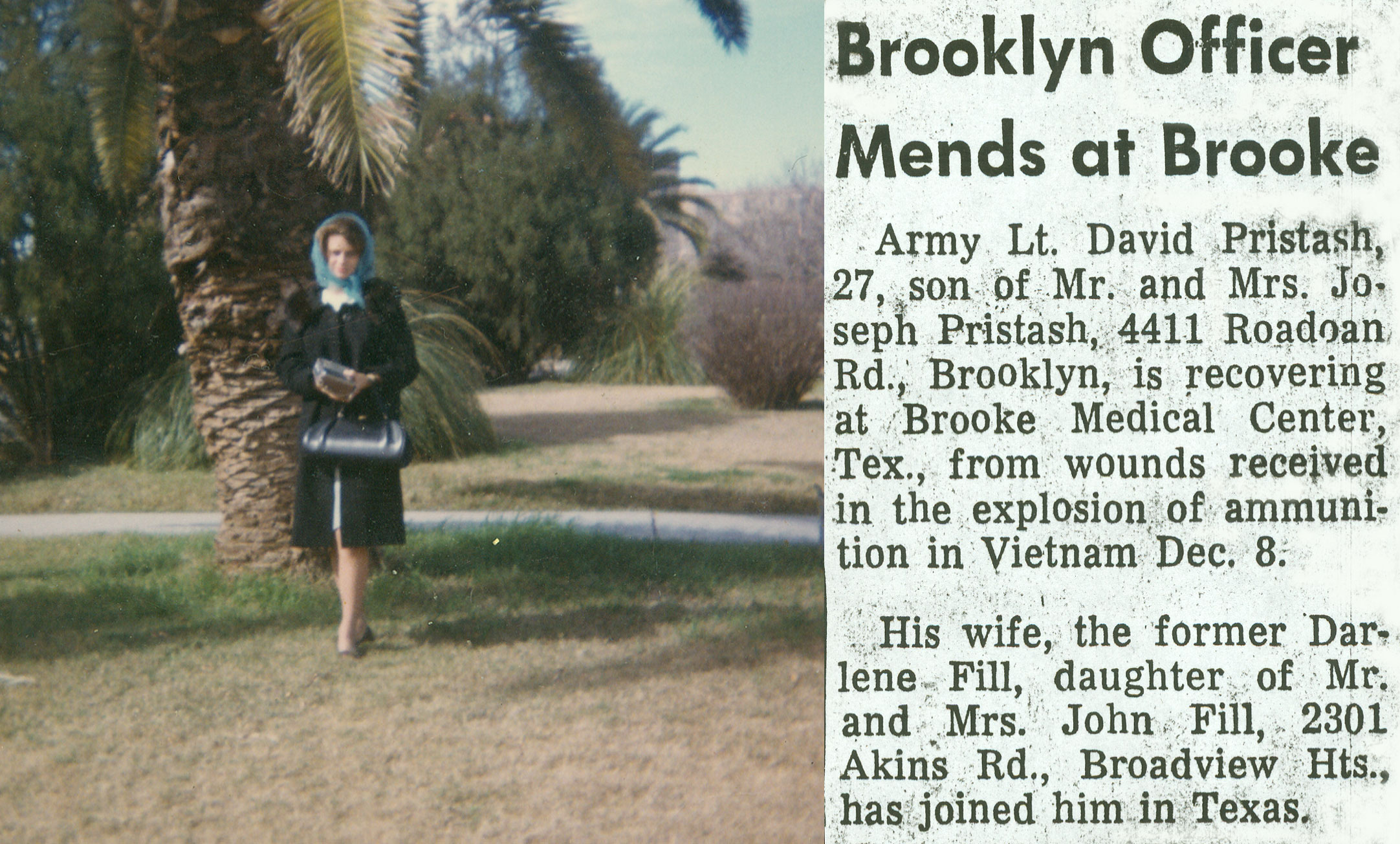
My wife, Darlene, flew to San Antonio to be with me and I attribute my recovery solely to her presence there. She was there the entire time I was, and I believe that this gave me enough of an anchor to reality to hold on to life. My brother, Jonathon, also visited me while I was in the hospital during December 1967, around Christmas, if I remember correctly. There was one good experience later on, which was I think in February, when I received a phone call from Martha Ray (the famous entertainer) she wished me a speedy recovery from my wounds. This call was a real surprise and resulted from a request from my parent’s neighbor’s daughter, Susan McCollum. She was a dancer and with Martha Rays’ troop in Vietnam in 1967/1968 when she heard about my being wounded, and she had Martha Ray call me. That was really something I can tell you and shows what was in her heart; unlike many in the entertainment industry today. Note: Martha Ray did a lot for Special Forces troopers such that she was later made an honorary Colonel in the Green Berets.
One other thing happened to me while at Brooke and that was that my left elbow froze to the point that I could not move it at all, from calcification. When I was discharged from the hospital the doctors told me that after a year or so they could operate to free the joint (they also stated that I would not get back 100%). Prior to that length of time they said it would not have stabilized and could have reoccurred again. That meant that I would have no motion in my left arm until that operation could be performed. Along with that I had a lot of Keloid tissue (scar tissue) form that gave me additional motion problems on my arms. That too would have to wait but could also be fixed. Since I knew that it would be 12 to 18 months before I would be done with all these corrective surgeries I elected to stay in the army and take a light duty assignment instead of getting a medical discharge, which was an option. I couldn’t picture myself waiting around for a year or more waiting for these operations. It would be impossible to get a job and I would just be another unemployable vet until these operations were finished.
While I was in the hospital (over three months the first time) I received several operations and skin grafts to repair the massive burn and shrapnel damage I had received in Vietnam. SFC Broom and SP4 Schroeder who were there with me in Vietnam both died at Brook Army Medical Center while I was there. I was therefore the only one of the three wounded in the mortar pit at Bu Dop that made it. SFC Broom was very severally burned and there was probably never any chance that he could be saved. I was bad but he was even worse as he was the closest to the explosion when it when off. He may even have shielded Schroeder and I from some of the blast. SP4 Schroeder was only slightly burned and was actually on his way to being released. He had been transferred to a different, non critical, ward and then he developed a strange infection which ravaged his body with extremely high temperatures eventually killing him. Years later long after writing this book I visited the Vietnam Wall Memorial in Washington DC and found the names of all those that died at Bu Dop in 1967 while I was there.
Fortunately for me I was not that aware of what was happening and so I didn’t really comprehend that they were both gone until later when I was out of immediate danger. If I had realized what was happening to them it probably would have affected me to an extent and that may have been just enough to trip me over to the not make it category. In any case I didn’t really know and I just made it through this experience. The following paragraph was something I wrote to summarize what happened to me that night in Vietnam.
On the night of 7/8 December 1967 I was mortally wounded (all mortal wounds don’t kill you immediately). I was MEDEVACed and sent to a hospital in Texas where I meet the grim reaper soon after arriving. He told me he was coming for me but I told him I wasn’t ready; he laughed at me and said he was going to come anyway. I told him it didn’t matter whether he came or not I just wasn’t going with him. But he wasn’t to be denied and so he visited me every night in the form of a large Bengal tiger and we battled all night for the rights to my soul. He was a very vicious and determined tiger and he tried his best to rip my soul from my body with his sharp teeth and claws but I was strong and stubborn and I would not let go. This battle lasted for two months and he chewed me down to 95 pounds but in the end I prevailed and he disappeared and I was not dead and he had to settle for taking the souls of the two men who were standing next to me in Vietnam.
 Centinel2012