
Posted originally on CTH on January 18, 2026 | Sundance
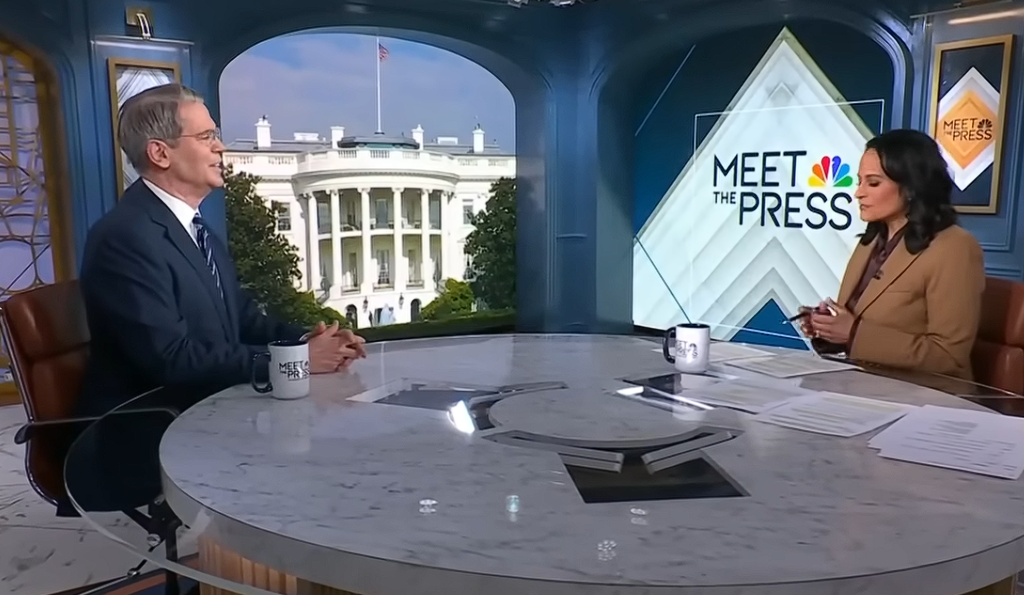
Treasury Secretary Scott Bessent appears on NBC to discuss the national security issues surrounding Greenland and the Trump administration’s face off against Europe and NATO. Additionally, Welker wants to protect Fed Chairman Jerome Powell against mounting evidence of his political bias and mismanagement of the Federal Reserve. Video and Transcript Below.
[Transcript] – KRISTEN WELKER:
Joining me now is Treasury Secretary Scott Bessent. Secretary Bessent, welcome back to Meet the Press.
SEC. SCOTT BESSENT:
Good morning, Kristen. Good to be with you.
KRISTEN WELKER:
It’s great to have you here, thank you for being here in person. Let’s start right there. President Trump threatening to impose steep tariffs against some of America’s closest European and NATO allies. The leaders of Denmark and Greenland say bluntly, “Greenland is not for sale.” What makes President Trump think it is?
SEC. SCOTT BESSENT:
Kristen, if we look for years, for over a century, American presidents have wanted to acquire Greenland. And what we can see is that Greenland is essential to the U.S. national security — we’re building the golden dome, the missile system. And look, President Trump is being strategic. He is looking beyond this year. He’s looking beyond next year to what could happen for a battle in the Arctic. We are not going to outsource our national security. We are not going to outsource our hemispheric security to other countries. In Trump 1.0, President Trump told the Europeans, “Do not build Nord Stream 2. Do not rely on Russian oil.” And guess what, Kristen? Guess what is funding Russia’s efforts against Ukraine? European purchases of Russian oil. So America has to be in control here.
KRISTEN WELKER:
I want to delve into everything that you said. But I just want to ask you big picture: Is this a negotiating tactic, Mr. Secretary? Or is President Trump serious about annexing Greenland?
SEC. SCOTT BESSENT:
President Trump strongly believes that we cannot outsource our security. Because, Kristen, let me tell you what will happen, and it might not be next year, might not be in five years. But down the road, this fight for the Arctic is real. We would keep our NATO guarantees. And if there were an attack on Greenland from Russia, from some other area, we would get dragged in. So better now, peace through strength, make it part of the United States, and there will not be a conflict because the United States right now, we are the hottest country in the world. We are the strongest country in the world. Europeans project weakness. U.S. projects strength.
KRISTEN WELKER:
But just very quickly, is this a negotiating tactic, Mr. Secretary? Is the goal to get a deal to have enhanced security in Greenland, for example?
SEC. SCOTT BESSENT:
The president believes that enhanced security is not possible without Greenland being part of the U.S.
KRISTEN WELKER:
Okay. Let me press you on what you have said are national security concerns, particularly as it relates to Russia and China. Senior Democrats say there are no pressing threats on Greenland’s security from Russia or China. The Danish foreign minister says there hasn’t been a Chinese warship in Greenland for a decade. What evidence do you have that this is a pressing threat?
SEC. SCOTT BESSENT:
Well, first of all, Kristen, we have asymmetric information. And again, President Trump is being strategic here. What evidence was there that the Russians were going into Crimea? Well, actually there was a lot of evidence that the Russians were going to go into Ukraine. And Joe Biden said, “Well, just take a little bit of it.” But what we know is that the U.S., that Greenland can only be defended it if is part of the U.S. And it will not need to be defended if it is part of the U.S. The president is trying to avoid a conflict.
KRISTEN WELKER:
You bring up Crimea. The president, as far as I have heard, has not taken military force off the table. If the United States were to take Greenland by force, how would that be different than Russia’s annexation of Crimea?
SEC. SCOTT BESSENT:
Look, I believe that Europeans will understand that this is best for Greenland, best for Europe, and best for the United States.
KRISTEN WELKER:
But military action is still on the table?
SEC. SCOTT BESSENT:
I haven’t spoken with the president on that. And again, I believe that the Europeans will understand that the best outcome is for the U.S. to maintain or to receive control of Greenland.
KRISTEN WELKER:
Well, so far what we’ve heard and seen from the Europeans is alarm and outrage. In fact they’re, as you know, holding an emergency meeting today. And part of the issue, the president has already reached a trade deal with the EU. How can countries have confidence in trade deals moving forward if President Trump is prepared to blow them up?
SEC. SCOTT BESSENT:
Well, first of all, the trade deal hasn’t been finalized. And an emergency action can be very different from another trade deal. So we’re in a very good equilibrium right now with China. But if China did something to upset that balance, I think the president would be willing to act. You know, same thing with India. We were working on a trade deal with India. But the president, unlike the Europeans, started charging the Europeans 25% for buying Russian oil. So the president leverages his emergency powers to do this.
KRISTEN WELKER:
I hear you saying that the deal hasn’t been finalized. And yet it was moving towards finalization. Doesn’t it undercut the United States’ word by threatening these steep new tariffs?
SEC. SCOTT BESSENT:
I think it does not. What it does is it enhances United States security. And again, we have seen that Europeans are unable to push back against Russia. The U.S. — this war that never would have started in Ukraine, Kristen, we are going to settle it. But it wouldn’t have started. And what President Trump is trying to do is prevent a taking or the Russian, Chinese action in Greenland in the future. So why not be strategic? Why? Always live in the moment.
KRISTEN WELKER:
Okay, let’s talk about being strategic. The United States has a base in Greenland. I’ve been talking to lawmakers on Capitol Hill. Denmark has given the United States a green light to beef up its security as much as is needed in Greenland. Why not take that route? Why is it necessary to take over and annex all of Greenland, something that 85% of people living in Greenland oppose?
SEC. SCOTT BESSENT:
Well, again let’s look back. Denmark has a terrible history with Greenlanders. There were forced sterilizations up until the ‘80s or the ‘90s. So all of a sudden, now that the U.S. has expressed an interest, there is, you know, this new interest. And again, the United States needs to be in control to prevent a war. And we do not want to get dragged into someone else’s war.
KRISTEN WELKER:
Well, but this is about the United States relationship with its allies, NATO allies, again reacting with alarm. They are warning that this move to annex Greenland could in fact destroy NATO. So let me just put this to you bluntly. Is Greenland or NATO more essential to the United States national security?
SEC. SCOTT BESSENT:
Both. Kristen, that’s obviously a false choice. You know, that’s an absolute —
KRISTEN WELKER:
Not from the perspective of European leaders.
SEC. SCOTT BESSENT:
The European leaders will come around. And they will understand that they need to be under the U.S. security umbrella. What would happen in Ukraine if the U.S. pulled its support out? The whole thing would collapse. The U.S., Kristen, to be clear, since 1980 the U.S. military spending versus NATO military spending, we have spent $22 trillion more than the Europeans have, that we are peace through strength, and the Europeans now are only trying to play catch-up. And that is only through President Trump. President Trump believes in NATO. But he does not believe in the American people being dragged in.
KRISTEN WELKER:
Well, in terms of the cost that has been paid, Denmark has stood shoulder-to-shoulder with the United States including after 9/11. In fact, it lost more soldiers per capita in Afghanistan than any other NATO nation apart from the United States itself, Mr. Secretary. Does President Trump want the United States to remain a part of NATO?
SEC. SCOTT BESSENT:
Of course, we are going to remain a part of NATO. But what President Trump does not want is for a war to start and the U.S. gets dragged in. Again, we are not going to outsource our Western Hemisphere security to others.
KRISTEN WELKER:
Let me ask you, broadly speaking, about the tariff portion of this. The president, as you well know, has justified his authority to impose previous tariffs without going to Congress by declaring national emergencies. It’s an issue before the Supreme Court right now. We’re all awaiting the high court’s decision. What is the national emergency that justifies these new slate of tariffs?
SEC. SCOTT BESSENT:
The national emergency is avoiding a national emergency. It is a strategic decision by the president. This is a geopolitical decision. And he is able to use the economic might of the U.S. to avoid a hot war. So why wouldn’t we do that? You know, same thing that what if we had a national emergency coming with these gigantic trade balances that we had with the rest of the world — I’ve been in financial markets for 30, 45 years — much better to be strategic, avoid the emergency.
KRISTEN WELKER:
You’re saying it’s a national emergency. But you’re also saying it’s a threat. It’s years away. How can both be true, Mr. Secretary?
SEC. SCOTT BESSENT:
Because you are avoiding creating the emergency, Kristen. What if during the great financial crisis, someone had raised their hand in 2005, 2006 and said, “Stop the sub-prime mortgages?” But no one did. President Trump is raising his hand. And that is preventing the emergency.
KRISTEN WELKER:
Do you think the Supreme Court will agree with that rationale, Mr. Secretary?
SEC. SCOTT BESSENT:
I believe that it is very unlikely that the Supreme Court will overrule a president’s signature economic policy. They did not overrule Obamacare. I believe that the Supreme Court does not want to create chaos. As you said earlier, we have set these trade deals. And it is very good for the United States if we are balancing our trade deficit. If you look, Europe is being overrun with Chinese goods. There is now an emergency in Europe. There is going to be an economic emergency. The Europeans will follow us. So President Trump is pre-empting this if we go back to emergencies, he put a fentanyl tariff, Mexico, Canada, China. Guess what’s happened to fentanyl deaths? If that’s an emergency, I don’t know what is. October 8th, when the Chinese threatened to put rare Earth export controls on the entire world, President Trump threatened 100% tariff. And the Chinese came to the table. And we negotiated on behalf of the whole world.
KRISTEN WELKER:
All right. Let me move to the Federal Reserve. I want to ask you about the revelations this week that the Department of Justice is investigating Jerome Powell and the Fed for allegedly going over budget in the Fed building renovations. Chairman Powell responded. He fired back at this. I want to play a little bit and get your reaction on the other side.
[BEGIN TAPE]
JEROME POWELL:
This is about whether the Fed will be able to continue to set interest rates based on evidence and economic conditions, or whether instead monetary policy will be directed by political pressure or intimidation.
[END TAPE]
KRISTEN WELKER:
Is President Trump committed to the independence of the Federal Reserve, Mr. Secretary?
SEC. SCOTT BESSENT:
Of course, he’s committed to the independence of the Federal Reserve. But independence does not mean no oversight.
KRISTEN WELKER:
But doesn’t this undercut the independence of the Federal Reserve if the Justice Department is investigating renovations? There are renovations at the White House.
SEC. SCOTT BESSENT:
The renovations at the White House are not $700 million, more than $1 billion or $1.5 billion over budget, Kristen. And the White House, that is being paid for with private funds. If I want to buy a new chair for my office at Treasury, that is an appropriation. Just to understand, the Federal Reserve has magic money. They print their own money. So when you have no oversight, why not have a little sunlight? Kristen, I have called since last summer for the Fed to do its own internal investigation. And that has not been heeded, not been heeded. And again, I don’t know about you. If I were to receive inquiries from the Justice Department, I would answer them. They went unanswered.
KRISTEN WELKER:
Well, let me ask you because Axios reported that you were not happy about DOJ’s investigation, that you told President Trump as much. Axios writes, “a perturbed Treasury Secretary Scott Bessent told President Trump late Sunday that the federal investigation into the Federal Reserve Chair made a mess and could be bad for financial markets.” That’s according to two sources familiar with the call. Is that accurate?
SEC. SCOTT BESSENT:
You know what, Kristen? I’m not going to discuss my conversations with the president. But if I said that, I was wrong. Financial markets, stock market went up, bond yields went down. So the markets are the ultimate arbiter of over whether the Fed’s independence is being impugned. And bond yields went down. I can tell you we had two of the best bond auctions that we have had in months for U.S. treasuries. So the market is looking beyond this. And again, maybe the market wants some transparency from the Fed.
KRISTEN WELKER:
One final question for you, Mr. Secretary. Some Republican senators, as you know, are threatening to block the president’s nominees over the Justice Department’s investigation. Do you think the investigation needs to be dropped in order for the Senate to confirm the president’s next pick to run the Fed?
SEC. SCOTT BESSENT:
I think that that will be up to the senators. I think —
KRISTEN WELKER:
But are you worried that they’ll block the president’s pick for the Fed?
SEC. SCOTT BESSENT:
I am not. I think we have four great candidates. I think that they will be quite happy with either of the four. I think we will move forward. I believe that we will probably be hearing from the banking committee soon on what they would like to see. And again, the supervision and bringing in some sunlight does not mean coercion.
KRISTEN WELKER:
All right. Thank you so much, Secretary Bessent, for being here to respond to all of the breaking
 Centinel2012