Posted originally on CTH on April 20, 2026 | Sundance
Promethean Action – Barbara Boyd previews renewed Iran peace negotiations in Islamabad ahead of a ceasefire deadline, as Iran allegedly challenged a U.S. naval blockade, lost a ship, and again closed the Strait of Hormuz, with Trump warning “No More Mr. Nice guy” if peace fails and arguing Iran is bleeding $500 million a day. She shows a City of London–linked propaganda network is working to prolong the war and damage Trump before the midterms by targeting Vice President JD Vance, citing a Financial Times column by Edward Luce and post–Munich Security Conference smears portraying Vance as pro-Putin.
Boyd outlines three layers of Iran-linked messaging—Press TV in London, NIAC in Washington, and the “Iran Experts Initiative” infiltration of U.S. think tanks—and says justice is coming via prosecutions led by Joseph DiGenova, with Kash Patel promising arrests, while Vance leads talks and a National Fraud Task Force.
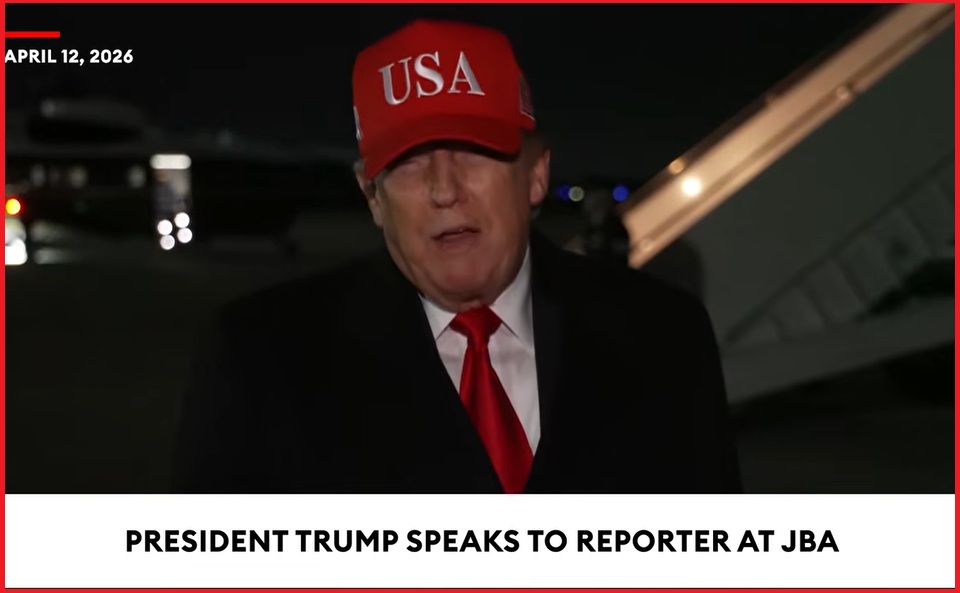
PRESIDENT TRUMP – “I’m winning a War, BY A LOT, things are going very well, our Military has been amazing and, if you read the Fake News, like The Failing New York Times, the absolutely horrendous and disgusting Wall Street Journal, or the now almost defunct, fortunately, Washington Post, you would actually think we are losing the War.
The enemy is confused, because they get these same Media “reports,” and yet they realize their Navy has been completely wiped out, their Air Force has gone onto darker runways, they have no Anti Missile or Anti Airplane Equipment, their former leaders are mostly gone (This has been, in addition to everything else, Regime Change!), and perhaps, most important of all, THE BLOCKADE, which we will not take off until there is a “DEAL,” is absolutely destroying Iran. They are losing $500 Million Dollars a day, an unsustainable number, even in the short run. The Anti-America Fake News Media is rooting for Iran to win, but it’s not going to happen, because I’m in charge! Just like these unpatriotic people used every ounce of their limited strength to fight me in the Election, they continue to do so with Iran. The result will be the same — It already is!” ~ President DONALD J. TRUMP
Posted originally on CTH on April 19, 2026 | Sundance |
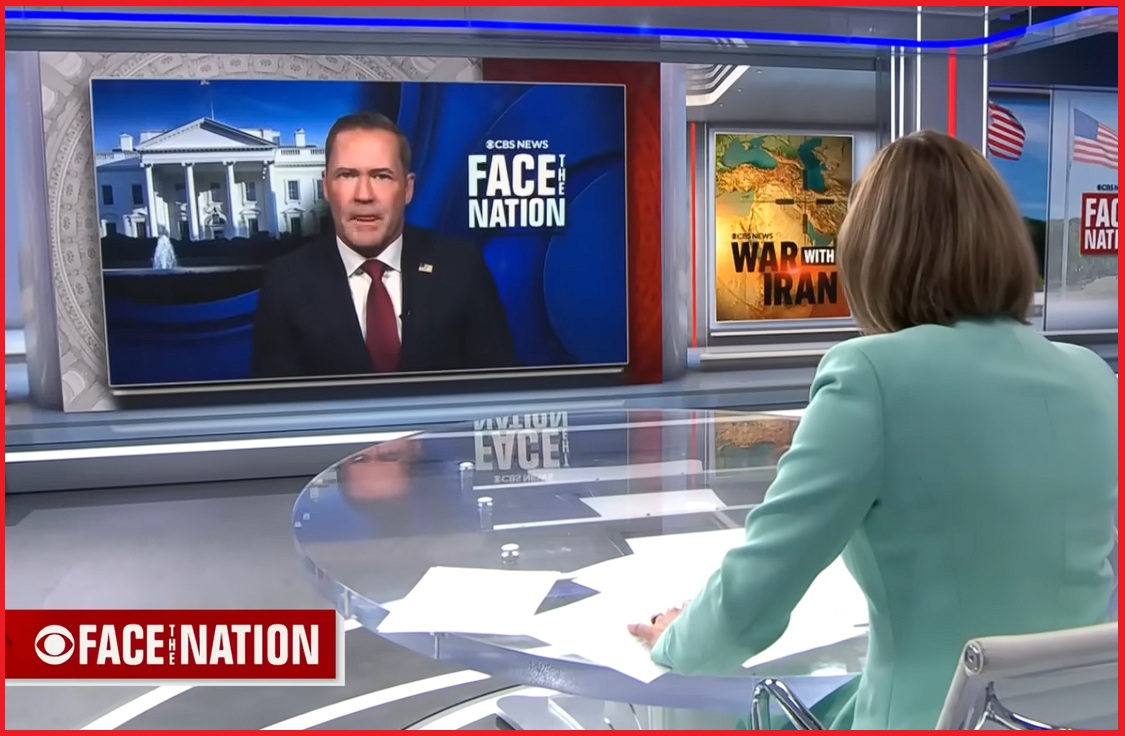
U.S. Ambassador to the U.N. Mike Waltz appears on CBS Face the Nation to discuss the difficulty of negotiating with Iran, a regime based on fanatical religious zealotry and control. The video and transcript are below:
[Transcript] – MARGARET BRENNAN: Imtiaz Tyab reporting from Dubai. We turn now to the U.S. Ambassador to the United Nations, Mike Waltz, who joins us this morning from New York. Welcome back to Face The Nation, ambassador.
AMBASSADOR MIKE WALTZ: Thank you, good to be with you.
MARGARET BRENNAN: So the President said Iran broke the ceasefire, but he is still offering them a deal. Is this a presentation of terms, or should we expect an actual, prolonged negotiation?
MIKE WALTZ: Well, I think this will be a continuation of the terms that the vice president offered a week ago. And look, we have to take a step back here in that – President Trump, the US Navy is controlling what is coming out of the straits. We’ve had the highest level engagement in the history of the Iranian regime, with the vice president leading. We have historic ceasefire talks going on between the Israelis and the Lebanese. The markets are up. Oil prices are relatively stable. The Iranian economy is devastated, and they’ve never been, I can tell you here at the United Nations, they’ve never been more diplomatically isolated. So Iran does not have the cards, and we are confident they will come to the table and finally give up their obsession with having a nuclear weapon.
MARGARET BRENNAN: Well, Iran has not yet announced that it’s sending a delegation to Islamabad. I know there’s this back and forth all morning long about whether the vice president would be leading it or not. CBS, as you just heard, is reporting he will be but why is it important that he be there in person? Is it because Iran has refused to send anyone with decision making authority, unless he is there?
MIKE WALTZ: Well, you’ve seen the chaos, I mean that you just pointed to on the Iranian side. The last 48 hours, you have their foreign minister announcing that they’re going to stop attacking shipping. Then you have the IRGC saying that they will and then doing so, as President Trump pointed out, an absolute violation. So the Iranian side is in a bit of chaos. This is absolutely due to the devastating strikes on their leadership. But I think the vice president leading shows the level of engagement from the US side that we are absolutely serious. And I for one, thank God for future generations that we are arresting a problem before it’s too late. We’re not waiting until the US has no options —
MARGARET BRENNAN: Well —
MIKE WALTZ: and Iran has some kind of breakout, which would lead to a nuclear breakout all over the Middle East.
MARGARET BRENNAN: Let me follow up on what you just said, though, because that’s important, the Iranian side is in chaos. So how do you know you’re negotiating with the right person? It’s been reported, The Institute for the Study of War says that the IRGC Commander General the Vahidi has secured control over the negotiations and the military within the past 48 hours. Does that mean Foreign Minister Araghchi is not the person to be sitting across the table from? Who’s in charge?
MIKE WALTZ: Well, look – again the Iranian regime, we’ve put them in chaos, but at the same time, we are never going to take an approach of trust. Any deal that comes out of this will have to absolutely be verifiable and be enforceable. I can tell you, from sitting in my seat at the UN we’ve been in extensive discussions with the International Atomic Energy Agency, the IAEA, which would have ostensibly a key role in ensuring Iran lives up to any deal that it signs to, this – signs up to, there is no trust on this side. There is verified and enforceable provisions that are that are on the table from the US to ensure they never have a nuke.
MARGARET BRENNAN: Okay, that’s important in terms of enforcement. Does that mean if you actually get to a negotiated deal, and the UN’s nuclear watchdog would be very much in those details of going in and perhaps securing that enriched uranium. Does this mean you’re going to put a deal for approval before the United Nations? Is it going to be codified like that?
MIKE WALTZ: Well, I’ll tell you, there are dozens and dozens of resolutions over the years, not just the United States, the entire world, saying Iran cannot have a nuclear weapon.
MARGARET BRENNAN: Right.
MIKE WALTZ: We had snap back provisions that are in place now for global sanctions and that Iran cannot enrich so anything that would would change those resolutions would then need to come back before but let’s not get ahead of ourselves. Let’s see if the Iranians actually sign up to a very reasonable offer that is sitting on the table from the United States —
MARGARET BRENNAN: Yeah —
MIKE WALTZ: which is an off ramp from them, and also will ensure the region, the United States, Europe and the world, is never threatened by a regime with its hand on a nuclear button.
MARGARET BRENNAN: Okay, so, but back to the point of who’s in charge. President Trump says he hopes they take the deal, that was the post this morning. But on Friday afternoon, he spoke to my colleague, Weijia Jiang, and he gave us an incredibly optimistic read. He said Iran had quote, agreed to everything, including to stop enriching uranium forever and to stop backs – backing all proxy groups like Hezbollah. He made it sound like it’s all been sorted out. So which is it? Was there an agreement with certain parts of the Iranian government, but now there are others in charge, or was he just, you know, I don’t know, speculating about something he hopes comes true?
MIKE WALTZ: Margaret, anybody who has dealt with the Iranians will tell you it is often two steps forward, three steps back. They’re incredibly slippery. They can’t be trusted. They cheated over the years, which is one of the reasons that President Trump withdrew us from the JCPOA. They were hiding sites. They were hiding capabilities, and this is why he made the bold decision —
MARGARET BRENNAN: Yep —
MIKE WALTZ: last year in operation midnight hammer, to just end it once and for all. And again, we have to take the perspective that we’re not waiting. We’re not trusting. We are reducing their capabilities. Their military is in shambles. Their missile program is in shambles, and now, hopefully diplomatically, they will do it the easy way, rather than the hard way, of finally giving up on this illegal ambition.
MARGARET BRENNAN: The Defense Intelligence Agency told Congress this past week, Iran has thousands of missiles and one way attack drones that can still threaten the United States. So there’s still a threat in certain ways. General Caine said on Thursday, the US is going to pursue Iranian flagged vessels or any vessel providing support, including those carrying Iranian oil. Beijing is the top customer. Are you going to start boarding vessels headed to to China? When do these operations begin?
MIKE WALTZ: Well, I’m not going to give – get into operational timelines, but I’ll tell you all options are on the table. The President is prepared to escalate, to de-escalate, he means it. When he said nothing that benefits Iran is coming out of the strait. And then on top of that, Secretary Bessent announced operation economic fury, where we are prepared to put secondary sanctions on banks who are transacting in illegal Iranian oil dollars. So we are truly putting maximum pressure on every aspect of the Iranian economy, and at some point they are going to see some level of common sense and pragmatism and say enough is enough with this nuclear obsession.
MARGARET BRENNAN: Is that the first step before you go back to combat? Because President Trump was talking about bombing power plants. Are the sanctions and the seizing of vessels —
MIKE WALTZ: Well, we’ve taken —
MARGARET BRENNAN: step one?
Mike Waltz: Well we’ve taken, you know, again, I’m not going to publicly sequence the steps, but the blockade was, was a tremendous step and has been tremendously effective, with dozens of ships turned around. Others that are already out on the water, our Pacific Command is prepared to interdict. We’re going after the banks. We’re going after this shadow fleet, one of which was run by a relative of Khamenei. So we are taking a number of steps. We’re even looking – our acting attorney general has made it very clear, he is going to start aggressively prosecuting, our threat finance unit is going —
MARGARET BRENNAN: Yeah —
MIKE WALTZ: after their illegal dollars. So this is a whole of government, full on press. I hope we don’t have to go back to a military option but President Trump’s made it very clear. And by the way, bridges, power plants that are run by the IRGC, which runs the entire military, are absolute legitimate military targets, not only now, but have been historically. That is a false, fake and ridiculous notion that this is some type of war crime.
MARGARET BRENNAN: Well, we’ll talk about that, and we’ll see if that happens. But Germany and other allies have said they will help the United States with that navigation through the Strait of Hormuz, eventually, once combat ends, but they said they need cover. They need an international mandate at the United Nations. Will Russia and China get on board? Are you trying to do that at the UN?
MIKE WALTZ: Well, as our Gulf Arab allies made it very clear at the UN, I guess that would be nice to have after the conflict, but they need help and are ready to take action now, particularly Bahrain, UAE, Qatar, Kuwait, Saudi Arabia, we had a historic resolution to the UN with 135 —
MARGARET BRENNAN: Yeah —
MIKE WALTZ: nations condemning Iran for its attacks on civilian infrastructure, on resorts, civilian airports, ports, shipping. That was truly tremendous. It’s disappointing the Russians and Chinese chose to side with Iran rather than our Gulf Arab allies —
(CROSSTALK BEGINS)
MARGARET BRENNAN: And you still lifted sanctions on Russia.
(CROSSTALK ENDS)
MIKE WALTZ: and freedom of navigation, but you’re going to see – yeah, you’re going to see continued action this coming week. The entire world is united that you – that a country cannot hold an international waterway and cannot hold the world’s economies hostage because it has a conflict with another country. You don’t see that in the Straits of Gibraltar, the Bering Strait, the Straits of Malacca, or any other international waterway. Iran is absolutely in the wrong here from a legal, diplomatic and economic standpoint.
MARGARET BRENNAN: Let me ask you about Lebanon. President Trump posted Friday that quote, Israel will not be bombing Lebanon any longer. They are prohibited from doing so by the USA. Enough is enough. How is the US prohibiting ally Israel from bombing in Lebanon? And what is the United States doing to confiscate weapons from Hezbollah like, how are you helping the Lebanese military do that?
MIKE WALTZ: Well to answer your last question, first, the US contributed over $250 million to the Lebanese Armed Forces. This is a tremendous historic opportunity for Lebanon, the Lebanese government led by President Aoun, a former general, the head of the Lebanese Armed Forces, to take their country back. Finally, with Iran on its back foot and militarily devastated, with Syria —
MARGARET BRENNAN: Yep.
MIKE WALTZ: in a much better place, with the fall of the Assad regime and the effective diplomacy that we’ve had there, and from the pager and beeper operation to now, Hezbollah has never been in a worse place. This is a true moment, and it was a real honor for me to be at the opening of the —
MARGARET BRENNAN: Yeah.
MIKE WALTZ: first Israel – Israel Lebanon talks, first ever —
MARGARET BRENNAN: How are you going to prohibit Israel from bombing?
MIKE WALTZ: in modern history. So, we have – look, but Maragaret, we have diplomacy on the march in a number of places —
MARGARET BRENNAN: Uh-huh.
MIKE WALTZ: Backed, of course, by military strength —
MARGARET BRENNAN: Okay.
MIKE WALTZ: but we have to take a moment to understand the magnitude of what’s going on.
MARGARET BRENNAN: Ambassador Waltz, we will be watching to see what happens in the coming days. Thank you for your time. This morning, Face the Nation will be back in a minute. Stay with us.
Posted originally on CTH on April 17, 2026 | Sundance
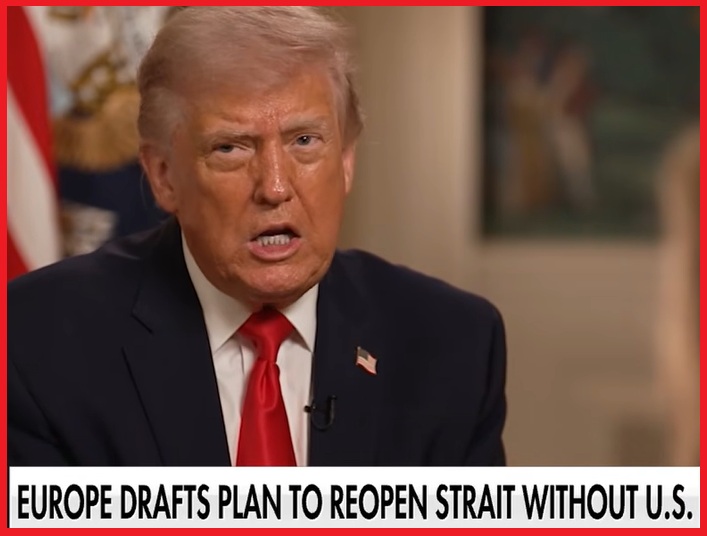
British Prime Minister Kier Starmer, French President Emmanuel Macron, Italian Prime Minister Giorgia Meloni and German Chancellor Friedrich Merz issue a joint statement on their plan to open the Strait of Hormuz, after President Trump secured and opened the Strait of Hormuz.
Essentially, after holding an international teleconference, leaders from the U.K, France, Italy and Germany gather to express their importance on an issue that has been entirely resolved without them. The result is akin to a Monty Python skit that’s missing the part where a guy comes out and slaps them in the face with a big fish. WATCH (prompted):
Posted originally on CTH on April 16, 2026 | Sundance
Secretary Pete Hegseth and Chairman of the Joint Chiefs of Staff Dan Caine hold a news conference in the Pentagon Press Briefing Room during a renewed push for a second round of negotiations between the United States and Iran.
The briefing is scheduled for 8:00am ET with livestream links below:
Posted originally on CTH on April 15, 2026 | Sundance
Promethean Action’s Barbara Boyd does a video recap of interconnected current events centered around Iran, President Trump’s seismic geopolitical shifts, and European, Nato and British intransigence. Meanwhile a U.S. Intelligence Community guardian is leading the fight against domestic intelligence opposition. WATCH:
Posted originally on CTH on April 15, 2026 | Sundance
President Trump talks with Maria Bartiromo about Iran and the U.S. economy. Part II
In this section of the interview, President Trump outlines the ongoing conflict with Iran, what it means on a geopolitical level, and his new perspective on how Trump views the European/NATO allies against their refusal to engage in eliminating the Iran nuclear threat they all consistently debated and claimed to be important.
In short, President Trump no longer looks at the EU allies through the prism of an alliance. As a loyal member of the Council on Foreign Relations (CFR) Maria Bartiromo quickly, VERY QUICKLY, changes the subject. Don’t take my word for it, WATCH:
Posted originally on CTH on April 8, 2026 | Sundance
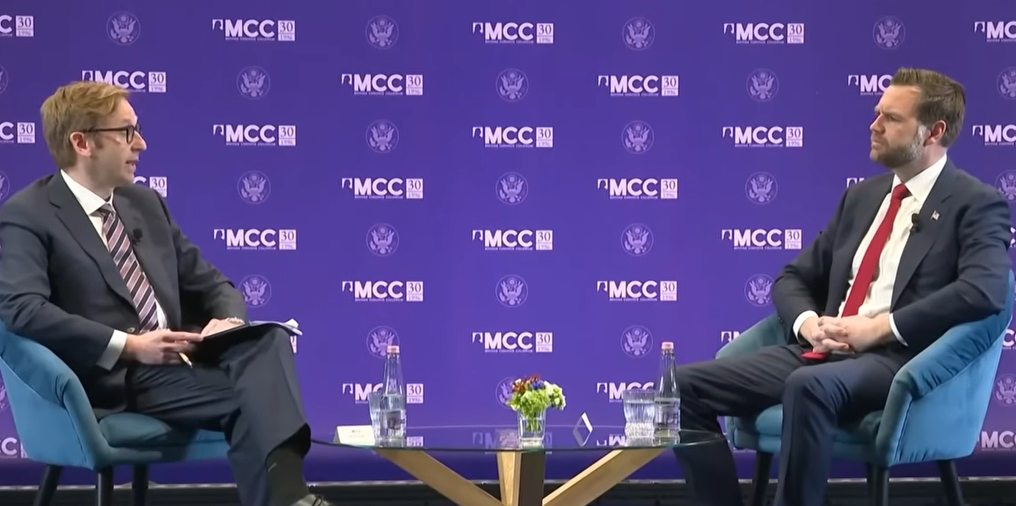
Vice President JD Vance was previously scheduled to appear at the Mathias Corvinus Collegium in Budapest, Hungary, when the truce deal with Iran was made public. During his appearance, the Vice President was asked about his perspective on the negotiations. WATCH:
Full discussion is included in the full video below.
U.S. Vice President JD Vance deliver impactful remarks at the Mathias Corvinus Collegium in Budapest, Hungary. The private Hungarian institution welcomed VP Vance as he spoke on U.S.-Hungary relations, leadership, and international cooperation.
Posted originally on CTH on April 4, 2026 | Sundance
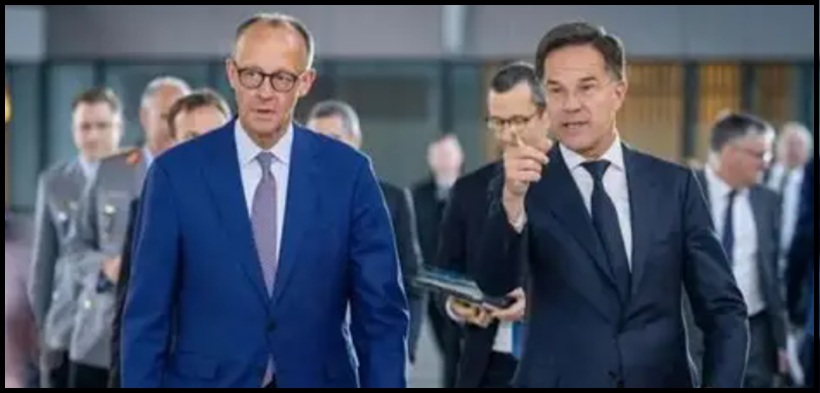
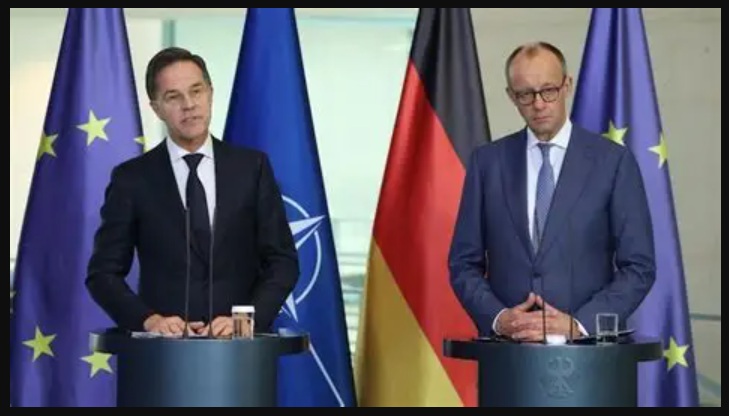
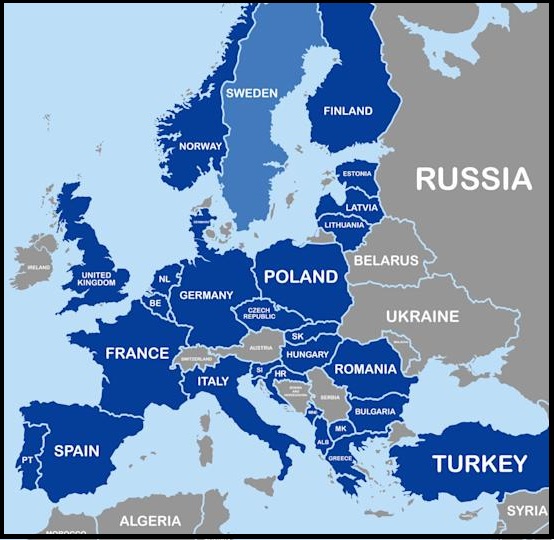
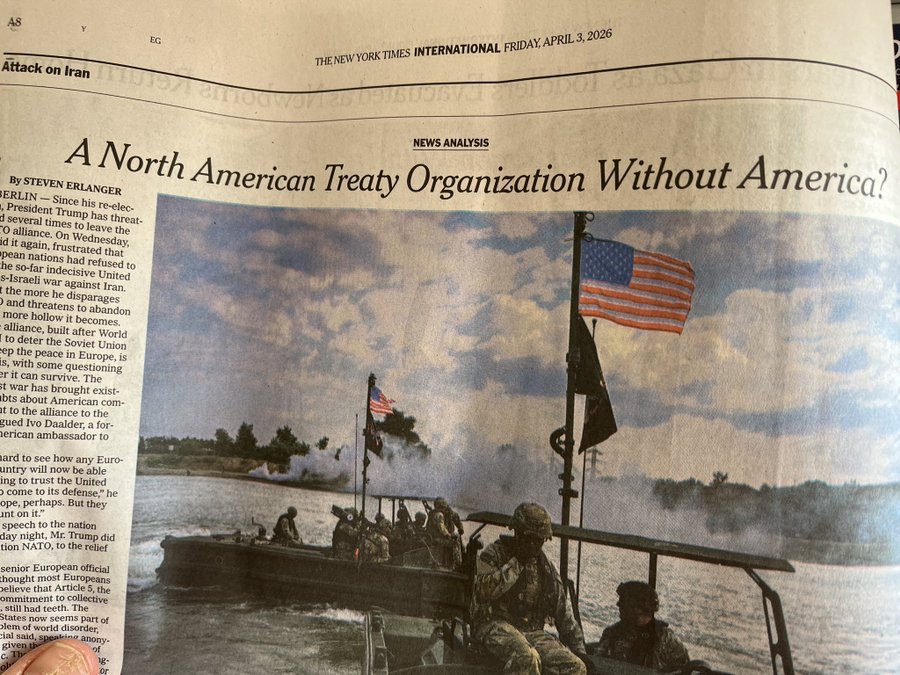
There are approximately 45,000 U.S. troops on NATO bases within Germany. NATO General Secretary Mark Rutte is scheduled to arrive in Washington DC on Wednesday, following remarks by President Trump and Secretary of State Rubio about possible changes in the U.S. relationship with NATO.
Simultaneous to this, the German government has now enhanced their conscription laws with a requirement for all males aged 17 to 45 to request permission for travel out of Germany if their exit will be longer than 3 months.
As part of a rather unusual Russian invasion deterrence, Germany is trying to hit a new target of between 255,000 and 270,ooo active and trained military troops by 2030. The new conscription targets seemingly underpin a travel permit system for German men.
GERMANY – Germany has implemented a significant reform to its military conscription law effective in 2026, mandating that nearly all men aged 17 to 45 must obtain approval from the Bundeswehr before leaving the country for more than three months. This change, part of the Wehrdienst-Modernisierungsgesetz, expands the previous restrictions beyond crisis periods, applying continuously regardless of Germany’s security situation.
The reform aims to bolster the Bundeswehr’s personnel from about 184,000 to between 255,000 and 270,000 by 2035 by reintroducing mandatory conscription examinations for young men. However, the implementation details—such as the approval process and possible exceptions—remain unclear, creating uncertainty among affected individuals. The Bundeswehr is actively working to clarify these procedures and reduce bureaucratic hurdles but has not yet specified consequences for those who depart without permission.
This major policy shift has stirred significant public reactions, including widespread school strikes and influential peace demonstrations during Germany’s traditional Easter marches held from April 2 to April 6. The marches, involving over one hundred events nationwide, address issues ranging from human rights and climate change to ongoing conflicts in Ukraine, Iran, Gaza, and Syria. This year, the new military regulation prominently features among the march themes. (read more)
As noted by Euro Weekly, “Chancellor Friedrich Merz recently hosted Syria’s new president during talks on refugee returns, as part of Europe’s rapid backtrack from pacifism toward heightened security doctrines. NATO Secretary-General Mark Rutte earlier flagged possible Russian invasion risks by 2030 while tensions with US President Donald Trump raise questions over 45,000 American troops stationed in Germany.”
I have created this site to help people have fun in the kitchen. I write about enjoying life both in and out of my kitchen. Life is short! Make the most of it and enjoy!
This is a library of News Events not reported by the Main Stream Media documenting & connecting the dots on How the Obama Marxist Liberal agenda is destroying America