
Posted originally on CTH on March 15, 2026 | Sundance
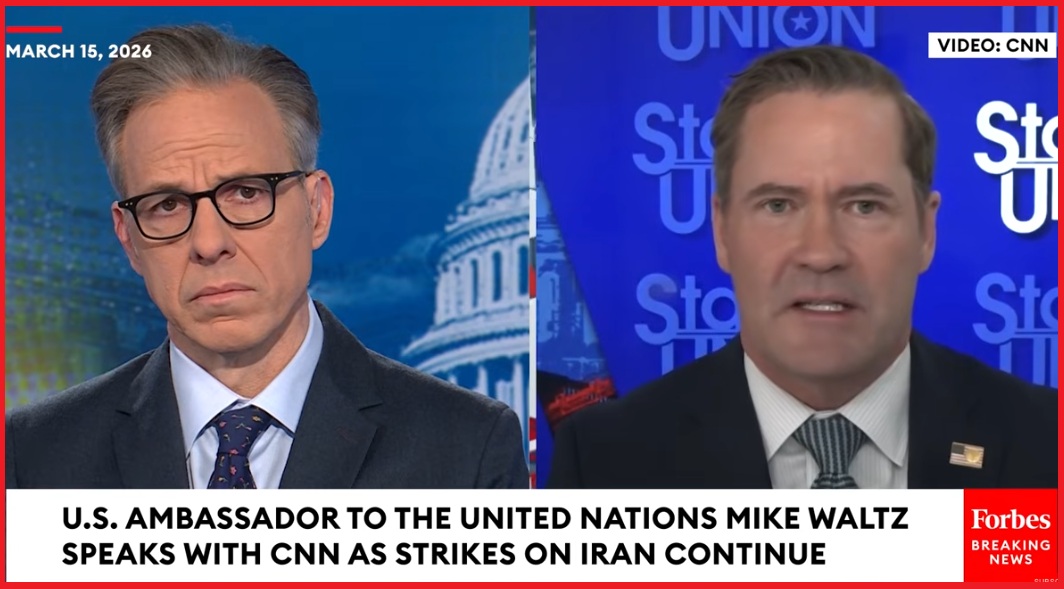
Perhaps the Ellison effect is actualizing inside CNN, but the insufferable furrowed brows of Jake Tapper were unusually non-combative today as he interviewed U.N Ambassador Mike Waltz while discussing Iran. [Video and Transcript Below]
[Transcript] – Joining us now to discuss, the U.S. ambassador to the United Nations, Mike Waltz, a former Green Beret who served in Afghanistan and the Middle East.
Ambassador Waltz, thank you so much for joining us.
The president just said that the U.S. has beaten and completely decimated Iran, both militarily, economically, and in every other way. Help us understand what that means, that Iran has been beaten. Does that mean that U.S. service members will soon be coming home?
MIKE WALTZ, U.S. AMBASSADOR TO THE UNITED NATIONS: Well, Jake, let’s just unpack that for a moment.
Militarily, the U.S. military has decimated Iran’s air force, their air defenses, their missile capability, their missile production capability. This has been a dominant victory, the likes of which we haven’t seen in modern American military history, economically, the maximum pressure campaign that President Trump put in place his first term and reinstituted the second — as the second major item, executive order that he signed this term.
Their currency is tanking. Their foreign reserves are completely depleted. And that’s why you saw the most recent uprising. You saw the uprising based on economic terms. And then, diplomatically, we just saw this week at the U.N. Security Council 135 nations — Jake, it was a U.N. record — 135 nations side with the Gulf Arab countries and condemn the GCC — excuse me — with the Gulf Arab countries, the GCC countries, and condemn Iran for its atrocious attacks on civilian infrastructure, ports, airports, hotels, resorts. And, as I pointed out at the Security Council, I don’t see how the regime argues that those are military targets. They are clearly not, and they are clearly deliberately targeting civilian infrastructure.
And I have got to tell you, this shoot-in-all-directions strategy that Iran has taken on is backfiring. They have never been more diplomatically isolated. Just one more point. Russia and Iran had an opportunity to veto that measure, and they stood back and did not. They abstained.
So, with friends like those, I think Iran is going to stay incredibly isolated.
TAPPER: You said Russia and Iran abstained. I assume you meant Russia and China abstained.
WALTZ: Excuse me, Russia and China. That’s right.
TAPPER: Yes. Yes.
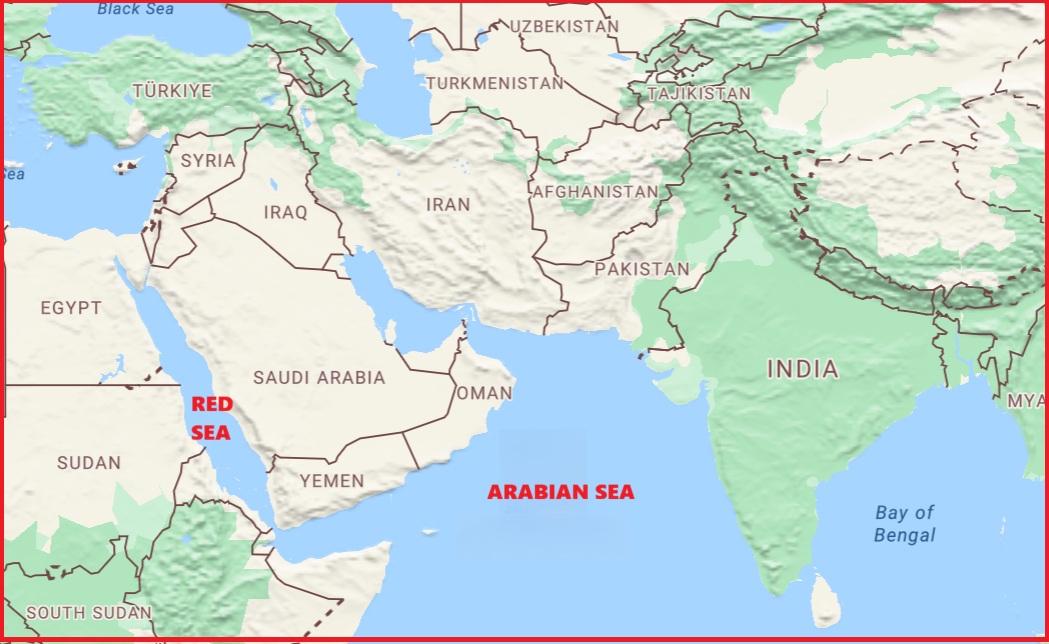
So, is he willing, the president, to accept an end to the war that leaves whatever of the regime is left still in place, the new ayatollah as supreme leader? Because it sounds like — the way you describe it, it sounds like President Trump, with the exception of the stranglehold that the Iranians have of the Strait of Hormuz, it sounds like everything has been achieved pretty much, with the possible exception of a new regime, which was not one of the specific goals.
WALTZ: Well, the president has said he’s not happy with this new nominated Mojtaba Khamenei, who, by many accounts, is an incredibly hardline individual, a hardline cleric.
We will see if he’s actually really in charge. As Secretary Hegseth said, he was wounded during the initial strikes. And it’s unclear that he really has control of the country, if he’s even alive at this point.
So, look, I will leave it to the president where he decides and when he decides and on what terms he decides as commander in chief to end hostilities. But I think the important point here is, the United States has never been in such a position of strength and the Iranian regime has never been in such a position of weakness when it comes to its options.
TAPPER: Despite U.S. strikes on military targets on Iran’s key oil hub of a Kharg Island Friday night, Iran says that oil production on the island is proceeding normally.
If Iran does not reopen the Strait of Hormuz, is President Trump prepared to target those oil facilities, which, as you know, handle 90 percent of Iran’s crude oil exports? And, if so, are you worried that that could risk even more of an escalation when it comes to the Strait of Hormuz? WALTZ: Well, President Trump is not going to take any options off the
table, Jake, and he pointed out in his TRUTH where he announced the military infrastructure strikes on Kharg, which, by the way, they use to project their fast boats, drones and other types of attacks on — into the Gulf, that he deliberately hit the military infrastructure only for now.
And I would certainly think he would maintain that optionality if he wants to take down their energy infrastructure. But we have to take a step back, Jake. I mean, look at what they’re doing to global energy supplies. Look at what they’re trying to do in terms of constraining the world’s economy with drones and boats.
One could only imagine if they had a nuclear arsenal or if they had a nuclear weapon. That’s what many of these Gulf Arab countries have woken up to, that they now realize, and why they have been so supportive and are standing with us as we seek to ensure this regime can never have a nuclear weapon, which President Trump has been consistent about for 10 years.
TAPPER: If not longer.
WALTZ: Yes.
TAPPER: President Trump said that the Navy, the U.S. Navy, is going to begin escorting tankers through the Strait of Hormuz and that will begin very soon. And he said — quote — “Many countries will be sending warships to keep the strait open and safe” — unquote.
The administration has been talking about potential Navy escorts for more than a week now. Shipping executives tell CNN that all their requests for escorts have, as of now, been rebuffed. President Trump said — quote — “Hopefully, China, France, Japan, South Korea, the U.K. and others will send ships to the area” — unquote.
Is he hoping that those countries are going to send ships or have they committed to sending ships? And how soon will those naval escorts be ready?
WALTZ: Well, I will leave those conversations to him. The conversations are ongoing.
I think there’s an important point that’s getting kind of missed in the conversation, that 80 percent of the oil coming out of the Gulf heads to Asia. Only about 7, 8 percent heads to the Western Hemisphere. And thank God for President Trump’s energy dominance agenda, everything from opening up ANWR, new pipeline in Alaska, incentivizing fracking, what we’re going to see come out of Venezuela and Guyana in the coming months and years.
This is why we have to be energy-independent. And I have to just say it’s a little rich coming from the progressive left, who has literally been at war against oil, literally were putting policies in place to drive up the price of oil in order to force Americans to buy E.V.s and go to wind and solar, are now suddenly celebrating it or decrying the lack of it.
Like I said, it’s a little bit rich. We have the energy dominance in place. But, to your point on escorts, look, back, in the ’80s, under the tanker wars then, the last time Iran tried to constrain global energy supplies, you had French, United Kingdom, even Soviet Union forces in there escorting their tankers out that were heading to their markets.
And I think that’s what President Trump is calling upon the world, saying the entire world is affected. Iran can’t hold your economies hostage. And we certainly welcome, encourage, and even demand their participation to help their own economies.
And, meanwhile, the U.S. military will continue to pound the Iranian military, their missile, boat and drone forces to keep the straits open.
TAPPER: Sources tell CNN that Russia has been providing Iran with intelligence to help Iran better target U.S. service members. You said in an interview last week that President Trump will — quote — “deal with it accordingly.”
Here’s what President Trump had to say about this on Friday.
(BEGIN AUDIO CLIP)
BRIAN KILMEADE, FOX NEWS ANCHOR: Do you think Putin is helping them?
TRUMP: I think he might be helping him a little bit, yes, I guess. And he probably thinks we’re helping Ukraine, right? China would say the same thing. You know, it’s like, hey, they do it and we do it, in all fairness. They do it and we do it.
(END AUDIO CLIP)
TAPPER: Do you see an equivalence between the U.S. helping Ukraine defend itself and Russia helping Iran target U.S. service members?
WALTZ: Well, Jake, we have known that Russia and Iran have this symbiotic, have this strategic partnership for some time now.
I will tell you what Russia has lost out of this. They have lost their biggest manufacturer of the Shahed drones. Russia’s been licensing those drones for quite some time and hitting Ukraine with it, all the more reason why we need to defang this regime and all the more reason that they cannot have a nuclear weapon.
And I will just point out too, because a lot of critics out there are making hay of this, it was President Trump that put sanctions on Russia’s largest oil producer, Rosneft. He also put sanctions on Lukoil. The Biden administration did not do that for many years.
They only did a kind of a pinprick action at the very end of the administration. He also took tough action on India. And now he’s put a temporary pause on that in order to calm energy markets. I think these are all pragmatic, commonsense approach — approaches,
while we deal with the Iranian regime.
TAPPER: But, surely, surely Russia helping Iran target our service members is upsetting and distressing, and action needs to be taken.
WALTZ: Well, I’m not going to get into leaked assessments of what intelligence is being provided or not. I just can’t and won’t do that.
But I will tell you, if they are doing it, it certainly hasn’t been affected — or effective, excuse me, because the Iranian air force, air defenses, missile forces, and Navy have been completely decimated.
TAPPER: All right, Ambassador Mike Waltz, thank you so much. Appreciate your time today, sir.
WALTZ: All right, thank you.
 Centinel2012