Posted originally on CTH on April 23, 2026 | Sundance
Following direct remarks from both Commerce Secretary Howard Lutnick and U.S. Trade Representative Jamieson Greer, a triggered Canadian Prime Minister Mark Carney says the U.S. will not be permitted to dictate terms of the USMCA renegotiation, now scheduled for formal talks with Mexico only beginning May 25th.
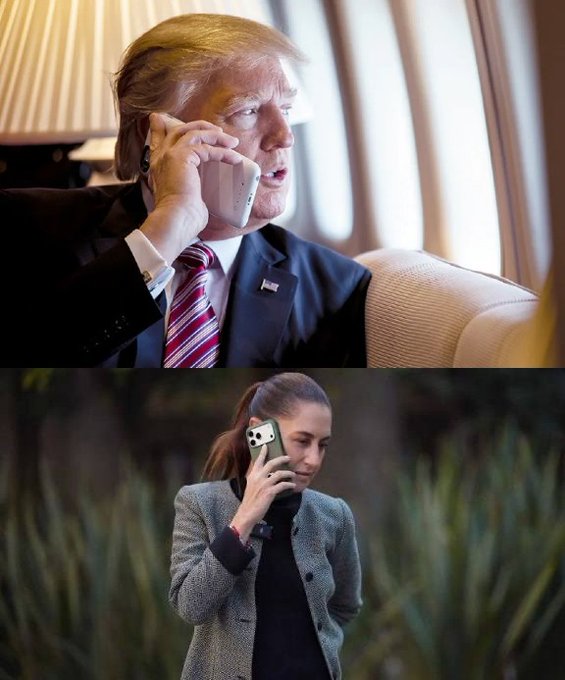
According to the Canadian leadership they do not need the United States in order to maintain their economy. The unfortunate people of Canada are very close to finding out exactly what that level of arrogance delivers.
USTR Jamieson Greer was just in Mexico meeting with Mexican President Claudia Sheinbaum and the Mexican trade delegation. “Mexico’s economy minister Marcelo Ebrard said on Monday that formal negotiations to review the U.S.-Mexico-Canada trade pact, known as the USMCA, are due to begin the week of May 25.”
“Tomorrow and this afternoon we will hear the U.S. side’s views. Once that is done, we will move on to the next phase, which is formal negotiations. We expect formal negotiations to begin the week of May 25,” Ebrard said following a meeting with U.S. Trade Representative Jamieson Greer.” {source}
Meanwhile Canadian Prime Minister Mark Carney continues talking to his domestic audience about fighting Donald Trump and refusing to accept any terms that do not meet his current pontifications: “It’s not a case that the United States dictates the terms. We have a negotiation, we can come to a mutually successful outcome – it will take some time,” he continued.
In Washington, Trade Representative Jamieson Greer said unless Canada engaged in talks about broadening the so-called rules of origin that allow goods to enter the United States tariff-free, Washington might have to impose other border controls. {source}
As the rhetoric continues increasing, the possibility of a full block against the import of Canadian goods increases.
It is worth remembering, the recent Supreme Court decision that overturned the IEEPA tariffs also reinforced the unilateral power of the U.S. President to regulate any/all trade with any foreign country including a full block of trade if designated. Canada is positioned to be the first nation to discover the expressed power of the U.S. President as affirmed by the United States Supreme Court.
One of the reasons why Canadians are oblivious to the potential collapse of their economy is because U.S. media reports are blocked from Canadian social media sites. One of the infringements within the USMCA is the Canadian Law Bill [C-18, the Online News Act] that blocks information to Canadian citizens that is not supported by the Canadian government.
The people of Canada are stuck inside an Orwellian government constructed echo-chamber unable to hear opposing viewpoints. They simply have no idea what is heading in their direction. Which is incredibly ironic considering how much Mark Carney rails against Russian President Vladimir Putin, yet Canada has more restrictions on information than Russia. Think about it. The need for control is a reaction to fear.

This information control dynamic helps to explain why Canadians, in the aggregate, simply do not realize the nature of the trade conflict that has been created by their own government. Perhaps a full 30-day blockade would help their eyes to open; perhaps not. However, something needs to happen in order for the Canadian people to have time to prepare for the economic collapse soon to fall upon them.
On June 1st Jamieson Greer anticipates telling congress that the U.S. intends withdrawal from the USMCA (CUSMA), pending unilateral negotiations with both Canada and Mexico to resolve conflict. Greer described two different protocols within any negotiation to deal with the structural differences between both Canada and Mexico.
Those differences include a completely different import/export profile with each country, different sectors of goods, difference in the wage rates within each country and a structural difference in the way each country is establishing their own, independent free trade agreements with other third-party countries. These baselines form the reason to tell congress of the dissolution, and on July 1st inform both Canada and Mexico about it.
In the interim, the points of conflict are currently being negotiated with Mexico toward resolution. Hence Jamieson Greer in Mexico meeting with officials on Monday and Tuesday.
It is not just Commerce Secretary Howard Lutnick and U.S. Trade Representative Jamieson Greer who are publicly warning the Canadian government about what lies at the end of this self-destructive path they have chosen, Deputy USTR Rick Switzer recently also sounded the alarm. WATCH (prompted):
The Canadians have been talking to U.S. media looking for sympathetic ‘Orange man bad’ coverage. However, within the contacts between Canadian government officials and U.S. corporate allies, the sentiment from team Trump is very clear:
“The key thing that has struck me, and I think it has struck all Canadians, is so many of these guys in the Trump administration, frankly, they just hate Canada,” said Brian Clow, former Prime Minister Justin Trudeau’s deputy chief of staff who led Canada-U.S. affairs. {source}
It’s not hatred, it’s annoyance.
Years of compounding parasitic annoyances and sanctimonious, ‘holier-than-thou’ pontifications from the arrogant and uppity Canadian government.
The only time Canada has been honest with themselves and with President Trump was when Justin Trudeau was exiting office and admitted Canada cannot function without all of the one-way benefits it receives from the USA {GO DEEP}.
When President Trump was asked about Prime Minister Mark Carney creating a new trade agreement with China, President Trump responded that he didn’t care – it was irrelevant to him. Yet, simultaneously inside the USMCA President Trump has the power to veto any trade agreement between Mexico or Canada and a non-member nation.
So, why didn’t President Trump care? Easy, because in President Trump’s mind there’s not going to be a USMCA; so, he really doesn’t care if Canada runs to violate it. In real terms, Canada doing bilateral deals with other countries, especially deals potentially detrimental to the USA, only strengthens his position on dissolving the USMCA.
If Canada violates the terms and spirit of the USMCA, it makes dispatch of the unliked trade agreement even easier. Canada is helping President Trump remove the congressional justification they could use to block him. If Canada is violating the USMCA (CUSMA), Congress is kneecapped from interference.
Provoking Canada into a trade position, that puts them at a disadvantage trying to stop the dissolution of the CUSMA, stops Congress from opposing the fracture, and then opens the door to a bilateral trade agreement, is creating a self-fulfilling prophecy that is entirely controlled by President Donald Trump.

Both Canada and Europe are independently, out of necessity, taking action that takes apart the trade and economic system they created. At the core of the old trade system both Canada and Europe were exploiting the USA, exfiltrating wealth and skimming the independent entrepreneurial innovation that originates from within the U.S. economic system.
That necessary exploitation happened because the USA is innovative (freedom-based capitalism), while the CA/EU system is built on government control mechanisms. The CA/EU energy policy is just one impactful example of their pontificating inability to be insightful when it comes to consequences. The EU and Canada are now stuck looking for markets that will do the dirty jobs, provide them with core components, while simultaneously looking for markets for their finished products.
On the other side of the approach is President Trump, working to expand U.S. industrial dirty job capacity, create our own core components, then create finished goods entirely on our own. A complete revitalization of the U.S. industrial and manufacturing base. Our U.S. GDP is currently expected to grow north of 5%. This is not happening by accident.
♦ SUMMARY: Some people have construed the bilateral trade preference of President Trump to be the elimination of globalism in favor of nationalism in trade agreements. While the outcome of Trump’s approach indeed aligns with that theme, it is not specifically the objective of President Trump to eliminate global trade, but rather to focus on specific interests in trade that benefit the unique nature of each party involved.
Canada can embrace China, and Europe can embrace India; in the bigger picture it really doesn’t matter. These relationships only create dependencies which are the natural outcome of globalism. From President Trump’s position, what really matters is what happens within our borders and how the United States economy is positioned. This is President Trump’s singular focus.
Do you remember President Trump leaving the 2025 G7 meeting in Canada early? The final day invitation list brought Australia, Mexico, Ukraine, South Korea, South Africa, India, the United Nations and the World Bank into the G7. President Donald Trump smartly exited the G7 assembly a day early, he departed before that crowd of interests arrived. The world leaders came because the process to keep USA wealth inside the USA is against their interests. That’s why they came, and that’s why President Trump left.
Globalism, in its economic construct, is a series of dependencies. However, the opposite is also true. If nations are not dependent, they are sovereign – able to exist without the need for support from other nations and systems. If nations are sovereign, then globalism is no longer needed.
If each nation of the world is operating according to its individual best interests, the position of Donald Trump, then what happens to the governing elite who set up the system of interdependencies?