
Posted originally on CTH on July 2, 2026 | Sundance
This next storyline needs context to understand appropriately what just happened.
In February of this year, German Chancellor Friedrich Merz travelled for the first time in his business and life to China. Merz a lawyer by training, worked in business and corporate life doing mergers and acquisitions (Blackrock), but had never been to China. Despite his upward climb in German politics, his worldview was always dominated by an internal acceptance that Germany was the industrial heart of the European Union.
Chancellor Merz believed that Germany was unrivaled within industrial manufacturing, particularly in aeronautics and mechanical engineering (auto sector). So, when Merz went to China -while he held no trade capabilities as an outcome of the EU collective controlling everything- he also had no idea what Chinese industrial capacitary actually looked like.
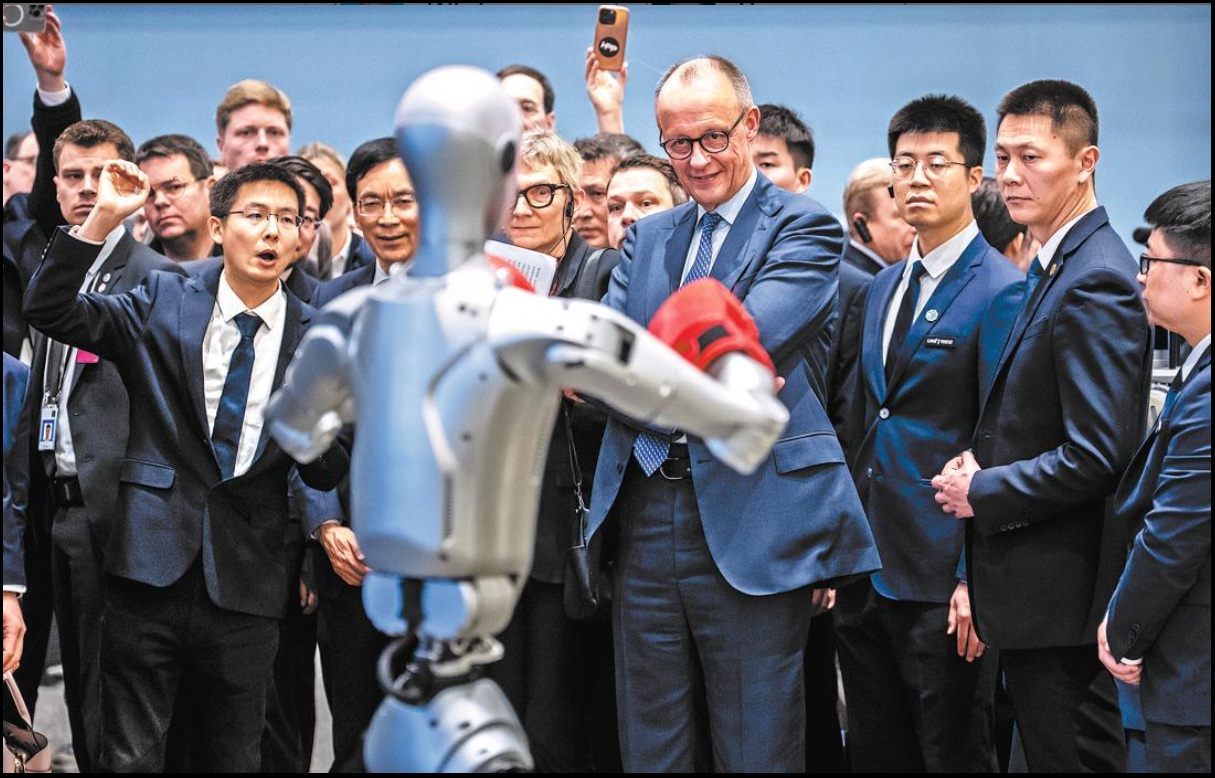
To say Chancellor Merz was stunned by the advancements in robotics and industrial manufacturing within China would be an understatement. Merz was shocked not only by the technological capability, but also by the Chinese industrial work ethic and capabilities of the workforce.
Merz returned to Germany and immediately began discussing how Chinese industrial capacity was far beyond anything he previously estimated. Merz was shook. His reaction was, essentially, the #1 industrial nation within the EU confronting a reality of years of industrial complacency. Immediately he began talking about how things in Germany must change; how the German workforce must immediately start to get serious about productivity and production capacity.
That was late February and early March.
Today, Friedrich Merz announced a series of reforms, radical modifications within the German industrial workforce.
German workers are no longer allowed to call in sick. The German government will now adopt a policy to make sure all workers report to their jobs, or else.
.
The German workforce may not like this at all.
There is a certain, shall we say, “Fascist irony,” when you think about mandated private sector productivity compliance and the relationship with official government policy.
Germany’s coalition government has announced a wide-ranging package of pension, tax and labor reforms aimed at boosting economic growth and strengthening competitiveness. Chancellor Friedrich Merz said the measures would create jobs, reduce bureaucracy and preserve key social welfare protections.
The 34-point plan includes income tax relief for low- and middle-income households as well as a gradual increase in the retirement age.
.
 Centinel2012