Moscow and Kiev Exchange Warehouse and Distribution Attacks, But Only One Side Feels Impact


Posted originally on the CTH on August 29, 2026 | sundance 

I mentioned this last night, and now more solid reports have emerged. Basically, Ukraine and Russia are taking turns striking each other’s warehouses and distribution centers with missiles and drones. However, the brunt of the damage and chaos is being felt only by one side—Ukraine.

Zero Hedge has a solid article explaining the dynamics:

A Russian drone struck a Ukrainian Defense Forces ammunition storage site in the village of Myla Friday evening, just west of Kiev. The resulting fire and hours of secondary detonations killed at least 37 people, injured dozens more, damaged around 50 residential buildings and a care home for the elderly and disabled, and forced the evacuation of hundreds. Among the dead was the local community head who had gone to help.

In response, Ukrainian President Volodymyr Zelensky said ¹the placement of a weapons depot next to civilians was “terrible negligence.” The first impact, he said, hit a depot storing shells, mines, other munitions, and drones that “definitely shouldn’t have been there” – while prosecutors in Kiev opened a criminal investigation into the legality of storing explosives next to civilian housing. This is the second such incident in two months. A July strike on a depot in nearby Vyshneve produced similar secondary blasts, deaths, and later detentions of state defense-company executives.

Russia’s Defense Ministry said the Myla site held components and launch boosters for long-range drones. It also claimed strikes on Flamingo cruise-missile related facilities in the Kiev region and on the ports of Mykolaiv and Izmail. Social-media claims that Patriots were stored there remain unconfirmed by official Ukrainian statements.

Here comes the fact that few in the west understand:

Friday night’s blast came amid a multi-day Russian campaign of jet-powered drones and missiles that has produced near-continuous air-raid alerts over Kiev and hit warehouses belonging to supermarket chains, postal operators, retailers, and logistics firms. Ukraine Agriculture Minister Taras Vysotskyi told reporters that, “roughly speaking,” about 90% of the food-logistics infrastructure used by major retail chains (large distribution centers serving networks such as Fora, Silpo, NOVUS, and Varus) has been destroyed.

[…] Both sides have been systematically striking each other’s logistics and dual-use commercial infrastructure. […] Zelensky’s government has framed its own long-range strikes as a way to force Russia to negotiate. (more)

You can hit centralized Russian distribution centers and not accomplish any material impact to the people of Russia.  However, if you hit centralized Ukraine distribution centers, chaos and crisis quickly surfaces for Kiev residents.

The why is not complicated.

Metropolitan Russia, home to more than 75% of the population, was set up around the concept of govt planned precincts.

Each few buildings you will find a generally useful grocery store, a bakery, a coffee shop, a pharmacy, a utility store, tobacco, produce shop etc. all within immediate walking distance.

EX. Bread is made in each bakery; made, not just taken out of a box. Actually made.

They set it up that way a long time ago during the Soviet era.  Now, over time stores are different, but the planning never changed.  The people of Russia also operate Dacha Gardens all over the urban sprawl and suburban areas.

“Gardening as provided food for the people of Russia for over 1,000 years, starting as mainly subsistence or survival gardening and evolving into an independent, self-provisioning model between the Bolshevik Revolution and World War II and continues into today.”

Ukraine, we are told – even by former Defense Minister Fedorov, was convinced by western intelligence analysis that destroying the roughly 200 online Wildberries distribution centers it would cripple the Russian consumer economy.

Increased strikes did not yield the desired results.

Who in their right mind thought destroying regional Russian online warehouses would have some great impact? Russia is analog in a digital world.

However, conversely in our westernized, centralized, corporate consumer structures and logistics, we built distribution economies on centralized production and cost-efficient distribution, vis-a-vis Kyiv or Brussels etc.

Ex. The western bread for a hundred locations is made in one centralized or regional facility. Boxed, shipped and distributed for maximum efficiency and profit.

Bombing Russian distribution centers doesn’t have any impact on the precinct level operation. But taking out westernized regional hubs and distribution centers in Kiev can create immediate chaos.

That’s what we are seeing now.

Honestly, this is not complicated to analyze.  These are two completely different economic and logistic models.  One is centralized (Ukraine) and one is decentralized (Russia).  Attacking the logistics of a decentralized system creates no substantive impact.  Attacking the logistics of a centralized system creates major impact.

I think part of the reason the western news doesn’t make sense is because western media doesn’t understand Russia or pretend not to know things.

Apparently, the same applies to Western intelligence.
.

[¹People are starting to suspect that Director Ratcliffe told his Russian counterpart Sergey Naryshkin where the ammo was stored.]

Posted in ig Govrnment, CIA, Deep State, Military, NATO, President Trump, Russia, Ukraine, Uncategorized, United Kingdom (UK) and Great Britain

Caviar and Economics – Hamptons Yacht Club Cancels Restaurant Service After Staff Deported


Posted originally on the CTH on August 29, 2026 | sundance 

A small sideline story that reflects a combination of sociological and economic facets. A Yacht Club in the Hamptons of New York is forced to cancel their restaurant services after their staff is removed from the USA due to immigration enforcement.

The larger picture is well worth discussing, because there is a large and inorganic part of the U.S. economy that will obviously be impacted by immigration enforcement and the removal of illegal or unauthorized workers. First, from the Hamptons:

NEW YORK – An ultra-exclusive Hamptons yacht club catering to the wealthy and well-connected was forced to suspend its members-only restaurant service for multiple days after several of its kitchen staff were booted from the country over visa issues, The Post has learned.

The swanky oceanfront Devon Yacht Club in Amagansett — which reportedly charges around $100,000 in initiation fees — canceled its Wednesday night dinner service after its foreign cooks had to leave the US because of problems renewing their H-2B temporary work visas, according to a letter sent to members the same day.

Food service was also canceled Thursday and was not expected to be back up and running until Friday’s lunch service, the club informed its deep-pocketed members — a group that once included Jacqueline Kennedy Onassis’s parents.

[…] “It seems that an oversight either by the agent or attorney responsible for submitting our petition or perhaps by the US Immigration Office itself has resulted in a situation where our H2B kitchen staff must leave the country immediately and return to their home countries for at least 60 days before their visas can be renewed.” (read more)

Obviously, there is not a lot of sympathy for a bunch of elitists missing their Avocado toast and brunch options.  However, if we stand back and think about the scale of economic activity impacted by a return to a nationally organic labor force, we accept there are going to be major ramifications to a variety of businesses across a broad spectrum of sectors.

As a ‘let’s get on with it’ proponent of deporting all illegal aliens, cancelling H1B and J-1 visas as well as removing all Temporary Protected Status populations from the USA, we must also accept the very predictable consequences.

Due to the inorganic nature of corporatized economics built on the backs of foreign workers, right now there are thousands of businesses in the USA operating on an inorganic business model, that could never have been sustained without massive import of cheap foreign labor.  Additionally, there are billions of dollars in investment that was poured into the economy based on this inorganic and manipulated job market.

There are resorts and venues operating in the USA which never would have been built without a foundation of foreign labor to service them.  Take that labor force out of the economy and things will significantly change.  This outcome is both predictable and necessary to reset the labor market.

As all of these foreign workers are removed there is going to be massive pressure on the wage rates for American workers.  That’s a great benefit.  Simultaneously, there’s also some businesses that will never survive without that foreign labor pool because the business model itself was built upon a false foundation.

Most of the time we think about the service industries with workforces that are significantly staffed with foreign workers.  Hotels, resorts, restaurants, vacation destinations etc.  Many of these locations currently operating would never have found capital or investment in a true economy that was not built on illegal immigration, visas or foreign workers.  There are likely hundreds of resorts that exist only because the labor market is inorganic.

With a predictable rise in wages comes the increased operating costs and diminished profit return for the investors and owners.  This can have a major impact, but again, this outcome is due to fraud in the underlying business model.  Those businesses likely would never have started and the investment never would have been capitalized without the fraud it is dependent upon.

Take out the illegal aliens; remove the H1B visas and all other ancillary visa approvals and remove the protected status returning foreign workers to their country of origin, and U.S. wage rates and benefits will quickly increase as companies try to find a way to shift to a business model built upon real economics.

This rise in wages will be significant and that can create an inflation increase.  As wages increase in price, the operating costs increase.  The per unit business model then must adjust and things like hotel rooms go up in price.  As resort prices increase, they become unaffordable to the current target customer, that leads to lower sales and decreased revenue.  However, that natural dynamic also returns organic competition to a market that has been missing competition for decades.

It’s not just about the service industries.  As the labor market contracts, wage rates for blue collar construction and manufacturing jobs also increase.  This can lead to higher consumer prices during the painful phase as the natural market balance is restored.  Again, many businesses will not exist because many businesses never would have existed without the baseline of imported foreign workers.

Sectors of the economy will shrink just as the restaurant service in the Hamptons has been reduced.

There will be more housing available and rent prices will return to market competition.  New construction homes will be more expensive to build, but less demand for the finished product brings back incentives and competition.  Overall home prices for preexisting homes will likely drop significantly; however, on the upside with increased wages and lower home values the younger generation will have the opportunity for home ownership.

The U.S. population is roughly 350 million.  There are roughly 170 million civilians in the eligible labor market.  If you take out 50 million illegal aliens, then do the math and you will quickly realize how many inorganic or excess businesses are in operation.

Thousands of restaurants will go out of business, because thousands of restaurants never had a real business model to maintain their existence.

The labor fraud created a fraudulent economy, and this reset is going to be significant.

Russia Begins Targeting Dual Use Infrastructure in Kyiv, Tens of Thousands Flee the Region


Posted originally on the CTH on August 28, 2026 | sundance 

Russian Federation President Vladimir Putin has been remarkably reserved and selective in his targeting, considering the scale and capability of the massively armed nation to obliterate Ukraine metropolitan areas.

Russia absorbed all the Ukraine attacks on Wildberries warehouses for all the reasons CTH previously noted.  Ukraine was convinced by western intelligence analysis that destroying the roughly 200 Wildberries distribution centers would cripple the Russian consumer economy.  However, increased strikes did not yield the desired results. Duh.

Ukraine then added Ozon to the target list, another online retailer for everyday items similar to Amazon (even with similar name).

Ukraine began targeting Ozon warehouse and distribution centers shortly before they began more parcel and car bomb attacks against strategic Russian military officers.

It’s almost like Western intelligence do not understand how resilient Russian consumers are.  Russia is considerably analog in an almost exclusively western digital world.  Perhaps that’s the disconnect, but I would think with the cultural connections between both nations, Ukraine would know better.

Then again, is it really Ukraine strategizing the war?

Regardless, Vladimir Putin has now taken the restrictions away from dual use infrastructure in/around Kyiv, and for the past two days Russia has continued to launch relentless volleys of missiles and drones at Kyiv warehouses.  Overall, during the two days of Russian attacks, 17 warehouse facilities, 16 private houses, three apartment buildings and 16 vehicles were damaged in Kyiv region. {source} It’s the retaliatory version of FAFO.

Western Ukraine (Kyiv region) is very ‘western’, very western.  Eastern Ukraine, not so much.  Suddenly the nightclubs, dance clubs and entertainment districts in/around Kyiv (Kiev) are empty.

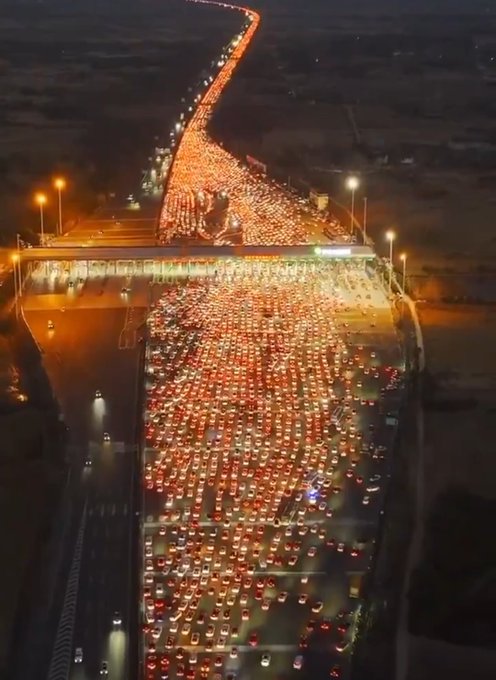
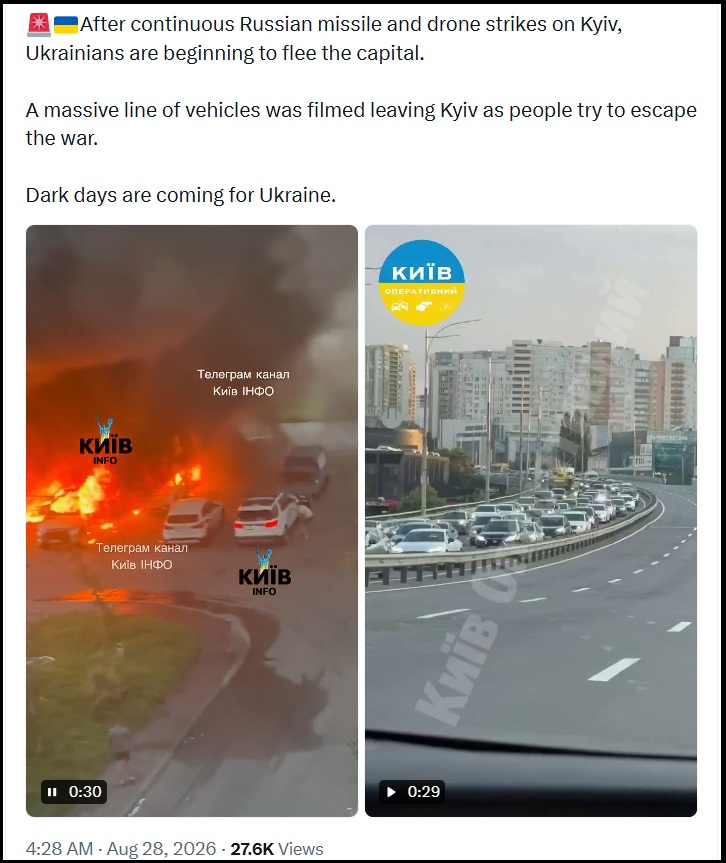
What is now beginning to be shared on background alternative media is the scope of exodus from Ukraine (picture above left).  Thousands of Ukrainians are now fleeing every day.

KYIVPOST -Russian forces struck Nova Poshta warehouse facilities in the Kyiv region early Friday, Aug. 28, then hit the same site twice more as firefighters were battling the resulting blaze, local authorities said.

The initial strike targeted warehouses in the Bilohorodka community, damaging a nearby production facility in Sviatopetrivske, according to Anton Ovsiienko, head of the Bilohorodka village council.

Nearly an hour later, while emergency crews were still fighting the fire, Russian forces launched two more strikes at the same location. Firefighters and other specialists managed to move to a safer area before the additional impacts, Ovsiienko said.

The Nova Poshta strike was part of a broader overnight Russian assault that repeatedly targeted logistics infrastructure across the Kyiv region.

Overnight on Aug. 26-27, Russian drones and ballistic missiles caused fires and damage at several warehouse facilities across the region, the Kyiv region Governor Tymur Tkachenko said.

A warehouse in Boryspil district caught fire, while facilities in Fastiv district were damaged. Private homes were also damaged in Brovary and Vyshhorod districts. There were no initial reports of civilian casualties.

Local residents published footage showing fires and reported that warehouses belonging to Ukrainian online retailer Rozetka and retail group Fozzy Group were among those hit. Those reports have not been independently confirmed. (read more)

This conflict fascinates me; in part because of the western media and EU/NATO propaganda behind it, and in part because the vast majority of westerners do not understand the cultural dynamic at play in this conflict.

There are no old men in Russia.  Go set up a cctv camera on a crowded street and look for men over 70 years-of-age.  You won’t find them.  Russia never had a baby boom after World War II.  Men were slaughtered by the millions.  Russia has a lot of old women, but old men – they are as scarce as a pregnant Chinese woman.

Gen-X, Millennials and now Gen-Z males are required to spend two-years in military service.  Almost all Russian men know how to war, and the Ukraine conflict is creating another generation of hardened war fighters.  I do not believe the “reported” Russian casualty counts, because if they were accurate, I would have run into families of the lost servicemembers during my visits; I have not.  A few dozen wounded (usually leg wounds) have been visible in two very cautiously organized visits to veterans’ hospitals.

If a million Russian soldiers were dead (western reporting), there would be signs of that scale. There are not.  In a nation of 143 million people, with well below half being males, a million dead out of 50 to 60 million would be very visible.  There are no signs of that.  The median age is 40.

As the ‘war’ enters its fifth year, Russia is assimilating the Donbas region in the East and fortifying territorial gains.  Ukraine is fighting Russia using western technology as a strategic advantage, but the strikes and attacks into mainland Russia are not consequential.  Russia is nowhere close to the level of severe economic hardship that western media and pundits proclaim. It’s just not.

Culturally, Russians are not ‘resilient’ in the western sense of the word.  Russians are pragmatic, deliberate and hard as a matter of cultural pride.  Jungle gyms, rope ladders, metal slides with sharp edges, rope swings and all that physical playground stuff you grew up with that western insurance companies eventually deemed too dangerous, are still in use and being built.  7-year-olds fall on concrete with reckless abandon, scrape their skin, stand up and keep playing.

Moms and dads don’t flinch.

Russia is analog in a digital world.  Stuff gets fixed quickly. No-one is sitting around waiting on an $800 microchip for repair.  You want water in a bathroom; you turn a knob – not wave your hands.  When the internet is turned off, no one twitches.  Phone calls do the job just fine and pens with paper transfer instructions to whoever needs the task.  They still sell maps.

Russians walk a lot, go shopping, in actual stores and stuff.  This is why bombing Russian online warehouses is far less effective than if you took down Amazon in the USA. If you forget something, or if you just don’t want to go out, you text the company or use an app and a guy on a moped shows up and hands it to you in a plastic bag; no delivery fee. It’s weird.

Remember, metropolitan Russia is set up with govt planned precincts. Each few buildings have a generally useful grocery store, a bakery, a coffee shop, a pharmacy, a utility store, etc. all within immediate walking distance.  They set it up that way a long time ago, and the stores are different, but the planning never changed.

  • 75.4% of the Russian population is urban (108,135,895 people in 2026) {source}

I say all of this to question myself about who in their right mind thought destroying regional Russian warehouses would have some great impact.  It’s akin to stomping individual ants.

This approach is not going to ‘destroy’ the Russian economy. However, in the westernized and centralized western consumer structure built on economies of scale and cost-efficient distribution, vis-a-vis Kyiv or Brussels etc., taking out regional hubs and distribution centers might just create some chaos.

When the power goes out or the internet stops working in our culturally convenienced western world, we start to get twitchy really quick.  In Russia they just grab a lantern, read a book – the actual paper kind – eat a sandwich or go for a walk.  Adults can also sit on benches and watch dogs for hours, without having a sense they need to be doing something.

I think part of the reason the western news doesn’t make sense is because we don’t understand Russians.

Think about conscripting Gen-Z and younger Millennials in Europe or America.  Think about the young people you know around you.  If they were pushed to a war-fighting disposition, how would they react without all their gadgets?

Russia is an entirely different kettle-o-fish.

It’s not better, it’s just different.  However, for this part of the hardcore existential stuff, they’re patriotic and hard.

We’ll keep watching.

Goodbye Canadian Oil – President Trump Announces “Biggest Oil Deal in World” with Venezuela


Posted originally on the CTH on August 28, 2026 | sundance

Secretary of State Marco Rubio has quietly been the lead on this initiative.  The discussions with Venezuela were working along slowly in the background as the negotiations with Canada on trade were proceeding.  Today, Canadian oil is replaced.

BREAKING NEWS: The United States of America has just entered into an Agreement with the Country of Venezuela on, THE BIGGEST OIL DEAL IN WORLD HISTORY! At my direction, Secretary of State Marco Rubio, and Secretary of War Pete Hegseth, working closely with Highly Respected Interim President of Venezuela, Delcy Rodriguez, and, through a partnership with private business, have secured majority U.S. control of more than 65 BILLION BARRELS of proven Oil Reserves in Venezuela, at no cost to the American Taxpayer.

This Historic Transaction MORE THAN DOUBLES American Oil Reserves, greatly increases our Oil Supply, and will substantially lower Gas Prices for all Americans, long into the future, while helping to continue to set Venezuela on a course toward Tremendous Success and Great Prosperity. This Transaction will greatly strengthen the already growing relationship between Venezuela and the United States! Thank you for your attention to this groundbreaking matter. MAKE AMERICA GREAT AGAIN!

~President DONALD J. TRUMP

No need for President Trump to mention Canada, the message is clear.  We can now reverse those north-south pipelines and pump heavy Venezuela crude oil north into U.S. refineries for transition into Canadian fuel.

If the USA no longer needs oil from Canada, but Canada relies on fuel from the USA….  Well, how does that energy leverage work out?

Danielle Smith has no idea what’s coming.

ICE Arrests Milo Yiannopoulos for Overstaying Visa Pending Deportation and Removal


Posted originally on the CTH on August 28, 2026 | sundance

Notorious provocateur Milo Yiannopoulos has been arrested by ICE enforcement in Louisiana and is in custody awaiting deportation.  Milo was a semi-regular guest on popular podcasts followed by young Millennials and counterculture Gen-Z.  The guy was a hot mess and came out of Steve Bannon’s stable.  Good riddance.

With a forced removal Yiannopoulos will never again be legally permitted to enter the United States.

VIA Homeland Security X Account – “On August 27, ICE arrested Milo Yiannopoulos, an illegal alien from the United Kingdom, at the Louis Armstrong New Orleans International Airport (MSY) in Kenner, Louisiana.

Yiannopoulos legally entered the country on May 14, 2019, through New York City, New York. He chose to overstay his welcome in violation of our nation’s laws.   Yiannopoulos was issued a final order of removal by an Immigration Judge on July 22, after failing to show up for his immigration hearing. He will remain in ICE custody pending removal.   

Being in detention is a choice. We encourage all illegal aliens to take control of their departure with the CBP Home App. The United States is offering illegal aliens $3,000 and a free flight to self-deport now. We encourage every person here illegally to take advantage of this offer and reserve the chance to come back to the U.S. the right legal way to live the American dream. If not, you will be arrested and deported without a chance to return.

VIA NBC – Milo Yiannopoulos, a self-described libertarian and professional internet troll who became known for his controversial right-wing political views, is in ICE custody.

A spokesperson for the Department of Homeland Security told NBC News that ICE arrested Yiannopoulos, a United Kingdom national, on Thursday at the Louis Armstrong New Orleans International Airport in Kenner, Louisiana.

The DHS spokesperson said Yiannopoulos legally entered the U.S. on May 14, 2019, through New York City, but then “chose to overstay his welcome in violation of our nation’s laws.”

Yiannopoulos was taken into ICE custody Thursday after “failing to show up for his immigration hearing” on July 22, prompting an immigration judge to issue a final order of removal against him, according to the spokesperson. “He will remain in ICE custody pending removal,” the spokesperson added.

Yiannopoulos has ties to Kanye West, known now as Ye, and previously served as the rapper’s chief of staff when Ye tried to run for president in 2020 and 2024. He also worked at Ye’s clothing brand “Yeezy,” but resigned from that job two years ago after the singer announced he was launching an adult entertainment studio under his Yeezy brand, TMZ reported.

Ye is scheduled to perform in Louisiana Friday night at the New Orleans Caesars Superdome. It’s unclear if Yiannopoulos was in the state to attend the concert.

A former editor of Breitbart, the conservative internet publication President Donald Trump once considered as one of his favorite news sources, Yiannopoulos resigned from Breitbart in 2017 amid backlash to his reported comments about teens and sexual abuse.

The DHS spokesperson said that the Trump administration is “working diligently to ensure that aliens in our country illegally can no longer fly unless it is out of our country to self-deport.” (read more)

President Trump Announces the United States Space Academy


Posted originally on the CTH on August 28, 2026 | sundance 

President Trump has signed an executive order [SEE HERE] establishing the United States Space Academy. “To continue to lead the world in space exploration and technology, while securing and defending our national interests in space, the Nation must prepare the next generation of astronauts, scientists, engineers, operators, entrepreneurs, civil servants, and warfighters and ensure that they are capable of advancing American interests in space.”

The Order establishes the Presidential Commission on the United States Space Academy, chaired by the NASA Administrator. [FACT SHEET] The Commission will advise and assist the President on establishing the United States Space Academy, a proposed NASA-led federal academy dedicated to combining rigorous technical education with leadership development, discipline, and a durable commitment to public service.

The United States Space Academy will combine rigorous technical education with leadership development and public service, preparing graduates for careers supporting America’s military, civil, and broader space enterprise. (read more)

.

BUILDING AMERICAN STRENGTH AND DRIVING ACHIEVEMENT: President Trump has demonstrated consistent leadership as a driving force for American strength and achievement in space. 

    • President Trump spearheaded the establishment of the Space Force, the first new branch of the Armed Forces since the creation of the Air Force more than 70 years ago. The Space Force is critical to preparing the Department of War for evolving warfighting conditions and expanding our capabilities.
    • During his first term, President Trump issued seven groundbreaking Space Policy Directives that instructed NASA to return American astronauts to the Moon and beyond through the Artemis Program, reformed our Nation’s commercial space regulatory framework, established cybersecurity principles for space systems, and much more.
      • In April 2026, America sent astronauts on Artemis II to lunar orbit for the first time in over 50 years.
    • In August 2025, President Trump signed an Executive Order enabling competition in the commercial space industry to ensure the United States maintains its leading role in the commercial use of space.
    • In December 2025, President Trump signed an Executive Order setting a bold vision for an America First space policy to ensure the United States leads the world in space exploration, security, and commerce.
    • In July 2026, the Federal Aviation Administration issued a significant proposed rulemaking to waive burdensome environmental reviews for launch infrastructure and enable a commercial space launch renaissance.
    • In August 2026, President Trump signed a National Security Presidential Memorandum reinvigorating America’s leadership in space transportation and enabling over 1,000 launches and reentries on American soil annually by 2030.

Washington Wants to Turn Chinese Banks Into the Next Battlefield


Posted  Originally on Aug 28, 2026 by Martin Armstrong |  

US Sanctions

Lawmakers from both parties are pressing the Treasury to target Chinese banks over their business with Iran. Washington is taking a confrontation it has failed to resolve and looking for ways to extend it into the financial system of another major power. The assumption is that Beijing will eventually surrender its commercial interests rather than risk losing access to American finance. What happens if China decides that accepting Washington’s authority over its banks is more dangerous than resisting it? That is the question missing from the tough talk about making other countries pay.

Lawmakers are demanding action against Chinese banks that facilitate Iranian business. Supporters argue that cutting off financing would weaken Tehran’s ability to sustain its military activities. That argument deserves to be examined, but so does the mechanism. Sanctioning a major bank can affect far more than the transactions officials intend to stop. Depending on the restrictions imposed, unrelated importers, exporters, lenders, and investors could suddenly find payments delayed, credit withdrawn, or counterparties unwilling to deal with them. The politicians announce the punishment while businesses discover how widely the damage spreads.

US debt to China Buy Bullets

Treasury has already laid the groundwork. In April, it warned financial institutions about transactions involving Chinese independent refineries purchasing Iranian oil and explicitly raised the possibility of secondary sanctions. These measures pressure foreign institutions to comply with American restrictions by threatening their access to American finance. Washington is effectively telling a Chinese bank that its business with Iran can jeopardize its business with the United States. That is considerable leverage, but exercising it against a major financial institution carries a different order of risk from sanctioning an obscure trading company.

The administration has so far stopped short of that broader confrontation. Reuters reported that the August 24 sanctions package targeted 60 individuals, entities, and vessels but did not include major Chinese financial institutions. There is still a consequential decision ahead: whether to escalate against institutions whose connections extend well beyond Iran.

Dennis Wilder, a former National Security Council director for China, shared a passage from the Politico report describing action against large Chinese banks as the “nuclear economic weapon.” That description ought to make people pause. A major bank is part of the machinery through which companies obtain financing, settle invoices, manage currencies, and pay suppliers. Threatening that machinery introduces uncertainty into transactions that have nothing whatsoever to do with Tehran. Even before restrictions take effect, banks may retreat from permissible business because the cost of accidentally violating a sanction appears greater than the profit from serving the customer.

China warned of retaliation if its companies were affected by expanded sanctions, while major Chinese financial institutions remained outside the latest measures. China has economic pressure points of its own, including critical minerals and access to its domestic market. Washington cannot assume that financial coercion will produce a response confined to banking. A dispute over Iranian oil could become another confrontation over industrial supplies, export restrictions, and the ability of American companies to conduct business.

The connection to sovereign debt is equally uncomfortable. Governments want dependable access to international capital while making international finance more political and less dependable. If restrictions disrupt supplies or raise transaction costs, businesses face higher expenses and governments face pressure to subsidize the damage. If confrontation then produces additional military commitments, borrowing rises again. None of this guarantees a debt crisis, but it adds costs and uncertainty to fiscal systems already burdened by competing promises.

Economic warfare has given foreign governments another reason to question the safety of keeping their national wealth in Western financial assets. When selected Russian banks were disconnected from SWIFT and Russia’s central-bank reserves were frozen in 2022, the message extended far beyond Moscow: access to your money can depend on your relationship with the governments controlling the system. That has strengthened the incentive to diversify reserves, accumulate gold, and reduce exposure to assets that could become inaccessible during a political confrontation.

China understands that vulnerability and has been building greater industrial self-reliance while seeking ways to reduce its dependence on dollar finance. Beijing is working toward becoming self-sufficient and independent of the West for it knows the relationship is taken lightly. Washington wants other nations to trust its financial system with their savings while threatening to exclude them whenever their foreign policy conflicts with American demands. Every additional threat gives Beijing another argument for reducing the dependence that makes those threats effective.

Categories:War

LAWFARE: Federal Judge Again Blocks USPS Mail Ballot Requirement


Posted originally on the CTH on August 27, 2026 | sundance 

The same federal judge who had her injunction overturned by the Supreme Court has again blocked the United States Postal Service requirement for mail-in ballots.  The Lawfare communists refiled their lawsuit today, the judge ruled within hours. [Ruling Here]

The issue is at the core of leftist manipulation of elections as the blue states refuse to comply with DHS and Social Security cross-checks for voter eligibility prior to sending out mail-in ballots.  The blue states do not want their voter rolls cross-checked to verify citizenship status and voter eligibility. We can only guess the number of illegal aliens on the voter rolls.

(VIA AP) – A federal judge on Thursday halted — at least for now — attempts to implement President Donald Trump’s executive order limiting mail voting.

The move stalled the directive for a second time only about a week before the first mail ballots are due to be sent out for the rapidly approaching midterm elections. U.S. District Court Judge Indira Talwani blocked the government from implementing the order for two weeks.

The case could soon be appealed back to the Supreme Court, days after the justices handed down a procedural decision that allowed the administration to move ahead.

The ruling Thursday came after Democrats and voting rights groups refiled their lawsuits to comply with the recent Supreme Court decision. The high court’s conservative majority did not rule on the legality of Trump’s executive order, instead saying Talwani had acted too soon.

Now the administration has issued a formal rule governing whether the U.S. Postal Service will deliver states’ mail ballots, effectively restarting the legal fight.

The whipsawing legal battle has major ramifications for the midterms. Nearly one-third of Americans vote by mail and election officials contend there isn’t enough time to revise their systems to comply with the new Postal Service directives.

The Postal Service says it won’t deliver mail ballots unless states provide a list of voters who should receive them and format the envelopes in a certain way. (read more)

Russian Airforce Lt Col Killed in St Petersburg Car Bomb Attack


Posted originally on the CTH onAugust 27, 2026 | sundance |

Deep breath.  Yesterday, CTH noted to pay close attention to the Finland-Russia border region and the areas in/around St Petersburg.  There has been a visible coordination between Finland and Ukraine in the attacks against Russia.  I would not be surprised to hear this terrorist crossed that border region.

A Lt Col in the Russian Airforce was killed immediately when a car bomb exploded that also severely injured his wife.  As you are reading this there are also reports of thousands of Ukraine civilians fleeing Kiev ahead of Russia’s predicted retaliation.  The serviceman was killed in an area heavily occupied by military personnel and their families.

This is the fourth car bomb in the past few months and the seventh Ukraine car/parcel bombing in the last few years. Zelenskyy is in Moldova today organizing new attacks against Russia.

RUSSIA – A senior Russian officer has been killed by a car bomb in St Petersburg, Russian media reported.

Footage posted on Telegram showed emergency workers and police flooding a street littered with the debris of an exploded vehicle and cordoning it off from the public.

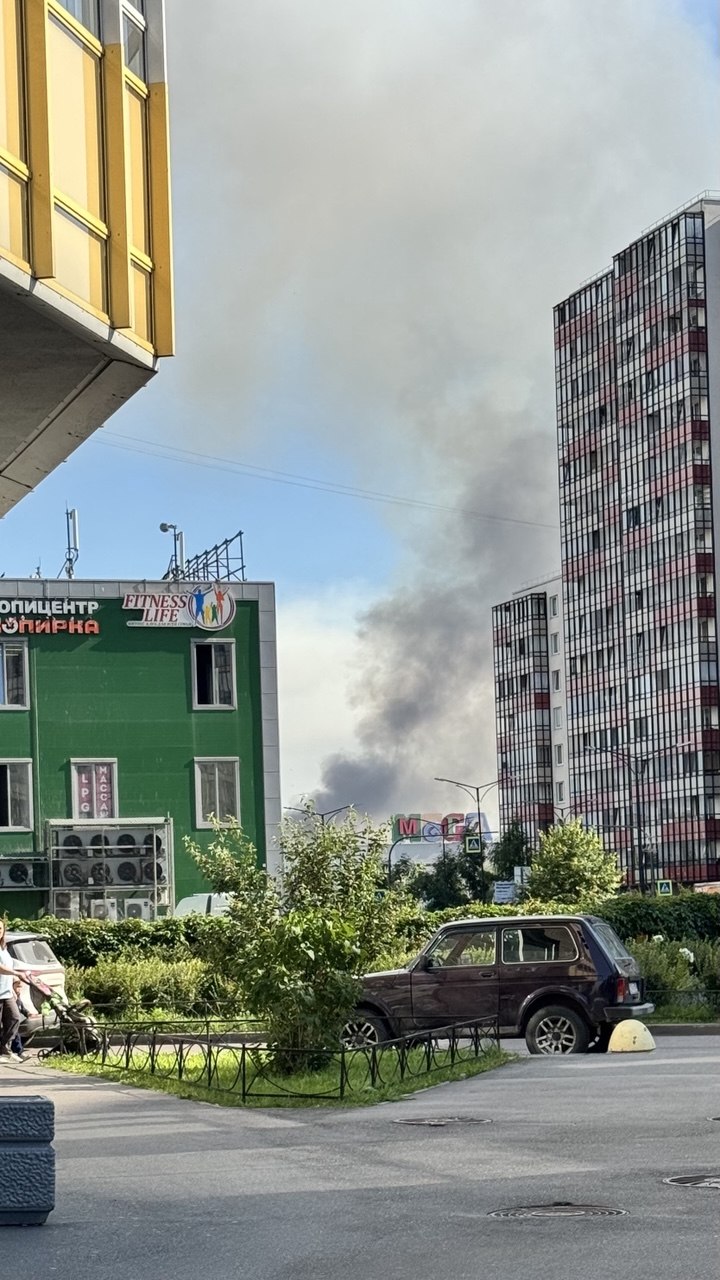
An explosion sounded at around 10am near a Magnit supermarket in the suburban neighbourhood of Shushary, killing the lieutenant colonel and badly injuring his wife, according to Fontanka, a St Petersburg news publication, which cited eyewitnesses.

The outlet claimed that both had lost their legs in the blast, which took place as they began driving away from their home. (read more)

Canadian State Media Tells Journalists: “Do not refer to the Sept. 11 attacks as terrorist attacks”


Posted originally on the CTH on August 27, 2026 | sundance |

The Canadian state media outlet, the Canadian Broadcasting Corporation (CBC), responds to the tensions of the Canada-USA relationship by telling all state funded journalists: “Do not refer to the Sept. 11 attacks as terrorist attacks.”

According to the internal communication: “The memo instead described the 9-11 events as hijackings that led to passenger jet crashes in Washington, D.C., Pennsylvania and Manhattan. It also said the World Trade Center was destroyed. {citation}

CANADA – The Canadian Broadcasting Corporation on Thursday defended an internal memo directing its reporters and editors to refrain from describing the Sept. 11, 2001, attacks as “terrorist attacks,” telling Fox News Digital the guidance reflected its longstanding practice of attributing terms it considers politically and emotionally loaded.

“It is the practice of the CBC to exercise extreme caution before using the words ‘terrorist’ and ‘terrorism,’” CBC Public Affairs Director Kerry Kelly said in a statement to Fox News Digital. “The memo was a reminder of the longstanding practice that favours the use of these terms with attribution in our reporting.”

The memo was authored by Basem Boshra, CBC News’ senior director of journalistic standards and public trust, and surfaced ahead of the attacks’ 25th anniversary. The directive was first reported by Toronto Sun columnist Warren Kinsella, who said it was addressed to CBC News staff. “Do not refer to the Sept. 11 attacks as terrorist attacks,” the memo said.

The memo instead described the events as hijackings that led to passenger jet crashes in Washington, D.C., Pennsylvania and Manhattan. It also said the World Trade Center was destroyed. (read more)

There is nothing more typically representative of a Canadian than taking the petty approach on any issue.

TRUE STORY:  A hotel manager in Europe once asked me, “are you Canadian?” I replied, no, I’m American. We then struck up a conversation. He was a polite fellow.  After some small talk he told me he knew I was American, but the general rule of thumb is to always ask if a person is Canadian because if you ask an American if they are Canadian, they will simply reply as I did.  However, if you ask a Canadian if they are American the guest will go bananas.  So, they just ask everyone if they are Canadian.

The Canadians will tell you that everyone around the world loves them.  Maybe that’s true, but everyone I’ve ever talked to said they don’t like Canadians because they’re self-centered and complain about stuff.  Terrible tippers too.