The Truth About the S&L Crisis Caused by Government & Endless Taxation


Posted originally on Jul 24, 2026 by Martin Armstrong |  
SL Crisis

QUESTION: You mentioned that the S&L Crisis of the 1980s was caused by the Democrats winning Congress in 1984 and changing the tax code on commercial real estate. Could you explain that connection? Was the banking and real estate crisis primarily driven by Democratic policies at that time?

DD
US_Discount_Rate Y 8 24 25

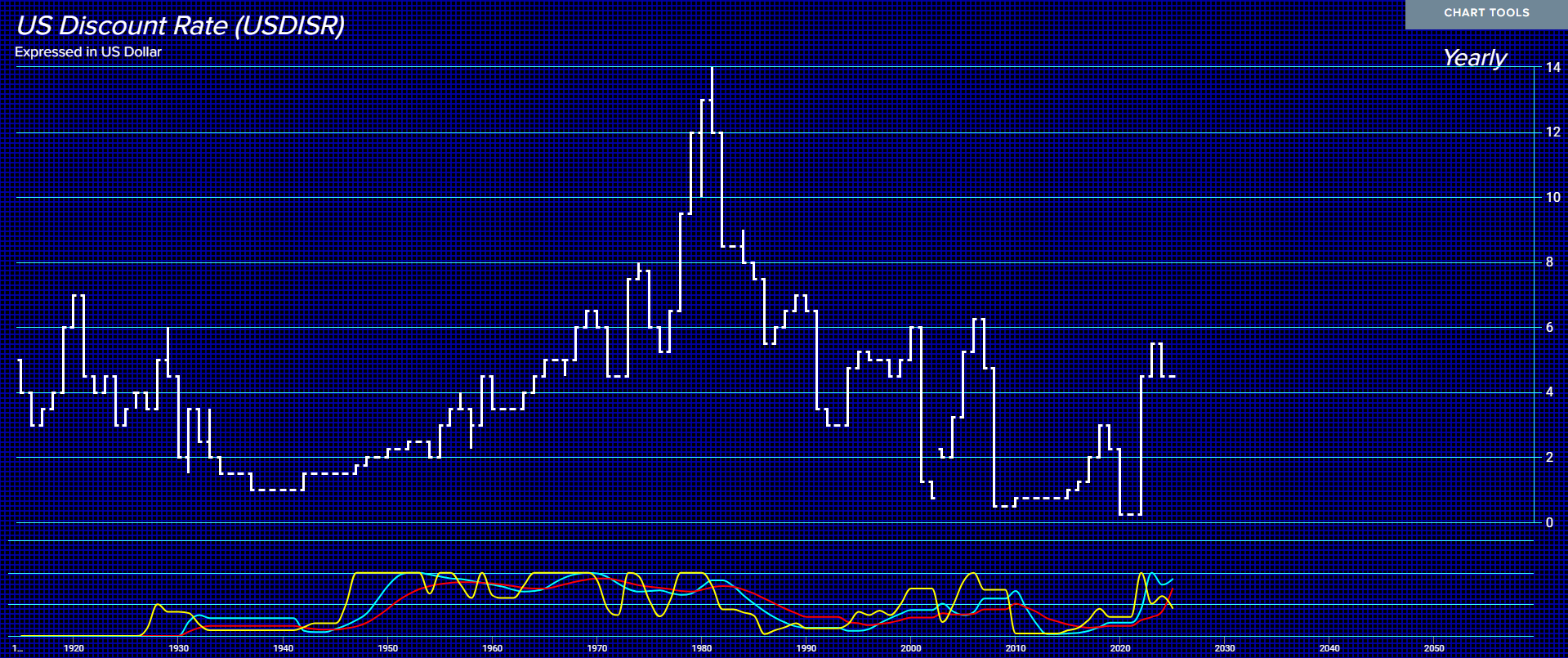
ANSWER: Oh, most definitely. But there were TWO insolvency waves. Because of the OPEC oil shock of the ’70s, that set in motion a cost-push inflation, which Paul Volker raised interest rates to 14% trying to reverse an inflation that had NOTHING to do with DEMAND.  Drastically higher interest rates resulted in about one third of S&Ls becoming insolvent, which was the first wave of failures in 1981–1983. The number of insolvent S&Ls did not peak until 1985 that year with 21.7% of the industry in trouble.
ParadoxOfSolution

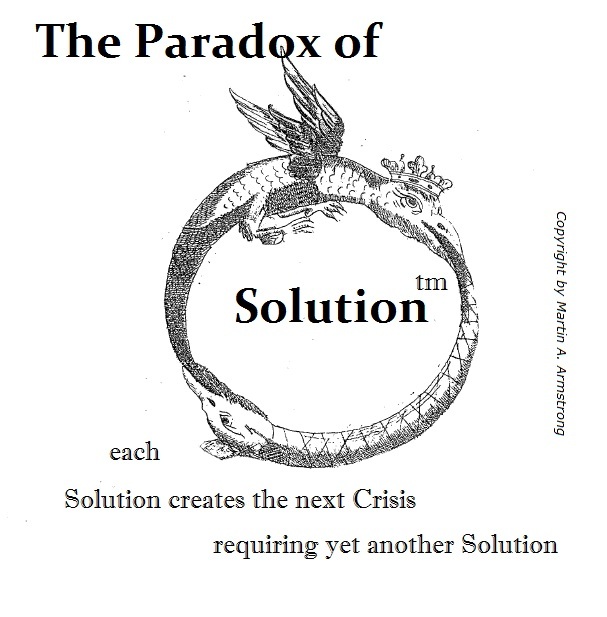
As I have warned many times, that the solution to a problem adopted by politicians always becomes the problem for the next solution. S&Ls were being crippled by high interest rates of Volcker trying to stop cost-push inflation. Their business model, funding long-term, fixed-rate mortgages with short-term deposits, meant that when the Federal Reserve raised interest rates to fight inflation, they had to pay higher rates on deposits but were still earning low rates on their old mortgages, leading to massive losses that the politicians would always blame on the private sector.

Congress responded passing the Depository Institutions Deregulation and Monetary Control Act of 1980. This began the process of deregulation, primarily by removing the caps on the interest rates S&Ls could offer depositors (phasing out Regulation Q), but it didn’t yet give them new lending powers. This tried to allow them to compete with Commercial banking.

Failing to solve the problem, Congress passed the critical legislation that allowed S&Ls to make commercial and commercial real estate loans. This was the Garn-St. Germain Depository Institutions Act of 1982. This act was specifically designed to help S&Ls earn their way out of the crisis by expanding their asset powers to include commercial real estate and construction loans abandoning the restriction on exclusive residential mortgages. The hope was that the higher returns from these new ventures would offset their losses from residential mortgages.

The primary piece of legislation was the Deficit Reduction Act of 1984 (DEFRA), which included several provisions that directly impacted real estate. The act increased the depreciation schedule for real property from 15 years to 18 years. This change meant that investors could not write off the cost of a building as quickly, reducing a key tax benefit for real estate investment. The law introduced new rules targeting “imputed interest,” particularly concerning below-market loans provided by sellers to buyers. These rules made it harder to use creative, seller-financed deals that lowered the buyer’s interest rate in exchange for a higher purchase price. Congress and the Treasury Department viewed this as a tax loophole that allowed sellers to convert ordinary income into lower-taxed capital gains and gave buyers a higher depreciation basis. The new rules were expected to curtail such transactions, which were seen as tax shelters. As if this attack on the Democrat’s hated “rich” imposed restrictions on industrial development bonds and a reduction of tax benefits for property leased by tax-exempt entities. It created a one-way market with an avalanche of sellers and no buyers. Savings and loans, or thrifts, began in the private sector with the first institution of this kind was the Oxford Provident Building Association, founded in 1831 in Frankford, Pennsylvania. The idea was for a group of people to pool their money so members could buy homes, and this model spread across the country.

It was the Great Depression when the Democrats stuck their finger into the pie. The Federal Home Loan Bank Act was signed into law to provide a stable source of funds for mortgage lending trying the resurrect the real estate market. This established the Federal Home Loan Bank System to support S&Ls with low-cost funds for real estate. This was followed by the Home Owners’ Loan Act authorized the creation of federally chartered S&Ls, establishing a national framework for these institutions. The next year saw the Federal Savings and Loan Insurance Corporation (FSLIC) created to insure deposits at S&Ls, similar to what the FDIC did for banks, which helped restore public confidence. The following year, 1935, is often noted in this history because it marked the completion of this initial regulatory framework and usurped the independence of the Federal Reserve branches as Roosevelt installed a Chairman of the Fed replacing the Secretary of the Treasury. The Home Owners’ Loan Act was further amended in May 1935 to allow existing state-chartered S&Ls to convert more easily to federal charters, a trend that grew significantly that year.
Democrats Taxing Every Dollar 1

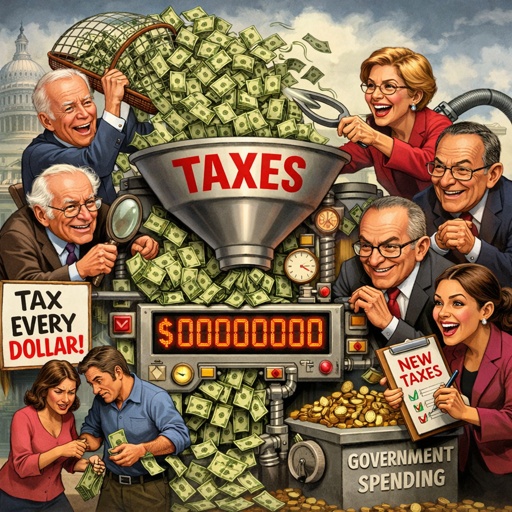
The Democrats never saw a dollar they did not want to tax. They never once consider the implication of their endless greed for taxes and how that alters economic behavior. For decades, the primary function of S&Ls was taking in savings deposits and originating residential mortgages, and their powers to make other types of loans were limited.

The critical shift happened with deregulation in the early 1980s. The Garn-St. Germain Depository Institutions Act of 1982 expanded S&L powers significantly. For the first time, they were explicitly given authority to make commercial loans, consumer loans, and other non-residential investments. This move enabled them to make commercial real estate lending. The the greed of the Democrats altering the tax code on commercial real estate set in motion a bear market and when the commercial real estate crashed, they blamed the S&Ls for the crisis.

In the wake of the crisis, the government fundamentally reversed course in 1989. The Financial Institutions Reform, Recovery, and Enforcement Act of 1989 (FIRREA) was specifically designed to push thrifts back to their traditional role. It did this through a key mechanism called the Qualified Thrift Lender (QTL) Test requiring S&Ls to hold 70% of their portfolio assets in “qualified thrift investments,” which were almost entirely housing-related assets like residential mortgages. This was a dramatic increase from the 60% requirement before FIRREA and was implemented with the explicit intent of “pushing thrifts back towards their traditional housing role.”

FIRRE was designed to prevent the commercial and non-housing lending that had bankrupted the industry thanks to the Democrats’ greed for taxation targeting commercial real estate. They always think they can just grab money and never consider any influence and how it will alter society.
Archer Bill Chairman 1995 2001

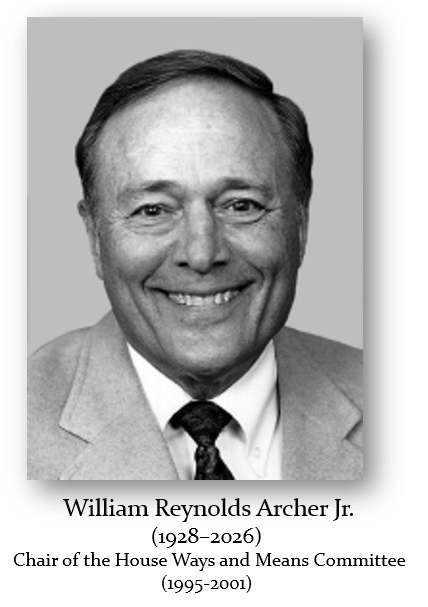
The Democrats created the S&L Crisis since they are ignorant of how the economy functions. I NEVER met a single Democrat, and most Republicans for that matter, with the exception of Bill Archer (1928-2026), who actually understand how the domestic economy functions no less the world economy. The only politician who understood was Bill Archer. Of course, nobody listened that altering the tax code on commercial real estate would result in a crash. When Bill became Chairman of the House Ways & Means Committee, Bill invited me to testify on the dollar and taxation.

Like Mandami in NYC thinks he can just grab money from whomever he pleases. Mayor Mamdani has taken actions targeting landlord misconduct, and various specific eviction pauses or restrictions have been proposed or implemented at different levels of government .

The city helped secure a moratorium on over 300 eviction cases at the Flatbush Gardens complex in Brooklyn. A bill has been introduced in the City Council that would raise fines for unlawful evictions from a maximum of $10,000 to $20,000 per violation, and would bar landlords found guilty of such evictions from receiving city tax breaks for five years.

Berlin_real_estate_exapropriation_at_DuckDuckGo

In Berlin, Germany, a proposal to seize rental properties from large corporate landlords created significant political and legal uncertainty in the real estate market. There was NO BID. Prices did not “crash” because nobody would buy such properties in the face of confiscation. The leader of the Berlin parliamentary group Werner Graf ,
publicly pushed the Green agenda for expropriation “to achieve a housing market that is mostly oriented towards the common good.” It is always the same story, rob the rich and give it to me.

The expropriation proposal, stemmed from a 2021 referendum pushed by socialists, that created considerable uncertainty. The debate alone was seen as a risk that deterred investment and brought to a halt any construction of new housing, as the market relies heavily on private capital. No bank would even lend into such a market when the property could be confiscated as if it was the 1917 Communism Revolution all over again.

Finally, with massive economic damage being inflicted, a federal law was passed only in 2026 to prohibit such expropriations by state governments. This was seen as a key move that neutralized the political risk for property companies, providing them with much-needed legal certainty. The uncertainty contributed to a significant decline in large-volume transactions that collapsed by 82.3% in Q1 2025 compared to the same period in 2024. That was proof that this insanity of the LEFT taxing every dollar they can find to fill their own pockets always results in an economic collapse.
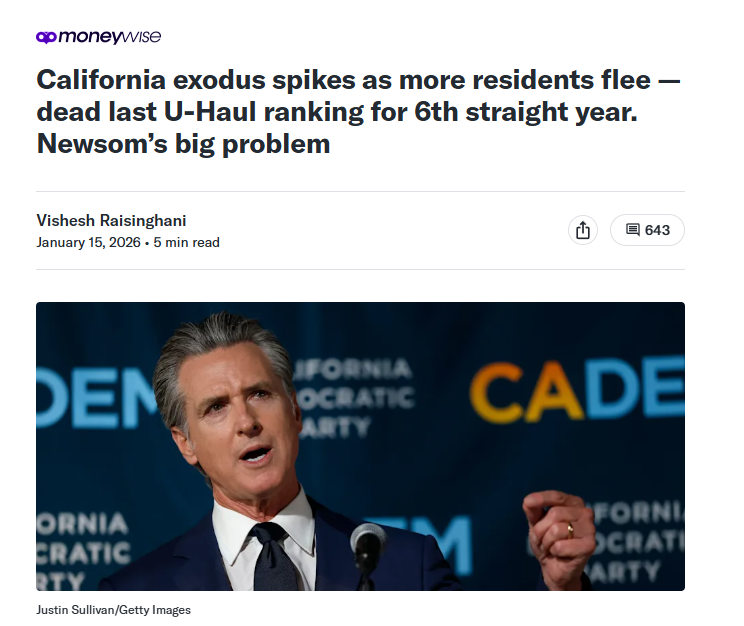
California_exodus_spikes_as_more_residents_flee_dead_last_U_Haul_ranking_for_6

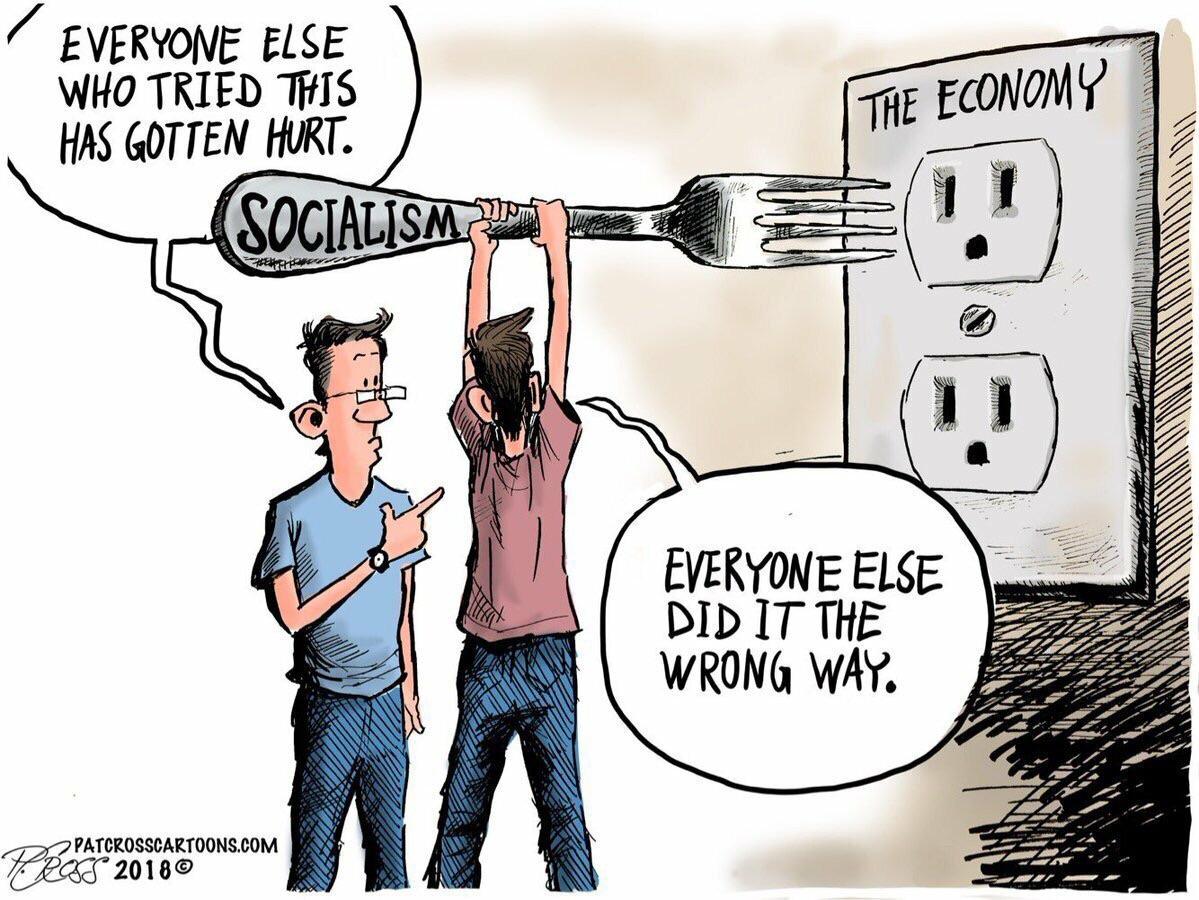
California has become the #1 state people are fleeing from and Newsom wants to become president? These people never look at the track record and how their constant attempt to just steal from people who have more than them to achieve a higher living standard by reducing that of others without having to work for it. The LEFT always tell the people they are the victims of the rich and count on the majority oppressing the minority, which is precisely against the founding principles of the United States, which had Constitutionally prohibited direct taxation to prevent this sort of legal persecution. The Marxist seized power toward the end of the 19th century and then pushed for a 16th Amendment to the Constitution to be allowed to engage in class-discrimination.
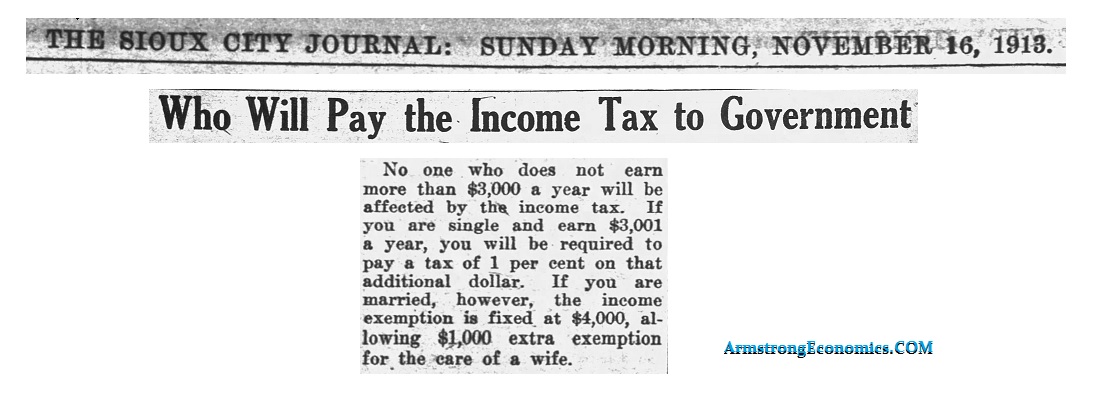
1913 Income Tax

When the Socialists passed the Income Tax engaging in class-discrimination, by World War II, they instituted the Payroll Tax and today nobody escapes. Once the socialist seized control of the government, they ensured that the United States will suffer eventually the same fate as China and Russia.
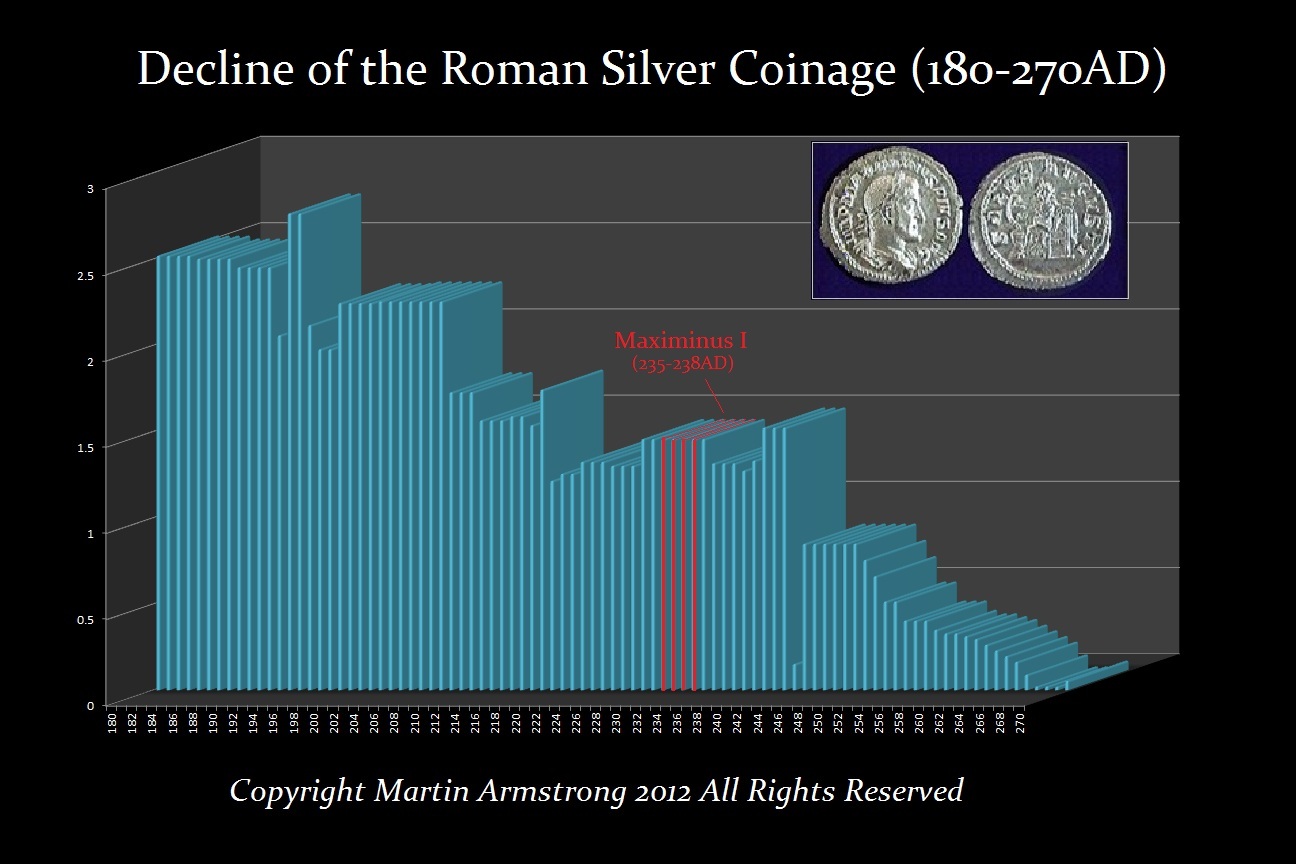
Maximianus Debasement
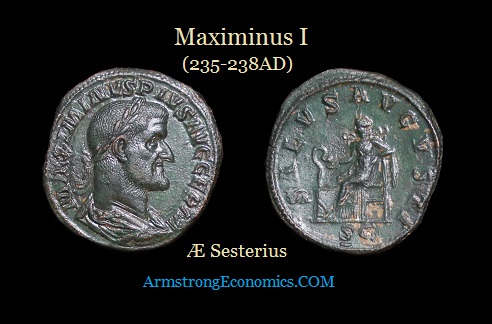
Maximinus I 235 238AD AE Sesterius R

The greater the Marxist agenda, the lower economic growth, and eventually the country will collapse and split just as Rome did as well as the USSR. Maximinus I was to declare that all wealth belonged to the emperor in a communistic fashion. What took place, however, was the complete breakdown of society. Wealth was driven underground, and money was hoarded, causing VELOCITY to collapse as cash flow in circulation vanished and hoarding prevailed. This caused the economy to implode as commerce ceased, fostering an economic depression that naturally reduced tax revenues.

Maximinus I did not stop with simply private wealth. Maximinus I ordered the wealth of all temples to be confiscated as well. Countless died in defense of their religious beliefs. Not even the gods were respected by Maximinus I, whose view was that they never answered prayers because they did not exist.

Where there had once been golden statues of former Emperors, Maximinus ordered their seizure so they could then be melted down. The Rule of Law collapsed, and Historia Augusta tells us that he -“condemned all whoever came to trial” and that he “reduced the richest men to utter poverty.” The LEFT has been the curse of humanity. They always present the dark side of the human race.
socialism.meme_

Categories:EconomicsRegulationSocialist
The Books to be Handed Out at the Seminar Are In


Posted originally on Jul 23, 2026 by Martin Armstrong |  

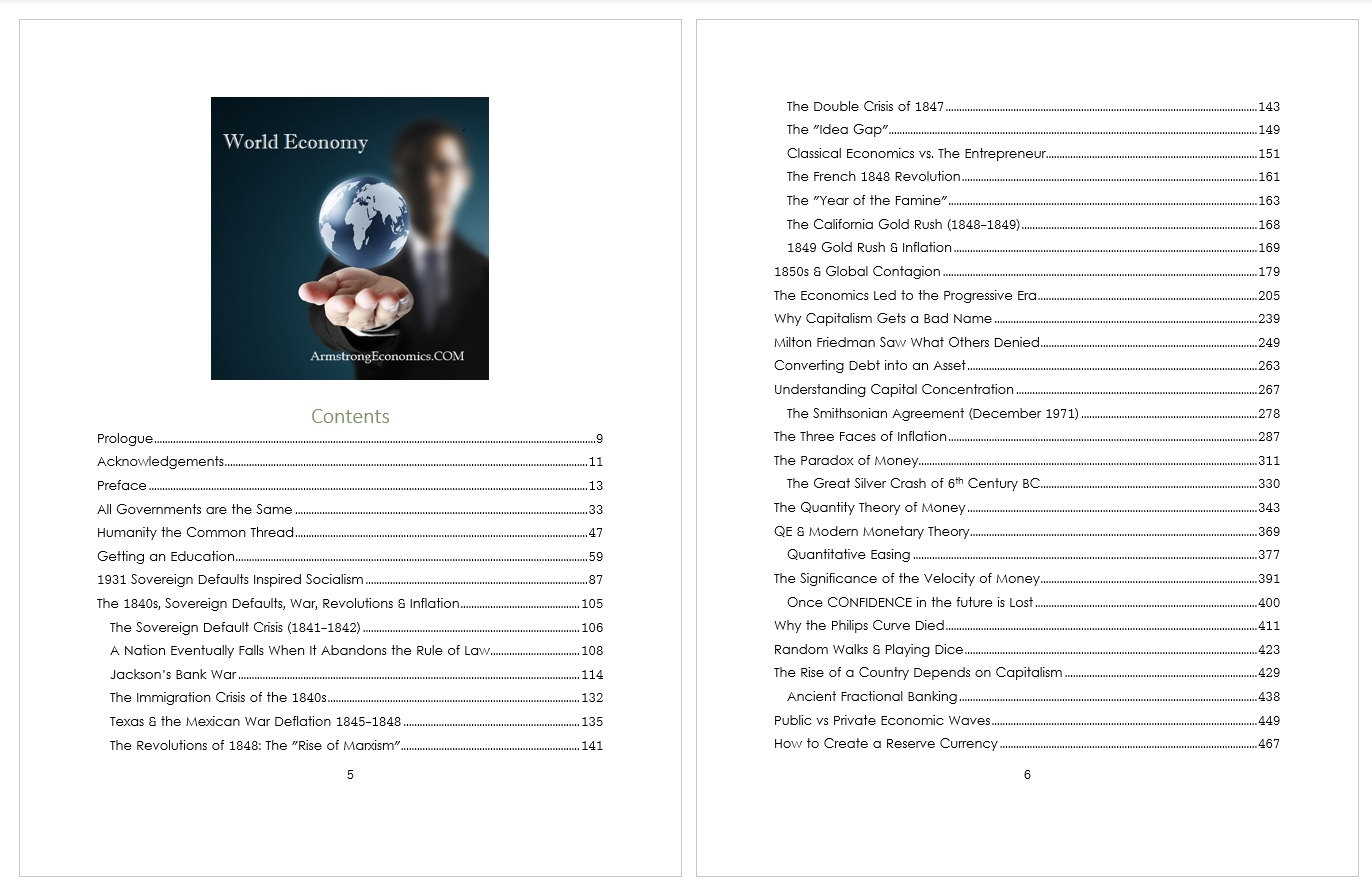
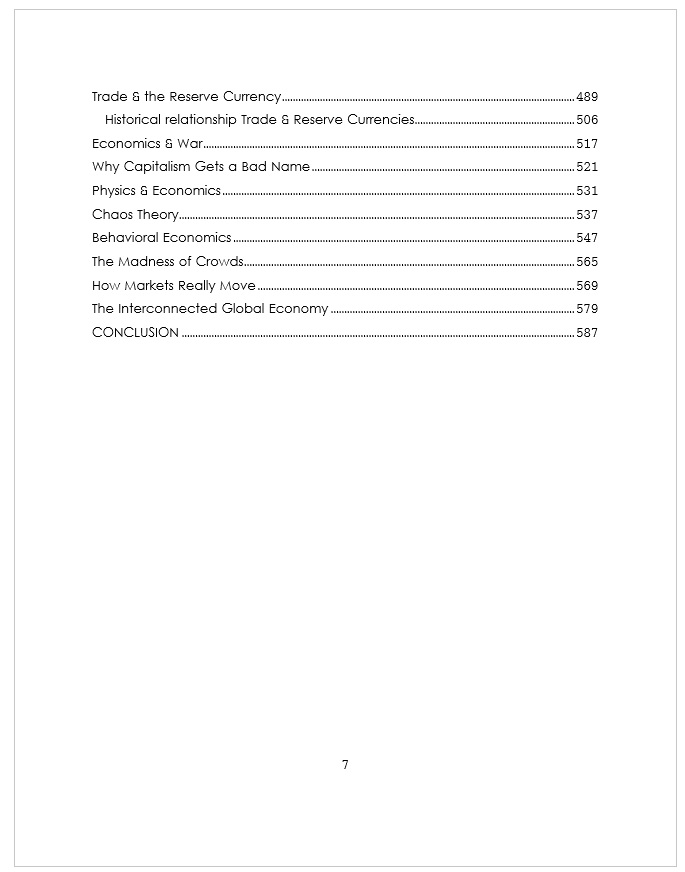
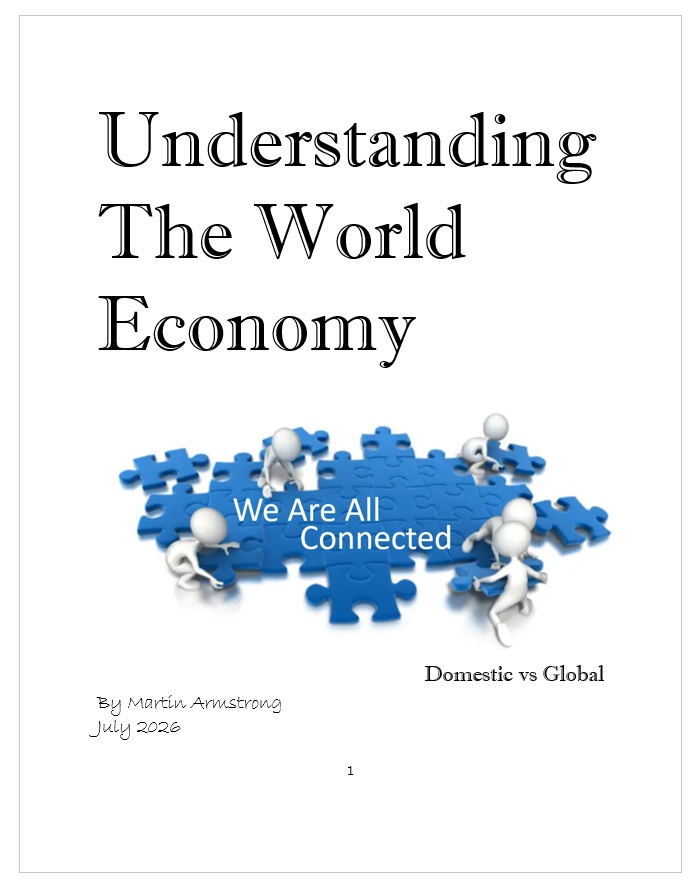
Understanding the World Economy
Understanding the World Economy Index 1
Understanding the World Economy Index 2
Posted Jul 23, 2026 by Martin Armstrong |  

Spread the love

Understanding the World Economy
Understanding the World Economy Index 1
Understanding the World Economy Index 2

Vance Is Positioning Himself for 2028—But No Candidate Is Free


Posted originally on Jul 23, 2026 by Martin Armstrong |  

US Vice President JD Vance says #Israel is trying to influence American  politics and is "losing the public opinion battle” in the US.⁣ .⁣ ? Follow  our LIVE coverage - link in bio.⁣ ⁣ ? @Reuters

Vice President JD Vance is clearly beginning to separate himself from the disastrous foreign policy that has dragged the United States into another Middle East war. The BBC reported that Vance has accused members of the Israeli government of trying to manipulate American public opinion against diplomacy with Iran. He is no longer speaking in the timid language traditionally used in Washington whenever Israel is involved. He is openly telling Israeli officials that the United States cannot continue financing every military ambition dreamed up in Jerusalem.

Vance asked Israel’s critics of the proposed Iran agreement a question they apparently cannot answer: “What is your exact proposal? You’re a country of 9 million people. You can’t just kill your way out of solving every single national security problem that you have.”

That is an extraordinary statement from an American vice president. Washington has spent decades pretending that every Israeli military operation is automatically in the national interest of the United States. No one is permitted to question Israel and blind loyalty is required on both sides of the aisle, which is perhaps the only aspect Dems and Republicans can agree upon.

Vance also said, “I find this whole freakout in Israel a little bit odd because I think that it comes from a place of mistrust, and I think that America has earned the trust of that region of the world.” He urged Israel to “give a little bit of credit to the United States of America, which I think has been an incredible partner for the Israeli government for a long time.”

Vance can see 2028 coming, and he understands that the MAGA base did not vote for endless war. Trump campaigned against the neocons, condemned the Iraq disaster, and promised to prevent World War III. Yet the United States is now bombing Iran, defending Israel, protecting Gulf shipping, and spending money that Washington does not have.

Vice President JD Vance has accused Israel of funding campaigns aimed at ruining US negotiations with Iran to end the war. There was no immediate response from Israeli officials to the allegation.⁣ ⁣

The Pentagon says the Iran war has already cost the United States $37.5 billion. The administration is seeking nearly $90 billion more in supplemental funding. At least 18 Americans have reportedly been killed and approximately 430 injured. Trump is now threatening to destroy an Iranian bridge or power plant for every ship Iran attacks in the Strait of Hormuz. This is no longer a limited operation to eliminate a nuclear facility. It is precisely how every forever war expands: one retaliation requires another retaliation until nobody remembers the original objective.

Trump is surrounded by people whose loyalty to Israel is greater than their concern for the long-term interests of the United States. Netanyahu has repeatedly pushed Washington toward regime change in Iran, while Trump has allowed the Israeli government to shape the boundaries of American policy. Netanyahu himself recently said that he and Trump remain aligned on the “big things.” That is precisely the problem. The American people elected Trump to put America first, not to place the United States military at the disposal of another government.

Yet nobody should mistake Vance for some independent farmer who wandered into Washington carrying only a copy of the Constitution. Vance also has a patron, and his name is Peter Thiel.

Thiel gave Vance his start in the elite world of venture capital. Vance worked at Thiel’s Mithril Capital, and Thiel later helped finance Narya Capital, the investment firm Vance co-founded. When Vance entered politics, Thiel contributed $15 million to the super PAC supporting his 2022 Senate campaign. Trump’s endorsement delivered the voters, but Thiel’s money built the runway.

Thiel is also the co-founder and chairman of Palantir, the data-analytics company that has embedded itself throughout the American military, intelligence, immigration, health, and law-enforcement systems. Palantir is not simply selling accounting software. It builds platforms capable of bringing enormous quantities of government and private information together, identifying relationships, tracking individuals, and turning scattered records into operational intelligence.

The U.S. Army awarded Palantir an enterprise agreement worth up to $10 billion over ten years, consolidating 75 separate software and data contracts. ICE awarded the company a $30 million contract associated with ImmigrationOS, a system designed to help identify and track immigration cases. Palantir’s federal contract awards nearly doubled in 2025 to more than $970 million, with most of that business connected to the Department of Defense.

Thirty members of Congress wrote to ICE and the Department of Homeland Security in April 2026 warning that Palantir-developed systems could contribute to a “mass surveillance ecosystem.” Civil-liberties organizations have raised concerns that combining medical, immigration, tax, employment, travel, location, and law-enforcement information could produce a centralized digital profile of millions of people.

This is where Vance’s anti-war positioning becomes complicated. He may oppose Netanyahu’s desire to bomb every regional adversary, but the political network that launched his career is deeply connected to the construction of the American surveillance and national-security state.

Trump has become politically bound to the Israeli alliance and to donors and officials who treat unconditional support for Israel as a test of loyalty. Vance owes his extraordinary rise in no small part to Thiel, whose company profits from government intelligence, military AI, policing, and mass data integration. One man is pulled toward a foreign-policy establishment centered on Israel. The other emerged from a technology establishment that wants to manage society through data.

Vance may sincerely believe that the Iran war must end. His criticism of Israel is justified, and his warning that a nation cannot “kill your way out” of every security problem is correct. Netanyahu’s strategy has produced endless retaliation, wider regional conflict, disrupted energy markets, and another enormous bill for American taxpayers. Someone inside the administration had to say it.

If Vance wants to become the genuine anti-war candidate in 2028, he must oppose more than Israel’s effort to prolong the Iran war. He must confront undeclared warfare, intelligence-agency abuse, military contracting, warrantless surveillance, centralized databases, and the companies that profit from turning every citizen into a collection of searchable data. Otherwise, 2028 will offer America another carefully manufactured choice: Trump’s war state or Thiel’s surveillance state. Neither represents the constitutional republic the Founders intended.

Note: Armstrong stopped allowing “some” of his videos to be copied. You can see them if you go to his blog.

Main Street Is Breaking While Wall Street Celebrates


Posted originally on Jul 23, 2026 by Martin Armstrong |  

These Beloved Retailers Permanently Closed In VA In 2025 | Old Town Alexandria, VA Patch

Every recovery eventually reaches a point where the official statistics no longer resemble reality. Politicians point to stock market records, economists celebrate another quarter of GDP growth, and central bankers congratulate themselves because inflation has moderated. Then you look at Main Street, where the people actually creating jobs are quietly closing their doors.

Small business bankruptcies continue climbing at an alarming pace. Total U.S. bankruptcy filings reached more than 310,000 during the first six months of 2026, a 12% increase from the same period last year. Commercial bankruptcies continue rising alongside consumer filings, reflecting financial pressure spreading across the entire economy rather than remaining isolated to one sector.

The most revealing figure involves Subchapter V bankruptcies, the streamlined Chapter 11 process created specifically for small businesses. According to Epiq AACER, those filings jumped 67% during the first quarter compared with a year earlier. Overall commercial bankruptcies increased 14%, while traditional Chapter 11 filings surged 37%. Those are not numbers associated with a booming economy. They describe an economy where business owners are fighting simply to stay alive.

Small businesses employ nearly half of the American workforce and account for roughly 44% of U.S. economic activity. They do not have the luxury of issuing corporate bonds, raising billions through Wall Street, or borrowing indefinitely from investors willing to overlook losses. They survive on cash flow. When customers stop spending, interest rates rise, insurance premiums double, payroll costs increase, and suppliers demand higher prices, there is nowhere left to hide.

Many commentators continue blaming one issue in isolation. Some point to inflation. Others blame tariffs, labor shortages, or higher interest rates. The reality is that business owners are being hit from every direction at once. COVID relief programs have disappeared, borrowing costs remain the highest they have been in years, operating expenses continue climbing, commercial insurance has become another major burden, and consumers themselves are increasingly stretched by record credit card debt and the highest cost of living many have experienced in decades. A business cannot prosper when its customers are financing groceries with credit cards.

This is what sovereign debt crises look like before governments admit they exist. The public often expects a dramatic collapse similar to 1929 or 2008. More often the deterioration begins slowly. Restaurants disappear from neighborhood shopping centers. Family-owned manufacturers quietly liquidate equipment. Local retailers announce closing sales. One bankruptcy rarely attracts national attention, but thousands occurring across the country reveal something much larger taking place beneath the surface.

The government continues spending at extraordinary levels while expecting the private sector to absorb the consequences. Federal debt continues approaching $40 trillion, yet Washington keeps borrowing because debt has become the preferred solution to every political problem. At the same time, small businesses are expected to refinance loans at interest rates two or three times higher than they became accustomed to only a few years ago. Governments borrow with virtually no limits. Small businesses face the full discipline of the marketplace.

There is another reason these bankruptcies deserve attention. Small businesses have historically been one of the primary engines of upward mobility in the United States. Large corporations create employment, but small businesses create ownership. They allow ordinary families to build wealth independent of financial markets. Every small business that disappears represents another piece of the middle class slowly being transferred into larger corporate hands.

Our computer has consistently warned that periods of declining confidence eventually concentrate economic power. Large institutions generally survive because they possess access to capital, political influence, and financial flexibility unavailable to independent operators. Smaller firms, despite often being more innovative, are forced to close because they simply cannot absorb years of rising costs while customers reduce spending.

The headlines continue celebrating resilient stock indexes and moderating inflation. Main Street is delivering a very different report. The real strength of an economy has never been measured by the performance of its largest corporations. It has always been measured by whether an ordinary citizen with determination, skill, and hard work could build something of lasting value. When those businesses begin disappearing one after another, the foundation underneath the economy begins weakening long before Wall Street notices.

Note: Armstrong stopped allowing “some” of his videos to be copied. You can see them if you go to his blog.

Trade Between India and China Soars


Posted originally on Jul 23, 2026 by Martin Armstrong |  

Recalibration of India-China ties | Hindustan Times

India’s imports from China reached a record $79.41 billion during the first six months of 2026, a 21.8% increase from a year earlier. Bilateral trade climbed to $91.72 billion, up 23.6%, putting the two countries on pace to exceed the record $155.6 billion in trade achieved in 2025. India’s exports to China did rise an impressive 37.5%, reaching $12.31 billion, but that only pushed the trade deficit even higher. India still recorded a staggering $67.1 billion trade gap with China in just six months.

The politicians love to frame geopolitics as though nations simply choose their trading partners based upon ideology. Reality has always been dictated by economics. India and China continue competing for influence across Asia, clashing over border disputes, and expanding their respective militaries, yet Indian factories continue relying upon Chinese components because modern supply chains were built around efficiency rather than national security.

China remains deeply embedded in India’s industrial base. Electronics, machinery, telecommunications equipment, chemicals, pharmaceutical ingredients, industrial components, and solar equipment continue flowing into India because replacing that manufacturing capacity cannot be accomplished by passing legislation. Politicians can declare economic independence whenever they like. Building an alternative industrial ecosystem requires decades.

Many people continue speaking about “decoupling” from China as though it were simply a political decision. If anything, the numbers demonstrate precisely the opposite trend. While governments around the world discuss diversification, commerce continues moving toward China because that is where the manufacturing infrastructure already exists. Capital does not relocate because politicians give speeches. Capital follows efficiency, profitability, and production capacity.

China’s exports surged far beyond expectations in June, rising 27% from a year earlier. Artificial intelligence infrastructure, computing equipment, semiconductors, electric vehicles, batteries, and advanced manufacturing are driving a new export wave that extends far beyond low-cost consumer products. The world continues talking about containing China while simultaneously purchasing more Chinese technology than ever before.

New Delhi has encouraged domestic manufacturing through its “Make in India” initiatives, expanded infrastructure spending, and sought to attract foreign investment away from China. Yet manufacturing itself requires enormous quantities of intermediate goods that still originate inside China. Even as India develops its own industrial capacity, much of that expansion depends upon importing Chinese machinery and components.

Modern economies function through integrated supply chains where one nation’s exports become another nation’s manufacturing inputs. Disrupt one link in that chain and production costs rise everywhere.

The broader geopolitical landscape only reinforces this trend. The conflict in the Middle East has disrupted shipping routes, increased insurance costs, and created uncertainty across global energy markets. India’s own trade deficit widened in June as exporters faced weaker global demand and shipping disruptions associated with the Strait of Hormuz. When transportation becomes more expensive and supply chains become more fragile, countries naturally gravitate toward suppliers capable of delivering at scale. China remains uniquely positioned to fill that role.

Our computer has always distinguished between political headlines and long-term capital trends. Governments may continue discussing strategic competition, tariffs, and economic realignment, but businesses still require dependable suppliers, functioning infrastructure, and competitive prices. Until another nation can replicate China’s manufacturing ecosystem on a comparable scale, trade will continue flowing toward Beijing regardless of diplomatic tensions.

Note: Armstrong stopped allowing “some” of his videos to be copied. You can see them if you go to his blog.

Why Globalist are Against AFD in Germany


Posted originally on Jul 23, 2026 by Martin Armstrong |  

01:41

“We need diplomacy between West and East. Therefore, if the Alternative for Germany (AfD) enters the government, we will seek peace in Ukraine and advocate for peace negotiations so that this senseless bloodshed finally ends. We do not want to unilaterally take sides. That is not the path to peace—it is the path to war. We must not be ‘ready for war,’ but ‘peace-seeking.’ Therefore, we will stop all aid to Ukraine. No more German taxpayer money for Ukraine, no more weapons, and no more German soldiers. Under our leadership, Ukraine’s accession to the European Union or NATO is out of the question.”

Note: Armstrong stopped allowing “some” of his videos to be copied. You can see them if you go to his blog.

It is Always a Matter of TIME


Posted originally on Jul 22, 2026 by Martin Armstrong |  

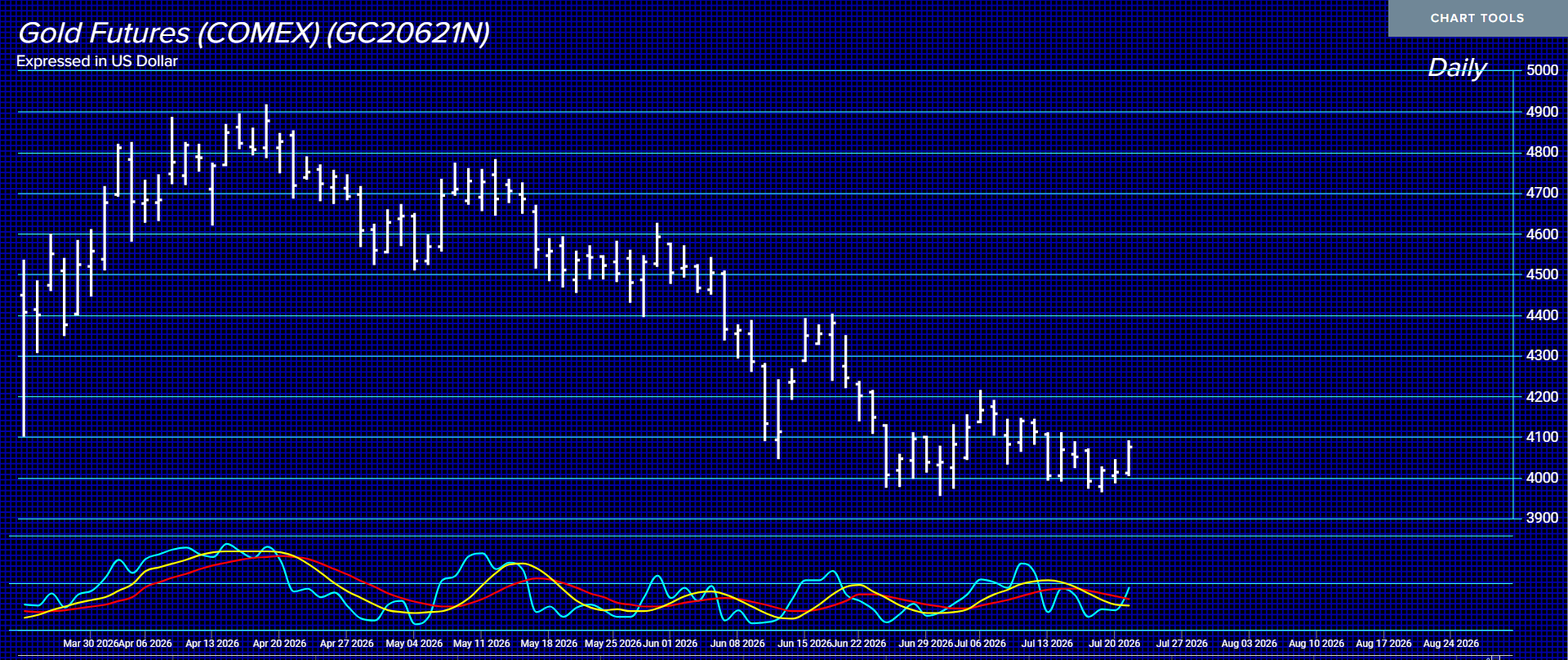
GCNYNF D Tech 7 22 26

COMMENT: Mr. Armstrong, I’m a new subscriber and just wanted to say thank you. Your work has given me a real understanding of how time and price interact, and it’s remarkable how your forecasts avoid the bias that pervades everyone else’s predictions. Even with all the geopolitical noise, gold dropped into June just as you forecasted at the start of the year. It just proves that everything hinges on what people believe.

Thank you for the education.

Shane

Rabbit Its Just Time
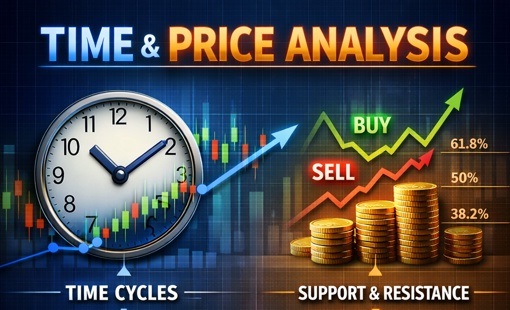
Time Price Analysis

REPLY: What I have always found is that TIME is more important than PRICE. You have a finite amount of time and that dictates the trend. PRICE is secondary. You can have a price objective, but if you run out of TIME, the game is over.

TIME and PRICE are two entirely separate forecasts that must align to confirm a major market turning point. PRICE alone is meaningless without the correct timing.

The Primacy of Time
TIME is the dominant and more important factor . It is the “fabric of the universe,” not just a component of market analysis. The central idea is that a market move reaching a specific price level is not significant unless it occurs at a predetermined point in time.

Price as a Secondary Objective
Price targets are determined by patterns and reversals, but they are always secondary and must be “earned” by the market. In the Down, I had provided multiple price objectives (e.g., for the Dow: 18,500, 23,000, 40,000, 55,000, 65,000). The key is that reaching one objective before the TIME target signaled the next price level becomes possible.

Order v Chaos

Markets are seen as a series of connected events (a “wave of contagion”). By understanding the “hidden order” within this apparent chaos, one can define scenarios to navigate the market, rather than trying to predict it with one-dimensional certainty. Those who argue Random Walks are incapable to seeing both PATTERNS as well as TIME. As Einstein said, God does not play dice with the universe.

Von der Leyen and Draghi Plot More Centralization to “Save” Europeoriginally onVon der Leyen and Draghi Plot More Centralization to “Save” Europe


Posted originally on Jul 22, 2026 by Martin Armstrong |  

S&Ds on EU Single Market Strategy: consumers' and workers' rights cannot be  used as a bargaining chip at the service of competitiveness | Socialists  and Democrats

European Commission President Ursula von der Leyen met with Mario Draghi in Brussels to discuss the EU’s competitiveness agenda and the implementation of Draghi’s 2024 report at Draghi’s request. Whenever these two gather behind closed doors to discuss “competitiveness,” the European taxpayer should grab his wallet because Brussels has never encountered a problem it did not believe could be solved with more centralized power, more borrowing, and more government spending.

The Commission claims that it is making “excellent progress” on trade diversification, regulatory simplification, and a new roadmap called “One Europe, One Single Market.” Paula Pinho, von der Leyen’s chief spokesperson, boasted that the Commission, Council, and Parliament are now committed to following a common timetable for implementing many of Draghi’s recommendations.

“One Europe, One Single Market” is another step toward stripping national governments of economic authority and transferring it to Brussels. They call this harmonization because admitting that it is centralization would alarm the public. European nations are expected to surrender more control over taxation, regulation, capital markets, energy, industry, and public spending to unelected officials who helped create the crisis in the first place.

Mario Draghi’s report correctly diagnosed many of Europe’s illnesses. Productivity is stagnant, energy is too expensive, investment is inadequate, markets are fragmented, and innovation is moving to the United States and Asia. Europe is falling behind in artificial intelligence, semiconductors, defense, digital infrastructure, and advanced manufacturing. Yet Draghi will not admit that the European Union’s own policies produced much of this destruction.

Brussels deliberately increased energy costs through Net Zero mandates, carbon taxes, sanctions, and the abandonment of reliable energy. It suffocated industry beneath environmental rules and compliance requirements. It imposed the Digital Services Act, the Digital Markets Act, ESG mandates, supply-chain directives, and endless reporting obligations. It then looked at the wreckage and concluded that Europe suffers from insufficient government management.

Draghi estimates that Europe requires between €750 billion and €800 billion in additional investment every year through 2030. That is approximately 4.4% to 4.7% of the EU’s annual GDP. The proposed spending includes roughly €300 billion for the energy transition, €150 billion for transportation and charging infrastructure, €150 billion for digital technologies, €50 billion for defense and security, and another €100 billion to €150 billion for innovation.

They are not discussing a modest reform program. They are contemplating an economic transformation costing up to €4.8 trillion over six years. Since private capital refuses to invest sufficient amounts under the conditions Brussels created, Draghi wants government to guide, subsidize, guarantee, and de-risk the investment. In other words, the taxpayer absorbs the losses while politically connected corporations collect the profits.

Power requires Europe to move from confederation to federation. At the Katholieke Universiteit Leuven, Mario #Draghi delivered a powerful and timely address that has been widely echoed across European media and political

The European Parliament has estimated that public financing would need to provide approximately €150 billion to €160 billion annually if Europe maintained its traditional 80% private and 20% public investment split. The EU budget cannot provide anything close to that amount. Brussels will therefore demand new “own resources,” expanded EU taxes, financial guarantees, redirected national budgets, or another round of common borrowing.

They always invent a crisis and then use it to push debt that the people never approved. COVID produced NextGenerationEU, which allowed the Commission to borrow hundreds of billions collectively for the first time. What was sold as an exceptional emergency became the blueprint for permanent EU fiscal authority. Those debts must still be repaid, with the repayment burden expected to reach around €30 billion annually beginning in 2028. Now Draghi’s competitiveness agenda provides the excuse for the next debt machine.

Draghi is the same man who promised to do “whatever it takes” to preserve the euro when he headed the European Central Bank. That statement is praised as some act of genius, but it meant that the ECB would suppress bond yields, monetize sovereign risk, and protect the political project regardless of the economic cost. His policies preserved the euro’s institutional structure while encouraging governments to avoid the structural reforms that a genuine market would have forced upon them.

Von der Leyen has operated by the same principle. When her policies fail, she never questions the policy. She demands more authority to enforce it. Europe lost cheap energy, so Brussels proposed massive green subsidies. European companies cannot compete, so Brussels demands a centralized industrial policy. National budgets are drowning in debt, so the Commission wants shared debt. Citizens reject deeper integration, so they rename it “simplification” and “competitiveness.”

In theory, the EU's economic policy is meant to fuse 27 national markets  into one pool of 450m consumers. In practice, it has failed to keep up with  the modern world. Paradoxically,

The Commission points to trade agreements with Mercosur, India, and Switzerland as proof of progress. Trade diversification is sensible, but no collection of agreements will compensate for making production prohibitively expensive inside Europe. A German chemical company cannot compete because von der Leyen signs another document in Brussels while its energy bill remains multiples of what a competitor pays abroad.

The EU’s competitiveness problem is not a shortage of reports. Draghi produced around 380 recommendations, yet a 2025 European Parliament study found that only 11% had been adopted by September of that year. Brussels now celebrates “steady progress” while European businesses continue to close plants, cut employment, and move investment abroad. These people measure success by the number of directives issued and committees formed, not by whether anyone can still afford to manufacture a product.

Europe does not need €800 billion annually in politically directed investment to repair damage caused by politically directed economics. It needs affordable energy, lower taxes, fewer regulations, protection of property rights, and governments willing to allow capital to allocate itself. Innovation cannot be ordered into existence by Ursula von der Leyen. Entrepreneurs do not need another EU fund administered by bureaucrats who have never created a business or met a payroll.

Their “One Europe, One Single Market” roadmap moves Europe closer to fiscal union without democratic consent. Monetary union was created without debt union or political union, producing the structural crisis embedded in the euro from the beginning. Brussels now intends to use every emergency to construct those missing components through the back door.

The productive citizens of Europe will be ordered to finance it all. They will pay through direct taxation, carbon costs, inflation, reduced pensions, financial repression, and the liabilities attached to common EU debt. German workers are already discovering that the state consumes nearly half the economic value of labor. High earners are looking toward Switzerland, Britain, the United States, and the UAE because the reward for productivity inside the EU continues to shrink.

Von der Leyen and Draghi are not rescuing European competitiveness. They are trying to preserve the centralized political structure that destroyed it. Europe was built by its people and its diverse nations. It is being dismantled by bureaucrats who genuinely believe prosperity can be produced through a timetable agreed upon by three EU institutions over lunch in Brussels. These are not economic architects. They are undertakers discussing how to finance the funeral.

US Home Builder Sentiment Contracts for 15th Month


Posted originally on Jul 22, 2026 by Martin Armstrong |  

How To Find A Builder To Construct Your New Home - BIAGC

Washington keeps insisting the economy is healthy because unemployment has not collapsed and inflation has moderated. Then you look at housing, and the entire narrative falls apart. A nation cannot call itself prosperous when ordinary working families can no longer afford the most basic measure of financial stability—a home.

The National Association of Home Builders reported that builder confidence fell to 34 in July, marking the fifteenth consecutive month below 40. That is the longest stretch of depressed sentiment since 2012, when the country was still climbing out of the housing crash. Builders are not pessimistic because they suddenly forgot how to build houses. They are pessimistic because the customer has disappeared.

To attract buyers, 37% of builders are now cutting prices, up from 35% just one month ago. The average discount remains around 6%, while nearly two-thirds are offering additional incentives just to get contracts signed. When builders begin sacrificing margins like this, it tells you demand has weakened far more than politicians are willing to admit.

Mortgage rates remain near their highest levels in years, and monthly payments have exploded. A modest decline in the purchase price does very little when financing costs have doubled. Someone who could comfortably qualify for a mortgage five years ago may find themselves completely priced out today, even if their salary has increased. Inflation did not simply raise prices. It destroyed purchasing power.

The problem extends far beyond housing. Americans now carry more than $1.25 trillion in credit card debt while total household debt has climbed above $18 trillion. Credit card interest rates remain above 20% for many borrowers, auto insurance continues setting new records, utility bills have climbed, groceries remain dramatically more expensive than they were just a few years ago, and student loan collections have resumed. Housing is not competing against one expense. It is competing against every expense. A mortgage payment has become just another bill in a long line of bills that many households can barely keep up with.

Meanwhile, builders continue battling higher material costs, expensive land, labor shortages, regulatory burdens, and financing costs of their own. The National Association of Home Builders estimates that government regulations, fees, permits, and compliance costs account for more than one-quarter of the final price of a new single-family home. Politicians continue promising affordable housing while making it increasingly expensive to build one.

Congress recently passed housing legislation intended to increase supply and reduce investor ownership of single-family homes. Those reforms may help around the edges, but they do not solve the central problem. You cannot restore affordability simply by building more houses if borrowing costs remain elevated and the purchasing power of the middle class continues deteriorating. Builders themselves acknowledged the legislation is a positive step, but they also admitted meaningful relief will take time and additional reforms at the state and local levels.

Housing has always reflected confidence. During periods of optimism, people willingly take on thirty-year mortgages because they believe tomorrow will be better than today. That confidence is fading. Prospective buyers are sitting on the sidelines because they no longer trust where the economy is headed. They see geopolitical conflict expanding, government debt exploding, inflation permanently embedded into everyday living costs, and interest rates that refuse to return to the emergency levels people had come to expect.

The American Dream is not vanishing because people no longer want to own a home. It is slipping away because the financial system has made ownership increasingly unattainable for the very people who built the middle class in the first place.

NEOCONS Usurping American Foreign Policy


Posted originally on Jul 22, 2026 by Martin Armstrong |  

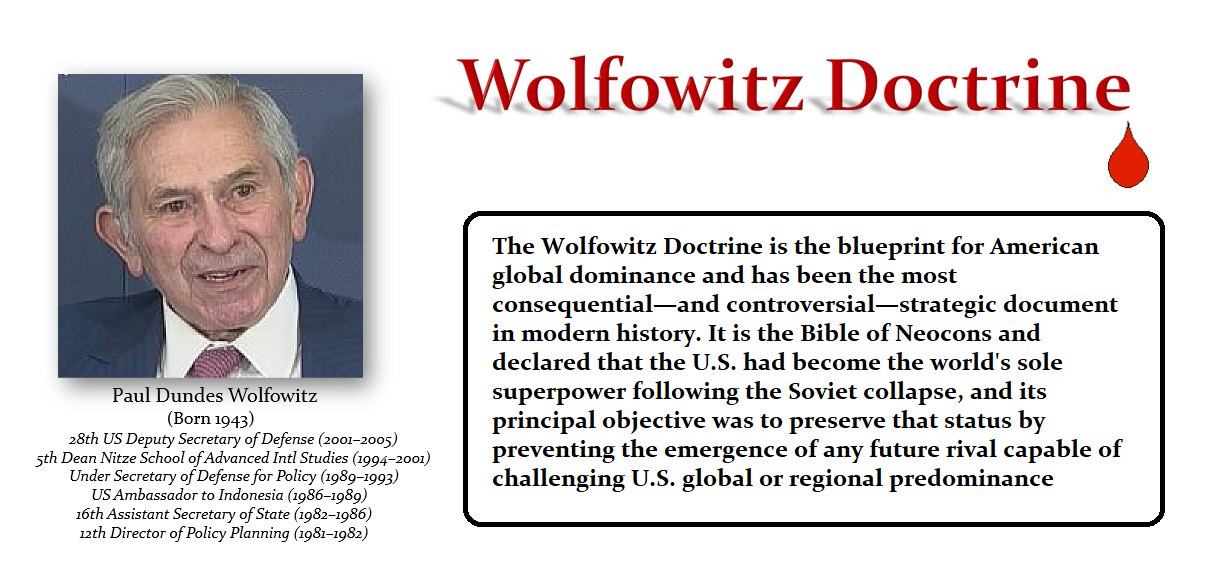
Wolfowitz Doctrine

QUESTION: You have mentioned that the neocons never look behind the end of the nose. Do they ever assess the risks correctly? Is it because they are just biased by what you have pointed out in Wolfowitz’s policy?

D

ANSWER: I have studied military tactics.  As I have said, my father was a colonel with General Patton from North Africa to Berlin. In any military action, you must begin every operation with a detailed look at the enemy. Before a commander approves a mission, the staff MUST explain the opposing force’s capabilities, intentions, and likely courses of action. Get the threat wrong, and everything that follows rests on a false assumption. This is what happened in this Iran debacle.

Netanyahu is a sick, biased Neocon. He always operates with the goal of trying to assassinate the leadership and assumes he will be victorious. That strategy has NEVER worked even once. But as they say, the definition of insanity is repeating the same mistake and assuming a different outcome.

I know for a fact that war game simulation with Iran conduct a decade ago all showed that Iran would take the Strait of Hormuz. There was no strategic planning. This is Netanyahu’s mess and the Neocons escorted him into the Situation Room to see this same stupid idea of instant victory with ZERO plan B contemplation. They did that with Iraq and there was ZERO planning for what would happen by taking out Saddam. They also completely ignored that taking out Saddam, they removed the #1 enemy of Iran.

r

My discussions even back in early 1990s with these Neocons was all about taking out Iraq, Iran, Syria, Libya, and Lebanon and it was to protect Israel. What Wesley Clark says here after 911, fits with what I was told in the early ’90s. As I have said, they created Homeland Security claiming that various agencies had information but did not share it. The first crew of terrorists were in Metropolitan Correctional Center, New York (MCC) and even drew the Twin Towers on the wall with planes going into them. The Bureau of Prisons (BOP) employee Mr. Kumb provided the recreation materials they used. The BOP came down to 10 South and filmed everything. Their lawyer, Lynne Stewart (1939-2017), was imprisoned for passing them notes for 4 years.

Sun Tsu Know your Enemy
Risk_Board_Game_Strategy

The Neocons assume that the US has the largest and most powerful military so they need only wage war with no strategy to win. This is why we get into these endless wars for they is ZERO planning. There is never an exit strategy. And they always have zero strategy for any aftermath.

These people are traitors to our country. They always seek to abuse the military power for personal agendas. That is no different from insider trading for monetary profit, but they have no regard for the lives lost for their military campaigns as if this is still some child’s game of RISK.

Neoconservative foreign policy is dangerously ideological and willing to accept significant human costs to achieve its goals. The question are they just “psychopaths” since the care nothing about the people they send to war perhaps can’t be proven or disproven since that is a clinical diagnosis.

Nevertheless, their personal motivation clearly colors or foreign policy outcomes, driven by their ideology, and decision-making processes. They clearly have no empathy for individuals whatsoever. Their ideological zeal comes at extremely high costs that extend beyond just the people who they send to their death. More than 50% of the national debt is all because of their reckless spending on endless wars and then perpetual servicing of that debt undermines the economy and erodes the living standards of the average American subjecting society to ever increasing proportion of GDP consumed by government.

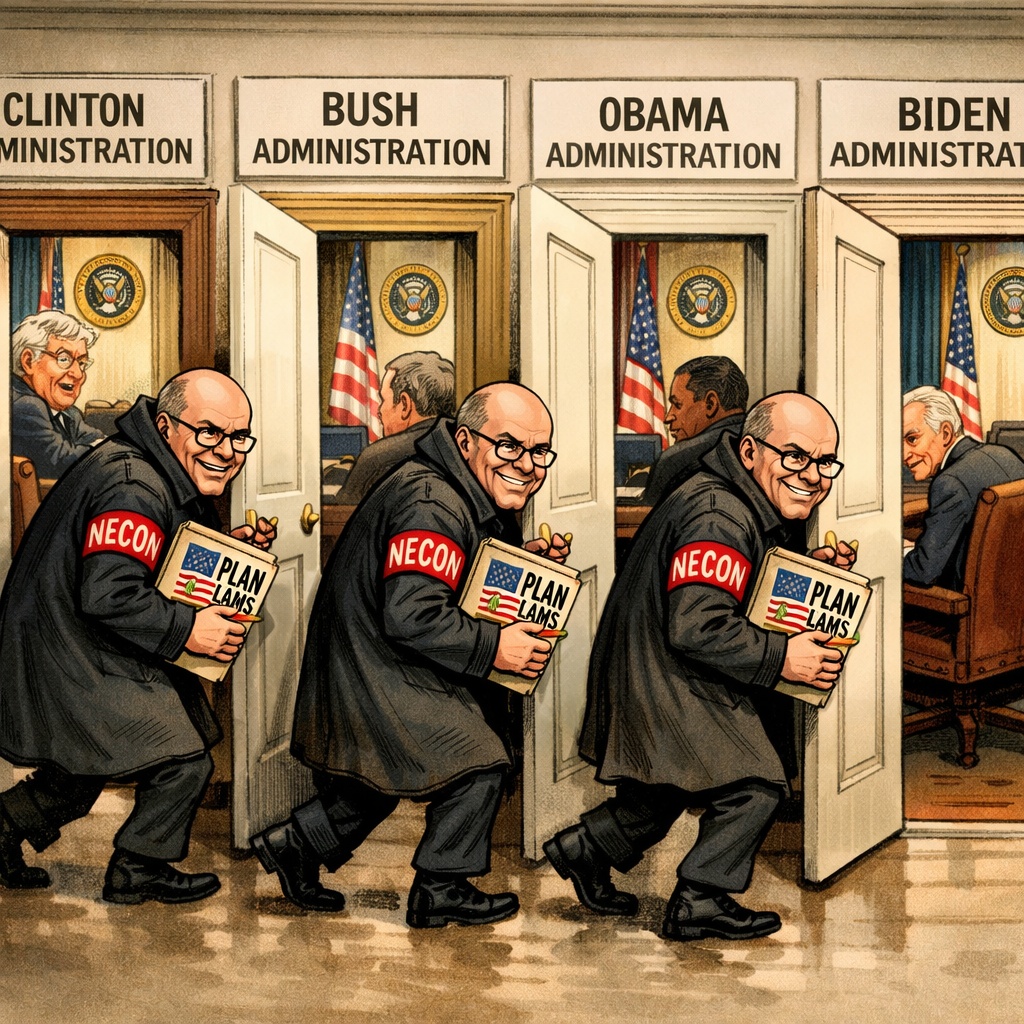
Nerocon Every Administration
America Alone

The book America Alone, details the neoconservative influence on the George W. Bush administration. It illustrates that this group pushed a foreign policy emphasizing military confrontation, leading to the Iraq War, with consequences yielded no benefit to the USA or Israel. This neoconservatism has been a movement focused on achieving and maintaining unchallenged U.S. military dominance as set forth in the Wolfowitz Doctrine. This quest for world domination has led to a series of perpetual wars of choice and confrontations with powers like Russia, pushing the world closer to major conflict.

This entire movement has been so misplaced and it washes its hands in blood while stuffing their pockets with money. Their entire premise has been built on a disdain of historical evidence entirely based on a false premise that U.S. military superiority can dictate terms worldwide. Because of this delusional idea of military power, this had led to a reckless series of endless wars that have undermined the economy and cast a shadow over the entire image of the United States as being the beacon of liberty and justice for all. They maneuver dominating every administration regardless of party affiliation.

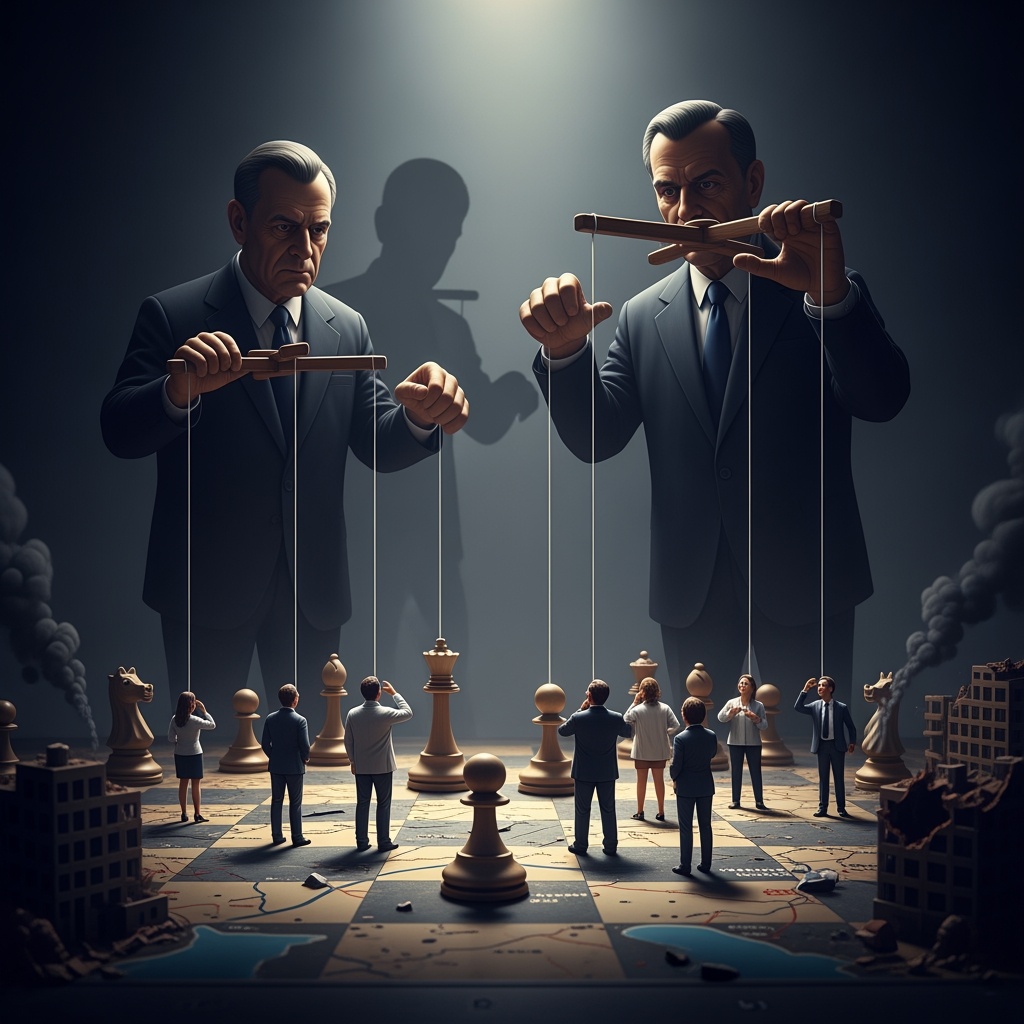
Neocons Manipulating

They convince themselves that they wear the white hats and are seeking to dominate the world to bring DEMOCRACY when in fact the very proof that they are unelected and infiltrate each and every administration to usurp American foreign policy proves that we do not live in a Democracy at all. This is NEVER in the interest of the people no less the nation. I know of no politician who would dare to cross swords with these people proving that they in fact control American foreign policy. No president nor Congress call the shots any more.

Note: a Armstrong stopped allowing his videos to be copied. You can see them if you go to his blog.