Posted Posted originally on: Oct 26, 2026 by Martin Armstrong |
India is giving the world something worth paying attention to through its expanding economy and domestic market. The IMF’s October World Economic Outlook puts growth at 7% for India’s 2026–27 fiscal year, up from 6.4% in July. The following year is also projected at 7%, up from 6.7%. These are forecasts, but the direction of the revisions matters. Higher energy costs and international turmoil have not prevented India from performing better than the IMF previously expected.
The IMF projects global growth of 3.1% in 2026, advanced-economy growth of 2.1%, and Chinese growth of 4.5%. India’s fiscal-year figure is not an identical calendar-year comparison, but the momentum difference is substantial. The IMF attributes India’s stronger outlook to domestic demand and services activity, with demographics, structural reforms, and a growing internal market supporting its potential. This is an economy where the opportunity to expand remains considerable.
Seven percent growth compounds into something powerful. If sustained for ten years, it would almost double real economic output. That shows why a sustained growth advantage changes the position of a country. Businesses gain customers, investment can support additional capacity, and a larger economy creates possibilities that did not exist a decade earlier.
What interests me is the domestic market. A country that develops a larger base of consumers and businesses has more than one source of demand. Export opportunities remain important, but the economy is less dependent on waiting for a foreign customer to place the next order. An entrepreneur can see opportunities in his own country. That changes incentives. People become willing to establish businesses, improve skills, and commit money when they believe tomorrow offers something beyond merely paying yesterday’s bills.
Demographics give India an opportunity, but a population does not become prosperous simply because it is large or young. People need productive employment, infrastructure, and the freedom to build businesses. The encouraging part of the IMF’s assessment is that it identifies actual demand and services activity alongside demographic potential. There is movement behind the promise. India still has considerable work to do, but it has a reason to do it: an economy growing fast enough to reward improvements in its productive capacity.
The energy problem has not disappeared. The IMF reportedly projects Indian inflation at 5% this fiscal year and a current-account deficit of 1.5% of GDP, compared with 0.7% previously. Those figures underline the cost of imported energy and the need to preserve stability while expanding. Growth is not permission to ignore the balance sheet. India’s achievement is that the outlook has improved despite those pressures, not that it has somehow escaped them.
India also gained from the trade routes disrupted by the Ukraine war and Western sanctions. As Europe turned away from Russian energy, Indian refiners bought discounted Russian crude and expanded sales of finished fuels abroad. Reuters reports that India exported 4.1 million metric tons of jet fuel to Europe in 2025, nearly three times its 2021 volume, and supplied almost 15% of Europe’s aviation-fuel imports over 2022–2025. India maintained commercial relationships across opposing geopolitical camps and captured business others had abandoned. Europe still needed fuel, Russia still needed buyers, and Indian refiners earned their place between them. That opportunity has since narrowed after the EU prohibited imports of products made from Russian crude from January 21, 2026. But the lesson remains. Sanctions can redirect commerce toward countries willing and able to act as intermediaries. India pursued its own economic interests, and its businesses benefited from the gap between political declarations and the world’s continuing need for energy.
Capital moves toward opportunity. Investment means people can build businesses, acquire skills, and earn a living that their parents could scarcely have imagined. That gives a population a reason to believe it has a future, and that confidence encourages further investment. The established powers seem to believe their position is permanent, as though capital owes them loyalty while they make it more expensive to operate. It owes them nothing. India still has serious problems to overcome, but a country opening opportunities for its people has something that a country taxing and regulating those opportunities away cannot manufacture by decree.
Posted Posted originally on: Oct 26, 2026 by Martin Armstrong |
I have written extensively about India’s economic rise and how the people are witnessing their economy expand in real time. Manufacturing is growing, foreign investment is pouring into technology and infrastructure, and an emerging middle class is finally experiencing opportunities that previous generations could only dream of. Yet there is another side to India that cannot be ignored. The 2026 Global Hunger Index ranked India 100th out of 122 countries, placing one of the world’s fastest-growing major economies in the category of serious hunger.
The numbers are disturbing. According to the Global Hunger Index, 9.8% of India’s population remains undernourished. Nearly three out of every ten children under five, or 29.3%, suffer from stunted growth, while an astonishing 19% experience wasting, meaning their weight is dangerously low relative to their height. The under-five mortality rate stands at 2.7%. These are children who are being deprived of the nutrition necessary for proper physical and cognitive development during the most critical years of their lives. This is not simply a matter of families being unable to afford certain luxuries. We are talking about basic food security in a country that has become an increasingly important player in the world economy.
India’s population exceeds 1.4 billion people. Even a relatively small percentage represents an enormous number of human beings. A 9.8% undernourishment rate translates into roughly 140 million people when applied to that population. That is an entire nation of people living without sufficient nutrition. Meanwhile, India is attracting multinational corporations, expanding its manufacturing base, and competing with China for international investment. Generations of the caste systems still prevail despite it being dismantled.
There has certainly been progress. India’s child stunting rate has fallen from approximately 50% in 2000 to 29.3%, and its overall hunger score has improved considerably over the past two decades. Now India received a hunger score of 24.1 in 2026, still within the serious category, and its child wasting rate remains exceptionally high.
The expansion of technology centers in Bengaluru, Hyderabad, and other major cities has created opportunities for skilled workers and attracted substantial foreign capital. But a farmer in a remote village does not automatically benefit because an American corporation establishes another technology operation in India. Growth in national GDP does not mean every household experiences an equivalent improvement in living standards.
Capital is moving toward the country because businesses recognize its enormous domestic market, young population, and expanding industrial capacity. India does not need to become another China to succeed, nor should its progress be dismissed because it has not yet eliminated poverty.
Nevertheless, there is a considerable difference between becoming a major economic power and achieving widespread prosperity. India can report impressive GDP growth while millions of families continue living in conditions that should be unacceptable for a nation with such extraordinary resources and capabilities. A nation cannot measure its success solely by stock market performance, manufacturing output, or the number of multinational corporations establishing operations within its borders. The real achievement will come when economic expansion reaches the families who have been excluded from prosperity for generations Oct 26, 2026 by Martin Armstrong |
I have written extensively about India’s economic rise and how the people are witnessing their economy expand in real time. Manufacturing is growing, foreign investment is pouring into technology and infrastructure, and an emerging middle class is finally experiencing opportunities that previous generations could only dream of. Yet there is another side to India that cannot be ignored. The 2026 Global Hunger Index ranked India 100th out of 122 countries, placing one of the world’s fastest-growing major economies in the category of serious hunger.
The numbers are disturbing. According to the Global Hunger Index, 9.8% of India’s population remains undernourished. Nearly three out of every ten children under five, or 29.3%, suffer from stunted growth, while an astonishing 19% experience wasting, meaning their weight is dangerously low relative to their height. The under-five mortality rate stands at 2.7%. These are children who are being deprived of the nutrition necessary for proper physical and cognitive development during the most critical years of their lives. This is not simply a matter of families being unable to afford certain luxuries. We are talking about basic food security in a country that has become an increasingly important player in the world economy.
India’s population exceeds 1.4 billion people. Even a relatively small percentage represents an enormous number of human beings. A 9.8% undernourishment rate translates into roughly 140 million people when applied to that population. That is an entire nation of people living without sufficient nutrition. Meanwhile, India is attracting multinational corporations, expanding its manufacturing base, and competing with China for international investment. Generations of the caste systems still prevail despite it being dismantled.
There has certainly been progress. India’s child stunting rate has fallen from approximately 50% in 2000 to 29.3%, and its overall hunger score has improved considerably over the past two decades. Now India received a hunger score of 24.1 in 2026, still within the serious category, and its child wasting rate remains exceptionally high.
The expansion of technology centers in Bengaluru, Hyderabad, and other major cities has created opportunities for skilled workers and attracted substantial foreign capital. But a farmer in a remote village does not automatically benefit because an American corporation establishes another technology operation in India. Growth in national GDP does not mean every household experiences an equivalent improvement in living standards.
Capital is moving toward the country because businesses recognize its enormous domestic market, young population, and expanding industrial capacity. India does not need to become another China to succeed, nor should its progress be dismissed because it has not yet eliminated poverty.
Nevertheless, there is a considerable difference between becoming a major economic power and achieving widespread prosperity. India can report impressive GDP growth while millions of families continue living in conditions that should be unacceptable for a nation with such extraordinary resources and capabilities. A nation cannot measure its success solely by stock market performance, manufacturing output, or the number of multinational corporations establishing operations within its borders. The real achievement will come when economic expansion reaches the families who have been excluded from prosperity for generations
Posted originally on Mar 27, 2013 by Martin Armstrong |
I often get the question would I run for politics? I prefer the mantle of a political prisoner who has stood up to the Bankers and their Puppets (Bureaucrats) than the less glamorous mantle of a mere politician. Besides, I would be assassinated before I reached the stage. They know far too well what I would do. Mar 27, 2013 by Martin Armstrong |
I often get the question would I run for politics? I prefer the mantle of a political prisoner who has stood up to the Bankers and their Puppets (Bureaucrats) than the less glamorous mantle of a mere politician. Besides, I would be assassinated before I reached the stage. They know far too well what I would do.
Posted ordinally on Oct 25, 2026 by Martin Armstrong |
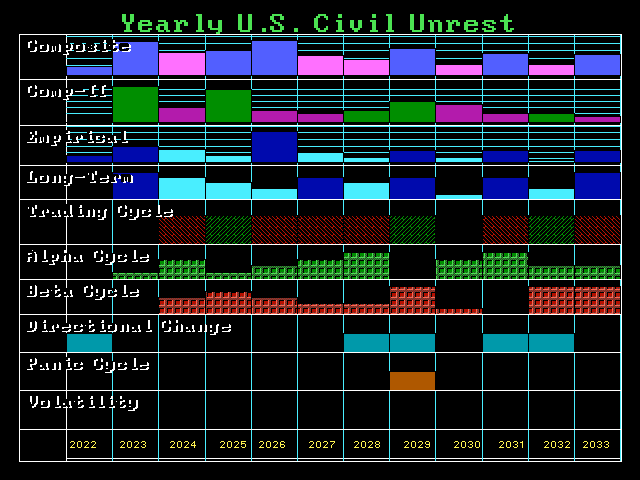
QUESTION: Marty, your Civil Unrest models targeted 2026 coinciding with international war. We have seen the Middle East erupting as you warned and now France with Macron is like Nero playing the fiddle while Paris burns. He is sending in 70,000 troops to the street this weekend. That’s half the Ukrainian troops that have deserted.
The waves of riots that have so convulsed France in recent weeks are in fact already rippling across Europe. I heard Greece is starting to have protests. Milan last weekend, where Meloni condemned “hooligans” trashing the city; in Brussels, protestors clashed with police, also inspired by events in France, thousands have marched in Portugal; in Spain, tens of thousands of people have taken to the streets in cities including Madrid, Valencia and Barcelona.
Your computer is amazing. Does it pick up human nature as part of the economic cycle? Will this spread to the USA?
Robert
ANSWER: Macron seems to be playing the fiddle as Paris burns as you said. I have said many times, these things become CONTAGIONS. Rome overthrew its kin in 509BC and within months Athens did the same and Democracy was born and spread to other Greek states. The American Revolution was 1776 and that prompted the French Revolution in 1789. We saw TiananmenSquare in Beijing, China in 1989 and within month the Berlin Wall fell. The 1849 European Revolutions began in Sicily and spread to Europe overthrowing the French government then too. This is spreading throughout Europe and it will come to North America going into 2028.
Our model works because it is based on reality – not academic hypothesis. Look, every economic theory is worthless from Random Walks & Efficient Market Theory to Keynesian Economic & Marxism. They all assumerational behavior and that society can be forced to act as they theorize. The European Central Bank (ECB) introduced NEGATIVE interest rates in June 2014 and ended them in July 2022. For 8 years they used this theory believing they could PUNISH people for not spending money. It failed and stifled economic growth.
I am a TRADER not an academic. What I had to do was understand market behavior. The wildest theory was Efficient Market Theory assuming people act rationally and all information is in the market determining price. Only an academic would come up with such nonsense for anyone who has traded markets REAL TIME, know the well-known and long-standing Wall Street proverb:
“Buy the rumor, sell the news.”
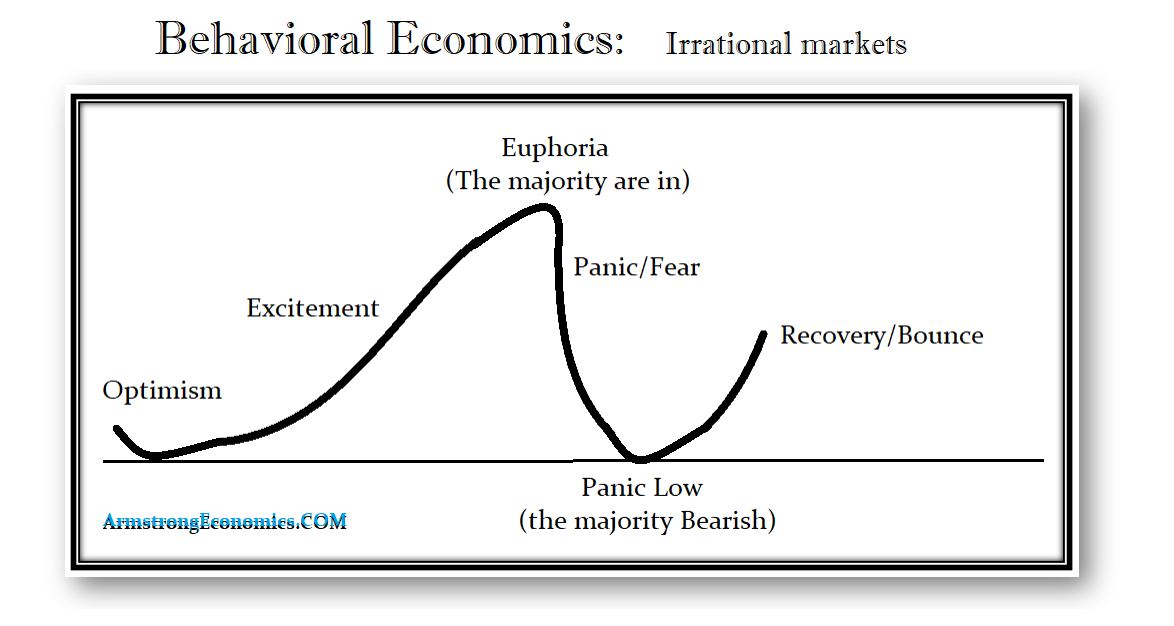
To trade a market, you must pay attention to how psychology, emotions, social influences, and cognitive biases affect economic decisions. It challenges the traditional economic assumption that individuals consistently make rational choices designed to maximize their financial well-being. That is UNREALISTIC. This is why many core economic principles like Supply & Demand, Comparative Advantage etc, came not from academics, but traders. A guy cannot write a book on how it feels to give birth. Some things in life REQUIRE hands-on experience.
In 2020, I warned that real estate would RISE with the first uptick in interest rates. Many thought I was nuts. When mortages rates kept declining, the average person is not stupid. They waited because it might be cheaper tomorrow. As soon as the first uptick took place, people ran out and locked in mortgages. The same took place in Japan back in 1988. The Consumption Tax Act was passed by the Japanese Diet in December 1988, and came into effect on April 1, 1989. People ran out and bought ahead of the tax and this yielded the false impression that the economy was booming contributing to the December 1989 Bubble top. People rushed to buy appliances etc. because it would be more expensive with the new tax. When the tax came in, people stopped buying and the recession began.
People RESPOND on ANTICIPATION. I have said many times, my mother and her sister locked in 10-year CDs at the very high in interest rates in 1981 and they DID NOT ask me for advice. When I asked why she did that, she said when would she ever get 20% again. The average person is OFTEN the real forecaster and the pundits respond to the data, which means the people act FIRST!!!!
Traditional economics crafted by academics with ZERO trading experience typically assume that people respond logically to prices, incentives, and available information. Any seasoned trader knows that people frequently make decisions based on rumor, fear, greed, confidence, habit, and expectations, even when those decisions contradict their economic interests. The 1987 Crash asked fund manager why they sold. They said the Dow fell 1,000 points, nobody knew why, so they did not know if it would against tomorrow so they sold. It was LACK of information that caused the panic!!!!!
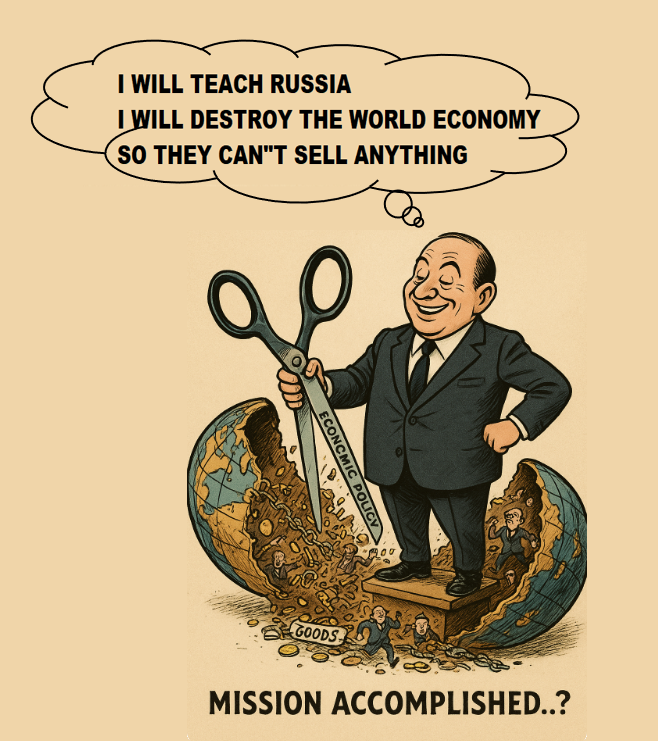
The Neocons have destroyed the world economy for they too always impose sanctions trying to PUNISH the people to force them to overthrow some government they do not like. Removing Russia from SWIFT resulted in splitting the world economy with the alternative system CHIPS. There is NO evidence that sanctions have ever worked even once.
They imposed sanction on Cuba in 1960 and are still there and the government is still there. Remove all sanctions, the people will prosper, and then they will take a stand against the government as we now see in France. Historical cases show that sanctions NEVER force a government to abandon a core strategic interest purely because of economic pressure. When the United States imposes sanctions with the explicit goal of changing a government’s behavior, the record demonstrates they only punish the people who then hate America. This is why the United States has a reputation outside of that it is imposing IMPERIALISM. These policies fail to work just as Keynesian Economics has failed.
The computer tracks the markets in advance of the numbers tapping into the TRUE nature of how markets and the economy function by Behavioral Economics, which flies in the face of the academics. A correlation of civil unrest and war has shown that when the economy is doing good, everything is functions.
Turn the economy DOWN, and you get civil unrest and war. As I have said, war does not come when everyone is fat and happy.
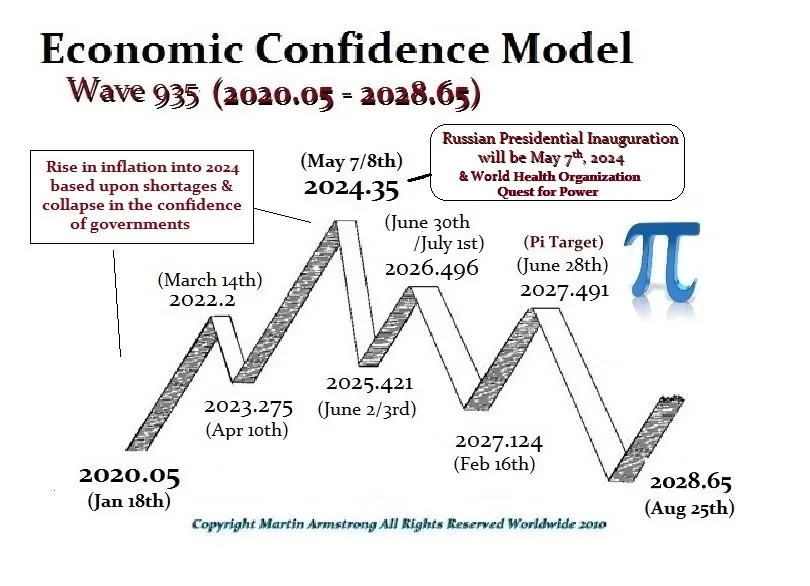
We are seeing protests now throughout Europe and you are correct, they have begun in Greece as well. It is spreading across all of Europe. With the Democrats coming into power this November, they are going to be vindictive as hell and the economy in the USA will turn down. They will raise taxes across the board and that is something you DO NOT do going into a global recession, which I have warned would accelerate from 2026 into 2028. This will heat up from February 2027.
The Democrats will NEVER learn because they cannot admit that progressiveness has NEVER worked once and it undermines the economy and eventually leads to its collapse. Wall Street is moving out of NYC thanks to Mandami and he will not relent. Where real estate was always in high demand even in North Jersey all because of NYC, that has already turned the corner and will decline sharply into 2028. Major New York banks are indeed shifting operations to other states. For at least one major bank, JPMorgan Chase, employment in Texas has already surpassed that in New York City.
JPMorgan Chase is the most typical case. According to its CEO Jamie Dimon’s shareholder letter and multiple reports, JPMorgan’s workforce in Texas has grown from approximately 26,000 in 2015 to approximately 32,000 today, while its New York City employees have decreased from 30,000 a decade ago to approximately 24,000. Dimon has also stated explicitly that JPMorgan now has more employees in Texas than in New York.
Goldman Sachs is building a large campus in Dallas, expected to accommodate approximately 5,000 employees. However, Goldman Sachs’ New York office remains its largest U.S. location, with approximately 7,800 employees, while the Dallas-Fort Worth area has approximately 4,500 employees. Therefore, for Goldman Sachs, Texas is expanding, but New York still holds the top position for now.
Are banks shifting operations abandoning NYC? The answer is Yes! Driven by tax, cost, and policy factors, banks such as JPMorgan, Goldman Sachs, and Morgan Stanley are expanding their presence in Texas (particularly Dallas).
Just look to the hard-left in France candidate Jean-Luc Mélenchon has proposed just defaulting on the National Debt of France. He claims the ECB holds 19% of France’s current debt. He has correctly states that that there have been many historical precedents and that another cancellation would not be so unusual. The last time France defaulted on its sovereign debt was in 1797, during the period of the Directory, in an event known as the “bankruptcy of the two-thirds” (banqueroute des deux tiers).
Napoleon created the Caisse d’amortissement (sinking fund) to manage the national debt and constantly intervened in its operations, frustrating his finance minister. To bailout the nation, lacking the ability to sell debt under severe financial strain in 1812 (largely due to the disastrous Russian campaign), he had used the army’s treasury to lend to the state: In 1808, he arranged for the army’s treasury to “lend” 84 million francs to the state, which was then repaid with government bonds. He could not sell debt, so he took the pension funds of the army to finance the state without going to the public.
As we head into 2028, the world economy will go into a sharp recession. As I said, where the American Revolution of 1776 inspired the French to revolt in 1789, this time France is spreading civil unrest to the rest of Europe and with the Democrats being prowar with Russia claiming they are supporting Democracy excusing the lack of elections in Ukraine because they are at war, NEVER have elections been suspended in the USA or UK during time of war. They just hate the Russian people all because Hillary claimed she would have won but for Putin.
So, prepare. The Democrats will bring the very unsound finance to the USA and only then will we see tensions rise with the prospect that the USA will also separate for the LEFT cannot sleep at night when they know someone has more money than they do. So look well at France. France has FREE health care, paid parental leave, paid family leave, FREE child care, FREE preschool, 5 weeks paid vacation, a 35-hour work week, generous unemployment and housing benefits, and heavily subsidized higher education. The forecast published by the Bank of France in December 2025 for GDP growth is (0.9%). France is just unsustainable.
Posted Posted originally on Oct 24, 2026 by Martin Armstrong |
Reliable sources report that two masked men set fire to Starlink antena in Bulgaria when it was said that Musk turn down Starlink for Ukraine. Then when it was to be turn on, oops, the Ukrainian in their typical vengeance destroy the antena that the Ukrainian military used.
According to reports from multiple news sources, two masked individuals did set fire to Starlink antennas in Bulgaria, but the incident did not occur in Ukraine, but at a secret facility near Sofia, the capital of Bulgaria. According to Bulgarian opposition lawmaker Ivaylo Mirchev, two masked men broke into a secret facility near Sofia and set fire to 11 out of 17 Starlink antennas used for communication with SpaceX satellites.
These antennas were reportedly providing critical communication connections for the Ukrainian military. Bulgarian Prime Minister Rumen Radev subsequently confirmed the investigation into the incident, but refused to disclose details, stating that he was cooperating with partner agencies and that releasing information prematurely would affect the results.
This incident is not isolated. In late September, a similar Starlink ground station arson attack also occurred in Poland, where Polish authorities identified it as sabotage and suspected Russian involvement. Lithuanian officials have linked the arson attacks in Bulgaria and Poland together, viewing them as part of a series of sabotage operations aimed at undermining Ukraine’s military capabilities. This time, the Bulgarian installation was set on fire after Starlink was curtailed.
It should be noted that the claim of “two masked Ukrainian men” has initially set forth. The Bulgarian side has now only identified the perpetrators as “two masked individuals,” without specifying their nationality. Reports mentioning the involvement of Ukrainian nationals refer to the Polish case, where Polish authorities detained a Ukrainian citizen suspected of participating in reconnaissance for the arson attack.
Ukraine blew up Nord Stream. They have no regard for anyone just as Zelensky told Trump to F-Off he would not stop destroying Russian refineries. The audacity of Zelensky destroying Nord Steam, undermining the Germany economy and Europe as a whole and then negs for money is beyond imagination.
Posted Posted originally on: Oct 24, 2026 by Martin Armstrong |
Reliable sources report that two masked men set fire to Starlink antena in Bulgaria when it was said that Musk turn down Starlink for Ukraine. Then when it was to be turn on, oops, the Ukrainian in their typical vengeance destroy the antena that the Ukrainian military used.
According to reports from multiple news sources, two masked individuals did set fire to Starlink antennas in Bulgaria, but the incident did not occur in Ukraine, but at a secret facility near Sofia, the capital of Bulgaria. According to Bulgarian opposition lawmaker Ivaylo Mirchev, two masked men broke into a secret facility near Sofia and set fire to 11 out of 17 Starlink antennas used for communication with SpaceX satellites.
These antennas were reportedly providing critical communication connections for the Ukrainian military. Bulgarian Prime Minister Rumen Radev subsequently confirmed the investigation into the incident, but refused to disclose details, stating that he was cooperating with partner agencies and that releasing information prematurely would affect the results.
This incident is not isolated. In late September, a similar Starlink ground station arson attack also occurred in Poland, where Polish authorities identified it as sabotage and suspected Russian involvement. Lithuanian officials have linked the arson attacks in Bulgaria and Poland together, viewing them as part of a series of sabotage operations aimed at undermining Ukraine’s military capabilities. This time, the Bulgarian installation was set on fire after Starlink was curtailed.
It should be noted that the claim of “two masked Ukrainian men” has initially set forth. The Bulgarian side has now only identified the perpetrators as “two masked individuals,” without specifying their nationality. Reports mentioning the involvement of Ukrainian nationals refer to the Polish case, where Polish authorities detained a Ukrainian citizen suspected of participating in reconnaissance for the arson attack.
Ukraine blew up Nord Stream. They have no regard for anyone just as Zelensky told Trump to F-Off he would not stop destroying Russian refineries. The audacity of Zelensky destroying Nord Steam, undermining the Germany econom and Europe as a whole and then negs for money is beyond imagination.
The United States has reached a point where the government is spending more than $1 trillion annually simply to pay interest on money it has already borrowed. The Treasury Department reported that the federal deficit reached $1.99 trillion for fiscal year 2026, an increase of $217 billion from the previous year. Total government spending climbed to $7.4 trillion while revenues amounted to only $5.4 trillion. Yet the most alarming figure is buried within that enormous spending bill. Net interest payments reached $1.05 trillion, while gross interest costs climbed to $1.36 trillion. Washington is now spending approximately $2.9 billion EVERY DAY in net interest, and that money does absolutely nothing to reduce the outstanding principal.
The interest expense alone has surpassed the entire national defense budget. Net interest is now the third-largest federal expenditure behind Social Security and Medicare, exceeding spending on Medicaid, veterans’ benefits, and numerous other government programs. Interest costs increased 8% over the previous fiscal year, while federal revenue increased only 3%. Washington collected more money from taxpayers, yet the cost of servicing its accumulated debt rose nearly three times as fast. Approximately 19 cents of every dollar collected by the federal government is now consumed by net interest payments. That money cannot build infrastructure, improve education, or provide additional services because it is being transferred to creditors for debts incurred by previous administrations and Congresses.
This is precisely what I have explained about the Sovereign Debt Crisis. Governments have absolutely no intention of repaying their debts. They continually roll over existing obligations while issuing additional debt to finance current spending. The politicians pretend that borrowing is a permanent source of revenue, but every bond eventually matures and must either be repaid or refinanced. When interest rates rise, the cost of refinancing becomes increasingly expensive. Washington became accustomed to artificially low rates during the pandemic and behaved as though that arrangement would continue indefinitely. The average interest rate on outstanding federal debt has now reached approximately 3.53%, more than double its 2021 level. Even that average understates the pressure from newly issued securities carrying higher market yields.
The numbers reveal how this process feeds upon itself. Federal debt held by the public increased by approximately $2 trillion during fiscal 2026, reaching $32.4 trillion, while total gross federal debt surpassed $40 trillion earlier this year. The government must borrow to cover its annual deficit while simultaneously refinancing trillions in existing securities as they mature. A one-percentage-point increase in the average interest cost on $40 trillion would eventually represent approximately $400 billion in additional annual interest, assuming the entire debt stock were affected. That increase would not occur overnight because existing fixed-rate securities retain their coupons until maturity, but the arithmetic demonstrates why the Treasury has become so sensitive to movements in the bond market.
Treasury Secretary Scott Bessent understands this problem because he comes from the world of global macro trading. He knows perfectly well that the Treasury cannot simply dictate what investors must accept as a return. The government can conduct buybacks, alter the maturity structure of its borrowing, and attempt to improve market liquidity, but none of those operations eliminates the underlying debt. Meanwhile, the Federal Reserve under Kevin Warsh can influence short-term rates, but it cannot command the 10-year or 30-year Treasury yield. If global capital demands higher compensation for inflation, currency risk, and the enormous supply of government securities, Washington must ultimately confront those market conditions.
Japan provides an important warning because it has spent decades attempting to manage an enormous sovereign debt burden through artificially suppressed interest rates. Japanese institutions are also among the largest foreign holders of U.S. Treasury securities. As Japanese government bond yields rise, those investors have a greater incentive to keep capital at home rather than finance Washington. This does not mean Japan must suddenly liquidate its American holdings. Even a reduction in future Treasury purchases matters when the United States must continually find buyers for enormous quantities of new and refinanced debt. Washington is competing with Japan, Europe, corporations, and private borrowers for the same international pool of capital.
The situation becomes even more absurd when politicians discuss cutting government spending. They argue endlessly over relatively small discretionary programs while interest costs are growing into one of the largest obligations in the entire federal budget. Interest payments are not optional expenditures that Congress can simply eliminate during budget negotiations. Treasury must honor its obligations if the United States intends to preserve the credibility of its debt. The more revenue consumed by interest, the less flexibility the government has to finance other commitments without additional borrowing or taxation. The political establishment has spent decades accumulating obligations, and now an increasing share of federal revenue is required merely to maintain the existing financial structure.
Consider what this means for the American taxpayer. The government collects income taxes, payroll taxes, corporate taxes, and numerous other forms of revenue, yet approximately one-fifth of federal receipts is now absorbed by interest on past borrowing. Americans are already confronting higher prices for housing, food, energy, insurance, and transportation. Washington continues demanding revenue from an economy where households are struggling to maintain their standard of living, and an increasing portion of that money is required to service the debt rather than provide any new public benefit. Politicians speak about the need for additional taxes, but the underlying spending problem remains untouched.
This is also why the notion that the Federal Reserve can rescue Washington simply by lowering interest rates is absurd. The Fed could reduce its overnight target, but that would not automatically lower long-term Treasury yields if investors remain concerned about inflation and fiscal sustainability. Attempting to suppress yields through massive bond purchases would introduce another problem by expanding central bank support for government financing. The United States already experienced the consequences of extraordinary monetary expansion during the pandemic. Americans are still paying the accumulated inflation bill, and repeating those policies would carry serious risks for purchasing power and confidence in the currency.
The most revealing aspect of the latest Treasury figures is that Washington is accumulating nearly $2 trillion in new deficits during a period when the economy is not experiencing a conventional recession. Revenue has reached approximately $5.4 trillion, yet the government still cannot come remotely close to balancing its books. Spending rose 6%, roughly twice the growth rate of revenue, while interest costs continued climbing. The political establishment keeps treating every new tax dollar as permission to spend even more, and nobody wants to confront the fact that the government has made itself increasingly dependent upon perpetual borrowing.
There is a fundamental difference between a government borrowing to finance productive infrastructure and one borrowing merely to maintain existing obligations. The latter becomes increasingly dangerous as debt servicing consumes a larger share of national resources. America has now reached the point where more than $1 trillion is spent annually on net interest, with no reduction in principal and no guarantee that refinancing costs will decline. The politicians will continue arguing over which party is responsible, but the debt has accumulated under both Republicans and Democrats because neither side has been willing to confront the long-term arithmetic.
The Sovereign Debt Crisis has never been about the government suddenly running out of dollars. The United States can create dollars, but it cannot create unlimited real purchasing power or compel international investors to hold its debt at whatever interest rate Washington prefers. The crisis emerges as confidence deteriorates and the cost of financing government becomes increasingly burdensome. We are watching that process unfold as interest payments consume more revenue, deficits expand, and the Treasury becomes increasingly dependent upon the willingness of global capital to finance its obligations.
The United States is now borrowing trillions annually while paying nearly $3 billion every day in net interest on its existing debt. That is an extraordinary financial burden for a government that continually promises the public more spending, more programs, and more benefits without explaining how any of it will ultimately be financed. The politicians have created a system where yesterday’s borrowing demands today’s taxes, and today’s borrowing guarantees an even larger interest bill tomorrow. They are not solving the debt problem. They are financing the cost of refusing to solve it.
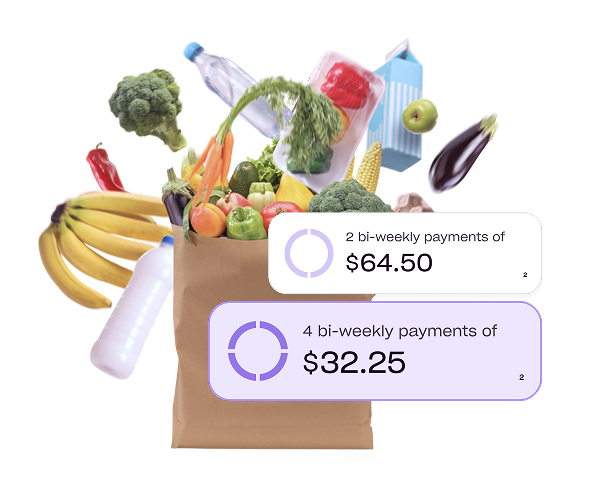
Americans are increasingly financing the basic necessities of life because their paychecks are no longer stretching far enough. Buy-now-pay-later financing has exploded into a $160 billion industry, according to research cited by the Associated Press, with the use of short-term pay-in-four loans increasing nearly 80% since 2023. What began as a convenient way to purchase electronics or clothing is now being used for groceries, transportation, household bills, and even rent. We have reached the point where people are borrowing against their next paycheck to purchase things they need to survive today.
The Federal Reserve’s latest household survey found that 16% of American adults used buy-now-pay-later services in 2025, compared with only 10% in 2021. Among households earning between $25,000 and $49,999, the participation rate reached 23%, compared with 12% among those earning $100,000 or more. The Fed also found that 30% of users identified affordability as the single most important reason for using installment financing. Another 20% reported using these services for groceries or food delivery. Think about what those numbers are telling us. Millions of Americans are dividing relatively small purchases into installments because paying the entire amount upfront would place too much pressure on their finances.
The situation becomes even more alarming when examining repayment problems. The Fed found that 26% of buy-now-pay-later users made at least one late payment during 2025. Among users earning less than $25,000, that figure reached 40%, while 33% of those earning between $25,000 and $49,999 fell behind. Compare that with only 11% of users earning $100,000 or more. These are enormous differences that demonstrate how lower-income consumers are increasingly struggling to manage even short-term obligations. Of those who paid late, 64% reported being charged additional fees. The people least able to absorb another expense are often the very people being penalized for falling behind.
The Consumer Financial Protection Bureau uncovered another troubling pattern. Its study of 2022 borrowing found that approximately 63% of buy-now-pay-later borrowers had multiple simultaneous installment loans, while 33% borrowed from more than one provider. The average borrower originated 9.5 loans during the year, and roughly one in five borrowers took out more than one loan per month on average. This is how relatively small obligations accumulate into a serious financial burden. A consumer may believe that four payments of $25 are manageable, but what happens when that person has ten separate payment schedules running simultaneously? The money has already been committed before the next paycheck even arrives.
The Federal Reserve’s October 2026 Survey of Consumer Finances reveals that this financial deterioration extends far beyond installment purchases. The share of American families reporting that they were behind on loan payments increased from approximately 12% in 2022 to nearly 20% in 2025. Families devoting more than 40% of their income to debt payments increased from 6.5% to 8.6%, the highest share since 2013. The median debt-payment-to-income ratio climbed to 15.4%, while the overall debt-to-income ratio reached 94.9%.
The Fed reported that real median family income increased 7% between 2022 and 2025, reaching $82,200, yet median net worth increased only 2% after adjusting for inflation. The bottom quarter of households experienced a staggering 50% decline in net worth, while the wealthiest households continued benefiting from appreciating financial assets. Among families holding stocks, median stock holdings increased 36% to $77,400. This is why the stock market can continue making new highs while millions of people struggle to pay their bills. The financial press looks at rising asset prices and declares prosperity, but a family with no meaningful investments receives absolutely no benefit from that rally.
We must also understand what inflation has done to the average household since 2020. Prices surged during the pandemic, and those increases were NEVER reversed. The politicians continue discussing inflation as though a decline in the annual rate somehow restores purchasing power. It does not. A family that was spending $1,000 on necessities before the pandemic may now need approximately $1,300 to purchase a comparable basket of goods and services, depending on the items involved. Another 3% or 4% inflation increase comes on top of that already elevated expense.
The latest retail sales figures provide another example of how misleading the economic statistics have become. September retail sales increased 0.8%, but gasoline station sales surged 7.1% as energy prices rose. The retail sales control group used in GDP calculations increased only 0.1%, below expectations. Retail sales are reported in nominal dollars, meaning that higher prices can inflate the sales figures without consumers purchasing additional goods. When gasoline becomes more expensive, Americans still have to drive to work. The government records higher spending, but the consumer has less disposable income available for everything else. This is hardly evidence of improving living standards.
Bank of America Institute reported this week that nearly one in five households using buy-now-pay-later financing had repayments exceeding $500. Its analysts did not characterize the overall trend as an immediate crisis, but the growing reliance on installment financing deserves attention when combined with weakening labor conditions and rising household delinquencies. A person who uses credit strategically to avoid interest is in a very different position from someone who must finance groceries because there is insufficient money in the checking account.
We are developing two entirely different consumer economies. Those with substantial assets, investment income, and mortgages locked in at 3% can continue spending while benefiting from rising markets. Those dependent upon wages face higher rents, expensive vehicle financing, mounting insurance premiums, and increasingly difficult choices about ordinary household expenses. The latest Federal Reserve data show that nearly one in five families have fallen behind on loan payments, while the use of installment financing continues expanding. These people are not purchasing luxury yachts or speculating in the stock market. Many are simply attempting to maintain a standard of living that their income no longer supports.
The financial industry has discovered how to divide an unaffordable purchase into four manageable-looking payments, but it has not solved the underlying problem. Every installment is a claim against future income, and when enough of those claims accumulate, the household loses the flexibility to absorb even a minor emergency. Americans are being encouraged to finance the present with money they have not yet earned, while Washington continues spending money it must borrow. The numbers reveal an economy where financial pressure is building beneath the surface, and the people experiencing that pressure are increasingly the ones who can least afford another setback.
Posted Posted originally on: Oct 23, 2026 by Martin Armstrong |
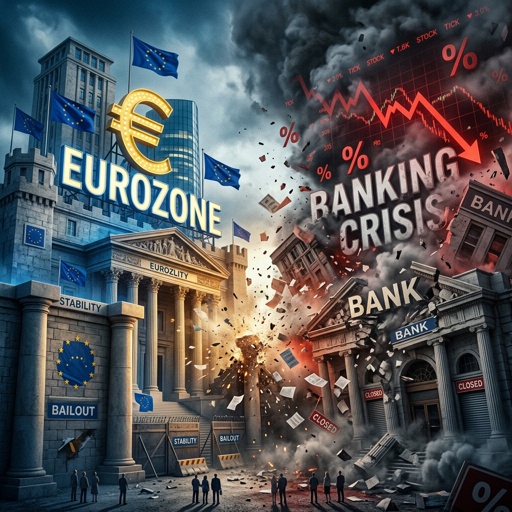
QUESTION: Mr. Armstrong, you have publicly warned the EU about this looming debt crisis. You have explained it as a trader on numerous podcasts. I find it incredible that the WSJ, Reuters, and Bloomberg do not interview you, which only confirms they have become fake news. Reuters quotes people who were not there from the beginning or even in 2010. They claim banks have diversified, suggesting the risk of a banking crisis today is minimal compared to 2010. They even concluded:
“Proposals to strip government bonds of risk-free status or impose concentration limits have so far failed. But the EU Commission has included a further diversification of sovereign bond portfolios among steps needed to strengthen the banking sector, and will present its proposals in early 2027.”
Because you were an analyst and a trader and were called in at the formation of the euro, you are the only one truly qualified on this subject. Am I correct that you frame what is happening as a threat to the Eurozone’s survival rather than a mere banking crisis?
Hal
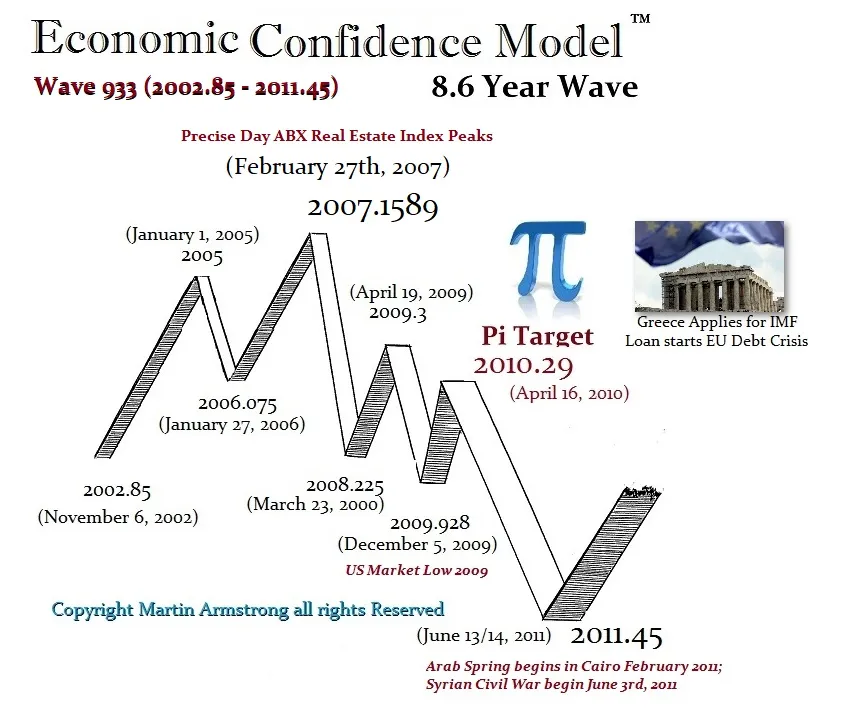
ANSWER: Thank you for that question. I will be glad to do a video call with the board. Yes, you are correct. This is like the mouse trying to get the cheese oblivious to the fact that the house is burning down. The 2010 European Debt Crisis took place precisely to the day of the Pi Target. It was kicked off by Greece applying for an IMF bailout. That was the CONTAGION risk, NOT a Eurozone crumbling because of the politics, but the question of insolvency of the banking system. This was before the Sovereign Debt Crisis itself, and first focused on the sovereign debt held as reserves. What I warned that the failure to CONSOLIDATE the debt meant that this was the vulnerability that one could take take the rest of the Eurozone.
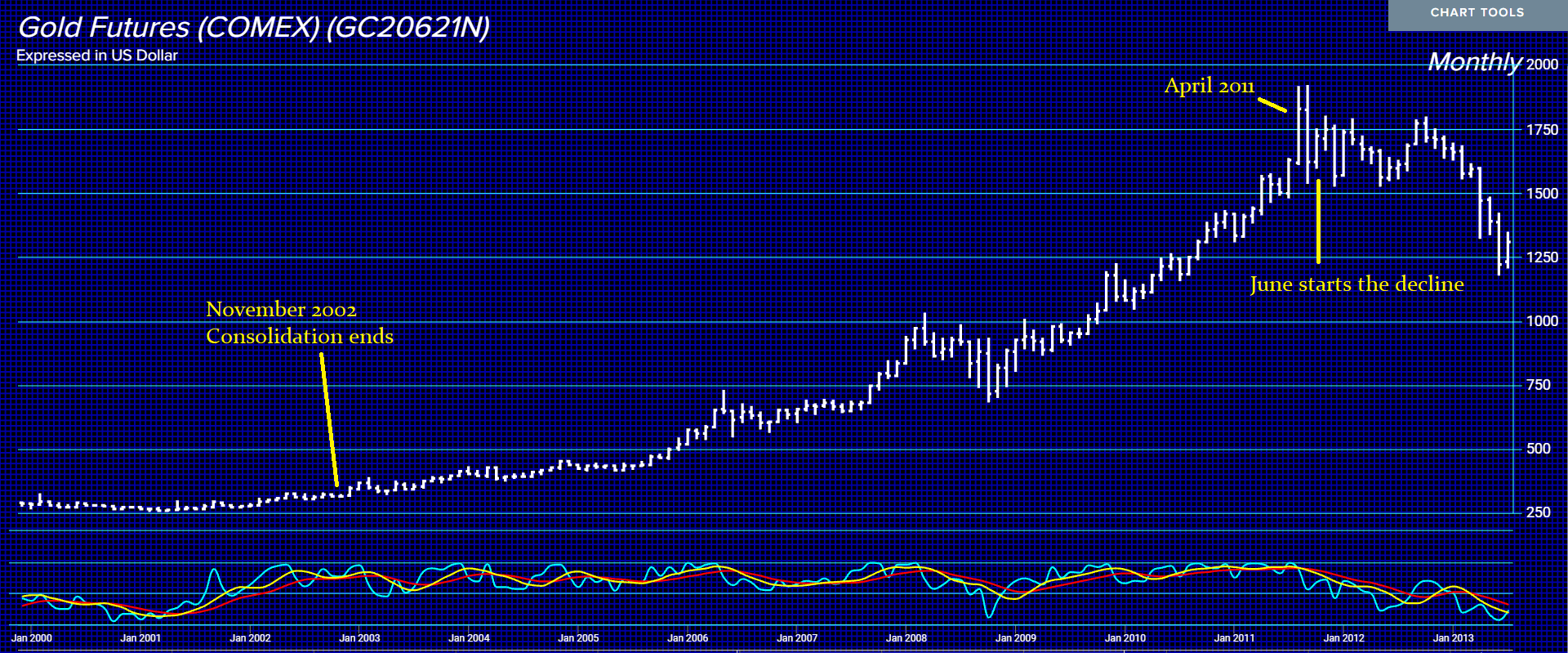
The GoldBugs were NOT happy with me when I forecast that gold would peak in 2011 and would decline into the next major target on the ECM of 2015.75. Gold then bottomed in December 2015. They would constantly call for the demise of the dollar as they too were oblivious to any fact outside of the USA. It always had to be the demise of the dollar. Gold rallied from the European Debt Crisis of 2010 and peaked in 2011 and the CONFIDENCE began to return.
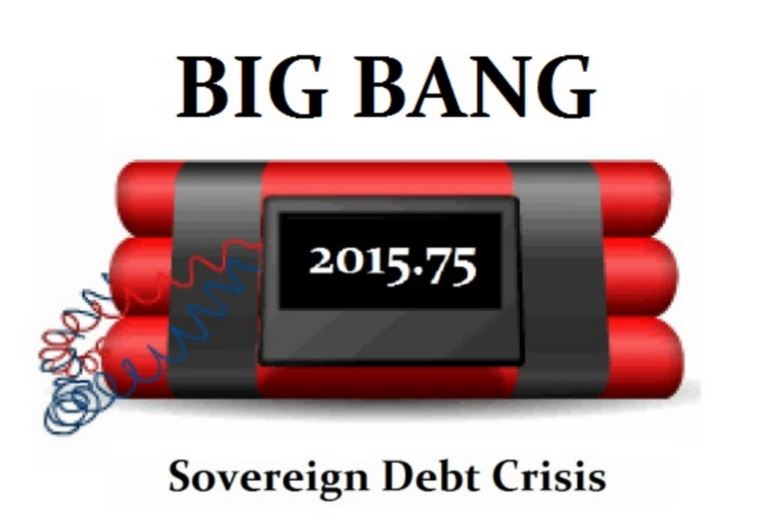
That aligned with the cycles calling for a low in gold in 2015.75, which I called BIG BANG – the start of the Sovereign Debt Crisis. That was the turning point on CONFIDENCE in government worldwide that has steadily eroded and is on track for the 17 year decline into 2032. That target was correct – the beginning of the Sovereign Debt Crisis. They thought I was nuts for the long-term forecast that Gold would hit $5,000. That was explicitly stated for the first time publicly predicting gold would reach $5,000 per ounce on November 7, 2009. It is always easier to forecast long-term with Socrates than the closing price tomorrow because the near-term tend to be just noise. The long-term is the trend.
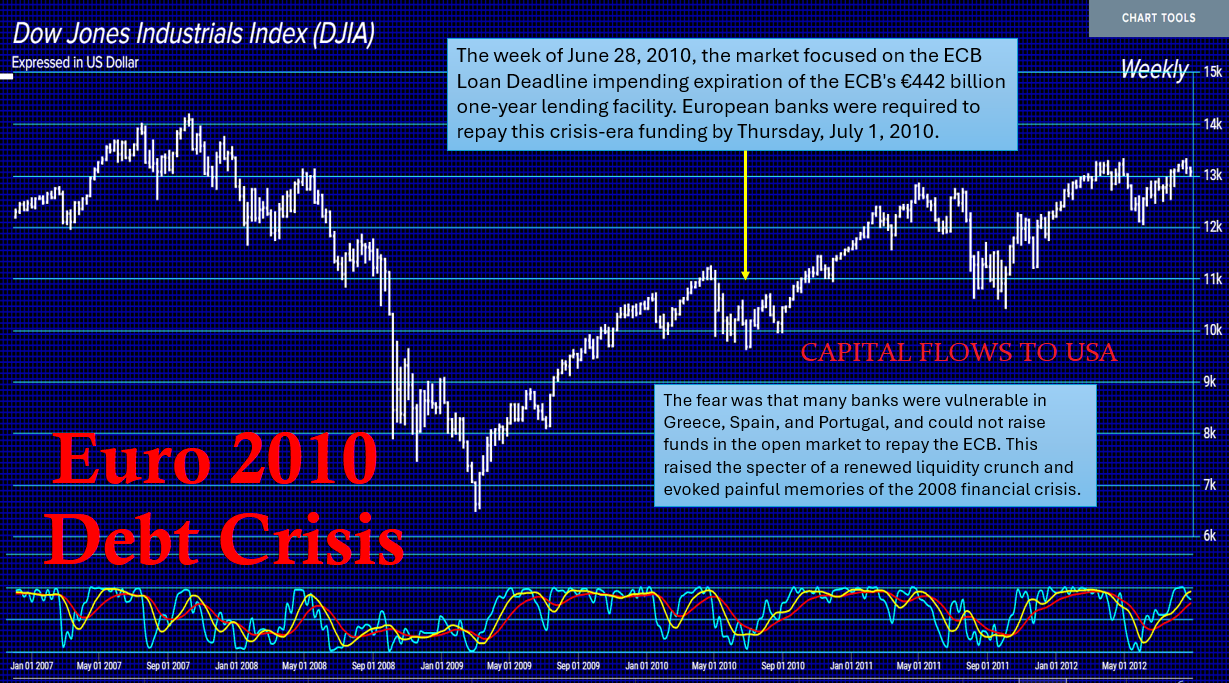
The official timeline shows that Greece requested financial assistance from the IMF in April 2010, The week of June 28, 2010, was a period of acute market stress focused squarely on the health of European banks, driven by a looming European Central Bank (ECB) funding deadline. The ECB Loan Deadline was the impending expiration of the ECB’s €442 billion one-year lending facility. European banks were required to repay this crisis-era funding by Thursday, July 1, 2010.
The fear was that many banks, particularly in fiscally vulnerable countries like Greece, Spain, and Portugal, would struggle to raise funds in the open market to repay the ECB. This raised the specter of a renewed liquidity crunch and evoked painful memories of the 2008 financial crisis.
August 2010 was a Period of Contagion and escalation. In August 2010, the crisis spread significantly to Italy and Spain and we see the Crash Here is Paribas. At that time, the yields on 10-year government bonds of Italy and Spain climbed to new highs (6.16% and 6.26%, respectively), triggering market panic and prompting the Italian finance minister to rush to Luxembourg for emergency consultations. This indicates that the crisis was deepening and spreading.
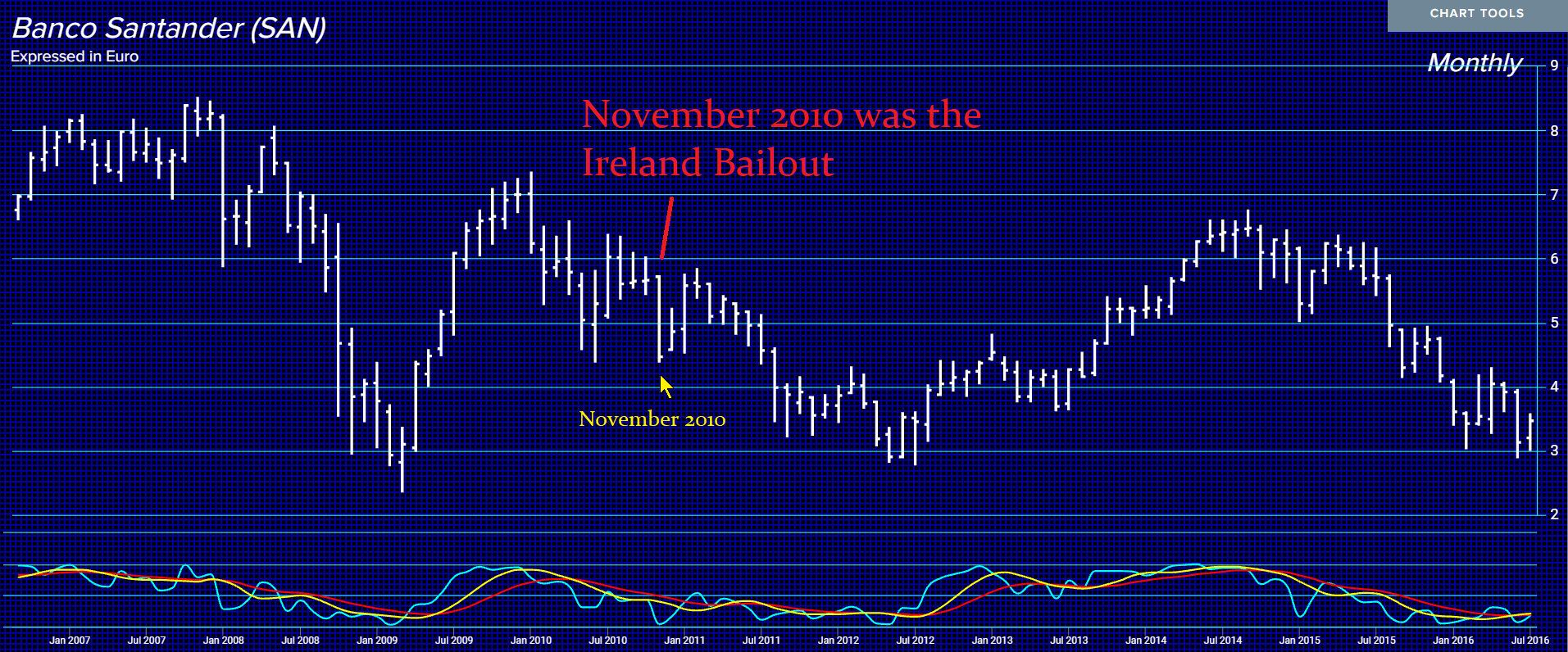
In November 2010, the crisis escalated significantly when Ireland officially requested international financial assistance. This was triggered by the massive costs of bailing out its banks, which had grown too large relative to the economy. The Irish government subsequently agreed to a bailout package, leading to political turmoil and the collapse of the government.
The events of November 2010 were widely reported at the time as fears that the “Irish debt crisis” could spread to other vulnerable economies like Portugal and Spain, rather than being the start of the crisis itself. We can see here in the Spanish Bank Santander that November was the retest of the low and there was no recovery to speak of as this bank share decline into July 2012 before CONFIDENCE began to return.
What we face THIS TIME is the flip-side. Now there a proposals to strip government bonds of risk-free status insofar as holding them for reserve status or impose concentration limits which have failed. But the EU Commission has included a further diversification of sovereign bond portfolios among steps needed to strengthen the banking sector, and will present its proposals in early 2027. What this means by stripping the European Sovereign Debt itself of risk-free status, is an acknowledgement that this nonsense that government debt is risk free because they cannot default will mean the market has won. Government debt is the riskiest of all because they always default and NEVER pay their debts.
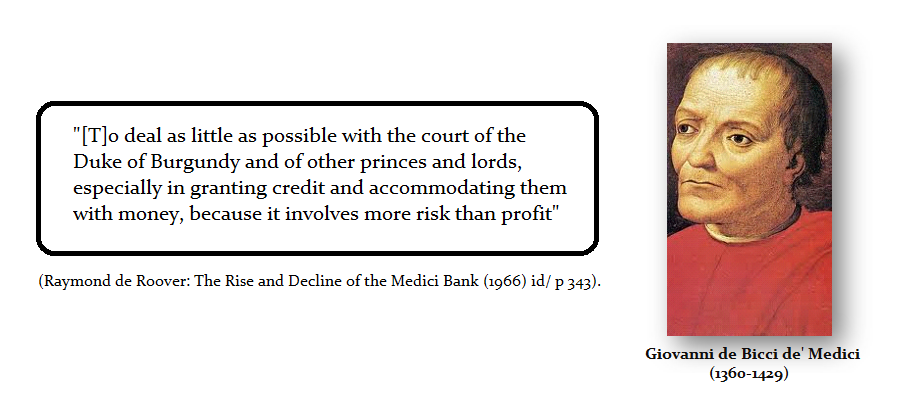
Here is the rule of the Medici. There is more risk in lending to the state than there is potential profit. Nothing has ever changed. The first sovereign debt was 400BC on the ancient quasi-central bank, the Temple of Apollo on the Island of Delos. Governments are ALWAYS the greatest risk because they are fiscally irresponsible historically – that is just a fact that has NOTHING to do with partisan politics.
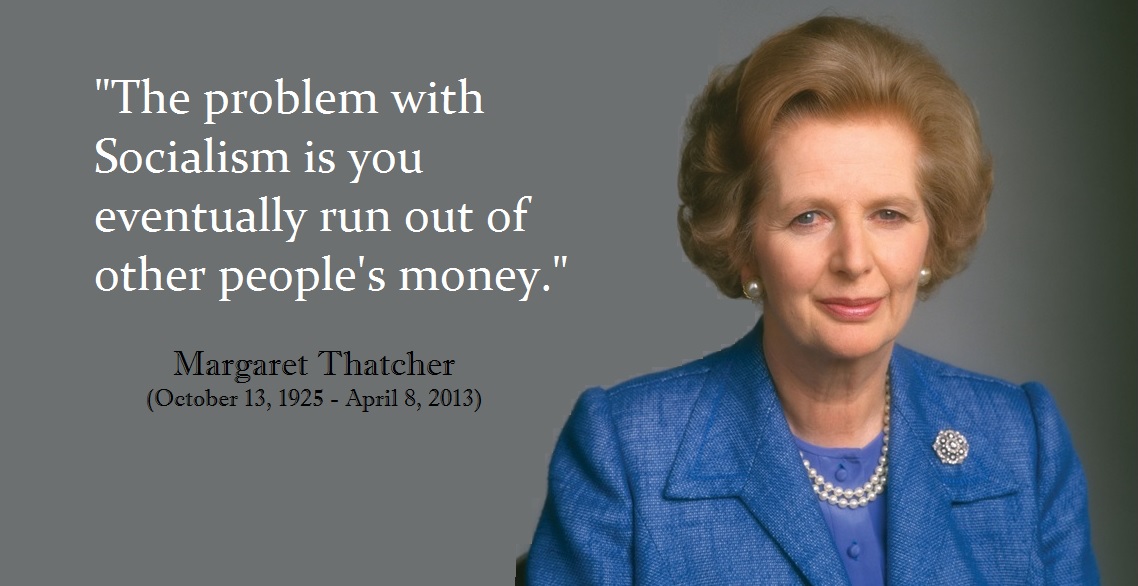
Margaret Thatcher was, in my opinion, the smartest head of state I ever met. She understood economics and the socialists refused to ever surrender their ideas of robbing the rich to pay for their lifestyle. It has never worked even once
In the late 3rd century BC, kings Agis IV and Cleomenes III attempted radical reforms ibn ancient Sparta that resembled socialism, canceling debts and redistributing land to create a larger citizen body. However, these were emergency rescue attempts to reverse the damage already done by DEBT CRISIS as always. Agis was killed by the civil unrest, and Cleomenes was ultimately defeated in war. To PREVENT capitalism insofar as a true market economy, Sparta NEVER issued coinage. The “inequality” had to do with land ownership for the economy was effectively close to 95% agrarian.
The European Union has refused to look at reality. They have dictated their stupid policies of allowing the migrants and
I have created this site to help people have fun in the kitchen. I write about enjoying life both in and out of my kitchen. Life is short! Make the most of it and enjoy!
This is a library of News Events not reported by the Main Stream Media documenting & connecting the dots on How the Obama Marxist Liberal agenda is destroying America