Spain Never Solved the Catalonia Problem


Posted  Originally on Sep 17, 2026 by Martin Armstrong |
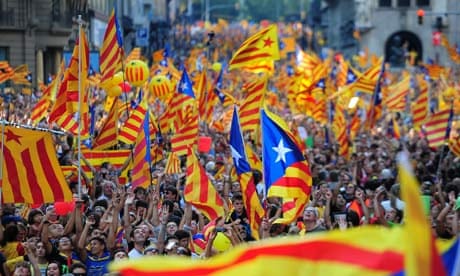
Catalan independence rally brings Barcelona to a standstill | Spain | The  Guardian

Madrid thought it had crushed the Catalonia independence movement in 2017 when it sent police into polling stations, declared the referendum illegal, removed the regional government, prosecuted separatist leaders, and watched Carles Puigdemont flee Spain. Nine years later, the European Union’s highest court has upheld key aspects of Spain’s 2024 amnesty covering acts connected to the Catalan independence process. Roughly 1,600 people were estimated to potentially fall within the law’s scope. Spain has reached the point where the political establishment is pardoning people associated with a separatist movement it once tried to destroy because the underlying political problem never disappeared.

Months before the referendum, when I had been in Barcelona, I said Catalonia would vote to separate from Spain. I explained that separatism was a process driven by declining confidence in centralized government. By October, Madrid demonstrated exactly how governments strengthen these movements. Instead of permitting a legitimate vote and confronting the political question, it declared the referendum unconstitutional and attempted to stop it by force.

A Timeline of the Catalan Independence Referendum in Spain
Catalonia Referendum: Detailed Results in 5 Maps - Political Geography Now

The images from October 1, 2017, should not be forgotten. Spanish police entered polling stations, confiscated ballot boxes, and physically confronted people attempting to vote. The referendum was not a mutually recognized binding vote, and opponents of independence largely boycotted it, but Catalan authorities nevertheless recorded more than two million ballots, with roughly 90% voting for independence on turnout of around 43%. Madrid’s response transformed a constitutional dispute into a demonstration of raw political power.

I argued then that Spain should have permitted a legitimate referendum and negotiated the outcome. Britain allowed Scotland to vote in 2014 and Canada allowed Quebec to vote twice. If a political union truly serves its people, government should not need police to prevent them from expressing whether they want to remain inside it.

Madrid instead imposed direct rule under Article 155, dissolved the Catalan parliament, removed Puigdemont’s government, and prosecuted separatist leaders. Brussels stood firmly behind Madrid because Catalonia represented something much larger than Spain. The European Union is built around political integration moving in one direction toward greater centralization, while separatism represents the opposite force of authority moving back toward nations and regions. A successful Catalan separation would immediately raise uncomfortable questions for Scotland, Flanders, Corsica, South Tyrol, and every other European region with a distinct political identity.

Now look at Spain in 2026. Prime Minister Pedro Sánchez needed Catalan separatist support after the 2023 election, and the amnesty became part of the political arrangement that allowed him to remain in power. The people once treated as enemies of the constitutional order suddenly possessed enough parliamentary leverage that Madrid was prepared to negotiate with them. The EU’s Court of Justice then ruled in July that EU law does not itself prevent Spain from adopting an amnesty, although legal disputes over its application continue.

Calling this reconciliation does not mean the underlying problem has been solved. Catalan identity remains, the political memory of 2017 remains, and the economic tensions remain. Independence parties have lost some of the strength they possessed at the height of the crisis and recent polling has generally placed outright independence below 50%, but separatist movements do not move in straight lines. They strengthen and weaken with economics, confidence, and political conditions.

Catalonia represents roughly one-fifth of Spain’s economy, which makes the economic question impossible to separate from the political one. Madrid views Catalonia as too important to lose, while separatists can look at the same productive capacity and question why taxation, spending, and political authority should remain concentrated in Madrid. When people believe central government provides prosperity and stability, separatism weakens. When they believe government takes more than it provides or no longer represents their interests, independence becomes far more attractive.

This is why the current separatist trend across Europe matters. Scotland, Wales, and Northern Ireland have just seen nationalist leaders coordinate against Westminster. Giorgia Meloni is arguing that greater sovereignty should remain with Europe’s nation-states rather than Brussels. Iceland rejected reopening EU accession negotiations, while nationalist and anti-establishment parties elsewhere are benefiting from dissatisfaction with centralized authority. These movements are not identical, but the common thread is declining confidence in political structures that continually demand more authority for the center.

Brussels has never understood that greater centralization eventually creates the political force for decentralization. Every crisis is used to justify additional European authority over debt, migration, energy, climate, defense, or foreign policy. Yet Europe remains a continent of different nations, languages, economies, histories, and political interests. Those differences cannot simply be legislated out of existence.

Spain may have kept Catalonia on the map after 2017, but keeping territory does not mean restoring confidence. If the crisis had truly been resolved, Spain would not still be debating amnesties, Puigdemont, separatist parties, and the constitutional consequences of what happened nine years ago. Madrid suppressed the immediate rebellion, but it never eliminated the conditions capable of producing another one.

The next serious economic crisis in Europe will test these political unions again. Catalonia will not be starting from zero because it already has the parties, institutions, national identity, historical memory, and experience necessary to revive the independence question. Madrid did not eliminate Catalan separatism in 2017; it merely bought itself time, and economic and political cycles will ultimately determine how much that time was worth.


Brussels Finally Admits Borders Matter


Posted  Originally on Sep 17, 2026 by Martin Armstrong |

For years, anyone who dared to say that a nation must control its borders was treated as some dangerous nationalist. Now Ursula von der Leyen stood before the European Parliament and declared that “Europe needs the means to protect its borders at all times.” Brussels is proposing a new European Emergency Response Framework to deal with sudden mass migration, particularly when migration is “engineered and weaponised.” Apparently borders matter after all, but only when Brussels decides that they matter.

The announcement follows the extraordinary crisis in Ceuta this summer, when a mass movement across the border from Morocco forced EU interior ministers into an emergency meeting. Von der Leyen now says the new framework would operate under strictly defined circumstances and temporarily relax standard procedures so governments can respond faster. She also wants stronger external border management, faster returns, greater Frontex involvement, and improved cooperation with countries outside the EU. These are policies Europeans have demanded for years while being lectured that migration required solidarity, humanitarian obligations, and increasingly centralized European management.

What makes this even more remarkable is that the EU’s new Pact on Migration and Asylum only became fully applicable on June 12, 2026. Brussels called it a comprehensive solution that would finally provide secure external borders, faster asylum procedures, better returns, and a permanent solidarity system among member states. Barely three months later, von der Leyen is already saying Europe’s tools must “evolve” because the existing system is inadequate for emergencies.

Brussels now openly uses the term “weaponised” migration. Think about what that admission actually means. Human beings can be deliberately used as instruments of geopolitical pressure because European governments surrendered sufficient control over migration that adversaries recognized it as a vulnerability. Poland, Finland, Greece, Spain, Italy, and other frontier states have confronted different versions of this problem, yet Brussels spent years trying to impose a common political answer upon countries facing completely different geographic and security conditions.

The new migration pact goes even further by establishing a mandatory solidarity mechanism. The European Commission determines which member states are under migratory pressure and organizes support through a European solidarity pool, which can involve relocations or alternative contributions. Brussels presents this as burden sharing.

This is where the sovereignty problem becomes unavoidable. Hungary does not have the same migration politics as France. Poland does not have the same geography as Portugal. Italy and Greece confront Mediterranean migration routes that northern European states do not. Spain faces pressure through Ceuta and the Canary Islands. Yet Brussels continually responds to these radically different circumstances by creating a one-size-fits-all solution.

Von der Leyen is correct about one fundamental point: Europe must be capable of protecting its external borders. No functioning political system can survive indefinitely without knowing who is entering, determining who has a legal right to remain, and removing those who do not. The dispute is over who should exercise that authority and whether another emergency framework in Brussels actually restores control to nations or simply transfers even more authority upward.

The separatist and sovereignty movements spreading across Europe are directly connected to this debate. People are increasingly questioning political structures because decisions affecting their daily lives are being pushed farther away from them. Migration merely makes the problem visible because nothing demonstrates the meaning of sovereignty more clearly than control over territory and borders.

The Fed Is Raising Rates


Posted  Originally on Sep 17, 2026 by Martin Armstrong |

Interest rate hike due to inflation percentage rising up, FED, federal  reserve or central bank monetary policy, economics or loan concept,  businessman archery percentage arrow high up into the sky. 5719413 Vector

The Federal Reserve has raised interest rates for the first time in three years, increasing the federal funds target by 25 basis points to 3.75%–4.00%. The significance is not the quarter-point move itself. The Fed spent 2025 cutting rates only to turn around and raise them again because inflation never vanished as the academics expected. Chairman Kevin Warsh says the move demonstrates the Fed’s commitment to returning inflation to its seemingly impossible 2% target, and the FOMC voted unanimously for the increase. They still cling to this theory that they can steer an $30 trillion economy by moving one interest rate up and down.

Even the Fed admits economic activity continues to expand at a “solid pace,” domestic spending remains resilient, productivity growth is strong, capital investment remains robust, and unemployment has changed little. This is precisely the problem with trying to manage an economy as if it were some laboratory experiment. People do not stop living because twelve people in Washington change the federal funds rate by 25 basis points.

The 10-year Treasury yield moved to around 5% following the decision while mortgage rates were already approaching 7%. THAT is where the pain becomes real. Housing affordability is already a disaster, borrowers are paying punishing rates, businesses face higher financing costs, and Washington must continually refinance an enormous national debt at rates dramatically above those of the previous decade. The politicians loved artificially low rates because they could borrow endlessly and pretend there would never be a bill.

Now the bill is arriving. The contradiction is that government desperately wants lower rates because it is the largest borrower in the entire economy. Washington has accumulated so much debt that rising interest rates threaten the budget itself, yet the government continues borrowing regardless of the cost because nobody in Congress has any intention of balancing anything. They spend first, borrow whatever is necessary, and then blame the Federal Reserve when the cost of servicing their own debt explodes.

This is why the Federal Reserve cannot control inflation the way these academics pretend. The Fed does not control government spending, fiscal deficits, taxation, energy, war, tariffs, shortages, or international capital flows. It can influence the price of short-term credit, but it cannot control DEMAND throughout an entire economy. It cannot stop Congress from spending another trillion dollars, force people to stop buying food or gasoline, prevent companies from investing when they see an opportunity, or manufacture oil when geopolitical events send energy prices higher.

Government itself is one of the largest sources of demand, yet the Fed has absolutely no power to tell Congress to stop spending. Raising rates instead attacks the private sector because the homeowner, small business, automobile buyer, and anyone dependent on credit feels the impact first. Government simply issues more debt and passes the higher interest expense on to taxpayers.

This is where modern monetary policy becomes absurd. Raising rates can destroy credit-sensitive demand, but it cannot cure inflation caused by shortages, taxation, government spending, geopolitical disruptions, tariffs, or energy. You can raise rates to 10%, but that will not produce another barrel of oil. You can bankrupt a homebuilder, but that will not create more housing. You can crush the consumer with higher credit-card rates, but that does not force Congress to reduce a trillion-dollar deficit. They are trying to control the temperature of the entire house by opening one window.

The Fed’s projections indicate another increase may follow this year. Whether that happens will depend on inflation, employment, energy, and capital flows, but the important development has already occurred. The easing cycle has reversed because inflation proved far more stubborn than the theories predicted.

The era of permanently cheap money was NEVER sustainable because government abused it more than anyone. Politicians accumulated mountains of debt believing rates could remain artificially suppressed forever, and now they are discovering that they cannot dictate the price at which the world will finance their spending. The Fed can move its overnight rate, but it cannot command global capital, and that distinction will become increasingly painful as the cost of servicing government debt continues to rise.

Susan Kokinda Outlines How Canada and Europe are Coordinating to Manipulate the U.S. Midterm Election – Energy Edition


Posted originally on the CTH onSeptember 17, 2026 | Sundance | 

In this outline Promethean Action’s Susan Kokinda summarizes how energy prices are being weaponized to influence the 2026 midterm election.  The multinationals, Canada, Europe, NATO and those opposed to America-First sovereignty are waging an economic war against President Trump’s geopolitical and economic reset.

This midweek update argues that the midterm elections are being shaped less by campaign ads than by coordinated economic and political pressure: rising diesel prices tied to Ukrainian strikes on Russian diesel infrastructure, energy pricing set by European exchange traders in London rather than producers, and continued Iran conflict framed as being prolonged to affect the vote.

Kokinda also cites Canada’s trade war and targeted tariffs as politically timed, alongside attacks on U.S. bonds and pressure to raise interest rates, describing “full spectrum economic warfare” against Trump’s agenda. A second front is an accelerated AI panic, beginning with viral warnings from an ex-Anthropic researcher and followed by Anthropic CEO calls for regulation, which Trump and allies call a control-driven “hoax.” The script traces AI-ban lobbying to London-based Control AI, highlights foreign funding networks, and links the push to international oversight and reduced national sovereignty.

.

Posted inArtificial Intelligence (AI), Big Government, Big Stupid Government, Deep State, Donald Trump, Economy, energy, European Union, Fabian Socialists – Modern Progressives, Legislation, media bias, President Trump, Professional Idiots, propaganda, Trade Deal, Uncategorized, USAPosted originally on the CTH on

During Impromptu Presser President Trump Notes a Political Fed Board and Sends a Warning to Europe/Canada


Posted originally on the CTH on September 17, 2026 | Sundance |

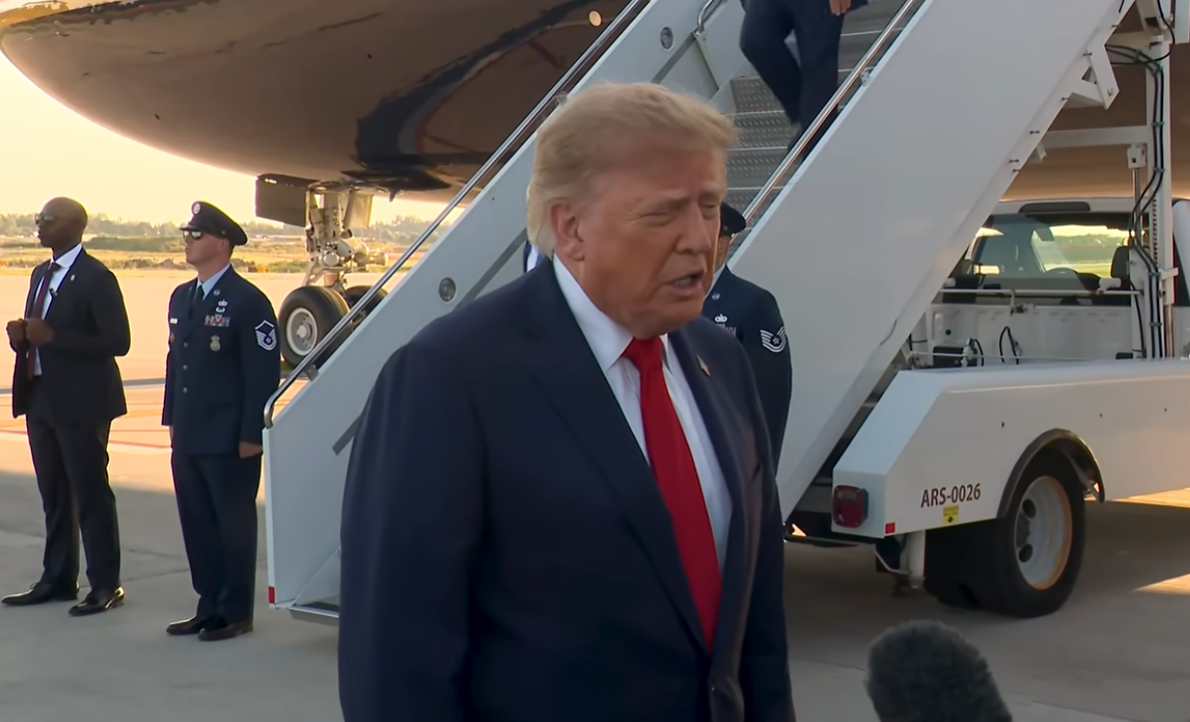
During an impromptu press availability before boarding Airforce One, President Trump paused to talk to the assembled press pool. President Trump notes during a discussion with Federal Reserve Chairman Kevin Warsh he told him to just go along with the board decision to raise interest rates again. The board is highly political and operating against the interests of the USA through economic manipulation.

On the subject of Canada now being an “Associate Member” state within the European Union, President Trump noted if the new partnership takes action against the economic interests of the United States, he will consider it a “hostile act” and trigger larger tariffs against the EU. WATCH:

.

Posted inCanada, President Trump, Press Secretary – Trump

Ursula von der Leyen Announces Canada as First Associate Member of European Union


Posted originally on the CTH on September 16, 2026 | sundance |

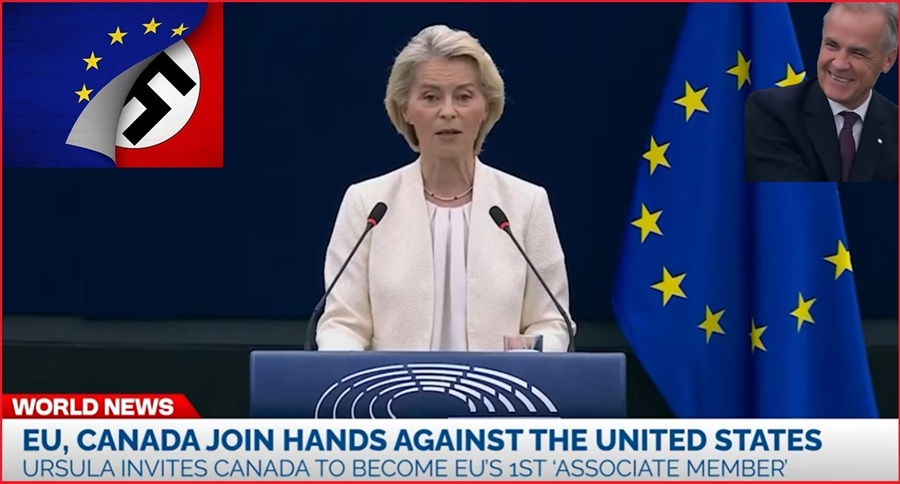
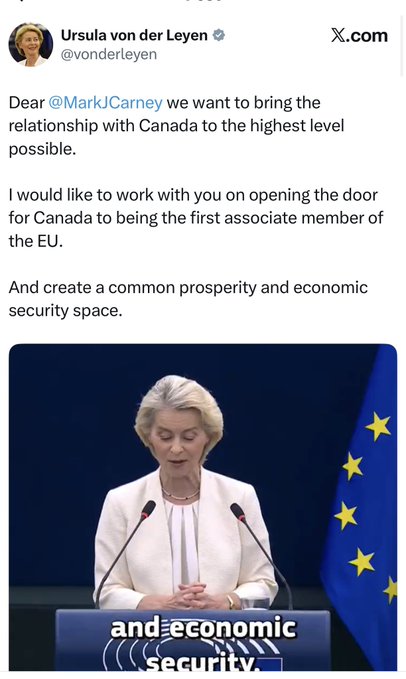
Pouring effusive and slobbering praise over the Canadian Prime Minister Mark Carney, the anointed “middle power” leader of a shrinking -and increasingly irrelevant- new world order, with grand pontifications EU Commissioner Ursula von der Leyen announced today that Canada is the first “Associate Member” of the European Union.

It’s a major award!  As noted by Reuters, “There is currently no such status as “associate member” set out in the European Union’s treaties — though various versions of an associate-type of membership have been floated in the bloc over the years. Germany suggested Ukraine be an associate member as an interim stage to full ​accession, though the proposal failed to gain traction as some EU capitals pushed back.”

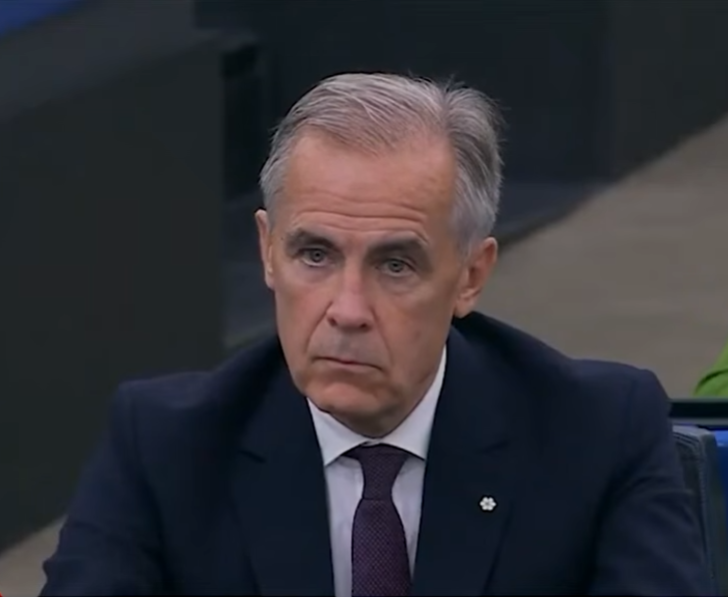
von der Leyen gushed: “Dear Mark, I said we must urgently reimagine our partnerships. So, I would like to work with you on opening the door for Canada to be the first associate member of the EU. We share one ocean, one set of values, one way of seeing the world. And we will now build our shared future as well – thank you for being here.”  Mark Carney sat with a big smile, giddy with excitement and barely able to control his visible glee.  WATCH:

DAILY MAIL – […] But the attempt to flatter the former Governor of the Bank of England backfired, with diplomats saying they were never briefed about the proposal and that, in effect, ‘associate membership’ doesn’t even exist.

EU diplomats accused Brussels of ‘over-reach’, an accusation often levelled against Eurocrats by UK Brexiteers before Britain left the bloc. 

One EU diplomat told the Mail: ‘This bombastic announcement is just not right.

‘There will be a summit at the end of October, so logically they will talk about deepening the relations.

‘But no one has ever seen an associate membership and no idea what it means in practice. Canada is a valuable partner for the EU, one of the few currently in the world where we share the values, so it is nothing against Canada.

‘But first and foremost the member states should be the ones to express what kind of relationship the EU wants to have with any third country.’

Another added: ‘She kept this bit of associate membership out of the text until the last moment. She also did not mention it up front to EU member states.

‘It seems like she is a bit too far out in floating this. Everyone is positive about Canada, and wants to strengthen the relationship.

‘But there is a lot of uncertainty about what von der Leyen envisages by coining this label.’

They added that, in reality, the most that can likely be hoped for is a deeper trading relationship rather than ‘associate membership’, which implies Canada taking part in EU programmes that it would be forced to pay into, becoming more politically integrated and potentially even having a say over the bloc’s rules.

But there would be huge barriers to overcome to establish closer ties, as swathes of Canada’s regulations are at present incompatible with EU single market rules, with high taxes on the bloc’s alcohol exports another thorny issue. 

Under EU law, any granting of membership would have to be approved by the 27 member states, which is another reason they were wrong-footed. (read more)

We all know what this is.

This is simply a joint Canada/Europe response to the geopolitical realignment currently underway by U.S. President Donald Trump.

At the core of the CA/EU association is the insufferable leftist mindset. A pontificating pretense that elites and globalists should determine the outcomes and values for the rest of the world.

Together both Europe and Canada convey a mindset and worldview that organizes fabricated problems to keep control of their populations.  It’s a corporatist structure of modern Fascism where instead of govt telling the corporations what to do, the World Economic Forum of multinationals tell the governments what to do.  It’s a constructed social and economic model where Western bankers are in charge of the proles beneath them.

The pontificating snobbery within the collective outlook, the pretenses and bureaucracy have nothing to do with representative government, as outlined in the unilateral approach by Ursula von der Leyen to create a status that doesn’t even exist, without any consultation with the members she is supposed to represent.

This move today is the personification of elitism and globalism in its last, desperate dying state.

For the little schoolboy inside Mark Carney, this is the culmination of a lifetime goal to be important. For the Canadian people, this should be embarrassing; but it’s not.

Canada is part of a British Commonwealth, and they proclaim “sovereignty” as their cause celeb against the horrible Trump, while rushing to the arms of the European Commission.

Actually, on second thought, this is perfectly Canadian.

Here’s the point that will be missed by 80% of Canadians.  The EU trade rules do not align with the USMCA.  I don’t mean that in a vague or disingenuous manner.   The specific rules, regulations and policies of the European Union are not compatible with the trilateral North American trade agreement between the U.S, Mexico and Canada.  It’s not even close.

What most Canadians don’t realize amid all this gleeful back-slapping and pretentious cheer, is that Mark Carney has officially sealed the position of Canada as it relates to the USMCA/CUSMA.

Canada just did exactly what President Trump and U.S. Trade Greer had been organizing and hoping for.  Mark Carney just pulled Canada out of the USMCA and there’s no one to blame but himself.

We have been waiting for this for a long time.  Thank you, Mark Carney.

A Major Award!

Posted inBanking and Finance, Big Government, Big Stupid Government, Canada, Economy, Election 2026, energy, European Union, media bias, NAFTA, NATO, President Trump, Professional Idiots, propaganda, Typical Prog Behavior, Uncategorized, United Kingdom (UK) and Great Britain, USMCA

A Tale of Two Viruses


A Tale of Two Viruses

Posted originally on the CTH on September 16, 2026 | sundance | 

It’s a tale of two viruses. One created in 2020 (Wuhan Labs), the other created in 2026 (Frontier Labs).

One was molecular (SARS-CoV-2), the other digital (Anthropic, AI).

Both man-made. Both promoted by media. Both escape a lab. Both create fear/panic. Both require experts to inform the public. Both introduce mitigation measures. Both end with govt control rules. And not coincidentally… both timed to coincide w/ critical elections.

With one you get a COVID Passport and vaccine.  With the other you get a Digital ID, and online govt safety and security certificate.

With the first one we heard “trust the medical scientists.”  Now you hear, “trust the computer scientists.”

There’s a pattern here folks. Stop me when you can see it.

We are witnessing a “Digital Covid” effort.

Wuhan Labs or Frontier Labs
NIH or Anthropic

SARS-CoV-2 or AI malware virus
Vaccination or Regulation

COVID panic = Election/Control
AI panic = Election/Control

The only thing we are waiting now, is patient zero.

However, you already have the antidote to the digital virus; it’s called, common sense.

Patient Zero (the pending AI false flag) could be anything from super serious to seriously annoying. What I am confident about is the Alinsky angle to it, where it will need to be personal to a large audience.

Again, all pure speculation… likely just gaming out possibilities that are not grounded. However, I don’t think banking or finance delivers the right outcome.

Something more passe’, yet alarming to a higher percentage of people. Something akin to AI frontier malware targeting in a communication network, Starlink or similar – even cell phone targeting.  It would also be helpful if it was global.

Something stealthy; yet personal – like an attack on Apple iPhones that overrides the built-in software charge limit protocol/parameter and creates a plugged-in overcharge that detonates the phone battery. Something like that, targeting a popular private sector device.

The result: Don’t plug in your phones, wait for a software update, stand in line at the store, something like that with an Alinsky ‘make it personal’ and annoying outcome that touches a wide audience.

It’s from that moment, when the cries for regulation, safety and security will begin.

It’s a tale of two viruses.

Warmest personal regards,

~ Sundance

Complicated business folks. Complicated business.

Posted inArtificial Intelligence (AI), Big Government, Coronavirus, Cyber Security, Deep State, Economy, Election 2026, European Union, media bias

LIVE | Steve Bannon and Bernie Sanders Take On Artificial Intelligence In Washington


Posted originally on Rumble by Bannons War Room, on: Sep 15 2026Posted

Episode 5663: Supreme Court Rules Against Trump; Generation MAGA


Posted originally on Rumble by Bannons War Room, on: Sep 15 2026Posted

Episode 5664: Cover Up Continue With The Deep State


Posted originally on Rumble by Bannons War Room, on: Sep 15 2026Posted