LIVE: Dr. Anthony Fauci Testifies Before the Senate…


Posted originally on: rumble on Bright Bart News Network on July 29, 2026

Can India Become the Next Factory of the World?


Posted originally on Jul 30, 2026 by Martin Armstrong |  

For more than a decade, Prime Minister Narendra Modi has been pursuing one of the most ambitious industrial programs attempted by any modern democracy. The “Make in India” initiative was never simply about creating jobs. It was a strategic effort to transform India from a nation known primarily for services into a manufacturing powerhouse capable of challenging China’s dominance over global supply chains.

That ambition deserves far more attention than it receives. When Make in India was launched in 2014, manufacturing represented roughly 16% of India’s economy. The objective was straightforward: attract foreign investment, build domestic industry, expand exports, and create millions of skilled jobs for one of the world’s youngest populations. Since then, New Delhi has introduced production incentives across electronics, pharmaceuticals, automobiles, semiconductors, renewable energy, defense, telecommunications, and numerous other strategic industries.

The government has approved hundreds of manufacturing projects under its Production Linked Incentive (PLI) programs covering fourteen major sectors. According to India’s Ministry of Commerce, these programs have generated more than ₹2.16 lakh crore in investment and over 1.4 million direct and indirect jobs.

No country has tried to build industrial capacity on this scale in decades. The greatest success has undoubtedly been electronics. India has become the world’s second-largest producer of mobile phones after barely existing in that market only a decade ago. Apple, Foxconn, Samsung, Tata Electronics, and numerous suppliers continue expanding production throughout the country. The government this week approved another ₹62,500 crore program aimed specifically at increasing mobile phone manufacturing, exports, and employment. That demonstrates New Delhi has no intention of slowing its industrial strategy.

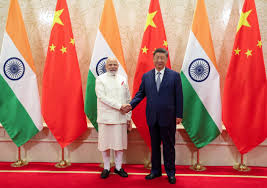
IndiaANDChina

Imports from China reached almost $80 billion during the first half of 2026 while India’s exports to China also rose sharply. Manufacturing growth itself is increasing demand for Chinese machinery and industrial components. In other words, India is becoming stronger while simultaneously becoming more dependent upon the world’s largest manufacturing base. That is how industrial revolutions usually begin.

Many politicians continue speaking about “decoupling” as though countries can simply walk away from global supply chains. History has never worked that way. Britain imported raw materials while dominating world manufacturing. The United States depended upon foreign commodities throughout its industrial expansion. China itself relied heavily upon Western capital and technology during its economic rise. Every emerging industrial power passes through a period of dependence before it develops complete vertical integration.

India appears to understand that reality better than many Western governments. Rather than attempting to isolate itself, New Delhi is encouraging foreign companies to manufacture inside India while gradually expanding domestic production of higher-value components. Officials have increasingly shifted attention toward building local electronics components, semiconductor packaging, batteries, and industrial equipment instead of focusing solely on final assembly.

Infrastructure still presents enormous challenges. Power reliability varies by region. Logistics costs remain higher than many Asian competitors. Labor reforms continue progressing unevenly across different states. Bureaucracy has improved considerably but still frustrates investors. Reuters reported earlier this year that some earlier PLI programs failed to meet their original targets and experienced delays in subsidy payments, illustrating that industrial policy alone cannot replace efficient administration.

Manufacturing centers develop over generations, not election cycles. Capital migrates toward nations offering political stability, expanding infrastructure, reliable energy, skilled labor, and confidence that investments will be protected. India has made impressive progress on several of those fronts, but the process remains incomplete.

The world appears to be entering an era where manufacturing will no longer be concentrated in a single country. Instead, production will become increasingly regionalized as governments place greater emphasis on national security than maximum efficiency. India is positioning itself to become one of the principal beneficiaries of that transformation. If it continues building its industrial base while strengthening domestic supply chains, the next great manufacturing story may not be about replacing China. It may be about creating the first genuine alternative to it.

Categories:India

Europe’s Wealthiest Households Are Drowning in Debt


Posted originally on Jul 30, 2026 by Martin Armstrong |  

EU Crumbling

Europe has spent decades portraying the southern nations as irresponsible debtors while presenting the north as the model of fiscal discipline. The latest Eurostat data expose that myth. Southern European governments may be heavily indebted, but the most leveraged households are concentrated in the supposedly prudent nations of northern and western Europe.

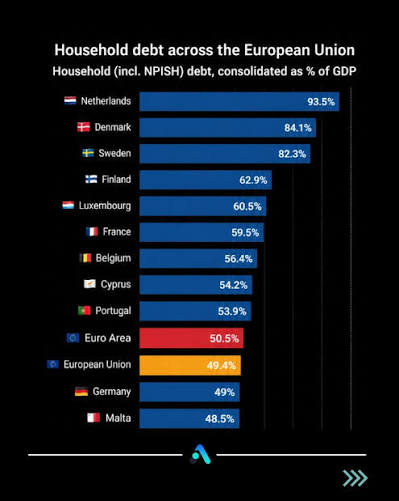
Euronews reports that household debt across the European Union stood at 49.4% of GDP in 2025, compared with 50.7% across the euro area. Both ratios have declined every year since 2020, when they exceeded 60%, but that aggregate conceals an enormous divide between member states.

The Netherlands has the highest household debt in the EU at 93.5% of GDP. Denmark follows at 84.1%, Sweden at 82.3%, Finland at 62.9%, Luxembourg at 60.5%, France at 59.5%, and Belgium at 56.4%. All seven exceed the European Commission’s 55% threshold for identifying household debt as a potential macroeconomic vulnerability.

The remainder of the top ten consists of Cyprus at 54.2%, Portugal at 53.9%, and Germany at 49%. Meanwhile, household debt amounts to only 42.9% of GDP in Spain, 38% in Greece, and 35.9% in Italy. The countries repeatedly insulted during the European sovereign-debt crisis have substantially less household leverage than the northern nations that lectured them.

Household debt includes mortgages, consumer loans, and other personal borrowing. The debt-to-GDP ratio does not tell us what each individual family owes, nor does it account fully for the assets held against those liabilities. Nevertheless, it shows how dependent an economy has become on credit relative to everything it produces.

eurohouseholddebt2026

People assume that high household debt is harmless when it is secured against homes. That is precisely what they believed in 2007. A mortgage is an asset to the bank but a liability to the homeowner. The house may appreciate on paper, but the monthly payment must be made with current income. A family cannot pay the electric bill by showing the bank that its home increased in value.

The Netherlands is the most obvious example of government manufacturing private debt through tax policy. De Nederlandsche Bank has admitted that Dutch mortgage borrowing is so high because government policy makes it attractive. Mortgage interest receives favorable tax treatment, and borrowers have been permitted to finance as much as 100% of a property’s value. Many other countries cap loan-to-value ratios at 90% or less.

Dutch household debt now equals nearly an entire year of national economic output. The country’s gross household debt-to-income ratio was about 184% in the earlier Eurostat series, meaning debt approached twice annual disposable income. Dutch households also possess significant pension and financial assets, but those assets are not evenly distributed and cannot be treated as if every borrower has an emergency account capable of eliminating the mortgage.

Denmark presents the same contradiction. Household debt reached 84.1% of GDP, while debt was approximately 177% of disposable income in 2024. Danes hold substantial pension savings and property assets, which government officials use to dismiss concerns. Yet pension wealth is generally locked away, whereas mortgage payments are due every month.

Sweden’s household debt stands at 82.3% of GDP. Variable-rate mortgages dominate its market, leaving borrowers exposed whenever monetary policy changes. A family that appeared financially secure when rates hovered near zero can suddenly find its disposable income devoured by interest payments. This is how monetary policy migrates from an abstract decision at a central bank into the grocery budget of an ordinary household.

The central banks created this vulnerability. They suppressed interest rates for years, punished savers, encouraged borrowing, and drove capital into real estate. Governments then restricted housing supply through zoning, environmental rules, construction regulations, and immigration policies that increased demand. Home prices rose far beyond wages, forcing younger buyers to borrow extraordinary amounts merely to obtain what their parents purchased on one ordinary income.

Then the European Central Bank raised rates to confront inflation that its own policies helped create. It is always the same pattern. Government encourages the debt, the central bank inflates the asset, and the household carries the risk when the cycle turns.

Finland’s household debt equals 62.9% of GDP. Ordinary housing loans constitute around 63% of Finnish household debt. When housing-company loans are included, the combined housing-related share reaches approximately 75%. These company loans are obligations attached to apartment buildings and effectively inherited by buyers. They allowed the true cost of housing to be obscured by separating the apartment’s purchase price from the debt carried by the building.

Luxembourg’s ratio reached 60.5%, and mortgages represent about 90% of household debt. Yet the burden is extremely uneven. Almost half of Luxembourg households reportedly carry no debt at all, while median household net wealth stood near €676,000 in 2023. An impressive national wealth figure tells us little about the vulnerability of the highly leveraged portion of the population.

France’s household debt reached 59.5% of GDP. Most French mortgages are fixed-rate, providing borrowers with more protection from sudden interest-rate shocks. Lending rules generally prevent debt service from consuming much more than one-third of net household income. These safeguards reduce immediate refinancing risk, but they do not erase the underlying debt or protect property prices when credit contracts.

Belgium recorded household debt equal to 56.4% of GDP. Around 43.1% of Belgian households own their homes with a mortgage, compared with an EU average of only 24.3%. New Belgian mortgage lending increased from €31.7 billion in 2024 to €40.7 billion in 2025, an increase of €9 billion or approximately 28%.

Portugal sits just below the Commission’s danger threshold at 53.9% of GDP. Household debt reached roughly €171 billion by late 2025, rising 8.6% in one year. More than 90% of Portuguese mortgages use variable or mixed rates tied to Euribor, making Portugal far more sensitive to ECB policy than its headline debt ratio suggests. The structure of the debt can be as important as its total size.

Cyprus stands at 54.2%, although its household debt ratio has fallen by approximately 62% since December 2016. Around 34% of the remaining debt consists of legacy non-performing loans held by credit-acquiring companies. That is not healthy credit supporting new economic activity. It is debris from the previous crisis still being worked through a decade later.

Germany’s household debt is close to the EU average at 49%. Its comparatively low ratio is partly explained by a homeownership rate of only 46.7% in 2022. Germany has a large rental market and does not provide the same mortgage-interest incentives found in the Netherlands. Yet low household mortgage debt hardly means the German population is prospering. Many workers remain permanent tenants because taxes, stagnant net wages, and elevated property prices prevent them from accumulating the capital needed to buy.

The difference between northern and southern Europe is not that one side is responsible and the other irresponsible. The debt merely sits on different balance sheets. Italy and Greece accumulated enormous public debts, while households remained comparatively conservative. The Netherlands, Denmark, and Sweden built systems in which private households assumed massive mortgage liabilities while governments appeared fiscally cleaner.

Debt does not become safe merely because it is classified as private. Private debt can be more immediately destructive because households cannot tax the population, issue currency, or roll their liabilities indefinitely. When income falls or interest costs rise, families reduce consumption, sell assets, or default. That contraction then spreads to retailers, builders, banks, and the wider economy.

A highly indebted household sector also corrupts monetary policy. Central banks become trapped because raising rates threatens property markets and household solvency, while lowering rates encourages another round of leverage and speculation. The ECB must set one interest rate for nations with radically different debt structures. A rate that appears manageable in Italy may crush a variable-rate borrower in Portugal or Sweden.

The northern housing systems have converted ordinary families into leveraged speculators without their realizing it. They are not purchasing homes merely with savings and accumulated income. They are making long-duration bets on property prices, employment, and central-bank policy. So long as asset values rise and credit remains available, everyone appears wealthy. When liquidity disappears, the wealth proves to have been conditional.

Europe’s decline will not emerge solely through sovereign debt. The public and private debt systems are connected through the banks. When households fail, banks suffer. When banks fail, governments guarantee them. Private losses then migrate onto public balance sheets, exactly as they did after 2008. The taxpayer ultimately stands behind a system from which he received none of the profits.

The Eurostat figures are not evidence that southern Europe has suddenly become economically sound. They show that the debt crisis has multiple faces. Italy carries the burden through the state. The Netherlands carries it through households. France is burdened through both. Brussels continues pretending these are separate problems because admitting the connection would expose the fatal structure of the monetary union.

Categories:European Union

The Fed Holds While Inflation Refuses to Die


Posted originally on Jul 30, 2026 by Martin Armstrong |  

Fed_Chair_Kevin_Warsh

The Federal Reserve voted to leave its benchmark interest rate unchanged at 3.50% to 3.75%, marking the fifth consecutive meeting without a change. Yet the 9–3 vote exposed a widening division inside the central bank, as Beth Hammack, Neel Kashkari, and Lorie Logan wanted a 25-basis-point increase.

This is no longer the Federal Reserve debating whether to cut rates. The debate is shifting toward when it will be forced to raise them again. Chairman Kevin Warsh insists that the Fed remains committed to its 2% inflation objective. “There is no soft inflation target,” he told reporters. “There is no soft implicit target, not on this committee’s watch. There’s only a target, and it’s 2%.”

Reducing inflation to 2% does not restore prices to where they were before the inflation began. It simply means that the cost of living continues rising at a slower pace from an already elevated level. Food, insurance, housing, electricity, transportation, and healthcare do not magically become affordable again. The purchasing power that was destroyed is gone.

Warsh acknowledged that reality when he said, “We’ve begun a new chapter and we understand that the five-plus years of inflation above target cannot be cured in nine weeks, or by a single month of modest price decreases.” He added that the Fed “will not waver” in its pursuit of the 2% target. Fine. But the Federal Reserve still refuses to admit that interest rates cannot repair supply shortages, end wars, produce energy, or reverse reckless fiscal policy.

The Fed’s statement conceded that inflation remains elevated partly because of supply shocks, including higher energy prices. The war in the Middle East has increased the cost of fuel and food, while the AI and data-center boom is driving enormous demand for electricity, construction materials, land, cooling systems, computer equipment, and skilled labor. Raising interest rates will not produce another barrel of oil, rebuild a damaged shipping route, or add electricity to an overloaded power grid.

This is why the belief that the Federal Reserve controls inflation with a single interest-rate lever is nonsense. Rates respond to economic conditions, capital flows, confidence, and risk. They do not command the economy like some thermostat.

The official statement claimed that economic activity continues to expand at a “solid pace,” while job growth has kept pace with the workforce and unemployment has changed little. If the economy remains solid and inflation is still above target, then the argument for cutting rates has evaporated. Financial markets had priced roughly a one-in-three chance of a July increase, and Reuters reported that markets were approaching a near-certainty of a September hike if the Fed remained on hold this time.

Half of the Fed’s 18 policymakers projected at least one rate increase during 2026 at the June meeting. Six anticipated more than one. Only one expected a cut. That was an abrupt reversal from only months earlier, when the political and financial establishment was still promoting the fantasy of endless rate reductions.

The three dissents matter because Hammack, Kashkari, and Logan are not demanding an emergency increase of 100 basis points. They wanted a modest quarter-point move. Their dissent signals that the internal argument has already moved beyond whether inflation is a problem. The dispute is now over how long the Fed can wait before responding.

Warsh refused to provide the usual forward guidance, saying only that the committee would “not hesitate to act” when necessary. Nevertheless, less communication does not cure bad policy. Warsh has established five task forces to examine the Fed’s communications, economic data, balance sheet, inflation framework, and the relationship between productivity and employment. Washington loves task forces because they create the appearance of action while ensuring that nobody accepts responsibility for the policies that created the problem.

The Federal Reserve’s balance sheet remains around $6.7 trillion. Since January, the System Open Market Account has purchased nearly $250 billion in Treasury bills, including approximately $160 billion in reserve-management purchases and $90 billion in reinvestments from agency securities. Bank reserves have climbed to roughly $3.1 trillion. They call this reserve management rather than quantitative easing, but changing the label does not change the mechanics.

The Fed is trapped between inflation and the sovereign debt crisis. Higher rates increase the government’s cost of servicing the national debt as old obligations mature and must be refinanced. Lower rates risk weakening confidence, reviving inflation, and punishing those who still save money. There is no painless solution because decades of borrowing and monetary manipulation have eliminated every painless option.

President Trump again demanded lower interest rates and declared that the United States “should have the lowest rates in the world.” The United States cannot order global capital to accept artificially low yields while Washington runs enormous deficits, fights foreign wars, and issues mountains of new debt.

Japan spent decades suppressing interest rates, and that policy did not abolish economic reality. It distorted the bond market, weakened the currency, and made the government increasingly dependent on perpetual intervention. Forcing American rates below global market levels would eventually produce the same disease on a far greater scale.

Trump may want cheaper mortgages and lower government financing costs, but the president does not control international capital flows. If investors demand greater compensation for inflation, political risk, and endless Treasury issuance, long-term rates can rise even while the Fed cuts its short-term target. The bond market is larger than any president, central banker, or political party.

The Fed is also confronting inflation that originates outside its domestic models. War raises energy costs. Sanctions disrupt trade. Tariffs alter supply chains. AI investment is consuming capital and electricity on a massive scale. Government deficits continue pumping demand into an economy already straining against supply constraints. None of this can be solved by crushing the consumer with more expensive credit.

The old Phillips Curve theory that inflation can be defeated by increasing unemployment was always morally bankrupt. Policymakers deliberately try to weaken labor demand and financially squeeze ordinary people because they refuse to confront the fiscal and geopolitical policies responsible for the price increases. The family struggling to finance a car did not create the Middle East war, the federal deficit, or the power shortage, yet that family is expected to absorb the punishment.

Warsh is correct that the Fed cannot quietly redefine its target above 2% simply because reaching that goal has become inconvenient. Doing so would destroy what remains of the institution’s credibility. But credibility will not be restored through speeches. It will require acknowledging that the central bank cannot maintain price stability while Congress spends without restraint and Washington treats war as a permanent economic policy.

The July decision merely postponed the confrontation. If inflation continues running above target and energy prices climb, September becomes a live meeting for a hike. If the economy weakens sharply, the Fed will face demands to cut even while prices remain elevated. That is the road toward stagflation, where the central bank is attacked regardless of which direction it moves.

The Fed held rates steady because it is caught, not because it has solved anything. Inflation remains above target, three policymakers demanded tighter policy, the federal debt continues compounding, and geopolitical pressure is feeding directly into consumer prices. Washington created a system dependent upon cheap money and endless borrowing, but the market is beginning to demand the bill.

President Trump Takes Questions From Media


Posted originally on CTH on July 29, 2026 | Sundance

During an Oval Office event to announce the remodel of Washington DC, Dulles airport, President Trump took questions from the assembled press pool.  The questions begin at 16:30, prompted:

.

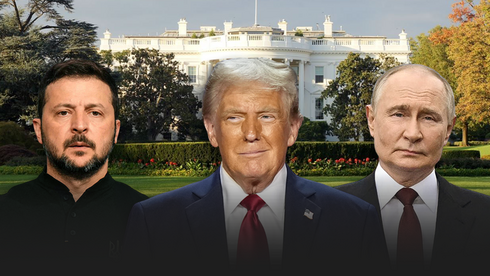
Senate Fan Girls for Zelenskyy then Advances Russian Sanction Bill 86-12


Posted originally on CTH on July 29, 2026 | Sundance

The behavior of the U.S. senators clamoring to be with Ukraine President Volodymyr Zelenskyy reflects a certain level of disconnect that needs to be witnessed to be realized.

Senators, grown adults awaiting Zelenskyy’s arrival, clinging to every word, clamoring to be first in line for his reception, competing against each other for time standing next to him, the entire event was grotesque and creepy.  WATCH:

Shortly after the guided tour of the upper chamber, the Golden Child was carried on a gilded chariot into the viewing chamber while trumpets blared, senators took turns bringing forth their taxpayer funded indulgences, and Senator Jeanne Shaheen knelt down at his feet and peeled Zelenskyy’s grapes.  Yeah, that’s the vibe.

The “Lindsey O. Graham Sanctioning Russia and Iran Act of 2026” was then advanced by the Senate in an 86 to 12 procedural vote teeing up the bill for final passage in the Senate later this week. However, I would challenge people to READ THE BILL, it’s only 61-pages.

Within the bill you will note almost everything within the law is left to the enforcement discretion of the President; which normally would not be of great concern, however, given the punishment for violations – things may get sketchy depending on who is in office.

A foreign person who “undermines the peace, security, political stability, or territorial integrity of Ukraine;” and/or “undermines the democratic processes of Ukraine,” will be in violation of the U.S. law and subject to fines, travel or visa restrictions. [Page 13, page 28]  As a consequence, any person who may be critical of Ukraine -undermining the democratic process via criticism- can be punished by the U.S. President.

Page 36 applies a 100% U.S. tariff against the import of any country’s goods into the USA if that country purchase energy products from Russia (with qualifiers).  The intent of that section is to stop China and/or India from purchasing Russian oil and gas.

As noted by Politico, ‘the revamped bill expands the number of Russian entities that would be subject to mandatory sanctions — including Russia’s shadow fleet of ships ferrying oil — but it also grants Trump broad waiver authority.’

The House is in summer recess, so things may stall even if the Senate (very pro-Ukraine) passes the bill.

Finland Plans to Build a New Iron Curtain and block Russian Internet Traffic


Posted originally on CTH on July 29, 2026 | Sundance

We have been warning for several years about the “new democratic norms” being established on a very totalitarian system of control; specifically, the control of information.

The need for control is a reaction to fear.

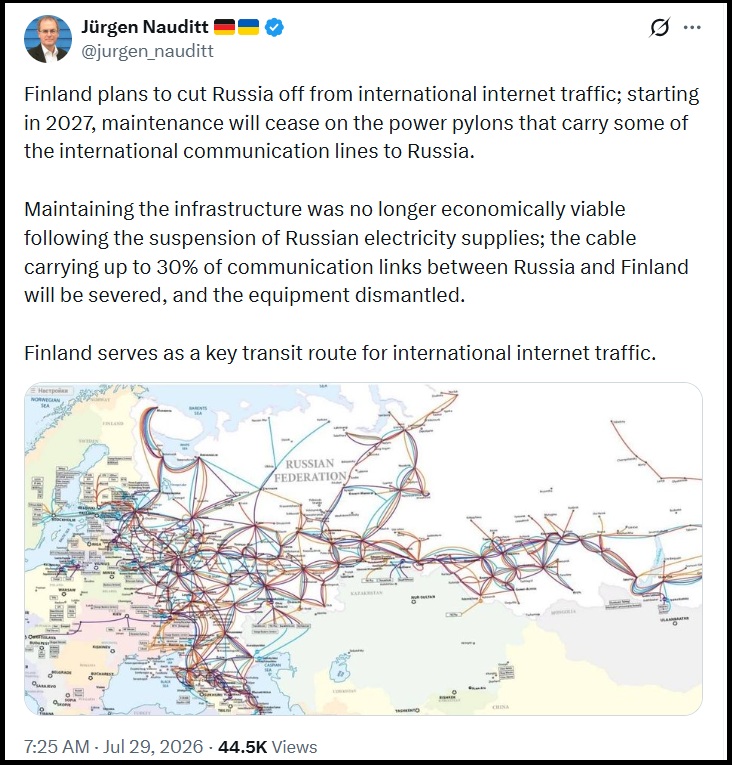
Finland is announcing that they will sever their international internet link that is connected to Russia, seemingly wanting to build a virtual wall between Russia and the ‘west’, or at least part of a virtual Iron Curtain they can control.

[SOURCE]

Four decades ago, the voice of freedom was heard saying, “tear down this wall.” Today, the modern version of European democracy is taking action akin to saying, “we must rebuild these walls.”

This is a very dangerous approach because a desire to stop discussion, a demand to stop the free flow of challenging ideas, an approach to silence – as opposed to winning the argument, is the exact opposite of freedom; it is the activity of totalitarian dictatorships.

We used to have Radio Free Europe in order to send ideas and information about the inherent value of freedom over the walls to what we called ‘oppressed’ people.  Now, the baseline of modern western values is to do exactly the opposite, to block information that may come from the other side of the curtain.

Reasonably intelligent people might ask, what exactly is it the Europeans fear?

It looks like both JD Vance and Marco Rubio were correct in 2025 when they warned Europe what lay at the end of this censorship slope they are chasing.  The era of ‘western values’ being understood by both Europeans and Americans has certainly come to an end.

I doubt very much that Russian Federation President Vladimir Putin is against the idea of having Europe sever the internet in an attempt to isolate the people of Russia.  Every dictatorial step the ‘west’ makes from covid passports to vaccine mandates, to quarantine camps and beyond, only makes the Russian Federation look more open and freer by comparison.

There is a reason why the Russian COVID-19 vaccine uptake was one of the lowest in the world, and that reason stands as a stark contrast to the claims of the ‘west’.  If Russia is such a control state, such a totalitarian state, then why didn’t the Russian people face forced masking or vaccination compliance?

Wait, that doesn’t make sense, right?….

Be careful comrades or you may find yourself asking the questions that all good compliant citizens are not supposed to ask.

Dr Anthony Fauci Testifies Before Senate Homeland Security Committee – 8:30am ET Livestream Links


Posted originally on CTH on July 29, 2026 | Sundance

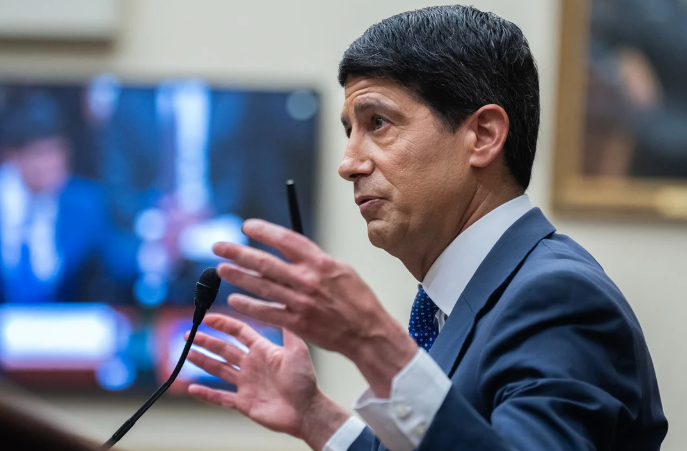
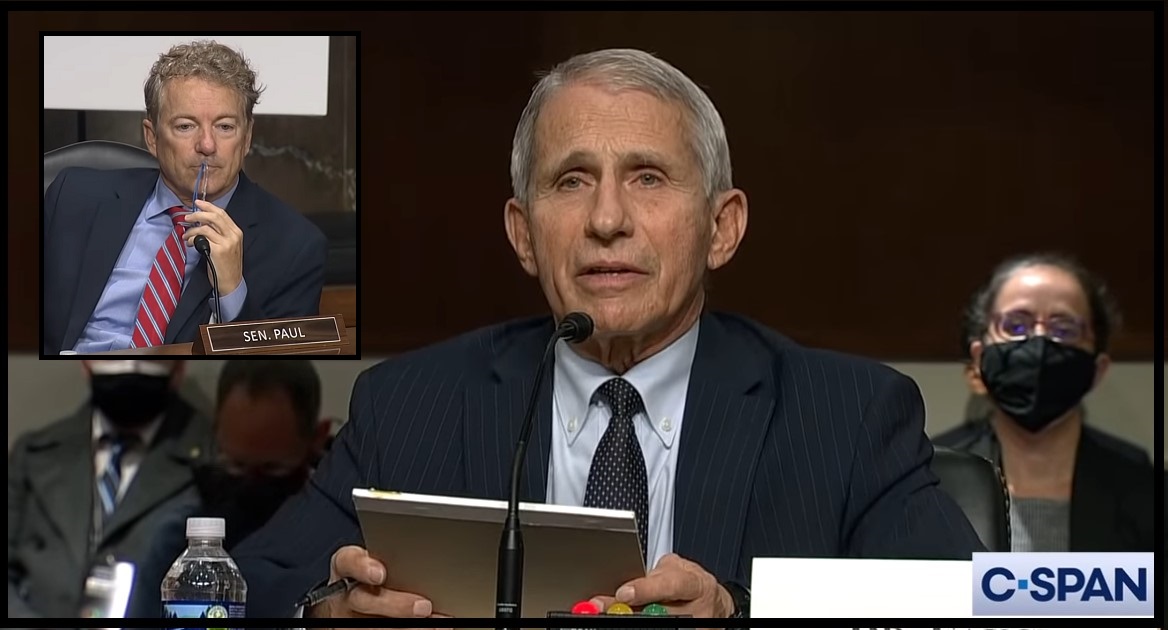
Dr. Anthony Fauci, the U.S. scientist who funded, created and then lead the nation’s SARS-CoV-2 (COVID-19) pandemic response, appears under subpoena to answer questions before the Senate Homeland Security Committee. The hearing is scheduled to begin at 8:30am ET with a crowded audience.  [Senate Hearing LINK]

Fauci is scheduled to face off again with Republican Sen. Rand Paul of Kentucky who has been probing the origins of the coronavirus and publishing documents showing Fauci’s involvement. Fauci appears before the committee to face accusations that the now-retired infectious disease expert had lied about the pandemic, something Fauci has called “preposterous.”  Livestream Links Below:

.

.

.

The Scale of Ineligible People Called for Jury Duty Starts to Highlight Number of Illegal Aliens Currently on Voter Rolls


Posted originally on CTH on July 29, 2026 | Sundance 

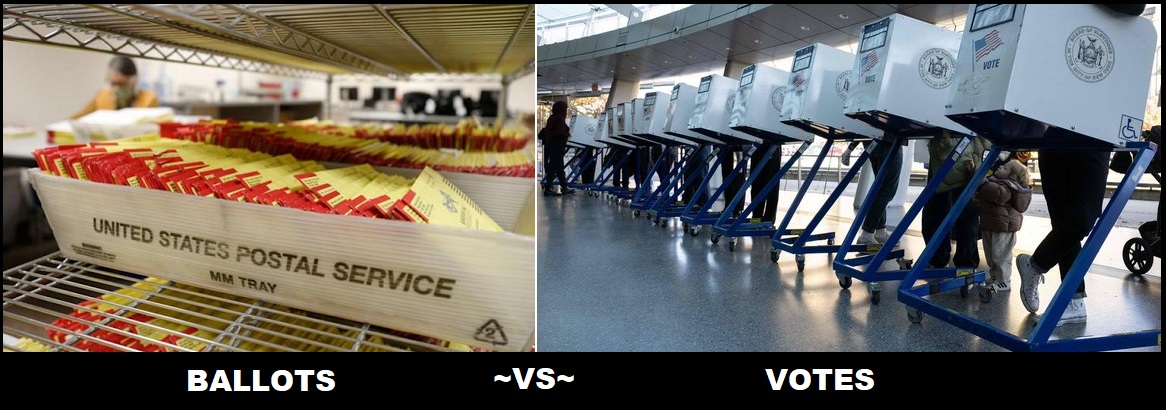
In most states the jury duty summons process comes from registered voter rolls. As a consequence, when a person is called for jury duty and is then disqualified as a non-citizen, we have another way to judge the scale of non-citizens on the voter rolls.

Reviewing lists of disqualified non-citizen jurors is now taking place in many counties led by citizen inquiry. The disqualification records, “non-juror” lists are public records in many states and counties.  These reviews are turning up tens-of-thousands of non-citizens who are on juror lists, which means they are also on voter rolls.

(New Jersey Globe) – About 75,000 noncitizens are summoned for jury duty in New Jersey each year, based on data from three state government agencies, including the Motor Vehicle Commission — a stunning figure that widens the scope of a growing controversy over government databases that may incorrectly identify noncitizens as eligible voters and jurors.

While the number is alarming, there’s no indication that noncitizens have served on a jury since the judiciary implemented additional guardrails to prevent it.

“Prospective jurors are asked about their citizenship and other qualifications when they complete the mandatory juror qualification questionnaire,” said Pete McAleer, a spokesman for the New Jersey Administrative Office of the Courts. “Those who advance are reminded of the eligibility requirements during jury orientation and are directly questioned about their citizenship during jury selection by the judge and, as permitted, the attorneys.”

In between, potential jurors watch a training video that includes the citizenship requirement.

The revelation of noncitizens making their way into jury pools comes three days after Gov. Mikie Sherrill disclosed that an alleged software glitch at motor vehicles led to the inclusion of roughly 6,600 noncitizens on New Jersey’s voter rolls; Sherrill blamed the vendor, IDEMIA, and said less than 400 noncitizens have voted in recent elections.

According to McAleer, the judiciary processes more than one million summonses annually for potential jury service and randomly selects records provided from the Division of Elections, the Division of Taxation, and the MVC. (read more)

That 75,000/yr number are just those summoned people who disqualified themselves by being truthful about their status.  I firmly believe the average non-pretending American will soon to realize/admit that many non-citizens actually remained on juries and passed judgement during trial.

Illegal aliens voting in elections is happening, we all know it and even though the media is still trying to retain their lies, you can tell that stance is softening against the reality.  However, illegal aliens sitting as jurors in trials, will create a big-time constitutional mess that is something the communist left and media will never admit.

Black People Spreading Fake 911 Call of White Kids Killing Nolan Wells


Posted originally on 2026 Rumble by The Salty Cracker on: July, 27, 2026