Posted Originally on Aug 31, 2026 by Martin Armstrong |
Governments and corporations are expected to borrow a record $29 trillion from global bond markets in 2026, according to the OECD. That is $4 trillion more than in 2024 and twice the amount borrowed only ten years ago. The financial press will present this as evidence that debt markets remain deep and resilient, but 78% of the borrowing by OECD governments will not finance new roads, productive industry, or economic expansion. It will be used merely to refinance debt that already exists.
This is the Ponzi structure underlying modern government finance. Politicians speak as though debt is repaid, but governments almost never repay the principal. When a bond matures, they issue another bond to obtain the money needed to redeem the first one. They then borrow still more to finance the current deficit and increasingly borrow to pay interest on the debt accumulated by previous administrations. The entire system functions only while investors remain willing to roll the obligations forward.
The $29 trillion figure is annual borrowing, not the total amount of outstanding debt. Sovereign and corporate bond markets combined have already reached approximately $109 trillion. The system must therefore absorb an enormous wave of new securities every year merely to prevent old promises from defaulting. This is why the refinancing cycle matters far more than the political debate over whether a technical default will occur. A government can continue paying every bondholder on time while still entering a debt crisis if refinancing costs rise beyond what its tax base can sustain.
Politicians became addicted to short-term debt because it was cheaper than locking in long-term interest rates. The OECD reports that 30-year yields have risen significantly across most countries since 2022, leading governments and companies to issue more short-maturity debt. This lowers the interest bill temporarily but forces borrowers to return to the market more frequently. They are trading today’s discomfort for tomorrow’s crisis because nobody in government wants to admit the actual cost of decades of fiscal mismanagement.
A nation that finances itself for thirty years is protected from immediate changes in interest rates on that debt. A nation that continually borrows at short maturities must refinance again and again at whatever rate the market demands. When confidence falls, the cost resets quickly across the debt structure. A one-percentage-point increase may appear insignificant to some bureaucrat, but applied to trillions in recurring issuance, it consumes hundreds of billions that must be extracted through higher taxes, reduced services, inflation, or still more borrowing.
Central banks are also reducing their government-bond holdings after years of manipulating rates through quantitative easing. This leaves hedge funds, households, and foreign investors to absorb a growing supply of debt. These buyers are more sensitive to price and are not obligated to rescue politicians from their own stupidity. If the yield does not compensate them for inflation and political risk, they will demand a higher return or move their money elsewhere. Government calls this market instability because it cannot stand the idea that its debt should be priced honestly.
The competition for capital is becoming vicious. Governments need money for welfare states, pensions, military expansion, energy subsidies, industrial policy, and the interest on existing debt. Corporations must refinance their own obligations while funding new investment, and the artificial-intelligence race is adding another enormous borrower to the market. Nine major technology companies are expected to issue approximately $1.2 trillion in bonds between 2026 and 2030 as they pursue a combined $4.1 trillion in capital spending. Every dollar absorbed by government debt is capital that cannot finance productive private investment without pushing rates higher.
War will make this rollover crisis far worse. Governments are expanding defense budgets while rebuilding supply chains, stockpiling strategic resources, subsidizing domestic manufacturing, and attempting to reduce dependence on geopolitical rivals. These expenditures are being added to budgets that were already insolvent before the War Cycle turned higher. They are preparing for a global conflict with borrowed money while the cost of that money is rising.
This is why the Sovereign Debt Crisis will not resemble the 1930s or some dramatic bankruptcy proceeding. Governments that borrow in their own currencies can create the money necessary to make nominal payments, but they cannot create purchasing power. They will repay creditors in depreciated currency, force financial institutions to hold public debt, suppress interest rates below inflation, impose capital controls, and search for new ways to trap private savings inside the system. Default will come through the destruction of the currency and the confiscation of wealth rather than a polite announcement that the Treasury has missed a payment.
The movement toward CBDCs and tokenized bonds must be understood within this context. Governments facing a record refinancing burden will want a financial system capable of identifying capital, controlling its movement, and directing it toward approved assets. They will say digital money improves efficiency and tokenized debt provides instant settlement. What they will never advertise is that the same infrastructure can prevent capital from escaping when investors no longer wish to finance the state voluntarily.
The OECD recommends that governments ensure the “long-term sustainability” of their debt, as if politicians who created this disaster will suddenly discover restraint. They will not cut spending until the bond market forces the issue because every expenditure has a constituency and every reform threatens someone’s election. They will raise taxes, manipulate markets, change accounting rules, and blame speculators long before admitting that government itself has become the greatest threat to financial stability.
The world must absorb $29 trillion in borrowing during 2026 while war expands, rates rise, central banks retreat from bond markets, and private industry competes for the same capital. The system remains functional only because confidence has not yet completely broken. Once investors question whether rolling government debt forward is worth the risk, the refinancing machine will seize. Governments do not have $29 trillion sitting in a vault to repay these obligations. They have only the ability to borrow again, tax the public, or destroy the value of money.
Posted Originally on Aug 31, 2026 by Martin Armstrong |
Mexico’s economy expanded 1.4% in the second quarter, nearly three times the OECD average of 0.5%. That placed it sixth among the economies in the report and marked its strongest quarterly expansion since early 2022. Yet listen to the political discussion in Washington and you would think nothing exists south of the border except cartels and migrants. There are factories, engineers, suppliers, and entire communities whose livelihoods depend on producing goods for the North American market. Politicians can dismiss Mexico all they want, but corporations making investment decisions have to look at costs, transportation, labor, and access to customers.
Mexico is benefiting from manufacturing moving closer to the United States, with opportunities spreading into the businesses supporting that production. The economy contracted a revised 0.3% in the first quarter before rebounding, and output in the second quarter was 2.1% above a year earlier. Nobody should pretend that this means Mexico has entered some uninterrupted boom. Nor should we attribute the entire rebound to manufacturing when the report identifies primary activities as the fastest-growing sector, expanding 2.4%. The broader point is that a country’s productive potential does not vanish because one quarterly number disappoints. Investment takes time to become capacity, and capacity takes time to become income.
Washington’s mistake is assuming that forcing companies to reconsider China automatically means all that production will return to the United States. A manufacturer must calculate whether it can operate profitably. Moving closer to American customers while retaining a competitive cost structure can make Mexico attractive. Tariffs may change that calculation, but they do not abolish it. Businesses will adjust their operations to survive whatever rules governments impose.
There is also a difference between attracting productive investment and attempting to manufacture prosperity through public spending. A factory must eventually sell something customers want at a price they will pay. Government can borrow to finance an unsuccessful program and then borrow again to conceal the failure. The private business does not possess that luxury indefinitely. Its survival depends on meeting demand, controlling costs, and investing where it expects a return. That discipline is precisely what disappears when politicians convince themselves they can direct the economy better than the people risking their own money.
Mexico can still squander the opportunity. Security, water, electricity, transportation, and predictable rules matter to anyone considering a long-term investment. A cheap workforce is of little use if production is repeatedly interrupted or goods cannot reach the customer. Mexico’s government cannot simply congratulate itself over a favorable growth ranking and assume investment will continue regardless of its decisions. Geography provides an advantage, but government can make even an advantageous location too difficult to operate in.
Mexico’s recovery deserves attention because it brings the discussion back to something governments routinely forget: people need the opportunity to earn a better living. They need employers competing for their skills and customers willing to purchase what they produce. A quarterly GDP ranking will not provide that by itself, but sustained productive investment can. Mexico has an opportunity to turn its position beside the American market into lasting prosperity. The greatest service its politicians can provide is to stop assuming that the wealth created by everyone else exists primarily for government to spend.
Posted Originally on Aug 31, 2026 by Martin Armstrong |
The United States has crossed $40 trillion in gross federal debt, and Washington will treat it as another unfortunate milestone before returning to the business of spending money it does not have. The more immediate problem is what it costs to carry that debt. Treasury’s figures show approximately $1.17 trillion in gross interest expense through July, just ten months into fiscal year 2026. That works out to roughly $117 billion a month, or $3.85 billion every single day over that period. These are interest costs, not repayments that reduce the principal. Washington incurs this expense while the debt itself continues climbing.
There are two different interest figures, and they should not be confused. Treasury’s gross interest expense includes interest credited to government accounts holding Treasury securities. The federal budget’s net interest measure excludes those internal payments and includes other offsets. The Congressional Budget Office’s February outlook placed net interest at approximately 3.3% of GDP in 2026, implying more than $1 trillion for the full fiscal year. Even on that narrower measure, Washington is devoting roughly one dollar in five of projected federal revenue to interest. The distinction matters for accounting, but neither number describes a government bringing its finances under control.
The issue was never simply that government had borrowed a large sum. It was that borrowing had become a permanent arrangement, with interest added to budgets already running deficits. Politicians take credit for the original spending, while the cost of financing it survives long after they leave office. Their successors inherit the bill and issue more debt rather than confront the promises that created it.
Consider what refinancing actually means. When a Treasury security matures, its holder must be repaid. If Washington finances that redemption by selling another security, the creditor has changed, but the government has not eliminated the obligation. It has renewed it at whatever rate the market will accept. Borrowing to refinance principal is separate from the interest bill, yet both require continued access to willing buyers. This is why a government can make every payment on time while its underlying financial position deteriorates.
The mathematics of higher rates becomes brutal at this scale. Every additional percentage point on $1 trillion of debt means another $10 billion in annual interest once that debt carries the higher rate. Apply that to successive waves of refinancing and the expense builds year after year. The entire $40 trillion does not reset overnight, and it would be misleading to suggest otherwise. Existing fixed-rate securities retain their coupons until maturity. That delay, however, can conceal the developing burden and give politicians another excuse to postpone action.
There is no magic number at which a country automatically collapses. Confidence, borrowing costs, economic growth, and the ability to raise revenue all matter. The danger is that higher interest expenses require more borrowing, while concerns about that borrowing encourage investors to demand still higher yields. A deteriorating fiscal position can then begin reinforcing itself.
CBO projects net interest costs reaching $2.1 trillion in 2036, or 4.6% of GDP. That is a projection under its stated assumptions, not a guaranteed outcome, but it demonstrates that the problem does not disappear even in an orderly baseline. Washington is not merely struggling with a temporary expense left over from an emergency. It is carrying an interest burden expected to grow while elected officials continue making commitments against future revenue.
War makes this arithmetic harder. Military operations require resources today, while the interest on borrowing to finance them can remain for decades. If conflict also raises energy costs or disrupts production, it can complicate the Federal Reserve’s inflation problem. Higher rates may be necessary to restrain inflation, but they also increase the cost of new federal borrowing. Demanding that the Fed cut rates does not repair that conflict, especially when long-term investors remain free to demand compensation for inflation and fiscal risk.
Republicans cannot explain this away by blaming Democratic spending while defending every unfunded commitment of their own. Democrats cannot promise an expanding government without confronting the cost of financing it. Both parties have constituencies they refuse to disappoint and obligations they prefer to leave to the next administration. The interest bill does not recognize party affiliation, and the bond market does not have to accept a campaign promise as repayment.
The $40 trillion figure should therefore be understood through the income required to sustain it. America possesses enormous productive capacity, but that is not permission for Washington to claim an ever-larger portion of future revenue before the public receives any new service. More than a trillion dollars in annual net interest is already a substantial claim on that income. The question is how much further government intends to mortgage the future before admitting that borrowing has become its substitute for governing.
Posted Originally on Aug 31, 2026 by Martin Armstrong |
Netanyahu, I believe, is a sick individual. In 2024, in his Knesset speech, Netanyahu said: “I’ve been warning about Iran for 30 years.” It was reported on March 3rd, during a visit to a site struck by an Iranian missile, Netanyahu stated: “We read in this week’s Torah portion, ‘Remember what Amalek did to you.’ We remember—and we act.”
In 1 Samuel 15:2-3, God gives King Saul a specific, direct order to carry out this command. The prophet Samuel relays the message: “This is what the LORD Almighty says: ‘I will punish the Amalekites for what they did to Israel when they waylaid them as they came up from Egypt. Now go, attack the Amalekites and totally destroy all that belongs to them. Do not spare them; put to death men and women, children and infants, cattle and sheep, camels and donkeys. ‘”
The harshness of the command in 1 Samuel has disturbed Jewish scholars for centuries, leading to various interpretations that move beyond a literal call for genocide. If Netanyahu believes that genocide is the command of God, that is NOT in the self-interest of the United States. He knows you cannot accomplish regime change from the air. This is the very first time when we are in a partnership with another country who is really calling the shots here where the interests of Netanyahu are by no means the same national interest of the United States.
This Iran War is Netanyahu’s war, not America’s. He is consumed with hatred and he will NEVER stop because he sees only total annihalation of Persia. This has been an ancient feud that goes back thousands of years. We should NOT be involved because Netanyahu will NEVER accept peace so this war will NEVER see a resolution while it is draining the resources of the USA leaving the country vulnerable on a grand scale. The US can be defeated conventionally because of Netanyahu.
Let me make this very clear. The US has bombed the hell out of Iran to the point that the stockpile of conventional weapons has been seriously depleted. I warned from the outset, if I was on the other side of the table, I woud use this war to drain the US as we have used Ukraine to weaken Russia. There is no way to win this war. Iran cannot be bombed into oblivion. Sources familiar with internal data state that the US has fired a vast number of its most advanced long-range missiles. Reports suggest that almost ALL of the Army Tactical Missile Systems (ATACMS) and the newer PrSM have been used during the campaign. These are costly, land-based missiles valued at well over $1 million each.
It would take boots on the ground to secure the Strait of Hormuz meaning you ust occupy 50 miles indland on each side of the Strait permanently. Anyone who is NOT biased can see Netanyahu has dragged us into his endless war trying to fulfill 1 Samuel 15:2-3.
The Persians captured Marcus Crassus, a member of the Triumvirate with Caesar and Pompey, at the Battle of Carrhae in 53 BC. As the legend goes, he was famous as the wealthiest man of Rome, so the Persians poured molten gold down his throat to kill him. The symbolic message was “you thirsted for gold, now drink it.” Then in 260AD, they were the first to capture a Roman Emperor Valerian I in 260AD.
Even during the civil war that followed the assassination of Julius Caesar, Cassius sent Quintus Labienus to join with the Parthians during the civil war asking for their help against Octavian and Mark Antony. They did not arrive in time. Yet, this coin issued by Labienus showed a Persian horse on the reverse.
The Romans were NEVER able to conquer the Persians. They have always been a proud and formidable enemy. Sorry, but I warned that I did not see a change in the government until 2027. The risk here is that they have shifted the real power from the Ayatollah to the Islamic Revolutionary Guard Corps (IRGC), which is an elite military and security force in Iran, established after the 1979 revolution. It was created by Ayatollah Khomeini to protect the new Islamic system from both internal and external threats, serving as a powerful ideological counterweight to Iran’s regular army.
Today, the IRGC is much more than just a military branch. It has evolved into one of the most powerful institutions in Iran, often described as a “state within a state” due to its immense influence over the country’s military, political, and economic spheres. To be part of that they must be the hardline believers. This is far more difficult to negotiate with than an Ayatollah assuming he is even alive. Of course, Netanyahu smiles and claims the Ayatollah is dead as if that is some victory.
Lucius Verus invaded Persia, claimed a victory after sacking two cities. As the Roman army withdrew from the East, it brought back more than just victory. The soldiers carried a lethal disease, which became known as the Antonine Plague. The plague had a catastrophic impact on the Roman Empire. It raged from 165 to 180AD and is estimated to have killed 5 million people, with mortality rates in the army and cities reaching as high as 15% in some areas. In Rome itself, the plague was so severe that it is reported to have caused up to 2,000 deaths per day at its peak. It Even Killed an Emperor: In 169 AD, Lucius Verus himself died from the plague, becoming one of its most high-profile victims.
For Iran to win, they merely have to survive.
But the US is now Vulnerable for the stockpile of conventional missiles has been seriously depleted for a war that cannot be won.
Posted originally on the CTH on August 30, 2026 | Sundance |
A very interesting outline as Promethean Action’s Mike Steger notes the current lack of USA street protests is directly connected to Treasury Secretary Scott Bessent tracking, tracing and targeting the dark money non-profits.
From Arabella Advisors and the Sixteen Thirty Fund to the Tides Foundation, Open Society Foundations, CAIR, and the Southern Poverty Law Center, Mike explains how donations can move through interconnected charities and political organizations without revealing the original donors. These networks, he argues, allow billionaire-backed operations to influence elections, protests, political movements, and American culture while retaining their tax-exempt status.
Mike then examines the Trump administration’s response, including Treasury’s Form 990 Transparency Initiative, investigations into nonprofit financial networks, and efforts to hold tax-exempt organizations accountable for where their money goes. He also considers how Bessent’s campaign against Iran’s financial infrastructure offers a model for dismantling domestic networks accused of financing political violence.
But this system did not begin with a recent election. Mike traces its legal foundation to 1913, when the Rockefeller Foundation received a permanent charter and the Revenue Act created broad tax exemptions for charitable, religious, scientific, and educational organizations.WATCH:
Chapters
:00:00 Bessent Targets the Dark Money Machine 01:50 Political Terrorism and Nonprofit Funding 02:35 Inside the Arabella Dark Money Network 04:30 Treasury Begins to Act 05:38 Trump’s Presidential Memorandum 06:12 Operation Economic Outcast 07:28 The Foundation System Created in 1913 09:23 How the Foundation Racket Works 10:12 Wright Patman’s Warning 11:53 The Nonprofit Industrial Complex 12:29 How Foundations Move Political Money 13:24 How Dark Money Flipped Colorado 14:10 The Globalist Foundation System 15:19 Citizens vs. Anonymous Entities 16:35 The Creative Soul of Man
Posted originally on the CTH onAugust 30, 2026 | Sundance
The drone in question was a limited distance quadcopter that needed to be remotely operated from a visible location. Everything about the Leipzig airport drone attack story was sketchy {BACKGROUND}. Germany said they were investigating the failed “attack” and now reports are surfacing that German Chancellor Friedrich Merz is likely to pin the blame on Russia. Because of course he is.
Together with the U.K and France, Germany is one of the key NATO partners in the so-called ‘coalition of the willing’. German bases are currently being used by NATO allies to stage their Ukraine military support and logistics.
The German economy is in a severe state of contraction, opposition political parties are gaining momentum and Merz, like Macron, needs a distraction.
BERLIN, Aug 30 (Reuters) – German Chancellor Friedrich Merz said on Sunday Berlin was preparing a response to the suspected drone attack on a Ukrainian cargo plane in Leipzig this month in coordination with its European and NATO partners.
“We are in the process of concluding the investigation. There is broad consensus within the Federal Government on how we should respond, and we will make this clear in the coming days; it won’t be long now,” he said in an interview on ARD public television.
Germany has so far not said officially who it believes was behind the suspected attack attempt at Leipzig/Halle airport on August 4, when an explosives-laden drone was discovered near a Ukrainian Antonov cargo aircraft used for military supplies.
On Saturday, the daily Die Welt reported that in the next few days, the government would blame Russia for the attack and announce measures that would include sanctions coordinated with European Union partners.
Merz made no comment on who Berlin believed was responsible but said its response was being coordinated with its partners.
“It has been agreed upon, and final agreement is due to be reached in the next few days with the European Union and our NATO partners,” he said. (more)
Again, more datapoints for last week’s trip by CIA Director John Ratcliffe to Moscow, shortly before Russia began having extraordinary success locating and hitting Ukraine ammunition warehouses. Is the Trump administration trying to head-off a NATO effort to expand the conflict? Time will tell.
Posted originally on the CTH on August 30, 2026 | Sundance |
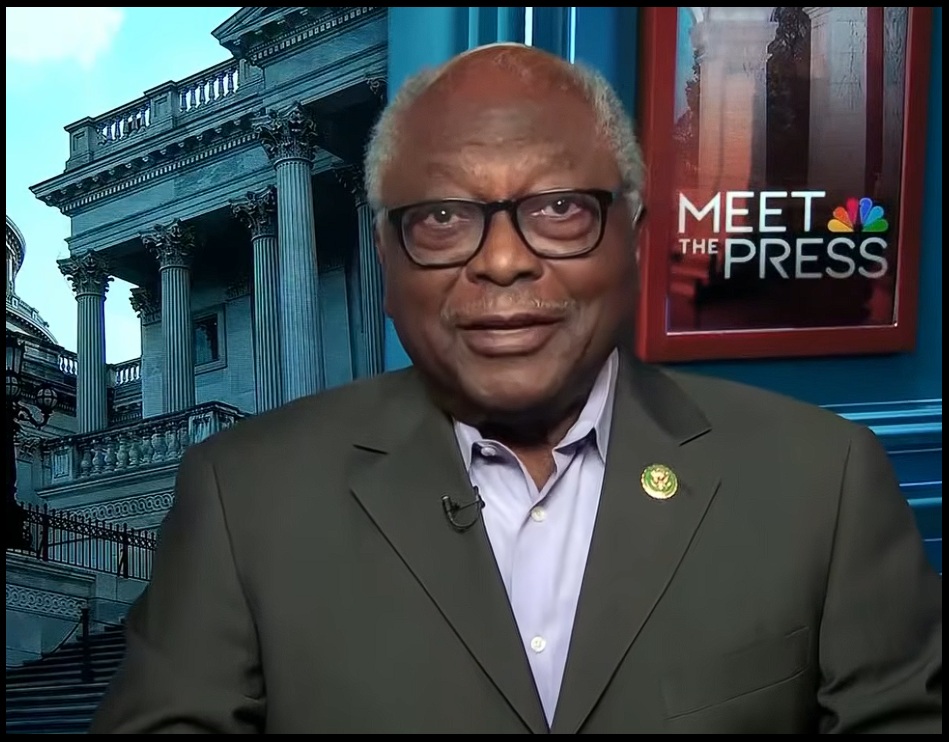
When the South Carolina congressman travelled to Wisconsin in 2024 to visit with poll workers and not candidates, no one seemed curious about the intent. When South Carolina had the opportunity to redistrict that same congressman, the professional republicans in the palmetto state protected him.
Now the organizer of the AME Church network of poll workers appears on NBC to say at the first available opportunity the Democrats should pack the court with another four leftist judges to ensure all of the constitutional restraints are removed from the judiciary. Yep, that’s James Clyburn.
Clyburn begins his remarks in this segment by decrying Supreme Court Justice Clarence Thomas for not adhering to the manipulative racial expectations of his position. Clyburn then advocates for adding as many justices as needed in order to advance his agenda. WATCH:
[Transcript] – KRISTEN WELKER: Welcome back. Joining me now is Democratic Congressman James Clyburn of South Carolina. Congressman Clyburn, welcome back to Meet the Press.
REP. JAMES CLYBURN: Well, thank you very much for having me back.
KRISTEN WELKER:
Well, thank you so much for being here. I do want to start with what we just heard from Senator Cruz. We were talking about, of course, Justice Clarence Thomas. In 1991, you actually testified in favor of Clarence Thomas’s confirmation to the Supreme Court. I want to play a little bit of that video.
[BEGIN TAPE]
REP. JAMES CLYBURN:
It’s a pleasure for me to be here today to present testimony in favor of my good friend, Clarence Thomas. I have known Clarence for ten years and I consider him to be a personal and professional friend, in spite of the fact that he shares a conservative Republican philosophy.
[END TAPE]
KRISTEN WELKER:
Do you stand by your decision to make the case for Clarence Thomas’s confirmation?
REP. JAMES CLYBURN:
Absolutely not. You know, I have made mistakes in my life, and that’s one that I made. And I will own up to that mistake. The fact of the matter is I had faith and confidence in the fact that his background and experiences would instruct him in his professionalism, especially sitting on the bench. We had worked together when he was chair of the Equal Opportunity Commission. And of course, I was running the state agency here in South Carolina. We had differences over how that agency should run. But I also thought that he believed in precedents of the law. And I felt sure that he would be there upholding those precedents set down in 1954 in the Broad v. Board of Education decision. I thought that he would follow those court decisions that upheld the Voting Rights Act, the Civil Rights Act. I had no idea that Clarence Thomas would rebel the way he has against his own background and experiences. He was raised by his grandfather and he has shown very little sensitivity to the environment his grandfather grew up, down in Pin Point, Georgia, just south of where I now sit. And so yes, that was a mistake on my part and I own up to it.
KRISTEN WELKER:
Okay, well, since we are on the topic of the court, let’s speak more broadly about it. Former Vice President Kamala Harris shares some of your criticisms, clearly. She’s called for expanding the Supreme Court from nine justices to 13. Do you support adding four more seats to the Supreme Court, Congressman?
REP. JAMES CLYBURN:
Yes, I do. I think that we are in a position now that calls from some significant actions taken by the Congress, and we ought to expand — and 13 is a pretty good number. A baker’s dozen would be a good number to have on the court. And I would hope we would get people on the court who will follow the constitutional underpinnings of this great nation of ours. The 13th, 14th and 15th Amendments have been interpreted different ways over the years. And we had in the Warren Court an interpretation of those amendments that I thought would be set for the future of the country. We have now a Supreme Court that has decided to reverse course, and take this country back, I say, to those rulings of Justice Taney, that said that no Black man has any rights that the white man must respect. That was the Supreme Court that made that decision. I had hoped that Clarence Thomas would follow the mordant underpinnings of that constitution of ours, but he has not done so. In fact, he’s decided to go all the way from an angry leftist to a very angry rightist.
KRISTEN WELKER:
Okay. Let’s talk about the midterms and let’s talk about your state of South Carolina. Senator Darline Graham, as you know, the sister of the late Senator Lindsey Graham, did win her primary. She’s going to be facing off against Dr. Annie Andrews, the Democrat running in that Senate race. Do you believe Dr. Andrews can win given that no Democrat has won that Senate seat since the 1990s, Congressman?
REP. JAMES CLYBURN:
I do believe Dr. Andrews can win, and I do believe that she will win. The only thing that would stop her from winning this race is for us to not do our part to turn out the vote. I have said before, and people seem to misrepresent this: we have to do a better job of turning our base voters out. When the other side is turning out 71% and we are turning out 59%, we need to take stock of why that is happening. But that did happen in the last election. I take some responsibility for that. I’ve been working on that very vigilantly. I spent yesterday and the day before, and I’ll be spending time this afternoon working on the turn out the vote effort –
KRISTEN WELKER:
Alright.
REP. JAMES CLYBURN:
– that I think will update what we’ve been doing in the last few years, and make for a much better turnout. And if that were to happen, I think that Dr. Andrews will do well in this election.
KRISTEN WELKER:
Congressman Clyburn, I had the opportunity to interview Leader Hakeem Jeffries and he has not ruled out impeaching President Trump should Democrats take back control of the House. But some Democrats have said to me privately that that would just be a distraction, to impeach President Trump for a third time. Do you believe Democrats should impeach President Trump if they take back the House?
REP. JAMES CLYBURN:
If the Democrats were to take back the House, and I feel confident that we will, our first order of business ought to be developing an accessible and affordable campaign effort that will yield what I will call making this country, its greatness, accessible and affordable for all of its citizens –
KRISTEN WELKER:
Do you rule out impeachment?
REP. JAMES CLYBURN:
I don’t want to forget about the American people.
KRISTEN WELKER:
Do you rule out supporting impeachment?
REP. JAMES CLYBURN:
I don’t rule it out, but I don’t rule it in. No, I don’t. But I don’t think that should be our priority if we get into office. Our priority ought to be making housing, education, energy, healthcare affordable and accessible for all of our citizens. Impeaching the president will not do that. We need to focus on what is necessary to make education available for our children, making healthcare affordable for our children, making housing affordable, making energy affordable. That’s where the focus ought to be.
KRISTEN WELKER:
Okay. Congress —
REP. JAMES CLYBURN:
And we can walk and chew gum at the same time, and maybe do both.
KRISTEN WELKER:
All right. A few more questions for you, and we’re almost out of time. I have to ask you about what’s happening in Michigan, the Senate race there. Dr. Abdul El-Sayed has apologized to Jewish Democrats for comments he made after the attack on a synagogue in March when he said, quote, “Hurt people hurt people.” That comes as he’s also faced scrutiny over his association with Hasan Piker, who some Democrats this week denounced for what they called antisemitic remarks from Piker. Do you believe that this divide within the Democratic Party over Israel and antisemitism is becoming a political liability that could hurt Democrats in November?
REP. JAMES CLYBURN:
I don’t think will hurt Democrats at all. Some Democrats who get painted with that brush will have to defend the things that they’ve said. I have spoken with the good doctor. He’s our nominee. I support his election. I take him at his word. He has apologized. He says he’s — he will not campaign with Piker anymore. I think that it’s worth taking him at his word. All of us deserve second chances.
KRISTEN WELKER:
Very quickly, Rob Sand, the Democratic candidate for governor in Iowa, says former Vice President Kamala Harris should not run again in 2028. When you look to 2028, Congressman, do you think Kamala Harris should run for President again?
REP. JAMES CLYBURN:
Now, that’s up to Kamala Harris. I supported her when she ran the last time. I would consider her among all the others if she were to run again. But whether or not she should run is a very personal family decision that I will leave up to her and her family.
KRISTEN WELKER:
All right.
REP. JAMES CLYBURN:
And when they make that decision, whatever it is, I will then make determinations as to what my actions would be going forward.
KRISTEN WELKER:
All right. Congressman Jim Clyburn, thank you so very much for being here. We really appreciate it.
I have created this site to help people have fun in the kitchen. I write about enjoying life both in and out of my kitchen. Life is short! Make the most of it and enjoy!
This is a library of News Events not reported by the Main Stream Media documenting & connecting the dots on How the Obama Marxist Liberal agenda is destroying America