Posted originally on Jul 15, 2026 by Martin Armstrong |
June’s Consumer Price Index fell 0.4% for the month, pulling the annual inflation rate down to 3.5% from 4.2% in May. Core inflation, excluding food and energy, remained flat for the month and slowed to 2.6% year over year. Predictably, markets immediately began betting that the Federal Reserve will soon ride to the rescue with lower interest rates. They continue trying to force the economy into a textbook model that has never explained how the world actually functions.
The biggest driver behind the decline was energy. According to the Bureau of Labor Statistics, gasoline prices plunged 9.7% during June while the overall energy index dropped 5.7%, the sharpest monthly decline since the COVID lockdowns. Shelter costs rose just 0.1%, the slowest pace in years, while motor vehicle insurance, apparel, communications, and several medical categories also eased. On paper, it all looks encouraging. Unfortunately, economies do not move on paper. They move because of confidence, politics, and capital flows, which is precisely what Keynesian economists have never understood.
Everyone is pretending this is some great achievement by the Federal Reserve when the reality is that oil simply backed off after the temporary ceasefire between Israel and Iran allowed shipping through the Strait of Hormuz to normalize. Oil retreated, gasoline followed, and CPI reflected that decline. Yet the geopolitical situation has hardly been resolved. The Middle East remains on the edge, shipping risks have not disappeared, and energy markets can reverse far faster than politicians can hold another press conference claiming victory. Anyone who believes one month of cheaper gasoline means inflation has been defeated has learned nothing from the last several years.
Food prices certainly did not get the memo. Americans continue paying more at the grocery store, restaurant prices remain elevated, and household budgets are still being squeezed from every direction. Shelter inflation may have slowed, but housing remains one of the largest burdens facing ordinary families. Insurance premiums continue climbing, property taxes are rising almost everywhere, financing costs remain substantially above where they were just a few years ago, and governments continue finding new ways to extract revenue from their citizens. This is why people no longer trust official statistics. They know perfectly well what it costs to feed a family, insure a home, or buy a vehicle.
The Federal Reserve now finds itself trapped in the same position I have been warning about for years. Inflation remains well above its mythical 2% target, yet economic growth continues to slow. The markets still cannot decide whether the Fed will raise rates again or begin cutting them because everyone continues looking only at inflation while ignoring the far bigger problem sitting underneath the entire system. Sovereign debt has reached levels where governments themselves have become the greatest source of financial instability.
This is where our computer has always differed from conventional economics. Interest rates are not driven simply by inflation. They are driven by confidence. Capital moves toward political stability and away from governments that investors no longer trust. During periods of geopolitical uncertainty, both the USD and gold can rise together because money is fleeing risk, not because someone solved an equation in an economics department.
The computer has never been focused on a single CPI report because one month’s inflation data does not change the trend. We are moving through a Panic Cycle where sovereign debt, geopolitical conflict, and the collapse in public confidence are converging at precisely the same time. Temporary declines in gasoline prices do not alter that trajectory any more than temporary rallies in the stock market end a bear phase. The people celebrating today’s inflation report are looking in the rearview mirror while the next crisis is already forming on the horizon.
Posted originally on Jul 15, 2026 by Martin Armstrong |
Governments opened their borders and welcomed millions of Ukrainian refugees while the television cameras were rolling. Politicians competed with one another to demonstrate their compassion. Now that the war has dragged on for years, the tone has completely changed. Suddenly, humanitarian principles have collided with military reality, and military reality always wins.
The European Union is preparing new rules requiring newly arriving Ukrainian men of military age to provide official documentation proving they are exempt from military service before qualifying for temporary protection. If they cannot prove Kyiv authorized them to leave the country, they may no longer receive the protections that millions of Ukrainians have enjoyed since 2022.
This should surprise absolutely no one. The European Commission already proposed extending temporary protection for Ukrainian refugees until 2028 while specifically excluding newly arriving military-aged men who lack authorization to leave Ukraine. EU Migration Commissioner Magnus Brunner openly admitted the objective is to balance humanitarian protection with Ukraine’s ability to continue fighting the war. Even more revealing was his statement that this exemption was requested by the Ukrainian government itself. Europe is no longer simply offering refuge. It is becoming an extension of Kyiv’s mobilization system.
From the very beginning I warned that this war would consume an entire generation of young Ukrainian men. Wars are never fought by politicians. They are fought by ordinary people who are sent to die while those who make the decisions remain comfortably behind their desks. As casualties mounted and voluntary enlistment disappeared, Ukraine inevitably turned to forced mobilization. Videos have circulated for years showing military recruitment officers dragging men off sidewalks, pulling them from shopping centers, restaurants, and public transportation. That was never sustainable because eventually the only people left to draft are those desperately trying to escape.
The European Union is now acknowledging what it refused to admit publicly. Refugee policy has become military policy. Back in 2024, Zelensky’s government suspended passport renewals and many consular services for military-aged Ukrainian men living abroad. At the time, many dismissed it as a temporary wartime measure. It was the first indication that Kyiv intended to reach beyond its own borders to keep men from escaping military service. Europe initially hesitated, but today the position has changed dramatically. The latest proposal effectively tells Ukrainian men that unless Kyiv approves their departure, Europe may no longer recognize them as refugees.
More than 4.33 million Ukrainians currently receive protection across the European Union. Hundreds of thousands of military-aged men also reside throughout Europe. Every man who remains abroad is one less soldier available to replenish units that have been fighting continuously for more than four years. Governments can dress it up in humanitarian language, but the objective is painfully obvious.
Men in Ukraine are trapped. They cannot leave. They cannot vote for a change in policy or leadership. I have written extensively that Ukraine is simply running out of men. Earlier this year I noted that over one million men had already been mobilized since 2022, while reports suggested as many as six million military-aged men were attempting to avoid conscription. Zelensky lowered the draft age from 27 to 25 because the supply of volunteers disappeared long ago.
Europe is now becoming an accomplice. Instead of offering sanctuary, Brussels is discussing whether military-aged Ukrainian men should be denied protection unless Kyiv certifies they are exempt from service. Think about what that means. Refugee policy is no longer based on humanitarian principles. It is being subordinated to military necessity. The European Union is quietly helping ensure that men cannot escape the battlefield.
The greatest irony is that Europe spent years proclaiming it stood for human rights, freedom of movement, and the protection of refugees. Those principles are now being redefined according to military necessity. Refugee status is no longer determined solely by humanitarian need. It increasingly depends on whether a government fighting a war believes it can spare you.
Our computer has consistently warned that this conflict would not remain confined to the battlefield. War changes everything. It changes financial markets, destroys economies, erodes civil liberties, and eventually transforms legal systems themselves. The line separating civilian life from military obligation becomes increasingly blurred. Europe is now crossing that line.
Posted originally on Jul 15, 2026 by Martin Armstrong |
Britain is becoming one of the most aggressive governments in the Western world when it comes to policing opinions, regulating speech, and deciding what information its citizens should consume. Every year the excuse changes. It was terrorism. Then it became misinformation. Then hate speech. Now they have set their sights on YouTube itself because they no longer trust the public to decide what they want to watch.
The latest proposal would allow the British government to pressure platforms like YouTube and TikTok into changing their recommendation algorithms so that content from government-approved broadcasters such as the BBC, ITV, and Channel 4 receives preferential treatment over independent creators. Ministers claim this is necessary to combat misinformation and protect democracy, meaning it must control information to save democracy. History tells us democracy is already in trouble.
Think about what they are actually proposing. YouTube’s algorithm currently attempts to recommend videos based upon what users choose to watch. The British government wants that replaced, at least in part, with political priorities determined by Whitehall. They call it “prominence.” Throughout history governments have always invented pleasant-sounding names for censorship. They never admit they are controlling speech. They simply insist they are promoting trusted information.
Britain has already crossed lines that much of the democratic world once considered unimaginable. Police have investigated citizens over social media posts, individuals have been arrested for offensive online comments, and the Online Safety Act dramatically expanded government oversight of digital platforms.
Now they want to influence what millions of people even see before they decide what to watch. That is a completely different level of control. If independent creators are pushed down in search results while state-backed broadcasters receive preferential placement, the government is no longer merely regulating speech. It is actively shaping public opinion by deciding whose voice deserves to be heard first. YouTube itself has warned that forcing platforms to give special treatment to government-selected organizations undermines the principle that creators compete based on what audiences actually choose to watch.
Governments spent years attacking so-called monopolies in technology while simultaneously demanding those same companies manipulate their algorithms to achieve political objectives. They criticize platforms for exercising editorial judgment and then insist they edit content exactly as the government prefers.
Europe has become increasingly hostile toward free expression whenever speech challenges official narratives. Whether the subject is immigration, climate policy, COVID, Ukraine, or government spending, the response is remarkably consistent. Debate is no longer answered with better arguments. It is answered with censorship, de-platforming, algorithmic suppression, and criminal investigations.
This is exactly what history warns happens during periods of declining confidence in government. As public trust collapses, politicians become less tolerant of criticism. Instead of asking why people no longer believe them, they conclude the public is consuming the wrong information. Their solution is always to regulate speech, monitor communications, and now even redesign the algorithms that determine what people watch.
Once government decides it can choose which opinions deserve greater visibility, freedom of speech becomes little more than a slogan. Britain is discovering what every empire eventually learns. When governments begin fearing their own citizens more than they fear losing liberty, censorship always follows. It never ends with one platform, one algorithm, or one law. It grows until the government believes it owns the truth itself, and history has never been kind to nations that reach that point.
Posted originally on Jul 15, 2026 by Martin Armstrong |
QUESTION: Someone said that you view of history inspired Chris Martin, the English singer and songwriter of the rock band Coldplay, in his hit sone “Viva La Vida” and that this fit the last emperor of China, Puyi right down to him sweeping the streets he use to own. It is certainly a song of revolution and the cyclical rise and fall of nations.
Pete
ANSWER: That is one of my favorite songs. Yes, it fits Puyi almost perfectly.
He ruled as a child emperor. He lost his throne after the Xinhai Revolution. He later became the Japanese-backed ruler of Manchukuo. He ultimately lived as an ordinary citizen after the Communist victory.
I never met Chris Martin nor communicated with him. The song is generally understood to be about a deposed ruler reflecting on the loss of power. I do not believe that he has said it was inspired by by Puyi. From what I know, it is clearly the cyclical nature of power surrounding kings and revolutions rather than a specific historical figure. I don’t think the Biblical references, especially the line “I know Saint Peter won’t call my name,” suggesting judgment after a fall from power, would apply to China. I believed this is more about the broadly, the universal theme that even the most powerful rulers eventually lose their kingdoms. This is what we face by 2032. I am certain we can apply the words to many parallels to other fallen rulers besides Puyi such as Napoleon Bonaparte, Nicholas II, Louis XVI of France, and partially to George III of England. But these are interpretations rather than confirmed inspirations.
Perhaps I should invite him to sing one time at one of our WECs.
Posted originally on CTH on July 14, 2026 | Sundance
President Trump was asked about his Thursday 9:00pm ET presidential address to the nation on “election integrity” and other matters. President Trump responded today by saying the announcement is “really big news, it’s really, really big news, and our country has to shape up.” WATCH:
The general chatter amid the various DC interests and specific subject matter experts who seemingly have information and knowledge of the matter suggests the content of the election integrity aspect will be to highlight how Chinese interests have worked within our body politic to influence U.S. elections.
There will likely be specific citations, particularly to election investigations in Michigan, but generally the international aspect revolves mostly around China with some ancillary information about Venezuela. CCP organizations also have compromising information on members of congress which will likely be highlighted and raise eyebrows.
President Trump will be joined in the event by CIA Director John Ratcliffe, acting Director of National Intelligence Bill Pulte, FBI Director Kash Patel, Homeland Security Secretary Markwayne Mullin and others. However, caution should be noted as newly appointed Special Government Employee John Solomon is responsible for the content.
While the expert investigators responsible for ongoing election interference investigations are alarmingly clueless about the overall Thursday intent, CTH has information on background from the pre-announcement coordination meeting.
Having a general understanding of the people around the Oval Office who are involved in the matter, I sense the Thursday announcement is more about positional optics than structural substance.
Trying to afford the most generous motive of intent, perhaps the anticipated 11-million-page (yes, you read that correctly), document dump is intended to give internet researchers the material to launch independent reviews.
That is a nice way of saying a lot of information is going to be released, but specific accountability outcomes will not be involved.
If honesty was applied to the endeavor, the White House could openly say, ‘here’s the information – what can crowdsource researchers discover’? However, in an era when those interests around the White House are more concerned with getting credit than actually delivering actionable accountability, moderate your expectations accordingly.
This is a John Solomon operation.
Only one person’s credibility should be on the line.
Unfortunately, Solomon is likely to attempt distance from the negative backlash created by hype that leads to not much; the media will put the egg squarely on the face of President Trump.
China is the main focus; Venezuela is secondary. The Venezuela research indicates that domestically the Maduro regime controlled the election machine voting in 2020 within Venezuela; however, there is no direct evidence the Venezuela voting system or processes were used to manipulate the 2020 U.S. election.
Much to the disappointment of Emerald Robinson and Patrick Byrne, there will be no claim that Venezuela interfered in the 2020 U.S. election. The Intelligence Community did not discover any direct, high-confidence evidence in that regard.
Regarding China, the Intelligence Community -this is where Pulte comes in- has assessed the CCP attempted to interfere in the U.S. election using a variety of direct and indirect methods. You are probably familiar with many of those prior reports already (Konnech etc.), what we should see on Thursday is some direct documentary evidence.
The Beijing evidence includes CCP-affiliated U.S. enterprises transmitted electronic voter files to agents of China with the intent that those files would be exploited to interfere in the election. Additional evidence of CCP compromise over U.S. elected representatives will likely be included in this aspect.
The CCP stakeholders involved in the targeting operation are generally in state government and state election offices. This is where jurisdictional accountability becomes murky at a federal level. It will be interesting to review the actual data that is released; however, again we should not anticipate a lot of specifics.
This is a John Solomon operation. Do not lose sight of that as the Thursday night buildup continues.
Don’t ask me why President Trump is willing to be influenced by John Solomon, I have no idea. That said, this access might change dramatically by Friday morning.
CTH anticipates directionally plausible enough claims will be made to give the patina of possibility that something important exists.
A Dot.Gov website generated, files of importance professed. Somewhere around 11,000,000 documents dropped for review. However, at the end of the rainbow…. Not much, unless crowdsourcing internet researchers can connect dots the Intelligence Community could not. [NOTE: that outcome would not be a surprise.]
There is a concern that disposable AG Pam Bondi was to the Epstein files as disposable ADNI Bill Pulte is now positioned to the 2020 Election files.
It’s not that anyone is a bad actor in this scenario; the problem is that most people seem more concerned about their position of influence and importance in the hierarchy of the White House.
Each person is more concerned about their proximity to the office of the President, and his opinion therein.
Psychologically, this credibility problem, that has now become our credibility problem, is created by a shallow sense of self that needs to be enhanced with the illusion of institutional importance gained by the proximity to power.
This unfortunate situation, combined with the deeply ingrained resistance within the executive branch that is rarely acknowledged and allowed to fester, has consistently been the core accountability issue in President Trump’s circle.
SOLOMON: 'DON'T BELIEVE THE LEAKS.' 👀🇺🇸@jsolomonreports says anonymous reports about President Trump's upcoming primetime address are getting it wrong, promising Americans will walk away saying, "Wow, that was pretty amazing." pic.twitter.com/h2DykkRHpW
— Real America's Voice (RAV) (@RealAmVoice) July 14, 2026
Posted originally on CTH on July 14, 2026 | Sundance
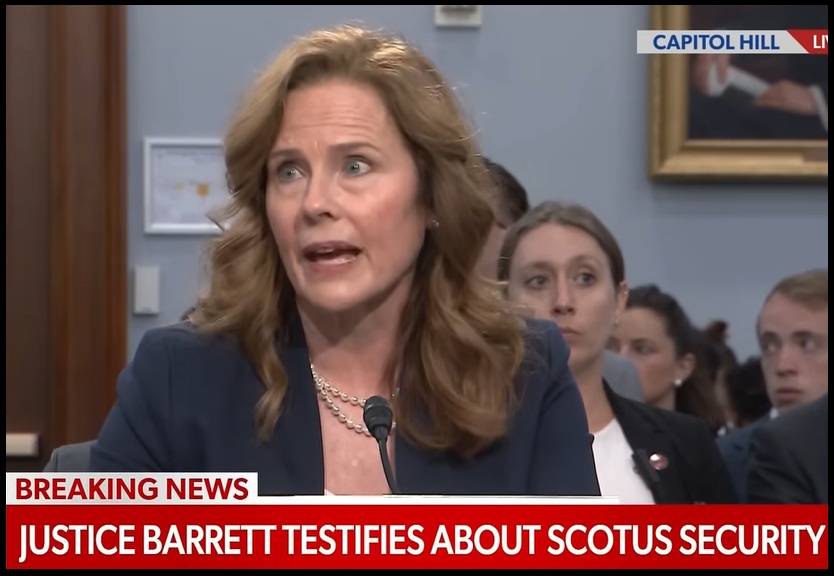
Supreme Court Justices Amy Coney Barrett and Elena Kagan appeared on Capitol Hill to request a ten percent increase in Supreme Court budget spending. The intent is to hire additional security to protect themselves from the outcome of their rulings.
Justice Barrett talked about the harrowing threats to herself and her family as the Court wants to bolster security. The overall appearance before congress is slightly ironic considering the increase in threats is a direct consequence of court rulings that have opened borders, blocked deportation, stalled law enforcement, granted illegal aliens rights to citizenship and generally undermined our nation’s domestic tranquility.
Sorry, but my opinion on the matter has adjusted to new information. The Supreme Court should have to live in the reality of the world they judicially create. No additional public security should be afforded. They have a security detail that supersedes any security level a taxpaying American citizen might be afforded.
No expanded security details should be afforded to government employees, just to avoid the consequences of their ideology.
Mrs Barrett and her family can carry self-defense firearms, wear protective vests and worry about their security in the parking lot of the local supermarket just like we do. Not to be obtuse, but the Constitution equally applies.
I have created this site to help people have fun in the kitchen. I write about enjoying life both in and out of my kitchen. Life is short! Make the most of it and enjoy!
This is a library of News Events not reported by the Main Stream Media documenting & connecting the dots on How the Obama Marxist Liberal agenda is destroying America






 Centinel2012