Posted originally on Jun 1, 2026 by Martin Armstrong |
Poland, one of Ukraine’s strongest supporters, is openly condemning Zelensky for glorifying a movement associated with the slaughter of Polish civilians.
Poland absorbed millions of Ukrainian refugees. Poland became the primary logistical hub for Western weapons. Poland spent years standing shoulder to shoulder with Kiev. Then Zelensky signs a decree honoring a military unit tied to the traditions of the UPA, an organization remembered in Poland for massacres that claimed tens of thousands of civilian lives. Depending on the estimates used, the Volhynia massacres and related ethnic cleansing campaigns killed somewhere between 50,000 and 100,000 Poles, including women, children, and entire villages wiped from existence.
People were hacked to death with axes, burned alive, and murdered specifically because they were Polish. The Polish parliament has repeatedly classified the atrocities as genocide. Yet somehow we are supposed to pretend this is merely a misunderstanding.
Polish President Karol Nawrocki has now stated that Zelensky is not acting like someone prepared to join the European family and has even called for stripping him of Poland’s highest state honor. Imagine how furious Polish officials must be to reach that point after everything they have done for Ukraine.
The Western press spent years screaming that anyone who discussed Ukrainian ultranationalist movements was spreading misinformation. Anyone who mentioned the legacy of the Organization of Ukrainian Nationalists, Stepan Bandera, the UPA, or extremist factions inside Ukraine was immediately attacked. Now the permanent president of Ukraine himself is honoring genocidal organizations and suddenly everyone wants to look the other way.
Zelensky presents himself as the champion of democracy while elections remain suspended. He speaks about freedom while opposition parties have been banned. He lectures the world about human rights while draft officers drag men off the streets and force them into military service. He demands endless funding while Ukraine’s population continues shrinking and hundreds of thousands have fled abroad permanently.
What does that say about the man? The truth is that many Western politicians never cared about democracy. They cared about war. Zelensky became a useful idiot because he was the face they needed to sell a conflict to the public. As long as the money kept flowing and the weapons kept moving, uncomfortable questions were pushed aside.
The war cycle is now exposing everything. Governments always lose control of the narrative when conflicts drag on too long. Historical grievances return. Corruption surfaces. Alliances begin cracking. The truth starts leaking through the propaganda.
Poland’s outrage matters because Poland knows this history firsthand. Entire Polish communities disappeared during the massacres. Families still remember what happened. Graves still exist. The blood is real even if politicians would prefer everyone forget it.
The most disturbing aspect of all this is that Zelensky knew exactly what he was doing. Nobody accidentally honors a movement this controversial. Nobody accidentally signs a decree carrying this level of symbolism. This was a deliberate political choice to honor and uphold a genocide. And yet Western leaders who spend every waking moment condemning historical injustices will likely remain silent because acknowledging the truth would undermine the mythology they spent years creating.
The mask is slipping, and the more desperate this war becomes, the harder it will be to hide what has been standing in plain sight all along. ZELENSKY IS A FRAUD.
Posted originally on Jun 1, 2026 by Martin Armstrong |
Statistics Canada reported that Canadian GDP contracted by 0.1% in the first quarter of 2026 after a revised 1.0% contraction in the fourth quarter of 2025. That marks two consecutive quarters of decline and places Canada in what economists call a technical recession. More importantly, the economy performed dramatically worse than forecasts that had expected growth of roughly 1.5%.
The numbers beneath the surface are even more troubling. Business capital investment fell 0.7% during the quarter. That was not an isolated event. It was the fifth consecutive quarterly decline. When businesses stop investing, they stop hiring. When hiring slows, wage growth weakens. When incomes stagnate, consumption eventually follows. The economy is now moving through that sequence exactly as one would expect.
Government spending dropped 2.5% while domestic demand slipped 0.1%. Imports surged 2.9% while exports edged lower. Vehicle exports were particularly weak as manufacturers continued dealing with trade disruptions and tariff uncertainty. Business confidence has been deteriorating for months.
Household spending managed to rise 0.4%, but consumers cannot carry an economy indefinitely. Governments around the world always assume the consumer is some endless source of growth. The reality is that consumers spend only when they feel secure about employment and future income. Once confidence declines, spending follows.
Canada’s economy grew only 1.7% in all of 2025, the weakest pace since the pandemic period. The Bank of Canada now expects growth to slow further to only 1.2% in 2026.
Youth unemployment has been climbing, business closures remain above historical averages, and investment continues flowing toward the United States despite political tensions. Statistics Canada reported business closure rates running above pre-2020 norms, another indication that small and medium-sized enterprises are struggling under rising costs and economic uncertainty.
What many analysts miss is that recessions are not merely about GDP. They are confidence events. Once businesses begin postponing investment projects, capital starts searching for safer jurisdictions. Canada has spent years increasing regulatory burdens, raising taxes, restricting resource development, and discouraging private investment. At the same time, housing affordability has collapsed, household debt remains among the highest in the developed world, and productivity growth has stagnated.
Canada possesses some of the world’s largest reserves of energy, minerals, farmland, timber, and fresh water. It should be one of the strongest economies in the Western world. Instead, policymakers have spent years trying to engineer growth through government spending while simultaneously undermining the productive sectors that generate wealth.
There are signs of a short-term rebound. Statistics Canada estimates GDP may have increased by 0.4% in April, helped by oil and gas production and manufacturing activity. Yet one month does not reverse a trend. The issue is not whether Canada can produce a positive quarter here or there. The issue is whether businesses believe the future is worth investing in.
Posted originally on Jun 1, 2026 by Martin Armstrong |
China is now reportedly requiring leading AI experts at private firms to obtain government approval before traveling internationally. Beijing fears that top researchers could leak sensitive information, defect, or become targets for foreign intelligence agencies as the AI race intensifies. This policy is now expanding beyond government-linked entities directly into the private sector itself. That tells you everything about how seriously Beijing views artificial intelligence strategically.
People still think AI is just about chatbots, search engines, or replacing office jobs. Nonsense. AI is becoming military infrastructure, financial infrastructure, surveillance infrastructure, cyberwarfare infrastructure, and economic infrastructure simultaneously. Whoever dominates AI gains enormous advantages not only economically but also militarily and geopolitically.
China understands this perfectly. That is why Beijing is treating AI talent almost like strategic state assets. During the Cold War, nuclear scientists could not simply move freely because governments feared technological leakage. Now, AI engineers are entering the same category because advanced models increasingly intersect with military targeting systems, drone warfare, cyber operations, financial surveillance, intelligence gathering, and autonomous weapons development.
The United States is doing the exact same thing in a different form. Washington has aggressively restricted semiconductor exports to China, blocked advanced Nvidia AI chips, pressured allies like the Netherlands and Japan to limit lithography technology exports, and expanded investment restrictions tied to Chinese AI firms. The Biden and Trump administrations alike both viewed AI dominance as critical to national security because the geopolitical establishment in Washington now sees China as the primary long-term rival.
The AI race is replacing globalization itself. For decades the world operated under the assumption that economic integration would reduce geopolitical conflict. Instead, the exact opposite happened. Globalization created interdependence, but once relations deteriorated, every dependency became weaponized.
Semiconductors are weapons. Data is a weapon. Software is a weapon. Supply chains are weapons. Rare earth minerals are weapons. Financial systems are weapons. Artificial intelligence is rapidly becoming one of the most valuable strategic assets on earth.
China knows it cannot afford a massive brain drain of elite engineers while competing directly against Silicon Valley and the U.S. defense establishment. Chinese firms like DeepSeek, Alibaba, Tencent, and Baidu are now central players in Beijing’s technological ambitions while the government pours enormous resources into AI development. China already graduates vastly more STEM students annually than the United States, and Beijing understands human capital is now as important as oil reserves were during the 20th century.
The United States helped create much of this situation through sanctions, export controls, financial warfare, and trade restrictions. Once Washington froze Russian reserves and weaponized SWIFT, every major power on earth understood the world had entered a new era where economic systems themselves had become geopolitical battlegrounds.
What we are witnessing is the slow division of the world into competing technological spheres. One side centered around the United States and Western allies. The other increasingly centered around China and alternative systems. AI will sit at the center of this divide because whoever controls advanced AI systems gains advantages across finance, intelligence, defense, medicine, robotics, and industrial production.
The naval arms race before World War I intensified tensions between Britain and Germany. The nuclear arms race defined the Cold War. Now the AI race risks becoming the defining geopolitical competition of the 21st century.
AI may ultimately centralize power further than any technology in human history. Whoever dominates AI infrastructure could potentially dominate information, finance, labor markets, surveillance, and warfare simultaneously.
Posted originally on CTH on May 31, 2026 | Sundance
Ironically, I find myself with a grin on my face as I read the recent media reports about how the data processing demand behind AI is beyond the scope of financial sustainability.
For several years I have asserted, accurately, the business model for social media was never feasible because the data processing demand needed for the scale of simultaneous users was beyond the capabilities of the revenue side of the equation. I have been told by all the high-horse experts on the matter how wrong I am. However, each story they write about the prohibitive cost of AI proves I was not wrong.
CTH watches the tokenization and subscription fees for various AI model use with the same perspective CTH viewed over a decade of false claims within the financial market that told lies about social media viability and data processing costs.
Now, we watch the seemingly exponential growth of AI capabilities and associated costs with the same pragmatic perspective.
Robotic pool cleaners were introduced two generations ago. Did the pool cleaner business dry up? No, it expanded. Robotic vacuums broke into the popular household appliance market five years ago, you probably have one, did it eliminate maid services? No, still growing.
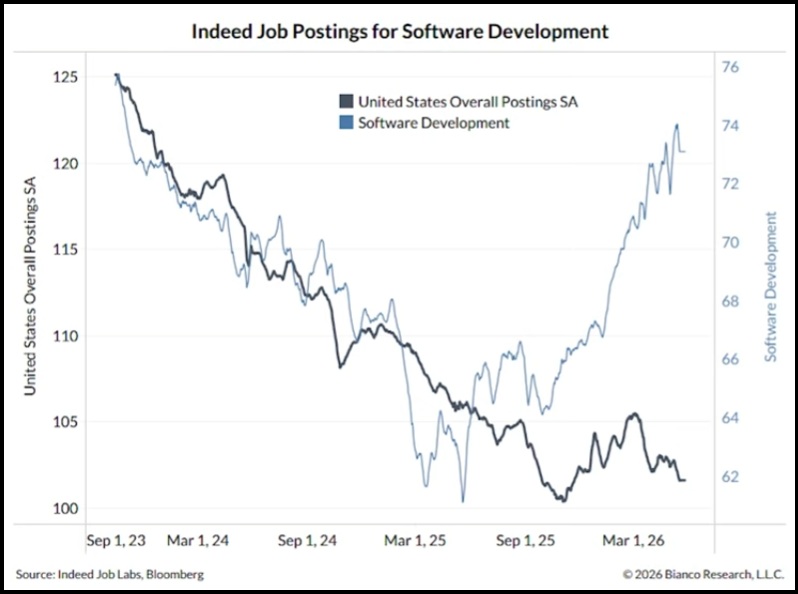
AI can now write its own code to generate outputs. Are software developers getting fired? No, demand for software designers and engineers is up 15% in the past year.
The mainframe approach, the one AI brain to run all systems, will never work – it is cost prohibitive (see first paragraph – wash, rinse, repeat). Deny this reality at your own investment risk. If needed, politely absorb the ridicule – for it matters not.
CTH predicts AI will become a localized and optimized sub-set for each sector of the economy, requiring each major organization and corporation to adopt specific cost/benefit data libraries and networks for use and functionality.
At scale, a thousand coders each working on Gemini, ChatGPT, Anthropic, Grok, etc. will become 100,000+ software designers working inside companies to create personalized, targeted, bespoke AI data systems and networks; each system specifically tailored to the industry or sector of business. The intranet of internets will happen again.
Creating and selling AI system networks and integration functions that are personally tailored to highly specific company functions, creates an entirely new sector of the technology industry that has not even begun yet. [There’s an investment opportunity there]
Will AI robots replace some repetitive human functions? Yes, the ice rink Zamboni will likely not have a steering wheel, just an emergency joystick. A reference for a comparative industrial scale Roomba vacuum, or the robotic pool cleaners. However, at scale the robotic industry is slower than human efficiency in almost all sectors that matter; the cost benefit analysis will limit growth. The maid service sector will not be impacted any more than the software developers (see chart above).
It is not an issue to fear some AI task efficiencies will grant more time available that will be filled with alternate task capabilities. Human productivity will increase in certain sectors of the economy, but humans will not lose work opportunities. Blue collar jobs will continue to expand as each of the hardware tools developed will need manufacturing, installation, maintenance and monitoring.
The further downstream the worker is from a repetitive function within the [XXXX] industry, the more irreplaceable they become; remember that.
As to the bigger picture of fully developed AI and the intersection of information and knowledge; yes, the automation of AI can present an issue. However, all AI concerns can be mitigated so long as multiple, alternative AI systems exist within the larger information realm.
As a nation we need dozens of different AI models each competing within the industry for the best AI product. As long as we have multiple AI systems, alternatives to the hive-mind, we do not need to fear the AI network as a source of information. If we don’t like the AI outputs, we can switch to an alternate AI provider.
If the subscription cost of the AI is too high, then as long as we have a competitive market where a lesser expensive, perhaps bespoke, AI option can exist, we should be okay. Let the free-and-fair market decide.
If AI outputs don’t offer empirical truth or real value to the end user, we should be fine as long as consumers have alternative options available. AI providers should be information providers in the same concept as cell phone providers. The key is to have multiple, competing AI systems available for industrial, business, professional and personal use.
On the upside of this information worry dynamic -in the pragmatic and optimistic perspective- we have the cost limiting nature of a massive singular AI information network.
A single AI central brain handling over 360 million users at once, all requiring identical responses that update with every tiny change in a multi-trillion datapoint-per-millisecond data stream, is far beyond the capacity of any computational AI system. The costs tied to such a setup are only now becoming clear, and AI business models are starting to fall apart in real time. This is a hard truth that isn’t going to change.
Within the AI business, those who can carefully write AI input instructions to achieve maximum value in AI output -industry by industry- will become increasingly more valuable. Those who can train AI to be cost effective -and provide materially beneficial outputs- within their granular sector of business, within each company, will become priceless to the organization. Wage rates will follow competency.
As noted by David Sacks in this segment highlighted below, the one key about AI to emphasize is the need for multiple competing models. If China (hive mind) has their model, and Europe (another hive mind) has their model, and the United States (entrepreneurial competitiveness) has multiple competitive models – we will win and simultaneously we will retain freedom.
What we don’t want is a singular AI model to win the support of the United States government and then end up with an AI regulatory system where they start defining terms of “safety” to eliminate information adverse to the interests of the government that regulates it. Both China and Europe will predictably do that.
Posted originally on CTH on May 31, 2026 | Sundance
**Bumped by Request**
A few weeks ago, I was having a politics conversation with a tech insider. The issue of datacenters became a focus of the conversation. The first response from him was “this is the issue that might decide 2026 and will certainly decide 2028.”
The tech side of the issue is essentially: As 5G wifi was to mobile connectivity, so too are the datacenters the cornerstone of nationwide AI rollout. Eventually, all of the datacenters will interconnect and become part of a massive information system that houses all knowledge, a great digital brain. From that point, engagement with Artificial Intelligence (AI) systems will become like a public utility.
The datacenters themselves can be a hot button issue as their proximity to people creates friction. Battles against datacenters are taking place in rural and non-rural areas alike. With deep pockets and strong national security arguments involving the “AI race,” the technocrats are currently winning the argument. However, as with all special interest issues, the opportunity for political benefit now determines DC advocacy. WATCH:
What are your thoughts on this issue?
Is opposition to datacenters strong enough to tilt the outcome of the 2026 midterms? And do you believe 2028 will be determined with this issue at the forefront?
Posted originally on CTH on May 31, 2026 | Sundance
Armed with a host of narratives against the Trump administration, CNN host Dana Bash confronts Interior Secretary Doug Burgum about his audacity to support Freedom 250 events in Washington DC this year. Apparently, it is not in alignment with the interests of CNN for Americans to celebrate the anniversary of our independence.
Complaining about DC fountains being cleaned; complaining about people not being consulted for their viewpoints to permit the graffiti and filth to remain in place prior to cleaning; complaining that years of environmental studies and municipal hearings did not take place prior to the decision to repair the reflection pool; complaining about saving hundreds of millions by not opening up each restoration process to consultancy fees, studies, public hearings and various bureaucratic indulgency opportunities; a very unhappy Dana Bash confronts Interior Secretary Doug Burgum about his support for President Trump to clean and restore the nation’s capital without consideration for those who prefer things to be a mess.
I have created this site to help people have fun in the kitchen. I write about enjoying life both in and out of my kitchen. Life is short! Make the most of it and enjoy!
This is a library of News Events not reported by the Main Stream Media documenting & connecting the dots on How the Obama Marxist Liberal agenda is destroying America