Posted originally on Jun 11, 2026 by Martin Armstrong |
The Pentagon has now added BYD, Alibaba, Baidu, and dozens of other Chinese firms to its list of companies allegedly linked to China’s military establishment. Washington wants the public to believe this is about national security. China’s greatest crime is not that it has a military. Every major power has a military. China’s greatest crime is that it competed too well.
China is building electric vehicles that are taking market share from Western automakers. Suddenly it becomes a national security concern. China develops world-class battery technology. National security concern. China advances artificial intelligence. National security concern. China dominates solar manufacturing. National security concern. China expands semiconductor capabilities. National security concern. At some point people need to ask whether the issue is military activity or economic competition.
The United States spent decades shipping factories, manufacturing, technology, and investment capital to China. Wall Street and consumers rejoiced after receiving cheaper products. The assumption was always that China would remain a low-cost manufacturing platform while the West retained financial and technological dominance. That has never been what our computer indicated, and although it may not have made sense decades ago, every indicator shows China on the rise.
China took the capital, the technology, the expertise, and the industrial capacity and built an economic machine that now challenges the West across nearly every major strategic industry. BYD now sells more electric vehicles than many Western competitors. China produces the overwhelming majority of the world’s battery components. Chinese companies have become major players in artificial intelligence, robotics, telecommunications, and advanced manufacturing. The problem is not that China failed. The problem is that China succeeded.
What would happen if BYD were headquartered in California? Politicians would celebrate it as proof of American innovation. If Baidu were based in Silicon Valley, every financial network would praise its technological achievements. If China’s battery industry belonged to the United States, politicians would be holding press conferences celebrating industrial leadership.
Instead, these companies are Chinese. Yes, there have been instances of technology theft as both nations play dirty to compete. Every success achieved by the rival nation is portrayed as a threat. Governments begin redefining ordinary commerce as strategic warfare.
Washington is finally admitting what China understood from the beginning. Beijing never separated economics from national strategy. China viewed industrial development as national power. The West viewed industry as something to offshore in pursuit of quarterly profits. Now policymakers are discovering that surrendering industrial capacity has consequences.
We are rapidly approaching a world where every Chinese company is viewed as a military company and every American company operating abroad is viewed as an instrument of Washington. Once governments start treating commercial competition as military competition, the distinction between economic warfare and actual warfare begins disappearing.
The public should understand what is taking place. This is not merely about BYD, Alibaba, or Baidu. This is another step in the escalation between the world’s two largest economies. The war cycle is advancing precisely as expected. The rhetoric becomes more hostile as restrictions become more aggressive. The economic walls will grow higher.
Posted originally on Jun 11, 2026 by Martin Armstrong |
The Taiwan issue is not simply about reunification. That has always been far too simplistic. If Taiwan were merely a political dispute, China would not be spending trillions of yuan to build one of the largest navies on Earth. It would not be launching aircraft carriers into the Pacific. It would not be conducting large-scale naval exercises beyond the first island chain. What we are witnessing is something much larger.
Japan is reporting that China’s aircraft carrier Liaoning and its accompanying strike group recently conducted extensive operations east of the Philippines. Carrier aircraft reportedly carried out roughly 170 takeoffs and landings as the fleet operated throughout the western Pacific. These were not coastal defense exercises. These were blue-water naval operations designed to demonstrate that China intends to project military power far beyond its own shores.
Taiwan sits at the center of what military planners call the First Island Chain, a series of islands stretching from Japan through Taiwan and the Philippines. Since the end of World War II, this chain has effectively limited China’s direct access to the broader Pacific. Control of Taiwan would fundamentally alter that equation. Military analysts have openly acknowledged that China’s navy is steadily expanding beyond the First Island Chain and increasingly operating in waters once dominated almost exclusively by the United States and its allies.
This is why military planners throughout Asia are becoming increasingly concerned. China is not simply building ships. It is building the capability to operate far from home for extended periods of time. In 2025, Chinese carriers reportedly spent a record amount of time operating beyond the First Island Chain, launching thousands of aircraft sorties as operational experience rapidly increased. These are the actions of a nation preparing for regional power projection, not merely coastal defense.
Japan is expanding defense spending. The Philippines is increasing military cooperation with the United States. Taiwan is rapidly expanding missile production. China continues building carriers, destroyers, submarines, and long-range missile capabilities. Every nation claims it is acting defensively. History shows that when everyone is preparing for war defensively, the risk of conflict rises dramatically.
Our models have warned that 2026 would be a panic-cycle year characterized by rising volatility and escalating geopolitical tensions. We are now watching multiple theaters move simultaneously. Ukraine continues to expand. The Middle East remains unstable. Europe is openly discussing military vulnerability windows extending into 2028 and 2029. Meanwhile, China is steadily pushing farther into the Pacific. None of these events exist in isolation.
Posted originally on Jun 11, 2026 by Martin Armstrong |
The May inflation report came in exactly where many expected, yet the details beneath the headline reveal what is actually taking place in the economy. Consumer prices rose 0.5% for the month and 4.2% year-over-year, the highest inflation reading in three years. Core inflation, which excludes food and energy, rose only 0.2% for the month and 2.9% annually. This is primarily an energy shock that is spreading through transportation, travel, and production costs due to the war in Iran.
Government data show that energy alone accounted for more than 60% of the monthly increase in consumer prices. Energy prices rose 3.9% in May after climbing 3.8% in April. Gasoline prices surged 7.0% in a single month and are now up 40.5% compared to a year ago. Electricity prices rose 5.9% over the past year while natural gas prices increased 3.0%. These are not insignificant numbers. Energy is the foundation of every economy. Every product must be manufactured and transported. Every store must be heated, cooled, and illuminated. When energy rises, it eventually works its way into virtually every aspect of economic activity.
What is particularly important is that shelter inflation remains elevated. Shelter costs rose another 0.3% in May and are up 3.4% over the past year. Rent increased 0.4% for the month while owners’ equivalent rent rose 0.3%. Housing remains one of the largest expenses for the average household, and these increases continue to erode disposable income even as policymakers insist inflation is under control.
Food prices are also moving higher, though at a slower pace than energy. The overall food index rose 0.2% during May and 3.1% over the past year. Food away from home increased 3.5% annually, showing that restaurants continue passing higher operating costs on to consumers. Fruits and vegetables are up 6.1% over the past year while beverages increased 5.8%. The average family notices these increases every week at the grocery store regardless of what economists may say about “core inflation.”
Transportation is beginning to show the impact of rising fuel costs. Airline fares jumped 2.7% in May alone and continue to rise as carriers pass along higher jet fuel expenses. The travel sector has been particularly vulnerable because energy prices affect everything from airline tickets to hotel operations and rental cars. We are seeing the same pattern that has repeated throughout history whenever geopolitical tensions disrupt energy supplies.
The political establishment will attempt to debate whether inflation is temporary or permanent. They always focus on labels instead of causes. The numbers show that this inflation surge is being driven primarily by energy. Whenever governments become involved in war or geopolitical confrontation, energy becomes the transmission mechanism that spreads economic pain throughout the system. The current Middle East conflict has once again demonstrated how fragile global supply chains remain and how dependent modern economies are on stable energy markets.
The May CPI report demonstrates that inflation has not disappeared. It merely changed form. The energy sector is once again dictating economic reality. As we move deeper into a Panic Cycle year, geopolitical events are becoming increasingly important drivers of economic activity. The lesson remains the same as it has throughout history: when energy prices move sharply higher, they eventually impact everything else.
Posted originally on Jun 10, 2026 by Martin Armstrong |
COMMENT: You have always stated that wars are created by the leaders, not the people. The majority of Israelis do not want Netanyahu to run again. According to a poll released this week by the Israel Democracy Institute, it found that 61% of Israelis, including 27% of Likud members, do not want to see Netanyahu run again this fall. The same proportion said they want to see Israel adopt a two-term limit for prime ministers in the future.
I understand your criticism of Netanyahu that this is an endless war that does not end well for us, according to your computer. There has to be some long-term solution, and sending missiles back and forth will not resolve this. Do you have any update for us here in Israel?
V
REPLY: I know, we have a lot of readers in Israel. The greenback is starting to position itself for a rally and we still have a major directional change in 2027. I agree with you that the real problem here is that there is no military victory. Netanyahu has sold his Neocon theory and he always assumes that if you assassinate the leader, you are cutting off the head of the snake and you win. The logic behind it is known as the “better the devil you know” or the “decapitation paradox.” Often, the second-in-command is less capable, less charismatic, or lacks the same control over factions. This can lead to a less effective or more moderate successor. If you kill the leader, the entire command structure that could negotiate a ceasefire or surrender is gone. You might be left fighting a fragmented, leaderless, and even more vengeful enemy for years. Killing a charismatic leader can turn him into a martyr, inspiring a new wave of recruits and making negotiation with his followers politically impossible. Netanyahu’s strategy is by no mean foolproof especially since Iran countered by decentralizing. Taiwan is now adopting the Iran model of decentralization.
Like Iraq, they focused on removing Saddam. They NEVER consider what comes next. Netanyahu puts out the same BS I have heard about Russia. Get rid of Putin and the people will rise up and give the Neocons a tickertape parade. They made the same argument about Iraq. It did not happen there either. Iran decentralized its government knowing Netanyahu’s strategy of assassinating. You hear Rubio now saying they are having to negotiate with the 3rd tier of leaders.
Trump is trying to get out of this mess but Netanyahu is up for possible reelection. Trump has been saying that he was unsure if Netanyahu would press forward in the elections. Netanyahu’s party has rejected speculation that he might not run in Israel’s election this fall, following an offhand comment by U.S. President Donald Trump.
We have a clash of self-interests where Netanyahu is being criticized there by his opposition that he has achieved nothing including no regime change or the people rising up. This makes Netanyahu anti-peace or he has to admit failure. In the USA, there are the midterms and if Trump does not end this before, he looks like a failure. These two elections are on a collision course.
It just does not seem to be peace on the horizon long-term.
Posted originally on CTH on June 11, 2026 | Sundance
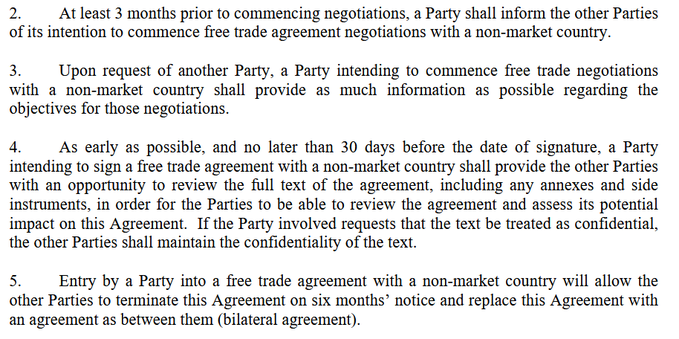
An interesting article in Japan Times reinforces several insider trade discussions that have been taking place over the past eighteen months. Essentially, all trade deals with Canada are contingent upon their access to the USA market. Lose the USMCA trade deal, and any trade terms between Asian and Canadian counterparts are null and void.
This is not the first time this background from key trade nations has been shared with Canada. Japan told Canada last year that most sector trade, specifically the auto industry, was contingent upon tariff-free access to the U.S. market. If Canada loses the USMCA, the terms of trade change completely.
This reality is now surfacing in comments directly from the Canadian trade teams and business insiders within Canada. They are now admitting without the USMCA their leverage for trade with other countries disappears. This is a considerable admission from within Canada government that has not yet become part of the average Canadian understanding.
If Canada loses their trade agreement with the USA, all other countries will modify their trade agreements with Canada. Think about the leverage within that reality, overlay the Canadian government’s severe anti-Trump mindset, and you quickly realize just how dangerous Mark Carney is for Canada.
JAPAN TIMES – […] Carney’s push to lessen dependence on the U.S. is colliding with a stubborn reality: access to American markets remains a crucial part of Canada’s appeal to prospective trading partners, according to interviews with a dozen government officials and business leaders.
[…] Canadian officials acknowledge that the main draw for many potential trading partners is the prospect of gaining tariff-free access to the world’s largest market through Canada’s participation in the U.S.-Mexico-Canada trade agreement.
Carney regularly touts Canada’s preferential access to the U.S. market, noting that more than 85% of bilateral trade remains tariff-free.
“That (USMCA deal) has been kind of a baseline of our investment attraction message,” said a top Canadian government official who requested anonymity to speak frankly.
[…] The auto sector — dominated by Japanese automakers Toyota and Honda — is a prime example. […] Together the two companies account for over 75% of vehicles made in Canada.
[…] “For many of the Japanese companies investing here, one of the reasons for their investment is definitely the special access Canada has enjoyed over the long years,” said Ishii Hideaki, minister and deputy head of mission at the Japanese Embassy in Ottawa.
[…] Goldy Hyder, CEO of the Business Council of Canada, which represents large companies, praised the government’s efforts to attract investment into critical minerals and energy. But he also sounded a note of caution.
“For large investors from Asia or Europe looking at Canada, any decision to deploy capital would necessarily take into account not only our national investment climate but also our connections to the North American continental economy as a whole.” (read more)
Last year we noted an insider trade report from Toyota warning that if the U.S. cancelled the USMCA, Toyota would move all production out of Canada. The U.S. market is the majority reason Toyota operates in Canada.
As noted in the Japan Times article, this is the first time the Canadian trade and business community have openly stated their trade strategy is contingent upon selling access to the U.S. market. If Canada loses that access, everything within the economy of Canada will dramatically change.
There are trillions at stake.
Yesterday, yet again, President Trump affirmed he has no intention of continuing the USMCA and will instead prefer two separate bilateral trade agreements, one with Mexico and one with Canada.
Things are going to get spicy very quickly.
Most Canadians have no idea just how consequential that shift will be.
This is a recap video highlighting the damage Mark Carney has done.
Highlight reel of @MarkJCarney torching the Canada-U.S. relationship every chance he gets.
Posted originally on CTH on June 10, 2026 | Sundance
According to The Gateway Pundit there are five names being debated for permanent DNI {SEE HERE}.
Qualifying any comment by saying this is entirely speculation, a few have asked me for opinion.
Gateway Pundit posits the names: GOP Representative Elise Stefanik, GOP Representative Rick Crawford, current Deputy Director of the CIA Michael Ellis, Vice President JD Vance’s national security adviser Cliff Sims, and former GOP Rep Jason Chaffetz.
Names not mentioned in that article include former HPSCI Chairman Devin Nunes or former Representative now U.S. Attorney for North Carolina Dan Bishop.
Without being fully transparent about how I am reaching my perspective, here’s my take on these names.
I have not seen Michael Ellis in this discussion before. However, he would be a very solid consideration. Ellis is a very straight, non-pretending, deliberate and serious person. With a firm grasp on the problem, Ellis would be a solid option.
Current HPSCI Chairman Rick Crawford would also be a solid consideration. As current HPSCI Chairman Crawford has worked with Tulsi Gabbard, and he does have a very firm grasp on the nuances and issues within the current intelligence community.
Dan Bishop’s name has not been mentioned by many, but he would also be an asset in the role. At least he should be interviewed to see if he thoroughly understands the problem and would be willing to confront it.
Stefanik might want the job and might be the favorite of White House Chief of Staff Susie Wiles, but I’m not sure Stefanik is strong enough to stand up to the pressure within the overall intelligence apparatus. There’s a general pretending that often comes from DC familiarity as well as willingness to go along with norms and status quo. Stefanik is not a disruptor.
It doesn’t seem like Devin Nunes wants the job, for all of the reasons why a tenured IC person wouldn’t want the job. Jason Chaffetz would be worthless, as he was when Chairman of the House Oversight Committee. I don’t know enough about Cliff Simms to give an opinion.
Ranked: Ellis, Crawford, Bishop.
Concerning: Stefanik, Chaffetz.
Best Route: Give strong weight to Tulsi Gabbard’s recommendation.
Posted originally on CTH on June 10, 2026 | Sundance
It is not shocking to us. It is not shocking to anyone who has followed this story for the past few years. It is particularly not shocking to you. However, the Canadians are going bananas right now.
President Donald Trump responded to a question about the current status of the USMCA trade agreement, or what Canada calls CUSMA. Watch and listen to how President Trump points out that he has no intention of renewing the USMCA.
This has been obvious since May of 2025 {GO DEEP}.
I don’t want to say ‘I toldya so’, but…. Video prompted to 37:55:
Posted originally on CTH on June 10, 2026 | Sundance
In the bigger picture, it is very likely that congress will reauthorize FISA (702) surveillance because not doing so is against their interests. That reality creates an unusual dynamic where President Trump can leverage the inevitable outcome for his own political benefit.
PRESIDENT TRUMP – “Just like they did on Border Funding, the Radical Left Dumocrats are trying to take our National Security hostage because of unrelated issues. They should stop playing politics with the safety of our Great Country.
I have named William Pulte to be Acting Director of National Intelligence, who will take over on June 19th, and have asked him to execute the immediate and needed downsizing of the office, reverting staff to their home agencies. At the same time, I am looking for a permanent ODNI Nominee with experience in National Security.
FISA 702 is very important to our Military, and keeping the American People safe, especially during the World Cup and America250 Celebrations. If nothing is done, this important Law will expire this week. I am asking Congress to send me a short-term extension of FISA to provide time for the selection and confirmation of a permanent Head of the Agency. I would like to thank Director Pulte for his time and commitment.” ~ President DONALD J. TRUMP
The Legislative Branch is opposing FISA (702) renewal by using opposition as a narrative to enhance their “orange man bad” credentials. Their opposition is fake. In non-pretending reality we understand the Legislative Branch both wants and controls the dynamics around FISA (702).
The CIA drug trafficking disruptions come as a result of intercepted telecommunication between foreign narco traffickers and those in the U.S. on the receiving side.
With evidence provided, a standard U.S. federal court can issue a warrant against the American side of the communication network if the evidence supports it.
FISA is not needed for the foreign intercept, and FISA is not needed to obtain a warrant. False baseline.
Posted originally on CTH on June 10, 2026 | Sundance
Earlier today, President Donald Trump signed the Secure America Act in the Oval Office. The bill provides $70 billion for immigration enforcement, including $38 billion for Immigration and Customs Enforcement, $26 billion for the Border Patrol, and $5 billion to cover unforeseen costs. WATCH:
.
The appearance of Senator Rand Paul and House Speaker Mike Johnson together is rather interesting, considering the current internal dynamics behind the FISA (702) issue that puts them on opposite sides – with President Trump in the curious middle.
I have created this site to help people have fun in the kitchen. I write about enjoying life both in and out of my kitchen. Life is short! Make the most of it and enjoy!
This is a library of News Events not reported by the Main Stream Media documenting & connecting the dots on How the Obama Marxist Liberal agenda is destroying America