SCOTT PRESLER: My Encouragement To Any State Senator Or Any Legislator Thinking About Defying The Will Of Their Own Constituents: Follow Through On The America First, MAGA Agenda And Support President Donald J. Trump Or Lose Your Seat


Posted originally on Rumble on Bannon War Room on: May 11, 2026

REP. JORDAN PACE: The South Carolina Senate Simply Doesn’t Like Being Told What To Do. But All The Data Says This Redistricting Plan Should Be A 7-0 Slam Dunk! It’s What South Carolina Wants And What America NEEDS To Keep Control Of Congress!


Posted originally on Rumble on Bannon War Room on: May 11, 2026

BANNON: The LEADERSHIP Of The Democratic Party Is Trying To DISSOLVE The VA Supreme Court For A Do-Over, And They Are Openly Floating Packing SCOTUS!


Posted originally on Rumble on Bannon War Room on: May 11, 2026

LIVE: President Trump Welcomes Indiana Hoosiers National Football Champs to the White House…


Posted originally on Rumble on Bright Bart News Network on: May 11, 2026

MOMENTS AGO: President Trump Holds Maternal Healthcare Event from the Oval Office…


Posted originally on Rumble on Bright Bart News Network on: May 11, 2026

LIVE: ‘Harnessing American Power’ Breitbart News Speaks with Interior Secretary Doug Burgum…


Posted originally on Rumble on Bright Bart News Network on: May 11, 2026

US Real Estate Remains Stale


Posted originally on May 12, 2026 by Martin Armstrong |  

home for sale real estate sign in front of house generative ai photo

April existing home sales in the U.S. came in at an annualized pace of just 4.02 million units, barely rising 0.2% from March and missing expectations yet again. We are now looking at one of the weakest spring housing seasons in decades, despite population growth and years of underbuilding.

Real estate has always been driven by confidence in the future. People buy homes when they believe their job is secure, taxes will remain manageable, and the economy is stable enough to justify taking on long-term debt. That confidence has been steadily collapsing under inflation, rising insurance costs, property taxes, and geopolitical uncertainty.

Mortgage rates briefly dipped below 6% earlier this year and everyone rushed out claiming the housing market was recovering. Then rates shot back toward 6.4%-6.5% as inflation fears returned and war tensions escalated globally. That immediately froze buyers again. A $500,000 mortgage today carries monthly payments hundreds of dollars higher than buyers were paying only a few years ago. For younger generations already struggling with rent, food, insurance, and student debt, ownership is becoming mathematically impossible in many regions.

The median existing home price still rose to $417,700 in April, marking another record high for the month. This is the real crisis. Sales volumes are stagnating, yet prices remain elevated because inventory is still historically tight. We do not have a healthy market. We have a distorted market where people locked into 2%-3% mortgages refuse to sell because replacing that loan with a 6.5% mortgage would double their financing costs. That traps inventory and prevents natural market clearing.

The National Association of Realtors admitted inventory rose 5.8% to 1.47 million homes, but even that remains well below historical norms. A balanced housing market typically requires roughly a 5-6 month supply. We remain around 4.4 months. That means the market is simultaneously weak and expensive, which is the worst possible combination for society because it destroys mobility and locks younger generations out of ownership entirely.

What is unfolding now mirrors the broader sovereign debt crisis model. Governments kept rates artificially low for years to support endless borrowing and deficit spending. That created massive asset inflation in stocks, bonds, and real estate. Once inflation appeared, central banks had no choice but to raise rates, but they cannot normalize rates without crushing the very debt bubble they created. Housing is now caught directly in that trap.

The regional split is also important. The South and Midwest saw slight sales increases while the West continued weakening. That reflects the capital flow trend we have been monitoring for years. People are fleeing high-tax, high-cost regions in favor of states with lower taxes and cheaper living costs. California, New York, Illinois, and parts of the Northeast continue losing population to states such as Florida and Texas. Real estate is no longer just about location. It has become a referendum on government policy itself.

The broader danger is what comes next. Real estate historically drives consumer confidence because homes are the largest asset for most households. When housing freezes, consumer spending eventually follows. Construction slows, furniture sales weaken, appliance demand drops, and local tax revenues decline. The ripple effects spread throughout the entire economy.

The political class will eventually demand lower interest rates again to “save housing,” but lowering rates while inflation remains elevated only destroys purchasing power further. This is why the crisis becomes cyclical. Governments intervene to solve one problem and create a larger one. The housing market today is no longer operating under free-market conditions. It is functioning under constant monetary intervention, and every intervention creates another layer of instability.

Categories:Real Estate

Europe’s Push for an EU Army Signals the Beginning of NATO’s Fragmentation


Posted originally on May 12, 2026 by Martin Armstrong |  

Friends of Europe Frankly Speaking European army 2023

The calls coming out of Spain for a unified European army are not some isolated political fantasy. This is part of a much larger shift taking place behind the curtain as Europe quietly prepares for a world where NATO may no longer function in its current form. What politicians are now openly discussing would have been politically impossible just a few years ago, yet the conversation has accelerated because confidence in the postwar order is breaking down.

Spanish Prime Minister Pedro Sánchez has openly called for the creation of a European army, warning that Europe must strengthen collective defense capabilities as geopolitical tensions rise. The fact that this idea is now being discussed seriously across Europe tells you everything about where this cycle is heading.

I have warned repeatedly that NATO was never designed to survive indefinitely. It was a Cold War alliance built around the Soviet threat and financed overwhelmingly by the United States. Once the Soviet Union collapsed, NATO lost its original purpose. Instead of dissolving, it expanded eastward, transforming itself from a defensive alliance into a geopolitical instrument used to project influence throughout Europe and beyond.

The United States is increasingly focused on China and domestic instability. Europe is facing economic stagnation, migration crises, sovereign debt pressure, and energy shortages simultaneously. At the same time, European governments are realizing they may no longer be able to rely on Washington as the unquestioned guarantor of their security. That realization is what is driving these calls for a European military structure.

The timing here is critical. Europe is discussing an EU army precisely as military spending across the continent is exploding higher. Germany alone is now committing hundreds of billions toward rearmament. NATO members are under pressure to raise defense spending toward 3.5% of GDP. Countries that spent decades dismantling military infrastructure are now rushing to rebuild it.

What makes this especially dangerous is that Europe lacks political unity even as it talks about military unity. Spain itself has already broken publicly with parts of NATO over the Iran conflict, refusing offensive involvement while distancing itself from Washington’s position. That exposes the core weakness inside the alliance. Once member states begin diverging on major conflicts, cohesion starts to collapse.

France wants strategic autonomy. Germany wants military leadership. Eastern Europe wants maximum confrontation with Russia. Southern Europe is more concerned about economic instability and migration. Britain remains tied to Washington but is struggling economically itself. These are not unified objectives. They are competing interests temporarily held together by fear and uncertainty.

At the same time, Europe’s economic foundation is weakening. Net Zero policies have driven energy prices higher, industry is leaving, debt levels continue rising, and growth remains stagnant across much of the continent. Yet governments are simultaneously discussing massive military expansion. Historically, that combination creates internal instability rather than long-term strength.

The irony is extraordinary. Europe spent decades dismantling borders, reducing national armies, and promoting the idea that war between major powers was obsolete. Now the same political class is discussing “Military Schengen” systems to move troops rapidly across Europe and openly debating nuclear deterrence independent of the United States.

The war cycle has been turning for years, and what you are witnessing now is the institutional response. Governments sense the geopolitical environment deteriorating, so they are attempting to centralize military power before the crisis fully emerges. But historically, creating larger supranational military structures often accelerates tension because it increases fear among rivals and reduces flexibility among member states.

The bigger issue is that the creation of a European army would fundamentally alter the balance of power inside NATO itself. Once Europe develops independent command structures, procurement systems, and military integration separate from Washington, NATO begins losing relevance. It does not disappear overnight, but it slowly transforms into something weaker and more fragmented.

What politicians are admitting publicly now is that they no longer fully trust the existing structure to survive the next major crisis. Once alliances begin questioning their own future openly, fragmentation has already begun behind the scenes.

Canada’s Labor Market Is Cracking Under the Surface


Posted originally on May 12, 2026 by Martin Armstrong |  

Jobs

Canada’s unemployment rate has now climbed to 6.9%, the highest level in six months, after the economy unexpectedly lost 17,700 jobs in April while economists had projected gains instead. More importantly, the country has now lost approximately 112,000 jobs during the first four months of 2026 alone, marking the steepest four-month employment decline since early 2021. Nearly all of those losses came from full-time positions, which fell by roughly 46,700 in April, while part-time employment partially masked the deterioration statistically.

The political establishment in Canada spent years insisting mass immigration, soaring housing prices, and debt-driven consumption represented economic strength. In reality, much of the apparent growth was built on artificial liquidity, real estate inflation, government spending, and population expansion rather than genuine productivity growth. Now the pressure is beginning to show directly inside the labor market.

The details underneath the employment report are even worse than the headline itself. Canada’s goods-producing sector lost roughly 26,800 jobs while manufacturing, construction, and industrial sectors continue weakening under trade uncertainty, rising costs, and slowing demand. Youth unemployment climbed toward 14.3%, which is becoming a major political problem because younger Canadians are already struggling with impossible housing costs, weak wage growth relative to living expenses, and record household debt burdens.

This is why so many Canadians increasingly feel trapped financially despite constant government claims about economic resilience. The labor force itself continues expanding because immigration levels remained extraordinarily high for years, but job creation is no longer keeping pace. That creates the exact conditions for rising unemployment, weakening wages, and growing social frustration. Canada’s labor participation rate actually rose slightly to 65% because more people were searching for work even as full-time employment deteriorated.

The broader structural problem is that Canada tied enormous portions of its economy to housing, banking, immigration growth, and consumer debt rather than industrial competitiveness or productivity expansion. Mortgage renewals are now occurring at materially higher rates while housing activity weakens underneath the surface. Consumers are increasingly squeezed by food costs, taxes, utility bills, insurance premiums, and debt servicing simultaneously.

At the same time, Mark Carney and the political class continue pushing Canada further toward the European economic model just as Europe itself enters a depressionary phase into 2028 according to our ECM projections. Europe is already struggling with industrial decline, rising debt, weak productivity growth, migration pressure, and collapsing middle-class purchasing power. Canada increasingly mirrors many of the same policies involving aggressive climate regulation, expanding bureaucracy, centralized governance, and growing dependence on state intervention. The result is predictable, slowing growth underneath the surface while ordinary citizens feel poorer despite rising headline GDP figures inflated largely through immigration expansion.

The ECM has projected for years that confidence would erode gradually across Canada as the gap widened between official economic narratives and the lived experience of ordinary people. Canadians increasingly understand that despite government rhetoric about growth and stability, their quality of life is deteriorating underneath the surface.

Former CIA Director John Brennan Says There are Still “Legions” of His Allies, Deep State Operatives, at DOJ, FBI and CIA


Posted originally on CTH on May 12, 2026 | sundance

Appearing on MSNBC to talk to Lawfare ally Nicole Wallace, wife of New York Times narrative engineer Michael Schmidt – the guy who received leaks from FBI Director James Comey via Daniel Richman, former CIA Director John Brennan notes there are “legions” of operatives still embedded within the DOJ, FBI and CIA who are working against President Donald Trump.

This is not a surprise as we have noted the Trump administration continues to take apart the tentacles of Lawfare and Intelligence operatives in Main Justice, various U.S. Attorney offices, FBI Headquarters, FBI field offices and various Intelligence Community silos.

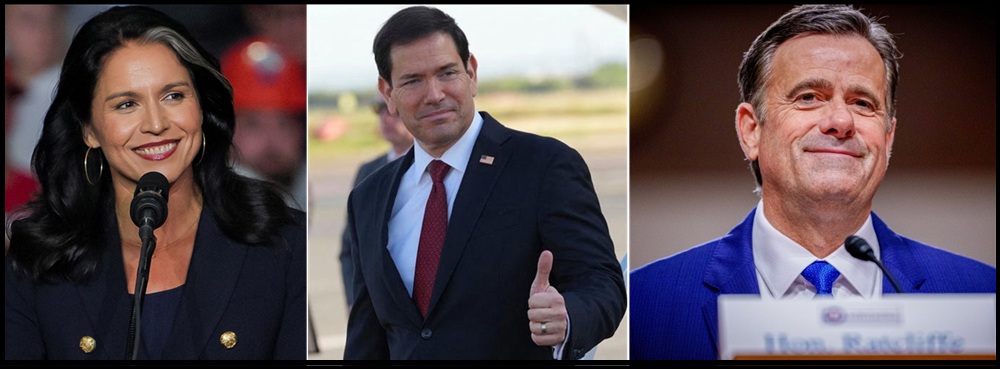
Marco Rubio has been working to clean up the National Security Council as well as the State Department operations, including USAID.  Tulsi Gabbard and John Ratcliffe have been working on the NSA and CIA collaboratively, and Todd Blanche has been working through the Dept of Justice.  FBI Director Kash Patel has removed about ten percent of the problem in his agency.

The core problem goes back to what we outlined on these pages {GO DEEP} and is not limited to those operatives who remain from the Obama/Biden era.  Some of the problems surface as a result of ‘republican’ voices recommending “sleeper cell” staff and sketchy personnel for positions in the administration. [I’ll put an example below]

One way to tell if the agency head or leader understands the challenge is by paying attention to how they talk about the agency’s mission objective.

Leaders like Marco Rubio and Tulsi Gabbard have openly acknowledged the problem and are actively tackling corruption within their ranks. Even John Ratcliffe has admitted his agency was politically weaponized and has taken steps to address it. There’s still a lot of work ahead, but their actions show visible progress.

People like Pam Bondi and Kash Patel have praised the institutional embeds without drawing attention to the corruption beneath them. Thankfully, Acting AG Todd Blanche seems to be taking a more confrontational approach internally, so maybe Kash Patel will follow suit. This isn’t about style—it’s about results, and there’s an urgent need for action.

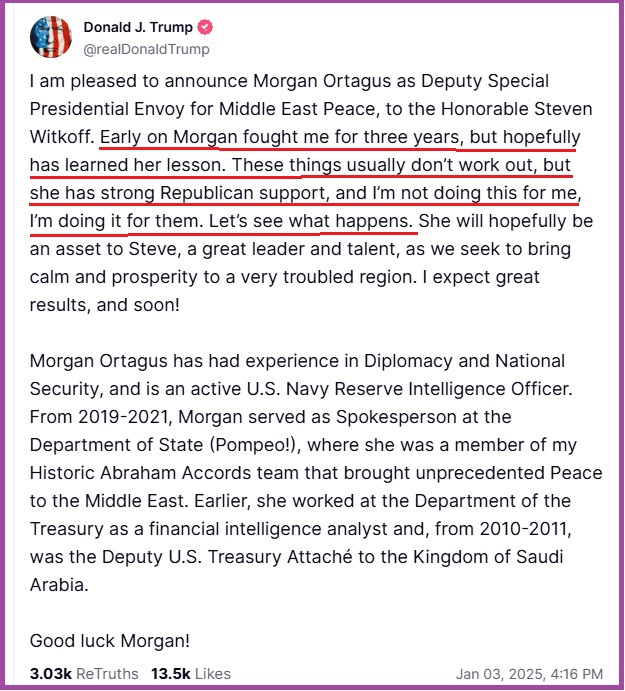
To give an example of “sketchy” recommendations and predictable outcomes, I would draw attention to the lesser visible appointment of Morgan Ortagus.  Do you remember this very weirdly worded announcement, two weeks prior to the inauguration?

[SOURCE]

I have no idea who “them” is referencing in the announcement.

[…] “I’m not doing this for me, I doing it for them”

There were always three options for “them”: (1) the strong republican support people; or (2) people in the Middle East who would be dealing with her; or (3) Stephen Witkoff and Jared Kushner.  Regardless, of who “them” was, it was obvious President Trump was not thrilled by “their” request.

Mrs. Morgan Ortagus is a long time Deep State operative with roots in the U.S. intelligence community and USAID {citation}.  It was very predictable that she would undermine the goals of President Trump and she only lasted six months in the job.  Ortagus was quietly dispatched from her position in June 2025.

CTH predicted {SEE HERE} Mrs. Ortagus would be a big mistake because she was, quite frankly, one of the “legion” insiders referenced by former CIA Director John Brennan.  Ortagus’s entire career profile was/is textbook intelligence operative, likely legacy CIA.

Not coincidentally, former National Security Advisor Mike Waltz was removed from his position only a month before Ortagus lost hers.

On the day he was announced CTH said National Security Advisor Mike Waltz would be the first administration member to get the boot, because in the non-pretending world Waltz was a horrible choice just like Ortagus.  Mike Waltz was removed as National Security Advisor in May 2025, {citation} Ortagus was removed as Middle East envoy in June {citation}.

If the goal was to eliminate the Deep State, President Trump couldn’t take on a deeply corrupt Intelligence Community while also appointing its allies. Their close ties to the Intelligence Community made the failures of both Waltz and Ortagus predictable.

That said, behind the veneer of John Brennan’s statement on MSNBC is a guy who realizes the Trump administration has changed the dynamic and the agency systems Brennan is talking about no longer exist; at least they no longer have the same capabilities.

The need for control is a reaction to fear, and Brennan’s fear is both visible and very well founded.

The DOJ and FBI operate under the influence of the Intelligence Community, which ultimately holds the reins. The key figures leading the IC have made changes to the institutions that have significantly reduced the impact of bad actors within the DOJ and FBI.

The key positions are the National Security Advisor, the Secretary of State, the Office of the Director of National Intelligence and the Director of the Central Intelligence Agency.

Marco Rubio, Tulsi Gabbard and John Ratcliffe are the people to watch, and we can tell by the counsel(s) they have put into place that each of them has clear eyes and a steady hand on those critical institutions.

Since mid-year 2025, around the same time Waltz and Ortagus were dispatched, you will note significant changes began surfacing in the National Security Council, the State Dept, the DNI and importantly the CIA.  Some of the changes make headlines, many do not; however, each is important and builds on a larger goal of dismantling a highly weaponized and political intelligence apparatus.

Internationally, what we see in the reaction of allied -or oppositional- governments and their intelligence agencies, is in large part a geopolitical reaction to the consequential changes being made by Rubio, Gabbard and Ratcliffe.  Each building upon a system that fundamentally changes U.S. policy to be in alignment with President Trump.  Each of them should be commended.

Domestically, the accountability developments involving James Comey, John Brennan, John Bolton, Michael Atkinson, Eric Ciaramella and others yet to emerge, stem from the transparency brought by the same trio working upstream from Main Justice and the FBI. The combined intelligence apparatus of the U.S. can cut through the chaff and countermeasures of Lawfare operatives, and I feel optimistic watching them in action.

Again, it’s not just the silo heads that are making a positive impact, it is the personnel decisions they are surrounding themselves with.  The amount of sunlight now coming over the horizon is toxic to the interests of those who organized shadow operations.

As long as Rubio, Ratcliffe and especially Gabbard, keep pushing the truth to the surface; as long as they keep exposing all the corruption that was used to manipulate and weaponize our government; as long as they keep strategizing on ways to declassify evidence former officials buried under false pretenses; then the DOJ, FBI and more importantly We The People, will have information we can use to make decisions.

Ultimately, it is the truth which makes evil enterprise retreat.