Posted originally on Jun 18, 2026 by Martin Armstrong |
After spending years defending him, campaigning for him, endorsing him, and standing beside him while anyone who questioned his fitness was attacked as a conspiracy theorist, Hillary Clinton now says Biden made a “terrible mistake” by running again. That is convenient, but the problem is that Biden did not act alone. The entire Democratic establishment knew exactly what was happening and saw his cognitive decline. They heard the incoherent speeches, watched the debates. Yet they all marched in lockstep behind a man they insisted was perfectly capable of serving another four years.
Clinton is really attempting to do is rewrite history. Biden did not force the Democratic Party to rally behind him. The party leadership, the donors, the consultants, the media allies, and every major power center in Washington actively protected him from criticism. Anyone who raised concerns about his age or cognitive condition was dismissed. They shut down a meaningful primary process and effectively told Democratic voters that there would be no debate, no competition, and no alternative. Then, after the disastrous debate exposed what millions of Americans had already seen with their own eyes, panic set in. The same people who spent years telling the public everything was fine suddenly discovered there was a problem.
Then came the greatest political bait-and-switch in modern American history. Biden withdrew only months before the election. Dems immediately installed Kamala Harris, leaving voters with a candidate they never selected. No one voted for Kamala during her first bid as presidential candidate but Democratic voters were told to accept the decision and remain silent. Clinton now argues that another Democrat could have beaten Trump.
“We would have had a real contest,” Clinton said about what would’ve happened if Biden didn’t run. “And very sadly I believe whoever emerged from that contest, whether it was the vice president or a governor or a senator or anybody else, would have beaten Donald Trump.”
Precisely why the Democrats lost: the party is completely out of touch with the wishes of the people. They abandoned working-class voters and became the party of divisive politics. They ignored growing concerns over inflation, immigration, crime, foreign policy, and economic insecurity. Biden spent his presidency pushing forth the globalist Build Back Better agenda, abandoning domestic interests. Democrats spent years lecturing the public instead of listening to them and then seemed shocked when voters revolted.
Clinton will think of losing to Trump on her deathbed; she simply cannot let it go. After 2016 there was a seemingly endless list of culprits. Now, after 2024, the blame falls squarely on Biden. Yet Clinton herself endorsed Biden’s campaign, defended him publicly, and later endorsed Kamala Harris when he withdrew. She did it for her career and not the people. The same political class that created the disaster is now trying to convince everyone they were warning about it all along. Americans are not that foolish. The public watched the cover-up in real-time. They watched party leaders insist Biden was fine. They watched them pivot overnight to Harris. They watched them demand loyalty at every stage. Now they want to pretend they were innocent bystanders. That may be the biggest insult of all.
Posted originally on Jun 18, 2026 by Martin Armstrong |
Everyone expected Kevin Warsh to come into his first Federal Reserve meeting and immediately begin cutting rates because Trump put him in the chair. That was never going to happen. Markets have once again demonstrated they do not understand how interest rates actually function. The Federal Reserve left rates unchanged at 3.50% to 3.75%, but what mattered was not the decision itself. What mattered was the complete shift in tone.
The Fed removed language suggesting future easing and, for the first time this year, officials openly moved toward discussing potential rate hikes rather than cuts. Inflation is moving higher again, energy prices have surged amid Middle East tensions, and the bond market immediately understood what many economists still refuse to accept.
What I found far more interesting was Warsh’s attack on the institution itself. He announced five separate task forces to review how the Federal Reserve operates, how it communicates, how it measures inflation, how it uses economic data, how it manages its balance sheet, and how productivity and employment are evolving in a rapidly changing economy.
Warsh is openly signaling that he believes the Fed has become bloated, overly academic, and detached from reality. For years I have argued that governments and central banks are operating on outdated models that no longer reflect the world economy. Warsh appears to recognize the same problem.
The irony is that Warsh was selected largely because many believed he would be more dovish than Powell. Instead, his first meeting produced one of the most hawkish shifts we have seen this year. Officials now see inflation remaining elevated and several policymakers are looking toward possible rate increases before year-end. Bond yields jumped, the dollar strengthened, and equities sold off because traders suddenly realized the era of guaranteed rate cuts may be over.
Posted originally on Jun 18, 2026 by Martin Armstrong |
Only 29% of Democrats say they are extremely or very proud to be American, compared with 90% of Republicans, based on a recent NBC poll. Among Americans aged 18-34, just 36% express strong pride in their country, compared with 75% among those over 65. Those numbers should concern anyone who understands history because they point to a crisis of confidence in the nation itself.
Most people blame Trump for dividing America, but the fracture began long before Trump entered politics. The split emerged during the Obama years as the Democratic Party gradually abandoned its traditional working-class foundation and embraced identity politics, globalism, and the expanding administrative state. The 2007.15 Economic Confidence Model turning point marked the beginning of a broader collapse in confidence across Western governments. The Great Recession weakened confidence and caused upheaval. The cohesion from the 9/11 Bush years had come to an end as war in the Middle East dragged on. By 2013 and 2014 the divisions were becoming increasingly visible. Trump’s election in 2016 did not create the divide. It exposed it.
What shocked the Democratic establishment was discovering that millions of Americans no longer shared the worldview being promoted by the media, academia, and Washington. Since then the separation has only accelerated. The old Democratic Party of labor unions, manufacturing workers, and middle-class families has increasingly been replaced by a coalition whose priorities are divisive identity politics.
People lost faith in Washington, but they still believed in America. The anger was directed toward politicians, bankers, and government institutions. Republicans blamed Democrats. Democrats blamed Republicans. The country was divided, but there was still a common identity underneath it all.
Then Trump arrived and the divide exploded. Politics stopped being about policy and became personal. COVID was the final nail in the coffin. Families stopped speaking to one another. Friendships ended, and neighbors viewed each other as enemies. Every election became a battle between good and evil. The left convinced itself that Trump supporters were destroying the country, while the right concluded that the establishment would do anything to remain in power. The left fractured and then divided as years of divisive race, gender, and sex-based policies caused the group to completely lose track of its messaging. The hostility reached levels not seen in modern American history.
Now we are witnessing another transformation. The divide is no longer simply between the left and the right. Increasingly, it is between the left and America itself. Look at the NBC numbers. Only 29% of Democrats say they are extremely or very proud to be American. Think about that for a moment. We are not talking about dissatisfaction with a president or Congress. We are talking about pride in the nation itself.
What makes this even more disturbing is that politicians have begun saying the quiet part out loud. We now have candidates openly declaring they do not support the United States, do not support the military, and look down on America itself. Twenty years ago such statements would have ended a political career overnight. It would have been unthinkable for either side to openly declare hostilities toward the nation they claim to represent. Universities have spent years teaching young people that America is uniquely evil, ironically shielding them from the realities of history. Activists portray the nation as fundamentally illegitimate. The result is exactly what this poll shows. A generation has been raised to believe that patriotism is evil while resentment toward their own country is somehow righteous.
A growing portion of society no longer believes America deserves to exist in its current form. The initial push boosted globalist morale, but we are left with a broken population that is too deep into self-loathing to be productive. This segment of the population is eager to vote for a pro-globalist, anti-America candidate because they want to see the nation fail. You are no longer debating tax rates or spending priorities. You are debating whether the country itself is worth preserving. That is a very dangerous place to be, and the poll numbers suggest we are moving deeper into that territory rather than away from it.
Posted originally on CTH on June 17, 2026 | Sundance
I’m not sure exactly what happened in the protocol of timing, but eventually President Donald Trump arrived for a dinner hosted by France’s President Emmanuel Macron at the Palace of Versailles near Paris.
President and Mrs. Macron waited on the steps of the palace for over eight minutes before the motorcade finally arrived. Every second of those eight minutes there was a massive camera pool in front of them. Here’s the full video. If you are awaiting Trump, take a Snickers. lol President Trump arrives at 7:45 of video WATCH:
Posted originally on CTH on June 17, 2026 | Sundance
President Trump is navigating a narrow path through a minefield of foreign and domestic opposition to his preferred trade position on the USMCA. Ironically, or not, on the issue of ending the USMCA we likely have more allies in the labor unions and Bernie Bros than we do amid the congressional republicans.
President Trump was asked again today about his position on the USMCA against the backdrop of a hot-mic moment when Canadian Prime Minister Mark Carney was telling him about caps on Chinese EVs coming into Canada. [Prompted]
“I would rather not have the USMCA. The primary reason I wanted it was because there was no way out of NAFTA, which was the worst trade agreement ever made — like, ever — and they had no termination… I would prefer not having an agreement, but I’m open to doing it.”
Several desperate Canadian trade watchers have framed President Trump’s “that’s good” response to Carney as if Trump was approving of the Chinese EV deal. Again, folks are just not looking at Trump’s position through the correct lens.
Trump doesn’t care about the issue. Trump is ambivalent to the issue. It’s the same mindset Trump has carried throughout all questions and comments since the questions were first raised.
The reason for Trump’s ambivalence about the granular, sectoral questions is simply because in the big picture of Trump’s outlook, he doesn’t plan on staying in a trilateral trade deal. Any bilateral trade deal Canada makes with a trade partner is perfectly okay, because Canada is not going to be connected to the USA in a trilateral obligation.
President Trump tells you his intention, then reminds himself of the opposition to his intention, then softens the original statement against the context of domestic political challenge he understands he has to overcome. This outlook is often expressed similarly in the comments of U.S. Trade Representative (USTR) Jamieson Greer.
Think of the scenario like a divorce. The ex-wife says to Trump, “I’m buying an EV.” Trump responds. “that’s good,” from a position they are no longer in a relationship, and he simply just doesn’t care.
Fully invested in the USMCA, Mark Carney says, “we put a limit of 49,000 EVs on the trade agreement with China.” Completely ambivalent Trump responds, “that’s good.” It’s a generic throwaway response because Trump no longer considers the USA and Canada to be in alignment or meshed in a trilateral agreement.
That’s why, when questioned, President Trump didn’t even recall the moment, yet he is being asked about it because it’s the most important thing on the mind of the Canadian side. It’s a little bit funny – but totally Trump.
Soon, when the USMCA moment circles around to the 12 o’clock position of immediate action, Trump will just turn to Jamison Greer and say, “ok, tell them we’re done now.” That’s it. Figure out the way to exit legally, let’s get out of this thing and start working on the optimal solution of a bilateral trade agreement with Canada.
The remarks today are the umpteenth time President Trump has repeated that the USMCA was the optimal way to get out of the quicksand NAFTA trade agreement. Once that NAFTA break was finished, the inherent value of the USMCA ended. Now Trump wants to end the USMCA and get to the core approach he has mentioned for over a decade; two bilateral trade agreements – one with Mexico and one with Canada.
Posted originally on CTH on June 17, 2026 | Sundance
ssence, the British Commonwealth is the IC commonality. [Yes, there is some validity to the Lyndon LaRouche perspective (Promethean Action PAC)] Additionally, I would also posit a reminder of the international assembly who structured the originating financial sanctions against Russia; again, a commonality.
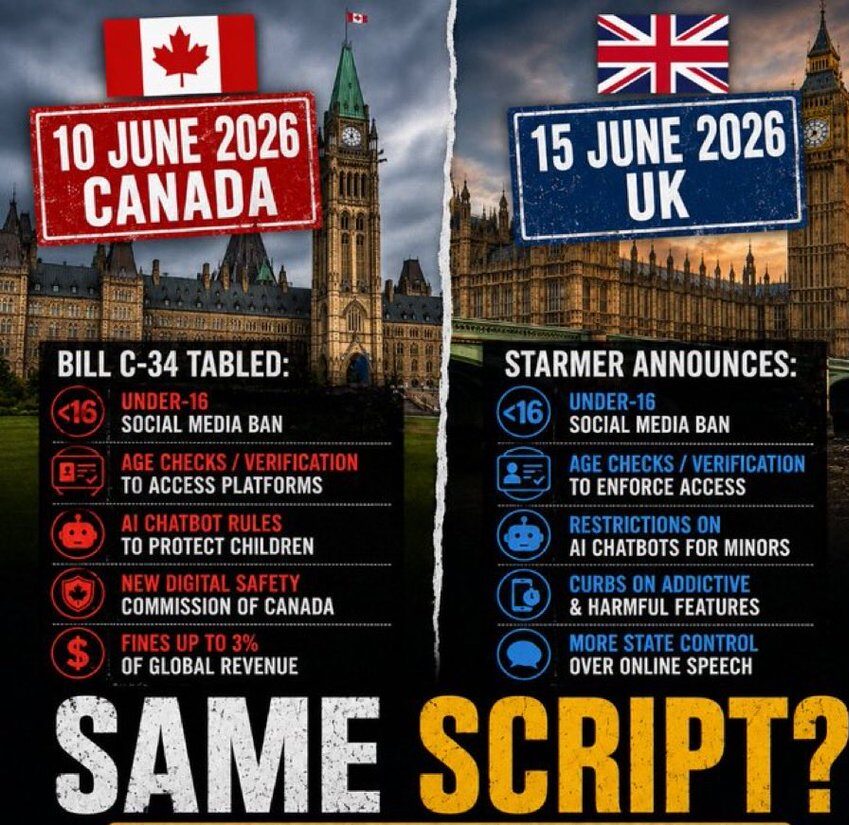
Focusing on the most recent political creation in Canada, there are three bills currently being rushed through the Canadian House of Parliament, C-34: keep kids safe on social media; C-36: stronger privacy rules, and C-22: modern tools for police.
Not surprisingly, it is difficult to find non-govt-approved information about this legislative construct online.
Canadian media must remain compliant with approved government narratives in order to maintain their business model. However, putting together some various information found on non-controlled information sources, it is possible to begin discussion of the situation.
The two issues that merge with the greatest impact are Bill C-22: The Surveillance Bill, and Bill C-34: The Children’s Safety Bill.
Bill C-22 requires that all information transmission providers, every telecom and internet company, retain metadata on all Canadian users for up to one year. This is electronic metadata which we all know encompasses a lot more than just content.
Signal app, NordVPN, Windscribe, DuckDuckGo, Apple, and Meta have all formally opposed it. Signal app has threatened to leave Canada entirely rather than comply. This is a government mandated metadata storage library on all electronic communication and activity by Canadian users.
Then there’s Bill C-34: The Children’s Safety Bill, as noted by Lucy Hargreaves, a bill that ‘Applies to Everyone’, not just kids. “The government’s social media ban for under-16s is genuinely popular, with 75% of Canadians supporting it in polling. The problem is what it requires in practice. To stop anyone under 16 from creating an account, platforms need to know how old everyone is. There is no way to identify who is under 16 without identifying everyone who isn’t. This means every Canadian adult would need to submit government ID or a face scan to a third-party verification company before posting a photo, using cloud storage, or playing an online game. The bill also creates a new Digital Safety Commission with sweeping powers to set the rules, decide which platforms must comply, and approve or deny exemptions — with almost no criteria written into the law itself.”
Then there’s Bill C-34: The Children’s Safety Bill, as noted by Lucy Hargreaves, a bill that ‘Applies to Everyone’, not just kids. “The government’s social media ban for under-16s is genuinely popular, with 75% of Canadians supporting it in polling. The problem is what it requires in practice. To stop anyone under 16 from creating an account, platforms need to know how old everyone is. There is no way to identify who is under 16 without identifying everyone who isn’t. This means every Canadian adult would need to submit government ID or a face scan to a third-party verification company before posting a photo, using cloud storage, or playing an online game. The bill also creates a new Digital Safety Commission with sweeping powers to set the rules, decide which platforms must comply, and approve or deny exemptions — with almost no criteria written into the law itself.”
“Australia introduced the same social media ban in December 2025. Six months later, the eSafety Commissioner told Parliament she was “not really keen” on it from the start and called it a “blunt force approach” drafted too quickly. 70% of young Australians reported the ban had little effect on their social media use. It didn’t reduce cyberbullying. What it did produce was a surge in VPN use… pushing young people to darker, less-monitored platforms.
The UK implemented age verification under its Online Safety Act in mid-2025. Within one month, VPN downloads hit over two million — the highest ever recorded — and monthly downloads stayed above one million for a year as users raced to bypass the requirement.
The EU considered its own version of mandatory message scanning (dubbed “Chat Control”) and its own Parliament voted it down in March 2026, with the EU’s legal service concluding that indiscriminate scanning of private communications is incompatible with fundamental rights.
The government’s core justification for C-22 is that Canada is the “only Five Eyes country” without a lawful access framework. But the United States has no federal mandatory metadata retention law. The EU’s highest court has struck down blanket retention twice as incompatible with human rights. When the Public Safety Minister claimed Canada’s provisions would be “in line with U.S. counterparts,” he was forced to walk back the statement within hours.” (read more)
Think about what all the critics (correctly) point out as the bigger issue behind the “age id” social media stuff.
What is the unspoken goal of Australia, New Zealand, the U.K and Canada?
Ultimately control. Govt online surveillance, correct? Some form of legal, legislated, govt authorized data surveillance that permits law enforcement to have actionable mechanisms, right?
If that is indeed the goal, then in the USA we overlay FISA (702).
NZ, AU, UK and CA get digital IDs. The USA gets 702. It’s the same basic premise; the same govt motive; the same underpinning
reasoning. Just different and nuanced approaches.
Bill C-22 forces tech companies to give the RCMP and CSIS access to your data WITHOUT A WARRANT.
Meta has warned that C-22 would turn their company into "an arm of the government's SURVEILLANCE APPARATUS."
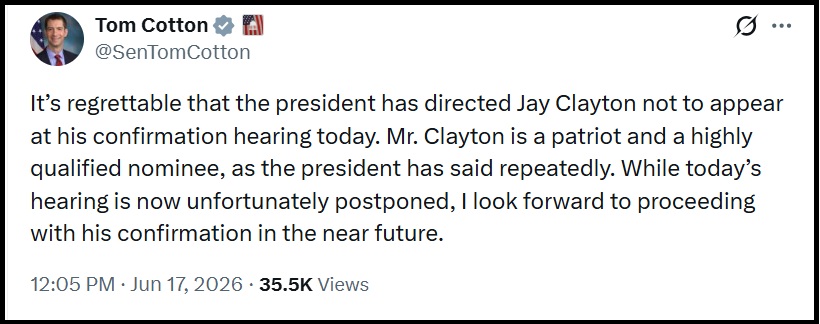
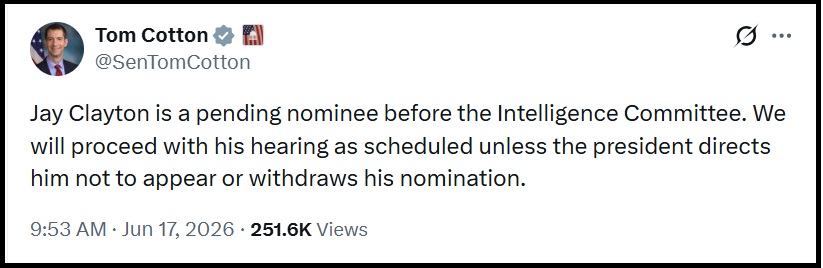
PREVIOUSLY: Now, you know the dynamics. Now, you know the reasoning. Now, you know the motives and intents. Now, you know how the SSCI sits at the epicenter of the enabling mechanism we call the “Deep State”….
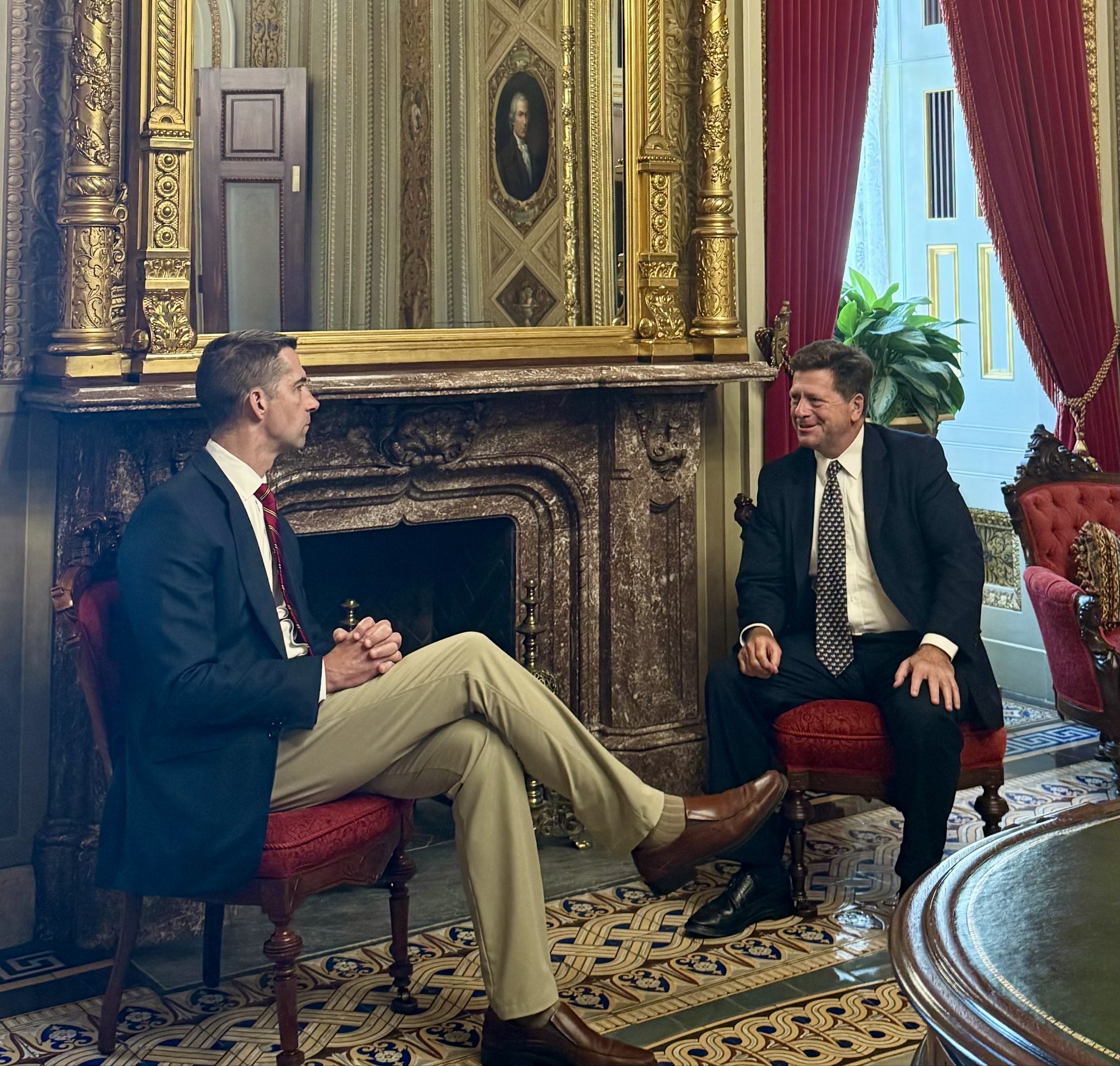
…. and now you know why SSCI Chairman Tom Cotton would send this message:
They are so fancy, no?
Welcome to the world of the uppity, self-appointed omnipotent controllers.
Posted originally on CTH on June 17, 2026 | Sundance |
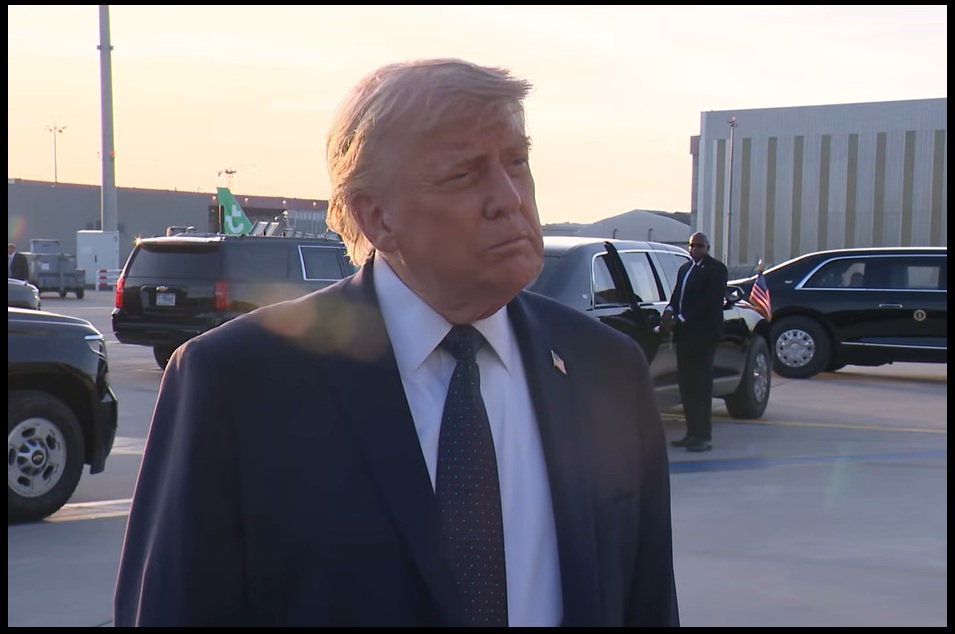
At the conclusion of the G7 assembly in France, President Trump is scheduled to hold a very consequential press conference. The anticipated start time is 11:00am ET; however, the timing is estimated with ongoing events. Livestream Links below:
I have created this site to help people have fun in the kitchen. I write about enjoying life both in and out of my kitchen. Life is short! Make the most of it and enjoy!
This is a library of News Events not reported by the Main Stream Media documenting & connecting the dots on How the Obama Marxist Liberal agenda is destroying America