Dr. Bradley Thayer on the protests in Ireland: This is being driven not really by the high fuel costs but by immigration. 1 out of every 5 people living in Ireland is not native born.


Posted originally on Rumble on Bannon War Room on: April 13, 2026

Curt Mills: “The president is unfortunately sacrificing a lot of political capital to get Israel’s war in Iran done, and I urge him to, at minimum, walk away from this.”


Posted originally on Rumble on Bannon War Room on: April 13, 2026

Used EV Market Exposes the Cracks


Posted originally on Apr 15, 2026 by Martin Armstrong |  

Tesla 1

Reports indicate that a wave of used EVs is beginning to hit the market as leases expire, forcing automakers to rethink how they handle pricing and inventory. What was once sold as the inevitable future is now a dud cause with minimal demand. When those vehicles return to the secondary market, they must compete on price, performance, and practicality, not ideology. That is where the cracks begin to show.

This ties directly into what I have warned about with government attempts to force economic outcomes through policy. The Biden administration pushed aggressively toward electrification under the banner of climate policy and Net Zero, but this was never purely about the environment. It was about directing capital, restructuring industry, and attempting to control long-term consumption patterns. The problem is that markets do not respond to mandates the way politicians expect.

Nearly 4,000 US car dealers warned the Biden Administration that consumer demand would not keep pace with supply. You cannot force consumers into a product they are not ready to adopt, especially in an environment where the cost of living is already rising.

Electric vehicles still account for only about 7–8% of total US vehicle sales, yet federal policy aimed to push that figure toward 50% or more by 2032 through emissions rules that effectively function as mandates. At the same time, EVs remain significantly more expensive, with average transaction prices roughly $8,000 higher than comparable gas vehicles.

Government attempted to accelerate this transition through incentives and mandates. The Inflation Reduction Act introduced tax credits of up to $7,500 per vehicle, effectively subsidizing purchases to stimulate demand. Meanwhile, federal policy called for the entire government fleet to transition to zero-emission vehicles by 2035, impacting hundreds of thousands of vehicles.

You can already see the early signs of that correction in the used EV market. As more vehicles come off lease, prices are under pressure because supply is increasing faster than demand. Automakers are now adjusting strategies, trying to manage resale values and prevent a collapse in pricing. This is the same pattern we have seen in other sectors. When supply is artificially expanded through policy, it eventually overwhelms real demand.

The used car market in general is far beneath the levels witnessed in 2022. EVs are far more difficult to offload. Industry estimates show that more than 300,000 electric vehicles will come off lease in 2026 alone, with projections rising toward 500,000 or more as we move into 2027. This is a surge of supply that the market must absorb whether demand is ready or not.

New EV sales have already dropped 28% year-over-year in early 2026, while used EV sales have risen 12%, reaching nearly 93,500 units in a single quarter. Pricing confirms that shift. Used EV prices have fallen dramatically, in some cases dropping as much as 40% over the past year, and are now within roughly $1,300 of comparable gasoline vehicles. That is a market adjusting to oversupply. When prices fall that quickly, it reflects a mismatch between production and real demand.

Cost, convenience, infrastructure, and reliability all matter more than political objectives. The government will always fail when it attempts to artificially stimulate demand.

China’s Gold Strategy Is a Long-Term Move Against the Monetary System


Posted originally on Apr 15, 2026 by Martin Armstrong |  

China on the Rise

China is not reacting to events, it is executing a long-term strategy that has been unfolding quietly for years. The latest data confirms that it continues to accumulate gold month after month as part of a deliberate effort to reduce reliance on the existing monetary system. The People’s Bank of China has now extended its gold buying streak to roughly 15–16 consecutive months, bringing total holdings to approximately 2,300 tonnes, which equates to about 74 million ounces and represents close to 10% of its total reserves, placing it among the largest official holders globally.

This steady accumulation is not a short-term hedge against volatility, it is a structural repositioning that reflects a recognition that the global financial system is built on confidence in sovereign debt, particularly US Treasuries, and that confidence is becoming increasingly fragile as global debt levels exceed $310 trillion. China is not making headlines with dramatic announcements, instead it is quietly converting portions of its reserves into gold, which is the only reserve asset that carries no counterparty risk and cannot be sanctioned or frozen in the same way as foreign currency holdings.

At the same time, global trends reinforce this strategy as central banks worldwide have been buying gold at one of the fastest paces in modern history, often exceeding 800 to 1,000 tonnes annually, while the dollar’s share of global reserves has steadily declined from around 66% to roughly 57% over the past decade. This shift is not driven by ideology but by practicality, because as geopolitical tensions rise and financial systems become increasingly fragmented, nations seek assets that provide independence from external control.

China’s approach is methodical and patient, and that is what makes it significant because it is not waiting for a crisis to unfold, it is preparing in advance by building a reserve base that can withstand a loss of confidence in sovereign debt markets. This aligns directly with the broader pattern we are seeing, where central banks are not abandoning the system outright but are quietly hedging against its potential breakdown.

The Oil Conspiracies


Posted originally on Apr 15, 2026 by Martin Armstrong |  

SHIPNG C

QUESTION: Mr. Armstrong, about half the cargo ships are headed to the US to get oil. Some have claimed that Trump is trying to replace the Middle East. This seems to be a conspiracy theory that contradicts what you have reported. What do you make of that?

RW

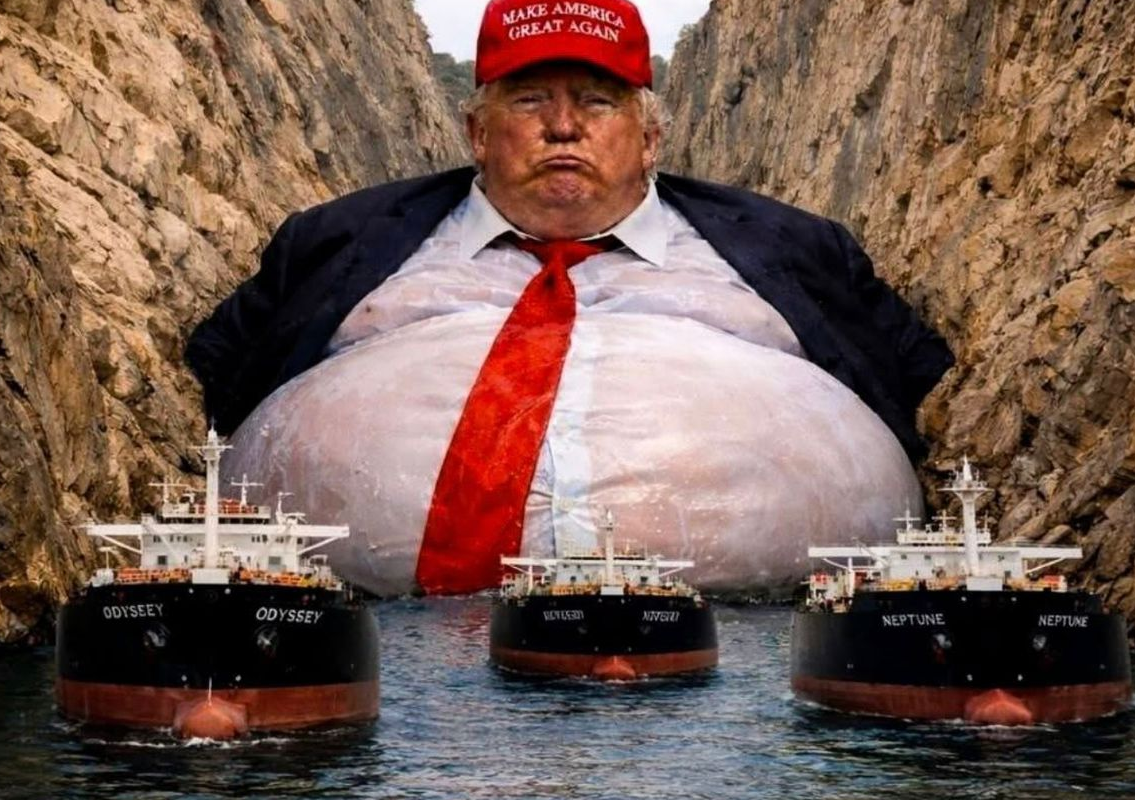
Trump Hormuz Blockaide

ANSWER: I know, there are wild conspiracy theories being proposed. I have even heard that Trump did this to force the EU to collapse. Sending the world into recession/depression is absurd. Trump is trying to sell more widgets, not fewer. Plus, rising oil prices put the Midterms at risk. That just makes no sense. Most of these conspiracy theories assume the people in government are smart – that is NOT the case.

As for tankers, there are not enough in the world to transport all the oil that needs to be transported. We have had some of the world’s largest shippers as clients for decades. There is what is known as “Tonne-miles” (or tonne-kilometers), which is the standard unit for measuring freight transportation volume, and it’s a key metric for understanding crude oil logistics.

A single ton-mile represents moving one ton of cargo over a distance of one mile. In the oil industry, a “ton” of crude oil is approximately 7.5 barrels. This metric allows you to directly compare the total transport “work” done by different modes (pipeline, rail, ship, truck), regardless of the shipment size or distance.

The most notable shift in the data is from water carriers to pipelines. In 1980, water carriers held a slight lead over pipelines for crude oil ton-miles. By 1999, pipelines had grown their share to over 75%, while water carriers had dropped to under 24%.

On a global scale, the focus shifts to seaborne trade, which is measured in tonne-miles (the metric equivalent). Recent data shows this is a massive and growing industry, currently being reshaped by geopolitical events. Global oil tonne-miles (for all products) grew from roughly 15.3 trillion in 2020 to 16.4 trillion in 2024, an increase of about 6%. Crude oil itself constitutes roughly 70% of total global seaborne tonne-miles.

In 2025, the global figure stood at approximately 12.2 trillion (year-to-date), indicating a contraction. This decline is partly due to the rerouting of tankers away from the Red Sea because of Houthi attacks, which caused tanker tonne-miles to hit a five-year high earlier in 2024 before the current dip. The reason this is critical to our analysis is that this is a core measure of economic activity. The total volume of crude oil moved is a key input for GDP figures, while changes in tonne-miles affect the costs of energy and consumer goods.

This allows for a direct comparison of efficiency between modes. For example, pipelines and large tankers are far more energy-efficient per ton-mile than trucks or rail. Some look at this also as a carbon footprint and other environmental costs of transporting crude oil over long distances. Energy companies and governments rely on tonne-mile forecasts to decide where to build new pipelines, expand ports, or invest in rail infrastructure.

The longer the trip to transport oil the higher the cost to ship that oil. Therefore, we have another variable here regarding the cost of shipping. On top of all of this, the claim that the United States is somehow displacing Iran is really absurd. The United States is a NET IMPORTER of crude oil. We may be able to facilitate some for geopolitical reasons and to try to keep prices down, but the US can in no possible way replace the Middle East. Who ever makes up these stories are really beyond hope.

The Great Migration of Capital Within the United States


Posted originally on Apr 14, 2026 by Martin Armstrong |  

U.S. map of states people moved to and left in 2025

What we are witnessing across the United States is not just people relocating. It is the migration of income itself, and the numbers now confirm the scale. According to the latest IRS data, California lost $11.9 billion in adjusted gross income in a single year, while New York lost $9.9 billion. At the same time, Florida gained $20.6 billion, Texas gained $5.5 billion, and states like South Carolina and North Carolina each gained roughly $4 billion. This is not theoretical. This is measurable capital movement, and it is accelerating.

The critical point is that the IRS is not tracking opinions or surveys. It is tracking tax returns. These figures represent actual households, actual income, and actual wealth moving from one jurisdiction to another. The data is based on year-to-year address changes on filed tax returns, capturing both the number of households and the total income they take with them. When billions in adjusted gross income leave a state, that is not just population loss. That is a direct hit to the tax base.

What stands out immediately is the imbalance. Florida alone gained more than $20 billion in income from new residents in just one year, making it the largest beneficiary of domestic migration. In places like Palm Beach County, incoming residents reported average incomes of $178,085 compared to $98,527 for those leaving. That tells you exactly what is happening. This is not a random movement. This is higher-income individuals relocating and concentrating wealth in specific regions.

At the same time, high-tax states are seeing the reverse. The states losing the most income—California, New York, Illinois, New Jersey, and Massachusetts—are also among those with the highest tax burdens. California’s top tax rate sits at 13.3%, while New York City residents can face combined state and local rates approaching 14.8%. When you combine those tax levels with high costs of living, the outcome becomes predictable.

What makes this even more significant is that the migration is being driven disproportionately by higher earners. IRS data consistently shows that households with $200,000 or more in income play an outsized role in net migration flows. In practical terms, that means a relatively small number of people can move a very large amount of taxable income. When they leave, they do not just reduce the population. They reduce revenue potential.

There is also a structural shift underway. States attracting capital tend to share common characteristics: lower taxes, lower housing costs, and policies that encourage development. In fact, analysts note that states gaining wealth are often those increasing housing supply, which helps keep costs down and attracts migration. This is not about ideology. It is about environment.

The longer-term consequence is a divergence in economic trajectories. States gaining income expand their tax base without raising rates. States losing income face a shrinking base and increasing pressure to maintain spending. That creates a feedback loop. As revenue declines, governments look to raise taxes further, which encourages additional outflows.

This is not a short-term trend. IRS migration data has been tracking these flows for decades, and the pattern has become increasingly pronounced in recent years. The rise of remote work has only accelerated what was already in motion by removing geographic constraints that once tied income to location.

What matters here is not just where people are moving. It is why they are moving. When individuals begin to calculate that relocating can save them tens of thousands of dollars annually in taxes alone, the decision becomes economic, not emotional. Once that calculation spreads, the migration becomes systemic.

The United States is effectively undergoing an internal redistribution of capital. Wealth is concentrating in regions that offer favorable conditions, while high-cost, high-tax states are experiencing steady erosion. This is not driven by a single policy or event. It is the cumulative result of incentives.

Governments can debate the causes, but they cannot alter the outcome. Capital moves. It always has. The only difference now is the speed and scale at which it is happening.


Martyrdom and the Psychology of War


Posted originally on Apr 14, 2026 by Martin Armstrong |  

Iran Regime Change

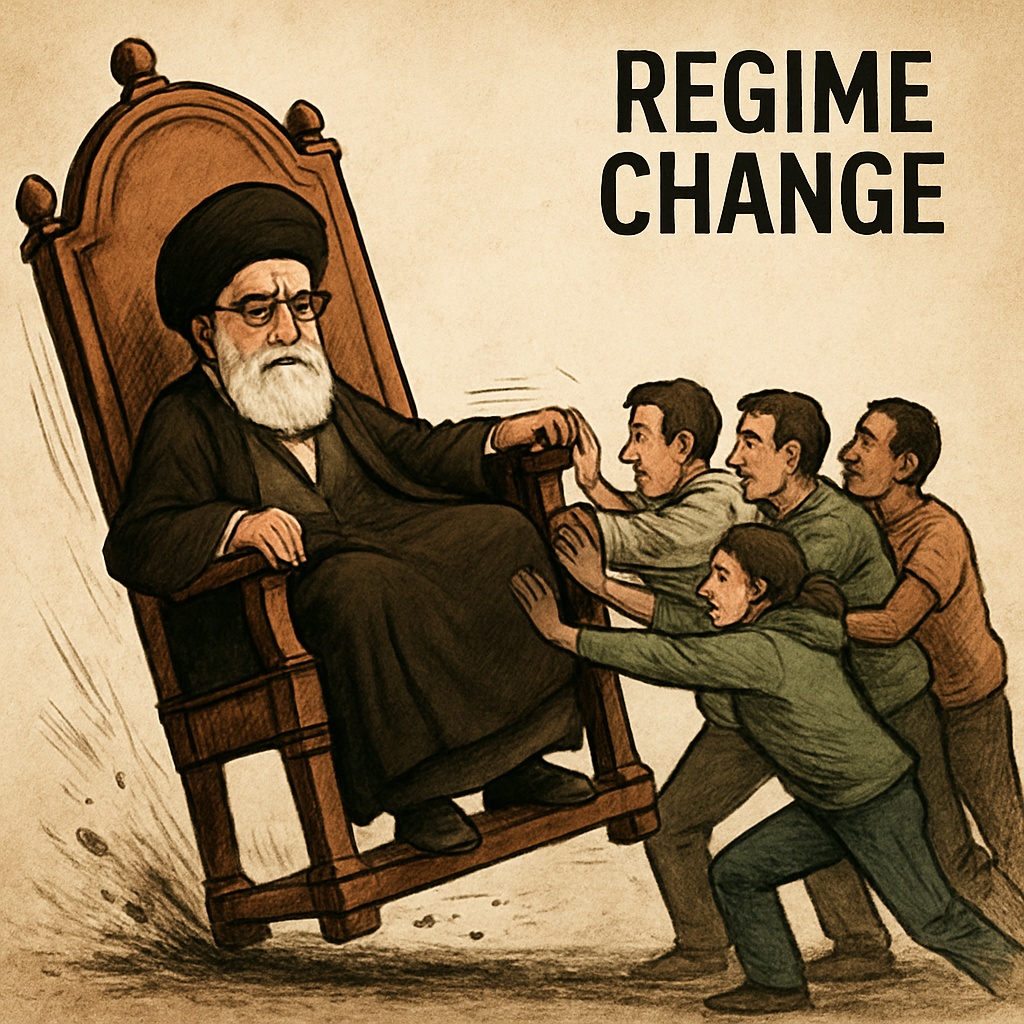
One of the greatest mistakes Western policymakers repeatedly make is assuming that other cultures think the same way they do. They approach international conflicts through a secular lens of power, economics, and negotiation. But when dealing with Iran, they are confronting a political system deeply intertwined with religious ideology. When an Ayatollah or senior clerical leader is killed, the event does not necessarily weaken the movement. In many cases, it strengthens it.

In Shiite Islam, the concept of martyrdom sits at the center of religious identity. The defining event for the Shia world was the death of Imam Hussein at the Battle of Karbala in 680 AD. Hussein, the grandson of the Prophet Muhammad, was killed after refusing to submit to what he regarded as illegitimate rule. His death became the foundational narrative of Shia resistance. To this day, millions commemorate Ashura every year, mourning Hussein’s death and celebrating the idea that righteous martyrdom is preferable to submission to injustice.

This is not merely historical symbolism. The religious narrative reinforces the belief that suffering and sacrifice in the face of oppression ultimately leads to divine justice. The Quran repeatedly praises those who die in the path of God. One verse states that those killed in the cause of God should not be considered dead but alive with their Lord receiving provision (Quran 3:169). Another passage declares that God has “purchased from the believers their lives and their wealth in exchange for Paradise; they fight in the cause of God, kill and are killed” (Quran 9:111). These passages shape a worldview in which death during a struggle against perceived injustice can be interpreted as spiritual victory.

From that perspective, killing a religious leader such as an Ayatollah risks transforming that individual into a symbol of sacrifice. Instead of eliminating the movement, it can reinforce the belief that the struggle itself is righteous. In a secular political system, the death of a leader may weaken an organization. In a religious revolutionary system, it can unify followers under the banner of martyrdom.

The Western mindset approaches assassination very differently. When a leader is killed in the United States or Europe, the reaction is generally political or emotional rather than religious. When President John F. Kennedy was assassinated in 1963, the event shocked the nation and certainly increased patriotism and unity for a time. Yet Americans did not interpret his death as a religious sign or martyrdom that would justify continuing a sacred struggle. It was viewed as a national tragedy, not a divine narrative unfolding.

This difference is profound. Western societies mourn their leaders, investigate the crime, and eventually move forward politically. The death does not typically transform the leader into a theological symbol driving long-term resistance or warfare. In the Shia tradition, however, martyrdom is embedded in religious identity itself. The story of Karbala is reenacted every year precisely to reinforce that belief.

This is why Western policymakers often misunderstand the psychological dynamics of such conflicts. The assassination of leaders like Qassem Soleimani did not collapse Iranian influence in the region. Instead, it triggered massive demonstrations and strengthened the narrative that Iran was engaged in a sacred struggle against external enemies.

When a Shia religious authority is killed, the event is interpreted through the lens of Karbala. The leader becomes another martyr in a long line of figures who died resisting oppression. That narrative carries enormous emotional power. It binds communities together and legitimizes continued struggle.

Politicians in Washington often believe removing a leader will end a conflict. Yet in ideological and religious movements, the opposite frequently occurs. Killing a leader can transform a political confrontation into a moral crusade, reinforcing the belief that the faithful must continue the struggle no matter the cost.

Understanding this cultural and religious framework is essential. Without it, policymakers will continue to miscalculate the consequences of their actions. History repeatedly shows that wars are not fought only with weapons. They are also fought with ideas, beliefs, and narratives that can outlive any individual leader.

Unsettled Science – More Americans Distrust Vaccines Than Ever Before


Posted originally on CTH on April 14, 2026 | Sundance

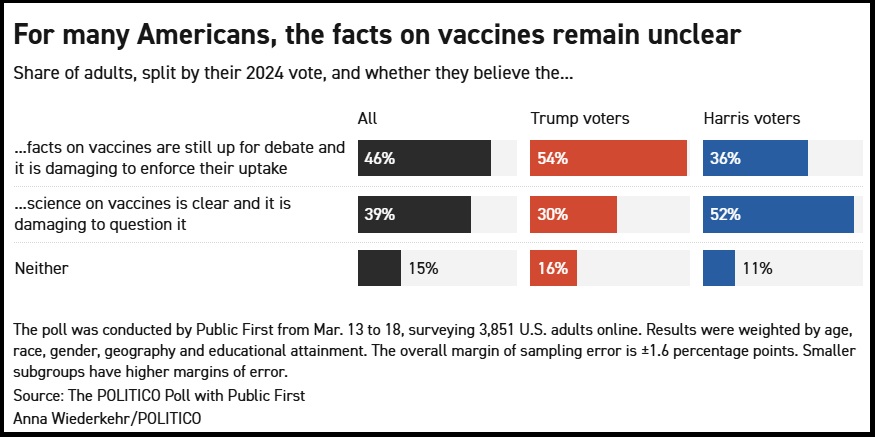
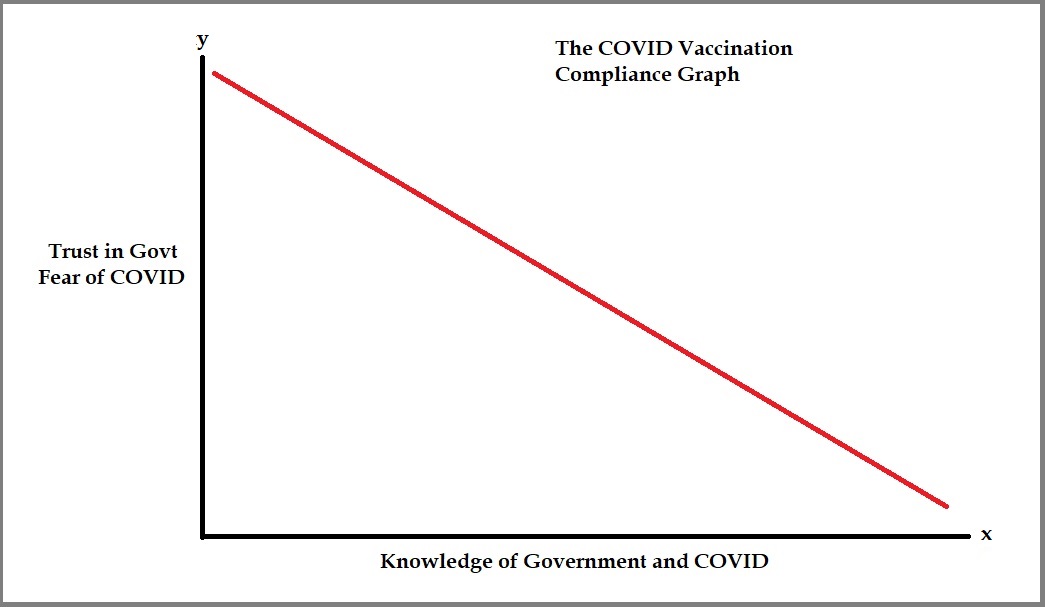
Many people said one of the results from the COVID-19 experience and the subsequent vaccination controversy would be a big drop in those who supported the government position on overall vaccine efficacy and safety.  A recent poll conducted by Politico now reflects exactly that outcome.

[SOURCE]

(Politico) – […] Results from the March poll of 3,851 U.S. adults conducted by Public First show that a plurality of Americans question the safety of vaccines, support reducing the number administered and believe that people’s right to decide what they put in their bodies is more important than preventing the spread of disease.

Nearly half of U.S. adults surveyed last month signaled they think the science on vaccines remains up for debate and that it’s damaging to require people to receive them, rather than that the science is clear and it is dangerous to challenge it. (read more)

President Trump Calls for a Clean FISA (702) Extension


Posted originally on CTH on April 14, 2026 | Sundance

My personal opinion on the FISA-702 reauthorization is well known {GO DEEP}.  However, I am not naïve enough to believe there is enough DC support to stop it. {GO DEEP} That said, I am disappointed the reauthorization will not be attached to the Save America Act as leverage.

[Via Truth Social] – “I am working very hard with our Great Speaker, Mike Johnson, along with Chairman Jim Jordan and Chairman Rick Crawford, to get a clean extension of FISA 702 through the House of Representatives this week. I am asking Republicans to UNIFY, and vote together on the test vote to bring a clean Bill to the floor. We need to stick together when this Bill comes before the House Rules Committee today to keep it CLEAN!

I was a victim of the worst and most illegal abuse of FISA in our Nation’s History, by Radical Left Lunatics, who lied to the FISA Court to spy on my 2016 Presidential Campaign in their attempt to RIG the Election in favor of Crooked Hillary Clinton. Their use of this instrument in the 2020 Presidential Election was even worse! When the Dirty Cop, James Comey, the failed Head of the FBI, went after me, he was using FISA Title I, the Domestic Collection, not FISA 702, the Foreign Collection, which needs to be extended today.

While parts of FISA were illegally and unfortunately used against me in the Democrats’ disgraceful Witch Hunt and Attack in the RUSSIA, RUSSIA, RUSSIA Hoax, and perhaps would be used against me in the future, I am willing to risk that as a Citizen in order to do what is right for our Country.”

“Our Military desperately needs FISA 702, and it is one of the reasons we have had such tremendous SUCCESS on the battlefield, both in Venezuela and Iran. Since the first day of my already Historic Second Term, my Administration has worked tirelessly to ensure these FISA Reforms are being aggressively executed at every level of the Executive Branch to keep Americans safe, while protecting our sacred Civil Liberties guaranteed by our Great Constitution. With the ongoing successful Military activities against the Terrorist Iranian Regime, it is more important than ever that we remain vigilant, PROTECT our Homeland, Troops, and Diplomats stationed abroad, and maintain our ability to quickly stop bad actors seeking to cause harm to our People and our Country.

The fact is, whether you like FISA or not, it is extremely important to our Military. I have spoken to many Generals about this, and they consider it VITAL. Not one said, even tacitly, that they can do without it — especially right now with our brilliant Military Operation in Iran. Thank you for your attention to this matter!”

~President DONALD J. TRUMP

I have outlined this seemingly inevitable construct with great detail; the systems creating the surveillance state for several years; culminating in a December 2024 recap [SEE HERE] along with my position in January of 2025 [SEE HERE].  I do not like it, but I understand the arguments behind it.

Secretary of State Marco Rubio Holds Peace Talks Between Israel and Lebanon – Video and Transcript


Posted originally on CTH on April 14, 2026 | Sundance | 

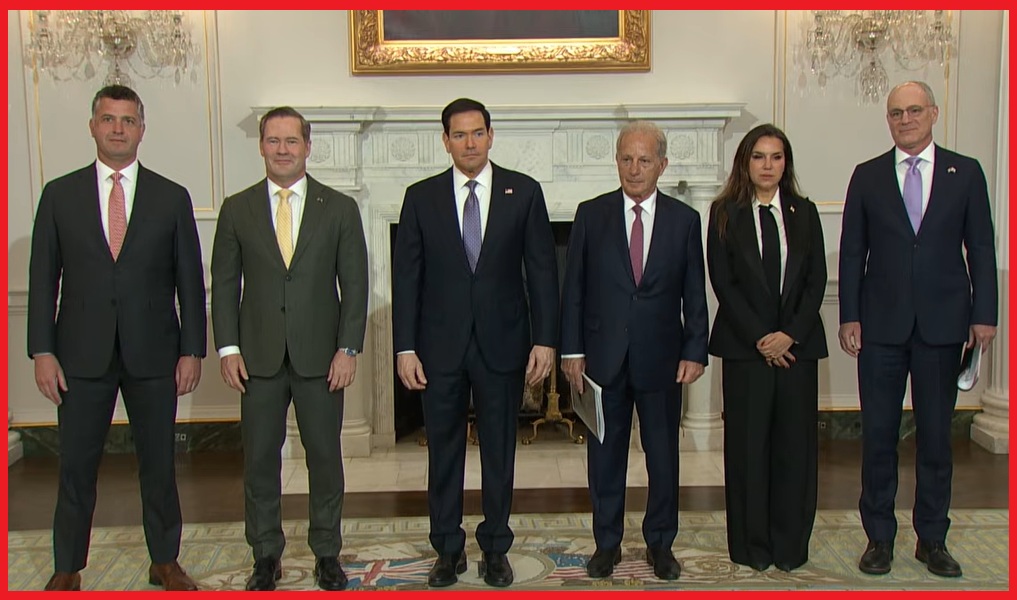
U.S. Secretary of State Marco Rubio described the Israel-Lebanon talks in Washington as a historic opportunity, with Israeli Ambassador Yechiel Leiter and Lebanese Ambassador Nada Hamadeh Moawad attending. The meeting focuses on moving forward amid complex regional tensions and a fragile Middle East ceasefire. WATCH:

[TRANSCRIPT] QUESTION: Mr. Secretary, why did you decide to join? Is it a signal that the U.S. is fully engaged?

QUESTION: Can we see a ceasefire soon between Lebanon and Israel?

QUESTION: Secretary —

SECRETARY RUBIO: “May I please? Thank you very much. Thank you for being here today. We’re very honored to be joined by two countries that the United States wants to have strong – have strong relations with, and we’re obviously very happy to serve in this facilitating role.”

“This is a historic opportunity. We understand we’re working against decades of history and complexities that have led us to this unique moment. And the opportunity here – I know some of you were shouting questions about a ceasefire. This is a lot more than just about that. This is about bringing a permanent end to 20 or 30 years of Hizballah’s influence in this part of the world and the – not just the damage that it’s inflicted on Israel, the damage that it’s inflicted on the Lebanese people. We have to remember the Lebanese people are victims of Hizballah. The Lebanese people are victims of Iranian aggression. And this needs to stop.

And so our hope here – and I know this will be a process, okay? This – all of the complexities of this matter are not going to be resolved in the next six hours. But we can begin to move forward to create the framework where something can happen – something very positive, something very permanent – so that the people of Lebanon can have the kind of future they deserve, and so that the people of Israel can live without fear of being struck by rocket attacks from a terrorist proxy of Iran.

So that is the hope here today. That is what we are beginning to work. We are joined by excellent people who will be in a position to obviously take this back to their respective capitals. This is a process, not an event. This is more than just one day. This will take time. But we believe it’s worth this endeavor, and it’s a historic gathering that we hope to build on, and the hope today is that we can outline the framework upon which a permanent and lasting peace can be developed so that, as I said, the people of Israel can live in peace, and the people of Lebanon can live not just in peace but the prosperity and security that they deserve.

Okay? Thank you.”

{END TRANSCRIPT}