Posted originally on Apr 29, 2026 by Martin Armstrong |
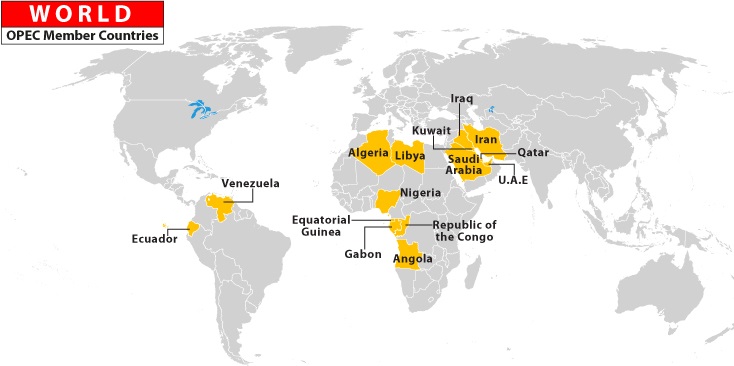
What is unfolding right now is not just another dispute inside OPEC. This is the beginning of the breakdown of coordinated global energy policy under the pressure of war. The decision by the United Arab Emirates to exit OPEC effective May 1 comes as oil supply is being physically disrupted, not merely negotiated.
Officials in the UAE have tried to frame this as a strategic move, stating they need “greater flexibility to manage production independently” and to expand output capacity without being constrained by quotas. That statement alone reveals the real issue. They have the ability to produce more oil, but OPEC restrictions have prevented them from doing so at a time when global supply is tightening. When a producer is sitting on capacity in the middle of a supply shock, remaining in a cartel becomes a liability rather than an advantage.
The numbers here are critical. OPEC production has already fallen sharply, with estimates showing output around 20.79 million barrels per day in March, while disruptions tied to the Iran conflict are removing as much as 7–10 million barrels per day from global supply flows, particularly through the Strait of Hormuz. That is not a minor disruption. That is a structural shock to the system.
At the same time, oil prices are reacting exactly as expected. Brent crude has surged above 110 dollars per barrel, with U.S. crude crossing 100. Analysts have warned that “there is no clear end in sight to the supply disruption,” which means volatility is not temporary. It becomes embedded in the system.
The UAE has made it clear that it intends to increase production capacity toward 5 million barrels per day by 2027, well above its current quota near 3 million. That gap explains everything. By leaving OPEC, they can monetize that capacity immediately rather than waiting for collective agreements that no longer align with their national interest. Estimates suggest this could translate into tens of billions in additional annual revenue.
I have written many times that OPEC was never a permanent solution to managing energy markets. It was a political construct that worked only when member states had aligned interests and a shared incentive to restrict supply. The moment those interests diverge, the structure begins to fail. OPEC has historically struggled with compliance. Members routinely exceeded quotas when it suited them, particularly during periods of high prices or fiscal stress. That was always the underlying weakness.
What we are seeing now is that weakness being exposed under extreme conditions. War changes everything. When geopolitical survival overrides economic coordination, agreements collapse. OPEC cannot function when members are facing direct threats or when they see an opportunity to maximize revenue independently. This is precisely why these types of organizations tend to break down during periods of rising global tension.
The UAE’s decision signals something much larger about the future of OPEC. If one major producer walks away to pursue independent production, others will begin to reconsider their own participation. The incentive to cooperate declines as the incentive to produce increases. That creates a feedback loop where the cartel loses its ability to enforce discipline.
At the same time, the global energy landscape has already shifted. The United States has emerged as a dominant producer, reducing the relative influence of OPEC compared to previous decades. When OPEC was formed, it had far greater control over global supply. Today, that control is diluted, and fragmentation only accelerates that trend.
Looking forward, OPEC is unlikely to disappear overnight, but its role will change. Instead of acting as a unified force capable of stabilizing markets, it will become a looser alliance with diminishing influence. Pricing power will shift toward individual producers and market forces rather than coordinated quotas. That transition introduces far greater volatility because there is no longer a central mechanism to manage supply in times of crisis.
Geopolitical conflict will increasingly dictate energy flows. When supply routes are threatened and production becomes a strategic asset, countries will prioritize control over cooperation. Energy becomes a tool of leverage rather than a shared economic resource.
The contradiction globally is becoming impossible to ignore. While policymakers in Europe continue to push for eliminating fossil fuels, producers are expanding output and repositioning themselves to control supply. This divergence guarantees instability. There is no substitute capable of replacing this level of energy demand, and the attempt to force that transition is colliding directly with geopolitical reality.
The UAE’s exit is not an isolated event. It is a signal that the system is changing. Energy markets are moving away from coordinated control and toward fragmentation driven by national interest. Once that shift takes hold, it does not reverse easily.
The real takeaway is simple. When supply is disrupted, cooperation breaks down, and producers begin acting independently, the result is sustained volatility. Prices rise, markets become unstable, and geopolitical tension intensifies. This is not a short-term disruption. It is the early stage of a much larger transformation in the global energy order.
Posted originally on Apr 29, 2026 by Martin Armstrong |
There has always been this convenient belief that Big Tech operates independently from government, as if the data you store, search, and upload exists in some neutral corporate space, but that illusion is breaking down rapidly as the lines between Silicon Valley and Washington disappear in real time.
Google has now entered into a classified agreement with the Pentagon allowing its artificial intelligence systems to be used for “any lawful government purpose,” which is a phrase that sounds benign until you understand what it actually means in practice.
This is not a narrow contract tied to a single project. It opens the door for integration into mission planning, intelligence analysis, and even weapons targeting systems operating on classified networks, and once those systems are embedded, the distinction between commercial technology and state infrastructure effectively disappears.
At the same time, Google does not retain control over how that technology is ultimately used, because under the terms being reported, the company has no ability to veto lawful government operations, meaning once access is granted, the downstream application is no longer in their hands. Please be reminded that Google has been collecting data on everyone and everything for decades: Google Maps, Google Search, Google Photos, Google Drive, Gmail, etc.
This is where the narrative people have been told begins to collapse, because for years the assumption was that your data sat within a corporate ecosystem governed by terms of service and internal policies, yet what is now being constructed is something entirely different, a shared infrastructure where private data, artificial intelligence, and state power intersect.
Even inside Google, there is significant resistance to this shift, with more than 600 employees signing letters to CEO Sundar Pichai warning that these systems could be used for “lethal autonomous weapons and mass surveillance,” and expressing concern that once deployed in classified environments, there is no meaningful oversight or transparency. “We want to see AI benefit humanity; not to see it being used in inhumane or extremely harmful ways. This includes lethal autonomous weapons and mass surveillance but extends beyond,” the letter reads.
This is part of a broader shift in which every major AI company is now aligning with the defense sector, competing for contracts reportedly worth hundreds of millions of dollars, thereby transforming artificial intelligence from a commercial tool into a strategic asset within global power dynamics.
From my perspective, this follows the same pattern we see in every major cycle of power consolidation, where private innovation is gradually absorbed into state control during periods of rising geopolitical tension. Once that process reaches a certain threshold, the distinction between public and private effectively vanishes.
People focus on the wrong question, asking whether Google is “sharing your data” directly with the government, when the real issue is far more structural. Once the same systems that process your emails, photos, searches, and behavior are integrated into government operations, the architecture itself becomes unified, and access becomes a matter of policy, not possibility.
When artificial intelligence becomes the interface between data and decision-making, whoever controls that system controls the interpretation of reality itself, and that is where the real power lies. For the first time in history, we are witnessing the convergence of data, technology, and government authority into a single structure that has already become far too powerful to dismantle.
Posted originally on Apr 29, 2026 by Martin Armstrong |
The latest polling on Keir Starmer is not simply weak, it is a clear rejection. Labour has slid sharply, with support falling toward the high teens in some recent surveys, while his personal approval rating has dropped deep into negative territory, approaching levels that historically signal a government losing control of the narrative. This is not a temporary dip. It reflects a growing disconnect between policy and reality.
What the public is reacting to is not difficult to understand. The UK economy is under pressure from all sides. Borrowing costs have climbed above 5%, households are still dealing with elevated living expenses, and growth remains sluggish. At the same time, policy continues to lean heavily into Net Zero commitments that raise energy costs while offering no reliable alternative capable of sustaining industrial demand. You cannot impose higher input costs on an economy already under stress and expect confidence to improve.
Starmer positioned himself as the steady hand, promising stability after years of political turmoil. Instead, the perception is that nothing fundamental has changed. The same structural problems remain in place, and in some cases, they are being reinforced. Energy policy continues to squeeze industry, regulation remains heavy, and there is no coherent strategy to reverse capital outflows or stimulate productive growth. People are not reacting emotionally. They are reacting to what they are experiencing in their daily lives.
There is also the issue of credibility. Once a government begins to lose public confidence, every decision is questioned. Scandals, internal disputes, and policy reversals all begin to carry more weight because the trust is no longer there. The Mandelson controversy only added to the sense that decisions are being made behind the curtain rather than in the open. That perception accelerates the decline.
What makes this particularly important is that this is not isolated to the UK. Governments across Europe are facing similar backlash because they have followed the same playbook, restricting energy, expanding regulation, and ignoring the economic consequences. The result has been stagnation, rising costs, and a steady erosion of confidence. When people feel their standard of living slipping, they do not care about political messaging. They look for alternatives.
Starmer’s problem is that he represents continuity at a time when the public wants change. You cannot campaign as a reformer and then govern as a caretaker of the same policies that created the problem. The numbers reflect that contradiction. This is not about personality. It is about policy failure becoming visible in real time.
Once sentiment turns this sharply, it rarely stabilizes on its own. It tends to accelerate as opposition grows and internal pressure builds. That is what these polls are signaling. The market may tolerate uncertainty for a time, but the public does not. When confidence breaks, it becomes a political issue first and an economic one shortly after.
Posted originally on CTH on April 28, 2026 | sundance |
Tonight, President Donald Trump and First Lady Melania Trump will host King Charles III and Queen Camilla of the United Kingdom at a White House state dinner. Livestream Links Below.
From the First Lady: “President Donald J. Trump and First Lady Melania Trump will welcome Their Majesties King Charles the III of the United Kingdom of Great Britain and Northern Ireland and Her Majesty Queen Camilla for a State Dinner this evening, Tuesday, April 28, 2026. The First Lady led the preparations for the dinner, which will honor the Special Relationship between the United States and the United Kingdom as the American people mark 250 years of independence.”
MENU
First Course Garden Vegetable Velouté Hearts of PalmToasted Shallots Micro Mint
The first course offers delicate garden herb velouté, silken and aromatic, complemented by a refreshing hearts of palm salad. Finished with crisp toasted shallots and a whisper of micro mint for brightness and contrast.
Second Course Spring Herbed Ravioli Ricotta CheeseMorels Parmesan Emulsion
The second course is made of a handcrafted spring herb ravioli, featuring herbs from the White House Kitchen Garden, generously filled with creamy ricotta, earthy morels, gently dressed in a light parmesan emulsion, which enhances the essence of the dish.
Third Course Dover Sole Meunière Potato PavéSpring Ramps Snow Peas Parsley Oil
The third course is made of a classic dover sole meunière, expertly prepared and bathed in a nutty brown butter. The fish is accompanied by tender spring ramps, sweet snow peas, layered potatoes pavé, and a vibrant parsley oil for a refined, seasonal finish.
Dessert White House Honey & Vanilla Bean Crémeux Flourless Chocolate GâteauAlmond Joconde Crème Fraîche Ice Cream For dessert, guests will be served a sweet beehive shaped chocolate gâteau with a smooth vanilla bean crémeux custard, delicately set inside with an almond joconde. The refined, feather-light sponge joconde will provide the dessert a nutty taste, balanced with a brown butter crumble. The beehive will be complimented with crème fraîche ice cream and White House honey.
WINES
The following wines were selected to complement the menu while honoring the shared heritage and enduring friendship between the United States and the United Kingdom, and celebrating the strength of American winemaking today.
The Penner-Ash Pinot Noir “Willamette Valley” 2022, Penner-Ash Wine Cellars
The Newton Chardonnay “Unfiltered” 2022, Newton Vineyard
ENTERTAINMENT
The evening’s entertainment will feature performances by the United States military musicians from the Marines, Army, and Air Force, including “The President’s Own” United States Marine Band, The United States Army Chorus, The United States Army Strings, The United States Army Herald Trumpets, The United States Air Force Singing Sergeants, The United States Air Force Strings.
FLORAL & DÉCOR
The décor for the evening reflects a shared appreciation for gardens. Cherry blossoms greet guests upon entering the Grand Foyer. Inspired by the beauty of English gardens, towering trees and blossoming garden boxes of lilac enhance the splendor of the room. Tables, dressed in green pleated linens, are adorned with seasonal blooms of lilac, butterfly ranunculus, phlox, and lily of the valley, underscoring the beauty of spring. Lush garden greens are complemented by accents of gold and white. The tables are set with more than 250 pieces of vermeil from the White House collection, alongside hand-crafted ceramics by distinguished American artisans, including Ben Wolff. The Clinton Anniversary Service is presented alongside hand-painted menus, with courses served on both the Clinton and Bush china services. Rooted in traditions cherished on both sides of the Atlantic, these details reflect the long and enduring friendship between the United States and the United Kingdom. (source)
.
• The President of the United States, Donald J. Trump and Mrs. Melania Trump • His Majesty King Charles III of the United Kingdom of Great Britain and Northern Ireland and Her Majesty Queen Camilla • The Right Honourable Sir Clive Alderton, Principal Private Secretary to Their Majesties • Justice Samuel Alito of the Supreme Court of the United States and Mrs. Martha-Ann Alito • Mr. Tobyn Andreae, Director of Communications of the Royal Household • Mr. Marc Andreessen and Ms. Laura Arrillaga-Andreessen • Mr. Bret Baier and Mrs. Amy Baier • The Honorable John Barrasso, United States Senator from Wyoming • Ms. Maria Bartiromo and Mr. Jonathan Steinberg • Mr. Marc Benioff and Mrs. Lynne Benioff • The Honorable Scott Bessent, Secretary of the Treasury and Mr. John Freeman • Mr. Jeff Bezos and Mrs. Lauren Bezos • The Honorable James Blair and Mrs. Samantha Blair • Ms. Senay Bulbul, Minister Counsellor, British Embassy Washington • The Honorable Doug Burgum, Secretary of the Interior and Mrs. Kathryn Burgum • General Dan Caine, Chairman of the Joint Chiefs of Staff
• Mr. Varun Chandra, Prime Minister’s Chief Business, Investment and Trade Adviser • Justice Amy Coney Barrett of the Supreme Court of the United States and Mr. Jesse Barrett • Mr. Tim Cook • The Right Honourable Yvette Cooper, Secretary of State for Foreign, Commonwealth, and Development Affairs • The Honorable Steve Daines, United States Senator from Montana • Ms. Sophie Densham, Private Secretary to Her Majesty the Queen • The Honorable Sean Duffy, Secretary of Transportation and Ms. Rachel Campos-Duffy • Ms. Ainsley Earhardt • Mr. David Ellison • Mr. Pepe Fanjul and Mrs. Emilia Fanjul • The Honorable Ed Forst, Administrator of the General Services Administration • Justice Neil Gorsuch of the Supreme Court of the United States and Mrs. Marie Louise Gorsuch • The Honorable Lindsey Graham, United States Senator from South Carolina • The Honorable Jamieson Greer, United States Trade Representative and Mrs. Marlo Greer • Mr. Greg Gutfeld and Ms. Elena Mussa • The Honorable Beau Harrison and The Honorable Hayley Harrison • The Honorable Pete Hegseth, Secretary of War and Mrs. Jennifer Hegseth • Mr. Jensen Huang and Mrs. Lori Huang • Ms. Caroline Hurndall, Principal Private Secretary to the Foreign Secretary • Ms. Laura Ingraham • Mr. Otis Irwin
• The Honorable Mike Johnson, Speaker of the House of Representatives and Mrs. Kelly Johnson • Ms. Tham Kannalikham • Justice Brett Kavanaugh of the Supreme Court of the United States and Mrs. Ashley Kavanaugh • Mr. Howard Kessler and Mrs. Michele Kessler • Mr. Viktor Knavs • Mr. Robert Kraft and Dr. Dana Kraft • Mr. Harry Lopes • Mr. Juan Luciano • The Honorable Howard Lutnick, Secretary of Commerce and Mrs. Allison Lutnick • Mr. Rory McIlroy and Mrs. Erica McIlroy • The Honorable Stephen Miller and Mrs. Katie Miller • Mr. Brendan Nelson • Ms. Meg O’Neill • Mr. John Paulson and Ms. Alina de Almeida • Mr. Isaac Perlmutter and Mrs. Laura Perlmutter • Mr. Hervé Pierre • Mr. Keith Poole • Ms. Ruth Porat • The Honorable Dina Powell McCormick and The Honorable Dave McCormick, United States Senator from Pennsylvania • Mr. Anthony Pratt and Ms. Claudine Revere • Mr. Adam Riddle • The Honorable Jim Risch, United States Senator from Idaho and Mrs. Vicki Risch • Mr. Don Robert • Chief Justice John Roberts of the Supreme Court of the United States and Mrs. Jane Roberts • The Honorable John F.W. Rogers • Mr. James Roscoe, Deputy Head of Mission, British Embassy Washington • The Honorable Marco Rubio, Secretary of State and Mrs. Jeanette Rubio • Mr. Christopher Ruddy • Mr. Theo Rycroft, Deputy Private Secretary to His Majesty the King • The Honorable Dan Scavino and Mrs. Erin Scavino • Mr. Steve Schwarzman and Mrs. Christine Schwarzman • Mrs. Suzanne Scott • Mr. Brian Sikes • The Honorable Warren Stephens, American Ambassador to the United Kingdom of Great Britain and Northern Ireland and Mrs. Harriet Stephens • Justice Clarence Thomas of the Supreme Court of the United States and Mrs. Virginia Thomas • Lieutenant Colonel Jonny Thompson, Senior Equerry to His Majesty the King • The Honorable John Thune, United States Senator from South Dakota and Mrs. Kimberley Thune • Mr. Eric Trump and Mrs. Lara Trump • The Honorable Ivanka Trump and The Honorable Jared Kushner • Ms. Tiffany Trump and Mr. Michael Boulos • Sir Christian Turner, His Majesty’s Ambassador to the United States of America, and Lady Claire Turner • The Vice President of the United States, JD Vance and Mrs. Usha Vance • Mr. C.S. Venkatakrishnan • Mr. Jesse Watters and Mrs. Emma Watters • The Honorable Steve Witkoff, Special Envoy to the Middle East and Ms. Lauren Olaya
Posted originally on CTH on April 28, 2026 | sundance
President Trump and the First Lady Participate in a Family Photo with the King and Queen of the United Kingdom. The short formal moment precedes the State Dinner this evening. WATCH:
Posted originally on CTH on April 28, 2026 | Sundance |
This afternoon, King Charles III will become the first British monarch to address the U.S. Congress since his mother, Queen Elizabeth II, in 1991. Livestream Links Below
Posted originally on CTH on April 28, 2026 | Sundance
President Donald Trump and First Lady Melania Trump participate in a formal welcome ceremony for King Charles III and Queen Camilla of the United Kingdom of Great Britain and Northern Ireland. The entire event video is below with the prompt to the beginning of President Trump’s remarks.
Posted originally on CTH on April 28, 2026 | Sundance
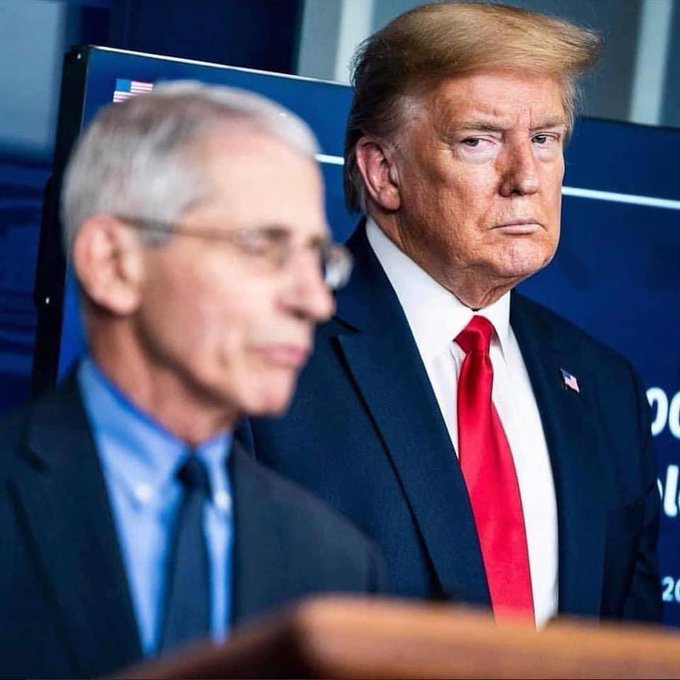
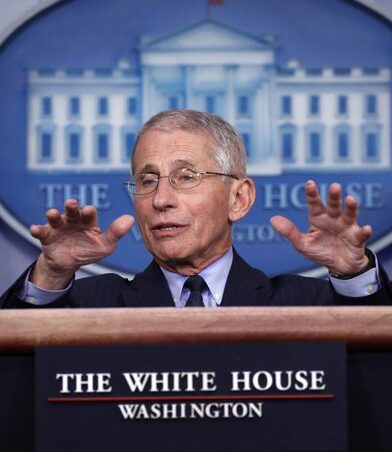
Things are quickening. It would appear that accountability for the COVID-19 cover up is finally here.
David Morens, 78, was the senior advisor to Anthony Fauci at the National Institute of Allergy and Infectious Diseases (NIAID). Mr Morens was indicted today by the Dept of Justice for conspiracy against the United States; destruction, alteration, or falsification of records in federal investigations; concealment, removal, or mutilation of records; and aiding and abetting. [Indictment pdf HERE]
In essence, Morens was indicted for manipulating science, facilitating the creation of the SARS-CoV-2 virus and then running a cover-up operation. The evidence of the cover up is what busted him. Morens is hopefully the first of many who could be taken down in this network. Peter Danszak should be next.
NEW YORK – […] The indictment, unsealed Monday in Maryland federal court, also notes two unnamed co-conspirators who “concealed, removed, destroyed and caused the concealment, and removal of federal records to evade FOIA [Freedom of Information Act] and FRA [Federal Records Act].”
Information in the indictment indicates the co-conspirators are Dr. Peter Daszak, the president of Manhattan-based non-profit EcoHealth Alliance, and Dr. Gerald Keusch, an associate director of Boston University’s National Emerging Infectious Disease Laboratory Institute and National Institutes of Health (NIH) grantee.
Morens, who served as a senior advisor to Fauci from 2006 to 2022, made his initial appearance in court Monday, and a judge granted him conditional release pending trial so long as he surrenders his US passport by Wednesday. He must also “avoid all contact” with the co-conspirators. (more)
DOJ PRESS RELEASE: […] “These allegations represent a profound abuse of trust at a time when the American people needed it most — during the height of a global pandemic,” said Acting Attorney General Todd Blanche. “As alleged in the indictment, Dr. Morens and his co-conspirators deliberately concealed information and falsified records in an effort to suppress alternative theories regarding the origins of COVID-19. Government officials have a solemn duty to provide honest, well-grounded facts and advice in service of the public interest — not to advance their own personal or ideological agendas.”
“Circumventing records protocols with the intention of avoiding transparency is something that will not be tolerated by this FBI,” said FBI Director Kash Patel. “Not only did Morens allegedly engage in the illegal obfuscation of his communications, but he received kickbacks for doing so. If you have engaged in activity conspiring against the United States, we will not stop until you face justice.” (read more)
The DOJ needs to keep working their way up the chain until they get this guy…. 👇
Posted originally on CTH on April 28, 2026 | Sundance
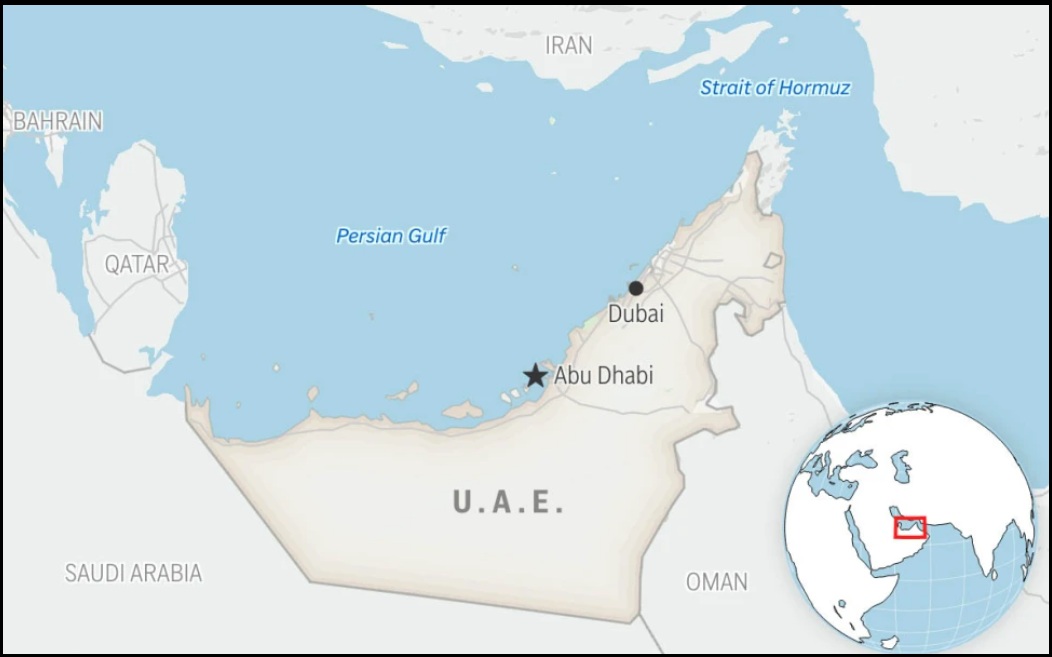
The United Arab Emirates (UAE) has announced they are leaving OPEC in order to manifest their own sovereign economic destiny and increase domestic oil production without the limits and rules of the OPEC cartel. This is a significant alignment with President Donald Trump who has actively argued against the OPEC assembly and the oil price controls they have historically imposed.
DUBAI, United Arab Emirates (AP) — The United Arab Emirates said Tuesday it will leave OPEC effective May 1, stripping the oil cartel of one of its largest producers and further weakening its leverage over global oil supplies and prices.
The UAE’s decision had been rumored as a possibility for some time, as it pushed back in recent years against OPEC production quotas it felt had been too low — meaning it wasn’t able to sell as much oil to the world as it had wanted.
“Having invested heavily in expanding energy production capacity in recent years, the bigger picture is that the UAE has been itching to pump more oil,” Capital Economics wrote in an analysis. “The ties binding OPEC members together have loosened,” it said, particularly after Qatar withdrew from the cartel in 2019. (read more)
As noted by CNBC, “The UAE has played an influential role in OPEC’s decisions over nearly six decades. It was the group’s third-largest oil producer in February behind Saudi Arabia and Iraq. The Gulf state joined OPEC in 1967, seven years after the organization was founded.”
This is where things get really interesting…. Because the UAE can effectively eliminate the Hormuz chokepoint, and Secretary of Treasury Scott Bessent previously outlined something very important to the UAE:
LAST WEEK:
WASHINGTON – US Treasury Secretary Scott Bessent said on Wednesday that a number of allies in the Gulf region and in Asia have requested currency swap lines from the United States to help deal with energy shocks and other fallout from the Middle East war.
Bessent told US senators that both the US and the United Arab Emirates would benefit from a proposed swap line that President Donald Trump said he was considering on Tuesday.
Bessent did not name the countries making such requests, but told a US Senate Appropriations subcommittee budget hearing that such facilities would help stabilize financial markets amid turmoil from the Iran war.
“And swap lines, whether it’s from the Federal Reserve or the Treasury, are to maintain order in the dollar funding markets and to prevent the sale of the US assets in a disorderly way,” Bessent said. “So, the swap line would benefit both the UAE and the US, and as I said, numerous other countries, including some of our Asian allies, have also requested them.”
The US Treasury last October provided Argentina with a $20 billion currency swap to help stabilize the country’s peso during a tumultuous election period that helped strengthen the position of President Javier Milei’s party.
That swap line, backed by the Treasury’s $219 billion Exchange Stabilization Fund, provided Argentina with a safety net of dollars that the central bank could use to help prop up the value of the peso and prevent a devaluation ahead of the vote. It has since been repaid.
REQUESTS FOR RUSSIAN OIL
Bessent also said that he extended sanctions relief on Russian seaborne oil for another 30 days after requests from a number of countries that are most vulnerable to oil shortages from the closed Strait of Hormuz. The requests came during last week’s International Monetary Fund and World Bank spring meetings, he said.
The action reversed his comments last week that he would not renew expiring sanctions waivers. A separate waiver to allow countries to buy Iranian oil stranded at sea lapsed on April 19. (more)
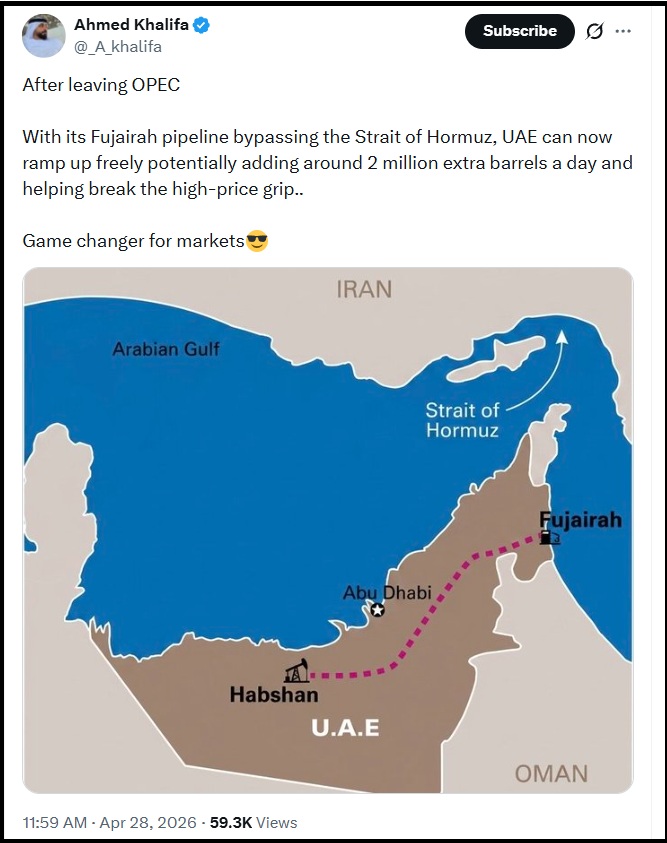
The UAE can bypass the Hormuz chokepoint, and Saudi Arabia can pump oil to the Red Sea via their east/west pipeline.
If Trump keeps the blockade against Iranian oil shipments in place, the UAE and Saudi Arabia can fill the global oil void; however, they need to get outside the OPEC restrictions to do it. Thus, the UAE exiting OPEC makes strategic sense both now and in the geopolitical longer term.
However, in the short run the UAE needs financial stability as the switch is done. Enter Scott Bessent with the currency swap lines for the UAE.
I have created this site to help people have fun in the kitchen. I write about enjoying life both in and out of my kitchen. Life is short! Make the most of it and enjoy!
This is a library of News Events not reported by the Main Stream Media documenting & connecting the dots on How the Obama Marxist Liberal agenda is destroying America