Posted originally on Apr 28, 2026 by Martin Armstrong |
There is a growing contradiction unfolding in the global economy that exposes just how distorted this entire artificial intelligence narrative has become, because companies rushed to replace human labor under the assumption that machines would be cheaper, only to discover that in many cases AI is now costing more than the workers it was supposed to eliminate. The latest data shows compute expenses alone are exceeding payroll in some firms, with one Nvidia executive admitting outright that the cost of running AI systems has surpassed the cost of employees, while global IT spending is projected to surge to $6.31 trillion in 2026, up 13.5% in a single year.
Companies were sold the idea that AI would slash labor costs, yet they are instead encountering an explosion in infrastructure expenses, energy consumption, and ongoing operational costs that do not scale as human labor does. AI is not a one-time investment, it is a continuous cost center, and the more complex the system becomes, the more expensive it is to maintain.
At the same time, firms have already begun restructuring their workforce in anticipation of these savings, cutting jobs, freezing hiring, and eliminating entry-level roles, only to find that the economic benefits are not materializing as expected. There are estimates showing tens of billions poured into generative AI with the overwhelming majority of companies seeing little to no return, which is exactly how bubbles form, with capital chasing an idea before the underlying economics justify the investment.
AI does not necessarily reduce work, it often intensifies it. Studies tracking employee usage of AI tools have found rising burnout, increased pressure, and only marginal time savings, meaning workers are being pushed harder rather than replaced outright. The expectation that machines would lighten workloads is being replaced by a reality in which productivity demands increase and human workers are forced to compete with systems that never stop.
What is unfolding fits directly into the broader economic cycle, because this is not simply about technology; it is about capital concentration and the displacement of labor. The benefits of AI are captured by a very small number of firms that control the infrastructure, while the costs are distributed across the broader economy through layoffs, rising workloads, and increased financial pressure on businesses trying to keep up.
This is also why the labor market signals remain contradictory, because while there is widespread fear of job loss, the actual transition is uneven, with some sectors cutting aggressively while others struggle to integrate AI effectively. The narrative of immediate replacement has been exaggerated, but the structural shift is real and unfolding in phases that align with economic cycles rather than technological breakthroughs alone.
AI has become the new battlefield, requiring enormous capital investment, energy consumption, and geopolitical positioning, particularly as nations race to secure supply chains for semiconductors and data infrastructure. The critical mistake is assuming that technology alone determines the outcome, when in reality it is always the economic model that decides whether something succeeds or fails. Right now, the model is being stress-tested because companies are discovering that replacing humans with machines does not automatically yield savings; in many cases, it yields the opposite.
The meeting between Vladimir Putin and Abbas Araghchi is being presented as a diplomatic gesture, yet the substance reveals something far more significant: Moscow has now openly pledged support for Tehran while negotiations with the United States continue to collapse. Russia reaffirmed its strategic backing and even positioned itself as a mediator, while at the same time strengthening its alliance with Iran through military, economic, and nuclear cooperation, making it clear that this relationship is not temporary but structural.
What matters here is not the language of peace but the alignment of power, because when major players begin coordinating at this level during an active conflict, history shows the situation is already moving beyond negotiation. Russia and Iran have been deepening ties for years through sanctions pressure, energy cooperation, and military exchanges, including intelligence sharing and weapons support, and this latest meeting confirms that the alliance is now being formalized in real time as the geopolitical divide widens.
The breakdown in talks with the United States was inevitable, since both sides are demanding outcomes that neither can accept, particularly on nuclear policy and regional control. Iran has made it clear it will not abandon enrichment, while Washington continues to insist on full concessions, leaving no realistic middle ground. At the same time, tensions around the Strait of Hormuz and ongoing military pressure ensure that even temporary ceasefires remain fragile and largely symbolic.
This is precisely the type of environment the war model has been projecting into 2026, where escalation unfolds through a sequence of failed negotiations, tightening alliances, and economic pressure points rather than a single defining event.
Putin is signaling to the world that the lines are being drawn, and once that process begins, it becomes increasingly difficult to reverse. The fact that both nations are already cooperating across multiple fronts, from energy to military coordination, shows that this is part of a broader realignment rather than a reaction to a single conflict.
The critical mistake is assuming that these events can be managed through continued negotiation, because once alliances harden and economic consequences begin to ripple through energy markets and capital flows, the cycle takes on a momentum of its own. This is why the war model has consistently pointed to this period as one of rising volatility, where events accelerate and policymakers lose the ability to control the outcome.
What we are seeing is not the beginning of a crisis but the continuation of a cycle that has already turned, and once that shift is in motion, history shows it rarely resolves quickly or peacefully.
A report from Ukraine’s own military ombudsman now admits that after just 40 days on the front lines, soldiers reach a point where they “stop caring whether they survive,”which is not a sign of resilience but psychological collapse. That is what happens when human beings are fed into a machine that has no exit.
The numbers alone are staggering and should end any illusion that this is sustainable. Estimates as of early 2026 suggest roughly 250,000 to 300,000 Ukrainian military casualties, killed and wounded combined, with far higher cumulative losses over the course of the war depending on the source. Even conservative tracking projects have documented more than 90,000 Ukrainian soldiers confirmed dead or missing by name, and those figures are widely understood to undercount the true scale of losses. This is not a contained conflict, it is a grinding attrition that is consuming an entire generation.
The manpower crisis is now so severe that it can no longer be hidden. Ukrainian units are reportedly operating at a fraction of the required strength, with positions that should be held by 30 soldiers reduced to five or seven trying to hold off waves of attackers. That is not a functioning army. It explains why they cannot rotate men out of the front lines. There are simply not enough replacements left to cycle troops through rest and recovery, so they are being pushed until they break.
Video footage from western Ukraine’s Volyn region shows a military recruiter pursuing a man across a rooftop.
Both fell during the chase, after which other recruiters detained the man on the ground and proceeded with his mobilization. pic.twitter.com/Lfj7hQd4g5
This is why we are seeing increasingly aggressive and controversial recruitment practices. Reports have documented men being stopped in the streets, detained, and forcibly taken for mobilization, with widespread resistance and even physical confrontations as authorities attempt to meet quotas. Allegations have surfaced of officials beating or detaining unwilling recruits, prompting protests and driving some men to flee the country entirely despite strict travel bans. This is not voluntary enlistment, it is coercion born out of necessity because the losses have become unsustainable.
At the same time, there have been increasing calls for Ukrainians abroad to return and participate in the war effort, which underscores the scale of the manpower shortage. When a country begins looking beyond its borders to replenish its fighting force while simultaneously tightening domestic mobilization, it is a clear signal that the internal pool of available soldiers is being exhausted.
What makes this even more disturbing is that none of this is being framed honestly. The narrative continues to suggest that this is manageable, that progress is being made, and that morale remains intact, yet the data and internal reports point to the opposite. Soldiers reaching the point where they no longer care whether they live or die is not morale, it is burnout at a level that destroys cohesion and long-term effectiveness.
This is precisely what the war model has been warning about, because once a conflict enters this phase of attrition, it stops being about territory and becomes about endurance. The 2026 Panic Cycle in international conflict is not defined by a single event but by this exact type of escalation, where losses mount, manpower shortages intensify, and governments begin taking measures that would have been unthinkable at the outset.
Wars reach a turning point when the cost in human life begins to exceed the capacity of the state to sustain it, and the signs of that threshold are now clearly visible. Forced mobilization, inability to rotate troops, and collapsing morale are not isolated issues, they are indicators that the system is under extreme strain.
What is unfolding is not a short-term crisis but the continuation of a cycle that is accelerating, and once it reaches this stage, history shows it rarely de-escalates on its own.
You cannot have King Charles in the USA without checking on the perspective of Promethean Action. After all, Queen Elizabeth II and her offspring King Charles III were the arch nemesis of Lyndon LaRouche.
“Susan Kokinda links a third assassination attempt on Donald Trump at the Washington Hilton—where a 31-year-old Californian, Cole Tomas Allen, charged a Secret Service checkpoint with firearms and knives—to a broader political struggle she frames as the British imperial system versus Trump’s “American System.” She argues Trump’s own remarks about assassinations point to a pattern of targeting “impactful” leaders, comparing today’s climate to anarchist-era killings around 1900 and the 1901 assassination of William McKinley. Kokinda ties the attack’s timing to King Charles’ Washington visit, a new book, The Queen and Her Presidents, and a House of Lords/Chatham House report on “rebalancing” the UK–US partnership, highlighting UK dependence on the postwar “rules-based order” and concerns about a lasting US shift under Trump.”WATCH:
.There’s also a funny little video gif below that ties into this nicely.
Posted originally on CTH on April 27, 2026 | Sundance |
Today is not a good day for the Canadian trade team.
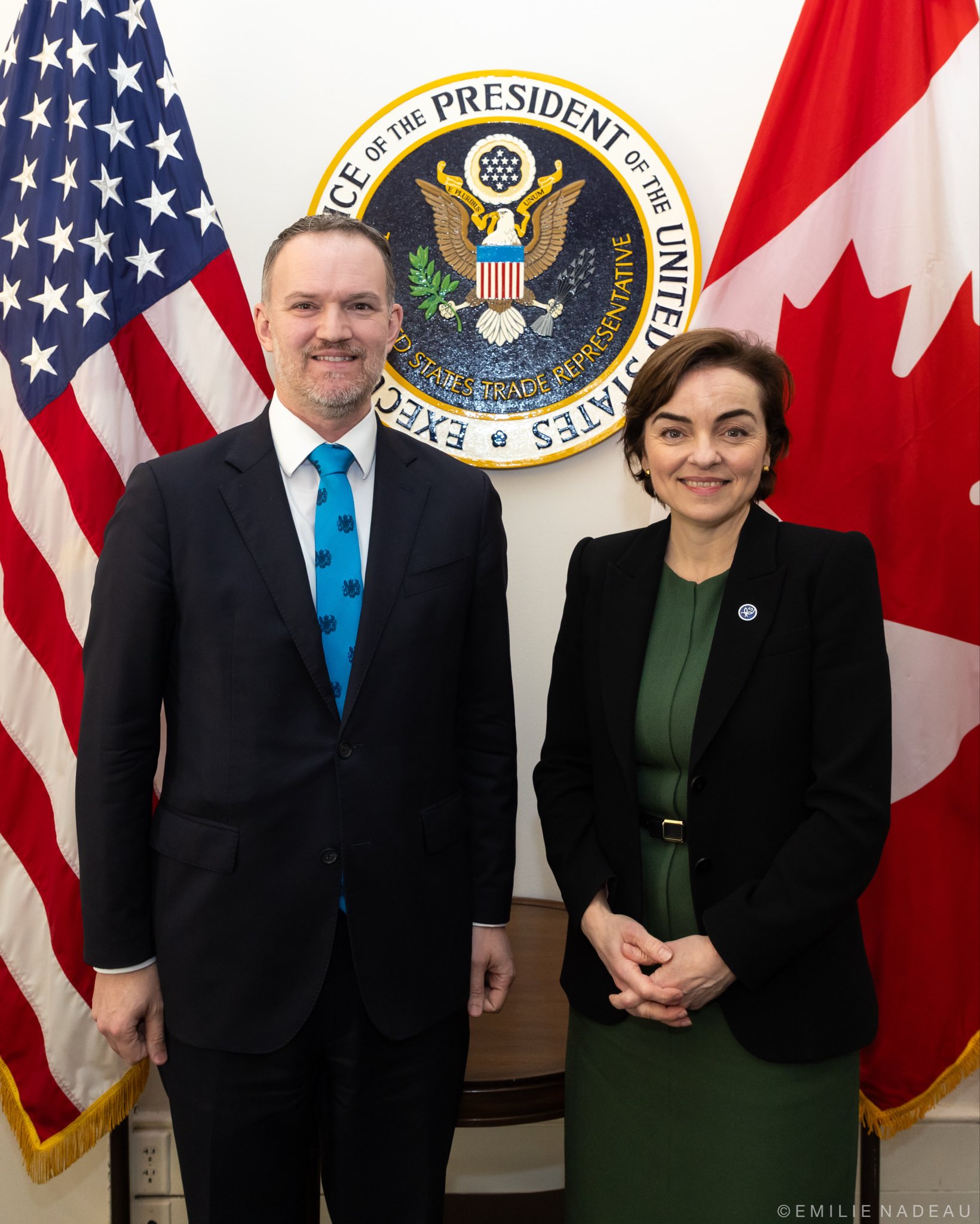
It started with Quebec’s new Premier in Washington DC meeting with U.S. Trade Representative Jamieson Greer {citation} in order to talk trade {SEE TIMELINE} saying on Twitter, “Quebec wants a renewal of the [USMCA] to ensure a stable and predictable framework for our economic exchanges.” However, Mrs. Christine Fréchette (pictured left) then bragged about having strategic discussions with the U.S. Chamber of Commerce. {citation}
For those who might not know, the U.S. Chamber of Commerce is a parasitic Wall Street and K-Street lobbying organization that has been locked out of trade influence since President Trump took office in 2017. It was the U.S. CoC who sold out our manufacturing base, paid-off prior administrations and wrote the actual trade language in almost every trade deal that destroyed U.S. manufacturing.
The U.S. Chamber of Commerce is a lobbying organization who focuses on the bottom-line profits of U.S. multinational corporations, and they don’t care what happens domestically to American jobs, American manufacturing and American wages. The CoC is the organization who created the rust belt and destroyed our manufacturing base under the guise of promoting a “service driven economy.”
If Canada want’s a successful trade negotiation with the USA, the Chamber of Commerce is the last organization they should be strategizing with.
Then comes Prime Minister Mark Carney who not only steps on a rake, but he also publicly insults President Trump and the entire U.S. trade team by saying every country in the world privately tells him they regret making a trade agreement with President Trump. ¹{Citation at 28:10 of Video}
I’m going to post the entire video of Prime Minister Mark Carney discussing USMCA (Canada calls CUSMA) trade negotiations because the tone deafness of it is off the charts. That includes the Canadian Prime Minister saying that Section 232 national security reviews are a violation of the U.S-Canada trade agreement. Carney believes any independent U.S. trade position that negates trade with any Canadian sector is a violation of trade rules, yet he is afraid to sue over Sec 232 because he doesn’t want to discover the flaw in his mindset.
Carney, like Trudeau before him, is highly upset about the U.S. tariffs on Steel, Aluminum and Softwood Lumber. Factually, those raw material sectors of the Canadian economy have been dumping product into the USA for decades despite the Canadian government simultaneously dismantling their industrial dirty jobs.
♦ This is how the Canadian system works:
Canada dumps raw materials into the USA market, then skips the manufacturing part (dirty jobs) because they are not climate friendly, then imports manufactured component parts from China and elsewhere, assembles the components and then tries to find markets for their finished goods, usually in the USA.
President Trump has worked to stop the “dumping part” by placing tariffs on the Canadian raw materials (Steel, Aluminum, Softwood Lumber), in order to generate our own industrial sectors of mining, logging, steel and aluminum works.
This tariff block creates a situation where Canada needs to find other outlets for their raw material dumping….. which them becomes funny because Europe has already rejected them (same reason as Trump) and China doesn’t need them.
As a consequence, Canada has no choice except to try and force the USA to accept the dumping by lobbying Democrats and various business interests like the Chamber of Commerce to put political pressure on President Donald Trump. So far, their approach not only isn’t working – but it’s also insulting.
If Prime Minister Mark Carney keeps promoting this type of ridiculous anti-Trump trade narrative for domestic consumption (orange man bad), the Canadian people are going to be blindsided when the backfire surfaces. It has already backfired; the Canadian people just don’t see it yet.
Video prompted to 18:51 where Carney discusses trade relations with the USA:
.
¹We are drawing attention to this because we understand administration officials review these CTH research inputs. President Trump is not going to like this insult.
Today, President Trump and First Lady Melania Trump welcomed King Charles and Queen Camilla to the White House. Video Below:
Today: President Trump and the first lady greet the king and queen “informally,” per Buckingham Palace. Then it’s off to a garden party at the British ambassador’s residence, just up the street from the vice president’s home.
Tonight: a formal White House welcome, complete with a ceremonial military review.
Tomorrow: President Trump and King Charles hold a bilateral meeting, while the first lady hosts Queen Camilla. Then the king will address a joint meeting of Congress — a rare honor. Queen Elizabeth II was the first monarch to do so, in 1991.
The day tomorrow wraps with a White House state dinner.
Before heading to New York, the royals will lay a wreath at Arlington National Cemetery, marking the military partnership between the U.K. and U.S. Then Thursday shifts south to Virginia (location to be announced), where the itinerary leans Americana: Appalachian cultural performances, a 250th anniversary “block party.” A national park visit focused on conservation and Indigenous communities. Then, separately, a horse farm stop for the queen. {Per Axios}
Posted originally on CTH onApril 27, 2026 | Sundance |
First, it becomes very important for people to understand some of the inside baseball in Washington DC circles in order to hold context for what has been made public today by the office of Senator Chuck Grassley.
Inside Chuck Grassley’s office there is an investigative team that every GOP senator and congressman will admit consists of the very best researchers and knowledgeable staff officials on how the Deep State operates. Grassley’s office is the venue, the vehicle or vessel, for those investigators to operate; Chuck Grassley is not organizing this group – he facilitates it.
Just as Robert Mueller served as the figurehead holding the legislatively authorized power of the special counsel—while the actual investigative work was carried out by his team—Chuck Grassley similarly acts as a symbolic leader, with the real action happening within the organization he oversees.
Mueller at 75-years old (2019) was to the special counsel as Grassley at 93-years old (2026) is to senatorial inquiry.
That said, today the office of Senator Chuck Grassley sent a dispatch of connected information about Hillary Clinton from DOJ/FBI files retrieved over the past several years as part of a longer-term investigation. Grassley’s office released the FBI Washington Field Office’s 12-page “electronic communication” (EC) that opened a preliminary investigation into the Clinton Foundation. [SEE HERE]
They also released a trove of documents showing overwhelming evidence of pay-to-play criminal activity by the Clinton family and emphasize lack of response from the DOJ which highlights both politicalization and weaponization of information by the Department of Justice and FBI.
The FBI and DOJ buried the investigations of Hillary Clinton, yet the evidence of corruption was simply overwhelming. With time running out on their ability to retain the venue, in essence Grassley’s office is urgently asking the DOJ and FBI, how could this not have been prosecuted?
Chuck Grassley, who turns 93 in September, has served in the U.S. Senate for 45 years. Grassley has spent more than 50 years in Congress overall, having served in the U.S. House from 1975 to 1981 before being elected to his first term as senator. In 2022, Grassley was elected to an eighth term, winning against Democratic challenger Michael Franken with 56% of the vote — a smaller margin of victory than in many of his previous elections. He will be 95 by the time his current term ends in 2028.
Currently, Grassley serves as president pro tempore of the Senate, in addition to being the Senate Judiciary Committee chair.
I strongly doubt there will be another Grassley term in office and given the stakes of the 2026 midterm election it looks like the people in his office are trying to push out as much information as possible while it can still do some good. I would bet you a donut this is the correct context to view this information flow.
Posted originally on CTH on April 27, 2026 | Sundance
Acting U.S. Attorney General Todd Blanche and FBI Director Kash Patel hold a press briefing in Washington DC, to update on the weekend attempted assassination effort by suspect Cole Allen, a schoolteacher from California.
I have created this site to help people have fun in the kitchen. I write about enjoying life both in and out of my kitchen. Life is short! Make the most of it and enjoy!
This is a library of News Events not reported by the Main Stream Media documenting & connecting the dots on How the Obama Marxist Liberal agenda is destroying America