CPT Maureen Bannon: No Matter How You Feel About The Iraq War, We Need To Honor Those Who Fought In It


Posted originally on Rumble on Bannon War Room on: October 22, 2025

Michael Pack: The Last 600 Meters Airs Nov 10 At 10PM On PBS, Telling The Story Of Fallujah And Najaf, The Biggest American Battles Since Vietnam


Posted originally on Rumble on Bannon War Room on: October 22, 2025

CLIFF MALONEY: New Jersey Is Officially In Play. Republicans Are Performing 5.5% Better Than This Time Last Year. The NJ Chase Effort Is Moving The Needle. Six Months Ago, No Chance. Today? We’ve Got A Real Shot To Flip A Deep Blue State


Posted originally on Rumble on Bannon War Room on: October 22, 2025

Post-Pandemic Inflation in Canada


Posted originally on Oct 23, 2025 by Martin Armstrong |  

inflation

Inflation in Canada rose to 2.4% this September, as reported by Statistics Canada. Excluding gas, the rate sits at 2.6%. Volatile prices among all essentials, from groceries to shelter, are ramping up the cost-of-living crisis for all Canadians.

Grocery prices have been on the rise since the pandemic and cannot be attributed to tariffs. The Consumer Price Index (CPI) shows grocery inflation is approximately 4% year-over-year, compared to an overall inflation rate of 2.4 percent. The 2025 Canada’s Food Price Report estimated that a family of four would spend C$16,833 on food throughout 2025, an increase of C$802, but prices have surpassed expectations.

Grocery prices surpassed overall CPI during COVID when inflation averaged 2.8%. That was merely the beginning of rising food prices, which rose to 3.5% YoY by 2021. Global energy price shocks due to the Russian-Ukrainian war, coupled with agricultural volatility, caused prices to reach all-time highs in 2022 when food inflation reached 9.8%. With no relief in sight, grocery prices peaked in early 2023 above 10%, marking a four-decade high. Prices stabilized to an extent this year but continue to outpace the overall rate of inflation.

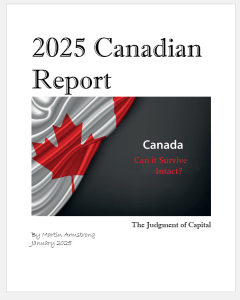
Canada Report 2025 F

Shelter is the other main component of the cost-of-living crisis in Canada. Over the last five years, the shelter component of CPI advanced from around 150 to about 188 index points, or a cumulative increase of roughly 25% since the pandemic. The Bank of Canada reduced rates to near zero early in the pandemic, which caused a surge in home purchases. National shelter CPI climbed 2% annually, but home prices soared 20% from mid-2020 to the end of 2021 as the cost of borrowing and inventory was low. Rent freezes among provinces caused the shelter component of inflation to remain muted through 2021.

The central bank pivoted from QE in 2022 and led to an unprecedented rise in mortgage costs. Shelter inflation soared above 6%, a level not seen since the early ‘80s. Real estate prices waned later in the year but CPI shelter costs rose due to rising mortgages. Shelter inflation peaked to 7% YoY in mid-2023, driving the majority of the broader CPI, while rentals averaged around 9%. Mortgage interest costs spiked by over 28% YoY, according to StatCan data.

Shelter relief was brief in 2024 for owners, but rentals soared above 9% into August. The average nationwide rental price hit C$2,200 by the end of the year, or 30% higher than pre-pandemic levels. The central bank maintained the 5% policy rate and interest costs plateaued. Now in 2025, shelter inflation still remains well above overall inflation. CPI shelter hit 188 in August, 2.6% up YoY, while rent decreased from 9% to 5%. Policy cuts at the BoC led to an average mortgage rate at around 4.6%. Still, shelter costs continue to rise faster than every CPI component aside from food in recent years.

Rentals are one-third higher than pre-pandemic levels and vary widely based on province. Grocery prices have not meaningfully waned since the pandemic, but these costs have become the new norm. Governments cannot prince away inflation through rate policy. Fiscal deficits and currency debasement must be addressed. If government spending continues, debt levels rise, and the central bank becomes effectively stuck. Central banks have limited control over inflation since fiscal and monetary policy have become polar magnets.

Mega Bankruptcies On the Rise


Posted originally on Oct 23, 2025 by Martin Armstrong |  

Bankruptcy

Corporations with assets exceeding $100 million are seeing a surge in closures and bankruptcies. Trends in Large Corporate Bankruptcy and Financial Distress—Midyear 2025 Update found that filings began to increase in early 2023 and have continued to rise into 2025. Over the past year, 117 mega corporations filed for bankruptcy. This is unusually high and 44% above the 2005-2024 average of 81 bankruptcies per year.

Mega bankruptcies or corporations with assets exceeding $1 billion are also on the rise, with 32 filings in the past month, up from 24 the year prior. The 2005-2024 average was 23 per year. In the first half of 2025 alone there were 17 mega bankruptcies on record, marking the highest figure on record since the pandemic of 2020.

Manufacturing has been hit hard. This is not the result of tariffs or a lack of migrant workers. The catalyst reported by 67% of manufacturing mega bankruptcies is the regulatory, legal, and political landscape. Additionally, 61% of all mega bankruptcies noted reduced demand due to high inflation, which forced them to file for financial insolvency. The service industry was hit the hardest by inflation as consumers do not have the disposable income.

Every report calls inflation an external factor but it has been exacerbated by fiscal deficits and central banks tinkering with rates in an attempt to control demand when that has never been the issue. Corporations of this size do not go into bankruptcy without a lengthy process. Years of mismanagement, trade barriers, ESG mandates, ever-changing policies, and taxation have chipped away at these industries.

Liability management transactions (LMTs) hit a record of 45 completed transactions last year and 27 in the first half of 2025. Dealing have become more complex as they attempt to delay the inevitable. Mega corporations relied on bailouts in the past, but the government has too many mouths to feed.

The fact that mega bankruptcies are rising shows that even large, previously “too big to fail” firms are no longer immune from collapse. That suggests a weakening foundation that threatens the broader financial system.

Amazon to Replace 600K Jobs with AI


Posted originally on Oct 23, 2025 by Martin Armstrong |  

assembly robot

The headlines continue to support what the computer has been stating—unemployment in the US will rise in 2026. A newly leaked document reveals that Amazon plans to replace over half a million workers as companies increasingly turn to automation to reduce costs.

An astounding 600,000 jobs are at risk as Amazon is seeking to replace a significant amount of its workforce with automated robots. In fact, the company believes it can automate 75% of all operations by 2027. Over 160,000 roles in the operations department will be lost in the next two years. The company believes the switch to automation will save them $12.6 billion from 2025 to 2027, with an average savings of 30 cents for every item shipped to customers from Amazon warehouses.

The New York Times revealed the plans that also include limited discussions of “AI” or “automation” to reduce the anticipated backlash. “Advanced technology” will replace the phrase “AI,” and “cobots” will replace the word “robots,” as Amazon would like the public to believe that these machines are working alongside humans to assist rather than replace. The company will also increase plans for community involvement, exploring options like a Toys for Tots parade, as protests and extreme backlash are inevitable—600,000 is an astonishing figure.

Online shopping has become the norm. Amazon has more than tripled its US workforce since 2018 to around 1.2 million. The board believes it will sell twice as many products by 2033. Amazon purchased robotics maker Kiva for $775 million in 2012 at the dawn of robotic AI replacement. By 2025, the company had developed one of the most advanced warehouses in the world in Shreveport, LA. Thousands of robots operate the Shreveport warehouse, where they are learning to replace their human co-workers. The warehouse needed a quarter fewer workers last year and plans to cut the number of human workers by half in 2026 as “cobots” advance in skill. Forty facilities modeling Shreveport will open across the nation by 2027.

Amazon currently “employs” one million robots worldwide. The dawn of automated human replacement is upon and will begin behind the scenes in warehouses and factories. Amazon’s plans were leaked; every major corporation is seeking to follow the same path.

EU Is Going to Have Their NATO War Against Russia – With or Without President Trump – And It Gets Worse


Posted originally on CTH on October 22, 2025 | Sundance 

Let’s put the events of the last 72 hours into context.

On Monday and Tuesday, Russian oil refineries in NATO countries Hungary and Romania suddenly, and simultaneously, have mysterious explosions and catastrophic fires {citation}}. On Wednesday, NATO head Mark Rutte comes to visit President Trump in the White House, and at the end of the day, the same Russian company, Lukoil, whose refinery exploded in Romania, suddenly becomes sanctioned by the U.S. Treasury {citation}. These events are not disconnected.

President Trump then disputes a Wall Street Journal report {citation}, further saying he did not give approval, nor does he know where NATO long-range missiles are coming from that were launched from Ukraine into Russia {citation}.

Alarmingly, both the Wall Street Journal and President Trump are seemingly correct.

President Trump did not give authorization; however, he did cede authority to NATO to make independent decisions about long-range missiles. The U.K. provided the British storm shadow missiles, and Ukraine launched them with NATO support for targeting deep into Russia.

President Trump saying, “wherever they may come from,” is alarming in itself.  We all know that British PM Starmer, French President Macron, German Chancellor Merz and NATO Secretary Mark Rutte are all in alignment to push NATO into a direct conflict with Russia using the non-NATO state of Ukraine to do it.

The frustrating part is not the obtuse deflection by President Trump – perhaps he really doesn’t know – but rather the alarming issue of questioning whether President Trump is getting accurate information from the U.S. intelligence apparatus to make sound decisions.  President Trump has abdicated the conflict decision-making to the NATO “coalition of the willing”, while the USA remains in NATO as a sideline observer.

The European members of NATO want war with Russia.  President Trump does not want war with Russia, yet remains tied to NATO as they push toward war with Russia.  This is not going to end well.

The U.S. Treasury sanctions against Russian energy companies is not going to cause Russian President Vladimir Putin to change his mind on his strategic objective of taking the Donbas region in Ukraine as a buffer zone against NATO encroachment.

WASHINGTON — Today, the U.S. Department of the Treasury’s Office of Foreign Assets Control (OFAC) is imposing further sanctions as a result of Russia’s lack of serious commitment to a peace process to end the war in Ukraine. Today’s actions increase pressure on Russia’s energy sector and degrade the Kremlin’s ability to raise revenue for its war machine and support its weakened economy. The United States will continue to advocate for a peaceful resolution to the war, and a permanent peace depends entirely on Russia’s willingness to negotiate in good faith. Treasury will continue to use its authorities in support of a peace process.

“Now is the time to stop the killing and for an immediate ceasefire,” said Secretary of the Treasury Scott Bessent. “Given President Putin’s refusal to end this senseless war, Treasury is sanctioning Russia’s two largest oil companies that fund the Kremlin’s war machine. Treasury is prepared to take further action if necessary to support President Trump’s effort to end yet another war. We encourage our allies to join us in and adhere to these sanctions.”

Today’s action targets Russia’s two largest oil companies, Open Joint Stock Company Rosneft Oil Company (Rosneft) and Lukoil OAO (Lukoil), which are now designated. Rosneft is a vertically integrated energy company specializing in the exploration, extraction, production, refining, transport, and sale of petroleum, natural gas, and petroleum products. Lukoil engages in the exploration, production, refining, marketing, and distribution of oil and gas in Russia and internationally.

Rosneft and Lukoil are being designated pursuant to E.O. 14024 for operating or having operated in the energy sector of the Russian Federation economy.

Additionally, OFAC is designating a number of Russia-based Rosneft and Lukoil subsidiaries, a list of which is available in Annex 1 below. All entities owned 50 percent or more, directly or indirectly, by Rosneft and Lukoil are blocked pursuant to E.O. 14024, even if not designated by OFAC. (read more)

It was Lukoil’s operation in Romania that exploded on Monday, and it was Rosneft oil that was being processed at the refinery in Hungary where the explosion took place on Monday night into Tuesday.  Then, suddenly on Wednesday, President Trump, NATO General Secretary Mark Rutte and Treasury Secretary Scott Bessent trigger sanctions against Rosneft and Lukoil.

President Vladimir Putin is not a pretending man.

The Russian Federation President can clearly see what NATO (sans Trump) is trying to do, even if the advisors around President Trump are not being fulsome with their information about what NATO is trying to do.

Fubar.  All of it.

[…] – The unannounced U.S. move to enable Kyiv to use the missile in Russia comes after authority for supporting such attacks was recently transferred from Defense Secretary Pete Hegseth at the Pentagon to the top U.S. general in Europe, Gen. Alexus Grynkewich, who also serves as NATO commander. (more)

President Trump Meets with NATO General Secretary Mark Rutte


Posted originally on CTH on October 22, 2025 | Sundance 

NATO General Secretary Mark Rutte visits President Trump while Trump and Secretary Bessent increase sanctions against Russian energy companies.

Check the body language.  Secretary of State/Nat Sec Advisor Marco Rubio does not seem to be in alignment with the conversation today.

.

Secretary of State Marco Rubio Impromptu Presser Traveling to Israel


Posted originally on CTH on October 22, 2025 | Sundance

Secretary of State Marco Rubio is heading to Israel prior to reconnecting with President Trump for the trip to Asia.  Vice-President JD Vance is departing Israel at the same time.

President Trump has instructed the top level of his administration to be highly engaged and in place in Israel as the tenuous peace agreement between Israel and Hamas still holds.  The U.S. led the effort, and the U.S. is remaining focused on the first steps in the peace agreement at the request of the regional partners who are participating.

.

Tucker Carlson Answers College Student Questions at Indiana University


Posted originally on CTH on October 22, 2025 | Sundance

Former Fox News host Tucker Carlson appears at a Turning Point USA event in honor of Charlie Kirk.  The event was held at Indiana University and Tucker Carlson did not deliver a speech, he simply stood on stage and answered questions.  WATCH:

.