Steve Bannon: New Film On Huawei—“Claws of the Red Dragon”, Hong Kong Protest & US China Trade War


Can President Trump actually order American companies out of China? What is Steve Bannon’s new film, Claws of the Red Dragon, all about? And why does he describe Chinese telecom giant Huawei as “the greatest national security threat we have ever faced”? How does President Trump differ from previous presidents, both Democratic and Republican, in his approach towards China? What did previous administrations fundamentally misunderstand about China and the ruling communist regime? And what is the role of Wall Street and Western business leaders in funding and empowering the Chinese Communist Party? And, how can we expect the Hong Kong protests to play out? This is American Thought Leaders 🇺🇸, and I’m Jan Jekielek. Today we sit down with Steve Bannon, former White House chief strategist to President Donald Trump, and former executive chairman of Breitbart News. He is also the Co-Founder of the Committee on the Present Danger: China. We discuss how, in Bannon’s view, the Chinese communist elites have gained power and wealth through access to Western capital and technology, and used that power to stifle dissent and advance their self-serving global ambitions. And we look at the threat of Chinese telecom giant Huawei and its ties to the People’s Liberation Army, which are spotlighted in a new film produced by Bannon called “Claws of the Red Dragon.”

Rage Against The Regime – Hong Kong Demonstrators Keep Resisting Beijing Authoritarian Dictates…


The protests and demonstrations began in mid-June, centered around the now-suspended extradition bill that would have allowed people in Hong Kong to be sent to mainland China for trial in courts controlled by the Communist Party.  Today, those protests are outlawed by Chinese authorities, organizers have been disappeared, and yet the protests continue.

Eric, a 22-year-old student, told Reuters news agency: “Telling us not to protest is like telling us not to breathe. I feel it’s my duty to fight for democracy. Maybe we win, maybe we lose, but we fight.”

Hong Kong police, seemingly comprised of Chinese militia, are using semi-permanent blue dye water cannons to mark the protesting groups. This helps them later identify their targets for the arrest (ie. disappearing).

(Reuters) Protest organizers have urged the public to overwhelm road and rail links to the airport on Sunday and Monday, potentially disrupting flights. A similar so-called “stress test” of the airport last weekend failed.

Late on Saturday and into the early hours, police fired tear gas, water cannon and rubber bullets and protesters threw petrol bombs, escalating clashes that have plunged the Asian financial center into its worst political crisis in decades.

Officers fired two warning shots in the air to scare off a group of protesters who had them surrounded and were trying to steal their pistols, the police said, only the second time live rounds have been used in more than three months of unrest. (read more)

.

Freedom HK@FreedomHKG

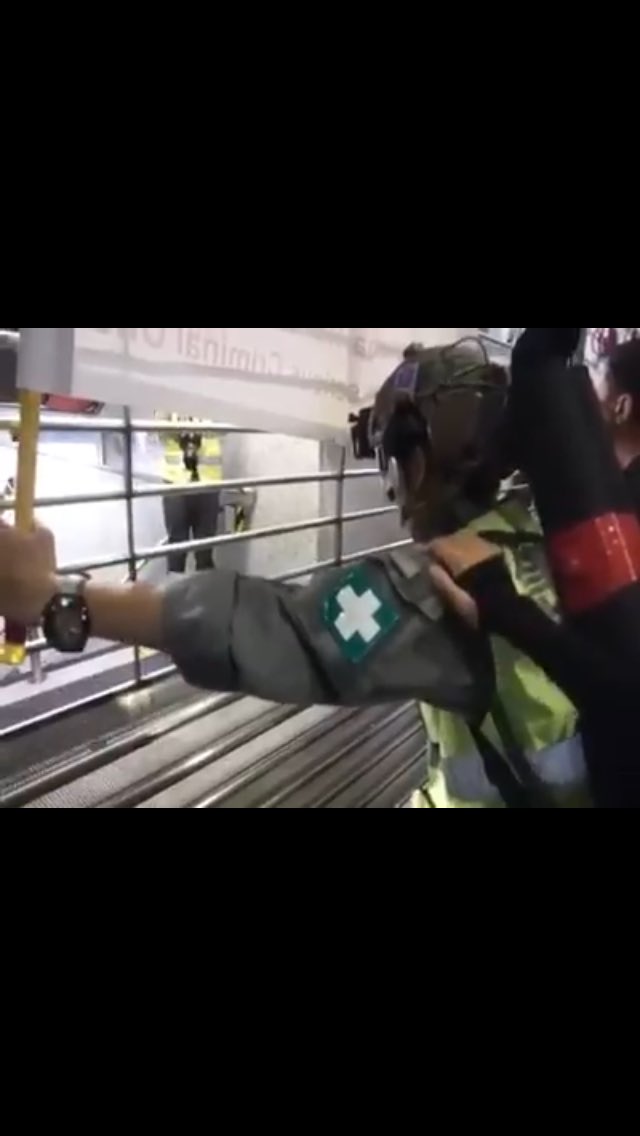
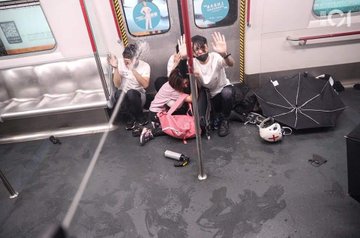
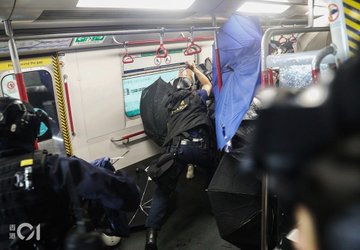
First aiders were not allowed to enter the station to provide immediate medical care for the injured citizens inside the station. The first aiders standing-by outside the station confirmed that none of the injured were transported out for proper treatment for over 3 hrs

View image on Twitter

Freedom HK@FreedomHKG

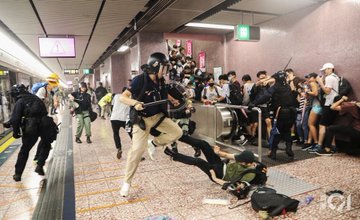
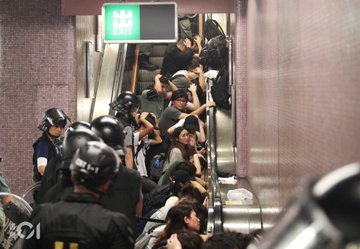
This is murder, not crowd control.

Photo source: hk01

View image on TwitterView image on TwitterView image on TwitterView image on Twitter
357 people are talking about this

World News Tonight

@ABCWorldNews

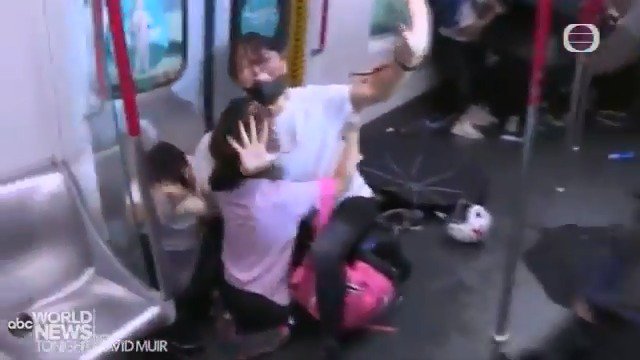
METRO STATION STANDOFF: Shocking video shows riot police in Hong Kong storming a metro station, using batons and pepper spraying protesters inside train cars, as pro-democracy protests continue for a 13th week; several people were arrested. https://abcn.ws/2Ldd58c 

Embedded video

892 people are talking about this

Get Off the Plane: Your Social Credit Score Just Went Negative


Published on Aug 30, 2019

China expands its system of tracking a citizen’s behavior with a social credit score, and limiting his freedoms if it goes negative. Your neighbor reports you smoking a cigarette at your house, and when you try to fly to Hong Kong the flight attendant says, your score is too low, get off the plane. Is this just a dystopian nightmare spawned by communism, or could measures taken by American companies to nudge consumer behavior lead to such a scenario in the land of the free? Right Angle — with Stephen Green, Scott Ott and Bill Whittle — is a production of the Members at BillWhittle.com, who pay to create dozens of new shows each month, run their own Member-written blog, and generally work to advance the message of liberty in the free and communist worlds. Perhaps you should join the team that’s working toward what you believe. Visit https://BillWhittle.com/register/ right now to become a Member.


China warning the Hong Kong Protests are a “Color Revolution”


After 12 weeks of protests in Hong Kong, the likelihood of China sending in troops has escalated. Xinhua News Agency said Sunday in China recalling comments by former top leader Deng Xiaoping saying Beijing has to act under such circumstances. In Sunday’s commentary, Xinhua said Hong Kong’s protests have turned into a Color Revolution aimed at overturning the Special Administrative Region’s constitutional institutions. This is not very accommodative at this point and the protesters have reached an extremely dangerous point.

There is a deep concern here in Asia since we have clients on both sides of this conflict, which is why I am in Asia at this moment in time.  There is a rising fear that if China sends in troops, exactly how long will such a situation play out.

Our key turning points remains unchanged – September, November, and the big one is January coinciding with the turn in the Economic Confidence Model. We do see rising volatility in the currency come October.

The Legacy of Tiananmen Square at 30


Published on Jun 10, 2019

The Tiananmen Square democracy protests in 1989, and the subsequent brutal crushing of the movement by the Chinese government on June 4, remain one of the key moments in China’s modern history. On the 30th anniversary of the protests and the crackdown, what is the legacy of Tiananmen Square, and how has it shaped modern China? How did the Communist Party maintain its grip on power, even while losing legitimacy in the eyes of many at home and abroad? Why has there been no follow-on democracy movement in China over the succeeding third of a century? In an era of populism and nationalism around the world, are there any prospects for a Chinese pluralism that embraces democracy? Hoover Institution Research Fellow Michael Auslin, famed Chinese democracy activist and former political prisoner Wei Jingsheng, student leader of the 1989 Tiananmen Square Democracy Movement Wang Dan, Claremont McKenna College Professor Minxin Pei, and Victims of Communism Memorial Foundation Executive Director Marion Smith discuss the legacy of Tiananmen Square.


Huawei Tech Prepares for 40 to 60 Percent Drop in International Smartphone Shipments…


Bloomberg has an interesting article citing an internal discussion within Chinese technology company Huawei as they estimate the financial impact to the U.S. blacklist position.

Do the math… Huawei estimates an international drop of between 40 million to 60 million units at an average retail cost of $500 per unit. That is a stunning financial forecast for a drop in sales.

(Via Bloomberg) Huawei Technologies Co. is preparing for a 40% to 60% drop in international smartphone shipments as the Trump administration’s blacklisting hammers one of the Chinese tech giant’s most important businesses.

China’s largest technology company is crunching internal estimates and exploring options including pulling the latest model of its marquee overseas label, the Honor 20, people familiar with the matter say.

The device begins selling in parts of Europe June 21 including France and the U.K., but executives are monitoring the launch and may cut off shipments if it sells poorly as expected, they said, asking not to be identified discussing internal matters. Already, two of France’s largest carriers aren’t bothering with the Honor at all, two people familiar with the matter said.

Huawei sales and marketing managers are internally charting a drop in volumes of anywhere between 40 million to 60 million smartphonesthis year, the people said. That’s a big chunk of an international business that in 2018 accounted for almost half of the 206 million phones it moved.

The unusually wide range underscores the uncertainty gripping Huawei, a Chinese national champion that Washington accuses of aiding Beijing in espionage — something the company has repeatedly denied.

The U.S. in May blacklisted Huawei, choking off the American components and software it needs to run its businesses. That includes updates for the Google Android system that powers all its smartphones abroad. Without that software, devices like the Honor 20 wouldn’t be able to run critical apps like Google Maps and Gmail.

[…] Priced at 399 pounds ($500), the Honor 20 runs on the most advanced Android 9 software and is the latest in a line that’s won over budget-conscious consumers, including in the U.S.

[…] Huawei aims to grab as much as half of the smartphone market in China in 2019 to offset the decline overseas, the people said, citing internal discussions about year-end goals.

While the domestic market is shrinking, Huawei hopes to boost shipments by investing in marketing and expanding distribution channels, one of the people said. (more)

$20 to $30 BILLION loss on Smartphones alone.

Hong Kong Leader Carrie Lam Suspends Chinese Extradition Proposal…


~ Dance With The Dragon ~

Amid the furor from hundreds-of-thousands -perhaps millions- of protestors, Hong Kong leader Carrie Lam announces a ‘suspension‘ of the proposed extradition law that would have permitted extradition of Hong Kong residents to Chinese law enforcement.

Lam apologized on Sunday, for the way the Hong Kong government handled the proposal but she did not fully take the controversial law off the table.  The ripple effect of the proposal itself now calls into question the autonomy of Hong Kong, and many observers foresee it is now only a matter of time before China takes a tighter grip.

Currently Hong Kong is not subject to the same economic consequences within the U.S-China confrontation.  As long as Hong Kong is considered ‘autonomous’ they remain detached from U.S. tariffs and other measures targeted to China.  However, if China breeches the increasingly unclear barriers, judicial and legal systems intended to provide that autonomy – well, then the situation could change.  Hong Kong is tenuous at best.

HONG KONG (Reuters) – Hong Kong’s leader Carrie Lam apologized to its people on Sunday as an estimated 1 million-plus black-clad protesters insisted that she resign over her handling of a bill that would allow citizens to be sent to mainland China for trial.

[…] On Sunday, she apologized for the way the government had handled the draft law, which had been scheduled for debate last Wednesday, but gave no further insight into its fate.

[…]  The protests have plunged Hong Kong into political crisis, heaping pressure on Lam’s administration and her official backers in Beijing.

Critics say the planned extradition law could threaten Hong Kong’s rule of law and its international reputation as an Asian financial hub. Some Hong Kong tycoons have already started moving personal wealth offshore.

U.S. Secretary of State Mike Pompeo said President Trump would raise the issue of Hong Kong human rights at a potential meeting with president Xi Jinping at the G20 summit in Japan this month.  (read more)

This controversy couldn’t come at a worse time for Chinese Chairman Xi Jinping as many in the international community are beginning to question the scale of damage likely to increase as an outcome of the U.S. -vs- China confrontation.

President Donald Trump is applying massive economic pressure upon China in an effort to force a complete restructuring of trade terms that will have global implications.  The recent moves by Trump have significantly weakened the supply chain position of a Chinese nation that is dependent on raw materials, and the import/acquisition of technology systems.

As a consequence, on the geopolitical front – Beijing is now threatening any institution that would consider an exit from China, and simultaneously burning massive amounts of cash to subsidize their manufacturing position and offset any tariff impact.

As manufacturing investment begins to shift to South Korea, Vietnam, Japan, Philippines and alternate ASEAN nations, capital is starting to flow out of Hong Kong into safer financial systems within Tokyo and Singapore.

The situation for Chairman Xi is worsening daily and U.S. President Donald Trump has only just begun the consequence phase.

China has never faced a structural economic challenge so comprehensive and simultaneously so consequential.  Decades of central planning by Beijing is being deconstructed by President Trump, and the Chinese have yet to see the worst of it.

Historically the totalitarian Chinese response has been to drop the panda mask and turn to their Red Dragon authoritarian nature.  However, until now they have only faced internal challenges to their systems….

President Trump is applying external pressure, external challenges, and Beijing is discovering when they unleash the Dragon approach into an external global market that is adverse to Dragon instability, the economic systems do not acquiesce.  Instead, with more antagonism and threats the free West responds by quietly discontinuing the relationship.

Beijing has no frame-of-reference, culturally, to understand this dynamic.  Economic systems, based on freedom and capitalistic markets, are like free people… neither like to be threatened and controlled by oppressive regimes.

Stunning how consequential this is in the larger dynamic.