Can Biden Declare Marshal Law To Suspend the Election?


Posted originally on Oct 21, 2024 By Martin Armstrong 
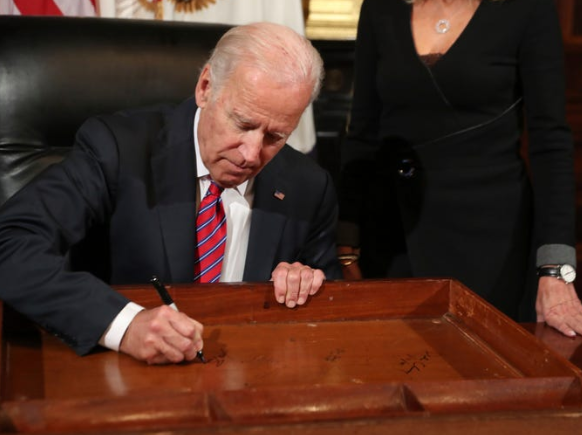
Biden Signs Executive Order

QUESTION: Marty, you are a constitutional scholar. I heard your father was quite brilliant and defended the Constitution, even going against McCarthy. I would like to hear your legal opinion on the topic: Can Biden declare Marshal Law like Zelensky and postpone the election?

DR

ANSWER: YES! The question of the constitutional status of martial law was raised during World War II by the proclamation of Governor Poindexter of Hawaii on December 7, 1941. He suspended the writ of habeas corpus and delegated to the local commanding General of the Army all his own powers as governor and also “all of the powers normally exercised by the judicial officers . . . of this territory . . . during the present emergency and until the danger of invasion is removed.” Two days later, the Governor’s action was approved by President Roosevelt. The regime which the proclamation set up continued with certain abatements until October 24, 1944.

During the Civil War, when it was over, a divided Court, in the elaborately argued Ex parte Milligan, 71 U.S. (4 Wall.) 2 (1866), was truly an important case that effectively ruled that the use of military tribunals to try civilians when civil courts are operating is unconstitutional. This also means that during war and courts can be closed, the all bets are off. The Court’s opinion bearing on this point is the following:

“If, in foreign invasion or civil war, the courts are actually closed, and it is impossible to administer criminal justice according to law, then, on the theater of active military operations, where war really prevails, there is a necessity to furnish a substitute for the civil authority, thus overthrown, to preserve the safety of the army and society; and as no power is left but the military, it is allowed to govern by martial rule until the laws can have their free course. As necessity creates the rule, so it limits its duration; for, if this government is continued after the courts are reinstated, it is a gross usurpation of power. Martial rule can never exist where the courts are open, and in proper and unobstructed exercise of their jurisdiction. It is also confined to the locality of actual war.”

Chief Justice Chase declared that Milligan’s trial was void because it violated the Act of March 3, 1863, governing the custody and trial of persons who had been deprived of the habeas corpus privilege. He declared the belief that Congress could have authorized Milligan’s trial. The Chief Justice wrote:

“Congress has the power not only to raise and support and govern armies but to declare war. It has, therefore, the power to provide by law for carrying on war. This power necessarily extends to all legislation essential to the prosecution of war with vigor and success, except such as interferes with the command of the forces and the conduct of campaigns. That power and duty belong to the President as commander-in-chief. Both these powers are derived from the Constitution, but neither is defined by that instrument. Their extent must be determined by their nature, and by the principles of our institutions. . . .”

If we dive into this question, we find that two theories of martial law have been reflected in decisions of the Supreme Court. The first originated from the 1628 Petition of Right, 1628 that provides that the common law knows no such thing as martial law, Sterling v. Constantin, 287 U.S. 378 (1932).

“The nature of the power also necessarily implies that there is a permitted range of honest judgment as to the measures to be taken in meeting force with force, in suppressing violence and restoring order, for without such liberty to make immediate decision, the power itself would be useless. Such measures, conceived in good faith, in the face of the emergency and directly related to the quelling of the disorder or the prevention of its continuance, fall within the discretion of the Executive in the exercise of his authority to maintain peace.” Id. at 399–400.

In other words, martial law is NOT established by official authority of any sort. Therefore, martial law arises from the nature of things, being the law of paramount necessity, leaving the civil courts to be the final judges of necessity, id/287 U.S. at 400–01.

Then, we have the second theory, which states that supreme political authority can validly and constitutionally establish martial law during wartime. In the early years of the Supreme Court, the American judiciary embraced the latter theory as it held in Luther v. Borden, 48 U.S. (7 How.) 1 (1849) that state declarations of martial law were conclusive and were NOT subject to judicial review, id/48 U.S. (7 How.) at 45.  The Court wrote:

“whenever a statute gives a discretionary power to any person to be exercised by him upon his own opinion of certain facts, it is a sound rule of construction that the statute constitutes him the sole and exclusive judge of the existence of those facts.”

In this case, the Court found that the Rhode Island legislature had been within its rights in resorting to the rights and usages of war in combating insurrection in that state. Although the decision in the Prize Cases, 67 U.S. 2 Black 635 635 (1862), did not directly deal with the subject of martial law, it nonetheless gave national scope to the same general principle.

Therefore, reviewing these decisions, I would have to say that while it would be controversial, the government could call this a necessity if they can get Russia, China, North Korea, or Iran to declare war or attack before January 20th, and they could declare Martial Law.
Todd Bensman Reporting Live From Tapachula, Mexico


Posted originally on Rumble By Bannons War Room on: Oct 18, 2024 at 700 pm EST

Benjamin Roberts Breaks Down How NGOs And Charity Groups Are Facilitating The Migrant Crisis


Posted originally on Rumble By Bannons War Room on: Oct 14, 2024 at 7:00 am EST

Phillip Patrick: “The Cost Of Living Under The Biden Admin Has Risen 20% In 3 And A Half Years”


Posted originally on Rumble By Bannons War Room on: Oct 08, 2024 at 06:00 pm EST

Ben Bergquam Talks to Voters in East Palestine About How the Biden/Harris Regime Abandoned Americans


Posted originally on Rumble By Charlie Kirk show on: Oct 05, 2024 at 8:00 am EST

Natalie Winters: FEMA Gives Aid To Migrants Awaiting Deportation


Posted originally on Rumble By Bannons War Room on: Oct 05, 2024 at 07:00 pm EST

UPDATE: USMX and Dock Workers Negotiate to the Strike Deadline


U

Posted originally on the CTH on September 30, 2024 | Sundance 

On one side you have the International Longshoreman’s Association (ILA), which represents 50,000 East and Gulf Coast dockworkers.  On the other side you have the U.S. Maritime Alliance, or USMX, an organization bargaining on behalf of the port owners, container owners and corporations.  In a few hours the ILA is scheduled to strike against USMX.

A late breaking development:

[SOURCE] – [pdf Specifics]

I am not sure how this is going to eventually end but suffice to say at least a one-week strike is built into the current dynamic.  I doubt any last-minute negotiations will stop that from happening, but you never know.

Below is a video reflecting the firm position expressed by ILA President Harold J. Daggett, who represents the interests of the workers.  There are many who may not like the tone or expressed strike intent of Mr Daggett; however, given the nature of modern corporatism as it stands, what workers have been doing hasn’t been working to change the dynamic.

Here is the full video interview:

East Coast Dock Workers Scheduled to Strike Starting Tomorrow


Posted originally on the CTH on September 30, 2024

First, my perspective for new readers.  I generally support private sector labor unions. I did not always support them.  I do not support public sector unions, nor the leadership of most labor unions in general who politicize their activity.  In our modern era, the baseline for organized labor to support the interests of their blue-collar workforce is valid.

Against the backdrop of the larger geopolitical dynamic, I would make the case that, similar to the solidarity movement of the mid 1980’s, organizing the general workforce is going to be the last-resort backstop measure to block ideological western government and corporate intentions.

Populism, nationalism and MAGA specifically, needs a unity alliance with organized private sector labor.

I also believe President Trump sees the looming importance of this relationship as made visible by his support for the Teamsters union during the RNC convention.

Consider what we witnessed and endured with the forced worker vaccination programs of 2021.  I do not like the idea of politicized labor but contemplate how organized labor could have been used to pushback against the diminishment of liberty. There is a potential for value; thus, I evaluate organized apolitical labor as a potential pragmatic ally.

That said, let us discuss the looming strike by The International Longshoreman’s Association, which represents 50,000 East and Gulf Coast dockworkers.

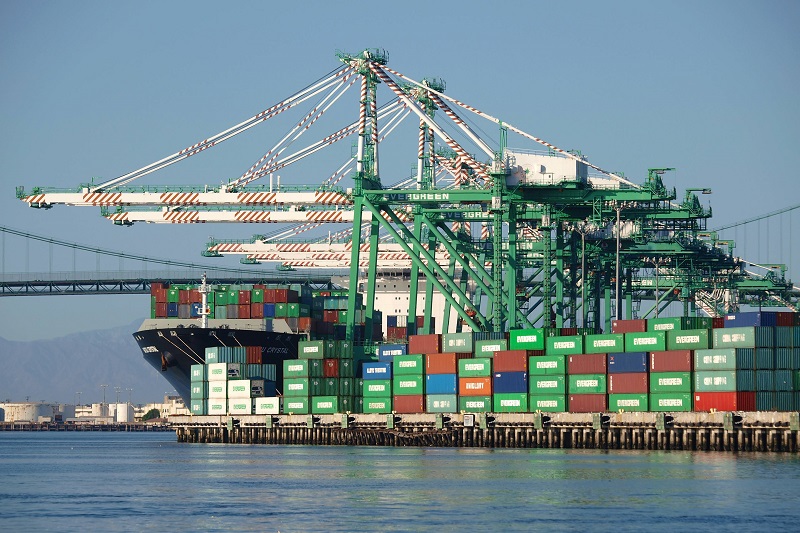
There are a lot of economic impacts that can be created by a dockworker strike; they range from inconvenient to severe depending on the industry and sector therein.  With the U.S. manufacturing base diminished, imported goods now represent the system to deliver essential products into our nation.

Example: Within the network of essential goods, refined fuel is a critical component.  I am not sure how the Port of Tampa and Port of Everglades would be impacted, but most fuel deliveries into Florida come from these two ports. I would consider fuel a vital and essential product.  Stop the offloading of fuel and things can get sketchy quickly for the Florida economy.

On a global scale, stopping the export of USA generated Liquified Natural Gas (LNG) could be a potential problem for Europe. The EU is now dependent on non-Russian energy stores, the USA exports are a component of those needs.  The U.S. Maritime Alliance, or USMX, an organization bargaining on behalf of the dockworkers’ employers, claims that only 25,000 workers will be impacted by the likely work stoppage. I don’t think we quite know which sectors would be most affected.

On the agricultural side, deliveries of perishable imports like bananas would likely lead to almost immediate price increases if those products were stopped.  However, the USA produced farm products would likely drop in price if exports stopped and could potentially offset any increase in import price for agriculture goods at retail.  Again, bottom line – no one is sure the impact.

♦ One angle is predictable.  If there are shortages of goods that create problems for those in politics, hurricane Helene will likely be used as an excuse for supply chain disruption.  It will be difficult to gauge the accuracy of any deflective claim.  The ability to deflect this scenario, it’s not the ports – it’s the bridges and roads, can be exploited by the Biden administration.

The Wall Street corporations have a narrative to push, represented by ABC News:

[…] A strike lasting a matter of months could cause a shortage of raw materials that brings some manufacturing activity to a halt, leading to layoffs at affected plants as well as in related industries such as shipping and logistics, some experts said.

“If there aren’t shipments to pick up, it would have a boomerang effect across the whole nation,” Bill Stankiewicz, owner of Georgia-based logistics consulting company Savannah Supply Chain, told ABC News.

At the heart of a potential disruption, shortages of parts would prevent manufacturers from assembling and shipping out final products, Miller said. The auto sector would be heavily impacted but the slowdown would affect “all types of industries,” he added.

“If you start having a very extended strike you’ll be looking at temporary layoffs because plants can’t get their parts,” Miller said.

Kamins echoed concern about manufacturing workers. Still, such an outcome would only result from a prolonged strike, he said.

In 2002, a strike among workers at West Coast ports lasted 11-days before then-President George W. Bush invoked the Taft-Hartley Act and ended the standoff. However, the last time East and Gulf Coast workers went on strike, in 1977, the work stoppage lasted seven weeks.

“Conceivably, some manufacturing workers could be affected,” Kamins said. “That would be many months down the road. I’d be surprised if it gets to that point.” (LINK)

In the bigger picture, while we are unsure of the specific and/or granular impacts, I am cautiously optimistic the outcomes of a general labor strike by the longshoremen can be of benefit in solidifying the strategic value of an organized workforce.

There may be a time in the not-too-distant future when Americans as a whole need to repeat the approach of the Solidarity movement in order to defeat the enterprise of weaponized government intent on oppression.

All other attempts to raise valid grievances, stop insane policies, and demand a voice at the table have seemingly failed. President Trump represents our last effort for reasonable cohesion.

Last point, an awakened American public know President Donald J Trump could stop this labor conflict. WATCH:


Chmielenski: “Our Nation’s Immigration Policies, Both Legal And Illegal, Are Hurting Americans.”


Posted originally on Rumble By Bannons War Room on: Sep 28, 2024 at 01:30 pm EST

Natalie Winters: Biden/Harris Immigration Policy Is A War Crime


Posted originally on Rumble By Bannons War Room on: Sep 27, 2024 at 05:30 pm EST