
Posted originally on the CTH on September 1, 2026 | Sundance |
Within 12 hours of the Friday announcement that Canada had walked away from trade discussions with the U.S, we were able to piece together what the four points were. Several people disagreed and claimed something else was involved. Today, Prime Minister Mark Carney affirmed specifically the accuracy of those four points.
While Prime Minister Carney used his verbose gaslighting to describe them, you can listen for yourself. It boiled down to four issues: [1] U.S. streaming services writing code for “search engines” in the French language (cultural issue). [2] The U.S. having a right to reject a trade deal made by Canada with a non-market economy, ie. CHINA. [3] Removal of tariffs on Canadian assembled heavy trucks, semi-trucks and industrial trucks (not in the auto sector). [4] Canada demanding 5% of gross revenues from U.S. tech platforms, with an attitude that U.S. controls North American trade.
You can listen to his own words describing these issues. WATCH:
The United States must, as a matter of U.S. national security and survival, immediately cut all trade ties with Canada completely. I’ll explain why this is so critical and important.
The most appropriate metaphor is the drowning victim (Canada) with an intentionally placed anchor on its foot (China), now becoming a threat to the rescue swimmer (USA). If we don’t cut ties, we risk our own livelihood.
Here’s the four counterpoints:
♦The Stupid French Language thing. The French language stuff was an ancillary aspect where the Canadian Cultural Police were demanding that all U.S. streaming platforms (YouTube, Netflix etc.) must have search engines using the French language so Canadian users can search for stuff to watch using the French language. A ridiculous issue that was not part of the trade discussion, but Mark Carney saw political value in blowing up the issue.
This is really stupid, because when you buy your hardware (TV, Phone, Computer etc.) it asks you what language or country during set up. If you live in France, you put France. The operating system does the rest. We don’t code search engines for French in FRANCE because the OS does it! But Canada was requiring U.S. tech companies (streaming services) to install search features in French [I guess so they can set up the OS in English but get some ancillary feature.] It was a stupid “side paper” in the Intellectual Property sector of the trade discussion.
♦U.S. Right to Limit Canadian Trade Deals. This point is exponentially ridiculous for Canada to be upset about because the current USMCA/CUSMA already has that clause. The U.S (or Mexico) can exit the USMCA if Canada enters into a trade agreement with a “non-market” economy, ie China. [USMCA Sec 32:10]
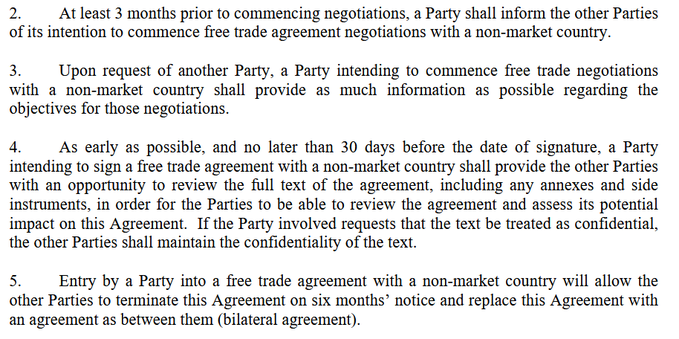
Canada was already in violation of the USMCA/CUSMA when they entered into a trade agreement with China and agreed to import Chinese EVs. This action triggered the U.S. to become more focused on the stuff Canada was going to import; hence, the renewed emphasis on the clause.
This is critical. It’s not an ancillary issue. The Carney administration had requested “Fortress North America” a synergetic alignment of U.S-Canada trade principles. Canada claimed they wanted a united North American continent against the world on trade. Therefore, this talk of Canada being upset about joint collaboration and agreement on trade agreements with third countries, a point brought up repeatedly by Carney just doesn’t make sense.
If Canada wanted to join a united trade policy for North America, where each nation is anchored to the $31 trillion U.S. market, then each nation in North America must hold the same baseline trade agreement with third parties, other nations. Those were previously agreed principles; until all of a sudden Canada accused the U.S. of dictating terms and violating its sovereignty.
♦U.S. tariffs on Canadian “heavy use trucks”. This is not the “auto sector” despite Canada trying to make heavy duty trucks part of it. These tariffs are on industrial trucks, farm equipment, heavy trucks and semi-trucks. The U.S. said no, these are not autos and auto tariffs do not apply.
The reason is simple. Tractors, heavy industrial trucks, big rigs assembled/built in Canada are compromised when built in Canada. Why? Because they are full of cheap Chinese component goods and parts that wear out quickly. The U.S. wants two things on this issue. Either: (1) Make heavy industrial trucks in the USA, or (2) stop using cheap Chinese component parts. Failing to do so retains tariffs.
The parts that Canada are using are not even available in the USA because we tariff and reject them, so why should we accept them when Canada installs them? Either quit using Chinese parts (hence, the trade alignment against Chinese imports) or accept a tariff equal to the rate we would apply if the product was coming directly from China. This is the USA approach to that specific sector of heavy trucks.
SUMMARY: Yes, the United States dictates the terms for North American trade, because the United States is the overwhelming center of North American trade and consumer spending. The USA is the market, and Canada has an entire economy about the size of Texas. It is ridiculous to contemplate that the Canadian government can dictate terms against the U.S. economy, and we have no option other than to adhere to them out of some demanded politeness.
Enough already. Announce the termination of the USMCA.
- Build a North American fortress.
- Secure the Western Hemisphere.
- Exit NATO.
- Respectfully engage with each bilateral interest as a sovereign nation.
Posted in Auto Sector, Big Government, Canada, Cultural Marxism, Culture, Donald Trump, Economy, Election 2026, European Union, media bias, NAFTA, Notorious Liars, President Trump, Professional Idiots, propaganda, Trade Deal, Uncategorized, US Treasury, USA, USMCA

