
Posted originally on Feb 1, 2026 by Martin Armstrong |
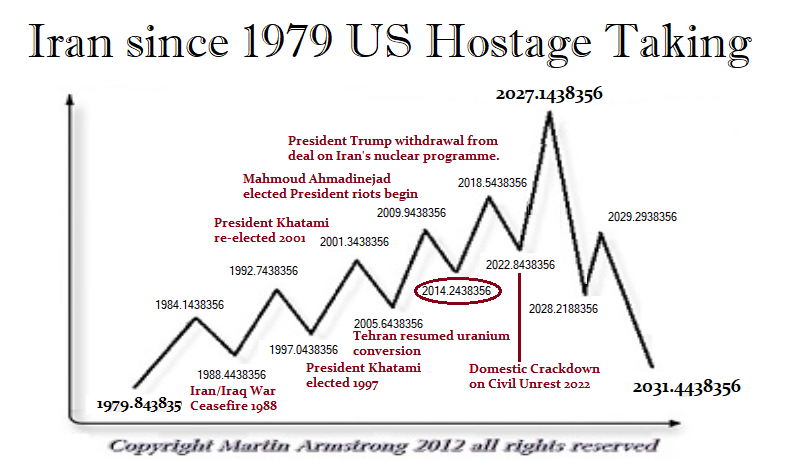
QUESTION: Do you still see the risk of a Middle East War by 2027?
HF
ANSWER: Unfortunately, yes. I will do a Report on the Middle East for 2026.
The Paradox of a Regime That Can’t Afford Peace
Let me start with the question everyone’s asking wrong: “Will Iran start another war with Israel?”
Wrong question. The right question is: Can Iran’s regime survive WITHOUT war?
The answer is no. And understanding why reveals everything about what’s coming in 2026 and beyond. Iran is facing its worst domestic crisis since the 1979 Revolution. As we have witnessed, starting December 28, 2025—just six months after the war—massive protests erupted across all 31 provinces. What began as economic demonstrations over hyperinflation and currency collapse rapidly evolved into demands for wholesale regime change. This isn’t like 2009’s Green Movement or 2022’s protests after Mahsa Amini’s death. This is different.
The economic devastation from sanctions, war damage, and decades of mismanagement has severed the social contract even with traditional regime supporters—the Bazaaris (merchant class) who helped bring Khomeini to power in 1979. When you lose the Bazaar, you’ve lost Iran. The shopkeepers shuttering stores in Tehran’s Grand Bazaar aren’t revolutionaries—they’re businessmen who can no longer operate because inflation destroyed the currency and the economy is broken. By early January 2026, Iranian police detained over 21,000 suspects during the unrest, including 260 accused of spying and 172 for illegal filming. Several Kurdish men were executed publicly for alleged collaboration with Israel.
Think about that. The regime is executing people for “collaboration” while simultaneously trying to rebuild military capabilities to fight Israel again. That’s not the behavior of a confident government. That’s desperation.
Why War Becomes Necessary
From a cyclical perspective, Iran’s regime is trapped between two lethal forces:
External Pressure:
Nuclear program set back 1-2 years (rebuilding frantically)
Proxy network (Hezbollah, Hamas, Syria) decimated
Direct military confrontation exposed defensive weaknesses
U.S. and Israel signaling willingness to strike again in 2026
Regional Arab states increasingly skeptical of Iran as stabilizing force
Internal Collapse:
Hyperinflation destroying purchasing power
Water scarcity creating agricultural crisis
Youth unemployment astronomical
Brain drain of educated class
Massive protests demanding regime change
Even security forces expressing financial desperation (viral videos of police officers describing severe hardship)
 Centinel2012