Posted originally on CTH on May 10, 2026 | Sundance
Bumped and Updated as more of the transcript is now available.
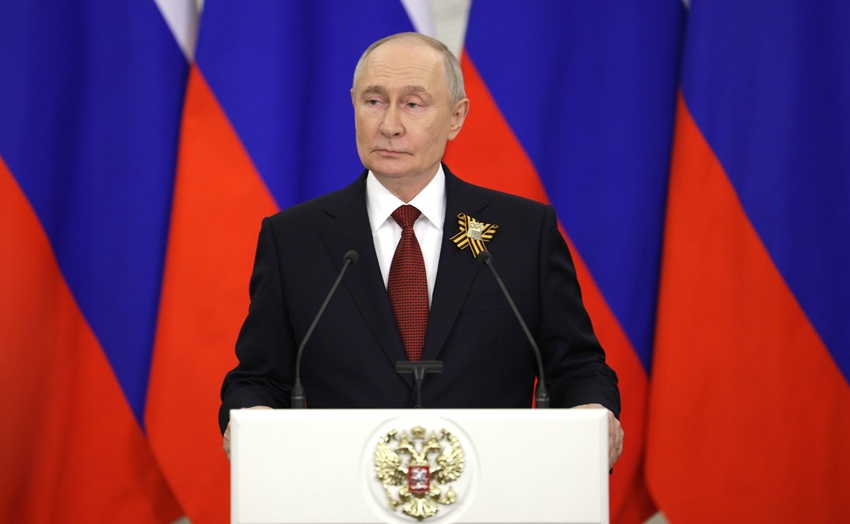
Reports are beginning to surface about Russian President Vladimir Putin saying the end to the special military operation in Ukraine is close. I am embedding the full press conference video below as only part of his remarks has been translated and transcribed.
President Putin is asked for his overall impressions of the Victory Day events, and the context of the ceasefire against the backdrop of a request by U.S. President Donald Trump. As with most things Russian, the nuance is often between the lines.
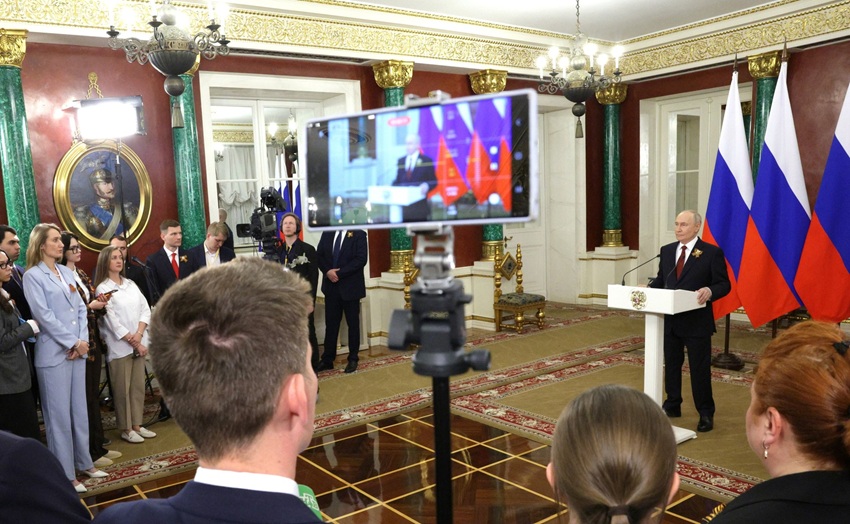
[RU Transcript] – “President of Russia Vladimir Putin: Good evening. Happy holiday once again, happy Victory Day.
Question: Let me start with today and the way you view it, if I may. Today is a great and momentous day. Earlier, US President Donald Trump came up with an initiative to declare a three-day ceasefire. You supported it, so did Zelensky. However, on the eve of May 9, there were still a number of grave and provocative statements coming from Kiev.
How would you assess today and the way events unfolded? Even the military parade was held in a somewhat reduced format due to security concerns. Could you share your overall assessment of the day? Were there any provocations?
Vladimir Putin: As for provocations, as you can see, I am here, and so far, the Defence Ministry has not reported anything of that nature to me, so I cannot comment on it.
Regarding the parade. You know that this year – which is not an anniversary year but nevertheless it is Victory Day – we decided that the celebrations would go ahead in any case but without a display of military hardware, and not for security concerns but primarily because the Armed Forces should focus on the decisive defeat of the enemy within the framework of the special military operation.”
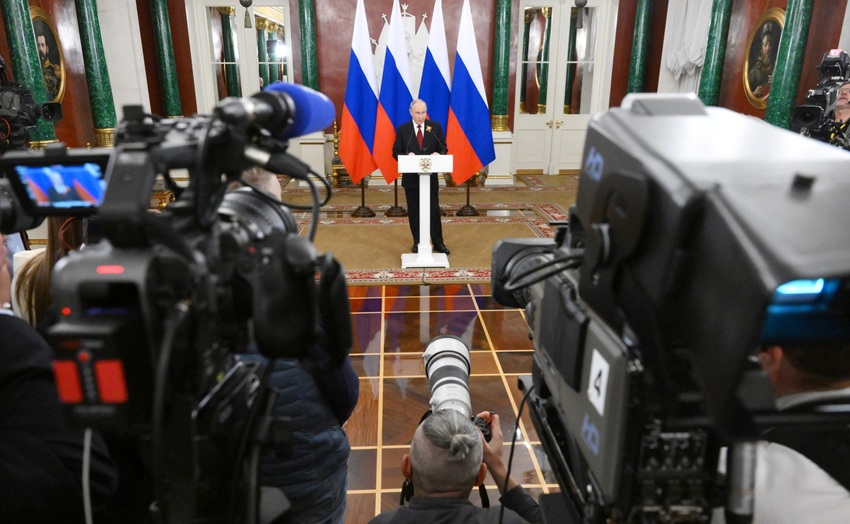
“As for the provocative statements, all of those decisions had been made much earlier than all those provocative statements were issued, as you said.
As for the statements, we have responded to them, as you know. The Defence Ministry issued a certain initial statement – it is well known – that in case an attempt were made to disrupt our celebration events, we will respond with massive missile strikes on Kiev. Was there anything unclear about it? This is what was intended to be a response.
We did not limit ourselves to it. It was followed by a Foreign Ministry’s note, which is an official document, not just a declaration. But we did not stop there. We started working with our major partners and friends, primarily with our friends from the People’s Republic of China, India and some other nations, including with the US administration. What did this work involve? We simply presented our friends, colleagues, and partners with a picture of what the situation could develop into. We have no desire to worsen or damage relations with anyone. Such a situation could arise given that all the command and decision-making centres in Kiev are located in close proximity to the diplomatic missions of a number of countries – several dozen, in fact. That is precisely the issue. When we began this dialogue with the US administration, we drew their attention to this matter, outlined the potential consequences, and asked them to do everything necessary to ensure the security of their country’s diplomatic mission.
As a result of all these discussions, US President Donald Trump proposed an additional two-day ceasefire and a prisoner exchange during that period.
We immediately agreed to this proposal, particularly because, in my view, it was fully justified, motivated by respect for our shared victory over Nazism, and clearly humanitarian in nature.
By the way, a few days earlier, on May 5, we had also submitted a proposal for a prisoner exchange to the Ukrainian side and provided a list of 500 Ukrainian servicemen held in Russia. The initial response was that they needed to review the proposal more carefully – perhaps not all 500, but maybe 200 – and after that they effectively disappeared from contact and later stated directly that they were not prepared for such an exchange. They did not want it.
Therefore, when the proposal from US President Donald Trump was put forward, we, of course, immediately supported it. We hope that, in this case, the Ukrainian side will ultimately respond positively to the proposal of the US President. Unfortunately, so far, we have not received any response.”
SEGMENT 2
Alexei Konopko: Good afternoon. May name is Alexei Konopko, Rossiya Channel.
Mr President, you have held a veritable marathon of bilateral meetings. Can you tell us about the main issue addressed during these talks?
If I may, I would like to ask an additional question on a related subject.
Vladimir Putin: Go ahead.
Alexei Konopko: We often saw representatives of one more former Soviet republic, Armenia, at our Victory parades. They have not come this year. But several days ago, Pashinyan met with Zelensky, who used that opportunity to make threats towards Russia.
What is your attitude to this? How can relations with Yerevan develop?
Thank you very much.
Vladimir Putin: Speaking about my bilateral meetings and what they focused on, the main issue for Russia and for other countries, in this case, friendly countries, as we say, whose representatives have come to Moscow for celebration events, was Victory Day. Our conversations focused on it, on the common result we achieved in the fight against Nazism, on ways to perpetuate the memory of heroes of the Great Patriotic War and World War II, and on using this memory as the foundation for efforts to prevent a repetition of these events in the future.
Of course, we also discussed bilateral relations. Of primary importance are certainly our relations with our closest allies and partners – Belarus, Kazakhstan and Uzbekistan.
Our trade with Belarus is more than $50 billion. Isn’t this an impressive figure for a country with barely 10 million of population? There is a great deal we have to discuss; there are really many issues of mutual concern.
This is also true about Kazakhstan and Uzbekistan, which are rapidly developing economies. We have solid plans, including in investment. We have common interests with Kazakhstan in the framework of the EAEU. We also have common interests with the countries whose representatives I have held meetings with, for example, Laos. It is an important partner. Our mutual trade in US dollars is very modest, but the outlook is good, and the country is advantageously located. ASEAN is an important region for us.
There were issues to discuss in each particular case, and the talks were substantive and pragmatic.
As for the plans of Armenia and the Armenian authorities, you know that we have not specially invited anyone because this is not a jubilee. But we forwarded information to all countries saying that we would be glad if they will come, that we do not shut our door to anyone. No official invitations have been sent out, and so not only Armenia but also many other countries that are our good neighbours, partners and friends have not been represented here today. I do not regard this as anything strange.
However, those who have come here have demonstrated a degree of personal courage, because they only learned about certain arrangements, including President Trump’s initiative to extend the ceasefire period, exchange prisoners, and so on, they only learned about a certain easing of tensions after they have come here. They did not know about them before, yet they decided to be here with us, which deserves special respect. However, I would like to repeat that we do not regard the absence of other people as strange.
As for Armenia’s plans to join the EU, this certainly requires special consideration. We discussed it with Prime Minister Nikol Pashinyan on several occasions, and do not see anything strange about it. Actually, he can confirm that I have told him several times, and can repeat this in public now, that we will support everything that will benefit the Armenian people. We maintained special relations with the Armenian people for centuries. And if the Armenian people consider any decision as beneficial, we will certainly have nothing to say against it.
However, of course, we should keep in mind some circumstances that are important both for us and for our partners. What does this mean? For instance, our trade with Armenia has decreased now; it was much bigger last year and the year before last – $7 billion in 2025 was quite good. Given that the country’s GDP is $29 billion, this is a serious amount, and Armenia also enjoys considerable advantages in the EAEU. They concern agriculture, manufacturing, customs and other duties and so on and so forth. They concern migration. And I think it would be right with respect to the people, the Armenian citizens, and to us as its main economic partner, if a decision was made as soon as possible, for instance, at a referendum. This is not our business, but as a matter of principle it would be logical to ask the Armenian citizens what their choice will be. On seeing it we will make the relevant conclusions and take the path of a gentle, intelligent and mutually beneficial divorce.
We are currently living through everything that is happening in respect of Ukraine. And how did it start? It started with Ukraine’s joining or attempting to join the EU. They completed the first stage, only the first stage. Even then we started discussing it, including with the Europeans. We told them: listen, phytosanitary standards are absolutely different in your countries – in the EU – and in Russia. By the way, our phytosanitary standards are much stricter. It is impossible for your products to come to the Russian market via Ukraine. We cannot allow this – at that time we had free borders, a free trade zone with Ukraine – and we will have to close our borders. The same relates to many industrial goods.
Frankly speaking, I was surprised by such a tough, straightforward position on the Europeans’ part. They took a harsh stand: No, no, no on each issue. In the end, the then President Yanukovych read [the association agreement] more carefully, figured it out, and said: No, I am probably not ready for this yet. The reason is that it meant too much damage to the economy of Ukraine. He did not decline to join. He said: I should return to it once again and analyse everything. All this has later led to the state coup, to the Crimean story, to the stand taken by the south-eastern regions of Ukraine, and combat operations. That’s what it’s all led to. It is a serious question.
Therefore, they should not take it to the extreme; they just need to say in a timely manner that they will do this and that. There is nothing strange in it. Everything must be calculated. Both by the Armenian side and our side should do it. While I am answering I think that this issue may well be raised at the next EAEU summit.
Andrei Kolesnikov: Good afternoon. My name is Andrei Kolesnikov, Kommersant.
Vladimir Putin: Good afternoon.
Andrei Kolesnikov: Mr President, you said some time ago that you would announce a ceasefire from May 8.
Vladimir Putin: Yes.
Andrei Kolesnikov: And Zelensky immediately said that he would announce a ceasefire from May 6. You have not said anything to that. Why?
And one more thing. The media wrote that Robert Fico was to convey a message to you from Vladimir Zelensky. Has he conveyed it? Nothing has been said on this score. We don’t know anything. Maybe it is because you still need to force yourself to deal with Vladimir Zelensky?
Thank you.
Vladimir Putin: First, about the ceasefire. The issue of May 9 celebrations was raised during my latest telephone conversation with US President Trump. Incidentally, I think he spoke very well about that. He recalled our alliance in the fight against Nazism.
I told him about my plans to declare a ceasefire on May 8 and 9. Why May 8? Because victory is celebrated in Europe on May 8, and Ukraine has accepted this too, and I think that they now celebrate Victory Day on May 8.
But this is not important. What matters is that President Trump actively supported that initiative, which we made public a day later. However, our announcement has not produced any reaction. A day or two later, when Kiev considered the matter and saw that the US Administration supported our idea, they saw fit to react to it. How could they react? They probably deemed it unprofitable to simply accepting our initiative, and that is why they advanced their own idea, a ceasefire starting May 6.
You know that May 9 is not a comedy show combined with piano playing for us in Russia. It is a sacred day for us because every family has suffered. The Russian Federation has lost about 70 percent out of the 27 million lives laid on the altar of Victory in the Soviet Union. According to post-war documents, the Russian Federation lost nearly 70 percent or more precisely more than 69 percent.
How many lives has Russia lost if the total number is 27 million? Nearly 19 million lives. Of course, this is an event that concerns every citizen of the Russian Federation, every family. We are not playing games here.
We made our proposal, and there was no reaction for two days. And then they suddenly started playing games. We don’t play such games.
However, since the US President later proposed a prisoner swap, which we also suggested doing on May 5 – you can ask [FSB Director Alexander] Bortnikov, who won’t conceal that we sent a list of 500 names – we welcomed the idea and were ready to implement it. And we did so. We extended the ceasefire for two days hoping to exchange prisoners. I hope that we will ultimately do it.
What was the second part of the question about?
Andrei Kolesnikov: It is about the message.
Vladimir Putin: Yes, Mr Fico told me about it; he told me about his meeting. Actually, there was no special message, I just heard once again that the Ukrainian side, Mr Zelensky, is ready to hold a personal meeting. Yes, I’ve heard it. But this is not the first time that we hear it.
What can I say in this regard? That we have never refused, and I have not refused to hold it. I do not propose this meeting, but if someone does, we are ready for it. Let the one who proposes arrive. Let him come in Moscow, and we will meet.
We could meet in a third country, but only after reaching final understandings on a peace agreement, which should be designed for a long historical perspective, so that a meeting is held to sign it. However, it should be the final point, not negotiations themselves because we know what negotiations themselves are.
I was personally closely involved in this process in Minsk during the drafting of the Minsk agreements. You can talk for hours, endlessly, day and night, and all to no avail. Professionals should work everything out, doing everything to make the documents clear to both sides and coordinate all aspects of these understandings. In this case we can meet anywhere either to put the signature or to attend the signing.
Alexander Yunashev: May I ask for more details about Ukraine?
Vladimir Putin: You are welcome.
Alexander Yunashev: Alexander Yunashev, Live.
Good afternoon, Mr President. Happy holiday.
Vladimir Putin: Good evening.
Alexander Yunashev: In view of what you have said about negotiations, what do you think, in general, about continuing to work with the Americans on the settlement of the Ukraine conflict? The pause has been protracted; the last round of talks took place in winter. Given that Rubio said that maybe it is not worth investing time in it at all.
Vladimir Putin: Listen, this primarily concerns Russia and Ukraine. If someone wants to help us and is doing so, and we can see that the current US Administration and the US President are sincerely, I want to emphasise it, seeking a settlement – they obviously have no need for this conflict, and have many other priorities – then we can only be thankful to them. However, this is, above all, a matter for Russia and Ukraine.
Pavel Zarubin: Good evening. Pavel Zarubin, Rossiya Channel.
The developments around Iran have been the hottest international topic for the past two and a half months, of course. How will the situation in the Middle East, in the Persian Gulf will develop? Do you think there is a real possibility of a peace agreement between the United States and Iran?
I also can’t help but ask this question. You have recently said that the terrorist threat is growing, meaning the Kiev regime. We can see that such strikes are targeting cities located far away from the border, such as Yekaterinburg, Perm, and recently, Cheboksary. Is the West going too far? The West has admitted that the Kiev regime would not have survived several days without its support,
Thank you.
Vladimir Putin: What exactly is the West? I believe that it is the so-called globalist part of the Western elites. It is them who are fighting against us by proxy of Ukraine. They have it pretty good in this respect, of course, having provoked this conflict. I have already spoke about how it all started. I have not invented anything about the initial reference point. Strangely, it all began with Ukraine’s decision to join the EU. They could go ahead by all means, but this has led to a military conflict. Why has this happened? Because they had no regard for Russia’s interests whatsoever.
Moreover, seeking to use Ukraine as an instrument for attaining their geopolitical goals, these people in the West lied to everyone, as they have now openly admitted. They started to lie to us about the non-expansion of NATO to the east at the beginning of the 1990s. They told us that NATO would not move a single step eastward. Well, where are they now?
Taken together, all this has provoked the current situation. They are fighting against us, which has become clear to everyone, by proxy of Ukraine.
We have recently discussed this issue with our colleagues, remembering how it all started. We concluded an agreement with the Ukrainians and initialled it in Istanbul in 2022. And then one of my colleagues – frankly, it was Macron who did it – called me and said, “Ukraine cannot sign such documents with a gun to its head.” This is a direct quote; we have the tape of that conversation. I asked him, “What should we do?” He said, “Can you withdraw troops from Kiev?” We have done it. One member of the show business popped up, the then Prime Minister of Britain. What did he say? He said that the agreement cannot be signed because it is unfair. Who says what is fair and what is not? Why is it unfair if the head of the Ukrainian negotiating team has initialled the document? Who is the judge? Next, they promised assistance [to Ukraine] and started fostering confrontation with Russia, which is continuing to this day. I believe that the matter is coming to an end, but this is really a serious matter.
The question is why they are doing this. First, they expected a “crushing defeat” of Russia, as we know, the collapse of Russian statehood within a matter of several months. It did not work out. And then they got stuck in that groove, and now they cannot get out of it. That’s the problem. There are certainly clever people over there, those who certainly understand the essence of the current events. I hope that these political forces will gradually return to power or will take power into their own hands with support from the overwhelming majority of European countries.”
Regarding relations between Iran and the United States, this is a highly difficult and complex conflict. It places us in a sensitive position because we maintain good relations with Iran and, without exaggeration, friendly relations with the countries of the Persian Gulf. We remain in contact with all sides and hope this confrontation can be brought to an end as quickly as possible.
In my view, there are no longer many actors interested in prolonging this conflict. Of course, we understand that any agreements must take into account the interests of all nations and states in the region. There are different options, and while I would prefer not to discuss specific scenarios as we see them now, it is possible to imagine what form they can take and that they can be reached.
By contrast, if the situation continues to escalate into a higher level of confrontation, everyone stands to lose.
Segment 3
Rossina Bodrova: Happy Victory Day! Rossina Bodrova, Zvezda TV Channel.
Mr President, we know there is a “coalition of the willing” supporting Kiev and Ukraine, but recently there also seems to be a growing – or perhaps re-emerging – “coalition of the willing” interested in restoring contacts with Russia. The President of the European Council mentioned this yesterday, adding that they are looking for an ideal candidate to represent Europe in such contacts.
Question: Who would you personally prefer for negotiations? Do you think there are still pragmatic politicians left in Western Europe with whom dialogue is possible?
Vladimir Putin: Personally, I would prefer former German Chancellor Gerhard Schroeder. Otherwise, Europeans should choose a leader they trust, someone who has not badmouthed Russia. We have never closed the door to negotiations. It was not Russia that refused dialogue; it was our counterparts.
Anna Kurbatova: Good afternoon, Mr President. Anna Kurbatova, Channel One.
It is a difficult question, if I may, about what we are seeing now.
Vladimir Putin: Is it really necessary to ask a difficult question? Today is a holiday.
Anna Kurbatova: The skies over the Baltic region are now becoming a corridor for Ukrainian drones. The drones used in strikes against Russia are assembled in factories within the European Union. The Russian Ministry of Defence has even published locations and details. What does Russia intend to do with this information?
And another point – this question has already been asked, but I would like to elaborate: Russia has been expanding a security buffer zone in border regions, but drones continue to strike deeper inside Russia, including places such as Perm, the Leningrad Region, and Tuapse. Does this mean the security zone may need to expand further? Maybe to the western borders of Ukraine, where…
Vladimir Putin: You have answered your own question. Our objective is to ensure that no one can threaten Russia. That is what we will continue to pursue.
We know that Ukraine receives technology from Europe and that some systems are assembled there. They are playing for the upper hand, but judging by what has just been said, they are already seeking contacts with us, realising that this play for the upper hand could be costly.
Please go ahead.
Hassan Nassr: Thank you very much. Hassan Nassr, RT Arabic.
Mr President, I would like to return to the issue of the developments in the Persian Gulf. One of the strict demands the United States continues to insist upon is the removal of highly enriched uranium.
Russia previously offered its own territory as a site for that transfer, but the United States keeps rejecting the proposal. At the same time, Iran has stated that it wants to retain the uranium. Under these circumstances, what solution do you see to this deadlock?
Vladimir Putin: You know, I will let you in on something, although it is not much of a secret really.
Not only did we make such an offer; we already implemented it once before, back in 2015. Iran has complete trust in us, and not without reason. First, we have never violated any agreements, and second, we continue to cooperate with Iran on peaceful nuclear energy programmes. We built the Bushehr [nuclear power plant], which is now operational, and we are carrying on with our work there. Our cooperation in the field of peaceful nuclear energy continues regardless of the current developments. So, we already carried out this arrangement in 2015, and it became the foundation for the agreement reached between Iran and all the interested parties, playing a highly constructive role. We therefore have practical experience in this matter, and as I have already mentioned, we remain ready to do it again.
At the outset – and this is somewhat sensitive information – everyone agreed to the idea: representatives of the United States agreed, as did Iran and Israel. However, later the United States toughened its stance, insisting that the materials be transferred exclusively to its territory. In response, Iran also hardened its own position. Mr Ali Larijani visited [Russia]. Sadly, he has since passed away, which is a great loss. He was someone with whom it was possible to have a constructive dialogue; he listened carefully, and responded thoughtfully. So back then, he arrived and said: “You know, we have revised our position as well. We are no longer prepared to export this enriched uranium anywhere. Instead, we are proposing a new format of cooperation with Russia – establishing a joint venture on the Iranian territory and jointly diluting the uranium there.” I replied: “Okay, that is acceptable to us. The most important thing is reducing tensions.” But I also said that I doubted anyone else – neither the United States nor Israel – would agree to such a proposal. And that is what happened. Frankly speaking, the situation in this area has now reached an impasse.
Our proposals remain on the table, and I believe they are reasonable. Why? First, if everyone agrees to them, Iran could feel fully confident that the materials will be transferred to a friendly country – one that cooperates with Iran and intends to continue cooperating in the peaceful use of nuclear energy. Iran has repeatedly stated that it has no ambitions related to nuclear weapons or other military nuclear programmes. There is also the fatwa issued by the previous Iranian supreme leader, and we have heard repeated public statements on this matter. Moreover, the IAEA has never stated that it possesses evidence showing Iran is pursuing nuclear weapons. At the same time, I believe the other participants in the process could also be interested in such a solution and find it acceptable.
First, everyone would know exactly what materials exist, in what quantity, and where they are located. Second, everything would remain under IAEA supervision. And finally, the process of diluting the uranium would also take place under IAEA oversight, in a transparent and safe manner. For our part, we do not need anything from this. At the same time, we don’t need anything merely to, excuse the expression, flex political muscle and claim that nothing can be done without us. We simply want to make our fair share of contribution acceptable to all sides toward easing tensions.
And if this proposal does not suit everyone, then so be it. In any case, we will support any arrangement or solution that helps break the deadlock and opens the path toward a peaceful settlement. I also believe there are still nuances and areas where compromise is possible, although I will not go into those details right now.
[Transcript (to be continued)].
First, Ukraine was/is apparently worried that returning prisoners may not be in alliance with Ukraine’s war effort. Second, it appears the diplomatic warning provided by President Putin to President Trump was the impetus for Trump suggesting an extended ceasefire. Third, from the way Putin is describing U.S. and Trump contact, it is reasonable to infer the lines of communication are very open.
[You can use the closed captioning option to review the full remarks if you want to get ahead of the FULL transcript release.]