
EXHIBIT SIGN:
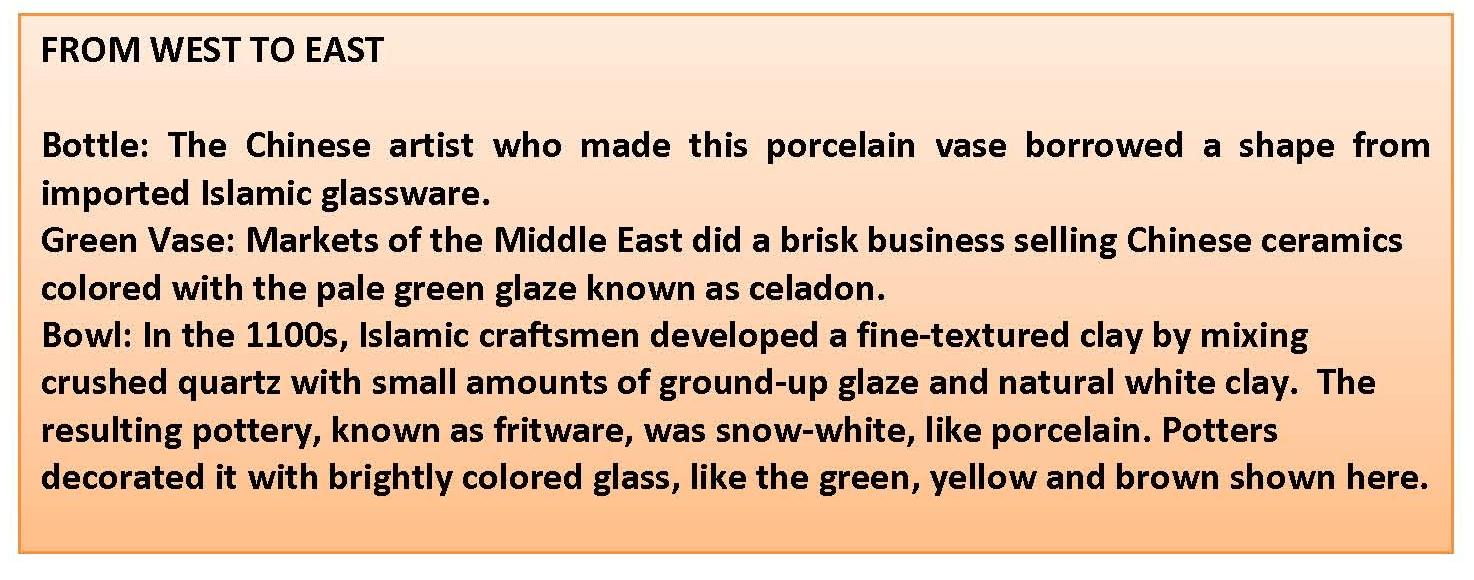
WHAT WASN’T SAID:
1. That glass making originated with the Jewish people, a secret maintained for the next 3,000 years.
2. That it had been considered an Egyptian discovery until an archaeological expedition unearthed the truth, and acknowledged in 1983.
FACTS:
1. The art of glassmaking was born in Akkadia, the Biblical locale in Mesopotamia, home of Terach, father of Abraham, ~2400 B.C.E. It was a Semitic, and then Jewish, art for the next three millennia. Unique among the arts, glassmaking was invented only once in all of human history and its spread was parallel and coincident with the dispersal of the Jews.
2. Manufactured glass was discovered by Dr. R. H. Hall on an archaeological expedition near the ancient city of Eridu, close to Abraham’s purported birthplace of Ur, in the winter of 1918-19. “Only one object of great interest has been found,” reported the astounded Hall, “… In the rubbish beneath the pavement was found a lump of opaque blue vitreous paste which I recognized as true glass… the most ancient piece of glass known.” The object’s date was fixed at between 2047-2038 B.C.E. Later, Akkadian glass, more than two centuries older, was found from buildings and cemeteries of the ancient city of Ur itself.
3. Museums and texts on glassmaking history had always cited Egypt as the birthplace. However, glassmaking depends on thick forests for fuel, requiring several tons of wood to produce just one kilogram of glass, and Egypt had no forests. Further, glass is liquefied silicate stone (quartz), and only a reverberatory furnace (absent from ancient Egypt technology) could achieve and maintain the necessary temperatures of 1200 degrees Celsius. Further, glassware couldn’t suddenly appear in 1500 BCE in 18th Dynasty tombs without a trace of hundreds of years of necessary development. Finally, there is no word for “glass” in Egyptian language (scribes used the Akkadian term) and there was no cobalt, the coloring for the glass, available in Egypt.
4. In 1983, Donald B. Harden, author of the catalogue of the British Museum’s collection of Greek and Roman Glass, finally removed all doubt, admitting, “During my two years at Ann Arbor and the next winter season on the excavating staff in Egypt, I naturally became too Egypto-oriented.”
5. Once manufactured, glass is easily melted and reformed into glassware. Delicate glassware was not transportable, but beads or amulets were. A Canaanite merchant vessel was found off the Turkish coast at the turn of the 14th century, with tons of cargo of glass ingots and eye-beads (beads overlaid with concentric rings of colored glass). Glass was produced in Israel and Judah, and transported by Canaanites, whom Greeks called Phoenicians – “purple,” from the purple-stained hands and clothes of those who made purple dye.
6. Egyptians and Greeks made advances in glassmaking; Romans brought glass into everyday life by making it transparent at a lower temperature. They manufactured in bulk and transported throughout the Roman Empire via their vast trading infrastructure. The Roman love of glass evolved into the glass window, providing protection from the elements while delivering light. They developed the mirror at a lower cost, increasing effectiveness and longevity.
7. Roman innovation developed into glassblowing to produce delicate creative shapes, and into clear drinking vessels, for color, transparency and wine clarity.
EXHIBIT SIGN:

FACTS:
1. The first evidence of this significant historical milestone was recovered from the 5th century BCE grave at Lo-yang. Glass beads to wear in the next world were among the artifacts buried with the deceased. The Chinese had no knowledge of glassmaking at that time.
2. The beads were typical of eye beads made in Israel – overlaid with concentric rings of colored glass – and distributed around the Mediterranean by Canaanite seafarers (Phoenicians)
3. Late BCE eye-beads found in Europe and the near East paralleled those found in China. The technique and composition of eye beads traded across Eurasia validates their common Near-Eastern origin.

4. Persian Jews were merchants in Uzbekistan, the Central Asian Silk Road in Bukhara and Samarkand (areas mentioned in exhibit, improperly credited), where major trading posts were established. Evidence of thriving Jewish settlements was found along the Eastern Silk Road, into Kaifeng, China (which included synagogues and Hebrew documents). For the next thousand years, Jewish glassware and linens were the principal goods exchanged for the silk and spices of China and India.
5. Arabs traded with a variety of merchants and are known for taking proprietorship of the items produced by the peoples they conquered: Africans, Greeks, Jews; Jews traded with Persians, Georgians, Uzbeks, Chinese; Chinese traded with Indonesians, Thais, Sri Lankans. Bloodlines merged; cultural practices and foods were integrated, all blending to form the Great Silk Road.
EXHIBIT SIGNS:
FACTS:
1. Pottery originated during the Neolithic Ceramic objects like the Gravettian culture Venus of Dolní Věstonice figurine discovered in the Czech Republic date back to 29,000–25,000 BC, and pottery vessels discovered in Jiangxi, China date back to 20,000 BP (before present). Early Neolithic pottery has also been found in Jomon Japan (10,500 BC), the Russian Far East (14,000 BC), Sub-Saharan Africa and South America.
2. Pottery was in use in ancient India, including areas now forming Pakistan and northwest India, during the Mehrgarh Period II (5,500-4,800 BC) and Merhgarh Period III (4,800-3,500 BC), known as the ceramic Neolithic and chalcolithic. Pottery, including items known as the ed-Dur vessels, originated in regions of the Saraswati River / Indus River and were found in a number of sites in the Indus Civilization.
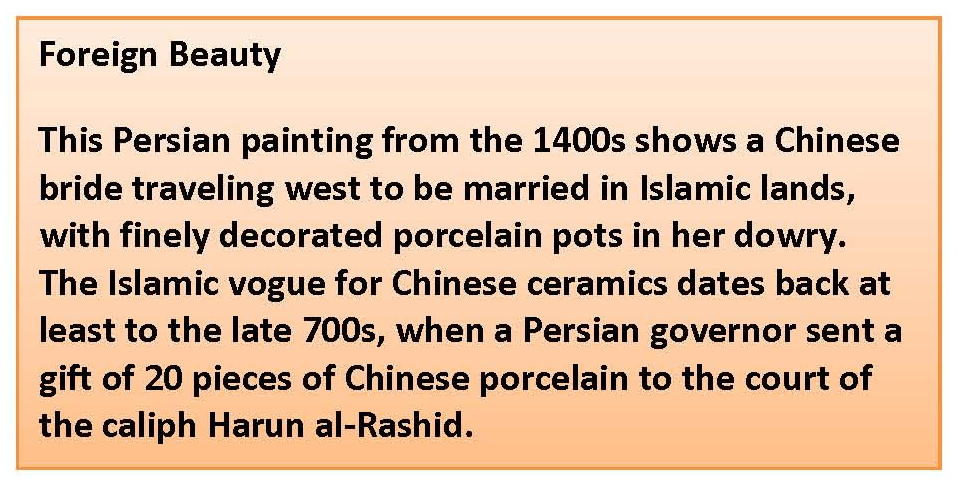
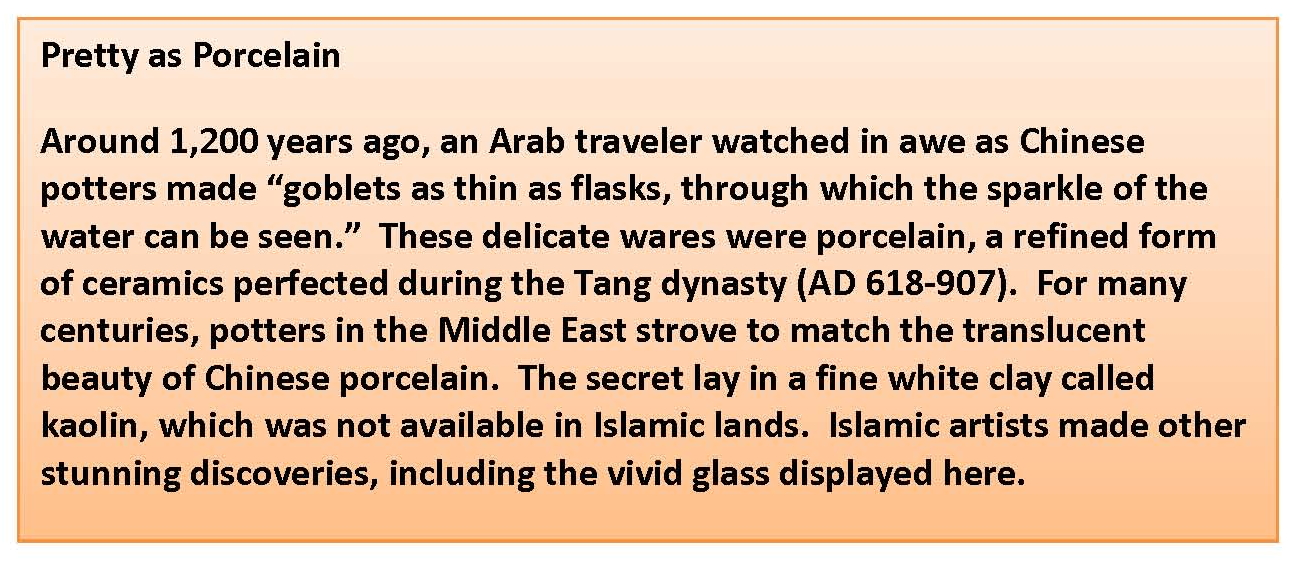
3. Early Islamic pottery followed the forms of the regions which the Muslims conquered. Eventually, however, there was cross-fertilization between the regions. One major emphasis in ceramic development in the Muslim world was the use of tile and decorative tilework.
WHAT WASN’T SAID:
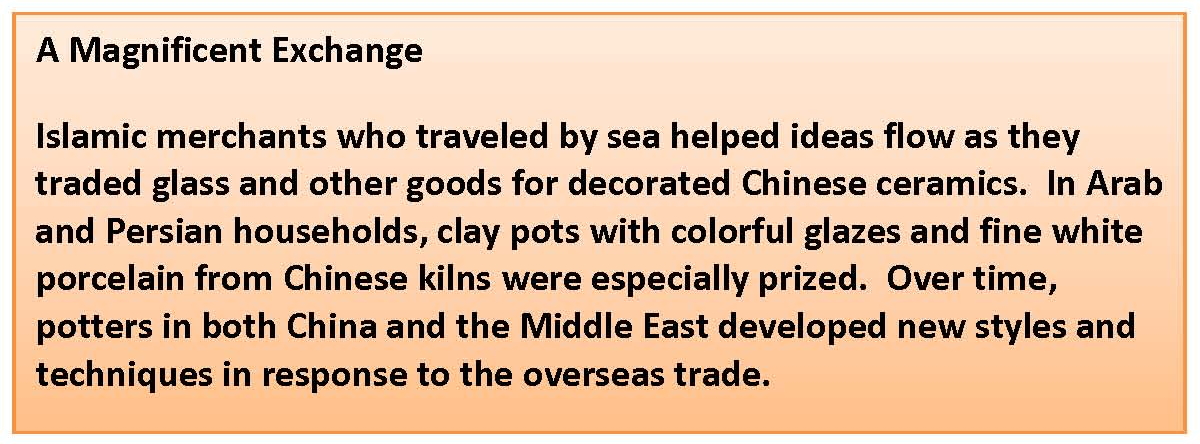
1. That Muslims were neither the first nor the only merchants to travel the seas.
2. That the Mediterranean Jews were responsible for opening up these trade routes.
FACTS:
1. Mediterranean Jews were entrepreneurs who controlled much of the trade in the region and developed the economies of those nations, which included Alexandria’s shipping; Syria’s markets; Beirut’s silk-production industry and textile dyeing; and the glass factories, with bead shapes and colorations that are traced to Near Eastern Jewish glass designs.
2. Persian/Jewish traders pioneered the route from the Near East to Kaifeng, then capital of Imperial China, 1700 years before Marco Polo set out on his journey from Venice to China.
3. Interestingly, a saying attributed to Marco Polo is: “The militant Muslim is the person who beheads the infidel, while the moderate Muslim holds the feet of the victim.”
Along another Silk Road
1.The Chinese systems (Buddhism and Confucianism) fused with Korea and Japan, creating a Golden Age, which included the construction of pagodas and temples.
2. Products of the Silk Road were found at a Buddhist Temple site in Korea: bronze iron scissors, glass Buddha beads, terra cotta figures, jade ornaments, bronze buckles, images and bells, pottery, metalworking. The Middle Kingdom (Korea) became proficient at making iron blades and tools, 500 – 400 BCE.
3. Japanese had imports from Silla of perfume, medicine, cosmetics, fabric-dyeing materials, metallic goods, musical instruments, carpets, measuring tool; silk came to Japan in 306 CE. Buddhism became Japan’s state religion in 372 CE.
4. Korea’s Koryu Dynasty (935-1392) had the world’s first metal-printing technology before Gutenberg; the world’s oldest printed book, the Jikji; the world’s oldest surviving complete transcription of the Buddhist cantons; the world-famous Celadon pottery; and development of Buddhism throughout the peninsula.
 Centinel2012