
Posted originally on Aug 8, 2026 by Martin Armstrong |
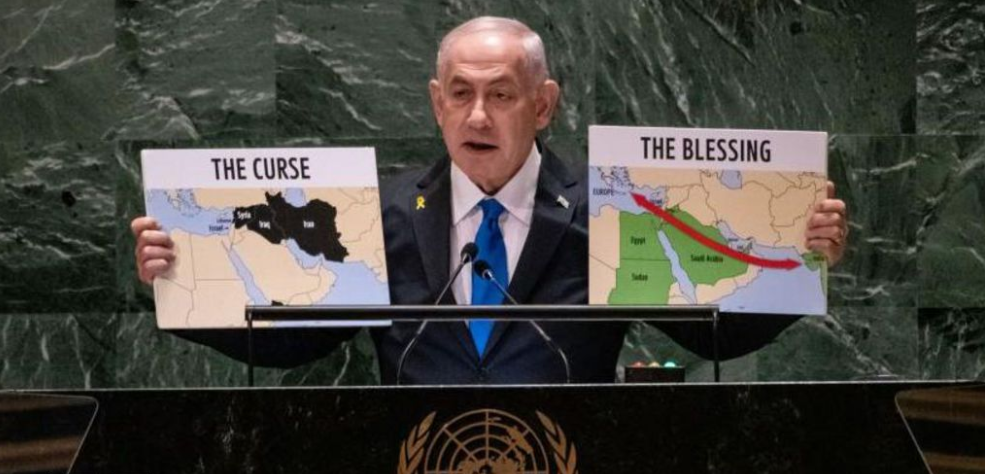
I have reported that Trump was mislead into this unwinnable war with Iran, which has been planning for it since 1979. They had amassed the largest stockpile of balistic missiles and understood the way to fight Israel was to overwhelm their dome defense. Israeli Prime Minister Benjamin Netanyahu is going to run for reelection in October. However, I would not put it past him to pull a Zelensky to retain power. He has implied that he may be considering taking unilateral action to prolong a costly and unwinnable war with Iran, even as Washington and Tehran appear to be close to an interim deal to open the Strait of Hormuz. Trump keeps trying to exit and Netanyahu tries to keep the US in to fund his war.
Iran’s investment in ballistic missiles was a deliberate strategic choice, made in the context of its long-standing tensions with the U.S. and Israel. This decision was driven by the understanding that the way to defeat Israel was to overwhelm its defense and that would take a vast supply to compel Israel to eventually run out of missiles.
There is no evidence that Netanyahu has EVER pursued a peace agreement with Iran. Instead, his decades-long career has been defined by consistent, vocal, and active opposition to diplomatic engagement with Tehran, favoring military and economic pressure to prevent Iran from acquiring nuclear weapons. I have stated many times that the primary directive of a Neocon is to reject any communication with a deemed enemy. There is NEVER a desire of peace. With both sides at each other’s throats, there is no solution militarily. Netanyahu is a threat to Israel the same as Zelensky is a threat to Ukraine. Neither consider the civilians who are killed in the process.
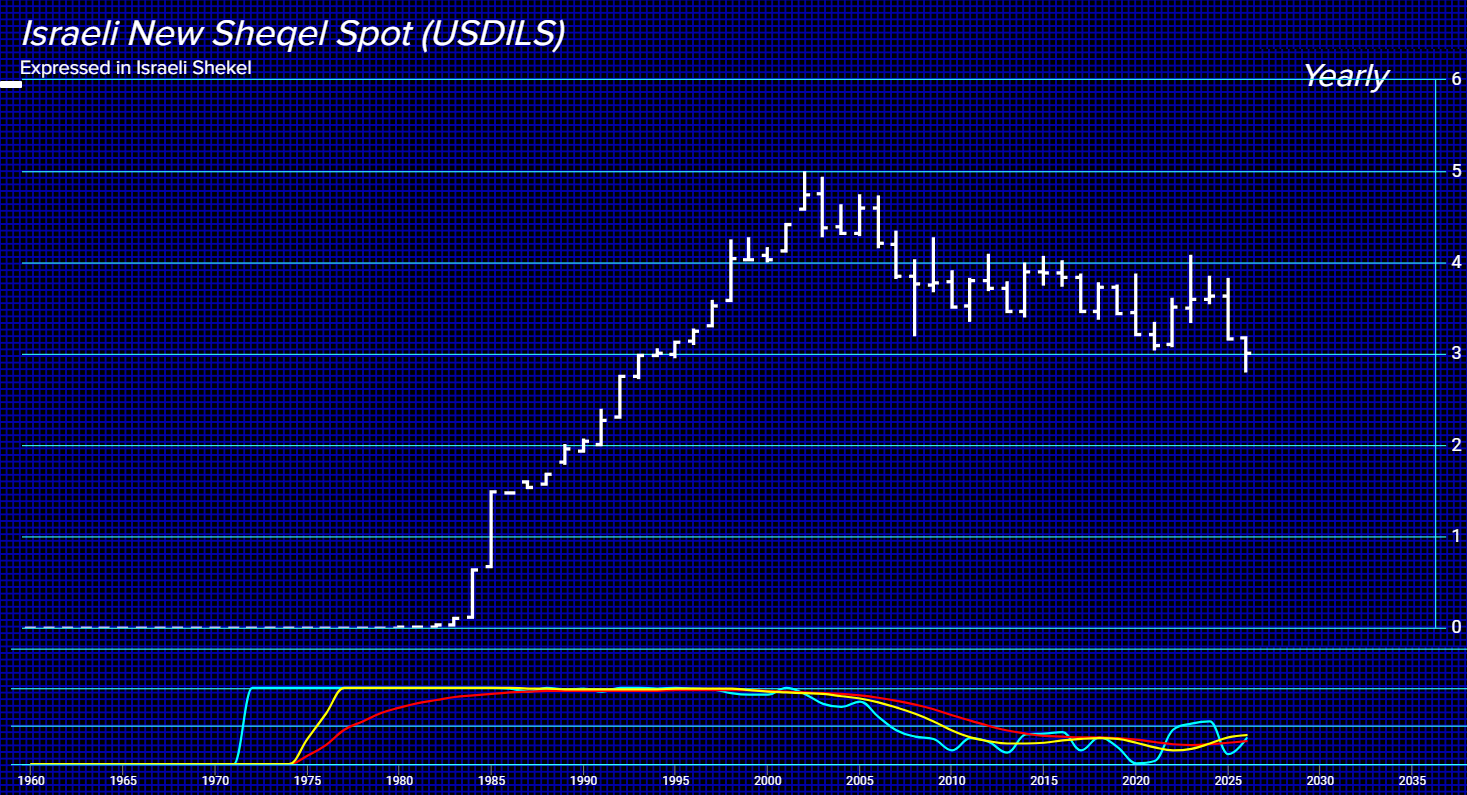
Nonetheless, the shekel reached its weakest point in modern history in May 2002, when the exchange rate hit 4.916 ILS per 1 USD. Since that peak, the currency has generally strengthened. By 2025, the average annual exchange rate was around 3.77 ILS/USD, and in 2026 it has traded significantly lower (stronger shekel), around 2.80-3.00 ILS/USD. This has been driven in part due to the High-Tech and Foreign Investment factors (Capital Flow). Israel has a powerful high-tech sector that attracts massive foreign investment. A significant portion of this investment comes from the US, creating constant demand for shekels.
Then there is the “Nasdaq Effect” and Institutional Hedging. Israeli pension funds and institutional investors hold vast portfolios of US stocks, particularly in technology. To manage currency risk, they engage in “hedging” thereby selling dollars and buying shekels. When US markets, especially the tech-heavy Nasdaq, rise, the value of these portfolios increases, prompting them to buy even more shekels to rebalance their currency exposure. This creates strong, self-reinforcing demand for the local currency.
The Bank of Israel has maintained relatively high interest rates to control inflation. It has been these higher interest rates that have made shekel-denominated assets more attractive to investors, increasing demand for the currency.
The prospects for war introduce geopolitics and that has introduced the “Risk Premium.” The shekel’s trajectory has often been influenced by geopolitics. For instance, the ceasefire following the October 2023 conflicts reduced the “Risk Premium” on Israeli assets, encouraging capital to return and supporting the shekel. However, our computer is warning that renewed geopolitical tensions, such as an escalation with Iran, could cause a sudden “flight to safety” and weaken the shekel.
Consequently, these factors have combined to strength the the shekel for 24 years overall. The Bank of Israel has historically intervened to smooth out extreme volatility, but it appears to be refraining from actively trying to reverse the structural trend of a strong shekel, preferring to let market forces play out. This is where we see things are starting to shift in 2027 and it appears we can see a major shift in trend post-2028.
Netanyahu’s Opposition to the 2015 Nuclear Deal
Netanyahu was vehemently opposed to the Joint Comprehensive Plan of Action (JCPOA) negotiated by the Obama administration in 2015. In what was seen as a direct challenge to the U.S. president, Netanyahu accepted an invitation from congressional Republicans to address a joint session of Congress, where he publicly argued the deal would not block Iran’s path to a nuclear weapon but would instead pave the way for it . He spent years campaigning against the agreement and welcomed President Trump’s decision to withdraw from it in 2018 .
Rejection of Any Diplomacy & Advocating Confrontation & Destruction of Iran
The evidence shows that Netanyahu’s strategy has consistently been to advocate for maximum pressure and military action over negotiation. In a video after launching a joint war with the U.S. against Iran in 2025, Netanyahu stated the attack “allows us to do what I have been hoping to do for 40 years.” His fixation on Iran as an existential threat has always been his central theme of his political identity.
He reportedly convinced President Trump to rejoin the conflict in June 2025, framing it as a chance to achieve what past administrations had not. As recently as July 2026, Netanyahu expressed skepticism about a potential deal with Iran and opposes any peace deal. When President Trump began negotiating a peace agreement with Iran in 2026, reports indicate Netanyahu actively tried to prevent it. It was reported that Netanyahu planned massive strikes on Iranian energy and infrastructure to derail negotiations but was stopped by President Trump. While Netanyahu did not publicly criticize the deal, admitting to “disagreements” with Trump , he acknowledged he could not stop it from being signed.
Netanyahu’s approach has consistently been one of opposition to diplomatic engagement and a preference for confronting Iran through military and economic pressure. Iran is well aware of this personal animosity and had built an enormous arsenal of balistic missiles. This strategy resulted in Iran holding what is described as the largest ballistic missile stockpile in the Middle East, with estimates ranging from 2,500 to 6,000 missiles of various types.
Preparation for Conflict
Beyond the buildup, there is clear evidence that Iran prepared a military plan for a potential U.S. or Israeli attack. The Islamic Revolutionary Guard Corps (IRGC) stated that a military action plan was approved by the late Supreme Leader Ayatollah Ali Khamenei to be executed in the event of an attack. This suggests a high level of preparation for a scenario that ultimately came to pass. Military experts also affirmed that Iran had made significant preparations for a potential conflict with the U.S. and Israel.
This US-Iran war that broke out on February 28 put Iran’s massive missile stockpile to the test. While initial strikes damaged the arsenal, Iran’s ability to preserve and potentially rebuild its capabilities is a major part of the story. U.S. sources initially claimed that up to one-third of the arsenal was destroyed early in the conflict. However, subsequent U.S. intelligence assessments indicated that Iran retained about 70% of its prewar missile stockpile. Reports suggest that Iran used a truce to restore access to damaged underground facilities and may have replenished its stockpile with Russian-made missiles.
Despite significant strikes on its infrastructure, Iran is assessed to have regained operational access to the vast majority of its underground missile sites along the strategic Strait of Hormuz. This indicates that while the war has taken a toll, Iran’s underlying missile infrastructure has proven resilient.
V
In short, Iran’s massive missile buildup appears to be the product of a long-term definitive strategy to prepare for the possibility of a major war with the US and Israel. While the available information does not state the buildup was a plan for the specific war, the presence of a pre-approved military response plan and the subsequent use of these missiles in the conflict demonstrates a clear and sustained level of preparation.
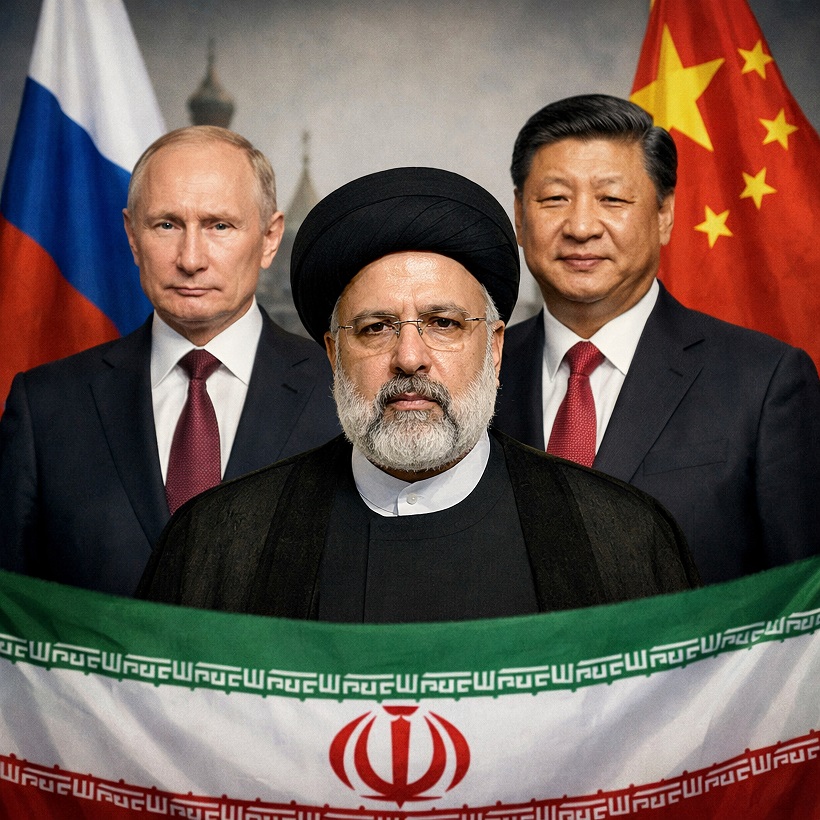
WILL CHINA & RUSSIA STAND SILENT IS ISRAEL SEEK TOTAL DESTRUCTION OF IRAN?
China and Russia have not indicated they would allow Israel to “totally destroy” Iran. On the contrary, they have actively opposed the military strikes and are calling for a ceasefire and a return to diplomatic negotiations. Allowing the “total destruction” of Iran would fundamentally contradict China and Russia’s stated policies. Their actions are aimed at preventing further escalation, which suggests they would not only NOT allow such a scenario but would actively work against it through diplomatic channels. As the Shanghai municipal government’s information office stated, claims that China has “abandoned Iran” are “narratives that not only distort the facts.”
From a realistic perspective, there is NO WAY either Russia or China would allow Netanyahu’s end-game to become reality. It seems that Netanyahu has the same delusions as Zelensky who seeks the destruction of Russia with comments from military leaders pronouncing Moscow will fall. There is absolutely no indication that either Zelensky or Netanyahu will succeed in their end game hgoals.
UNWINNABLE War
While this war has killed about 250 military leaders with the Ayatollah, these tactical gains have not translated into political outcomes. The Iranian regime has not fractured, and its nuclear program has not been dismantled, only set back. Iran has also opened a second front through Hezbollah in Lebanon, sustaining the conflict and then there are the Houthis who have declared a naval blockade against Saudi shipping and have followed through with attacks on oil tankers, effectively creating a crisis for one of the world’s most important shipping lanes.
Iran is built for a prolonged, attritional fight, a lesson reinforced by its experience in the Iran-Iraq War. It has employed a strategy of horizontal escalation, extending the conflict into the economic and political domains where time favors the side absorbing pain. This includes disrupting shipping through the Strait of Hormuz, which has collapsed shipping to roughly 5% of pre-war levels, and targeting the energy infrastructure of Gulf states to create global economic pressure. This dynamic gives Tehran significant leverage, as the economic costs of the war are a major incentive for the US to seek a ceasefire. As I have said, every war game played had Iran taking the Strait of Hormuz. All I can assume is that the plane was Netanyahu’s with the assumption of killing the Ayatollah would end the war in one day like Venezuela. Trump was ill-advised and the question is who escorted Netanyahu into the Situation Room to sell this war to Trump.
This has simply become a War Without End! Without a clear, shared definition of victory between the US and Israel, the war continues without a decisive conclusion in sight. The conflict is settling into a pattern of strikes, pauses, and negotiations that prevent collapse but lead to no final resolution. A war fought without a clear objective and exit strategy, described by an “anti-Powell Doctrine,” risks becoming a “forever war” as the Neocons engaged in with Vietnam, Afghanistan, and Iraq. At least the Korean War was instigated by the North invading the South.
The question of whether the war is “winnable” cannot be answered with a simple yes or no. From a military standpoint, the coalition can achieve tactical victories. However, if the benchmark is forcing Iran into submission or achieving regime change, the evidence points toward a conflict that is unwinnable. Because Iran requires only survival to claim its own victory, the war appears to be a conflict where decisive victory is unattainable.
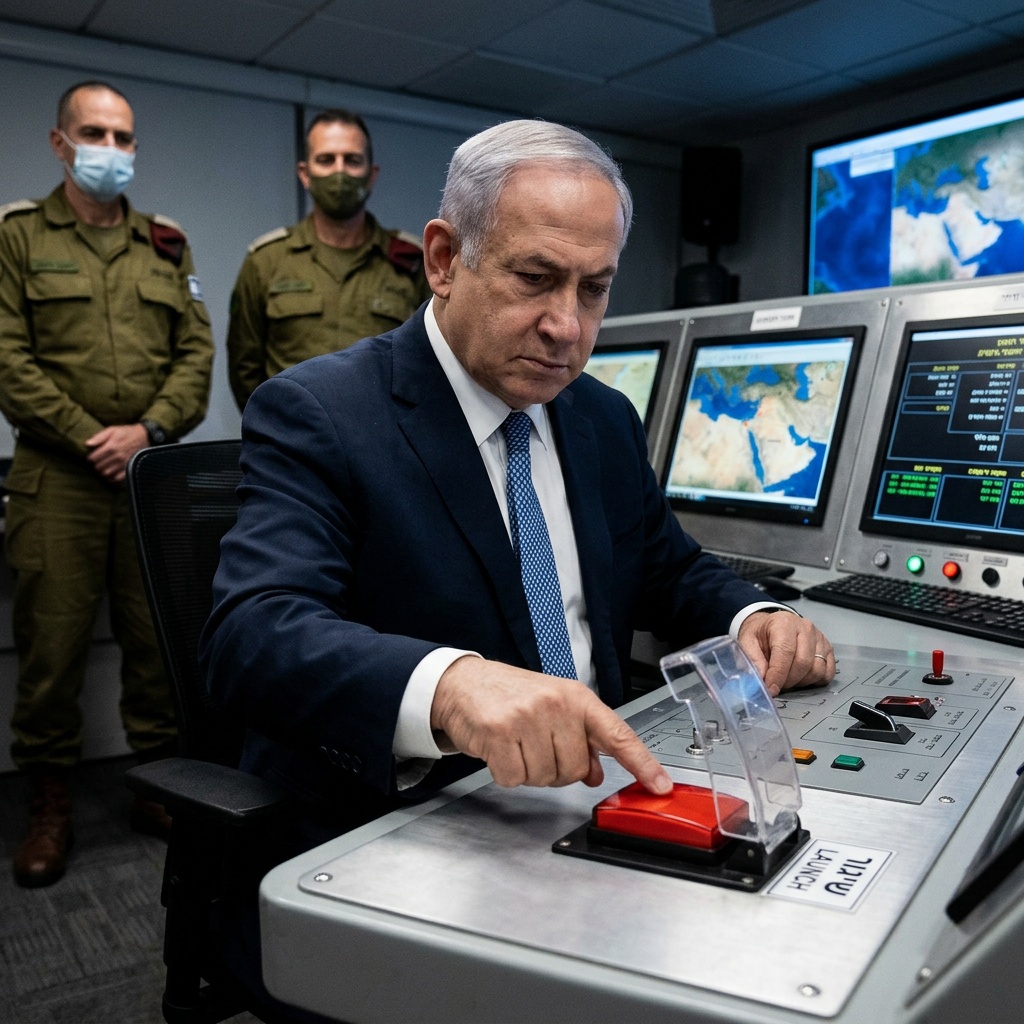
The Nuclear Option
Netanyahu has not publicly discussed this option deploying tactical nuclear weapons against Iran. However, there remain concerns given his relentless animosity toward Iran. Israel’s nuclear capability is widely believed to be tied to the “Samson Option” doctrine, which is a last-resort deterrent meant only for an existential threat to the state’s survival. The conflict with Iran, has often been characterized as an existential threat to Israel that he has claims goes to the survival of Israel. The problem that he faces is that a tactical nuclear strike might NOT even fully destroy Iran’s deeply buried nuclear facilities. Israel already possesses a range of advanced conventional weapons, including bunker-buster bombs, which could achieve similar objectives without the immense risks of nuclear escalation. President Trump, has publicly dismissed the possibility of an Israeli nuclear strike, stating, “Israel wouldn’t do that.” However, even the USA would resort to that option if confronted with the inevitable loss in a major war with anyone.
I have been often asked about if Robert Maxwell, Epstein’s girlfriend’s father, stole US nuclear secrets and handed them to Israel. The allegations linking Robert Maxwell to a series of intelligence-related activities involving Israel began with claims of Ari Ben-Menashe, a former Israeli intelligence officer. I cannot speak definitively to this allegation. What I do know is that he was part of the “club” and that he agreed that Israel would recognize the coup against Gorbachev in return to allow the Jews in Russia to flee to Israel. I have maintained that nobody wants really to investigate WHY Epstein was engaging in his scheme ising girls to implicate powerful people. I believe they keep the focus on the girls as the victim and avoid the WHY because that leads to an operation nobody wants to expose.

