
Posted originally on Aug 13, 2026 by Martin Armstrong |
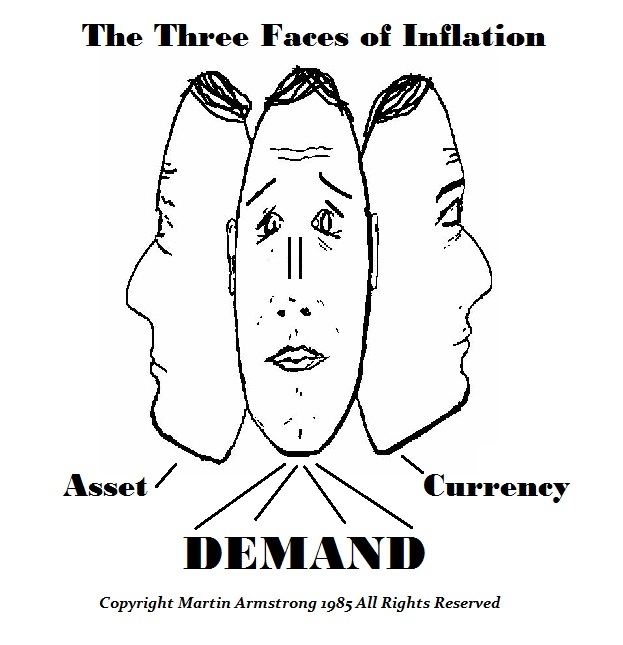
The Consumer Price Index rose just 0.1% for the month after declining 0.4% in June, bringing the annual rate down slightly from 3.5% to 3.4%. Core CPI rose 0.2% and declined on an annual basis from 2.6% to 2.5%. Yet inflation is not one number, and anyone looking only at 3.4% is missing what is taking place underneath the surface.
The first layer is energy, and this is where the headline number becomes extremely misleading. Energy prices declined another 1.5% in July after collapsing 5.7% in June, which restrained the overall CPI considerably. Gasoline fell 2.9% for the month, but gasoline is still 24.6% higher than one year ago. Fuel oil is up an astonishing 39.1% year over year, electricity is up 4.2%, natural gas is up 4.3%, and the entire energy index remains 14.7% above July 2025. So when they tell you inflation is cooling, they are describing the rate of change from June to July while ignoring what people are actually paying compared with last summer.
This is why I have disagreed with New York Fed President John Williams suggesting that inflation has peaked. That assumes the geopolitical situation has peaked, and there is no basis for making that assumption. The United States has been cushioning the energy shock by drawing down petroleum inventories, but those inventories eventually have to be replenished. The war involving Iran has not disappeared, the Middle East remains unstable, and Trump himself said this week that one option is to hit Tehran “really, really hard.”
War is inflationary from almost every direction. It raises oil and transportation costs, increases insurance premiums on shipping, disrupts fertilizer and agricultural markets, diverts industrial production into military production, creates shortages, and forces governments to borrow extraordinary sums to finance weapons and military operations. Europe is simultaneously embarking upon its largest military buildup in generations while already struggling with sovereign debt. Those costs eventually migrate through the world economy.
Food is the second layer, and here again the headline does not tell the story experienced by households. Overall food prices rose 0.1% in July and are 3% higher than one year ago. Grocery prices actually declined 0.1% for the month, helped by a 0.7% decline in meats, poultry, fish, and eggs, a 1.5% drop in pork, and an extraordinary 16.4% decline in lettuce. Fruits and vegetables remain 5.1% more expensive than last year, nonalcoholic beverages are up 4.1%, cereals and bakery products are up 2.7%, and the overall grocery basket remains 2.7% higher.
Restaurant prices increased 0.3% in July and 3.4% over the year. Limited-service restaurants, which include many fast-food establishments that people traditionally used as inexpensive alternatives, raised prices 0.4% in a single month and 3.3% over the year. Full-service restaurants are up 3.4%. This reflects labor, rent, insurance, electricity, transportation, ingredients, and financing costs moving through the entire chain before the customer ever sees the menu.
Housing is the third layer and remains the largest burden for millions of households. Shelter increased only 0.1% in July, but that accounted for roughly two-thirds of the entire monthly increase in CPI because shelter carries such enormous weight in the index. Both actual rent and owners’ equivalent rent increased 0.3% during the month, while shelter remains 3.2% higher than one year ago.
Healthcare provides yet another layer that cannot simply be dismissed as “core inflation.” Medical care increased 0.4% in July. Medical care services rose 0.6%, hospital services increased 0.5%, and physicians’ services advanced another 0.2%. Prescription drugs provided some relief by falling 0.8%, but anyone who actually pays insurance premiums, deductibles, hospital bills, or elder-care expenses knows that healthcare has become one of the largest financial threats facing American families.
Transportation presents an equally distorted picture. Gasoline declined in July, but airline fares jumped 2.2% in a single month and are now 25.5% higher than one year ago. Used cars and trucks increased 0.4% in July, although they remain 1.9% lower annually, while new vehicles edged 0.1% higher. Transportation services rose 0.3% during the month. Motor vehicle insurance finally declined 0.3% after falling 2% in June, but that comes after years in which insurance became one of the fastest-rising expenses in the household budget. A few months of moderation do not return those premiums to where they were before the surge.
Then there is the inflation buried throughout ordinary life that receives almost no attention. Communication costs increased 0.6% in July, education rose 0.5%, recreation increased 0.2%, apparel rose 0.1%, household furnishings increased, and services excluding energy services remain 3% higher than a year ago. Apparel is up 3.9% annually, recreation 2.6%, and household furnishings and operations 2.2%. These increases may appear small individually, but households pay all of them simultaneously.
This is where the entire political discussion about inflation becomes dishonest. Inflation falling from 3.5% to 3.4% does not mean prices fell 0.1%. It means the overall price level is still rising, only at a slightly slower annual rate. Actual deflation would be required to return the price level to where it was before.
There is also a fourth layer that CPI cannot adequately measure, which is asset inflation. A house, farmland, stocks, gold, and other tangible assets can rise because capital is moving away from government debt or because the purchasing power of money itself is declining. Someone who already owns assets can become wealthier during an inflationary period. This is how inflation widens the gap between classes even when the official statistics suggest conditions are improving.
The Federal Reserve will now debate whether 3.4% inflation and 2.5% core inflation justify holding rates steady or eventually easing policy. The Fed’s benchmark rate remains between 3.50% and 3.75%, and before today’s report markets were assigning roughly a 46% probability to a September increase. Yet the Fed is attempting to steer an economy whose largest inflation risks are increasingly geopolitical and fiscal rather than purely monetary. Washington is running massive structural deficits while the world is simultaneously increasing military expenditures and preparing for additional conflict. Interest rates cannot correct fiscal irresponsibility, nor can they negotiate peace in Ukraine or the Middle East.

