
Posted Originally on Sep 4, 2026 by Martin Armstrong |

All Republics eventually turn against their citizens when they begin to see their power slipping away through their fingers. Today in Europe, free speech has vanished. In the US, you see “See Something, Say Something.” Looking at history, we see this same pattern. Perhaps the most famous example was the Venetian Republic, which eventually destroyed its own power.

The practice of encouraging citizens to report others was instituted by Maximinus I (236-248AD) who tore Rome apart declaring all wealth belonged to the state and paid rewards to people who reported others. Once he turned everyone against each other, there was no going back. The economy began to implode as trust and unity evaporated. The wealthy began to hoard their wealth instead of investing and lending it out. Capitalism requires wealth disparity for then the wealthy put their money to use in venture type arrangements that even took place in ancient Athens, which was the birth of insurance underwriting voyages for trade. Maximinus I destroyed that unity andventure capital virtually ceased to exist after him.
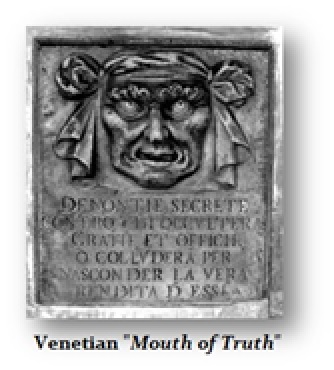
The Venetian “Mouth of Truth” (Bocca di Leone) letterboxes was officially introduced in 1310 where people could rat ot fellow citizens. This introduction was a direct response to a specific political crisis. The first of these stone mailboxes were installed after the failed coup d’état led by Baiamonte Tiepolo in 1310. The Venetian government established this system to allow for the secret reporting of crimes and conspiracies, creating an early intelligence network to protect the state.
The system was significantly reformed in 1542, when anonymous denunciations were largely abolished because people were reporting other out of personal disputes, jealousy, and vengence. To prevent frivolous reports or personal vendettas, the government required that denunciations be signed to be considered valid. An exception was made only for reports concerning conspiracies against the Republic itself.

The “Lion’s Mouth” boxes were more than just a general reporting system; they were a tool of the state’s security apparatus. Their primary purposes were to supposedly root out corruption the same as the Flock Cameras that are tracking everyone. Citizens could use them to denounce corrupt officials who concealed favors, services, or their true income. The Flock Cameras only target citizens not corrupt politicians who no doubt took bribes to install them in the first place.
The information gathered was vital for the Council of Ten (and later the State Inquisitors), who used it to monitor internal dissent, foreign spies, and potential subversion against the Venetian Republic. So, while the system began in 1310, it matured over time, with the rules around anonymity being a key adjustment in 1542.

