Posted originally on CTH on July 7, 2025 | Sundance
White House Trade and Manufacturing Advisor Peter Navarro talks about how the Fed monetary position is lagging with the intent of Trump’s MAGAnomic policy. In the short review, Chairman Jerome Powell is approximately 0.50% in rate cuts behind the growth plan of President Trump.
Peter Navarro notes this disconnect is politically motivated when viewed through the window of hindsight. Navarro is correct. CTH has been outlining this economic policy and monetary policy disconnect, specifically as it pertains to President Trump’s Main Street focused agenda, for almost a decade {GO DEEP}.
Additionally, in many ways the Trump tariffs are the reverse of decades of ‘exfiltration’ of American wealth. Just as there was a shift when the value of the Wall Street economy surpassed the value of the U.S. Main Street economy, the politicians began responding to their new donors, so too is the Fed reluctant in reverse focus and advance the agenda of Main Street. WATCH:
Here’s the key – The DC challenges are not overwhelming when you take a non-traditional approach toward finding solutions.
Consider the issue of SSI supplemental benefits and budgets. Yes, from the traditional perspective the financial drain on the system can collapse the federal budget. However, if we double the size of the economy and/or modify import tariffs, we can increase tax revenue and resolve the SSI budget problem. The problem for DC is that no one knows how to double the economy or leverage tariffs to expand the domestic pie. President Trump does.
Again, we mistakenly view our problems through the prism of how they were created.
This paralysis by analysis is emphasized by tradition, by DC punditry and by the media complex who exist to talk about the problems. But thankfully, President Trump views our problems through the prism of how to solve them. President Trump doesn’t look backward, he looks forward; it is a very unique and effective approach.
We look at the problem as if we individually are given an elephant to eat. President Trump looks at the problem as if there needs to be more of us with forks. It is, essentially, the feed a man a fish or teach a man to fish conversation. Which one creates the larger economic pie?
Despite the naysayers, backbiters and backseat drivers, we must continually remind ourselves that Trump’s optimal solution approach works. We have the history of the Trump Doctrine (2017 through 2020) to review as a reminder. It just works.
Posted originally on CTH on July 7, 2025 | Sundance
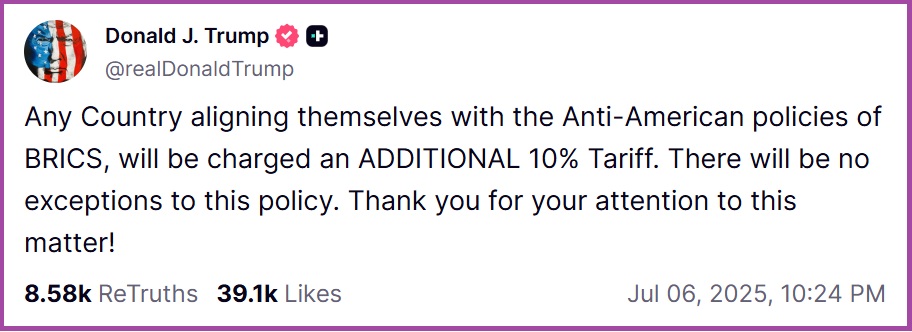
President Donald Trump has begun posting the country specific tariff rate announcements on his Truth Social account.
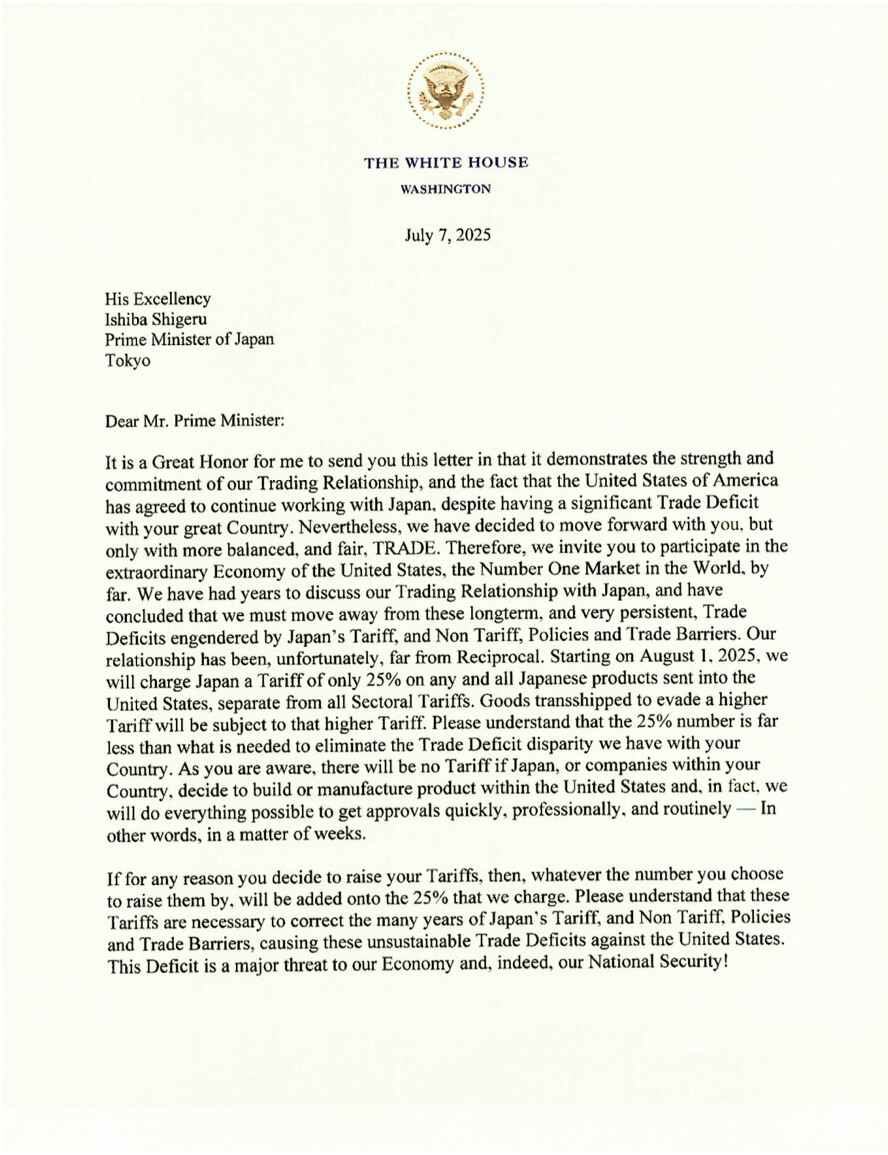
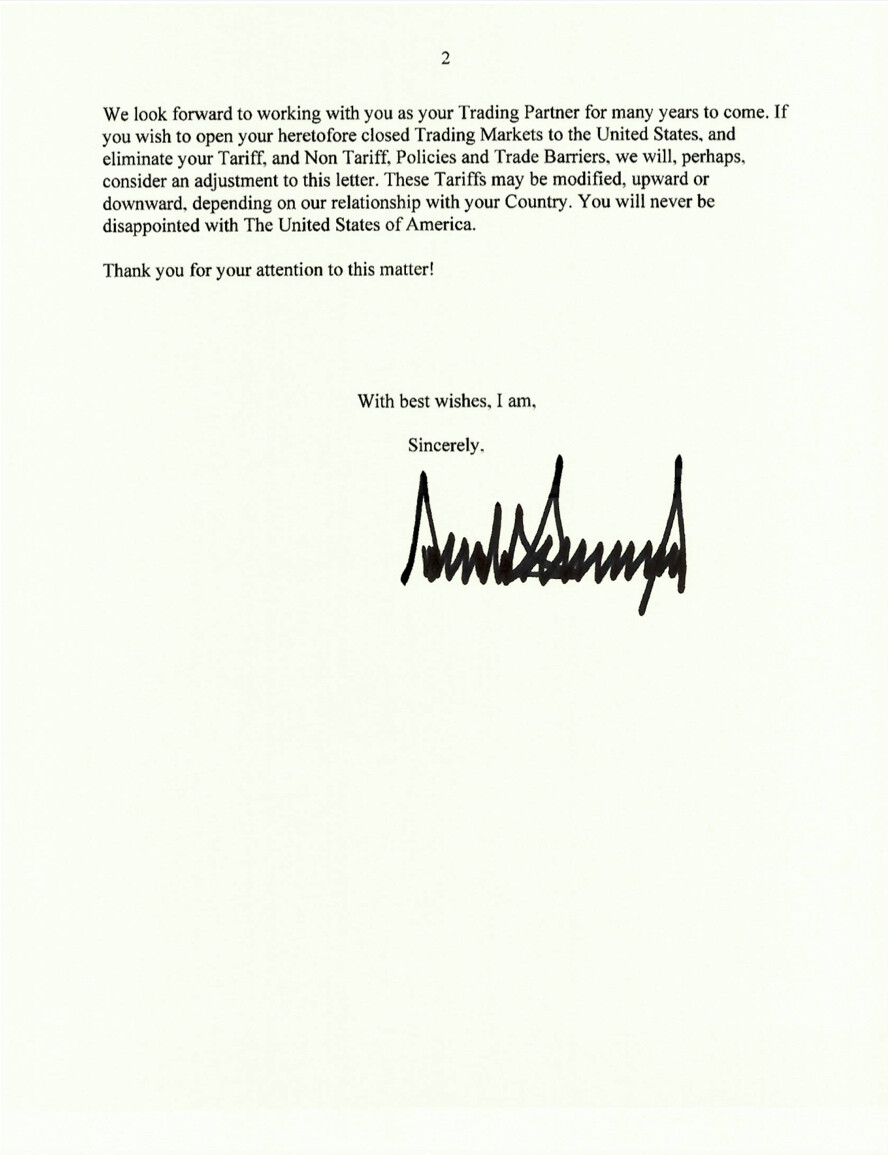
Beginning with Japan and South Korea, President Trump is sending letters to each nation not currently in direct negotiations with the USA. Japan example below:
Both Japan and South Korea are assigned 25% baseline tariff rates “separate from all Sectoral Tariffs.” Additionally, if the nation participates in transnational shipping, the rate attempting to be avoided will be applied to the country violating the trade position.
Example: South Korea (25%) acts as a passthrough for a country with a higher tariff rate like Vietnam, 40%. If South Korea is caught engaging in transnational shipping then the applied tariff rate on the South Korean goods is 40%.
There are eight country notifications on Truth Social from today.
Posted originally on CTH on July 6, 2025 | Sundance
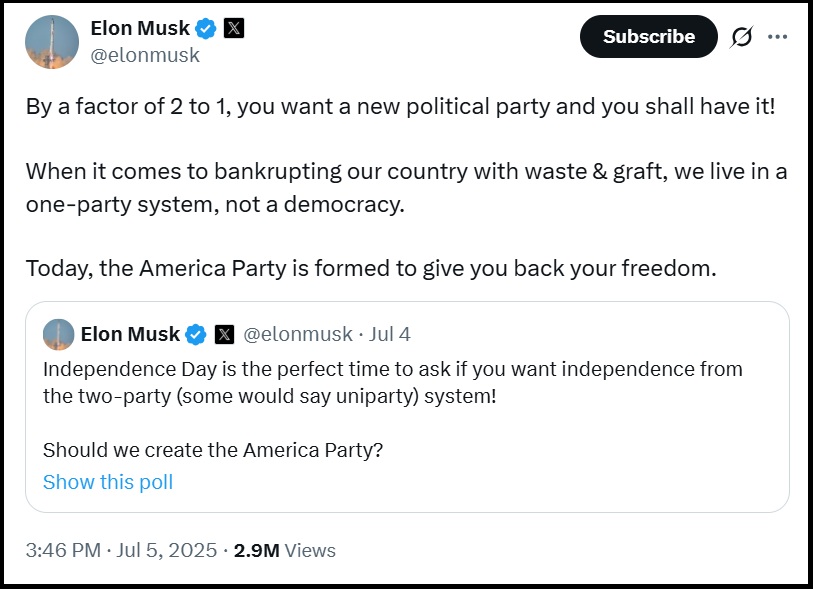
President Trump responds to Elon Musk’s ongoing outrage.
PRESIDENT TRUMP – “I am saddened to watch Elon Musk go completely “off the rails,” essentially becoming a TRAIN WRECK over the past five weeks. He even wants to start a Third Political Party, despite the fact that they have never succeeded in the United States – The System seems not designed for them.
The one thing Third Parties are good for is the creation of Complete and Total DISRUPTION & CHAOS, and we have enough of that with the Radical Left Democrats, who have lost their confidence and their minds! Republicans, on the other hand, are a smooth running “machine,” that just passed the biggest Bill of its kind in the History of our Country.
It is a Great Bill but, unfortunately for Elon, it eliminates the ridiculous Electric Vehicle (EV) Mandate, which would have forced everyone to buy an Electric Car in a short period of time. I have been strongly opposed to that from the very beginning. People are now allowed to buy whatever they want – Gasoline Powered, Hybrids (which are doing very well), or New Technologies as they come about – No more EV Mandate. I have campaigned on this for two years and, quite honestly, when Elon gave me his total and unquestioned Endorsement, I asked him whether or not he knew that I was going to terminate the EV Mandate – It was in every speech I made, and in every conversation I had. He said he had no problems with that – I was very surprised!
Additionally, Elon asked that one of his close friends run NASA and, while I thought his friend was very good, I was surprised to learn that he was a blue blooded Democrat, who had never contributed to a Republican before. Elon probably was, also. I also thought it inappropriate that a very close friend of Elon, who was in the Space Business, run NASA, when NASA is such a big part of Elon’s corporate life. My Number One charge is to protect the American Public!
Posted originally on CTH on July 6, 2025 | Sundance
President Trump and Commerce Secretary Howard Lutnick hold an impromptu press conference before departing Bedminster, New Jersey en route to the White House.
Topics included the devastating flood in Texas, Elon Musk creating a third party, the ongoing trade negotiations and pending tariffs, President Trump’s conversations with both Vladimir Putin and Volodymyr Zelenskyy as well as the upcoming visit of Benjamin Netanyahu to the White House on Monday.
As noted by Secretary Lutnick the new tariff rates go into effect August 1st. WATCH:
Posted originally on CTH on July 6, 2025 | Sundance
White House National Economic Chairman, Kevin Hassett, discusses the current status of the ongoing trade negotiations as the deadline for engagement windows is scheduled to close on July 9th.
As outlined by Kevin Hassett, we can expect those nations who are not in current negotiations will receive letters from President Trump letting them know that the baseline tariff rate (10%) and reciprocity rate (unknown) will be. Large nations like India and China are currently in negotiations. The EU collective has preliminary contact information, and a few others are in close proximity to Free Trade Agreement closure.
With the Big Beautiful Bill passed, in combination with baseline and reciprocal tariffs, the revenues to grow the GDP are in place to expand the overall U.S. economy. WATCH:
[Transcript] – WEIJA JIANG: We turn now to Kevin Hassett. He is the director of the National Economic Council and one of President Trump’s top advisors. He’s also very popular on that driveway where I’m usually alongside about a dozen reporters. So, Kevin, thank you so much for your time this morning. I want to start with trade, because there’s a big deadline coming up on Wednesday. As you know, that 90-day pause on reciprocal tariffs that the President announced back in April is set to end. So far, the US has announced a few deals; the UK, Vietnam, and you’re inching closer to a final agreement with China. Do you expect to get any more deals done with America’s biggest trading partners by Wednesday?
KEVIN HASSETT: Yeah. First, I do have to take- take a pause and share your thoughts and prayers with the people of Texas. It’s an incredible, heartbreaking story, and Kristi Noem and the President have instructed the federal government to throw everything they’ve got at helping the survivors and helping clean up that place. So, anyway, I’m really heartbroken today to see these stories, and I want you to know that in the White House, everybody is putting every effort they can into helping the people of Texas today.
On trade, there’s going to be quite a bit of news this week. And, I think, the headline of the news is that there are going to be deals that are finalized. There are a whole number that Jameson Greer has negotiated with foreign governments, and then they’re going to be letters that are sent to countries saying, here’s how we think it ought to go, because the deals aren’t advanced enough. And the headline is going to be that countries are agreeing around the world to open their markets up to our products, and to allow us to put some kind of tariff on their products when they come into the US. At exactly what the numbers will be, will be things that you’ll find out in the news this week.
WEIJA JIANG: Kevin, you said there are going to be deals. For those really important trading partners, if there’s not a deal by Wednesday, is the President going to extend this pause?
KEVIN HASSETT: You know, the United States is always willing to talk to everybody about everything that’s going on in the world. And there are deadlines, and there are things that are close, and so maybe things will push back the dead- past the deadline, or maybe they want- in the end, the President’s going to make that judgment.
WEIJA JIANG: And you also mentioned those letters that will start going out tomorrow, according to President Trump. He said about 10 to 12 countries will receive them. Do you- can you tell us who’s going to get one and what they say?
KEVIN HASSETT: Because- because, again, the part of the letter that could be happening right is that we’re close to a deal, we’re not really satisfied with the progress that we’re making at the deal, and so we’re saying, okay, fine, we’re going to send a letter, but maybe you get a deal at the last minute too. Until we see everything that plays out, I think that we need to just hold our fire and watch for the news this week.
WEIJA JIANG: Is it fair to say that those notices are going to go to our smaller trading partners, as you negotiate with our bigger ones?
KEVIN HASSETT: I think that it could be that it’ll be both. But also, don’t forget, that when we have great trade deals, our smaller trading partners could become much bigger trading partners. And that’s, I think, one of the reasons why countries are racing to set deals up with us ahead of the deadline.
WEIJA JIANG: I have to ask you about the deadlines, Kevin, to make these deals, because you just mentioned you’re always open. The president said there’s not really any flexibility left between now and Wednesday. Less than two weeks ago, the Treasury Secretary Scott Bessent said that deals would be wrapped up by Labor Day. So, I wonder, you know, if- how can companies plan if the goal posts keep moving? How can countries negotiate if they don’t even know how much time they have left?
KEVIN HASSETT: Right. Well, the rough outlines of the deals are becoming clear to everybody, because we have some deals like the UK, and the Vietnam deal that are starting to be, you know, I guess, guidelines for what might happen. But, one of the things that we’re seeing that’s really interesting to me, is that people are just on-shoring production of the US at a record rate. As we’ve had record job creation, record capital spending, and this is even ahead of the Big, Beautiful Bill. And so, I think what’s happening is that people are responding to President Trump’s, you know, potential threats to have high tariffs on countries by moving their activity here into the US, which is creating jobs, more than 2 million jobs, since he took office, and raising wages. You know, wage growth is heading up towards the really, really high pinnacles that we saw in 2017. And so, I think there’s a race right now to get activity into the US. And, in part, that race has been kicked off by President Trump.
WEIJA JIANG: I remember after these reciprocal tariffs were announced, you told me that there were about 15 deals that countries were bringing to the President. How close, if you could give us any number at all, what number are we going to see this week?
KEVIN HASSETT: Yeah, you’ll have- you’ll have to get that from Jameson and the President. I think that, you know, we’ve seen lots of deals that have been finalized by our negotiators, and then the President finds things that could make them better. And so, it’s- I’m not going to get ahead of the President on the number of deals.
WEIJA JIANG: Okay, thanks, Kevin. We’ll look out for that. I want to move now to the One Big, Beautiful Bill that, of course, the President signed into law on Independence Day. You have it, and now you have to pay for it. And there’s a consensus that this bill adds tremendously to the deficit. I know that you are so familiar with these numbers. The Yale Budget Lab estimates it will add $3 trillion to the debt. The Tax Foundation says this tax portion of the bill could also add $3 trillion to the deficit. The Committee for a Responsible Federal Budget, which factors in interest on the debt, says it could add up to $5 trillion over the next decade. And on this very program, even Speaker Johnson answered in the affirmative when asked if this bill would add over $4 trillion to the deficit. I know that the administration says the bill will actually shrink the deficit by $1.5 trillion. Help me understand why there is such a drastic difference between your number and all those others.
KEVIN HASSETT: Well- well, first of all, let’s remember that science is not democracy. Truth is not democracy. Our estimates are based on modeling that we used last time, when I was Chairman of the Council of Economic Advisers to say what would happen if we had a bill, how much growth we would get. And we said, and we were criticized soundly, that we would get 3% growth. And we even had the really technical macroeconomic models that said that we would get 3% growth. We run the same models through this tax bill, it’s even better. And what we’re seeing is that if you get 3% growth again, then that’s $4 trillion more in revenue than the CBO and these other bodies are giving us credit for. They have been wrong in the past, and they’re being wrong again, in our belief. But, the thing that disappoints me is that if I put out a model and I say, hey, here’s what’s going to happen, we’re going to get 3% growth. And then it turns out it’s 1.5% growth, then, as an academic economist, as a scientist, then it’s my duty to say, what did I get wrong? What did my model miss? These people aren’t doing that. And that’s the thing that I find disappointing, because we put peer-reviewed academic stuff on the table, said we’re going to get that 3% growth, and then we got it right last time, and we believe we’re going to get it right this time. But, if you think that 1.8% growth is what’s going to happen over the next 10 years, then you should agree with the CBO number. But, there’s another part of the CBO number that you need to worry about. And that is that if we don’t pass the bill, that it’s the biggest tax hike in history. And with that big tax hike, that of course, we would have a recession. The CEA says that we’d have about a 4% drop in GDP and lose 9 million jobs. If we had a 4% drop in GDP and we lost 9 million jobs, what would happen to the deficit? And so, I don’t think that the CBO has a very strong record. I don’t think these places have a very strong record. And what they need to do is get back to the basics of looking at macroeconomic models. There’s a really famous macroeconomist at Harvard named Jim Stock. They should go back and read everything Jim Stock has written for the last 15 years, and fold those into their models, and then maybe we could talk.
WEIJA JIANG: I want to talk too, Kevin, about another number that I know you and the President disagree with, but that Democrats and many Republicans are worried about, and that’s the CBO’s projection that as many as 12 million Americans could lose Medicaid coverage because of this law. What is the NEC’s estimate for how many people could lose coverage?
KEVIN HASSETT: Well- well, yeah. Let’s- let’s unbundle that a little bit. Because, first, on the CBO coverage, so what are we doing? So, what we’re doing is we’re asking for a work requirement. But, the work requirement is that you need to be looking for work, or even doing volunteer work, and you don’t need to do it until your kids are 14 or older. And so, the idea that that’s going to cause a massive hemorrhaging in availability of insurance, doesn’t make a lot of sense to us. And then, if you look at the CBO numbers, if you look at the big numbers, they say that people are going to lose insurance. About 5 million of those are people who have other insurance. They’re people who have two types of insurance. And so, therefore, if they lose one, they’re still insured. And so, the CBO numbers on that side don’t make any sense to us at all. But, on the other side, go back to 2017 when we had work requirements for Obamacare, they said that we lose about 4 million insured between 2017 and 2019, and about double that over the next 10 years. And, in fact, the number of insured went up. It went up quite a bit, by more than 10 million over those two years, because the bottom line is, the best way to get insurance is to get a job.
And we’ve got a Big, Beautiful Bill that’s going to create a lot of job creation and a lot of insurance, and the CBO is just not accounting for that. And again, they need to go back and look at all the things that they got wrong. You realize that they’re underestimating Medicaid spending by 20%. They should look back at all the things they got wrong, and explain what they’re going to do to get it right in the future, and to do a better job. And if they do that, we’ll take them more seriously. But right now, I don’t think any serious thinker could take them seriously, because they’ve done so wrong, and wrong for so long.
Even back- if you go back to when President Obama passed Obamacare, they got every single number there wrong about how many people would get private insurance and how few people would get Medicaid, and so on. And so, their record in this modeling space is about as bad as it’s possible to be. In fact, you could, kind of, roll the roulette wheel and come up with a better set of numbers, better history, track record than CBO.
WEIJA JIANG: Kevin, what about the enhanced subsidies? Is that number wrong too? That the ACA allows about $705 for people to help pay for their health insurance. That doesn’t sound like the waste, fraud, and abuse that I know you and the President have talked about eliminating. That just sounds like people who cannot afford coverage, and now it’s going to be even more so with the subsidies gone.
KEVIN HASSETT: Right. Well- well, if you’re- if you’re looking at the- the change in the tax on the providers, which is something that has been a key talking point for the Democrats, they say that that’s going to close down rural hospitals. What has happened is that, rather than let the states- the states have this game where they give a dollar to a hospital and then the federal government matches the dollar, and then the state taxes some of the dollar away.
In other words, that we have an agreement with the states that they’re going to match, but then they have this they have this trick where they tax the hospitals after they give them the money, so really, it’s the federal government giving them the money. And that’s why we’ve been overspending Medicaid by 20% since this trick started happening. And so, what we’ve done is that we’ve put a haircut on that. But, we’ve also put $50 billion into a trust fund to make sure that the rural hospitals are there to treat the sick. So, I think this is a prudent form. It’s sound budgetary politics. And I think that nobody’s going to lose their insurance.
WEIJA JIANG: Kevin Hassett, we will watch for how that ages. Thank you very much. Really appreciate —
KEVIN HASSETT: – And if I get it wrong, we’ll check, and we’ll talk about why I got it wrong. I promise.
WEIJA JIANG: Thank you. We’ll have you back. Thank you very much, Kevin.
Posted originally on CTH on July 6, 2025 | Sundance
The intransigent European Union is hitting a dead end with immovable Trump on the issue of tariffs. The resulting dynamic is what we would expect given 75 years of the Marshall Plan (European Recovery Plan) as part of the EU’s only point of reference.
In order for the EU to maintain its socialistic form of government, it needs to continue the economic benefits from one-way tariffs that exploits the American consumer market. President Trump’s plan to force reciprocity is against its entire economic foundation. The EU simply cannot fathom life without the status quo.
In many ways the EU is in the same position as Canada. From its perspective, economic reciprocity is not sustainable; it would have to change its social compacts. This is the core of the conflict.
The EU trade delegation hit a brick wall in Washington DC, as the U.S. trade team reiterated the baseline tariffs are not something within the negotiation dynamic.
BRUSSELS — The European Union is weighing a provisional trade deal with the United States that would maintain a 10 percent tariff on most exports, the European Commission told EU ambassadors on Friday.
The EU executive reported back after a crucial round of talks in Washington on Thursday, in which Trade Commissioner Maroš Šefčovič sought to head off a threat by President Donald Trump to impose a 50 percent tariff on all European goods from July 9 if no deal is reached.
In addition to the baseline tariff, conversations would continue on providing relief to specific industry sectors such as cars, two national officials cited top Commission officials as saying.
The outcome fell short of expectations in European capitals after the Commission’s trade negotiating team had previously said the possibility of “up-front” tariff relief for some industries was under consideration. The U.S. levies 25 percent tariffs on cars and 50 percent on steel and aluminum. (read more)
As we highlighted in term-1, these ongoing negotiations with the EU on the issues of trade are extremely challenging. However, in term-2 President Trump’s position is much simpler; why keep arguing about the same problem only to end up in negotiations of intransigence?
Instead, if the EU is going to continue negotiations as a collective, President Trump is now favoring just sending the EU a letter informing them of the tariff rates applied to each of their industrial sectors. This is the most direct and impactful way to end the stalemate.
The EU cannot fathom the new level of ambivalence carried by President Trump, and by extension his trade team, toward the conversation. There is no level of countervailing tariffs the EU can announce that impacts the position of Trump. Even if the EU were to end all trade with the USA, that only feeds into the goals and objectives of the Trump administration.
The EU has no power in this dynamic beyond its purchasing power, and if the EU doesn’t want to level the purchasing – thereby maintaining a trade deficit, then Trump will equalize the financial imbalance with tariffs.
Canada is in the same position, hence its alignment with the EU.
With President Donald Trump capturing the overwhelming majority of middle-America within the new MAGA movement; essentially taking over the Republican party apparatus, I would consider that Musk’s assembly will likely be a collection of never-trumpers, alligator emojis and disgruntled former Republicans.
Posted originally on CTH on July 5, 2025 | Sundance
A painful update from Kerr County officials in Texas. The death toll has risen to 27, with 18 adults and 9 children killed. UPDATE: 32 killed. 18 adults and 14 children.
The region was beset by death and disaster on Friday after months’ worth of heavy rain fell in a matter of hours, leaving search teams to conduct boat and helicopter rescues in the fast-moving water that overtook riverfront communities and children’s summer camps.
The US National Weather Service declared a flash flood emergency for parts of Kerr county, located in south-central Texas Hill Country, following the heavy downpours. Officials in Kerrville, Texas deliver an update press conference.
UPDATE 3:00pm CT – Officials in Texas called the severe flooding a “mass casualty event” and said between 23 and 25 people were still missing from a summer camp. Texas Gov. Greg Abbott, Department of Homeland Security Secretary Kristi Noem and other authorities provided an update.
.
10:00am CT
A Kerrville city official said during this morning’s press conference that there will be two more briefings today, to update the public about the flood and rescue efforts. The next press briefing will be at 2pm Central time and the following will be at 6pm Central time.
Authorities say more than 1,000 rescuers are on the ground in Texas, searching for missing people as rains continue to fall outside of San Antonio, the Associated Press reports. Flash flood warnings remain in effect.
Twenty-seven girls from Camp Mystic remain missing, officials say, as authorities have rescued more than 850 people during operations so far.
The destructive fast-moving waters along the Guadalupe River rose 26 feet in just 45 minutes before dawn Friday, washing away homes and vehicles. The danger is not over as torrential rains continue pounding communities outside San Antonio and flash flood warnings and watches remain in effect for parts of central Texas.
Posted originally on CTH on July 5, 2025 | Sundance
Some thoughts on what I would call ‘modern warfare’ for citizen preppers. Some of this experience may pertain to urban areas, some perhaps pertinent overall.
Dimitri’s wife is grabbing her purse to go to the grocery store, when he casually says “it’s 5:45.” She just as ordinarily replies, “I’ve got cash.” Dimitri sees the slightly puzzled look on my face and flippantly notes, “they turn off the internet at six thirty now,” shrugs, and goes back to reading his paper.
Perhaps similar to London life during the blitz. Various municipal govts coordinated the shut down of lights and people wait. Others got about doing what they needed to do, sirens notwithstanding.
There is a familiar life amid modern drone warfare, and with the similar control of electricity comes the need to add internet.
When the drones are coming they turn off the internet.
As I contemplate the contrasts in social resilience, my most familiar reference point is life after a hurricane. In Florida when we are dealing with the aftermath of a hurricane, no power, no water, no internet, etc., you adapt to life without modern technological conveniences.
If you’ve ever lived amid the aftermath of natural disasters, you understand the need for a plan and quick adaptation. Do it a few times and adaption becomes ordinary. Horrible in ways, yes; awkward, certainly. But you take things in stride; overcome, figure out the optimal solution and keep moving. However, not everyone is prepared to consider a disruption an ‘inconvenience’ and many people who need consistency to retain stability end up in panic. I think long term readers well understand the reference.
As Dimitri goes back to the paper my mind shifts to stuff I’ve heard in bits and pieces but never given context before.
I think about this U.S. ‘Space Force’ thing, and now realize there are people who have gamed out modern warfare more than we discuss as a western technological society.
My mind also thinks about those reports I read a few years ago about various western govt offices concerned about the ability of Russia to target U.S. satellites. Suddenly I realize cell phone and telecommunication is not their concern.
There’s no internet; the problem is bigger than a temporary outage of Uber. I wonder how the commercial air traffic between Kazan, Moscow and St Petersburg is not disrupted. Old school stuff applies. Meanwhile, the kids, lots of them are playing outside as kids do – apparently life amid modern drone warfare is resilient. No one is staring at the sky.
It is very odd to see how quickly a non-technology driven society can adapt to no electricity and no internet as an ordinary part of daily life. An entire nation just figures out the optimal solution, in part because their time between analog and digital has been short. Russians have a totally different context of dependency.
I’m also starting to realize how the flexibility within a non-technological society is an asset in modern warfare. Turn off the internet in New York, Chicago, Los Angeles or any major metropolitan area – how would life be impacted?
I can only imagine the reactions from a generation who has never known life without wi-fi.
It would be a very good intellectual exercise to think carefully about what your life would be like without cell phone coverage or internet services. There are more than a few people who have never learned to read a clock with hands.
In Russia when the drones are coming they turn off the internet and sometimes the electricity. Stores stay open; people do the ordinary things people do, the trains still run, the busses stay on schedule and you can still get a hot coffee and a sandwich just about anywhere, albeit sans Starbucks. Private taxis, Uber equivalents, switch seamlessly to line up at pick-up points without issue. Try to duplicate that rapid on/off precision in Boston, Miami or St Louis… see my point?
Then extend those thoughts to Paris, Frankfurt, Warsaw or Helsinki. Dimitri is thinking about ordering a pizza, while I’m starting to realize why NATO countries are going bananas.
Can Russia beat Europe in modern warfare?
Well, turn off the electricity, turn off the internet and see what happens to social society in Prague, Rome or any region in Europe when the sirens start. Yeah, NATO is going bananas as Putin’s best non-discussed weapon just looms quietly.
Putin’s strongest weapon is essentially a social infrastructure akin to a nation full of people who can live in the aftermath of a hurricane without needing a digital screen to provide directions to the next six hours of their life.
Again, somewhere, in some office complex deep in the bowels of some agency or bureaucracy, someone has ran models of this and yet I cannot find a reference anywhere to ordinary people talking about it.
In the glovebox of every taxi in Russia you will find a paper map; when was the last time you saw one in the USA?
When the drones come, they always turn off the internet and sometimes the electricity.
I have created this site to help people have fun in the kitchen. I write about enjoying life both in and out of my kitchen. Life is short! Make the most of it and enjoy!
This is a library of News Events not reported by the Main Stream Media documenting & connecting the dots on How the Obama Marxist Liberal agenda is destroying America













 Centinel2012