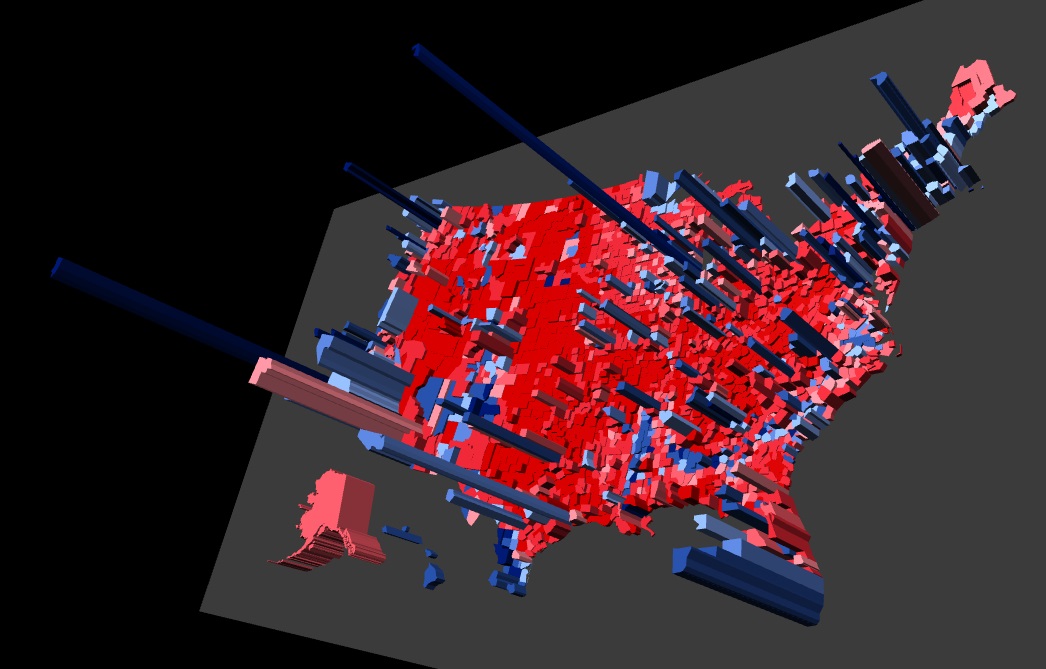
Interestingly, as expected, the various social media platforms and internet connectivity therein are sketchy and intermittent as the critical USA midterm election nears.
As we have done in the past, today we solicit reader feedback on the sentiment in/around your area as the midterm election nears. What is your local sense of the tone, voter intent, enthusiasm or lack therein, in the last 72 hours before election day on Tuesday.
This request comes with a very important and specific qualifier, DO NOT USE social media to gauge or report your sense of where things stand. The reasoning is simple; the algorithm you are exposed to is not necessarily the reality of your environment. The information being fed into the data system that holds your specific attributes, is purchased and created specifically to provide you a specific sense.
Whether you realize it or not, your algorithm is the culmination of specific identifiable definitions of your personage and your interests. That algorithm id may or may not represent you, but it is sold and used in order to influence your decision-making on a variety of aspects from commerce (purchasing decisions) to behavioral modification (influences).
As a consequence, the best view of the reality in your vicinity is what you personally experience in real life, not during your travels on the internet. With that thought in mind, what is your sense of the voting intent in/around your proximity?
From my own travels what I can identify with ease is the promoted narrative about abundant enthusiasm for leftist candidates is mostly false. I cannot identify any substantive enthusiasm to vote for the communist agenda of the Democrat Socialists or any other manufactured policy of the political left in real life.
Sure, online and in the media, there is a specific pipeline of information operating at maximum output to promote a blue wave premise. However, in real life -during my travels- I do not see that same level of enthusiasm claimed by oppositional advocates.
To the contrary, the datapoints and behavior of the political left indicate they are ‘trying’ to generate the illusion of something, as well as create some self-fulfilling prophecies. The appearances of President Obama in Detroit on behalf of Al-Sayed is an example. Obama is only deployed to get out the black vote. If the Muslim Brotherhood candidate was ahead in Michigan, Obama simply wouldn’t be there.
Additionally, the proverbial lawn sign indicators do not lend favor to a blue wave narrative.
That said, Georgia and Texas will be interesting to watch play out. Both of those states have been targeted by the various BLM, and DSA level operatives for several years. However, while they have succeeded in Georgia, they have not had a similar success in Texas – despite the lone star state being specifically vulnerable due to the Bush camp’s comfort with the larger socialist cause.
President Trump, DHS, ICE, DOJ and HSI have done all they can to trigger fear amid the professional population of election operatives who deploy fraudulent ballot operations as part of their electoral strategy. The Lawfare alliance has been spending billions to counteract this election integrity operation. It is yet to be determined which one will ultimately end up tipping the scale amid the various illegal voter systems.
What we can judge with some accuracy is the sense in our vicinity. What is the intent of our family? What do our neighbors say? What is the sense within our local community? These are measures of real sentiments that can be adequately assembled to provide a larger predictive sense.
Taking the social media network and subsequent algorithmic feed out of the equation, what is the reality of the sentiment in your area as best it can be judged?
posted originally on October 30, 2026 by | Sundance |
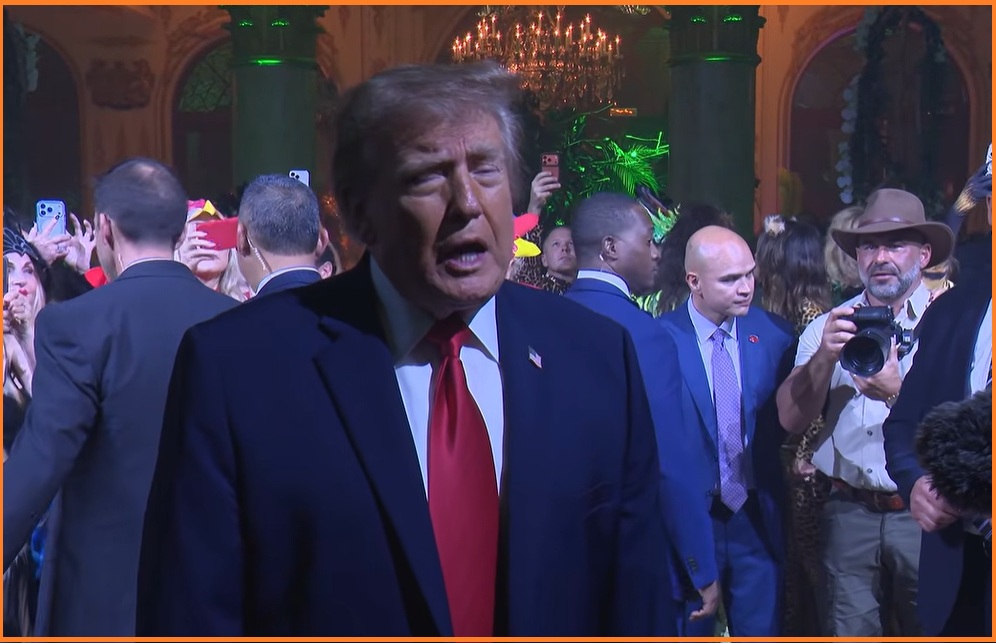
During a festive Halloween event at Mar-a-Lago, President Trump held an impromptu press conference discussing current events in the lead-in to the Tuesday midterm election. WATCH:
posted originally on October 30, 2026 by | Sundance |
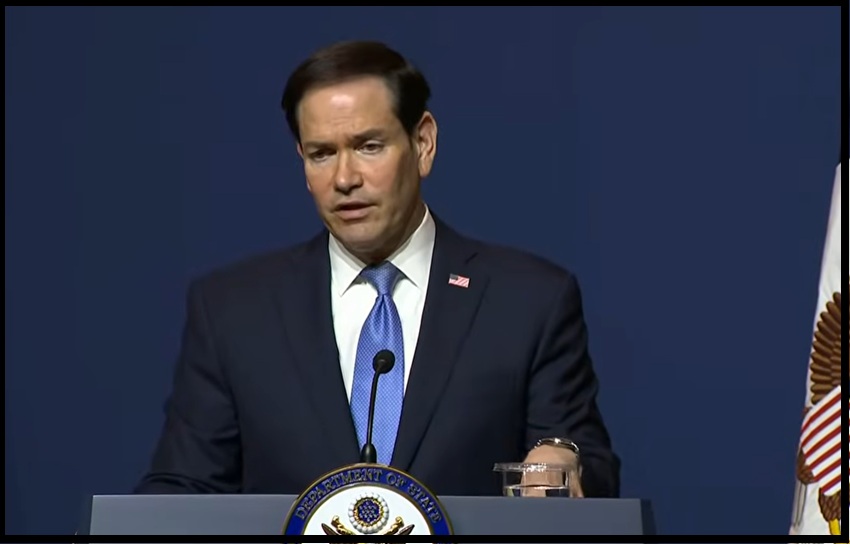
During the two-day G-20 summit of Foreign Ministers, Secretary of State Marco Rubio holds a press conference to answer questions from the international press pool. The questions and answers are wide ranging about multiple regions from Europe and Russia to India, Iran and beyond. WATCH:
posted originally on October 30, 2026 by | Sundance |
As noted by the KyivIndependent, “Despite efforts by the United Nations, the International Committee of the Red Cross (ICRC), and even Pope Leo XIV, a ceasefire agreement has only come about since the intervention of Melania Trump.” It was First Lady Melania Trump who was able to touch the people who mattered and organize the operation.
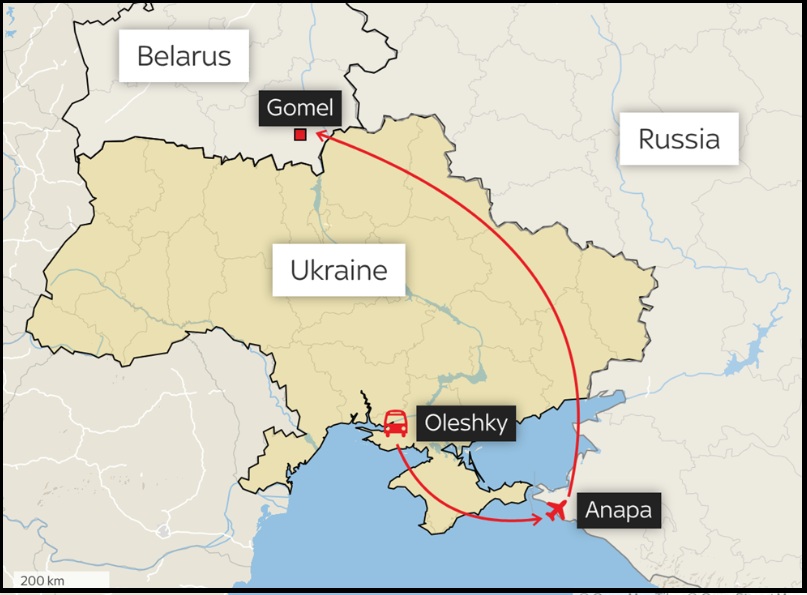
Four evacuation planes carrying hundreds of residents of Russian-occupied Oleshky in Kherson Oblast landed in the Belarusian city of Gomel on Oct. 31 as the evacuees continued their journey to Ukrainian-controlled territory, David Arakhamia, head of President Volodymyr Zelensky’s parliamentary faction, said. (more) Newsmax was granted exclusive media authorization to document the events. WATCH:
posted originally on October 30, 2026 by | Sundance |
It would appear that Michigan Senate candidate Abdulrahman Mohamed El-Sayed has just outlined why he is so filled with anger toward white people. During a rather bizarre rant against Secretary of War Pete Hegseth, El-Sayed attempts to ridicule Hegseth by comparing the level of support they both received during childhood.
As noted by Chuck Ross, “Hegseth was an all-state point guard in high school in Minnesota, set various school records. He played college ball and got some floor time in the 2001 NCAA tournament. El-Sayed played club lacrosse at Michigan.” Now WATCH:
Nicki Minaj outlines the psychology accurately: “If you listen carefully, it’s a misplaced anger at his own parents for not making him feel worthy that turned into raging jealousy of other children who had parents that lifted them up and poured into them. He’s projected all of that onto white people. He needs to mend his heart before thinking about running for any office. White ppl haven’t hurt him. He knows exactly who did. Notice how he doesn’t get the satisfaction he was craving when the interviewer simply anchors himself & doesn’t validate that experience.”
Suspicious Cat says, “Not stable. Big warning flag.”
posted originally on October 30, 2026 by | Sundance |
During the two-day G-20 summit of Foreign Ministers, Secretary of State Marco Rubio holds a press conference to answer questions from the international press pool. The questions and answers are wide ranging about multiple regions from Europe and Russia to India, Iran and beyond. WATCH:
posted originally on October 30, 2026 by | Sundance
Canadian Prime Minister Mark Carney said Friday that if his government could not successfully negotiate a suitable trade pact with the Trump administration, he was prepared to wait for a new American president; one that Canadians would approve of.
Asked if that meant he would hold out for a new American president; the prime minister answered in the affirmative. “We’ll have to, if that’s what it takes,” Carney told POLITICO
Within the interview Carney also emphasizes the risks from AI (SI) and underlines how the AI frontier labs are requesting a slowdown and regulation upon them. Carney says he agrees with the AI leaders on this issue and government regulation is a best approach.
In my opinion the reason Canada and the EU want AI slowed and regulated is simply because they are so far behind on their ability to generate their own models. They have a self-interest to stop AI (SI) development in the USA.
The transcript for the interview below:
(0:00) Prime Minister, thanks for speaking with Politico today.
(0:02) Thanks for having me.
(0:03) You’ve just wrapped up the 21st Kennedy EU summit here in Montreal. Um, this is a milestone meeting. You’re eager to deepen transatlantic ties. Um, but there is, we know, some dispute about how to characterize and name the Canada EU relationship. How would you describe the relationship status with the EU in one word?
(0:30) Tight. I don’t I mean I think that’s a little too clever of a question quite frankly uh for relations between jurisdictions as complex and uh multifaceted as Canada, the European Union. The uh what’s clear uh and I think what’s important is to recognize the ambition and the reality uh and the reality filling in with the ambition. And as we’ve made clear, the pres president Vanderline, President Costa, uh, (1:01) Chancellor Mets, uh, I saw a statement from him the other day. He and I speak regularly. Uh, this is (1:09) going to be the closest association between any country in the European Union in the world and the ambition around the closest association possible without being a full member of the European Union. So that is tight, but it’s broad. It’s multifaceted. Uh and it’s designed to do several things. (1:31) affordability for our families, uh, opportunity for our students, our people, our businesses, our researchers, and reinforce our sovereignty, our independence by bringing together our complementary strengths in a wide range of areas, energy, critical minerals, AI, space, uh, and beyond so that we can withstand shocks, so that others can’t leverage against us because of certain choke points or critical supply. And in that regard to continue to ensure that our citizens have the freedoms that they enjoy, that they can live their lives as they choose.
(2:08) Prime Minister, you said that you speak with the chancellor of Germany, Mertz, frequently. Have you expressed some frustration to him about this impasse over associate membership? Because we do know that he is he’s blocked it from the joint declaration and Germany is still against the use of that term.
(2:26) I think it’s uh well, I I I’ll make a couple of observations. one is that uh the in terms of frustrating we have a very constructive relationship so we focus on uh what we’re working on together a variety of global issues uh he’s in Asia at the moment maybe he’s just made it back home uh so we’ve been talking about a variety of other uh elements uh number two in terms of uh again the the titles I can slightly understand why you ask it but I’m not sure the best use of our time is to ask multiple questions is about one term. When what is this is about is a deep cooperation across technology, across trade, across culture, across research, across education uh working together on common problems with very specific agreements that are that are going to move uh to address them.
(3:22) But given that do you understand Germany’s objections? I well the issue the issue is a very uh internal European issue which relates to uh terminology around countries that are in Europe and could ultimately become a member of the European Union and nomenclature that’s applied to those countries. It’s not a Canadian issue. It’s a internal broader European issue and given where you are and Politico’s considerable resources I’m sure you can research and discover uh the details around them.
(3:56) Your government also in Montreal announced a new national security strategy. It (4:01) yes (4:01) uh identified frontier AI as a real threat facing Canadians. I’m curious how concerned you are about the enormous political the enormous economic power wielded by a handful of global tech executives.
I think the any time so thank you for that. The any time that there is a single point of risk or a couple of points of risk uh or points of failure uh you should be concerned in terms of and that those relate directly to the core economy. So let me draw that out and to be more specific. So what’s been happening over the course of the last several months is frontier AI models have been better able to identify holes in cyber defenses uh which run the risk of financial institutions seizing up uh power systems or other core systems in our economies uh stopping functioning because they need cyber defenses all the time. U it is not a good idea to have only one solution to that problem. It is a good idea to have multiple solutions to those problems and to have some of those solutions within your control either through partnership, direct ownership, direct development. And what our national security strategy does is it identifies (5:21) not countries per se, but it identifies the type of areas where there is that deep strategic risk. Critical minerals is another, energy is obvious, food security is a third. uh various aspects of AI, space technology. Increasingly what will happen is a variety of systems in our economies will run will be connected to space to satellites in some form. Well, if you’re connected to a satellite system that a billionaire almost trillionaire decides to turn off at one moment or not, uh that’s not a good idea either. So having the redundancy. So what’s one of the things that we in Europe are doing which is cooperating pooling our space assets some of our space assets Europe as you know has Iris squared, we have some leadership in low earth or orbit satellite um some other technologies can come together which creates some parallel systems (6:14) redundancy independence sovereignty and then there is not that uh that risk that that you just described
(6:22) But you alluded to what Elon Musk did with Starlink and Starshield. That was a huge problem for Ukraine on the battlefield. It took days to resolve. It still has exposed the extent to which Ukraine is vulnerable. And there’s nothing, as far as I can tell, that Canada, that Europe can do to replace that capability. (6:41) Well, I mean, instantaneously, you can’t instantly. (6:44) How long would it take?
(6:45) It takes, look, I what our LEO constellation will be operable in 2028. uh Europe’s uh a few years later I I’ll say roughly u we can help bridge to Europe’s constellation or and or we can help scale and pool those two constellations. Those are the types of things you can do if if you’re deliberate about them and and and focus on them and and accelerate and that’s exactly what we’re doing. So uh the the there are there are risks. Uh now we are not we have not uh hooked our dependencies to that system our our defenses to that system. Uh nor would we given the track record.
(7:28) Do you think the CEOs are doing enough when you consider the risk from AI? I mean you’ve identified it as a big threat to humanity. I mean the idea of slowing down gets re mentioned and then shut down are the tech company CEOs who you speak to do you feel like they’re taking the risk seriously and preventing it?
You know uh I don’t know if this is a contrarian view but uh the ones I speak to Demis would be an example Nobel laurate at Google deep mind uh Dario Amadai others they they do take it seriously and in many respects they’ve been at the forefront and very well informed and from an early stage in other words going back several years uh warning about the risks on cyber on recursive AI uh other aspects biohazards and things. So they have been it is exceptionally difficult (8:24) if not impossible I never I should never say something is impossible but it’s exceptionally difficult for uh industries to regulate themselves to truly regulate themselves uh on a much lower scale. I’m very familiar with what happens in finance and banks know that they shouldn’t stretch too far, but to quote uh Chuck Prince, when the music’s playing, it’s hard to stop dancing unless somebody is regulating the music, overseeing the music, providing guardrails in and around. That’s why so much was done in the financial sector. It should have been done before the financial crisis. Uh we did a lot after the financial crisis. It’s why Canada is advocating a technology stability board bringing together the safety institutes some of which are resident here in Montreal uh the MA we made an announcement at MA uh the other day uh where a lot of that expertise is a lot of that expertise is in Europe some of it’s in the UK of course some is in the US but pooling that providing getting common approaches making sure that you know we go back and apply it this is something we should be doing to be absolutely clear we should be doing at the G7. We should be doing at the G20. It’s not happening. It’s not moving fast enough. So, what do you do in that circumstance? If you’re the European Union, if you’re Canada, some other like-minded countries, is you come together and you do that together to the best extent you can. It’s not as good as it happening globally, but it’s far better than nobody doing it. And it does potentially create the momentum or at least the nucleus uh for broader solutions. And that is one of the examples of what we will be doing with the alliance for the future.
(10:01) I’m glad you put your central banker hat on because I want to ask you a question on that because obviously so much of the global economy now is being built on the potential of AI to boost productivity. (10:14) What happens if it fails?
Well, if you’re asking me from a central banker perspective, uh, back back to the old days, I mean, this is one of the issues is that (10:24) if the productivity benefits, if and when the productivity benefits come from AI that are widely spread, they have to be widely spread to affect the economy and and to bring wages up and and and growth up for for everyone. Um, then economies can grow faster without inflationary pressures. What you can’t do as a central banker is take that for granted and start to adjust monetary policy lower interest rates or have interest rates lower than they otherwise would be because you think that’s going to happen. You have to see it happen because the inflationary process works in a very short period of time. And so one of the issues for central banks is is teasing out when that’s going to happen. It’s (11:10) I personally I think it’s less tricky for them (11:15) because they need to see it in the actual performance um and then respond uh at that time
(11:22) on a personal level. How do you use AI day-to-day?
(11:25) How do I use AI? I use it well I use it not as much as I would like uh because much of what I receive is secret or top it it’s government uh information um and so I have to be accept you know I have to be very careful about uh what’s applied to that and our systems I’m speaking just openly are not well set up uh in terms of using data information across various systems it’s just there’s series of silos the way they’re designed. So what we’re doing as a government is uh we are embedding AI. We we brought Patrick Pette in a former CFO of Google very experienced in the area across the board and we’re transforming how government works and that’s going to be part of what I’m able to do. I can see what I would like to do with a series of agents in terms of uh managing my information flow and pulling things out. Uh but we need to restructure rapidly internally uh how we work as a government. Uh so that’s the that’s the longest short answer to how I use AI. Look, I mean recreationally I’ll use uh uh some um GPTs to uh to you know inquire about certain issues or others, but that’s uh it’s not as much as I would like it to be the case.
(12:49) I want to take you back to national security. Yeah. Um, I have a question on Golden Dome, the the US potential US missile shield.
(12:56) Yeah.
(12:57) Uh, in I’m going to quote you. We can see the geoic dome from here. (13:01) [clears throat] Buckminister Fuller’s dome right there from 1967.
(13:05) I’m going to have to go check it out.
(13:06) You can check it out. You just look over your [laughter] shoulder. You know, it doesn’t look much difference when you get that close. Sorry.
(13:11) Uh, in a
(13:12) You can edit all that out, Nick.
(13:13) No, we should keep it because Brussels has the automium. So, it’s like a dual Okay. bubble situation.
(13:19) All right. I’ll go uh next time. Next time when you’re in Brussels, I’ll take you to the UK and then Yeah. Okay.
(13:26) Um in a recent interview. Sorry, we’ve run out of time with the Times, [laughter] the New York Times. Um I’m going to quote you said hypersonic missile defense coordination with the United States will be and then you were interrupted. You didn’t get to finish the sentence.
(13:39) I can’t remember what I was going to say.
(13:40) What would you say now?
(13:42) What what’s just reflecting on on Golden Dome and uh Canada’s I guess potential? Well, there’s look there are there are a series of areas where um you know Canadian continued Canadian US cooperation are is the most effective way to defend Canada my interest um defend the United States as well. Uh and so what’s changed is uh and changing rapidly is the risk of hypersonic missiles uh circumpolar if I can put it that way or over polar uh missiles uh coming towards the United States or hitting Canada. Uh and so a coordinated approach there uh is of interest. We are we are investing in some of the components of that defense over the horizon radar. uh for example the Australian purchase that uh we we we’ve started to put in place which literally does looks over the horizon uh in order to give that extra period of time to uh provide that defense. So we’re making some of those investments. Uh there’s clear line of sight, you know, with us in the United States in terms of what we’re doing and and how uh how that potentially could fit into a broader solution.
(14:53) But do you think at this point that Golden Dome is is tangible? Is something that could actually happen that’s worth talking about participating?
(15:02) Uh the could being the operative word there.
(15:05) Um we’ll move to to Trump and and the trade war. Couple questions. Occasionally you’re asked about this. (15:13) Yeah. Um midterm elections are next week. Is it acceptable to you to never get the chance, never seal a new trade deal with Donald Trump while he’s in office?
(15:27) What I I would I would flip the question around. Um we will conclude a deal that’s in Canada’s interest when one is available and uh uh we will we can do it this afternoon. Uh we know the broad outlines of that. That’s a mutually advantageous uh trade deal with the US and Canada. By the way, the most mutually advantageous trade deal with US and Canada is our existing trade deal uh which they call USMCA. But if in an environment of the new trade policy of the United States, there are still things where uh given the starting point uh they’re very much win-win uh for the two countries uh and we can conclude that rapidly, but we’re not going to conclude uh something for the sake of concluding it. We’re not going to lock in something that’s not in Canada’s interest. We have agency. We have options. We are building this economy domestically at home. We’re deepening partnerships with the European Union, represented by your colleague. Um we are uh we’re we have free trade access to one and a half billion consumers around the world and we’re likely to double that in the next six months. Uh so yes, there’s a deal uh to have with the US. we can do that quickly, but if there’s not something that’s in Canada’s interest, uh we will we’re not, as I say, we’re not going to do it just for the sake of it.
(16:48) So, another way of asking it would be you’re willing to wait for the next US president if that’s what it takes.
(16:54) Well, we’ll have to if if that’s what it takes. Yeah. And you know, and uh American families, uh American businesses will also lose out because of that. They’re not winners in this circumstance. Um, but what is happening is that every month that goes by, Canada grows stronger, our options increase, uh, ultimately we’ll be a better partner for the United States. That’s not why we’re doing this. Uh, we’re doing this to create more opportunity for Canadians.
(17:28) I wanted to ask you about some of the comments that have come from the US Ambassador Pete Herstra and others who’ve been accusing Canada of election meddling ahead of the midterms. I mean, are you tired to borrow an expression of the US poking the bear?
(17:44) Uh, well, not a bear. Am I the bear in this metaphor?
(17:47) I think Canada’s the bear. Uh, I think Canadians are tired of it. I think that’s very clear.
(17:53) Have you raised it with Trump? raised uh the fact that you know that these accusations keep flying.
(18:00) Uh I think that might encourage more. Um look, we call out uh we call out the issues I call out specific issues with the United States. Uh there are a wide range of uh wide range of them. Unfortunately, um what what I focus on with uh in my interactions with President Trump are yes, trade uh and trying to push and encourage uh towards something that’s in their interest but very much in our interest, mutually advantageous deal. Uh there are a series of global challenges. We we all know them. Ukraine, uh, Iran, uh, Gaza, um, Sudan, uh, a series of, uh, areas where the United States has, uh, tremendous influence and and can be part of the solution, where Canada can do some things to help, and so to try to encourage outcomes that are that are going to make things better.
(18:57) Did you change any of the way in which you spoke about the EU Canada summit, anything that you did here this week with a view to what Donald Trump might say about it?
Absolutely not. That that way lies madness. I and I be absolutely clear about that. We do I what I speak for Canada. I speak in Canada’s interest. I can’t remember if I’m trying to manage my words so that uh it doesn’t offend this country there or that country there. It’s far better just to be absolutely clear what we’re doing. This is a very positive association. The bilateral relationship between Canada and Europe, the tightest uh one to go back to where we started, the tightest one uh that exists and a very positive alliance. So that that’s and it’s much better and it’s very much the mood of the country of of Canadians. Canadians want to build. Canadians want to move forward. Canadians want to do things. They want to solve problems. They don’t want to react to things. They don’t want to break things down. They don’t want to it’s it’s we’re uh we have challenges. There’s no question. Uh but people are in a good place. They want to come together. They want to build. And so we’re not adjusting for other what the US might think, what China might think, what uh what certainly what Russia might think.
(20:26) Might you adjust for what happens in Europe? Because the EU is moving towards the far right. The French election is coming up. Marin Le Pen is polling first. The AFD has won two consecutive regional elections. So, is there a worry that you have that this union that’s built on tight values on aligning on all of these things might actually look very different once those elections happen?
(20:51) Well, look, part of having values and valuing uh democracy and freedom and rule of law is that you have elections and the people decide which direction they want to go. Uh so that’s part and parcel of the European Union, certainly Canada. what we have I’ve yet to find a country that uh in a world that’s more dangerous and divided does that doesn’t want to be more sovereign more independent a better able to withstand shocks you quickly learn if you haven’t figured it out yet if you’re in one of these roles that to be sovereign is not to be alone that you need like-minded partners nobody is self-sufficient the United States is not self-sufficient. United States discovered that when China uh made restrictions on critical minerals. There’s lots of other areas uh where the United States relies on other countries for certain critical uh aspects. Um and so governments coming in within Europe. There are issues in Europe, but there are advantages within Europe. And and Europe itself gives more sovereignty to countries that are in Europe. Canada gives more sovereignty to Europe. Europe gives more sovereignty to Canada. Would you work with a president Le Pen across the (22:10) My look my uh my responsibility is to work with uh whether it’s provincial premiers or leaders of other countries in the best interests of Canada. Now working with and having agreement on are two different things but my experience is best to look to work together. Could the could the could the range of cooperation in Europe for Europe and and the way it its priorities change with democratic different democratic outcomes? Absolutely. Uh but that’s that’s the way it should be. Is there more than enough in terms of deepening our cooperation in the areas that we’ve set set out? Absolutely. As well and and both both are compatible.
Next month you’ll be the only NATO leader um aside from Donald Trump to attend the the Apex summit in China. You’ve said that if you hadn’t thought about that, but that’s true. Yes. And you’ve said that if you see Vladimir Putin, you will tell him to to get out of Ukraine, similar to one of your predecessors, Steven Harper. But do you do you plan to seek a meeting with Putin while there?
(23:14) Uh no, I I don’t. Uh but uh I mean that that’s my message to him. Um uh my message to him would be we’re going to tighten sanctions. Get out of Ukraine. Stop your war crimes.
Um we had some some breaking news today just shortly before we we sat down here. Uh Russian hockey teams likely let back into international tournaments. Canada is hosting the under20 championship we call in Canada of course the world juniors. Yeah. In Alberta. Um what do you make of the idea that that Russian teams will be competing once again?
(23:49) Uh wasn’t aware of it. It’s unwelcome. Yeah. Do you consider I’ll think about it. I’ll think about it. Yeah.
(23:58) I wanted to ask you about the four shirts from Brooks Brothers that Donald Trump gifted you. [laughter] Yes. Did they fit?
(24:07) I haven’t tried them on yet. I haven’t tried them on. I’m going to I’m going to wear If we have a trade deal, why I’ll put them on. Uh but it was uh you know, I thank the president for sending the shirts. Ask my shirt size.
Uh but and uh yeah have why did he send those shirts like what is I do know does it say anything more broadly about crossber relations or is it just your personal relation [laughter] uh did you I don’t want to go I don’t want to I don’t want to read too much into it.
Did you send him something back?
(24:39) I didn’t actually. I said thank you. I said thank you. Uh but uh yeah, no, I haven’t had occasion to put on the shirts cuz uh we don’t have a mutually advantageous uh trade deal. I look forward I look forward to the day that I am wearing uh the Brooks Brothers shirt as you say. I’m not going to wear all four at once. [laughter] Uh but they are Yeah, they’re sitting in my closet.
(25:01) What’s the last gift you gave the president?
(25:07) Can’t remember. Uh come on, Nick. [laughter] Well, there was a there was an Olympic hockey bet. Uh I heard some sort of gentleman’s wage.
No, there wasn’t a bet. We didn’t bet on the hockey. We talked about it and we talked about the World Series as it was going through. Uh I am trying to remember. I know what I gave. Uh which was for the um 250th uh anniversary of the United States. Uh we did a series of things uh as Canada. We lit up this was to the American people, president included. Uh we lit up various bridges, crossber bridges uh with the American flag. Nice touch I thought. uh we sent uh 250 maple trees to be planted across border states and then we had some commemorative uh coins uh that were made which had on them uh two two-sided uh one was the American eagle because as you know you know uh the American there’s lots of American eagles in Canada uh bald eagles uh in Canada as well of course as being the symbol of the United States and then on the other side his favorite monarch who happens to be king of Canada as well as the United States, Prince King Charles, I should say. Yeah.
(26:22) Uh, we have to ask you about Nathan Fieler, uh, Vancouver’s own. Nathan Fielder, his his documentary, Elizabeth Holmes, um, you can see everything. Canada’s latest. I can see everything, but I haven’t seen the documentary. So, [laughter] would you let him, knowing maybe a little bit about his style, make a documentary about you?
(26:38) I I don’t uh I mean, I know I have no idea. How’s that? How’s that?
(26:45) Well, let’s shift then to a cultural icon in Canada you certainly love, which is Heated Rivalry season 2 is coming. Well, I certainly Yeah. Okay. Yeah. Well, you’ve posed for photos quite warmly with one of the stars.
Um, it just happened.
Do we get a Carne cameo? Did we get Do we get a Carne cameo in season 2?
(27:03) I don’t I boy that would I think the business model of heated rivalry I mean apart from entertainment is uh to have as many people watch as possible and I think having a car carne cameo might drive down ratings so I wouldn’t hold my breath but of course Ottawa does play an important role in season two doesn’t it yeah look forward to it.
(27:23) I did want to ask about something you said in your uh press conference earlier you were asked about the support for Ukraine you mentioned how long is this interview like a [laughter] month.
We We get a year. Okay. That’s what we’ve been told. All right. You said press conference yesterday. You mean? No. No. Cuz it was yesterday. We’ve been here for 20 years. Oh, God. [laughter] Yes. Of course. Because you got the heated rivalry. Well, you look great for someone who hasn’t changed. I wanted to ask about the 500 million uh uh contribution to the Ukraine loan that you mentioned. You said that was the start. What is the sort of headroom you’re talking about?
(27:56) Well, I think that I mean that is that’s the essence. I think we recognize that’s the agreement and that’s within the maybe I didn’t choose the words exactly uh clearly enough. Uh you have the 90 billion as you know euros uh of that loan. Um we’re we’re taking 500 million euros of that. The question unfortunately back to the Putin point um is how long this continues to go on. this uh the suffering continues to go on um and the additional um needs that may be there for Ukraine. So, sorry, I was imprecise. I was more alluding to we’re going to stand by Ukraine uh and be there uh both for uh reconstruction um and ongoing support uh for their defensive purposes.
(28:49) Do you think there is a wavering in the global consensus around how to treat Putin? because it feels like lately a lot of leaders are picking up the phone and talking to him. Just recently we heard about the phone call between the uh and store. Do you think that’s the right approach?
(29:09) I think it depends on the message uh and whether previous messengers were clear enough about what the message uh and and the resolve for example for those members of the coalition of the willing the resolve of uh European Union uh resolve of European member states I should I mean clearly um and uh and countries like Canada uh sometimes it’s better to have uh those direct leader to leader conversation. So in that regard it’s fine. um uh and maybe constructive I don’t think that u well there has been some variance in terms of US actions uh with respect to restrictions on you know sanctions on Russia um provision of defensive capabilities to Ukraine that’s been unhelpful um I don’t think there’s been a wavering of uh resolve of other members. Clear there has not been a wavering of resolve. If anything, there’s been a hardening of resolve of members of the coalition of the willing Canada included. Um I the uh the atrocities continue. Uh h ballistic missiles being fired into the equivalent of uh old Montreal. Um in Kev, Russia lost uh another 35,000 plus soldiers in the last month. Um it’s a pointless slaughter uh that’s going on. Uh so the resolve the resolve continues.
(30:50) Prime Minister. Okay. Thank you very much for the full day you gave us all of our questions. [laughter]
This is an interesting potential shift in energy position for the European Union. There has been zero investment by the EU nations in oil refining capacity. Simultaneously, Europe is now realizing they need diesel and jet fuel.
Under the EU Emissions Trading System (ETS), refineries have an ever-diminishing cap on carbon emissions, and they receive fewer ‘free’ pollution allowances over time.
This means oil refining costs go up steadily, increasing the cost of operating the dirty carbon facilities, while these same refineries must adhere to stricter environmental rules and pollution limits under the Industrial Emissions Directive (IED). The entire regulatory system was created to eliminate gasoline, diesel and eventually jet fuel.
As the EU is now discovering, their climate change policies have been executed but the global and EU drop in demand has not occurred at the same pace. The EU is now in a position where the percentage of their own oil refining production is lower than their needs. More energy dependency has been created.
With the EU energy analysts now saying they don’t have the fuel capacity to support the political demands for a war with Russia, in combination with President Trump continually affirming the U.S. will not get involved in any expanded conflict, the European Union is now reevaluating how to increase domestic fuel production.
EUROPE– Over the past couple of decades, Europe has pursued some of the world’s most ambitious clean energy policies, aiming to become the first climate-neutral continent by 2050. Hardly surprisingly, Europe is now further along the clean energy transition compared to its western peers, with renewables accounting for roughly half of the continent’s power mix compared to about 26% by the U.S. However, Europe is now being forced to reckon with its decision to ditch some of its fossil fuel assets as yet another global energy crisis unfolds just years after the 2022 energy crisis.
[…] the continent has been forced to rely more heavily on imported refined products, exposing it to geopolitical risks. The Iran and Ukraine wars have led to a spike in oil and gas prices, with EU Energy Commissioner Dan Jørgensen terming geopolitical instability and the prolonged diesel squeeze a “wake-up call” for the bloc.
[…] Central European nations like Poland, Czechia, and Slovakia have been pressuring the European Commission to establish a long-term protective strategy for Europe’s oil refineries. They have called for refineries to be protected from carbon leakage and given access to EU funds to upgrade.
[…] now, Brussels is looking to rethink its long-standing approach to the domestic oil-refining industry. On Wednesday, the European Commission launched the first High-Level Dialogue with the European oil refining sector. Co-chaired by Dan Jørgensen (Commissioner for Energy and Housing) and Andrius Kubilius (Commissioner for Defence and Space), the forum discussed Europe’s energy security, industrial competitiveness and defense readiness amid recurring geopolitical disruptions. Participants mapped out short-term responses to supply disruptions stemming from ongoing conflicts in the Middle East, noting that EU refineries currently supply approximately 70% of jet fuel and 85% of diesel consumed across Europe. (read more)
”posted originally on October 30, 2026 by | Sundance |
Remember when former Canadian Prime Minister Justin Trudeau told President Trump the Canadian government could not continue its economic policy if the United States demanded they become self-sufficient.
One of the key reasons cited by Trudeau was the Canadian dependence on the USA for defense. Canada simply could not spend the amount of money needed to create their own military at a level required for independent defense and simultaneously follow their govt spending plan. Canada relied on the U.S. military as their defense strategy.
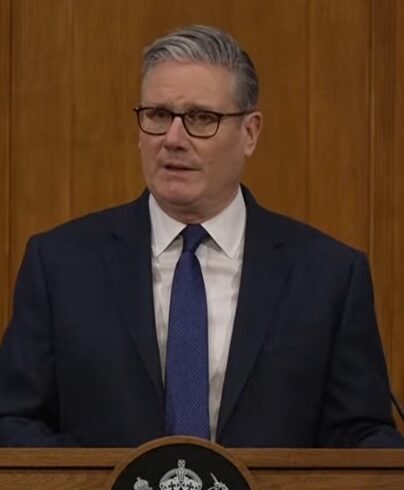
Yesterday, former British Prime Minister Keir Starmer said the same thing; only this time Starmer was saying the United States is no longer willing to “bankroll” Europe’s defense and both the U.K and European Union were going to need to find money to build their own military.
(VIA BBC) – Sir Keir Starmer has said Europe should build a common security framework, warning the change in its defence relationship with the US is permanent rather than “an aberration of the Trump presidency”.
The former prime minister was speaking at a British Irish Chamber of Commerce (BICC) dinner in Dublin on Friday evening.
Sir Keir said a “common security framework” for Europe was needed as much as a common market, with the UK at its centre.
He warned that “things will not go back to the way they were,” adding that the US had made clear it will no longer “bankroll” its European allies. (read more)
This public statement and admission by Keir Starmer follow remarks by current Canadian Prime Minister Mark Carney to Politico on the heels of the Canadian-EU summit, also yesterday.
“If you’re connected to a satellite system that a billionaire, almost trillionaire, decides to turn off at one moment or not, that’s not a good idea,” Carney said. (source)
Think about this for a few moments. Canada, the U.K and Europe are all facing the same problem…. MONEY! Where are they going to come up with the funds to pay for a military investment they have declined to make for the past 50+ years?
It’s not just an issue of finding funds for a standing military, hardware, ships, submarines, aircraft, tanks, heavy and light artillery, missiles and drones etc., they also have to fund the technological capabilities to use and deploy modern weapons.
They also need advanced manufacturing, steel works, technological guidance systems, large numbers of strategically placed satellites, a space program that includes rockets to put them into orbit, and much, much more.
At scale this is multiple trillions, and that doesn’t include the baseline manufacturing systems needed to create all this independent infrastructure.
It’s one thing to say, ‘we will build out our military capacity‘, and it’s another thing entirely to actually build it. Does Canada or Europe even have the human resources within the engineering sector to create all this infrastructure? Think about it.
When you really stand back and look at the required level of investment needed, in addition to the time it takes to build all of the ancillary processes that are required to meet such an expressed objective, it really puts the context of the Canadian, British and European opposition to President Trump into context.
What is more feasible? Doing what is required to build-out your own military defense systems; or is it simply easier to get rid of the person who stops you from using the USA as your standing army?…
posted originally on October 30, 2026 by | Sundance |
Things were simmering just below the surface due to pro-EU globalist Prime Minister Donald Tusk and a pro-nationalist President Karol Nawrocki both occupying leading roles in government, with a conflicted judiciary stuck between them making decisions about efforts to change the Polish constitution.
Tusk supports globalism, Nawrocki supports nationalism, the constitutional judiciary, a tribunal assembly essentially equivalent to the U.S. supreme court, held more nationalist judges than globalist judges – including the tribunal court president Bogdan Swieczkowski (essentially the Chief Justice).
LAST NIGHT – Prime Minister Tusk waited until President Nawrocki left the country, then together with aligned ideological judge Anna Korwin-Piotrowska, they declared the court President, Bogdan Swieczkowski, as null and void, while presenting herself as the replacement. Judge Korwin-Piotrowska attempted to become the self-appointed judicial president with the support of Tusk.
As best it can be determined, Prime Minister Tusk simultaneously ordered the police to surround the judicial court complex and block any attempts to stop what was happening inside the tribunal area. Justice Minister Waldemar Zurek, who is also the attorney general, told journalists he requested the lifting of legal immunity for Judicial President Swieczkowski and his deputy Bartlomiej Sochanski in order to carry out their replacement.
This was, by all reasonable interpretations, a stunning and planned judicial coup d’etat carried out by globalist Donald Tusk, an aligned judge Korwin-Piotrowska and an internal network of leftist government allies. However, President Karol Nawrocki, a close ally of Donald Trump, turned his plane around en route to Senegal and quickly returned to Warsaw so that he could intervene and stop the judicial overthrow.
To say the events were stunning would be an understatement. Prime Minister Donald Tusk essentially tried to forcibly remove the judicial blocks that were keeping Poland sovereign and away from the deleterious impacts of Brussels, including mass migration and the elimination of all Polish sovereign currency.
Donald Tusk wants Poland fully committed to the larger goals of the European Union; President Karol Nawrocki wants to keep Poland sovereign. The people inside Poland are caught in this remarkable dynamic, where a percentage of the population that wants full EU influence is now actively trying to destroy and remove all political opposition who favor the retention of Polish sovereign rights to control its culture, borders and currency.
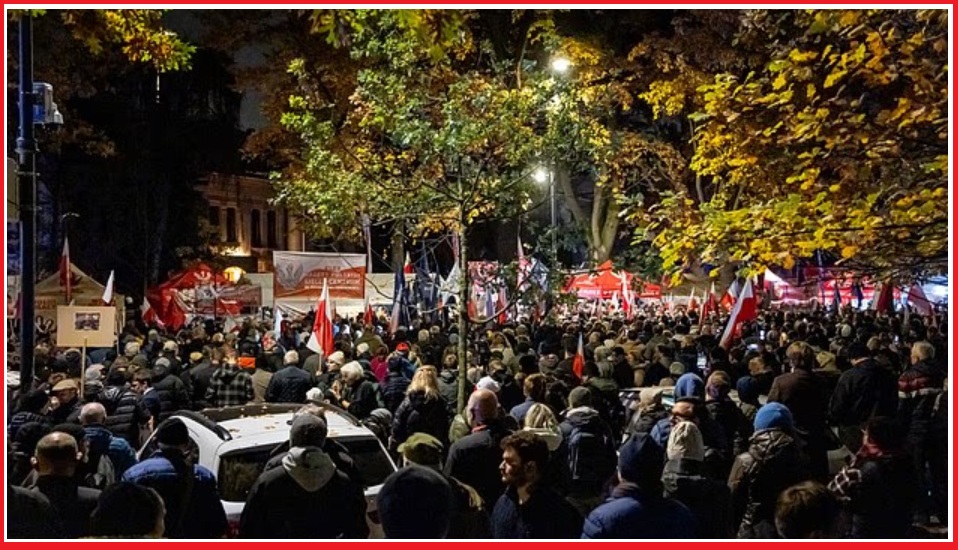
(Via Daily Mail) – Riot police have been deployed to Poland‘s top court amid claims of a ‘coup’ after its chief judge was suspended in an escalating battle between Donald Tusk’s government and the nationalist right.
Dozens of officers guarded the entrance to the Constitutional Court in Warsaw on Friday as protesters gathered outside, with some chanting ‘Tusk traitor’.
The extraordinary stand-off prompted President Karol Nawrocki to abandon an official trip to Senegal mid-flight and order his plane back to the Polish capital.
Three people were arrested after trying to enter the court complex, police said, as supporters of the opposition Law and Justice party (PiS) protested the ousting of court president Bogdan Swieczkowski.
Some said prayers while holding Roman Catholic rosaries and religious images.
The court’s official X account denounced the intervention as a ‘coup d’etat’ and insisted Swieczkowski remained in office.
The confrontation marks a dramatic escalation in the struggle between Tusk’s centrist government and the nationalist opposition over control of Poland’s judiciary.
Swieczkowski’s suspension was announced by fellow judge Anna Korwin-Piotrowska, who said the move was needed to restore the rule of law.
Justice Minister Waldemar Zurek, who is also the attorney general, told journalists he had requested the lifting of the legal immunity of Swieczkowski and his deputy Bartlomiej Sochanski. (read more)
Statement of the President of the Republic of Poland Karol Nawrocki
“This night, a violation of the constitutional order of the Republic of Poland occurred, along with the forcible takeover of a constitutional state organ. I have held consultations with the First President of the Supreme Court, Zbigniew Kapiński, who also does not recognize as legal the actions taken by individuals usurping power in the Constitutional Tribunal.
I call for the restoration of legal order and the departure from the Tribunal premises by the enforcement forces dispatched to the site by the government.
To the Constitutional Tribunal, I have enabled the entry of the legally serving Vice-President of the Constitutional Tribunal, Judge Bartłomiej Sochański.
In connection with the threat to the internal security of the Republic of Poland, I am convening urgent consultations today with the participation of representatives of parliamentary forces in order to achieve stabilization of the political situation and restoration of the constitutional order.
I thank all those who are at the Constitutional Tribunal, standing in defense of the Constitution of the Republic of Poland.”
I have created this site to help people have fun in the kitchen. I write about enjoying life both in and out of my kitchen. Life is short! Make the most of it and enjoy!
This is a library of News Events not reported by the Main Stream Media documenting & connecting the dots on How the Obama Marxist Liberal agenda is destroying America