Posted originally on Sep 30, 2026 by Martin Armstrong |
Zelensky now says Ukraine needs to mobilize 50,000 to 60,000 people EVERY MONTH simply to keep pace with Russia. Stop for a moment and think about what that number actually means. At 50,000 per month, that is 600,000 people per year. At 60,000, it becomes 720,000. Zelensky is talking about finding a population roughly equivalent to a substantial European city every single year to feed into a war that has already been grinding on since 2022. Where are these people supposed to come from?
That is the question nobody wants to confront because Ukraine does not possess an unlimited reservoir of military-age men. Its population was already declining before the war. Millions of Ukrainians subsequently fled abroad, millions more live in Russian-occupied territory, and the remaining population has endured years of casualties, disability, displacement, emigration, and demographic collapse. Ukraine does not publish a complete current population count because there has been no census since 2001 and wartime migration makes estimates difficult.
Ukraine has already been forced to expand the recruitment pool. The minimum mobilization age was lowered from 27 to 25 in 2024. Men between 18 and 60 generally remain subject to wartime restrictions on leaving the country, although there are exemptions, and Kyiv has repeatedly revised mobilization procedures as the military searches for additional manpower. Rumor has it that they will start going after the young women next. Ukraine has resisted lowering compulsory mobilization to 18, instead creating voluntary contracts with enhanced financial incentives for people aged 18 to 24. I’d expect that to change as well.
A 20-year-old is not merely another soldier on a spreadsheet. He is potentially forty or fifty years of future productive labor. He is a future engineer, farmer, mechanic, entrepreneur, taxpayer, husband, and father. Kill or permanently disable enough young men and the economic consequences continue for generations after the politicians finally sign whatever peace agreement they could have negotiated years earlier.
Human capital is much harder to measure. How do you calculate the children who will never be born because their prospective fathers died at 23? How do you calculate the businesses never created, the taxes never paid, the families never formed, or the skilled workers who fled the country rather than risk being mobilized?
Ukraine already entered this war with one of Europe’s worst demographic problems. Its fertility rate had been well below replacement for years, and the war drove births still lower. That means the generation Kyiv is drawing upon today was already smaller than the generations that preceded it. You cannot manufacture another generation of 25-year-olds because the Defense Ministry needs another 50,000 recruits next month.
Then there is the issue everyone conveniently ignores when quoting mobilization figures: recruitment is not the same thing as increasing the size of the army. If Ukraine mobilizes 50,000 people while thousands of existing soldiers are killed, wounded, medically discharged, missing, deserting, or otherwise leaving service, the net increase is far smaller. They are replacing men the war has already consumed rather than expanding the military.
Russia faces the same brutal arithmetic, but Russia began with a population several times larger than Ukraine’s. Ukraine cannot simply compete with Russia soldier-for-soldier indefinitely and pretend demographics do not exist. If Moscow can recruit or mobilize from a vastly larger population, matching Russia’s monthly manpower numbers becomes increasingly expensive for Ukraine in demographic terms.
The people cheering for endless war from Washington, Brussels, London, Paris, and Berlin do not have to supply 60,000 Ukrainians every month. They supply money. They supply artillery shells. They supply missiles. They supply loans and weapons contracts. Ukraine supplies the human beings.
That is why Zelensky’s 50,000 to 60,000 figure should horrify anyone actually concerned about Ukraine’s future rather than merely its battlefield position next month. Annualize the upper end and Kyiv is talking about mobilizing 720,000 people every year merely to match what it says Russia is recruiting. That does not mean 720,000 will necessarily be mobilized or sent into combat, nor does it tell us Ukraine’s casualty total. But the scale of the stated requirement exposes the fundamental problem.
Ukraine cannot continue burning through its human capital indefinitely. Neither can Russia. There is no victory worth celebrating if, by the time politicians finally decide to negotiate, an entire generation has been buried, crippled, displaced, or driven overseas and the country supposedly being saved no longer has enough young people left to rebuild it. The weapons can eventually be replaced. The buildings can eventually be reconstructed. The debt can be rolled over and politicians will pretend somebody else will pay it later. The young men disappearing into this war cannot be printed, borrowed, or replaced.
Posted originally on Sep 30, 2026 by Martin Armstrong |
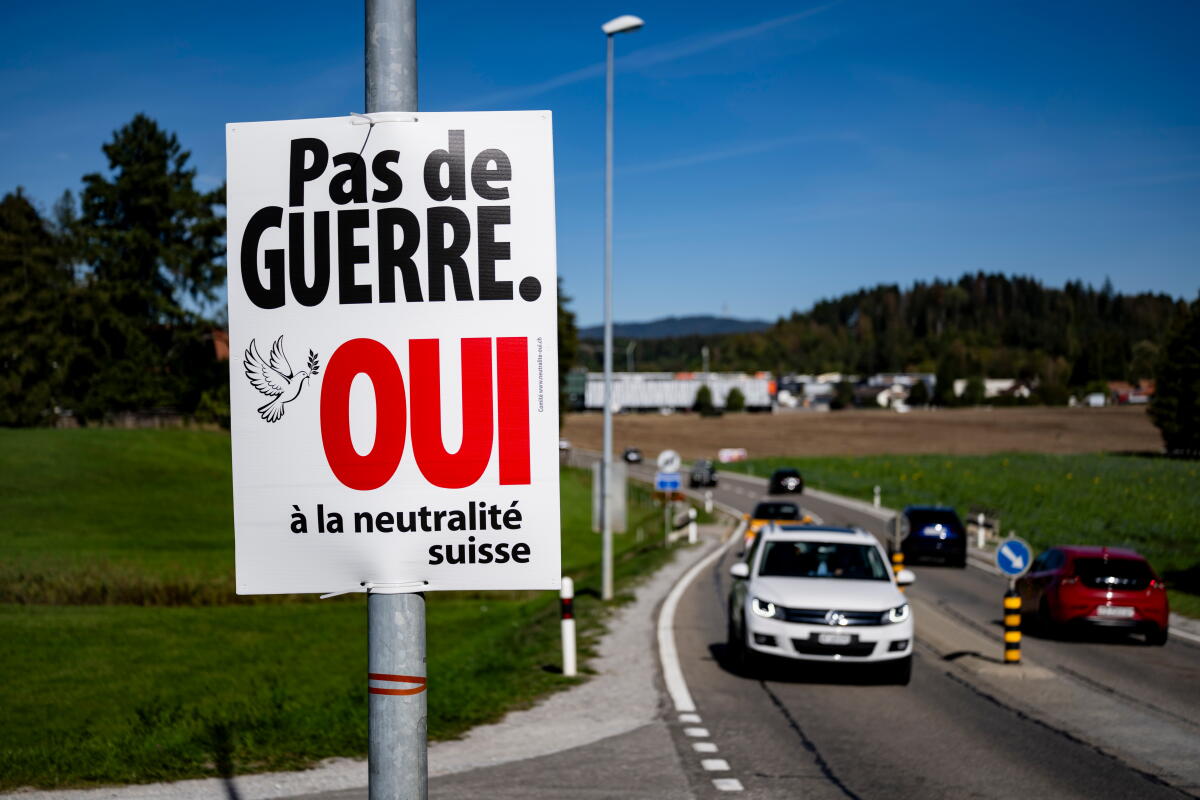
Switzerland built its reputation over generations on one simple principle: NEUTRALITY. It survived two world wars without joining either side, became a diplomatic meeting ground precisely because it was outside the military alliances surrounding it, and turned that independence into an enormous economic advantage. Capital trusted Switzerland because Switzerland was supposed to stay out of everyone else’s wars. Now even that definition is changing.
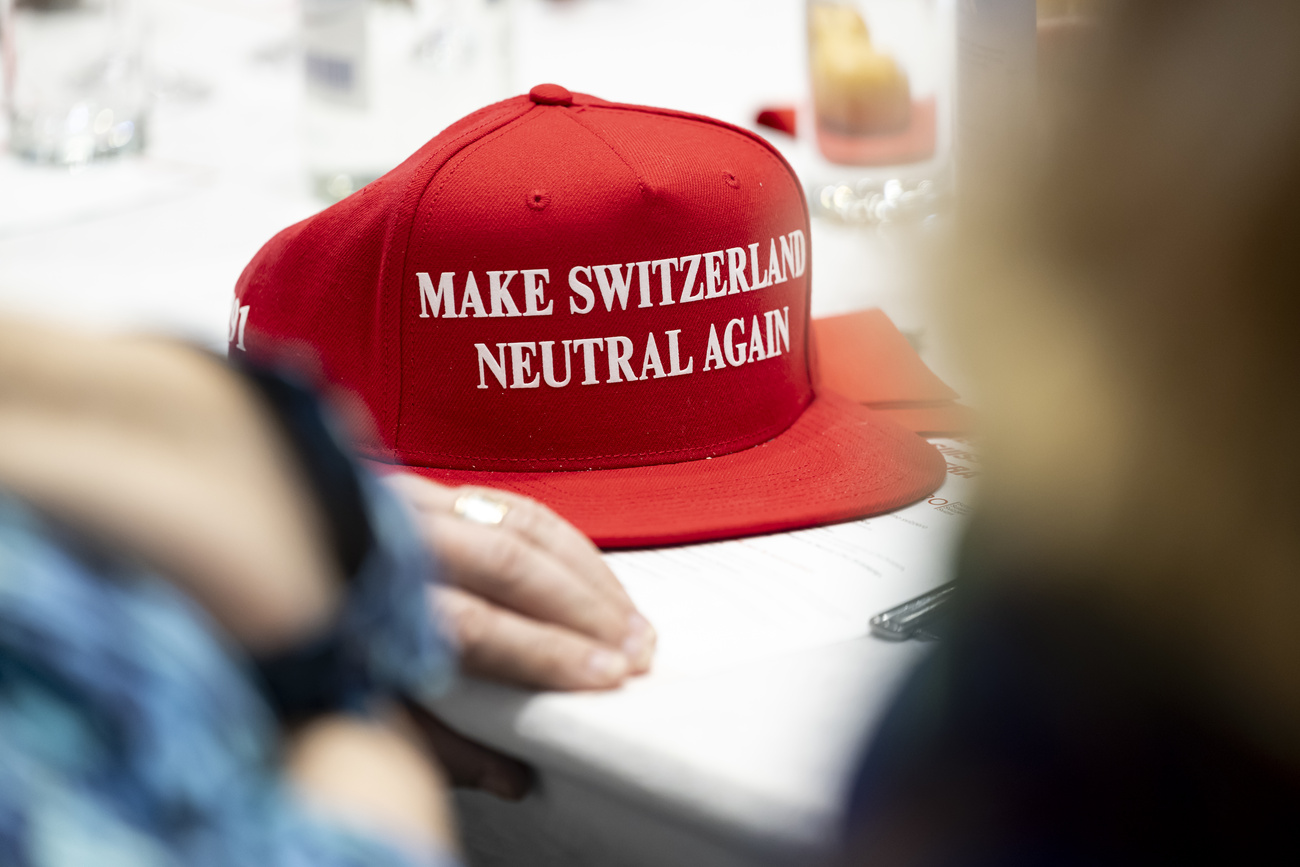
Swiss voters overwhelmingly rejected an initiative that would have written a much stricter form of neutrality into the constitution. The proposal was defeated by 70.15% to 29.85%, with every single district voting against it and turnout at 47.06%. The initiative would have prohibited Switzerland from cooperating with military or defense alliances unless Switzerland itself faced an attack or an imminent attack, and it would have prevented Bern from imposing sanctions on belligerent nations unless the United Nations had approved those sanctions.
The Swiss government opposed the proposal because it wanted to preserve the freedom to cooperate with other countries on security and to impose sanctions independently. Switzerland is not joining NATO because of this vote, nor did voters formally abolish neutrality. In fact, polling still shows overwhelming public support for remaining neutral. What they rejected was a much more rigid constitutional definition of what neutrality must mean.
How neutral can a nation become before the word itself begins to lose its meaning? After the war began, Switzerland largely adopted the European Union’s sanctions against Moscow. Bern has continued aligning itself with subsequent sanctions packages, including measures targeting Russian energy, banking, and the military-industrial sector. Switzerland has also cooperated with NATO for decades through the Partnership for Peace and joint activities, while its defense minister has argued for deeper security cooperation as Europe responds to the war in Ukraine.
Supporters of the defeated initiative argued that this is precisely how neutrality disappears. It does not vanish one morning when somebody lowers the Swiss flag and raises a NATO flag. It erodes incrementally.
Opponents made the opposite argument. They said rigid neutrality would tie Switzerland’s hands, prevent it from responding economically to violations of international law, and weaken its ability to cooperate with European partners on security. That is the choice Swiss voters were actually making, and they overwhelmingly decided that neutrality should not prevent their government from using sanctions or cooperating with NATO.
Fine. That is democracy. The Swiss people voted and the result could hardly have been clearer. But there is an economic issue here that goes far beyond Russia and Ukraine. Switzerland’s neutrality was never merely some romantic political tradition. It became part of the country’s financial architecture. Neutrality helped make Switzerland a place where competing governments, businesses, and private capital could operate precisely because the country was perceived as standing apart from geopolitical conflicts. That reputation helped build Geneva as a diplomatic center and Switzerland as one of the world’s great financial centers.
Once you begin weaponizing finance, sanctions, reserves, and access to markets, capital starts examining political risk differently. This is what governments repeatedly fail to understand. Money does not care about speeches on morality. Capital asks whether the rules will remain the same tomorrow.
The seizure and freezing of Russian assets throughout the West changed the calculation for governments everywhere. Whatever one thinks about Russia’s invasion of Ukraine, China, Saudi Arabia, the Gulf states, and every other holder of substantial foreign reserves watched what happened. They learned that financial assets can become geopolitical weapons when relations deteriorate. That lesson does not disappear because Western governments believe their cause is justified.
This is also part of a much larger transformation taking place across Europe. Germany is rebuilding its military and debating compulsory service. France has introduced a new voluntary national-service program as its military leadership warns the public about potential sacrifices in a confrontation with Russia. NATO members are dramatically increasing defense spending. The European Union is building an increasingly integrated defense industry. Even traditionally neutral states are reconsidering what neutrality means in an environment dominated by the Ukraine war.
Finland and Sweden have already abandoned military nonalignment and joined NATO. Austria remains formally neutral but participates in EU sanctions against Russia. Ireland is debating its own security posture. Switzerland remains militarily neutral, but the political distance between neutral Europe and NATO Europe has unquestionably narrowed.
This is how political systems change. Rarely does everything happen at once. Each decision is presented as a limited response to the crisis immediately in front of you. Governments insist nothing fundamental has changed because technically the old policy still exists. Then one day you look back and discover that the institution bearing the old name no longer resembles what previous generations understood it to mean.
The Swiss people have every right to redefine neutrality however they choose. That is one of the virtues of Switzerland’s direct democracy. Unlike Brussels, where bureaucrats make decisions several layers removed from voters, the Swiss actually put the question before their citizens. They voted overwhelmingly against locking the older definition into the constitution. But markets will make their own judgment as well.
Posted Originally on Sep 30, 2026 by Martin Armstrong |
There is one economic indicator governments consistently underestimate because they cannot control it with legislation or manipulate it with an interest-rate announcement: confidence. The Conference Board’s Consumer Confidence Index collapsed 6.7 points in September to 81.9, the lowest reading since April 2014. Economists expected 89.2. This was not some marginal statistical miss. Americans are becoming increasingly pessimistic about their jobs, their purchasing power, and what they see coming over the next six months.
This is how an economy changes direction. People do not wake up one morning because the government announces a recession and suddenly stop spending. They begin changing behavior long before the official statistics catch up. They cancel the vacation, stop eating out as often, hold off on that new car purchase, and begin putting whatever they can aside because they no longer TRUST what tomorrow will bring. That change in confidence then becomes economic reality because consumer spending is the backbone of the American economy.
The Conference Board’s Present Situation Index dropped 7.9 points to 109.3, while its Expectations Index fell another 5.9 points to just 63.6, the third consecutive monthly decline. The Expectations Index is particularly important because people are telling you what they THINK is coming. Confidence is not merely about whether somebody has a job today. It is whether that person believes the job will still exist six months from now.
That confidence in employment is clearly deteriorating. Only 23.6% of consumers now say jobs are “plentiful,” the lowest since February 2021. The share saying jobs are “hard to get” increased to 21.9%, the highest since January 2021. The gap between those two measures has collapsed to just 1.7 percentage points from 4.2 points in August. That labor-market differential has historically moved with unemployment, and consumers are clearly sensing weakness beneath the surface.
The government’s own job-opening data confirms that something is changing. Open positions fell by 256,000 in August to 7.079 million. There are now roughly 1.01 job openings for every unemployed person, compared with nearly two openings for every unemployed worker during the frenzy of 2022. Professional and business services lost 119,000 openings while healthcare and social assistance lost another 115,000. Construction, manufacturing, and government openings also declined. People feel these changes before economists sitting behind computers recognize them.
At the same time, the cost of living refuses to cooperate. Consumers told the Conference Board that references to prices, goods and services, and particularly oil and gasoline had risen to new highs. The University of Michigan’s separate survey tells essentially the same story. Its September Consumer Sentiment Index fell to 48.1, down 15% since January, while consumers’ one-year inflation expectations have risen to 4.6%. Views of both current and future personal finances deteriorated sharply.
This is precisely why confidence matters more than politicians understand. Inflation does not have to continue rising at 8% or 9% for people to remain angry. Prices NEVER went back to where they were before the COVID inflation. The rate of increase may slow, but the accumulated increase remains. A family paying substantially more for groceries, insurance, electricity, gasoline, housing, and automobiles does not care that some economist announces inflation has moderated. Now add interest rates.
The Federal Reserve raised rates this month for the first time in three years, taking the federal funds target to 3.75%-4.00%, because renewed inflation pressure has left policymakers with little choice. Meanwhile, the average 30-year mortgage has climbed above 7%. A young couple trying to purchase their first house is being crushed from both directions. The house itself costs more and the money required to buy it costs more.
Americans are becoming less willing to voluntarily leave their jobs. That is not necessarily a sign of a healthy labor market. During periods of strong confidence, workers quit because they believe they can find something better. When people become frightened, they cling to whatever employment they already have.
The stock market can make new highs while Main Street confidence collapses. There is nothing contradictory about that. Capital moves internationally and increasingly concentrates into assets when people lose confidence in governments, currencies, banks, or alternative investments. The Dow is not a national opinion poll. A rising stock market does not automatically mean the average household believes the economy is doing well.
Confidence is the foundation of every monetary and political system. A dollar is worth something because people have confidence somebody else will accept it tomorrow. A Treasury bond has value because investors have confidence the government will honor the obligation. A bank functions because depositors have confidence their money will be there when they ask for it. An economy expands because consumers and businesses have confidence that taking risks today will produce rewards tomorrow.
Once confidence begins to crack, governments cannot simply order it back. The September data is therefore more important than another monthly economic statistic buried in a government report. Americans across political affiliations, income groups, and age groups are becoming more pessimistic if not outright worried.
Confidence turns BEFORE the economy because the economy is nothing more than the collective decisions of human beings. Governments can manipulate interest rates, create money, borrow trillions, subsidize industries, and produce whatever economic forecast they please. What they cannot command is confidence. Once the public stops believing tomorrow will be better than today, their behavior changes, and eventually the statistics have no choice but to follow.
Posted Originally on Sep 30, 2026 by Martin Armstrong |
As I have noted before, the Roman historian Sallust concluded that the decline of the Roman Republic truly began once Rome had eliminated its external enemies—Carthage, Corinth, and Macedonia among them. With no foreign foe left to unite against, the Romans turned inward and tore themselves apart in bitter factional strife. That observation applies with striking force to our present political crisis. The United States, Europe, Canada, and parts of Asia and the Middle East have fractured into Left versus Right, and no shared sense of unity remains—no loyalty to country or people that transcends the divide. Each side wages war to destroy the opponent it despises. Unfortunately, this is our fate, and we must recognize it as it unfolds on the road to 2032. For now, the next two years threaten to become a living hell, with no one left to defend the country or its people. While others offer personal opinions, I do not have that luxury. My job is to relay what the computer is projecting.
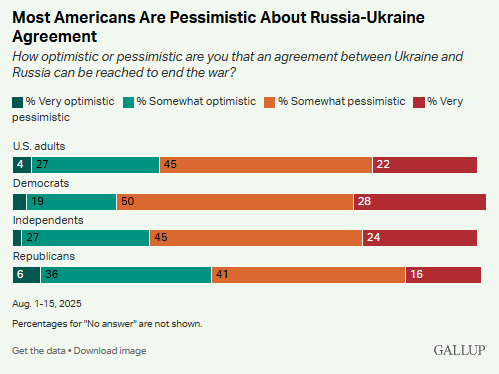
The overwhelming downside of a Democratic victory is that they are the pro-war party. A Gallup poll from last April showed that only 19% of Democrats were optimistic about a possible peace deal. As I have said before, it is almost always the Democratic Party that takes us into war. Wilson led us into World War I. FDR led us into World War II. Truman nuked Japan and took us into Korea. Johnson took us into Vietnam. Dick Cheney usurped foreign policy and took us into Iraq and Afghanistan. Obama tried to take us into Syria, while Hillary Clinton oversaw the gun-running neoconservative operation in Benghazi.
Look, for decades I have warn governments that this current system will collapse and a 2-year-old with a pocket calculator can figure that one out. For fiscal year 1980, the gross interest cost on the national debt was $74.8 billion. To put that in context, the total national debt at that time was roughly $715 billion and everyone was freaking out that it was going to hit $1 trillion.
Projections for fiscal year 2026 indicate net interest payments will reach approximately $1.0 trillion. Some data from the first nine months of the fiscal year shows net interest payments already totaled $827 billion on a $40 trillion national debt.
Interest expenditures on U.S. national debt first exceeded military spending in 2024. The Net Interest Payments was $879.9 billion compared to National Defense Spending $850.7 billion.
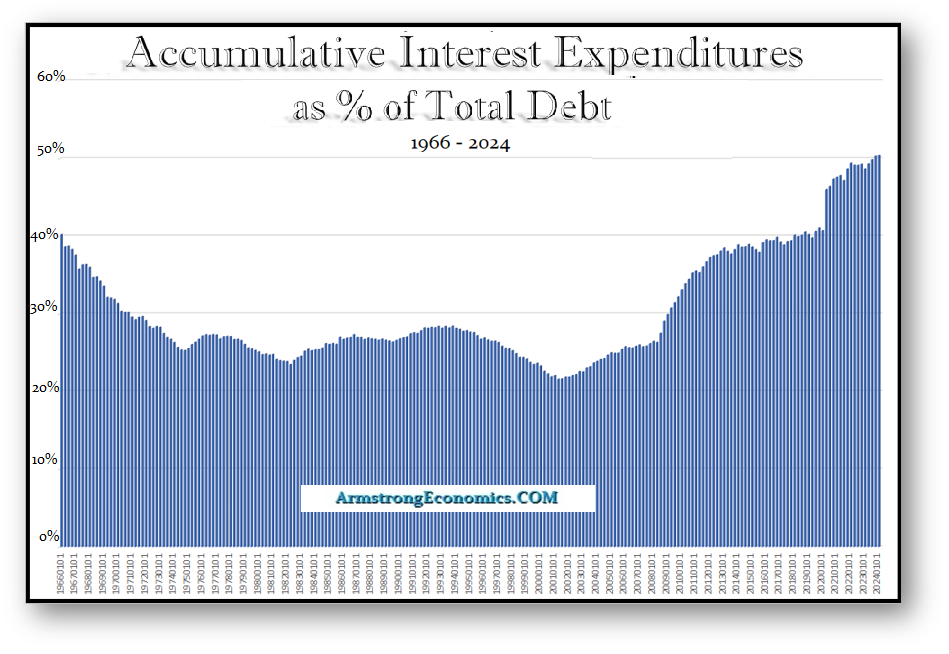
It’s not rocket science – just math. What happens is that interest expenditure keep rising because they only roll the debt and NEVER pay it off. Eventually, the interest expenditures crowd out all other spending. We reach the 50% level of the national debt was accumulative interest expenditures in 2024. This will not end nicely!!!!!
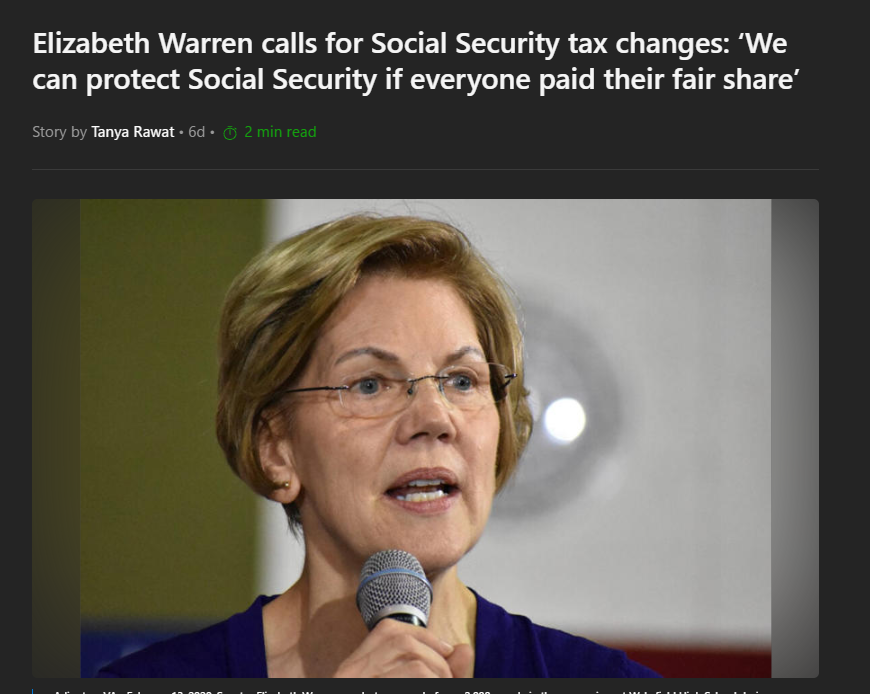
The Democrats will completely destroy the United States by 2032, and it is going to get ugly from 2028 onward. Why? I am not being partisan here, because the Republicans will not touch real reform either, fearing the people are not ready to make sacrifices. Consider Elizabeth Warren, who is determined to transform the United States into a socialist republic. She is obsessed with robbing the rich—whom she defines as anyone with more millions than she has—as if this is some kind of solution. It is just a band-aid on a bullet hole.
As reported, in a post on X Wednesday, Warren compared workers earning $60,000 and $184,500 with someone earning $10 million, saying the first two pay Social Security taxes on all their earnings while the higher earner pays the tax only on the first $184,500. “That doesn’t make sense,” Warren wrote. “We can protect Social Security if everyone paid their fair share.” Yet that contradicts what Social Security was supposed to be.
Social Security was sold to the American public as a “contribution” to present the program as social insurance, but the Supreme Court upheld it as a tax, and it was always collected through the IRS. The cap exists because Social Security was designed as a social insurance program, not a general welfare or savings account. Warren now wants to alter Social Security and transform it into a welfare benefit that will take care of all the illegal immigrants they protect to boost their voting rolls.
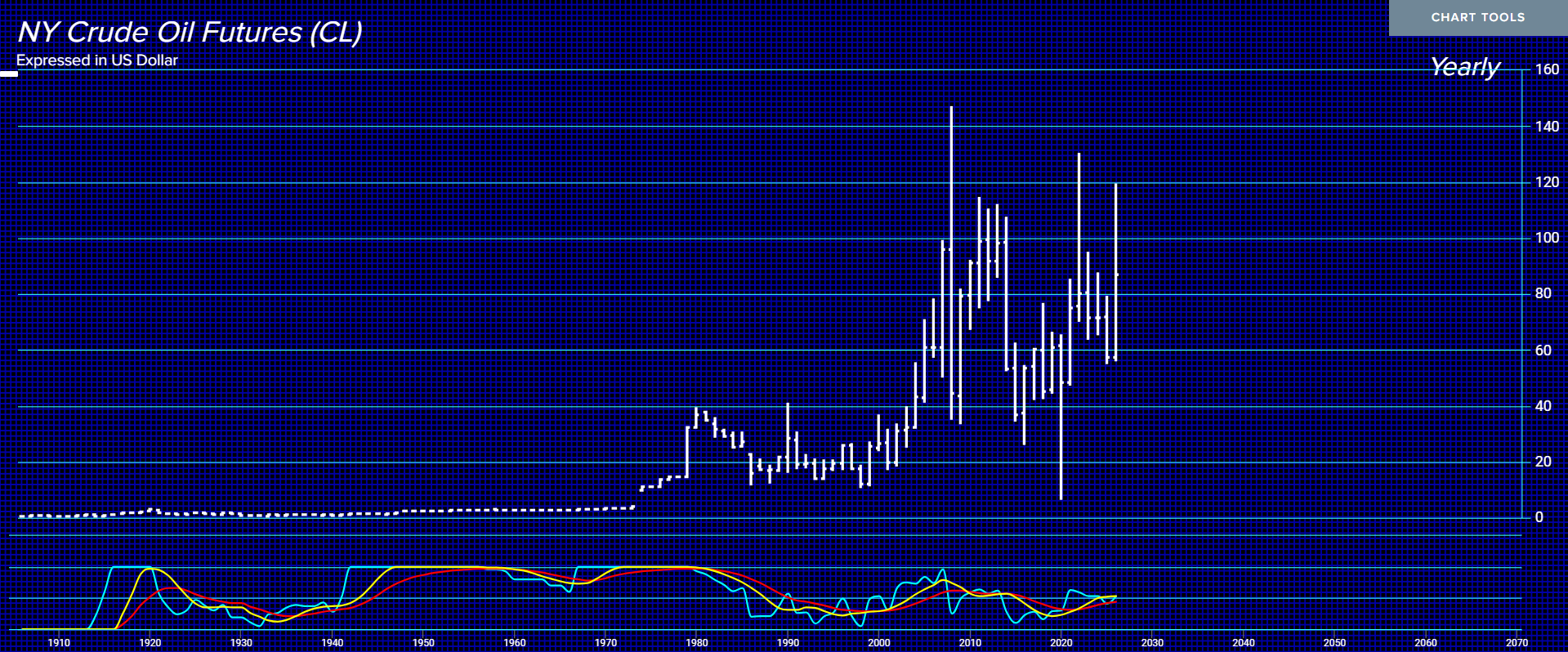
There is zero understanding of the world economy. Even with inflation, people see the price, assume the price is the problem, and propose regulation—but the price is simply the message. You have not just the Middle East, with the Strait controlled by Iran, but the Houthis determined to cripple Saudi Arabia. Throw in Zelensky, and our computer warns that crude oil could reach as high as $234 by 2028—especially if the EU and NATO end up going to war with Russia. That would probably lead to the merger of the Middle East conflict with the Ukraine War and draw in China and North Korea. We have support at $80, with resistance at $125 and $188. A year-end 2026 close above $111 will be a message we should not ignore.
Letting migrants into Europe, the United States, and Canada has been a LEFT agenda to retain power—knowing full well that their policies lower economic growth and reduce living standards. Economic growth in Germany has collapsed to 0.8%, and Italy is down to 0.5%. I first encountered this plot when I had a mandate from Hong Kong to negotiate with Australia to buy an island or allow Hong Kong residents to migrate and build their own city in the upper-left region of Australia. The 99-year lease of Hong Kong to the British expired on June 30, 1997, which was when the handover ceremony took place.
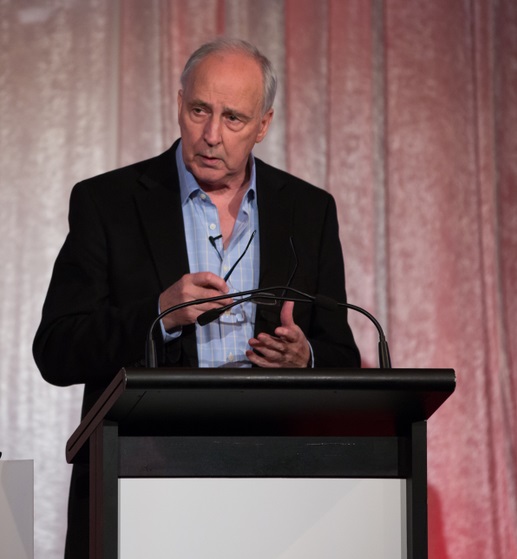
They knew I had contacts in Australia and asked me to try to strike a deal. I met with former Prime Minister Paul Keating. Everything I offered was rejected. I told him I had a blank check to pay off their national debt, but the answer was still no. I finally asked him directly if this was racism—was it because they did not like Chinese people? He said no. They were fleeing communism and would vote conservative. Keating led a Labour government. Allowing Hong Kong residents to migrate to Australia would have altered their politics.
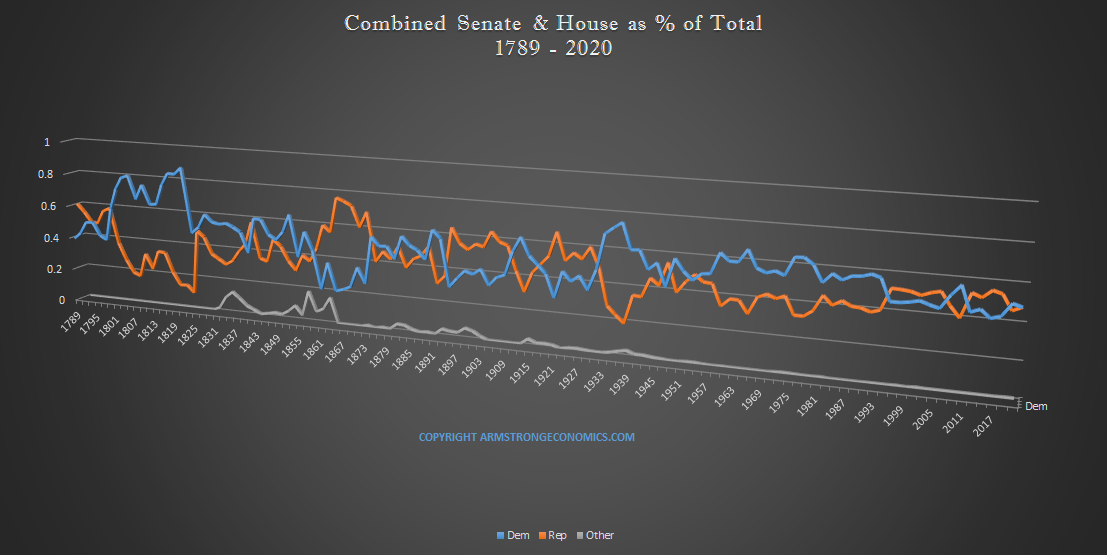
They understand this very well. Opening the borders has been about their knowledge that the LEFT has been losing ground and was destined to collapse. Look at this chart. Measuring the Democrats’ total number of seats by combining the Senate and House reveals the long-term trend. The Democrats held their highest percentage back in the early 19th century. Each subsequent high thereafter has been lower. Since FDR and the Great Depression, each rally has produced a declining number of seats. This is what the whole opening of the borders has been about—a desperate attempt to fight the trend and retain power, like Merz in Germany, who refuses to admit the people do not approve of his policies. It is never about the people or what is best for the country. It is always about forcing their ideas upon society.
Politics in Europe, as well as in Canada and the United States, has degenerated into war. It is no longer about compromise, the nation, or the people. They look down upon the people as too stupid to know what is best. This is exactly what Sallust described about the fall of the Roman Republic. The two sides are so far apart that there is simply no mending this political crisis. We are forced to watch it play out, and we cannot simply change the channel.
NEVER are they willing to look at history. And you do not even have to go back that far. Just look at the City of Detroit. They did the same thing as Mamdani in NYC. They exploited the auto industry to the point that all the car companies left town and Detroit went bust in 1933. Mamdani is doing it all over again. He is chasing Wall Street out. The Texas Exchange will reduce the NYSE. Even JPMorgan now has more employees outside of NYC than inside.
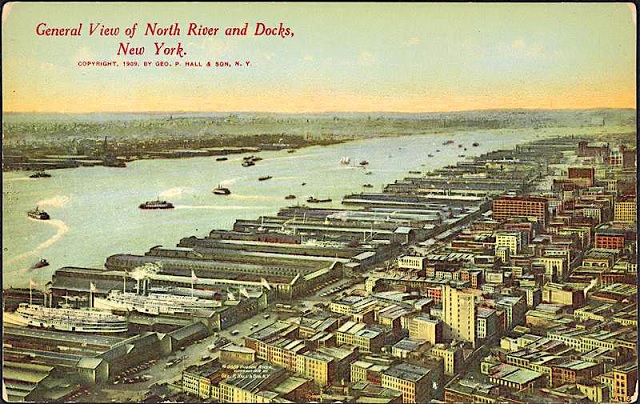
NYC was once the largest port in the United States. The labor unions were uncompromising and hostile. The companies left town, and nobody docks in NYC anymore. No matter what you show them, they refuse to listen.
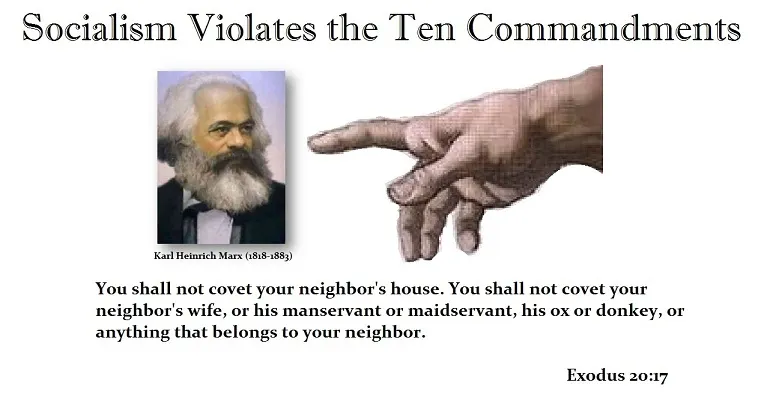
I find it interesting that there was even a communist state in Sparta, Greece. They were the only Greek city that never issued coins, because you were effectively an economic slave to the state, barred from accumulating wealth. Maybe AOC and Elizabeth Warren were married to Mamdani in ancient Sparta in another life. It is fascinating that their philosophy of always coveting their neighbor’s wealth is expressly forbidden in the Ten Commandments. That demonstrates there is this dark side to humanity that has been around for thousands of years.
We have incompetent people in government everywhere. While individuals learn from past mistakes in most cases, governments have no cumulative knowledge. Hence, they make the same mistakes from one generation to the next. There is no collective societal knowledge base. Thus, we are living in Groundhog Day, with the same crazy mistakes being made over and over and over again, incapable of breaking this vicious cycle.
I have warned that the computer has been projecting that 2028 will be sheer political chaos. Between now and then, we are in an unrelenting war cycle that turned up in 2014 and is escalating into 2027 from every direction. There is no sanity left anywhere. The Middle East has no resolution, for this is a religious war with each side looking to fulfill prophecy. Ukraine is consumed with sheer hatred that prevents any reasonable solution. Europe needs war because its climate change policies destroyed the German economy, and on top of that, they opened the borders and flooded the country, altering its culture forever. As tensions rise, following Sallust, they desperately need an external enemy to create unity and retain power in Brussels. The Democrats are so pro-war that they will seize power and fund Ukraine to utter destruction.
Congressional investigations will happen on an unprecedented scale, even for Washington. The Democrats are going to focus on 2028, and the best way to take over the country will be to expose the Trump Administration as rotten to the core. House Minority Leader Hakeem Jeffries has already said they would immediately focus on “corruption.” Jim Himes (D., Conn.) has expressed the same attitude, calling it “nakedly corrupt dealings” between the Trump administration and companies. My concerns are not so much about that, because the Democrats pander to corporations for big bucks as well. My concern is the President’s son-in-law, Kushner, who is NOT an actual government employee; he and his sidekick are “volunteers,” and this structure is meant to avoid FOIA filings, as Hillary did with her private server. If I were them, I would prepare to be torn apart limb from limb.
As we head into 2028, there will certainly be no shortage of Democratic candidates, ranging from governors and members of Congress to outsiders with thick skin. Democrats have desperately, as a whole, tried to navigate this midterm election without really confronting the differences between their Democratic Socialists of America flank and the more practical center of the party. This is what we should expect to see in the headlines as we head into 2028.
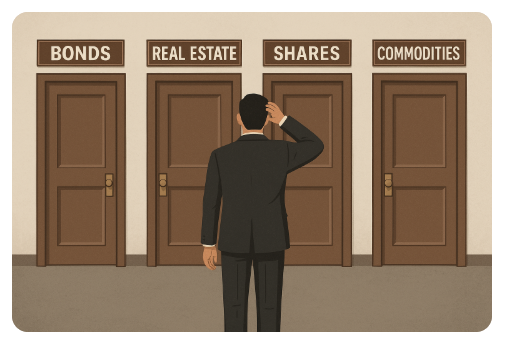
Capital flows are shifting as money moves from PUBLIC to PRIVATE. Bond markets globally are in crisis, for as you beat the war drums, debt rises and the loser always defaults. I have warned that we are in a PRIVATE WAVE that concludes with a peak in 2032. This is when capital shifts from government bonds to private assets. We are in the EVERYTHING BUBBLE, where stocks, real estate, art, gold, silver, and commodities in general tend to be tangible assets to which capital will flee. Others are starting to notice this trend.
When we do this year’s WEC inDecember 4, 5, and 6, we will have a lot to discuss. This is the only way to surve such a wave and we are in the final stages. What to avoid, and where to go.
Posted Originally on Sep 29, 2026 by Martin Armstrong
There is something deeply disturbing taking place in Europe. The generation that remembers war only through documentaries is increasingly willing to tell the generation that would actually have to fight one that military service should become compulsory. France provides perhaps the clearest example. An IFOP survey found that 64% of French respondents supported compulsory military service for people between 18 and 25. But look beneath that number and everything changes. Among the 18-to-24-year-olds who would actually be affected, support was only 40%. Among those aged 50 to 64, it soared to 80%. Among people 65 and older, 71% supported it. It is always easier to demand sacrifice when somebody else’s body will be making it.
France abolished compulsory military service decades ago, but military service is creeping back into the political conversation as Europe prepares for the possibility of a prolonged confrontation with Russia. Macron has now launched a voluntary national service program beginning with 3,000 young people, with plans to expand it to 10,000 annually and potentially 50,000 by 2035. They receive military training and €800 per month, and the government insists the present program is voluntary and that these recruits are not intended to be deployed abroad.
France’s armed forces chief, General Fabien Mandon, caused an uproar when he said the country needed the strength to “accept losing its children” if it was going to deter Russia. How could any mother or father sacrifice their child to an endless war? What will these neocons do to brainwash the public into believing this sacrifice must take place?
For years, European leaders told younger generations that nationalism was antiquated, borders mattered less, Europe had moved beyond war, and economic integration would make the conflicts of the twentieth century impossible. Now those same institutions are rediscovering patriotism because they need soldiers. Suddenly the nation matters again when governments need an 18-year-old to defend it.
At the same time, what exactly has this generation inherited from their lovely government? Housing has become increasingly unaffordable. Government debt continues climbing. Taxes consume enormous portions of income. Pension systems are strained by aging populations, and younger workers are expected to finance benefits for generations far larger than their own. Now the same political establishment wants them to shoulder Europe’s military burden as well. Governments spent decades borrowing against the future, and the young were already going to inherit that debt. Apparently, that was not enough.
This is precisely where Europe’s demographic crisis collides with its military ambitions. France, Germany, Italy, and much of Europe are aging. Governments need young people working, paying taxes, producing goods, starting businesses, having children, supporting pension systems, and maintaining the productive economy. Now they also want a larger pool of soldiers and reservists. You cannot keep demanding more from a shrinking generation without eventually discovering that there are not enough young people to satisfy every promise politicians made before they were born.
The numbers reveal the contradiction better than any politician ever could. Only 40% of those aged 18 to 24 in the IFOP survey supported compulsory service for their age group, while support reached 80% among those aged 50 to 64. The people most enthusiastic about compelling the young to serve are therefore not the people who would be fleeing a drone strike far away from home.
There is something profoundly wrong when the older generations sit comfortably at home discussing the necessity of sacrifice while debating whether the young should once again be prepared for the trenches. If France itself were attacked, young French men and women would have to decide what defending their country means to them, and polling suggests many would indeed be prepared to serve. But demanding compulsory service for somebody else’s generation is not sacrifice. Sacrifice is what you are willing to give yourself. Sending somebody else’s son or daughter to pay the price for your geopolitical decisions is something entirely different.
Posted Originally on Sep 29, 2026 by Martin Armstrong
Spain’s housing crisis has finally exploded into the streets. Tens of thousands marched through Madrid after an 87-year-old disabled woman, Maricarmen Abascal, was removed from the apartment where she had lived for more than 70 years. Police battled protesters trying to stop the eviction, and Maricarmen was ultimately carried from the building on a stretcher and taken away by ambulance. Protesters have now erected tents in Puerta del Sol, turning one woman’s eviction into a national symbol of a housing system that is breaking down.
The Bank of Spain estimated that the country was already short roughly 550,000 homes last year. Spain has experienced enormous pressure from tourism, short-term rentals, population growth, immigration, and years of inadequate housing construction. Madrid, Barcelona, Málaga, the Balearic Islands, and other desirable areas have seen housing costs move far beyond what ordinary wages can support. This is what happens when demand expands much faster than supply. Politicians can pass all the laws they want, but they cannot repeal economics.
Maricarmen became the face of this crisis because her case is so brutal. She had lived in the apartment for 71 years. After the building changed hands, she was offered the opportunity to purchase the apartment for €247,000, an impossible amount for a pensioner. Her rent had been €500 per month and was subsequently raised to €1,650 while her pension was reportedly only €1,350. The landlord ultimately prevailed in court over the validity of the old tenancy arrangement, and after several attempts to prevent the eviction, she was physically removed.
Now everyone is furious, and naturally the politicians are scrambling to prove that they can fix the problem they failed to prevent. Prime Minister Pedro Sánchez has promised another housing decree with stronger tenant protections and restrictions on evictions. His coalition partners are going even further. Sumar has demanded that the government expropriate Maricarmen’s former apartment so she can return to it, although another government minister has questioned whether such a move clearly fits within Spain’s constitution. Protesters are demanding rent freezes, restrictions on investment funds, stronger eviction protections, and still more government intervention in the housing market.
You cannot solve a shortage by making housing less attractive to build, finance, rent, or own. Housing is unaffordable, therefore punish the landlord. Rents are rising, therefore control the rent. Investment funds purchase buildings, therefore prohibit them from buying property. A tenant is evicted, therefore expropriate the apartment. Every solution attacks the symptom while politicians refuse to understand why people can no longer afford housing.
Spain needs more construction, more investment, faster permitting, available land, infrastructure, and an economic environment where developers can actually make a return for taking the enormous financial risk of constructing housing. If the political response to a shortage is to threaten landlords with rent controls, expropriation, restrictions on ownership, and increasingly difficult eviction procedures, capital does not magically volunteer to build millions of additional apartments. It goes somewhere else.
This is the same mistake governments make every time they interfere with markets. They see the price and assume the price is the problem. The price is the message. Rising rents are screaming that there is insufficient housing relative to demand. Suppressing the price does not manufacture another apartment any more than imposing a price ceiling on bread creates more wheat.
Spain’s population has been growing while housing construction has failed to keep pace. Immigration is not the sole cause of Spain’s housing crisis, nor are tourists, Airbnb, investment funds, or landlords. But every person requires somewhere to live. You cannot continuously increase housing demand while failing to increase supply and then act astonished when prices rise.
This is why the demonstrations in Madrid are so important. Housing is becoming a political fault line throughout Europe because younger generations increasingly believe the economic system has locked them out of ownership. Their parents purchased homes on ordinary salaries, often with only one working parent. Today young people can work full-time, pay enormous taxes, and still struggle to rent a small apartment without roommates. They are postponing marriage, children, and family formation because housing has become unaffordable. That has enormous consequences for Europe’s already disastrous demographics.
Watching an 87-year-old disabled woman being carried from the home she occupied for seven decades while protesters clash with police is precisely the sort of image that destroys confidence in the political system. But emotion does not change the underlying economics. Spain can confiscate Maricarmen’s apartment tomorrow and it will still be short hundreds of thousands of homes.
We are watching this same mentality spread across Europe. Britain is expanding powers allowing councils to take control of qualifying homes left empty for only six months. Spain’s governing coalition is openly debating expropriating a privately owned apartment. Rent controls and restrictions on landlords are spreading while governments simultaneously complain that there is not enough housing. These policies will not remain isolated because every socialist government eventually discovers the same convenient solution to scarcity: when government cannot provide enough, it begins telling private citizens what they may do with what they own.
Spain’s housing crisis is not going away because somebody passes another decree in Madrid. The Bank of Spain’s estimated shortage is measured in hundreds of thousands of homes. That cannot be solved with slogans, rent controls, or confiscating apartments one at a time. You either increase supply or continue fighting over the supply that already exists.
Madrid is showing us what happens when politicians choose the latter. Tens of thousands of people are already in the streets, tents are appearing in Puerta del Sol, and an 87-year-old woman has become the symbol of a generation that no longer believes housing is within reach. Governments should be very careful. Once people conclude that working harder will never allow them to own a piece of their own country, the housing crisis stops being about real estate. It becomes a crisis of confidence in the entire political and economic system.
Posted Originally on Sep 29, 2026 by Martin Armstrong |
Britain has decided that leaving your own property empty for six months may now be sufficient reason for the government to begin taking control of it. Housing Secretary Angela Rayner has announced that councils in England will be given expanded powers under Empty Dwelling Management Orders, reducing the qualifying period from TWO YEARS to just SIX MONTHS. The government will also remove requirements that councils demonstrate matters such as anti-social behavior or community support before seeking an order. They call this bringing empty homes “back into use.” I call it another erosion of the basic principle that private property belongs to the person who paid for it.
Let us be precise because the government is not technically confiscating ownership of the house. Under an EDMO, the title remains with the owner, and there are exemptions, including where the property is normally someone’s primary residence and that person is temporarily absent. But the state can take over management of a qualifying privately owned property and put it back into occupation. Ownership without the right to decide who occupies your property and when is becoming a rather interesting definition of ownership.
There are more than 300,000 long-term empty homes in England while more than 100,000 households are living in temporary accommodation. That is the political justification. There is a housing shortage; therefore, privately owned homes sitting unused should be brought back into circulation. Supporters argue that abandoned and derelict properties damage neighborhoods and that the government should intervene when owners let homes decay for years. There is a distinction between an abandoned ruin that attracts rats and crime for neighbors and someone simply deciding not to occupy a property they own. But that is precisely why reducing the threshold to six months should make people uncomfortable.
The government admits it does not even maintain a national count of EDMOs issued by councils, but tribunal records show only 10 applications or receipts in 2019/20, five in 2020/21, three in 2021/22, and ZERO in both 2022/23 and 2023/24. That is precisely why this change matters. The government is not responding to some enormous existing wave of properties already being taken over under EDMOs; it is deliberately making a rarely used state power easier to exercise. England had roughly 542,000 chargeable empty dwellings in October 2025, and the new rules reduce the eligibility threshold from two years to only six months while stripping away some of the evidentiary hurdles councils previously faced. Nobody can honestly tell you today how many additional homes councils will take under management once those barriers disappear. That is the experiment they are about to conduct with other people’s property.
Where I live, it’s quite common for homeowners to occupy their land for only part of the year. Six months is not some extraordinary period of abandonment. Estates become trapped in probate, families inherit properties and need time to decide what to do with them, renovations are delayed, owners become sick, sales collapse, couples separate, families maintain second properties, markets turn down, and owners wait rather than sell into a bad market. Countless reasons can keep a house unoccupied that have absolutely nothing to do with some evil speculator deliberately depriving society of housing.
Britain has a housing crisis, but politicians never want to address why housing became so expensive and scarce in the first place. Planning restrictions constrain supply. Construction costs have soared. Taxes and regulation discourage development. Government spending and monetary policy helped inflate asset prices. Mass immigration has added demand for housing, particularly in areas already suffering shortages. Temporary accommodation now costs taxpayers billions of pounds annually. Rather than admit that decades of policy created the shortage, government inevitably looks around for another pool of private assets it can manage.
The government says these reforms are intended to help families in need and people facing homelessness, and existing housing programs also provide accommodation for groups including Afghan resettlement families. Broader housing pressure does not erase the property rights question. A government confronted with insufficient housing has two choices: fix the policies restricting supply or acquire increasing control over the housing that already exists. Bureaucracy invariably finds the second option easier.
Watch this principle because Britain will not be the last country to consider it. Governments throughout Europe face housing shortages, aging populations, enormous migration pressures, fiscal constraints, and young people who increasingly cannot afford homes. The political temptation will be irresistible: identify privately owned assets that appear “underutilized” and declare that society has a greater need for them than the owner does.
That is the socialist mentality in its purest form. Your property remains yours only for as long as government approves of how you are using it as government sees fit. The debate should not be reduced to defending abandoned buildings that have been rotting for decades. Nobody wants derelict properties destroying neighborhoods. The issue is where the line is drawn and how quickly it moves. Britain has just moved that line from two years to six months while simultaneously making intervention easier.
Once government establishes the principle that private property may be commandeered because bureaucrats believe somebody else can make better use of it, the argument is no longer about an empty house. It is about who ultimately decides what happens to private property: the person who owns it or the state that has decided it knows better.
Posted Originally on Sep 29, 2026 by Martin Armstrong |
QUESTION: I was told that you had said the three wise men in the Nativity were Iranian and that they were the source of this final battle of Armageddon. Is that true?
WP
ANSWER: Yes, as far as the Nativity. The core concept of a final cosmic battle often known as Armageddon, also has ancient roots. Many historians trace this worldview back to the Persian prophet Zoroaster (around 1500 BC), who spoke of a cosmic struggle between good and evil ending in a perfect new world. This idea deeply influenced Jewish thought during times of great oppression, such as the Babylonian exile and the persecution by Greek rulers. The Book of Daniel (written around 167 BC) is a key text from this period, promising that God would soon overthrow the evil kingdoms oppressing the Jews. Early Christianity emerged from this same apocalyptic Jewish context, with followers believing Jesus’s return was imminent.
Zoroastrianism is significantly older than Christianity, and the “Three Wise Men” were most likely Zoroastrian priests. Zoroastrianism is one of the world’s oldest revealed religions. Its prophet, Zarathushtra (Zoroaster), is traditionally placed in the late 7th to early 6th centuries BC, though some scholars argue its origins stretch back even further into the 2nd millennium BC. This means it was already a well-established faith centuries before the birth of Jesus. It was the dominant religion of ancient Persia (modern-day Iran) until the 7th century AD.
The Gospel of Matthew calls them “Magi from the East” (Matthew 2:1). The Greek word magoi specifically referred to the priestly caste of ancient Persia, who were renowned for their knowledge of astrology and sacred texts. Most scholars agree these Magi were Zoroastrian priest-astrologers.
Several details support this, including their expertise in reading the stars, a core practice of Zoroastrian priests. The “East” points to Persia or Babylon, regions where Zoroastrianism was influential. The gold, frankincense, and myrrh they brought were traditional Persian royal gifts.
The familiar image of “three kings” comes from later Christian tradition, not the Bible itself. The number three comes from the three gifts, and the idea that they were kings was likely inspired by Old Testament prophecies. Totally shocking to most, is a train station in Tehran is dedicated to the Virgin Mary and Christianity that was opened recently in October 2025.
Many people do fear that a war with Iran could escalate into Armageddon, but the nature of that fear depends entirely on who you ask. A notable segment of the American population, especially among evangelical Christians, interprets a war with Iran as a step toward the biblical end times. For many others, the fear is not about biblical prophecy but about the real-world consequences of a wider war and the impact on energy, the cornerstone of modern civilization.
A June 2025 poll found that a slight majority of Americans (51%) feared the tensions between the U.S. and Iran could lead to a World War III. The fear of an “Armageddon” with Iran is real, but it is driven by two very different worldviews: one that sees it as a catastrophic failure of diplomacy, and another that sees it as the fulfillment of divine will.
We have zealot Jews and Christians who want to conspire to destroy the Dome of the Rock so they can rebuild the next Temple, ushering in Armageddon. According to the Book of Revelation in the New Testament of the Christian Bible, Armageddon is the prophesied location of a gathering of armies for a battle during the end-of-the-world scenario, interpreted as either a literal or a symbolic location. In Islamic theology, Armageddon is also mentioned in Hadith as the Greatest Armageddon or Al-Malhama Al-Kubra (the great battle).
Megiddo is a fascinating site of twenty cities constructed directly on top of one another. It has been inhabited continuously from 3000 to 300 BC and lies at a strategic junction of north-south and east-west roads. Whoever had control of Megiddo had control of one of the major trade routes of antiquity. There were no coins produced by Egypt until the Ptolemy and the conquest by Alexander the Great. Likewise, there was no coinage of Judah. This is a reproduction of a Jasper Seal of Shema discovered at Megiddo in 1903.
Many battles have been fought at Megiddo. One great Battle of Megiddo occurred in 609 BC when Pharaoh Necho II of Egypt joined his allies, involving the Neo-Assyrians and the Neo-Babylonians. This required passing through territory controlled by the Kingdom of Judah. The Judaean king, Josiah, refused to let the Egyptians pass. The Judaean forces battled the Egyptians at Megiddo, resulting in Josiah’s death, and his kingdom then became a vassal state under Egypt. The battle is recorded in the Hebrew Bible, the Greek 1 Esdras, and the writings of Jewish historian Josephus. There is always a chance of losing whenever there is war. This is how the arrogant always fall.
There remains considerable debate about whether this is literally or symbolically a Great Battle to be fought on the plane of Armageddon, overlooked by Megiddo, which made sense in those days since it was a major link between the East and West, or are we looking at that as just symbolic of the world ar large.
Isarel vs Iran
In 2024, in his Knesset speech, Netanyahu said: “I’ve been warning about Iran for 30 years.” It was reported on March 3rd, during a visit to a site struck by an Iranian missile, Netanyahu stated: “We read in this week’s Torah portion, ‘Remember what Amalek did to you.’ We remember—and we act.”
In 1 Samuel 15:2-3, God gives King Saul a specific, direct order to carry out this command. The prophet Samuel relays the message:
“This is what the LORD Almighty says: ‘I will punish the Amalekites for what they did to Israel when they waylaid them as they came up from Egypt. Now go, attack the Amalekites and totally destroy all that belongs to them. Do not spare them; put to death men and women, children and infants, cattle and sheep, camels and donkeys. ‘”
The Amalekites were a people group in the Hebrew Bible, presented as the archetypal and perpetual enemy of the Israelites. Their story is less about a distinct archaeological culture and more about a theological symbol of opposition to God’s purposes. According to biblical genealogies, the Amalekites descend from Amalek, kinging them to the Edomites and places them within the extended family of Abraham, making their hostility toward Israel a form of “brotherly” betrayal.
They are described as a semi-nomadic people inhabiting the Negev and Sinai regions, known for guerrilla-style raids. The Amalekites are defined almost entirely by their hostility to Israel. Over time, Jewish tradition transformed Amalek from a specific nation into a symbol of evil itself. There is no direct archaeological or extra-biblical evidence confirming the Amalekites actually existed as a distinct historical people. Scholars suggest the biblical portrayal is likely “blanket” designation for various hostile desert groups or a literary device to embody the theological concept of opposition to God.
In contemporary political and religious rhetoric, some Israeli leaders, most notably Prime Minister Benjamin Netanyahu, have explicitly compared the Iranian regime to the biblical Amalekites. However, Muhammad and Islam came roughly 2,500 years after Judaism. By no account, can the Iranians be the fabeled Islam, which did not emerge until the 7th century AD, long after the codification of the Hebrew Bible and the development of rabbinic Judaism.
Posted originally on Sep 28, 2026 by Martin Armstrong |
There was a time when you paid more for a German automobile because “Made in Germany” actually meant something. Mercedes-Benz, BMW, Audi, Porsche, and Volkswagen built an international reputation around engineering, quality, and precision. People willingly paid the premium because Germany was supposed to build the machine better than everyone else. That reputation became one of the foundations of Germany’s entire export economy.
Now Volkswagen Group is recalling 2.86 million Volkswagen and Audi vehicles because a screw in the steering system can corrode and potentially fail, causing a loss of steering. The recall covers Volkswagen Tiguan, Touran, Golf, Golf Variant, and Caddy models produced over an eleven-year period, along with Audi Q3s built between 2017 and 2024. Germany’s KBA says there have been no known injuries or property damage, and Volkswagen says the replacement takes about an hour. Fine. Recalls happen to every manufacturer. But this could hardly come at a worse time because the larger German automobile industry is already fighting for its life.
“Made in Germany” simply does not carry the economic weight it once did. German manufacturers are asking consumers to continue paying a premium while Chinese manufacturers have rapidly closed the gap in quality and, in areas such as batteries, software, electronics, charging, and manufacturing efficiency, have become formidable competitors. Brand loyalty only survives as long as consumers believe they are receiving something superior for the additional money.
The Germans are admitting the problem themselves. Mercedes-Benz said this week that manufacturing automobiles in Germany is NOT internationally competitive, particularly because of labor costs. Mercedes production chief Michael Schiebe warned employees that unless costs come down, the company could eventually close one German assembly plant and one powertrain plant. Volkswagen has already embarked on the largest restructuring in its 89-year history as it battles overcapacity and Chinese competition. It lost its position as China’s best-selling automobile brand to BYD in 2024 and fell behind Geely the following year. Volkswagen is now cutting tens of thousands of jobs and reducing production capacity.
Then there is Porsche, once the crown jewel of Volkswagen. Volkswagen has taken a €6 billion write-down on its Porsche stake after another €2.7 billion impairment the previous year. Porsche has been battered in China and made costly mistakes during the transition to electric vehicles. Its profitability has fallen so dramatically that Volkswagen’s budget Skoda operation has overtaken it on margins. What is the fundamental change? China unexpectedly learned how to manufacture.
For decades, Western companies treated China as a source of cheap labor. They moved manufacturing there, transferred technology, constructed supply chains, trained workers, and taught Chinese companies how Western industry operated. Politicians assured everyone this was globalization and that Europe would simply move toward higher-value industries.
Well, China moved up the value chain too. The European Central Bank now openly admits that China’s industrial rise is pushing European companies out of global markets, particularly in machinery and transportation equipment. Germany is the most exposed of the major European economies because its export profile most closely resembles China’s. The Chinese are no longer merely producing inexpensive toys, textiles, and household goods. They are competing directly in the industries Germany once believed belonged to it.
Automobiles are the perfect example. Chinese brands accounted for about 9% of EU automobile sales during the first half of 2026, according to industry data cited by Reuters, and AlixPartners estimates they could reach 16% of the broader European market by 2030. Meanwhile, foreign manufacturers’ share of China’s own automobile market has collapsed from 64% in 2020 to roughly 32% this year. China first displaced the foreign manufacturers at home. Now it is coming after them abroad.
This is how economic power shifts. It does not happen because somebody holds a press conference announcing that Germany is no longer competitive. Consumers simply stop buying the product.
The European response, naturally, has been tariffs and protectionism. Rather than asking why Chinese manufacturers can increasingly offer competitive vehicles at lower prices, Brussels wants to construct walls around the European market. But tariffs do not make German factories more efficient. They do not lower Germany’s energy or labor costs. They do not produce better batteries, faster software development, or cheaper automobiles. They merely force European consumers to pay more while giving domestic manufacturers additional time before reality arrives.
Germany inflicted much of this upon itself. It abandoned cheap Russian energy without constructing a competitive replacement, pursued an expensive energy transition, buried industry beneath regulation, and simultaneously demanded that its automobile manufacturers spend enormous sums transforming their product lines. Reuters estimates that the post-2022 energy shock added roughly €1,000 to the cost of manufacturing a vehicle in Germany. You cannot continuously raise the cost of production and then act surprised when someone else produces the same product for less.
This is the part politicians never understand. Consumers are not charities. Someone shopping for a vehicle does not care about preserving the German industrial model. They look at price, quality, technology, reliability, range, features, and financing. If a Chinese manufacturer can provide more technology for €10,000 less, telling that customer about Germany’s glorious manufacturing tradition will not close the sale.
Germany once earned its premium through engineering. The danger now is believing the badge itself entitles manufacturers to that premium forever. The Volkswagen recall is therefore symbolic of a much larger problem. Again, there are no reported injuries and every major manufacturer issues recalls. But Germany can no longer afford repeated blows to the perception that its products justify their higher prices while Chinese competitors are advancing at breathtaking speed. Reputation takes generations to build and remarkably little time to lose once consumers discover alternatives.
Germany’s automobile industry was not simply another business. It was a pillar of the country’s postwar economic model, supporting manufacturers, suppliers, engineers, skilled workers, exporters, and entire communities. If that industry continues losing competitiveness, the damage will spread far beyond Volkswagen dealerships. China did not destroy German manufacturing. Germany helped destroy its own competitive advantage while China spent decades building one.
The words “Made in Germany” once allowed a manufacturer to charge more because the customer assumed German engineering meant something exceptional. That reputation still has value, but it is no longer enough by itself. The Chinese are forcing the Germans to compete again on price, technology, efficiency, and quality rather than living off a reputation built by previous generations. If Germany cannot do that, no tariff from Brussels and no amount of nostalgia will save its automobile industry.
Something is happening in Germany that the politicians pushing Europe toward militarization should pay very close attention to. More than 45,000 students walked out of their classrooms across over 100 cities to protest the country’s new military-service system and the possibility that compulsory service will follow. These are the young people Berlin expects to put in uniform, and they are making something perfectly clear: you can increase the military budget with the stroke of a pen, but finding people willing to fight is an entirely different matter.
Germany suspended compulsory military service in 2011. Now the government is rebuilding the machinery needed to bring it back. All 18-year-old men are required to answer a questionnaire concerning their willingness and fitness to serve, medical examinations are being introduced, and if voluntary recruitment fails to produce enough soldiers, the Bundestag can move toward compulsory service. Chancellor Friedrich Merz wants Germany to possess what he has called the strongest conventional army in Europe, expanding the Bundeswehr from roughly 183,000 active personnel to 260,000 by 2035 with another 200,000 reservists.
But there is one rather important problem. The government needs the young. Politicians sitting safely in Berlin and Brussels can talk endlessly about preparedness, deterrence, defense spending, and security architecture. They can promise NATO another percentage point of GDP and borrow another hundred billion euros for weapons. None of those politicians will be the 18-year-old ordered to put on a uniform. That burden falls upon a generation that grew up being told Europe had moved beyond the wars that destroyed the continent twice in the last century.
Students have already organized repeated nationwide demonstrations against conscription. The youth are increasingly considering conscientious objection, and the new military-service system itself acknowledges the recruitment problem because Germany would not need questionnaires, mandatory examinations, and a mechanism for restoring compulsory service if enough young Germans were voluntarily rushing to join the Bundeswehr.
This is where the entire European rearmament program runs directly into demographics and public opinion. Governments can manufacture weapons. They cannot manufacture an unlimited supply of 18-year-olds. Germany is an aging society already struggling with labor shortages and an enormous demographic burden. The same young worker Berlin needs to support the pension system, pay taxes, staff German industry, and keep the economy functioning is now also expected to become the manpower reserve for Europe’s military buildup.
Older voters can support greater military preparedness without ever facing conscription themselves. Politicians can announce that Russia represents a generational security threat while surrounded by security details and government cars. The teens receiving a military questionnaire see the issue somewhat differently because suddenly the war commitment has their names and addresses attached to it.
Europe is moving toward rearmament while many of the people who would actually have to serve are increasingly asking why they should be compelled to participate. That does not settle the security debate; supporters of the government’s policy argue that Russia’s invasion of Ukraine demonstrated why Germany needs a much larger military and that deterrence requires credible manpower as well as weapons. But governments cannot simply assume that younger generations will automatically accept compulsory service because political leaders declare it necessary.
The young Germans marching through the streets understand that distinction perfectly well. Their government wants hundreds of thousands more soldiers while the voluntary system is already struggling to produce them. It does not take a sophisticated computer model to understand where that pressure leads if recruitment targets continue to be missed.
Europe’s politicians can approve all the defense budgets they want, but they cannot legislate enthusiasm for war. They cannot lecture an entire generation into surrendering years of its life, and they certainly cannot assume that young people will quietly accept being drafted because bureaucrats have decided Europe needs a larger army. The students filling Germany’s streets are delivering a message that Berlin would be foolish to ignore: before governments start planning their next armies and their next wars, perhaps they should ask the generation expected to fight them whether they intend to go.
I have created this site to help people have fun in the kitchen. I write about enjoying life both in and out of my kitchen. Life is short! Make the most of it and enjoy!
This is a library of News Events not reported by the Main Stream Media documenting & connecting the dots on How the Obama Marxist Liberal agenda is destroying America