UK Retail Sector Collapse


Posted  originally on May 1, 2026 by Martin Armstrong |  

shopping cart fallen street by grassy field_1048944 25982677

Britain’s retail sector has just posted the worst collapse in sales in more than 40 years, and this is precisely the type of economic deterioration our models have been warning would emerge across Europe into 2028. The Confederation of British Industry reported that its retail sales volume balance plunged to -68 in April from -52 in March, marking the lowest reading since the series began in 1983. An astonishing 77% of retailers reported declining sales while only 9% reported increases.

This is the type of collapse normally associated with a major recession or sovereign crisis environment. The mainstream press continues trying to isolate every economic problem into separate headlines, but the reality is that Europe is entering a broad systemic downturn. Consumer confidence is collapsing because households are being crushed simultaneously by inflation, energy costs, taxes, war fears, and declining real economic growth. Britain may no longer be formally inside the European Union, but its economy remains deeply tied to the broader European financial structure.

The CBI survey showed expectations for May falling further to -60, the weakest outlook since the COVID lockdown period in March 2021. That is an extraordinary statistic because it demonstrates businesses themselves see no near-term recovery.

The important detail here is that this collapse is occurring before the full economic consequences of the Middle East conflict have even filtered through the system. Reuters specifically noted that the Iran war and the closure of the Strait of Hormuz sharply increased inflation fears among households. Europe remains highly vulnerable to energy disruptions because politicians deliberately destroyed domestic energy independence under the Net Zero agenda.

Germany shut nuclear plants. Britain reduced North Sea production. Europe sanctioned Russian energy while simultaneously deindustrializing itself with climate regulations. They constructed an economic model dependent on cheap imported energy and permanent globalization, then shattered both pillars at the same time.

Now the consumer is breaking. The CBI itself admitted that “weak consumer confidence was weighing on spending in April.” That phrase understates the seriousness of the situation. Consumers are not merely cautious. They are running out of purchasing power.

Food inflation remains elevated. Energy costs remain structurally high. Mortgage rates across Europe have exploded compared to the zero-rate era. Governments continue raising taxes while simultaneously expanding spending on migration programs, military expenditures, green subsidies, and Ukraine funding.

What people fail to understand is that consumer spending is the final domino in an economic cycle. Manufacturing weakens first, business investment slows second, layoffs begin third, and finally the consumer collapses. Europe is now entering that final phase.

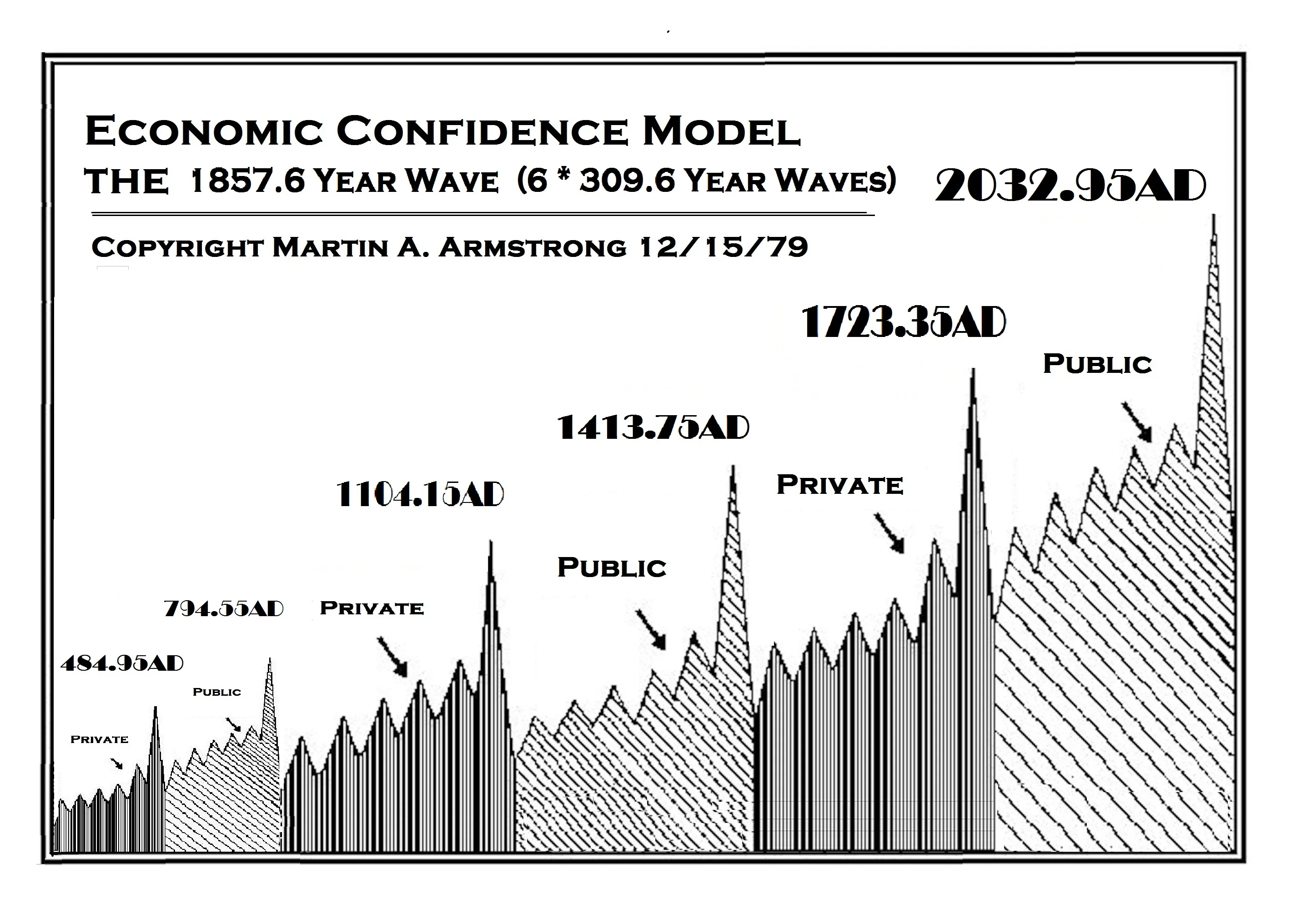
The ECM has been projecting that Europe would enter a depressionary phase into 2028 because confidence in government was collapsing alongside sovereign debt sustainability. This is not merely about economics. It is political. European governments continue behaving as though they can tax, regulate, borrow, and spend infinitely without consequence.

What we are witnessing now is the early-stage consumer retrenchment that typically precedes a much larger sovereign debt crisis. Governments across Europe are already discussing wealth taxes, exit taxes, digital asset registries, CBDCs, and enhanced financial surveillance precisely because they know capital is leaving and growth is evaporating.

Britain’s retailers are now begging the government to lower electricity bills, reduce property taxes, and avoid new employment regulations that increase business costs. Yet the political class across Europe remains completely disconnected from economic reality. Their answer to every crisis is more regulation, more taxation, and more centralized control.

This is exactly why capital has continued flowing toward the United States despite all its own political chaos. International capital always seeks the least-worst alternative during periods of sovereign stress. Europe has become openly hostile toward productivity, investment, industry, and private wealth itself.

The collapse in UK retail activity is not an isolated British story. It is another confirmation that the European depression into 2028 is unfolding exactly on schedule according to the ECM.

Categories:BRITAIN

Europe Explores Wealth Taxes, Capital Taxes, and Exit Taxes


Posted  originally on May 1, 2026 by Martin Armstrong |  

ECM Wave 2020 2028 Pi

The European Commission has now openly published a two-volume study examining “net wealth taxes,” “capital taxes,” and perhaps most alarming of all, “exit taxes.” They are no longer hiding the agenda behind slogans about “fairness” or “solidarity.” The report openly discusses how to tax wealth, how to monitor ownership, how to close compliance gaps, and how to prevent capital from escaping. This is precisely what I have warned was coming as governments across Europe enter the terminal phase of a sovereign debt crisis.

The study was commissioned by the European Commission’s Directorate-General for Taxation and Customs Union and examines wealth taxation systems across Europe and beyond, including France, Germany, Spain, Norway, Switzerland, and Colombia. The report specifically focuses on recurring wealth taxes, inheritance taxes, capital gains taxes, and exit taxes designed to capture wealth before individuals relocate outside the jurisdiction.

The timing is everything. Europe’s economy is collapsing into what our Economic Confidence Model has projected would become a prolonged depressionary period into 2028. Manufacturing across Germany has been imploding, energy prices remain structurally elevated because of the self-inflicted sanctions war and Net Zero agenda, and capital has been fleeing Europe into the United States for years. The EU knows this. They see the money leaving. They understand that confidence in European governments is collapsing, and instead of reforming policy, they are moving toward containment.

Tattered EU flag

The report openly admits that wealth taxes historically have not generated substantial revenue because the wealthy either legally restructure assets, move wealth offshore, or physically leave the jurisdiction altogether. In essence, they’re admitting capital flight is the central problem.

This is why exit taxes are becoming so important to Brussels. An exit tax is effectively a confiscation mechanism imposed when someone attempts to leave a country or transfer assets abroad. Governments tax unrealized gains before assets are sold. In other words, they tax theoretical paper wealth simply because someone wants to escape the jurisdiction. The report discusses the importance of tracking beneficial ownership, real estate registries, digitalized tax systems, and international information sharing.

That is the real objective here. This is not about “tax fairness.” This is about trapping capital inside Europe before the sovereign debt crisis accelerates. I have warned repeatedly that governments always begin with taxation but eventually transition toward outright restrictions on capital movement. Once governments become desperate enough, taxes alone no longer suffice. They require surveillance, digital tracking, asset registries, CBDCs, and eventually capital controls. Europe is moving down that road faster than anywhere else in the world.

The ECM has consistently shown that Europe faces the greatest structural risk heading into this cycle because Brussels destroyed competitiveness through regulation, climate extremism, and endless war spending. Germany, once the industrial engine of Europe, has seen factories shutting down while energy-intensive industries relocate abroad. France is drowning in debt and social unrest. The UK is outside the EU politically but remains economically tied to the same collapsing European model. Youth unemployment across parts of southern Europe remains catastrophic even before the next recession fully arrives.

Meanwhile, the EU continues funding Ukraine endlessly while demanding military expansion under NATO pressure, despite already carrying unsustainable sovereign debt burdens. They cannot finance pensions, healthcare, migration costs, green subsidies, military spending, and debt servicing simultaneously. The mathematics simply do not work anymore.

This is where the wealth tax discussion enters the picture. The report repeatedly references growing wealth concentration and the desire for “greater roles” for wealth-related taxes in generating revenue. The political class sees private savings as the solution to public insolvency. They do not intend to cut government. They intend to harvest private capital.

We have seen this pattern throughout history. Governments facing debt crises always move against private wealth. Roosevelt confiscated gold in 1933. Capital controls spread across Europe repeatedly throughout the 20th century. Cyprus seized bank deposits in 2013. During every major sovereign crisis, governments eventually redefine ownership rights.

wealth taxes in europe

The danger today is that technology now allows governments to track nearly every transaction digitally. The EU report specifically highlights “effective exchange of information on beneficial owners,” asset registration systems, and the “digitalisation of tax administrations.” In plain English, they want total visibility over wealth.

One section states the importance of “effective exchange of information on beneficial owners.” That is bureaucratic language for cross-border financial surveillance. They want governments sharing ownership information internationally so assets cannot disappear outside the system. There is discussion of “real estate and asset registration.” This is why governments worldwide are pushing centralized digital registries. They want a complete inventory of who owns what before the sovereign debt crisis fully erupts. “Effectiveness depends on administrative capacity, data availability, enforcement and international cooperation, including exchange of information.” Again, this is why we are seeing extreme data harvesting measures globally.

capital gains tax rates in europe 1 1201x1536

People still do not understand where this is heading. They assume wealth taxes only target billionaires. That is how every confiscatory system begins. Then thresholds decline over time because governments discover there are not enough billionaires to finance the welfare state. France’s wealth tax experience already demonstrated this problem. Wealth taxes often drive entrepreneurs, investors, and productive capital out of the country while generating far less revenue than projected. Even the EU study acknowledges design flaws, exemptions, compliance problems, and mobility responses.

This is exactly why our models projected Europe entering a depressionary cycle into 2028 while capital continues concentrating in the United States despite all the political chaos in Washington. Capital always seeks the least-worst alternative during sovereign debt crises. Europe has become hostile toward capital formation itself. They tax productivity, regulate energy, suppress agriculture, destroy industry, and now openly discuss how to prevent wealth from leaving.

The combination of wealth taxes, exit taxes, digital IDs, CBDCs, beneficial ownership registries, and expanding surveillance powers should terrify anyone with assets inside Europe. Once capital controls formally arrive, it will already be too late. Governments never announce confiscation in advance. They implement it during emergencies.

The EU depression into 2028 is not merely an economic downturn. It is a political transformation phase where governments become increasingly authoritarian as confidence collapses. Civil unrest rises, taxation intensifies, and restrictions on movement and capital expand simultaneously. That is precisely what our ECM has been warning about for years.

If you are sitting in Europe waiting for politicians to reverse course, you are gambling with your future. Get your money out of Europe while you still can.

South Korean Market Surges Past Britain’s


Posted originally on Apr 30, 2026 by Martin Armstrong |  

kospi

South Korea has now overtaken the United Kingdom to become the world’s eighth-largest stock market. The total market capitalization of Korean equities has exploded more than 45% in 2026 alone to roughly $4.04 trillion, while the UK has barely moved, rising about 3% to $3.99 trillion. What is most revealing is that, as recently as the end of 2024, the UK market was about twice the size of South Korea’s, underscoring just how quickly capital can migrate when the cycle turns.

The benchmark KOSPI has gone vertical, breaking above 6,600 and pushing total market capitalization beyond $4 trillion for the first time. This is not a random rally. It is concentrated, powerful, and driven by a very specific sector. Semiconductor giants like Samsung Electronics and SK Hynix now account for more than 40% of the index, which tells you immediately this is a capital flow into AI infrastructure, not a broad-based economic boom.

Compare that to the FTSE 100, which represents the largest companies listed in London. The UK market remains dominated by financials, energy, and consumer staples. These are legacy sectors. They do not attract speculative capital in the same way that technology does during a cycle shift. The FTSE has gained roughly 4% this year, which is not catastrophic, but it is completely disconnected from where the momentum is flowing globally.

When you step back and look at the historical performance, the contrast becomes even clearer. The KOSPI began with a base value of 100 in 1980 and spent decades struggling to break major psychological barriers like 1,000 and then 2,000. The real acceleration came after 2020, with the index pushing past 3,000 in 2021 and then exploding higher into 2025–2026, where it surged through 4,000, 5,000, and now over 6,500 in rapid succession. That is not normal growth, that is a vertical phase driven by concentrated capital inflows.

The FTSE 100, by contrast, has historically been far more stable and far less dynamic. It represents mature, dividend-heavy companies, and while that provides consistency, it does not produce explosive upside during periods of technological transformation. It is the difference between a capital preservation market and a capital attraction market. The UK has become the former.

This is exactly what the Economic Confidence Model has always shown. Capital does not move randomly, it seeks opportunity, and more importantly, it seeks momentum. When a new technological cycle emerges, whether it was railroads, automobiles, or now artificial intelligence, capital flows toward the regions that dominate that infrastructure. Right now, that is Asia, not Europe.

Categories:Capital Flow

Portugal’s Defense Sector Rising


Posted originally on Apr 30, 2026 by Martin Armstrong |  

AA21OGDS

What is unfolding in Portugal is a perfect example of how the cycle turns quietly before the public even realizes what is taking place. The arms industry there is now expanding at a pace that would have seemed unthinkable just a few years ago, yet this is precisely what happens when geopolitical tensions rise and governments suddenly rediscover the need for hard power.

According to Deutsche Welle, Portugal’s defense sector is gaining momentum as companies shift toward producing military equipment, drones, and advanced technologies, driven largely by the war in Ukraine and the broader push across Europe to rearm. The country is no longer simply importing defense capabilities, it is trying to build them domestically, which reflects a structural change rather than a temporary response.

You have to understand what this really means. Europe allowed its defense industry to decay for decades under the assumption that war was a relic of the past. Now, suddenly, governments are pouring money into rebuilding capacity, and the private sector is following that capital. Portugal is just one piece of that puzzle, but it is significant because it shows how even smaller economies are being pulled into this broader military buildup.

The numbers confirm the shift. Portugal has already raised defense spending to about €6.12 billion, reaching roughly 2% of GDP ahead of schedule, and is now seeking billions more in EU-backed funding to modernize its military with drones, armored vehicles, and naval systems. This is not defensive housekeeping. This is preparation. Once governments begin allocating capital at this scale, they are not planning for peace.

I have said many times that war is the ultimate driver of technological advancement and capital concentration. That is exactly what you are seeing here. Portugal’s emerging arms industry is not growing in isolation. It is part of a continent-wide shift where governments are trying to rebuild military capacity after decades of neglect. The problem is that you cannot simply flip a switch and create an industrial base overnight. Europe deindustrialized much of its defense sector, and now it faces capacity constraints, shortages, and rising costs just to produce basic military equipment.

Governments are attempting to accelerate production at the same time they are dealing with economic stagnation, energy crises, and rising debt. That combination historically leads to instability, not strength. You cannot sustain long-term military expansion without a strong economic foundation, and Europe has been systematically undermining that foundation with its own policies.

Portugal’s case also highlights the geopolitical alignment taking place behind the curtain. While some European nations are talking about strategic autonomy, Portugal has made it clear it remains committed to NATO and the transatlantic alliance. That tells you this is not about independence. It is about preparing for a broader conflict structure where alliances become critical.

From a cyclical perspective, this aligns perfectly with the convergence we have been tracking. The war cycle and civil unrest cycle are colliding into this 2026–2027 window, and what you are seeing now is the early phase of capital shifting into defense. This is always how it begins. First comes the funding, then the industrial buildup, and finally the political justification. By the time the public fully understands what is happening, the trajectory is already locked in.

Portugal is not becoming a military power overnight, but that is not the point. The point is that even smaller nations are now being drawn into the rearmament cycle. When that happens across an entire continent, you are no longer looking at isolated policy decisions. You are looking at a systemic shift toward confrontation.

The NO KINGS Party Gives King Charles a Standing Ovation


Posted originally on Apr 30, 2026 by Martin Armstrong |  

They parade through the streets chanting “no kings,” pretending to stand against authority and concentrated power, yet the moment a real monarch steps into the room, they rise to their feet applauding as if royalty itself suddenly became fashionable again. This is not merely hypocrisy, it is a revealing window into how politics operates beneath the surface.

The spectacle surrounding King Charles III being welcomed with cheers and a standing ovation by the very same political faction that markets itself as anti-establishment exposes the contradiction in plain sight. They rail against what they call authoritarianism at home, yet they celebrate it abroad when it suits the narrative. It reflects a deeper pattern I have warned about repeatedly, where ideology is merely a tool and consistency is abandoned the moment it becomes inconvenient.

Image

If you strip away the slogans, what you find is that these movements are not opposed to centralized authority. Quite the opposite. They are deeply in favor of it, provided they are the ones holding the reins. The idea of “no kings” is simply branding. It resonates emotionally, particularly with younger audiences who have been taught to distrust institutions, but in practice, the same people will support unelected bodies, international organizations, and even hereditary monarchies when those entities align with their broader political agenda.

Governments and political movements always gravitate toward structures that consolidate authority. Whether it is a monarchy, a bureaucracy, or a supranational institution, the form does not matter nearly as much as the control it provides. That is why you see politicians condemning “elite power” one day and then celebrating it the next when it comes wrapped in the right symbolism.

The public is told one story while a completely different set of actions unfolds behind the curtain. They are encouraged to oppose “kings” in theory, yet applaud them in practice, because the real objective is not to dismantle hierarchy, but to reshape it.

Iran & the Drawn-Out Cold War\


Posted originally on Apr 30, 2026 by Martin Armstrong | 

President Donald Trump’s Blockade will propel a depression in Europe. This may be the time for China to do the same to Taiwan. Trump has told his aides to get ready for a risky, extended blockade of Iran. The computer warned from the outset that this would NOT be a quick in-and-out as Netanyahu told Trump. It’s always his same tactics – assassinate the leadership and the government will fall. Netanyahu is a HIGHLY dangerous psychopath in my opinion. He has NEVER been correct even once. And as this clip from his 2002 testimony before Congress, cheering on the Iraq invasion for weapons that never existed, shows, he was the instigator of the Iraq War and propelled the US into escalating debt, for he does not give a shit about anyone but himself.

Based on the actions of Netanyahu, there is no way that I, as Iran, would now surrender nukes. I would be on high speed to get one up ASAP. That is the only way to prevent another invasion. Pakistan and North Korea have nukes. That is the only reason they are left alone. Iraq was a wake-up call. Without nukes, you are now vulnerable.

Trum Iran Cold War

US sources are relaying that this will be a drawn-out, Cold War-style conflict, and Trump has expressed frustration with Iran’s latest proposal to end the clash, which has now entered its third month. They are consistent and want a guarantee on permanently ending the fighting, followed by discussions to reopen the Strait of Hormuz, and then finally a deal involving Iran’s nuclear program. The computer shows this will begin to heat up from mid-May.

Energy War Breaks OPEC: UAE Walks Away as Oil Supply Collapses


Posted originally on Apr 29, 2026 by Martin Armstrong |  

OPEC

What is unfolding right now is not just another dispute inside OPEC. This is the beginning of the breakdown of coordinated global energy policy under the pressure of war. The decision by the United Arab Emirates to exit OPEC effective May 1 comes as oil supply is being physically disrupted, not merely negotiated.

Officials in the UAE have tried to frame this as a strategic move, stating they need “greater flexibility to manage production independently” and to expand output capacity without being constrained by quotas. That statement alone reveals the real issue. They have the ability to produce more oil, but OPEC restrictions have prevented them from doing so at a time when global supply is tightening. When a producer is sitting on capacity in the middle of a supply shock, remaining in a cartel becomes a liability rather than an advantage.

1617718521_world opec members countries map

The numbers here are critical. OPEC production has already fallen sharply, with estimates showing output around 20.79 million barrels per day in March, while disruptions tied to the Iran conflict are removing as much as 7–10 million barrels per day from global supply flows, particularly through the Strait of Hormuz. That is not a minor disruption. That is a structural shock to the system.

At the same time, oil prices are reacting exactly as expected. Brent crude has surged above 110 dollars per barrel, with U.S. crude crossing 100. Analysts have warned that “there is no clear end in sight to the supply disruption,” which means volatility is not temporary. It becomes embedded in the system.

The UAE has made it clear that it intends to increase production capacity toward 5 million barrels per day by 2027, well above its current quota near 3 million. That gap explains everything. By leaving OPEC, they can monetize that capacity immediately rather than waiting for collective agreements that no longer align with their national interest. Estimates suggest this could translate into tens of billions in additional annual revenue.

I have written many times that OPEC was never a permanent solution to managing energy markets. It was a political construct that worked only when member states had aligned interests and a shared incentive to restrict supply. The moment those interests diverge, the structure begins to fail. OPEC has historically struggled with compliance. Members routinely exceeded quotas when it suited them, particularly during periods of high prices or fiscal stress. That was always the underlying weakness.

What we are seeing now is that weakness being exposed under extreme conditions. War changes everything. When geopolitical survival overrides economic coordination, agreements collapse. OPEC cannot function when members are facing direct threats or when they see an opportunity to maximize revenue independently. This is precisely why these types of organizations tend to break down during periods of rising global tension.

The UAE’s decision signals something much larger about the future of OPEC. If one major producer walks away to pursue independent production, others will begin to reconsider their own participation. The incentive to cooperate declines as the incentive to produce increases. That creates a feedback loop where the cartel loses its ability to enforce discipline.

At the same time, the global energy landscape has already shifted. The United States has emerged as a dominant producer, reducing the relative influence of OPEC compared to previous decades. When OPEC was formed, it had far greater control over global supply. Today, that control is diluted, and fragmentation only accelerates that trend.

the national flags of the opec member countries are located below the logo of the organization of the petroleum exporting countries illustration vector

Looking forward, OPEC is unlikely to disappear overnight, but its role will change. Instead of acting as a unified force capable of stabilizing markets, it will become a looser alliance with diminishing influence. Pricing power will shift toward individual producers and market forces rather than coordinated quotas. That transition introduces far greater volatility because there is no longer a central mechanism to manage supply in times of crisis.

Geopolitical conflict will increasingly dictate energy flows. When supply routes are threatened and production becomes a strategic asset, countries will prioritize control over cooperation. Energy becomes a tool of leverage rather than a shared economic resource.

The contradiction globally is becoming impossible to ignore. While policymakers in Europe continue to push for eliminating fossil fuels, producers are expanding output and repositioning themselves to control supply. This divergence guarantees instability. There is no substitute capable of replacing this level of energy demand, and the attempt to force that transition is colliding directly with geopolitical reality.

The UAE’s exit is not an isolated event. It is a signal that the system is changing. Energy markets are moving away from coordinated control and toward fragmentation driven by national interest. Once that shift takes hold, it does not reverse easily.

The real takeaway is simple. When supply is disrupted, cooperation breaks down, and producers begin acting independently, the result is sustained volatility. Prices rise, markets become unstable, and geopolitical tension intensifies. This is not a short-term disruption. It is the early stage of a much larger transformation in the global energy order.

Google Partners with the Pentagon to Sell Your Data


Posted originally on Apr 29, 2026 by Martin Armstrong |  

40+ Google Logos & Product Icons For Free Download - 365 Web Resources

There has always been this convenient belief that Big Tech operates independently from government, as if the data you store, search, and upload exists in some neutral corporate space, but that illusion is breaking down rapidly as the lines between Silicon Valley and Washington disappear in real time.

Google has now entered into a classified agreement with the Pentagon allowing its artificial intelligence systems to be used for “any lawful government purpose,” which is a phrase that sounds benign until you understand what it actually means in practice.

This is not a narrow contract tied to a single project. It opens the door for integration into mission planning, intelligence analysis, and even weapons targeting systems operating on classified networks, and once those systems are embedded, the distinction between commercial technology and state infrastructure effectively disappears.

Google

At the same time, Google does not retain control over how that technology is ultimately used, because under the terms being reported, the company has no ability to veto lawful government operations, meaning once access is granted, the downstream application is no longer in their hands.  Please be reminded that Google has been collecting data on everyone and everything for decades: Google Maps, Google Search, Google Photos, Google Drive, Gmail, etc.

This is where the narrative people have been told begins to collapse, because for years the assumption was that your data sat within a corporate ecosystem governed by terms of service and internal policies, yet what is now being constructed is something entirely different, a shared infrastructure where private data, artificial intelligence, and state power intersect.

Stad för stad – så filmar Google-bilen i Sverige i år | Carup.se

Even inside Google, there is significant resistance to this shift, with more than 600 employees signing letters to CEO Sundar Pichai warning that these systems could be used for “lethal autonomous weapons and mass surveillance,” and expressing concern that once deployed in classified environments, there is no meaningful oversight or transparency. “We want to see AI benefit humanity; not to see it being used in inhumane or extremely harmful ways. This includes lethal autonomous weapons and mass surveillance but extends beyond,” the letter reads.

This is part of a broader shift in which every major AI company is now aligning with the defense sector, competing for contracts reportedly worth hundreds of millions of dollars, thereby transforming artificial intelligence from a commercial tool into a strategic asset within global power dynamics.

From my perspective, this follows the same pattern we see in every major cycle of power consolidation, where private innovation is gradually absorbed into state control during periods of rising geopolitical tension. Once that process reaches a certain threshold, the distinction between public and private effectively vanishes.

People focus on the wrong question, asking whether Google is “sharing your data” directly with the government, when the real issue is far more structural. Once the same systems that process your emails, photos, searches, and behavior are integrated into government operations, the architecture itself becomes unified, and access becomes a matter of policy, not possibility.

When artificial intelligence becomes the interface between data and decision-making, whoever controls that system controls the interpretation of reality itself, and that is where the real power lies. For the first time in history, we are witnessing the convergence of data, technology, and government authority into a single structure that has already become far too powerful to dismantle.

Starmer’s Collapse Is a Vote Against Policy Failure


Posted originally on Apr 29, 2026 by Martin Armstrong |  

Starmer Kier UK PM

The latest polling on Keir Starmer is not simply weak, it is a clear rejection. Labour has slid sharply, with support falling toward the high teens in some recent surveys, while his personal approval rating has dropped deep into negative territory, approaching levels that historically signal a government losing control of the narrative. This is not a temporary dip. It reflects a growing disconnect between policy and reality.

What the public is reacting to is not difficult to understand. The UK economy is under pressure from all sides. Borrowing costs have climbed above 5%, households are still dealing with elevated living expenses, and growth remains sluggish. At the same time, policy continues to lean heavily into Net Zero commitments that raise energy costs while offering no reliable alternative capable of sustaining industrial demand. You cannot impose higher input costs on an economy already under stress and expect confidence to improve.

Starmer positioned himself as the steady hand, promising stability after years of political turmoil. Instead, the perception is that nothing fundamental has changed. The same structural problems remain in place, and in some cases, they are being reinforced. Energy policy continues to squeeze industry, regulation remains heavy, and there is no coherent strategy to reverse capital outflows or stimulate productive growth. People are not reacting emotionally. They are reacting to what they are experiencing in their daily lives.

There is also the issue of credibility. Once a government begins to lose public confidence, every decision is questioned. Scandals, internal disputes, and policy reversals all begin to carry more weight because the trust is no longer there. The Mandelson controversy only added to the sense that decisions are being made behind the curtain rather than in the open. That perception accelerates the decline.

What makes this particularly important is that this is not isolated to the UK. Governments across Europe are facing similar backlash because they have followed the same playbook, restricting energy, expanding regulation, and ignoring the economic consequences. The result has been stagnation, rising costs, and a steady erosion of confidence. When people feel their standard of living slipping, they do not care about political messaging. They look for alternatives.

Starmer’s problem is that he represents continuity at a time when the public wants change. You cannot campaign as a reformer and then govern as a caretaker of the same policies that created the problem. The numbers reflect that contradiction. This is not about personality. It is about policy failure becoming visible in real time.

Once sentiment turns this sharply, it rarely stabilizes on its own. It tends to accelerate as opposition grows and internal pressure builds. That is what these polls are signaling. The market may tolerate uncertainty for a time, but the public does not. When confidence breaks, it becomes a political issue first and an economic one shortly after.

Human Employees Often Cost Less Than AI


Posted originally on Apr 28, 2026 by Martin Armstrong |  

AI Artifical Intelligence

There is a growing contradiction unfolding in the global economy that exposes just how distorted this entire artificial intelligence narrative has become, because companies rushed to replace human labor under the assumption that machines would be cheaper, only to discover that in many cases AI is now costing more than the workers it was supposed to eliminate. The latest data shows compute expenses alone are exceeding payroll in some firms, with one Nvidia executive admitting outright that the cost of running AI systems has surpassed the cost of employees, while global IT spending is projected to surge to $6.31 trillion in 2026, up 13.5% in a single year.

Companies were sold the idea that AI would slash labor costs, yet they are instead encountering an explosion in infrastructure expenses, energy consumption, and ongoing operational costs that do not scale as human labor does. AI is not a one-time investment, it is a continuous cost center, and the more complex the system becomes, the more expensive it is to maintain.

At the same time, firms have already begun restructuring their workforce in anticipation of these savings, cutting jobs, freezing hiring, and eliminating entry-level roles, only to find that the economic benefits are not materializing as expected. There are estimates showing tens of billions poured into generative AI with the overwhelming majority of companies seeing little to no return, which is exactly how bubbles form, with capital chasing an idea before the underlying economics justify the investment.

AI does not necessarily reduce work, it often intensifies it. Studies tracking employee usage of AI tools have found rising burnout, increased pressure, and only marginal time savings, meaning workers are being pushed harder rather than replaced outright. The expectation that machines would lighten workloads is being replaced by a reality in which productivity demands increase and human workers are forced to compete with systems that never stop.

What is unfolding fits directly into the broader economic cycle, because this is not simply about technology; it is about capital concentration and the displacement of labor. The benefits of AI are captured by a very small number of firms that control the infrastructure, while the costs are distributed across the broader economy through layoffs, rising workloads, and increased financial pressure on businesses trying to keep up.

This is also why the labor market signals remain contradictory, because while there is widespread fear of job loss, the actual transition is uneven, with some sectors cutting aggressively while others struggle to integrate AI effectively. The narrative of immediate replacement has been exaggerated, but the structural shift is real and unfolding in phases that align with economic cycles rather than technological breakthroughs alone.

AI has become the new battlefield, requiring enormous capital investment, energy consumption, and geopolitical positioning, particularly as nations race to secure supply chains for semiconductors and data infrastructure. The critical mistake is assuming that technology alone determines the outcome, when in reality it is always the economic model that decides whether something succeeds or fails. Right now, the model is being stress-tested because companies are discovering that replacing humans with machines does not automatically yield savings; in many cases, it yields the opposite.

Categories:AI Computers