DIGITAL ID: THE LOCKDOWN THEY NEVER ABANDONED


Posted Jun 9, 2026 by Martin Armstrong |  

Digital ID 2

Governments never abandon an idea once they discover it increases control. They simply wait until the public is distracted and repackage it under a different name. The lockdowns may be over, but the mentality that produced them never disappeared. It merely evolved.

The United Kingdom is now moving toward a digital identity system tied to smartphones through the GOV.UK Wallet and digital credentials. The politicians sell it as convenience. They always do. It is easier. It is faster. It is more secure. Those are the same promises made every time governments seek to consolidate information and authority into a single system. What begins as a voluntary tool gradually becomes expected, then preferred, then required. Before long, participation in normal life depends on compliance.

The concern has never been the technology itself. The danger is the inevitable expansion of purpose. Today, it is proving your age, identity, or right to work. Tomorrow, it becomes the preferred method for accessing benefits, taxes, banking services, healthcare, travel, voting, and countless other activities. Every government insists it will never go too far, yet history repeatedly demonstrates that once infrastructure exists, future politicians inherit powers they never had to build themselves.

Privacy advocates, cybersecurity experts, and civil liberties groups have already warned that digital identity systems will erode privacy and place sensitive information in a centralized database, ripe for the taking. Once your identity, credentials, permissions, and access are concentrated inside a digital ecosystem, the relationship between citizen and state fundamentally changes.

What few people appreciate is how quickly a digital identity can become the master key for everyday life. Once your government-issued digital credentials are stored on your phone, they can be linked to tax records, healthcare access, benefits, banking verification, travel documents, age verification, employment eligibility, and countless other services. Before long, those who refuse to participate find themselves navigating endless hurdles while everyone else is funneled into a single digital ecosystem. Participation becomes unavoidable. Every crisis then becomes an excuse to add another layer of monitoring, another credential, another requirement, until the smartphone evolves into a digital passport for participation in modern society.


DigitalVaccinePassports
vaccinepassport

We saw governments worldwide prohibit citizens from accessing public spaces during COVID if they refused to be vaccinated. Play by the rules if you want to participate in society. Look what happened in China during COVID as one of countless examples. China sought to prevent bank runs by restricting citizens’ physical access to banks. People were required to scan a pass to enter public transportation systems but were denied entry. If they made it to the bank, they were barred from entering because the code had been switched off.  Over $6 billion (39 billion yuan) was frozen, and thousands of people were unable to access their bank accounts. A few banks in rural Henan reported bank runs, and residents were planning a protest after finding that their funds were frozen. The government successfully controlled human behavior through a digital platform.

Conveniently, the COVID tracing app is required to enter the bank. Users need to scan their QR codes to enter most public places. It has been reported that thousands of COVID-negative individuals had their status changed via the app, restricting their movement and making public places inaccessible. So even those who play by the rules are at risk of losing their place among society, instantly, without warning or reason.

At first, they will claim that participation is optional. Governments claimed that the COVID vaccination was not technically mandatory, but citizens could not freely access society without proof of vaccination. The pattern is the same—you technically do not need to create a digital ID, but basic tasks will become increasingly difficult to the point where you either cave or find energy-intensive workarounds. If this were about convenience, the government would not be considering assigning every newborn a digital ID at birth.

Millions of people living in Thailand understand the power the government holds over them after digital IDs were linked to their ability to bank. The Thai government began freezing tens of thousands of bank accounts per week. Over three million accounts were frozen without notice or proper investigation. Shockwaves of panic spread throughout the nation. Businesses no longer wish to accept credit. Confidence in government and now the banks has been destroyed. This event occurred as a protective measure against money laundering, allegedly, but soon, governments will have the ability to deliberately revoke access to the system.

Freedom is rarely lost in one dramatic moment. It disappears through a thousand small steps, each presented as reasonable, practical, and necessary. Most people will accept digital ID because it appears convenient, but there are the remaining few who continue to trust the government. Once government decides that access to services, travel, employment, banking, or communication should depend on maintaining that digital identity in good standing then we will see a massive uproar. But of course, by then it will be too late, and any disobedience will be noted in your permanent digital file.


Enemies of the State Infiltrate Govt


Posted originally on

Jun 9, 2026 by Martin Armstrong |  

When I first saw the comments attributed to Zul Mohamed, a candidate for mayor in Texas, I had to read them twice. Any politician is free to criticize government policy. That is part of a free society. But when someone seeking public office reportedly declares, “No vet has made any sacrifice,” and goes on to say, “I do not support the US military” and “I do not support the United States,” that crosses into something entirely different. If those statements accurately reflect his views, then voters deserve to know exactly who is asking for their support.

Pakistan-born Mohamed has long-running legal troubles surrounding election fraud allegations and convictions tied to his earlier mayoral campaign. Texas authorities arrested him in 2020 on more than one hundred felony counts connected to a mail-ballot scheme. Prosecutors alleged that ballot applications were forged and directed to a mailbox obtained under a false identity. Years later, he pleaded guilty to numerous felony counts and was sentenced by a jury. Despite that history, his name returned to the ballot once again.

The issue here is larger than one candidate. Confidence in government is collapsing across the Western world because people increasingly feel that public office is attracting individuals who openly disdain the very institutions they seek to control. Citizens can disagree over taxes, foreign policy, immigration, or military intervention. Those debates are healthy. Yet there remains a basic expectation that elected officials should possess at least some degree of respect for the nation they hope to govern.

r/ConservativeMemes - Memorial Day: A Day of Remembrance

Veterans do not all share the same political views. Many criticize Washington as fiercely as anyone else. To claim that no veteran has made a sacrifice is an insult to those who returned home wounded, those who spent years separated from their families, and those who never came home at all. Whether one supported a particular war is irrelevant. The personal sacrifices made by service members are undeniable. There could be no United States without our troops.

This is not the first instance of a US politician openly hating the country they claim to represent. The Squad thinks it is progressive to be anti-America. Rashida Tlaib has repeatedly uses rhetoric describing America as an evil empire. Ilhan Omar stated that the United States was being turned into “one of the worst countries” in the world and openly supports her birth nation over America. New York’s Mamdani calls America a colonial imperialist nation and condemns capitalism.

An entire generation of politicians has been educated to view Western civilization as little more than a pile of sins. They can recite every historical failure but rarely acknowledge the freedoms, innovations, and opportunities that attracted millions of immigrants over centuries. It is extremely problematic that people who view the US with disdain are eager to enter politics. Who are they representing if not the American people? Where are their loyalties?

What is alarming is how a growing faction of the far left has stopped talking about fixing America and started talking as if America itself is the problem. They attack the country’s history, its institutions, its traditions, its military, and even the idea of patriotism itself. Every nation has flaws, but a political movement that teaches people to be ashamed of their country instead of fighting to improve it only breeds division and resentment. When politicians spend more time condemning America than defending it, voters have every right to question whose interests they truly represent.

This is a question for voters. If a candidate openly says he does not support the United States and looks down upon its military, then citizens must decide whether that is the type of leadership they want representing their community. Democracy only functions when voters pay attention. The greatest threat to any republic is indifference.

Categories:Politics

The Jobs Report Everyone Will Misread


Posted originally on Jun 8, 2026 by Martin Armstrong |  

Jobs

The May jobs report came in far stronger than expected. Nonfarm payrolls rose by 172,000 while other economists were looking for roughly 80,000 to 85,000 jobs. The unemployment rate remained at 4.3%, and March and April payrolls were revised higher by a combined 93,000 jobs. Leisure and hospitality added 70,000 jobs, local government gained 55,000, healthcare added 35,000, and manufacturing managed a small increase as well. On the surface, the numbers look solid and the financial press will immediately rush out stories claiming the economy remains strong.

What they never seem to understand is that employment is always a lagging indicator. Businesses do not fire workers the moment sales soften. They cut expenses elsewhere first, halt new hiring, and delay investment. Only after the downturn becomes undeniable do layoffs begin to accelerate. Looking solely at today’s payroll number and concluding that everything is fine is the same mistake governments and central banks have made repeatedly throughout history.

The more important issue is where these jobs are being created. Once again, government-related employment, healthcare, and hospitality accounted for a large portion of the gains. These are not the sectors that create long-term productivity growth. Financial activities actually lost jobs, and many white-collar industries continue to struggle as corporations adopt AI and reduce administrative staff. We are witnessing a structural shift in the labor market that the headline payroll number completely disguises.

Wages rose only 0.3% for the month and roughly 3.4% year-over-year. With inflation still running above the Federal Reserve’s target and energy prices elevated because of geopolitical tensions, real purchasing power remains under pressure. Workers may technically have jobs, but that does not mean they are getting ahead. This is precisely why consumer confidence has remained weak despite a labor market that appears healthy on paper.

The report also creates a serious problem for the Federal Reserve. For months there has been tremendous political pressure to cut rates. Yet a labor market producing 172,000 jobs per month with unemployment holding at 4.3% does not provide the justification for aggressive easing. In fact, some analysts are now openly discussing the possibility that rates may need to remain elevated longer than expected if inflation continues to move higher.

From a cyclical perspective, this is exactly the type of mixed economic environment we have been warning about. The economy is not collapsing, but neither is it expanding in a healthy and sustainable manner. Government hiring, wartime spending, healthcare expansion, and deficit financing can keep employment numbers elevated far longer than most analysts expect. At the same time, private-sector confidence continues to deteriorate beneath the surface. This divergence is what confuses forecasters because they are looking at individual data points rather than the broader cycle.

As we move deeper into 2026, the Panic Cycle year, volatility is likely to increase across both financial markets and geopolitics. The labor market may appear resilient today, but employment data has a long history of looking strongest immediately before conditions begin to deteriorate. The revisions always come later as the initial number is never accurate. That is why focusing exclusively on a single month’s payroll report is dangerous. The trend in confidence remains far more important than the headline number, and confidence is what ultimately drives capital flows, investment, and economic growth.

Russia Needs 800,000 Workers


Posted originally on Jun 8, 2026 by Martin Armstrong |  

ECM Russia 1991 Pi

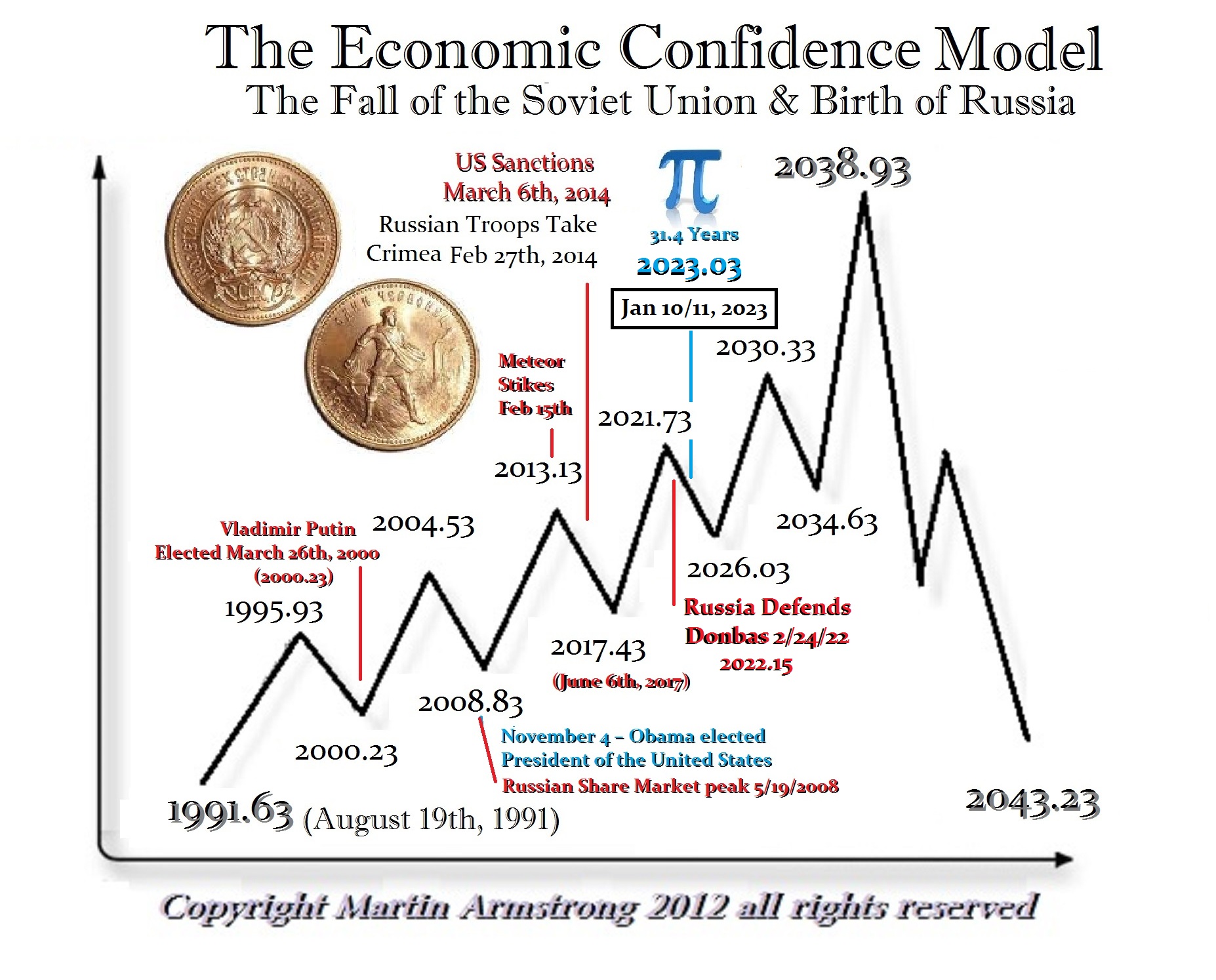
One of the most revealing stories coming out of Russia has nothing to do with missiles, tanks, or the battlefield. It concerns workers. Russia is now actively looking to India to help fill an enormous labor shortage that has developed throughout the economy, particularly in construction and infrastructure.

According to Russian officials and major financial institutions, the country faces an immediate labor shortage of at least 2.3 million workers. Construction alone is projected to require nearly 789,000 additional workers by 2030. Other estimates suggest Russia needs roughly 800,000 workers in manufacturing and another 1.5 million workers in construction and services. These are not small numbers. These are the kinds of figures that begin affecting an entire economy.

The number of work permits issued to Indian nationals has exploded. In 2021, before the Ukraine war, roughly 5,000 permits were issued. Last year that figure surged to almost 72,000. Russia’s First Deputy Prime Minister Denis Manturov went so far as to say that Russia could accept an “unlimited number” of Indian workers. When governments begin using language like that, they are acknowledging a structural problem rather than a temporary one.

Many people still measure the cost of war solely by military expenditures. They look at defense budgets and ammunition production. The larger economic cost is often the workforce itself. Russia entered this conflict already facing demographic challenges. Birth rates had been declining for years. The population was aging. Then hundreds of thousands of military-age men were either mobilized, volunteered for military service, emigrated, or were absorbed into defense industries supporting the war effort. The result is that civilian industries are now competing for workers with the military sector.

What is particularly interesting is that this shortage is not being filled by traditional sources of migrant labor from Central Asia to the extent it once was. The weaker ruble, tighter migration rules, and changing economic conditions have reduced those inflows. Russia is therefore turning increasingly toward India, where a massive pool of labor still exists. The Kremlin and New Delhi have already signed agreements designed to make it easier for Indians to work in Russia.

This development also reveals something broader about the global economy. Labor is becoming a strategic resource. Europe is struggling with demographic decline. Japan faces population contraction. China is confronting the consequences of decades of falling birth rates. Russia’s labor shortage may be receiving attention because of the war, but the underlying demographic trend is appearing throughout much of the industrialized world.

The geopolitical implications should not be ignored. Russia and India continue deepening economic ties through energy, trade, and now labor mobility. While much of the world focuses on sanctions and military developments, entirely new economic relationships are quietly being built beneath the surface. These shifts rarely receive much attention when they begin. Years later, everyone suddenly realizes the global landscape has changed.

We are entering a period where nations face rising debt burdens, labor shortages, aging populations, and increasing geopolitical tensions simultaneously. The war may have accelerated Russia’s labor crisis, but the demographic trend existed long before the first shot was fired. Governments around the world are discovering that printing money is easy. Replacing workers is not.

The shortage of 800,000 construction workers is not merely a Russian story. It is a warning sign of a much larger problem developing throughout the global economy. Capital can move instantly. Labor cannot.

The Drumbeat Around Taiwan Grows Louder


Posted originally on Jun 8, 2026 by Martin Armstrong |  

China v Taiwan 3

Taiwan’s Ministry of National Defense reported that 32 Chinese military aircraft, 10 naval vessels, and five additional official Chinese ships were operating around the island. More importantly, 25 of those aircraft crossed the median line of the Taiwan Strait and entered Taiwan’s air defense identification zone. That median line was once viewed as an unofficial buffer. Today, it is crossed so frequently that Beijing appears determined to normalize military operations in areas that would have been considered highly provocative only a few years ago.

The mistake many analysts continue to make is assuming that China must launch a massive sea invasion for the situation to become dangerous. Modern warfare is changing rapidly. A blockade, economic strangulation, cyberattacks, drone saturation, and missile pressure can accomplish many of the same objectives without immediately triggering a traditional war. Taiwan clearly understands this. The government is now accelerating plans to build an arsenal of more than 1,800 anti-ship missiles by 2029, including American Harpoons and domestically produced Hsiung Feng missiles. Officials openly describe creating a “kill zone” in the Taiwan Strait capable of inflicting severe losses on any attacking force.

Taiwan ECM 2

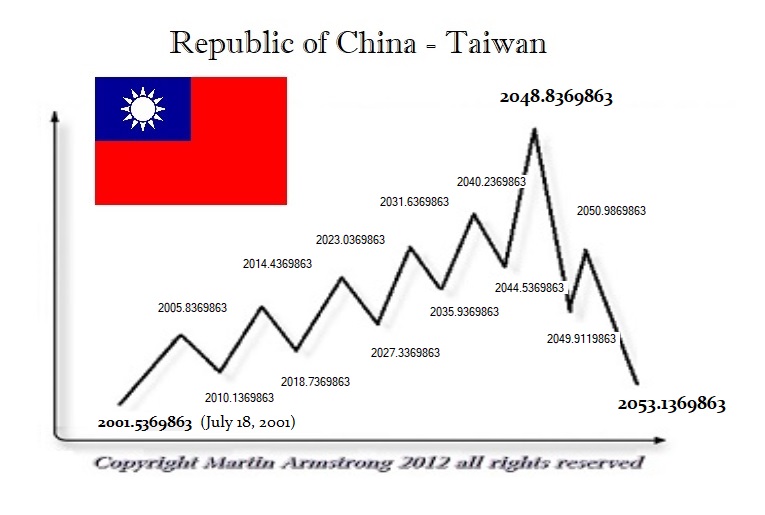
What interests me is not the daily military count. It is the timeline. China has increased military pressure around Taiwan for years, yet at the same time we see military planners throughout Asia discussing preparation windows extending into 2028 and 2029. Taiwan’s missile expansion is specifically designed to reach full strength around 2029. Military officials in Europe are discussing vulnerabilities that exist until roughly the same period. We are seeing governments independently focus on the same time horizon. That is difficult to ignore.

The larger issue is confidence. Governments always believe they can manage tensions indefinitely until suddenly they cannot. China is conducting larger exercises. Taiwan is rapidly arming. Japan is expanding defense spending. The Philippines is strengthening military cooperation with the United States. The entire region is preparing for a future that policymakers increasingly believe may be unavoidable.

Our models have been warning that 2026 would be a panic-cycle year marked by rising volatility and escalating geopolitical tensions. The risks continue building into 2027, which remains a major war-risk year. By 2028, recessionary pressures, sovereign debt concerns, and civil unrest begin colliding with these geopolitical tensions. Then we arrive at the major ECM turning point in 2029. Whether Taiwan becomes the spark is impossible to know in advance. What we can observe is that governments, militaries, and markets are all increasingly behaving as if they see a storm forming on the horizon.

Interview: Iran, Ukraine, Peace, Gold & Bitcoin


Posted originally on Jun 7, 2026 by Martin Armstrong |  

Why Turkey Matters More Than People Realize


Posted originally on Jun 4, 2026 by Martin Armstrong |  

Syria Map

I have repeatedly warned that people need to watch Turkey. Most analysts view Turkey as simply another emerging market struggling with inflation, currency volatility, and political uncertainty. They are missing the larger picture. Turkey sits at the crossroads of Europe, Russia, the Middle East, and Asia. When capital shifts, when energy flows change, when geopolitical alliances begin to fracture, Turkey is often standing directly in the middle.

Now Turkey is negotiating with Russia to extend natural gas supply agreements beyond 2026. The discussions involve Turkey’s state energy company BOTAS and Russia’s Gazprom, with future supply volumes and contract terms still under negotiation. Russia remains one of Turkey’s most important suppliers through the TurkStream and Blue Stream pipelines.

Europe spent years proclaiming that it would permanently divorce itself from Russian energy. Sanctions were imposed and pipelines were destroyed. Yet the laws of economics do not care about political slogans. Energy must still move from where it is produced to where it is consumed. Russia still possesses enormous reserves. Europe still requires energy. Turkey increasingly controls one of the most important transit routes connecting those two realities. Today, TurkStream is effectively the last major route carrying Russian gas into parts of Europe.

This is precisely why Turkey has become so important in the emerging multipolar world. Erdogan has spent years balancing relations with NATO, Russia, China, Europe, and the United States. Western leaders often criticize him, yet they continue dealing with him because geography has given Turkey leverage that cannot be replaced. Turkey’s position allows it to act as a bridge between competing power blocs.

At the same time, Turkey is not merely relying on Russian gas. Ankara is expanding energy cooperation with Azerbaijan, investing roughly $30 billion into its electricity infrastructure, strengthening transmission links across the region, and attempting to position itself as the primary energy hub connecting Asia, the Caucasus, the Middle East, and Europe.

Turkey sits directly on the fault line of several major geopolitical trends at the same time. The war cycle, the fragmentation of Europe, tensions between NATO and Russia, instability in the Middle East, migration flows, and the global energy transition all converge in one place. Whenever multiple historical trends intersect in a single region, volatility follows.

What many fail to understand is that Turkey’s future is no longer tied exclusively to Europe. It is building relationships eastward and southward while maintaining one foot inside the Western system. That balancing act may become one of the most important geopolitical stories of the next decade.

People should watch Turkey carefully because it is increasingly becoming the barometer of the new world order. The old postwar structure is breaking apart. The nations positioned between competing power centers often become the biggest winners. Turkey may be one of them, provided it can navigate the storms that are clearly gathering into 2027 and beyond.

Debt or Death – Economic Military Recruitment


Postedoriginally on Jun 4, 2026 by Martin Armstrong |  

The Majority of Russians Do Not Want to Fight, But a Minority Will Suffice for the Kremlin

Governments always know exactly where to find soldiers during economic decline. They look for debt, unemployment, hopelessness, and young men with no future. That has always been the pattern throughout history. Rome did it. Napoleon did it. Britain did it. The United States targeted poor communities for Vietnam and Iraq. Now, Russia is openly doing the same thing by forgiving massive debts for men willing to go fight in Ukraine.

Putin has now signed a decree wiping out debts up to 10 million rubles, roughly $140,000, for new military recruits and even their spouses if they sign contracts with the Russian Defense Ministry for at least one year. That is economic recruitment. They are effectively saying to indebted young men: fight for the state and we will erase your financial problems.

This is what governments do when war collides with economic stress. Military recruitment always surges where opportunity collapses. Young men drowning in debt, unable to afford housing, unable to build families, and unable to see a future become the ideal targets for governments needing manpower.

The Kremlin needs a constant supply of men while trying to avoid another politically dangerous mass mobilization. Instead of openly forcing millions into the army, they increasingly rely on financial incentives, debt forgiveness, bonuses, housing promises, educational incentives, and economic desperation.

Russia plans to recruit another 409,000 troops in 2026 — a clear sign the enemy is not abandoning its ambitions and continues preparing for further aggression against Ukraine, Commander-in-Chief Oleksandr Syrsky said.
From @apnews: "Russia offers cash bonuses, frees prisoners and lures foreigners to replenish its troops in Ukraine" "Kateryna Stepanenko, a Russia researcher at the Washington-based Institute for the Study of War, said

This is not unique to Russia whatsoever. Canada is moving in exactly the same direction economically even if the political class pretends otherwise. Youth unemployment in Canada has exploded higher over the past several years while housing costs have become completely detached from wages. In many parts of Canada, young people cannot even dream of owning a home anymore. Rent consumes enormous portions of income. Debt burdens continue rising. Real wages have failed to keep pace with inflation.

Then, suddenly, military recruitment begins rising sharply. That is not a coincidence. Governments always recruit most successfully during periods of economic hopelessness because the military starts to look like one of the few stable paths remaining for many young men. Canada itself has seen military recruitment improve recently after years of severe shortages, particularly as economic uncertainty, geopolitical fears, and deteriorating job prospects spread among younger demographics. The political class frames this as patriotism. In reality, economics is always lurking underneath.

May be a graphic of text that says '"You violently defund their public schools and intentionally starve their neighborhoods, creating an invisible economic draft. "We offer young, disadvantaged Americans a glorious pathway out of poverty, providing free college tuition and the profound honor of serving the greatest military force on earth." Then you hold a college degree over their heads, forcing desperate teenagers to go blow up poor kids in the Middle East just so they can afford to read a goddamn book." NOAM CHOMSKY LINDSEY GRAHAM'
Great Depression

During the Great Depression, military enlistment surged globally because civilian economies collapsed. During the Great Recession in 2008, the United States military disproportionately recruited from poorer regions devastated by deindustrialization and debt. Recruiters never set up offices primarily in wealthy neighborhoods. They go where economic pain exists.

Russia is simply becoming more direct about it. The frightening part is how normalized this becomes during prolonged war cycles. First it begins with bonuses. Then debt relief. Then special privileges. Then prison recruitment. Russia has already moved through much of this progression during the Ukraine conflict. Wagner heavily recruited convicts, prisoners, migrants, and economically desperate foreigners from poorer countries throughout Africa and Asia.

Reports now show Russia recruiting vulnerable migrants and foreign workers aggressively because economically vulnerable populations are always easier to pressure into military service. Governments understand human desperation very well.

Meanwhile the political elites who advocate endless war rarely send their own children anywhere near the front lines. That has also been true throughout history. The burden falls overwhelmingly on working class young men who often see enlistment as their only remaining path toward stability, income, housing, education, or debt relief.

The war cycle feeds on economic despair because hopeless populations are easier to mobilize. That is one of the oldest lessons in history.

How Far Has New Jersey Fallen?


Posted originally on Jun 4, 2026 by Martin Armstrong |  

New Jersey Democratic House candidate Adam Hamawy worked for an Al-Qaida-linked nonprofit in the 1990s before international investigations led to its closing, Jewish Insider reported. Hamawy said in a 1996 interview that

I grew up in New Jersey and raised my children there. I watched politicians make promises, raise taxes, expand government, and drive businesses and productive people out of the state. Every year it became more expensive, more corrupt, and more hostile to anyone trying to build something. The state has fallen into absolute ruin to the point where I am hesitant to visit.

In a new low for the Garden State, New Jersey voters have selected Adam Hamawy as the Democratic nominee for Congress in the 12th District. The controversy surrounding his campaign stems from reports that he volunteered in the 1990s with the Benevolence International Foundation, an organization that was later shut down after authorities found it functioned as an al-Qaeda support network. The 9/11 Commission Report noted that the organization was funneling money to Osama bin Laden during the 1990s ahead of the worst terrorist attack on US soil.

Close-up of Sheikh Omar Abdel Rahman, a blind, grey-bearded man, speaking at a press conference.

Hamawy traveled with Omar Abdel Rahman otherwise known as the “blind sheikh” during a 1991 conference in Detroit called “Towards a Global Islamic Economy.” Hamaway later swore under oath that Rahman did not discuss jihad or terrorism, but transcripts prove otherwise. In fact, Rahman gave an entire lecture that day on the methods of successful jihad and martydom. Why was a man seeking a seat in US Congress willing to stand up as a defense witness for a man whose followers carried out the 1993 World Trade Center bombing that killed six people and injured more than a thousand? The political establishment now insists that such questions are somehow off limits, yet these are precisely the questions any serious electorate should be demanding answers to before handing someone a seat in the United States Congress.

Hamawy has denied any wrongdoing and says he was simply delivering medical supplies in Bosnia, and he has never been accused or charged with any crime. Nevertheless, the fact that such a connection even exists should have disqualified any candidate from serious consideration. Instead, he was embraced by the progressive wing of the Democratic Party and won the primary.

The issue here is larger than one candidate. It speaks to the complete collapse of standards in politics. We have reached a point where the establishment endlessly lectures ordinary citizens about extremism and misinformation, while simultaneously excusing associations that would have instantly destroyed a political career only a decade ago. The same political class that demands surveillance, censorship, and endless security measures suddenly discovers nuance whenever the controversy appears on their side of the aisle.

New Jersey has become a case study in political decay. The state already ranks among the highest-taxed jurisdictions in America. Residents face some of the nation’s highest property taxes, businesses continue relocating elsewhere, and population growth has lagged behind many southern states that offer lower taxes and fewer regulations. Yet instead of discussing affordability, economic competitiveness, or why so many people are leaving, political debates increasingly revolve around ideological purity tests and identity politics.

Perhaps this is simply the latest chapter in New Jersey’s long political history. The state produced some brilliant entrepreneurs, financiers, and innovators. It also perfected machine politics, patronage networks, and some of the highest taxes in the country. Looking at what passes for leadership today, I cannot help but think New Jersey is becoming a warning sign for the rest of the nation.

The tragedy is that many of the people still living there are hardworking families simply trying to survive. They are paying the bills for a political system that seems increasingly detached from reality. As for me, every time I see another headline coming out of Trenton or Newark, I am reminded why leaving New Jersey was one of the best decisions I ever made.

Sovereignty for Sale in Ireland – UK’s Starmer Hates White People


Posted originally on Jun 3, 2026 by Martin Armstrong |  

The European Union has now reached the point where it openly tells nations how many migrants they should accept and what they must pay if they refuse. They no longer even pretend that member states are sovereign countries. Ireland, a nation that fought for centuries to determine its own destiny, is now being told that decisions about its borders, communities, housing, and future will be made by bureaucrats in Brussels.

Under the EU Migration and Asylum Pact, Ireland will participate in what Brussels calls a “mandatory solidarity mechanism.” Each year, the European Commission determines how many asylum seekers should be relocated across participating member states. Countries are expected to contribute either by accepting relocated migrants, providing operational assistance, or making financial contributions. The current framework establishes a minimum annual EU-wide target of 30,000 relocations and a financial contribution of €20,000 for each migrant turned away. While Ireland is not assigned a fixed permanent quota in advance, it is now part of a system where Brussels can determine what contribution is expected from Dublin under the annual solidarity mechanism.

This is what centralized planning always becomes. Every empire eventually reaches the stage where the people making decisions are so far removed from reality that they begin governing through formulas, quotas, and statistics instead of common sense. They sit in offices creating migration targets while ordinary citizens are trying to find housing, afford rent, secure medical care, and keep their communities intact.

Ireland is already facing one of the worst housing crises in its modern history. Rents have surged to record levels. Home ownership has become unattainable for many young people. Homelessness has climbed to unprecedented levels. Public services are under strain. Yet the answer from Brussels is not to address the causes of these crises. The answer is to import additional obligations and then punish any nation that refuses to comply.\

The above video is quite disturbing but it has sparked a new wave of resistance across the United Kingdom. Henry Nowak, an 18-year-old kid, was stabbed five times by a migrant. The police officer refused to help Nowak and claimed he was racist for accusing the migrant of violent assault. Not only did officers refuse to help Henry Nowak, but they also arrested him as if he were the aggressor. Henry Nowak died in handcuffs.

Keir Starmer has come out to offer crocodile tears only after the bodycam footage was released. For those outside of the UK–the murder took place SIX MONTHS AGO! Then it took Starmer two days to respond because he was forced into a corner by public outcry. Starmer disarmed his population but made a carveout for Sikhs to carry “ceremonious knives.” Meanwhile rape cases are through the roof and women cannot even carry pepper spray. The failed UK government flooded the borders with dangerous criminals. They forced citizens to pay for the invaders’ tax-subsidized lives. No one is permitted to complain or they will be a dreaded “racist” because to be white means you should be filled with shame for existing.

Labour policies are precisely why authorities prioritized alleged racism over a violent attack. You can assault three police officers ON CAMERA and walk away without charges if you’re a migrant. If you’re a white Brit who posts an image online that may be deemed offensive, then you will be removed from society. People are now attending vigils with masks on as they fear Starmer’s Gestapo will arrest them for racism. It is safe to say Starmer hates British people and is an anti-white apologist. His two-tiered justice system ensures that Brits are no longer safe at home.

Image

Europe’s leadership no longer appears capable of recognizing the consequences of its own actions. Citizens across the continent have repeatedly expressed concern over migration levels. Elections throughout Europe have increasingly become referendums on border policy. Governments have fallen. Political parties once considered fringe have surged into the mainstream. Yet Brussels responds by centralizing even more authority.

The pattern is familiar because history is full of examples. Centralized governments always believe they possess superior wisdom. They assume local populations are incapable of making decisions for themselves. They insist that every problem can be solved through regulations, mandates, quotas, and directives. Then they are shocked when public anger explodes.

The people did not create Europe’s migration crisis, nor did they create the wars that have displaced millions. The people did not design the foreign policies that destabilized entire regions. Yet ordinary citizens are expected to absorb the consequences while being told that resistance is somehow immoral.

The lesson of history is simple. When governments stop listening and start imposing, they eventually discover that public patience is not unlimited. Europe’s leaders would be wise to remember that before they continue down a path that is dividing the continent more with every passing year.

Categories:IrelandEuropean Union