Posted originally on Feb 14, 2026 by Martin Armstrong |
What if the economy wasn’t chaotic at all-but followed a hidden code?
The Armstrong Economic Code reveals the powerful cyclical patterns discovered by legendary forecaster Martin A. Armstrong, whose Economic Confidence Model (ECM) has predicted every major boom, bust, and geopolitical shift for more than four decades.
Compiled and expanded by Kerry Lutz, host of the Financial Survival Network and longtime student of Armstrong’s work, this definitive edition connects the dots between history, markets, and the rhythm of human behavior. From the rise and fall of empires to the digital age of algorithmic finance, the Code shows how every crisis-and every recovery-follows a pattern few understand but everyone feels.
Whether you’re an investor, policymaker, or simply trying to navigate a world of chaos, The Armstrong Economic Code gives you the tools to see what’s coming next-and why the future was already written in the past.
Inside you’ll discover:
– The 8.6-year Economic Confidence Model and how it pinpoints global turning points
– How capital flows reveal the next great migration of wealth and power
– Why governments always collapse in predictable cycles of confidence and corruption
– Exclusive post-2020 commentary and charts expanding on The World According to Martin Armstrong
– How to interpret Armstrong’s forecasts to protect and grow your wealth
Posted originally on Feb 13, 2026 by Martin Armstrong |
According to ECB data cited by the Financial Times, American firms Visa and Mastercard now account for nearly two-thirds of all card transactions in the eurozone, while 13 EU countries have no national card schemes. Now, EU officials have issued a warning that an alternative medium must be deployed to counter US interference.
As cash usage continues to decline, EU officials are suddenly alarmed that payment systems could be “weaponized” during a geopolitical conflict. This concern was openly voiced by former ECB president Mario Draghi, who warned that interdependence has become “a source of leverage and control.” What Draghi never acknowledges is that it was precisely his era of central planning, negative interest rates, and regulatory micromanagement that drove Europe into this position. European banks were stifled, innovation was discouraged, and capital fled to jurisdictions that offered greater scale and efficiency. Now the same people who engineered Europe’s decline in competitiveness are lecturing the public about strategic autonomy.
“Deep integration created dependencies that could be abused when not all partners were allies,” Mario Draghi, former ECB president, said in a recent speech. “Interdependence, once seen as a source of mutual restraint, became a source of leverage and control.”
The European Payments Initiative and its Wero system are being presented as a private sector solution. When officials frame payment systems as matters of “sovereignty,” what they are really saying is that governments want leverage over transactions. That is why the discussion inevitably circles back to central bank digital currencies. The European Central Bank continues to promote the digital euro as a way to preserve “autonomy,” yet this has nothing to do with protecting consumers and everything to do with monitoring and directing financial behavior. A CBDC is not a payment innovation. It is a surveillance mechanism layered on top of a failing monetary system.
Even European banks themselves have quietly acknowledged this risk, warning that a digital euro would crowd out private payment systems rather than complement them. That admission alone dismantles the official narrative. If a CBDC were truly about efficiency or convenience, it would not require suppressing private alternatives. History shows that governments only insert themselves directly into transactions when they want enforcement power. Once payments are centralized, capital controls become inevitable, negative rates become unavoidable, and dissent can be punished instantly by restricting access to money.
The irony is that Europe is blaming American payment networks for a dependency created by European policy failures. Draghi’s worldview has always been rooted in the belief that bureaucrats know better than markets. The result has been stagnation and rising public debt. The push for CBDCs is simply the next phase of that experiment, and it will end the same way. When people trust institutions, they do not worry about who processes a transaction.
Posted originally on Feb 13, 2026 by Martin Armstrong |
Britain, one of the loudest voices pushing continued support for Ukraine, has already transferred enormous quantities of its own weapons and ammunition, and the reality now surfacing is that Western arsenals were never designed for a prolonged conventional conflict.
This was not simply surplus equipment sitting idle. A significant portion came directly out of British inventories, with about £171.5 million ($225 million) worth of equipment drawn from stockpiles by early phases of the war. Officials later warned that further transfers created “unacceptable risks” to Britain’s own readiness, forcing reductions in donations as the strain became evident.
What happens in Ukraine matters to our security and to our future.
Our 100 Year Partnership with Ukraine demonstrates our steadfast support.
We will continue to work together for both of our interests: freedom, democracy, and the rule of law. https://t.co/CqSM1nfenv
Heavy systems were also handed over. The UK transferred its AS-90 self-propelled artillery to Ukraine, and by 2025, reports indicated that the entire fleet of 68 vehicles had been donated, effectively retiring the platform from British service. Ammunition followed the same path, including contracts to deliver roughly 120,000 additional 152mm artillery shells through multinational funding mechanisms.
Even as these shipments continued, new pledges kept coming. In February 202,6 London announced another air-defense package worth more than £500 million, including missiles and funding mechanisms to buy U.S. systems for Kyiv. Additional announcements the same week included £540 million in aid and thousands of missiles to reinforce Ukraine’s defenses. A separate £150 million contribution was directed to a NATO-coordinated program designed to keep weapons flowing despite supply pressures.
Retired British Army Colonel Richard Kemp believes that the United Kingdom’s own stockpile could not last more than a week in the event of combat. “Knowledgeable observers have suggested that our munitions stocks – from rifle bullets and artillery shells to long-range missiles and drones – would see out only about a week of intensive fighting,” he wrote. “That’s even taking account of the fact that our Armed Forces are now very small, having been repeatedly hollowed out by successive governments…Even the handful of soldiers and tanks we could put into the field would be out of ammo in a matter of days.”
European initiatives to source shells have already struggled to meet funding targets, raising only about €1.4 billion of a planned €5 billion to secure ammunition supplies. The conflict has exposed what military analysts call the “return of industrial warfare,” where vast quantities of matériel are consumed continuously and must be replaced by manufacturing, not financial engineering.
The UK and all of Europe are now scrambling to rebuild arsenals it assumed it would never need again, while continuing to ship weapons to Ukraine. History shows that once nations enter this cycle of rearmament after disarmament, the economic consequences of debt expansion tend to last far longer than the war that triggered them. Europe remains reliant on the US for protection and has felt emboldened to sell off equipment because the bureaucrats firmly believe the US will rush to their aid in the event of conflict. In reality, politicians have left their populations vulnerable and are risking national security in a serious way.
Posted originally on Feb 13, 2026 by Martin Armstrong |
The Mayor of London’s recent declaration that his “ultimate goal is to reverse Brexit” and rejoin the EU captures the continued strain facing UK politics. When the British people voted to leave the European Union, they did not merely withdraw from a political union, but rather, they withdrew from the world’s most integrated economic bloc. That decision carried long-term consequences that today, six years on, are evident not just in statistics but in the structural reorientation of the British economy.
I was a strong proponent of Brexit because the structure of the EU is inherently unstable. You cannot have a single monetary system, regulatory regime, and political authority imposed on vastly different cultures and economies without creating permanent internal conflict.
The EU does not permit real democracy. When voters in France, the Netherlands, Ireland, or Greece rejected EU policies, they were forced to vote again until they produced the “correct” answer. When Italy or Greece elected governments that challenged Brussels, unelected bureaucrats intervened. Brexit was not an accident, nor was it some irrational emotional outburst by the British public as the press endlessly claims. It was the inevitable consequence of the European Union evolving into a centralized bureaucratic regime that stripped sovereignty from its member states.
I consistently supported Nigel Farage, who understood that this was not about tariffs or GDP forecasts, but about sovereignty. Those now calling to reverse Brexit argue that Britain has suffered economically. That is a dishonest framing. The entire European continent is in economic decline. Germany is deindustrializing, France is facing civil unrest and debt instability, and southern Europe never recovered from the sovereign debt crisis. To claim that Britain’s challenges stem solely from Brexit ignores the global contraction cycle that began long before the referendum.
Brexit was not a mistake. The real mistake would be pretending that voters did not know what they were doing. Markets will adjust. Capital will flow where it is treated best. What never survives is a system that refuses to listen to its own people.
Posted originally on Feb 12, 2026 by Martin Armstrong |
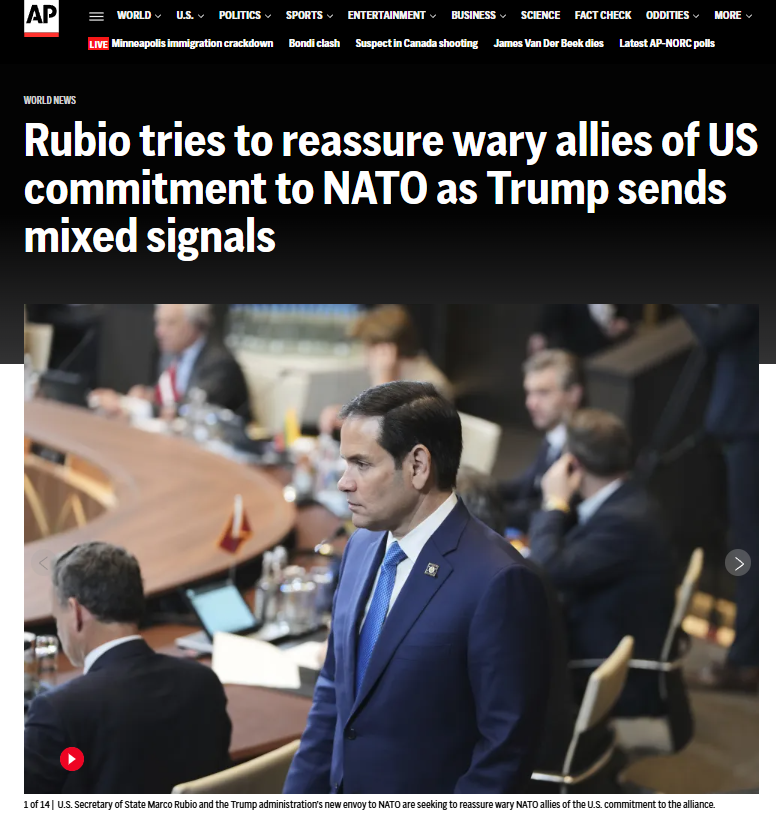
QUESTION: Marty, it’s clear you were called in to implement a peace plan because others have been blocking it. I voted for Trump because I thought he would end the Neocon wars, and he appointed Bessent, who was with Soros and the Neocon Rubio, who even introduced a law when he was in the Senate to prohibit Trump from exiting NATO.
I wrote to Tucker to have you on, and I got no reply. Nobody in the mainstream media will have you, it seems, because they want war.
Is this part of the destruction of the United States that these people are determined to rule the government, no matter who is president, to get their endless wars?
GW
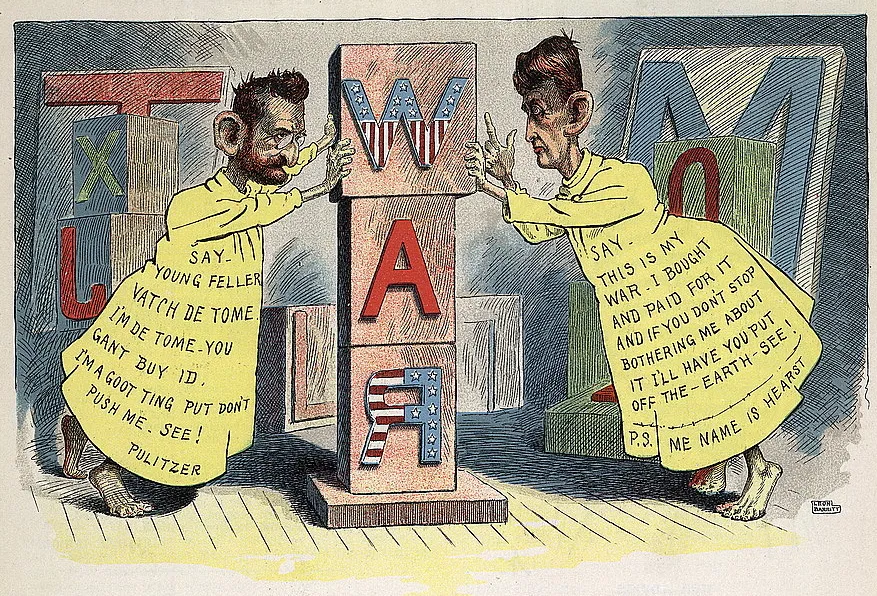
ANSWER: Mainstream media will NEVER have me on because they want to believe in random walk so they can manipulate society and create their perfect Marxist Utopia has never worked even once. They also love war because their readership increases with war. That is what made CNN so popular for it was the Gulf War. They love blood & guts. That was Pulitzer vs Hearst with the Spanish American War they intentionally created.
I am very disappointed for calling me in seems to have created a hostile environment and I suspect that the Neocons were really pissed off about asking me to write a peace plan that they were indeed blocking. The ONLY way to world peace is like Rome. Once everyone was economically benefiting, there was no rebellion. World peace requires economic integration. This deliberate hostility toward Russia has permanently guaranteed war.
We are already in a new Cold War, but it is a “Cold War 2.0” with significant differences from the original version.
It is unlikely that we will see a perfect replica of 1947–1991 for Russia is no longer Communist and it is not interested in spreading communism as was the case under Khrushchev. Our problem is that these Neocons have manipulated the West to carry out their personal revenge. They seized control of the Biden Administration and set in motion World War III interfering in Taiwan and launching the Revolution in Ukraine to deliberately weaken Russia in hopes of NATO invading and conquering their archenemy.
Look at the background of these three. All claim that their families were persecuted by Russians and all three come from the Balkans. This has raised serious questions did all three weasel their way into positions of power to start war with Russia?
Then tere was Nacy Pelosi interfering in international diplomacy to start war with China. As far as Nancy Pelosi’s trip to Taipei, it demonstrated the complete lack of international expertise that has engulfed Washington. There appears to be a complete lack of intelligence, and that is by no means confined to just Democrats. Anyone who supported her trip is totally incompetent in international politics. The trip was supposed to demonstrate US confidence in Taiwan’s leadership, but instead, it provoked a reaction from China that undermined the entire region. Beijing has apparently emerged with much more confidence than ever that it could retake Taiwan by force if necessary.
There was the One China Policy where as long as that stood, China did not need to invade Taiwan. Pelosi did what John McCain did in Ukraine. She deliberately reversed foreign policy regard Taiwan. No China, as a matter of pride, must invade Taiwan. Look at her stock porfolio and youy will see what she bought ahead of that trip. I would bet she was directed by the Neocons to make that trip.
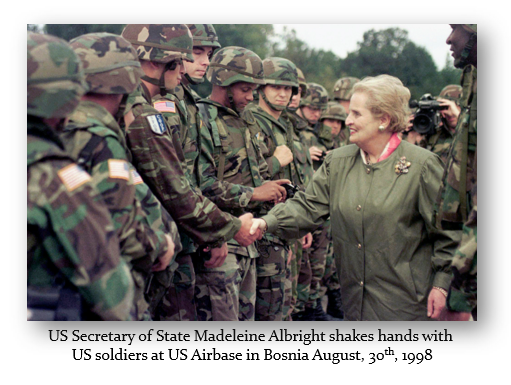
Madeleine Albright was also compromised by her ethnic prejudices growing up in Czechoslovakia. She was a refugee from Czechoslovakia twice, first from the Nazis and then from the Russian Communists. For some reason, people forgave the Germans for the atrocities of the Nazis. However, to this day, they refuse to let go of the hatred of Russians all for the days when Stalin and Communism ruled.
Czechs and Serbs are distinct ethnic groups, each with its own language, culture, and historical background. Albright’s family was of Czech Jewish descent, though they converted to Catholicism. She was Czech and spoke Czech at home.
Focusing on the Bosnian War (1992-1995), Madeleine Albright was the U.S. Ambassador to the United Nations. In this role, she was a central figure in the US foreign policy cabinet. However, she was an incredibly powerful and vocal advocate for intervention, and her influence was a critical factor in pushing the United States and NATO into decisive military intervention in a non-NATO region, bombing Serbs since they were pro-Russia between March 24th, 1999, and June 10th, 1999, all because of her disdain for Serbs and their ties to Russia. She chose sides: Croats vs. Serbs (Catholics vs. Orthodox).
Albright was the administration’s most prominent “hawk” by every means possible. She argued constantly, passionately, and consistently for lifting the arms embargo on the Bosnian Muslims and for using decisive NATO air power to crush the Serbian forces and what she called their atrocities. She famously clashed with many officials. It was clear that her ethnic hatred of Serbs and Russians, in fact, colored her decisions.
In a pivotal 1993 meeting, the Chairman of the Joint Chiefs of Staff General Colin Powell (1937–2021) clashed with Albright. Powell was against military action and put forth the “Powell Doctrine,” emphasizing the need for overwhelming force and a clear exit strategy before committing troops. The core of the disagreement with Madeleine Albright, Powell himself recounted in his memoir, My American Journey published 2003, about her challenging Powell, who was then Chairman of the Joint Chiefs of Staff, by asking,
“What’s the point of having this superb military you’re always talking about if we can’t use it?”
Powell’s reaction was one of deep concern. He saw it as a fundamental misunderstanding of the military’s purpose. He held that military force should be used only as a last resort and with clear political objectives. Albright was just a Neocon who thought nothing of the lives lost. This is typical of a Neocon who does not care for even their country or the people.
These Neocons all have a vestige interest in war with Russia. John McCain was a prisoner of war in Vietnam which was all propaganda claiming that Russia was begind that. McCain was broken and was reading propaganda for the Communists. He hated Russians thinking he had been broken by them which was all BS.
At lease the Neocon that took us into Vietnam admitted he was wrong. But he never had a personal vendetta against the Russian people as all of these people who sought power to allegedly use American military power to get back at people that they personally hated. To me, that was treason.
However, the continued hostile posture from the West has already resurrected the structural core of the Cold War. The sanctions imposed on Russia and the sheer hatred put out by the EU, guarantees that there is no peaceful resolution that is possible. We will see the final confrontation.
These are the people who are absolutely intent on making sure mainstream media will never ask about our War Cycle. They are not interested in having me interviewed on any subject that may negate their agenda or the socialists who do not want to hear that there is any kind of a definitive business cycle. If the economy is not random, that would prevent them from manipulating society to create their perfect world where there is no wealth disparity and a brain surgeon earns the same as the guy who just sweeps the floor.
Posted originally on Feb 12, 2026 by Martin Armstrong |
January’s U.S. jobs data released by the Bureau of Labor Statistics clearly illustrates the cyclical stagnation and weakness beneath the surface of the headline figures. Nonfarm payrolls rose by 130,000 jobs in January 2026 — nearly double the 70,000 economists had forecast — and significantly stronger than the 50,000 jobs added in December 2025. The unemployment rate ticked down to 4.3% from December’s 4.4% as measured in the household survey.
The sector composition of the gains highlights uneven strength. Health care added 82,000 jobs, social assistance contributed 42,000, and construction 33,000, while federal government employment declined by 34,000 and financial activities shed 22,000 jobs. Average hourly earnings moved modestly higher, leaving YoY wage growth contained and not indicative of broad inflationary pressure.
A critical component of this report is the extensive benchmark revision to prior data. Job creation for the full year of 2025 was revised sharply downward from an initially reported 584,000 jobs to just 181,000, marking a reduction of more than 400,000 jobs and the weakest annual performance since the pandemic period. Separate analysis indicates employment growth through March 2025 had previously been overstated by roughly 862,000 jobs before the revision.
Roughly 25% of the unemployed have been out of work for 27 weeks or longer, and labor force participation improved only slightly. Hiring remains muted as companies are simply not expanding.
One monthly headline does not establish a new trend. Compared to December’s report, which showed just 50,000 jobs added and an unemployment rate of 4.4%, January’s 130,000 gain appears strong at first glance. However, December already reflected a clear deceleration from prior months, and the massive downward revisions to 2025 data confirm that the labor market had been weaker than originally reported.
Posted originally on Feb 12, 2026 by Martin Armstrong |
Touted as cutting-edge AI technology, Waymo’s autonomous self-driving technology is actually based on a group of human operators based in the Philippines. A top executive at Waymo acknowledged before the US Senate that its robotaxis sometimes call upon remote workers to assist when the vehicle encounters a situation its algorithms cannot handle. These workers are described as “fleet response agents,” but the reality is that these cars are not autonomous.
The AI revolution walks a tight line between human labor and autonomous computing. Training AI models requires data that is often supported by cheap overseas labor. Capital is once again propelled by labor wherever it is cheapest, but now, to create the appearance of automation.
When AI was first touted as the next industrial revolution, even institutions like the International Monetary Fund warned that as many as 40% of jobs worldwide could be affected by its spread. That warning now appears less like a speculative fear and more like a description of the cycle of transformation we are entering. It is no accident that today’s labor market shows signs of weakening job growth even as corporations and AI developers report rising profits and productivity.
I worked with Dragon System back in the eighties when it was hardware you put into a slot in an IBM XT. It would allow the computer to talk. My daughter was fascinated by it. I wrote a program just to be able to hold a conversation with her and taught it how to be a politician. If it ventured into an area it did not know, it would just change the subject. I still remember she came home from school one day, and I had the computer apart, and she began crying that I had killed it. I used my kids to teach me how to write natural language so it would understand the words in a conversation. The good old days.
Big Tech claims AI will enhance the workforce rather than replace it. Yet, one of the easiest ways to eliminate or reduce labor costs is to outsource it to algorithms. But it takes humans to create those algorithms, and any job position can only produce at the worker’s capacity. It seems that most AI still requires human intervention at this point in time.
Waymo is not passing along once human-driven positions to AI, but rather, it is sending jobs overseas to Manila where labor costs are cheaper. Nothing about this structure preserves domestic employment. We are entering a period where AI will further compress the demand for human labor because capital seeks to displace labor wherever possible to preserve profits and valuations.
Government data published recently from the Federal Reserve Bank of New York shows that adoption of AI to date has not yet caused widespread layoffs. “Businesses reported a notable increase in AI use over the past year, yet very few firms reported AI-induced layoffs,” New York Fed economists wrote in the blog in September 2025. “Indeed, for those already employed, our results indicate AI is more likely to result in retraining than job loss, similar to our findings from last year,” and so far the technology does not point to “significant reductions in employment.”
We are witnessing a transition that will redefine how economies work and how societies survive. The “retraining” noted by the New York Fed is part of adaptation, and adaptation will be crucial during this wave of creative destruction.
Posted originally on Feb 12, 2026 by Martin Armstrong |
The Environmental Protection Agency under the Trump administration is on the verge of repealing the 2009 “endangerment finding” that formed the legal and scientific basis for regulating greenhouse gases under the Clean Air Act. That finding, first issued early in the Obama administration, concluded that carbon dioxide and five other greenhouse gases “may reasonably be anticipated to endanger the public health and welfare of current and future generations,” and it became the linchpin for federal climate regulations ranging from motor vehicle emissions standards to power plant and industrial restrictions.
Carbon dioxide is not toxic, and the attempt to regulate it under the Clean Air Act was always a legal and scientific stretch designed to bypass Congress. This single regulatory maneuver became the foundation for vehicle mandates, power plant restrictions, fuel standards, and a never-ending assault on fossil fuels. The economic consequences were predictable. Higher energy costs ripple through everything from transportation, food, manufacturing, and housing. It has been reducing real living standards while politicians congratulate themselves for “saving the planet.”
Climate policy has become a secular religion rather than a scientific discipline. Dissent is not tolerated, data is selectively presented, and every weather event is blamed on carbon emissions regardless of historical precedent. Governments have used this narrative to justify de-industrialization, energy insecurity, and the transfer of wealth and control to centralized authorities. Europe is the clearest example. Net Zero policies have devastated industrial competitiveness, forced reliance on foreign energy sources, and driven capital out of the continent. The United States has been heading down the same path, and this regulatory rollback is one of the few rational course corrections we have seen.
The legal challenges that will follow this repeal are inevitable, but the broader trend is already clear. The climate narrative is unraveling under the weight of its own contradictions. If carbon were truly the existential threat portrayed, there would be consistent global action rather than selective enforcement aimed at Western economies while China and others expand emissions without restraint. The reality is that climate policy was never about climate. It was about control, taxation, and restructuring society from the top down.
From a cyclical perspective, climate regulation accelerated the loss of confidence in government. People see rising utility bills, higher food prices, and declining real wages while being told it is all necessary for their own good. That is precisely how confidence collapses. When government policy openly works against the interests of the population, capital flees, productivity falls, and social unrest rises. This move signals a recognition that economic survival ultimately overrides fashionable doctrine, and that markets, not mandates, are the foundation of progress.
Posted originally on Feb 11, 2026 by Martin Armstrong |
Voter ID laws have finally passed, but in Somalia. Somalia has taken a step this year toward a “one person, one vote” electoral system with mandatory voter identification to ensure that each individual can cast only one ballot. Federal authorities took it a step further and have now moved toward biometric voter IDs and registration that tie citizenship documentation to the right to vote. It is ironic, bordering on the absurd, that a nation once synonymous with conflict and corruption would implement a measure to strengthen the legitimacy of elections, while in the United States, voter ID is considered suppression.
In April 2025, Rep. Ilhan Omar criticized the Republican-backed Safeguard American Voter Eligibility (SAVE) Act, calling it a “voter suppression bill” that “will disenfranchise millions of voters, especially married women.” Yet, her home country, whose interests she represents while acting as a US Congresswoman, has these very laws in place.
Critics of Mogadishu are not decrying voter ID as racist or exclusionary. There is only recognition that ,without identification, votes cannot be tied to citizens in a trustworthy way.
Meanwhile, in Minnesota (the very district Omar represents), debates rage over whether a system that allows voters to “vouch” for others without standard ID verification undermines ballot security.
The hypocrisy emerges when public figures decry voter ID in the United States as suppression, while their country of origin demands identification as essential to participation. If voter ID is suppression in the US, what label should we give to nations that refuse identification and invite chaos?
In Mogadishu, citizens and officials alike seem to understand that without identification, elections are hollow and easily manipulated. That understanding is missing in the United States’ current discourse. Whether because of ideological reflexes or political calculus, there is a failure to reconcile the principles that are celebrated in the abstract “everybody should vote” with the practical mechanics that make every vote credible.
To build trust, you require verification; to maintain legitimacy, you enforce verification; to protect rights, you protect the process. Somalia’s move toward biometric voter IDs and universally recognized citizen ballots should be a wake-up call to American policymakers. If a nation emerging from decades of instability can adopt measures to secure its elections, then there is no principled reason why the US cannot do the same.
Posted originally on Feb 11, 2026 by Martin Armstrong |
Discord will begin enforcing mandatory global age verification by requiring users to submit a face scan or government ID to access adult content and full platform features. Starting in March, every user account will be barred from age-restricted servers or live chat features until they comply with the system. The company will also deploy AI-driven “age inference” models to pre-screen users, reducing the need for direct ID checks in some cases. Once again, internet surveillance is being masked as protection.
Online safety for children is the new go-to line for increasing security measures. These measures are never limited to protecting children. Over the last year, governments around the world have enacted a wave of legal mandates that obligate platforms to verify ages, censor content, or restrict access. In places like the United Kingdom and Australia, age-verification laws have already compelled platforms to collect IDs and run facial scans just to remain compliant.
Anyone familiar with recent proposals, such as the French VPN ban, will recognize the same patterns emerging where safety and protection are used to justify sweeping surveillance and control over individuals’ digital lives. As I noted in my discussion of France’s VPN considerations, the move toward mandatory identity verification online is a omen of a surveillance mechanism that treats every user as a potential risk to be managed.
Once platforms begin requiring documented identity for access, the mechanisms of consent, data storage, and third-party verification become new levers of power. Discord, in particular, was once a domain for free speech. There is no room for anonymity on the internet. No matter how securely the company claims it deletes sensitive data, history has shown that trusting third parties with personal identification is a privacy nightmare waiting to happen.
Worse still, age verification systems can easily be repurposed for broader social control. Once governments have established that private companies can function as identity checkpoints, the next step becomes normalization of digital identity layers tied to every aspect of life: access to information, social interaction, even basic digital participation.
Age checks are not about content; they are about control points. Once the infrastructure of identity verification is established, anything becomes enforceable. The broader trend, seen from France’s VPN discussions to Discord’s corporate compliance with government expectations, is clear. The premise of protection leads to permission, which becomes power. Online platforms are rapidly transitioning from spaces of open interaction to gated systems requiring validated identity and behavioral compliance. This is being done in the name of safety for children, but the logical endpoint is a digital ecosystem in which every individual is known, categorized, and controlled.
I have created this site to help people have fun in the kitchen. I write about enjoying life both in and out of my kitchen. Life is short! Make the most of it and enjoy!
This is a library of News Events not reported by the Main Stream Media documenting & connecting the dots on How the Obama Marxist Liberal agenda is destroying America

















 Centinel2012