Posted originally on the CTH on November 4, 2023 | Sundance
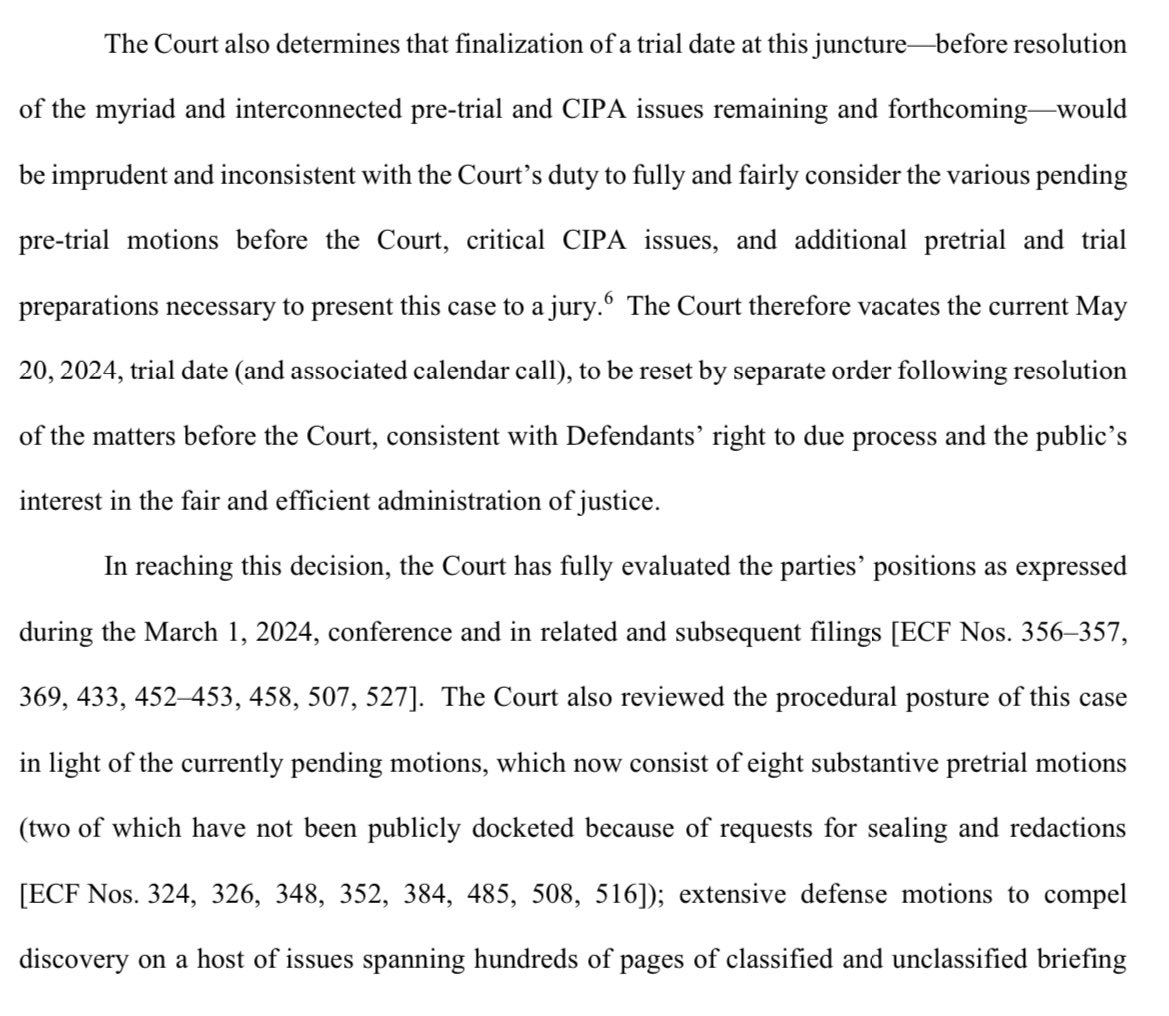
After several interesting hearings and court filings last week, U.S. District Court Judge Aileen Cannon has indicated she is likely to postpone the trial schedule requested by Special Counsel Jack Smith due to the scope of material evidence and the need for defense attorneys to review slow production by the prosecution.
As noted by journalist Julie Kelly, who has attended the hearings, “On Friday morning, [Cannon] announced a stay, or suspension, of all pre-trial deadlines as she prepares a formal order to explain her thinking and very likely issue a new trial date.”
Bad News / Good News – Before getting to the great summary outline provided by Kelly, it is worth remembering one of the challenges in the case, which fortunately Judge Cannon has great familiarity with.
You might remember when the issue of defining “classified documents” surfaced, Judge Cannon appointed a “special master” to review the documents and make determinations. The prosecution filed an appeal to that approach and won within the 11th Circuit based on an outlook the Jack Smith team is relying on.
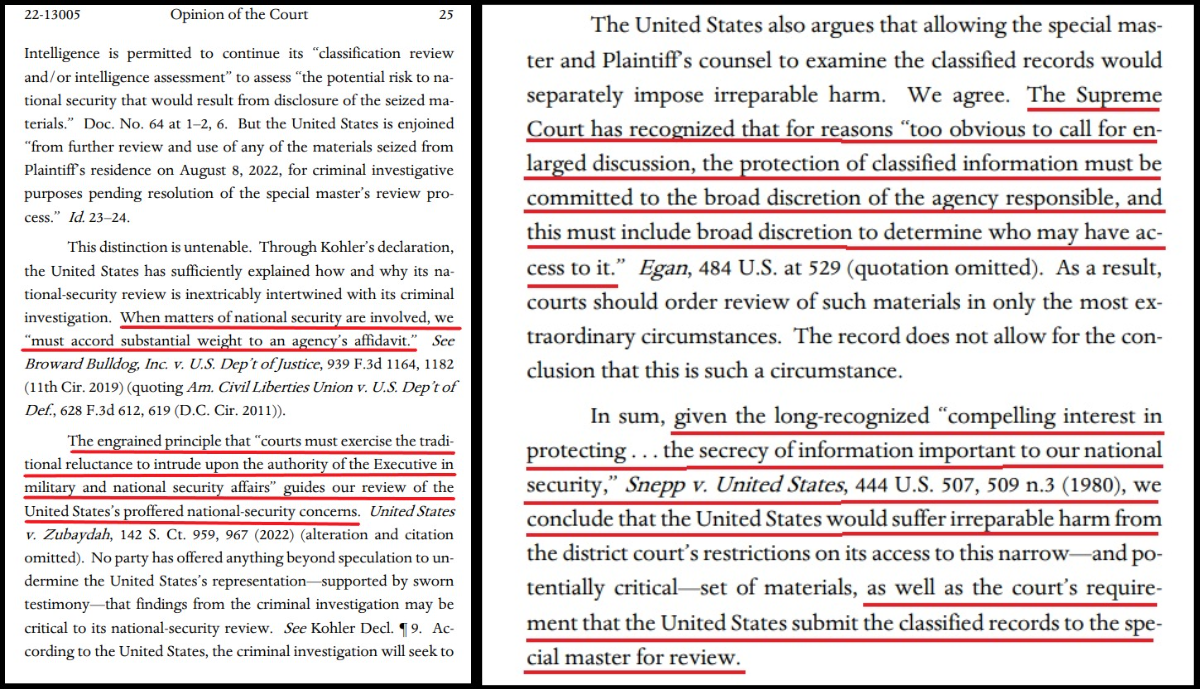
Essentially the appellate court ruled on the DOJ calling the material “classified” and “vital to national security”, by saying in the court’s determination they have no authority to question the decision of the executive branch when it comes to matters of national security. {Go Deep}
[Source]
The appellate court (judicial branch) stated they defer to the DOJ (executive branch) as to any/all claims of harm to national security that may be caused by a review of documents the DOJ-NSD determine, on their own authority, to be identified as classified (sensitive, secret or top-secret). Therefore, if the DOJ states sharing the “classified documents” with a special master may harm national security, the court must accept that position without challenge.
The Trump legal team did not appeal this 11th Circuit Appeals Court ruling for valid reasons.
The Supreme Court would not want to touch the issue of “classified documents” and/or how they are defined by the agencies in the Executive Branch. Any review of definitions by the executive could be interpreted as interfering in the plenary power of the Executive Branch to make decisions about national security.
To take up the issue would be to create consequences putting the Supreme Court in the middle of any classification argument beyond the Trump case. Think about FOIA requests denied due to “National Security” or classification status.
If the Supreme Court interjected in the debate between President Trump and Special Counsel Jack Smith, they would be stepping into an argument within the Executive Branch. This could be perceived as setting precedent for any denied FOIA lawsuit to appeal directly to SCOTUS, and that would create an entire apparatus of the High Court now being the arbiter of what is “classified intelligence” and what is not. This exceeds their constitutional limitations and separation.
If the executive branch wants to call the dinner menu between President Trump and Chairman Xi a classified document in the interests of national security, they can. The Supreme Court is not going to step in and be the arbiter to determine validity of the classification status.
This outlook of the judicial branch plays into the hands of Special Counsel Jack Smith and the unprecedented Lawfare approach.
Jack Smith (Weissmann/Eisen) knows the High Court doesn’t want to get involved in an “inside executive” dispute, not on this granular stuff. So, he is leveraging the ability of the current politics within the executive to his advantage. Essentially, the executive rules are whatever the current executive says they are.
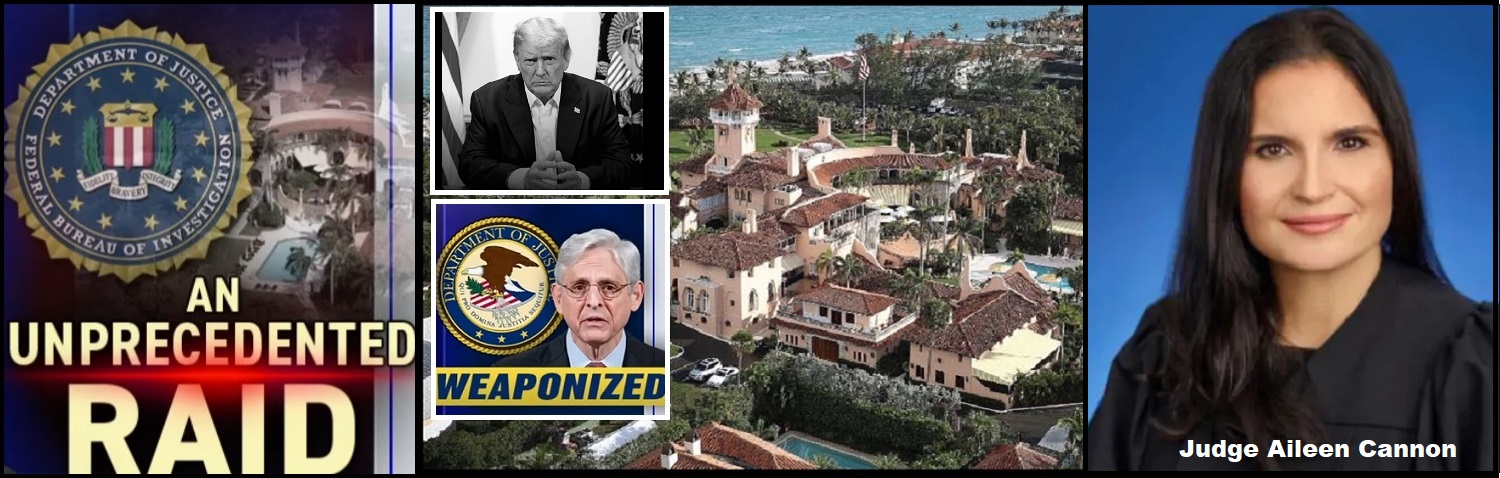
That brings us to last week, and Judge Aileen Cannon who can clearly see the approach Jack Smith is taking. Julie Kelly has a great summary of the week in the Florida court:
Julie Kelly – […] “The games already have begun. For example, Trump this week filed a motion at the appellate court in D.C. seeking an emergency stay (or hold) on Chutkan’s broad gag order. If the appellate court, stacked with Obama appointees, ultimately denies the request, Trump’s team signaled they are prepared to seek immediate relief at the Supreme Court. (Late Friday, a three-judge panel issued a temporary hold and expedited Trump’s appeal on the matter.)
Defense motions to dismiss the January 6 indictment based on selective prosecution and overall unconstitutionality now sit on Chutkan’s desk—requests she presumably will deny, prompting another wave of appeals. One can only imagine the coming fight over jury selection, which will commence on February 9 when potential jurors in D.C. are asked to complete questionnaires about their knowledge of the case.
In addition to the logical difficulties in viewing classified evidence in the documents case—which also involve tight restrictions under the Classified Information Procedures Act, or CIPA, and numerous hearings—the amount of discovery in the matter is “exceedingly voluminous,” Cannon wrote in July. She did not exaggerate.
DOJ so far has turned over at least 1.3 million pages of unclassified and 5,500 pages of classified records, far more than Smith’s office initially claimed. Further, roughly 60 terabytes of video footage recorded by security cameras at Mar-a-Lago must be reviewed by defense attorneys to track the movement of dozens of boxes, the basis of Smith’s obstruction charges. Both sides debated on Wednesday whether the amount of footage represented the equivalent of five years (Smith) or ten years (Trump) since the archive includes video captured by multiple cameras stationed throughout the property over the course of several months.
Team Trump also accuses Smith’s team of violating discovery deadlines, an allegation Bratt seemed to acknowledge when he admitted to the judge that the government made a discovery production as late as last week. (READ MORE)
I strongly suggest reading the full article presented by Kelly above.
President Trump’s legal position is very strong in the Florida documents case.
As we noted from the outset, and entirely different from what traditional pundits were saying at the time, the Mar-a-Lago documents case is the weakest case Jack Smith’s Lawfare crew have assembled. Additionally, the judge in Florida is indicating she can see through the Lawfare schemes of the prosecution – and she doesn’t like it.



 Centinel2012