Sunday Talks – Nat Sec Advisor Jake Sullivan Explains Hamas Holding 500 Americans Hostage as Human Shields


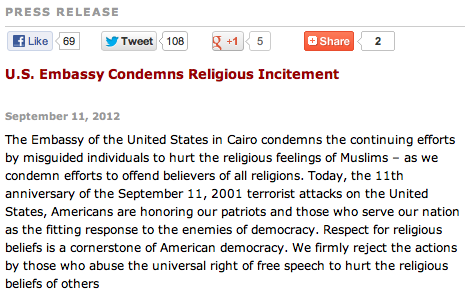
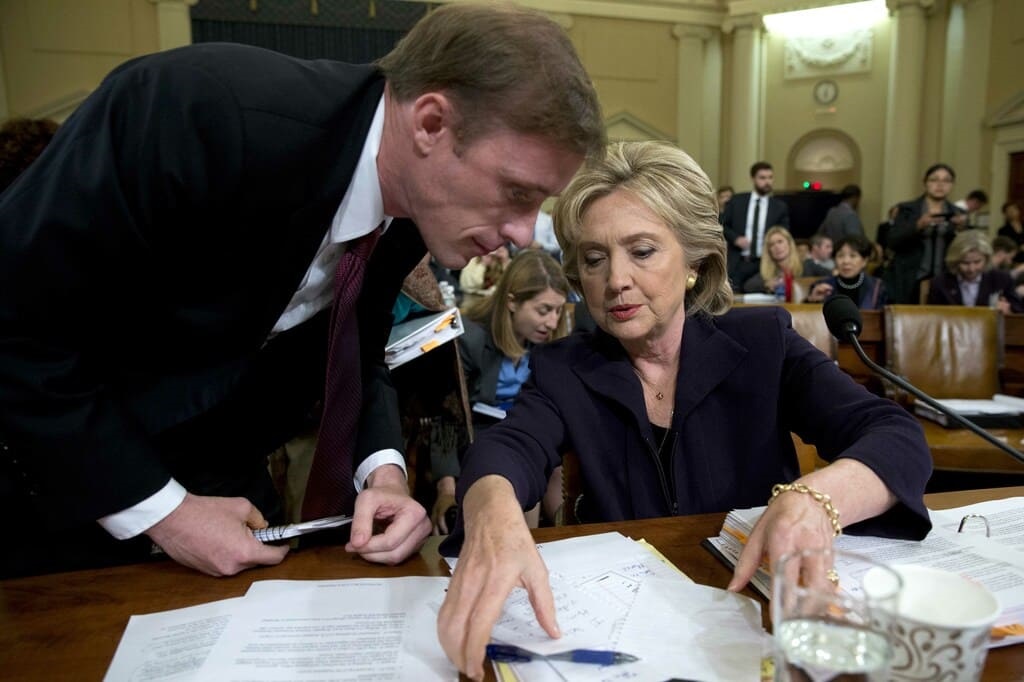
Every time this guy pops up, I am reminded of his previous fame in constructing the “YouTube video narrative” as an explanation for the 2012 Benghazi attack.  At the time, it was Jake Sullivan working in the State Dept who fabricated that entire story; yes, it was entirely his creation, and the Clinton and Obama team (then NSA Susan Rice) pushed it into the media as the official U.S. explanation.  It’s funny (not really) how no one ever calls Sullivan out on that history, given his current position.

Taking that background context, while also accepting that everything we are told about Ukraine and the official position of the U.S. as it pertains to current Israeli War aspects, Jake Sullivan’s prior manufacturing of extreme defensive narratives, abjectly false presentations, leads more credence to accepting that we are once again being manipulated by fundamentally false information.  Jake Sullivan is now Joe Biden’s National Security Advisor.

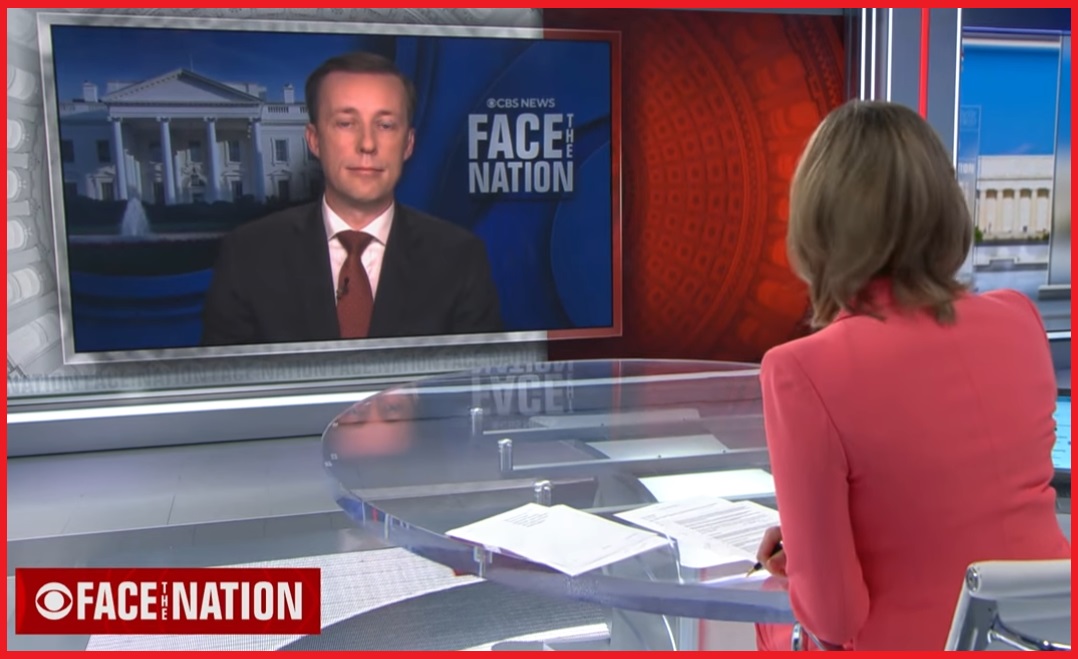
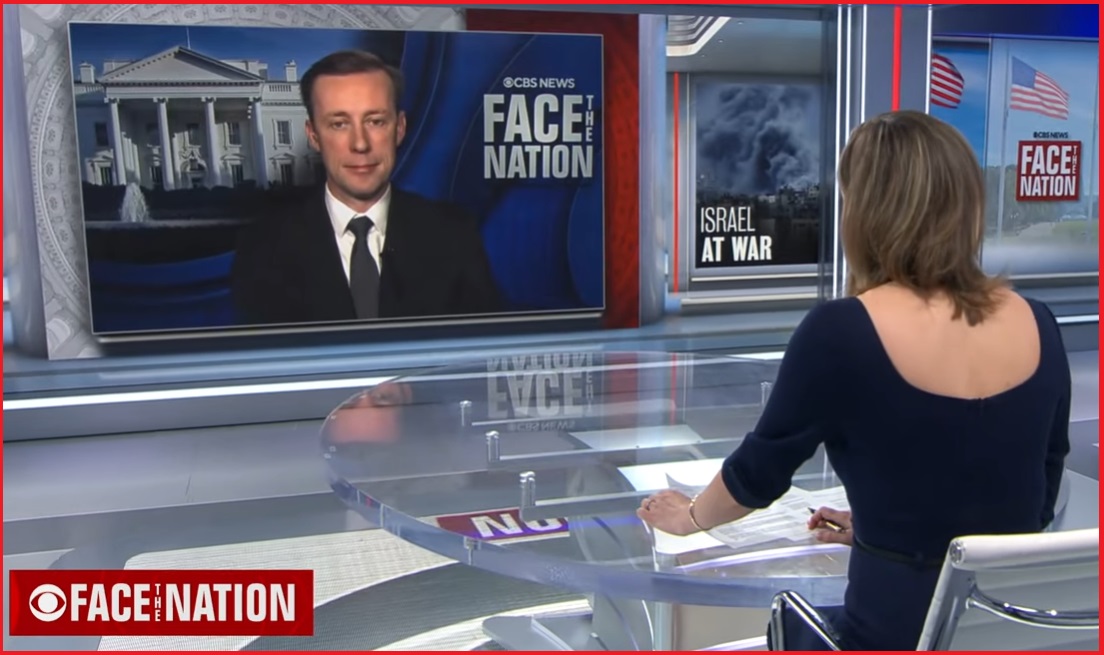
Appearing on CBS, Sullivan outlines the current coordination between the Biden administration and Israeli leadership.  While he didn’t specifically say the words in the headline, instead describing exactly that while pretending something else, Hamas is FACTUALLY holding 500+ Americans hostage as human shields. WATCH:

[Transcript] – MARGARET BRENNAN: We go now to White House National Security Adviser Jake Sullivan. Jake, good morning to you.

JAKE SULLIVAN: Good morning, Margaret.

MARGARET BRENNAN: Does the US know if the roughly five to six hundred Americans in Gaza have survived the past 23 days of bombing and have the hostages?

JAKE SULLIVAN:  We are in regular contact with most of the Americans who are in Gaza. We can’t say every single one, but all of the ones who reach out to us we follow up with on a regular basis, even sometimes a daily basis. And so, we know that many of them are still there, still waiting to get out. And we are working actively to try to make that happen. The challenge right now, Margaret, is that the Egyptians are prepared to let Americans and other foreign nationals out of Gaza. The Israelis have no issue with that. But ¹Hamas is preventing their departure and making a series of demands. We’re trying to work through that to create a circumstance where all of the Americans who are in Gaza are able to get out. It is a priority for the President. He has no higher priority than their safe passage out. And he will continue to work at it until it is accomplished.

[¹What is that, if not hostages and ransom?  /SD]
MARGARET BRENNAN: This morning the Palestinian Red Crescent said it received threats from the quote occupation authorities to evacuate al Quds Hospital in Gaza, because it’s going to be bombarded. Is that accurate? Is that hospital a military target?

JAKE SULLIVAN:  I have not heard that. So I can’t confirm that or deny that one way or the other. What I can tell you is that hospitals are critical civilian infrastructure. Under international humanitarian law hospitals should not be targeted. They are not military targets.

MARGARET BRENNAN: We’ll watch that developing story. Let me ask you about Israel and how it has explained its mission to the US government. Saturday their military said it committed it killed a Hamas leader who had overseen the drone strikes and the paragliders who carried out that horrific attack on October 7, they’d already announced that they’d killed the commander of forces responsible for the massacre at kibbutz Nirim, and another key Hamas commander. Have they told you yet at which point they will declare this mission a success?

JAKE SULLIVAN: Well, they have declared they have told us in broad terms that making sure that Hamas can never again threaten Israel in the way it threatened Israel before is their core strategic objective in this conflict. But in terms of what the specific milestones are, that is something that ultimately is up to Israel, this is their military operation, they will make that decision. And we will continue to ask the hard questions, Margaret, that we would ask of ourselves in a military operation like this, what exactly are the objectives? How are the means matched to the objectives? And how will this evolve over time? That’s a conversation we’ve been having. It’s a conversation we will continue to have in the days ahead.

MARGARET BRENNAN: So it sounds like that endgame has not been specifically laid out. Do you expect at this point, a full scale Israeli invasion and occupation of Gaza? Or is that off the table?

JAKE SULLIVAN: Well, I’ll let the Israeli Defense Forces speak to what their operational planning is. And I’m not going to characterize it on television today. What I will say is that the United States has been very focused on a core challenge here, which is that Hamas is using civilians as human shields, they’re hiding behind civilians, they’re hiding among civilians. They’re putting rockets and other terrorist infrastructure in civilian areas. That creates an added burden for the Israeli Defense Forces. But it does not lessen their responsibility to distinguish between terrorists and innocent civilians and to protect the lives of innocent civilians as they conduct this military operation. That’s true of striking from the air. It is true of going in on the ground, and this is something that we talk about with the Israelis on a daily basis.

MARGARET BRENNAN: I understand. But I also understand now that there has been a tremendous amount of death in Gaza. I know President Biden said the other day, he has no confidence in the numbers presented by Palestinian authorities in Gaza. But I wonder at which point does the US say there needs to be some cess-cessation of violence?

JAKE SULLIVAN: Well, first President Biden was making a straightforward point, which is that the particular institution, the Gaza health ministry, which is run by Hamas, we can’t take what Hamas says at face value. But we have also been clear, repeatedly, that we have seen thousands of Palestinian civilians killed in this conflict. That- that is a tragedy. Each and every one of those individual deaths is a tragedy, and that the life of every civilian, Palestinian, Israeli, anyone is sacred and has to be protected. And that, as I said before to you, Margaret, the fact that Hamas is using people as human shields does not lessen the responsibility on Israel to try to put heck, those civilians from the point of view of a ceasefire, what Israel suffered on October 7th was the equivalent of fifteen 9/11’s. After 9/11, if the terrorists had simply said, We want a ceasefire, I don’t think the United States would have said, We’re gonna stop going after terrorists. Now, it was important for us, and it is important for Israel, to distinguish between going after terrorist targets, to take out terrorists who continue to threaten Israel, and going after civilians. That is an obligation and a responsibility for Israel. And it’s something that we will continue to press them on. We also believe that there should be humanitarian pauses to get hostages out, potentially to get aid in and we will continue to work toward that end.

MARGARET BRENNAN: I know, Jake, I’ve heard this. And frankly, some of the language is a little contradictory, or it sounds that way, because Secretary Blinken said, even a temporary pause and bombing would benefit Hamas. He said that on this program last week. Then a few days later, he went to the UN and said a humanitarian pause must be considered, then the US at the UN voted against a humanitarian truce. So what exactly is the Biden administration calling for here because everyone from the Pope to the World Health Organization to the UN is saying, just stop the violence for a period of time at least.

JAKE SULLIVAN: Well, what a lot of people are calling for is just a stop to Israeli military action against terrorists period. Just stop no more Israel cannot go after terrorists who conducted this largest massacre of Jews since the Holocaust, and who continue to fire rockets and continue to attack Israel. We have taken the position that Israel has a right to defend itself against terrorist attacks. That is different from what Secretary Blinken spoke about, which was a humanitarian pause. A pause in the fighting, for example, so that there’s a period of time where there can be safe passage of hostages.

MARGARET BRENNAN: So just a hours–

JAKE SULLIVAN: President Biden and his whole team are working extremely hard to get those hostages out. We will continue to do that. I won’t put a timeframe on it. But I will say that given the number of hostages, it would be more than just hours if we were able to secure their release, and we are actively working to secure their release. And similarly, when Secretary Blinken said that any pause and fighting benefits Hamas, that’s a reality. There are a lot of complicated realities in this, a humanitarian pause would be a good thing to get hostages out. But you can bet that Hamas will try to use that time to their advantage as well. These are the things that Israel is trying to grapple with. And these are also the hard questions that we are trying to pose to Israel as it works to prosecute a campaign against Hamas, while we press them to make sure to distinguish between Hamas and the Palestinian people who Hamas does not represent and the Palestinian people deserve to live lives of safety, dignity and equality.

MARGARET BRENNAN: So to that point, Benny Gantz, who is part of the Netanyahu war cabinet said, “We will listen to our friends, but we will act in accordance with what is right for us.” Is there any daylight Jake, between the US and the Netanyahu government right now?

JAKE SULLIVAN:  We have conversations like friends do on the hard questions that I talked about before, on issues associated with humanitarian aid, on distinguishing between terrorists and innocent civilians, on how Israel’s thinking through its military operation. Those conversations happen multiple times a day, they happen between the President and the Prime Minister. They happen by the Secretary of State, Secretary of Defense myself, other senior members of our administration. We talk candidly, we talk directly, we share our views and an unvarnished way, and we will continue to do that. But sitting here in public, I will just say that the United States is going to make its principles and propositions absolutely clear, including the sanctity of innocent human life. And then we will continue to provide our advice to Israel in private.

MARGARET BRENNAN: I understand this is another country’s decisions here. But the US gives more than $3 billion a year in aid to Israel, some of those weapons being used in Gaza are purchased or help to be purchased with US taxpayer funds. So whether it’s intended or not, to some of the world, it looks like the US is endorsing all of what Israel is doing here. Are you at all asking the military to be more limited in its tactics or more strategic?

JAKE SULLIVAN: The United States of America when we transfer weapons to another country, whether it’s Israel or anyone else, requests, requires an assurance that those weapons will be used in accordance with the law of armed conflict, and we seek accountability to ensure that that is the case, we will continue to do that. We will also work around the clock to try to make sure that life saving humanitarian assistance gets to people in need. And so the United States will set out its policy and its principles as a sovereign nation, Israel will make its decisions as a sovereign nation. But fundamentally, what President Biden says, how he has described things from the point of view of civilian protection, access to life saving goods and medicine for civilians, this is where the United States stands. And we do not stand for the killing of innocent people, whether it be Palestinian, Israeli or otherwise. And we weep and grieve for every last life and will continue to do so.

MARGARET BRENNAN: Is that going to be your message to Saudi Arabia’s Defense Minister, when you meet tomorrow? I know, you know, a number of Arab partners are concerned about the level of violence in Gaza right now.

JAKE SULLIVAN:  We’ve been talking to our Arab partners, including to Saudi Arabia, about the unfolding crisis in Gaza. We listen to them carefully. We share our perspective. And yes, we will have the opportunity to dive deep, not just on what is happening today, but on what tomorrow could bring. Because what President Biden said in the Rose Garden this past week, was that we can’t go back to October 6th, that means Hamas can no longer terrorize Israel. But it also means that there needs to be a political horizon for the Palestinian people, two states for two peoples, the right of Palestinians to live in safety, dignity and equality. And we’re going to work towards that. And Arab states, including Saudi Arabia have a role and a responsibility in that as well.

MARGARET BRENNAN: Before I let you go, do you now believe Iran is deterred?

JAKE SULLIVAN: Well, what I believe is that the United States will follow through on what we say we’re going to do. We said that if our troops were attacked, we would respond, we responded. If they’re attacked again, we will respond again. And we are vigilant, because we are seeing elevated threats against our forces throughout the region, and an elevated risk of this conflict spreading to other parts of the region. We are doing everything in our power to deter and prevent that. But I’m not going to predict what the future brings, other than to say that if we are attacked, we will respond.

MARGARET BRENNAN: Jake Sullivan, thank you for your time. And Face the Nation. We’ll be back in one minute. Stay with us.

[End Transcript]

Again, we are all being manipulated.  Just a reminder…..
Posted originally on the CTH on October 29, 2023 | Sundance

Sunday Talks, Nat Sec Advisor Jake Sullivan Discusses China, North Korea, Ukraine and Steering Biden Policy from DC


Posted originally on the CTH on July 16, 2023 | Sundance 

National Security Advisor Jake Sullivan represents the UniParty outlook from Washington DC.

From the position of influence and affluence, both Republican and Democrat policy makers are aligned in a unified outlook toward foreign policy and geopolitical affairs. Washington DC does not have two competing political parties on these issues; there is complete alignment and unidirectional focus.  Never forget that.

Before getting to the Sullivan points, I’m going to shift the discussion slightly, back to the core and explain something that might help provide context for issues from China to Russia and beyond.

Everyone in Washington DC agrees with the agencies and institutions that create the national security state.  The intelligence apparatus and the national security agencies frame the “interests of the U.S. government.” The politicians never push back against those agencies and the strategic policies they present as a solution.  This is important to accept as you contemplate the continued push only in one interventionist direction, regardless of American public opinion.

The only countervailing force that has ever entered the modern system against this dynamic was President Donald Trump. That is why the “system”, consisting of both Republicans and Democrats, together with every institution the system controls, was/is/are unified to repel Trump.

This hive mindset is critical to understand, because the central conflict, the perspective that Trump represents a threat, originates from whether the combined institutional administrative state is correct in their assessments or not.

The “system,” an assembly of career ideologues who define themselves by their sense of self-importance, never believe they are wrong about anything; therefore, every means is justified in their mind.  Any person who opposes their worldview is a threat.  Every threat then becomes a target.

EXAMPLE (not accidentally selected) – If the DC HIVE believes that China may launch a biological weapon against the world.  Every agency within the system then begins to process themselves in defense of that perceived possibility.

The Defense Dept works to run drills against biologics and games out consequences and countervailing actions. The govt simultaneously begins inserting scientists into the Chinese operations to feedback information to support the activity of those in the U.S. organizing against the perceived possibility.

The CIA, NSA, DoD, DHS and State Dept, then begin constructing internal mechanisms that can evaluate, respond and react to the perceived possibility.  From that viewpoint, defeating Russia is viewed as a way to show China what will happen if the perceived possibility is real. 

In this scenario, the key point of reference is to note that all of the action taken by the system is done without ever addressing or confronting the core issue, the perceived threat.  Everything becomes a series of if this – then that, scenarios.  No one in the system ever questions the origin of the thesis.  Years can pass and this process grows on a totally unfounded theory, with an origin that eventually no one can identify. 

Into this weird system of perception, theory and possibility driving policy, comes an entity like Donald Trump.

President Trump does the complete opposite of what every institutional action has been created to support.

President Trump cuts to the bottom line, asking China directly, openly and publicly, “Hey, Chairman Xi, are you planning to create a deadly biological weapon – based on your desire to rule the world?

OMG, the entire DC system goes into apoplectic fits.  Every institution, now centered around a mission which was based on this perceived threat – generating billions in funding and thousands of jobs and careers, now proclaims President Trump is putting the U.S. at risk.

If you think this is an overly simplistic intellectual example, you’re wrong.  This is exactly how the DC process unfolds, and there are dozens of examples of this in the tenure of President Trump in office.

Trump’s foreign policy doctrine, a brutally honest and pragmatic approach, was essentially this.  Direct questions, direct expectations and direct outlines.

President Trump did it in Saudi Arabia with ISIS.  He did it in Egypt and Jordan to support Israel.  He did it in Europe with NATO. He did it in Asia with North Korea.  He did it with Turkey about Syria. He did it with Pakistan about the Taliban.  He did it in Afghanistan about Iran.  Trump did it in India, China, Canada, Mexico, the U.K, Russia and everywhere he went.

The President Trump message, the Doctrine per se’, was simple; don’t do stupid shit, and we’re good!  If you have been doing stupid shit, then stop!  If you don’t stop, I’ll destroy you economically.

The absolute pinnacle of this was Trump talking directly to Chairman Kim Jong-un, because he knew Beijing was the voice in the background controlling the activity of North Korea. Chairman Xi was gob-smacked in his noodles, not knowing what Kim and Trump were talking about.

People can argue about the effectiveness of the Trump doctrine, but the outcomes speak for themselves.  Everyone stopped doing their stupid shit, and things were better.

Here’s the DC HIVE:

.

[Transcript] – MARGARET BRENNAN: We turn now to White House National Security Adviser Jake Sullivan, who joins us from Washington. Good morning to you, Jake. The presidential envoy on climate John Kerry just landed in Beijing. He’s the third cabinet member in recent weeks to go to China. Do you expect President Xi and Biden to talk anytime soon?

WHITE HOUSE NATIONAL SECURITY ADVISER JAKE SULLIVAN: Well, we don’t have anything to announce today, but I do expect that at some point, the president, President Biden, and President Xi will have the opportunity to speak again. And there’s a lot to review in the relationship. It is a big, complex, challenging relationship that has to be managed carefully and that can only really be done effectively from the very top. So I do expect at some point the two leaders will speak.

MARGARET BRENNAN: Well, you know, the Commerce Department has, in many ways, been this like tip of the spear in this competition and restriction in the high tech space. That was one of the agencies targeted by China based actors, according to Microsoft in this hacking. Reportedly, the Commerce Secretary herself had her email hacked. Will there be repercussions for Beijing?

SULLIVAN: Well, first, Margaret, this was an intrusion, actually into Microsoft, into Microsoft’s cloud system. And they went in through that to get into the unclassified email system of U.S. government agencies. It was actually the U.S. government that discovered the intrusion, alerted Microsoft, and shut it down. And we’re taking steps to make sure that that’s not a vulnerability going forward. We have seen this kind of thing before many times over many administrations, and we take steps to try to hold the relevant actors responsible and will do so in this case.

MARGARET BRENNAN: They are China based actors, according to Microsoft. Do you have any reason to dispute that?

SULLIVAN: Well, we haven’t- No, I have no reason to dispute what Microsoft is saying. We go through a rigorous process of attribution. We have not formally attributed it, but I’ve seen nothing to dispute Microsoft’s judgment on who did this.

MARGARET BRENNAN: The Treasury Secretary told us that China’s decision to cut off ingredients for computer chips starting August 1 may be retaliatory for some of the actions the U.S. has taken to restrict tech sales to China. Do you see this as tit for tat moves here? Are we in a period of escalation, despite your diplomatic outreach?

SULLIVAN: Look, I can’t get inside the heads of the Chinese decision makers, so I’m not sure what was motivating them. What I do know is that I think it’s a self defeating move, because I believe that it will only reinforce the determination of many other countries in the world to de-risk, to find ways to reduce dependencies and increase the resilience of their own supply chains, including for the kinds of critical minerals that are at issue in this particular decision. So from our perspective, we are being clear and transparent about steps we’re taking. We’re not looking to end all trade with China, what we’re looking to do is have a small yard of restrictions on technology with national security implications, and a high fence around that yard. That’s what we’re going to continue to do. And China, of course, will have to make its own decisions.

MARGARET BRENNAN: Staying in Asia. We saw this week that North Korea appears to have taken a significant step towards an intercontinental ballistic missile that could put the US within range of a nuclear weapon potentially. Are you concerned that they will carry out another nuclear test in the coming weeks?

SULLIVAN: I have been concerned for some time that North Korea would conduct what would be its seventh nuclear test going back multiple administrations. And I remain concerned about that. I don’t see any immediate indications that that’s going to happen. But it would not come as a surprise if North Korea moved forward with another nuclear test with respect to its intercontinental ballistic missile capability. This is a capability they began testing several years ago, they have continued to test it. We watch all of those tests very closely to see how it is developing. And we coordinate extremely closely with our allies with Japan and Korea, to make sure that we are responding in lockstep to this threat.

MARGARET BRENNAN: Have you made any new diplomatic overtures since this test in order to negotiate with Pyongyang or talk to them at all?

SULLIVAN: Not since this test, but over the course of the Biden administration, we have indicated to North Korea that we’re prepared to sit down and talk without preconditions about their nuclear program. And we’ve also made clear to China that it is the United States who is ready for diplomacy, and North Korea who is not. So from our perspective, China has a role to play here too, given its relationship with North Korea, to indicate to the North Koreans that its continued testing, is destabilizing, and, frankly, is in fact only creating circumstances in which the United States, our allies, and partners have to step up our activities and posture to respond to the threat.

MARGARET BRENNAN: You are just back from Europe where the President was at this NATO Summit. On the diplomatic front, though, there are other issues as well, including the expiration of what’s known as this Black Sea initiative to allow for ships carrying food, leaving Ukraine to safely pass without Russia attacking them. Is there any sign from Vladimir Putin that he is willing to extend this?

SULLIVAN: Look, I can’t predict what Vladimir Putin will do. He has been all over the map with respect to this initiative over the course of the past many months. It is possible that Russia pulls out of it, it is possible they continue. If in fact, they pull out of it, the rest of the world will take a look at that and say that Russia has turned its back on ensuring that the countries of the global south and Africa and Latin America and Asia can get the food they need at affordable prices. And I think that will come at an enormous diplomatic cost to Russia going forward. So this is a choice Vladimir Putin is going to have to make. We are prepared for any scenario and we’re working closely with the Ukrainians on that.

MARGARET BRENNAN: Okay, because it’s set to expire at midnight tomorrow. In terms of the promises made at NATO, there was this general pledge to potentially allow Ukraine to join in the future. Are you concerned that that will shape a negotiation potentially with Russia to end the conflict, where they are incentivized to just drag this out?

SULLIVAN: The Ukrainians are currently, as we speak, bravely and courageously, pushing against the Russian lines in the south, and in the east. They are inflicting enormous damage on the Russian forces. The West is working to continue to tighten the squeeze of our sanctions, hollowing out Russia’s defense industrial base, weakening its capacity to produce advanced technology. We will continue to put economic pressure on Russia, and the Ukrainians will continue to put military pressure on Russia. So I think in the end, if Russia chooses to continue fighting in this war, it will come at a grave cost to Russia. And Ukraine will continue to make progress on the battlefield. In the meantime, we are going to make sure that Ukraine has the support it needs for as long as it takes, and that is a message that came out of the NATO Summit. And finally, yes, we said at NATO very simply Ukraine’s future is in NATO. We meant it. That’s not up for negotiation. That’s something that now all 31 allies have committed to.

MARGARET BRENNAN: Not up for negotiation. Okay. On Iran, before I let you go, you’ve said that the administration is trying to put Iran’s nuclear program back in the box, ultimately, through some diplomatic effort. Are you close to any type of understanding on that front and any type of understanding that would allow for the four Americans to be released?

SULLIVAN: We have tried very hard to secure the release of the four unjustly detained Americans in Iran, we have done so since the day that President Biden took office. We have had indirect contact with Iran on this in an effort to try to get a deal that could get them released. We have not arrived at an understanding that would get them out at this point. We are continuing to work at it. My hope is that we will get it done. But unfortunately today, Margaret, I don’t have anything to announce.

MARGARET BRENNAN: And by understanding in terms of the nuclear program, this would not be any kind of written agreement. We are not close to any kind of actual deal?

SULLIVAN: With respect to the nuclear program, we’re not close to any kind of a deal.

MARGARET BRENNAN: And, may I quickly ask you about Rob Malley, the President’s envoy. Is he coming back to the administration? We understand he’s being suspended as the security clearance has been reviewed.

SULLIVAN: Rob Malley has served multiple administrations faithfully and well. He is a public servant. He is a diplomat. He is engaged in high level, high stakes diplomacy for a long time. And he’s someone who a lot of us, including myself, have deep respect for. I can’t speak to the current circumstances. I have to refer you to the State Department on that.

MARGARET BRENNAN: All right, Jake- Jake Sullivan, thank you for joining us today. [transcript link]

The war in Ukraine ends the moment Trump is elected.  Russia keeps the eastern part. The U.S. stops trying to use Ukraine as a proxy. Ukraine stops doing stupid stuff and takes care of its own people.  And with Trump’s assurance to Russia – Ukraine will not join NATO.