
Category Uncategorized
BOLLING: We Either Stop Spending Like This, Or We Keep Charging Full Speed Tow-ard The Economic Wall, Hoping Something Breaks It Down Before We Hit It. That’s The Reality
Marjorie Taylor Greene & Trump Using Nuclear Weapons
Posted originally on Aug 21, 2026 by Martin Armstrong |
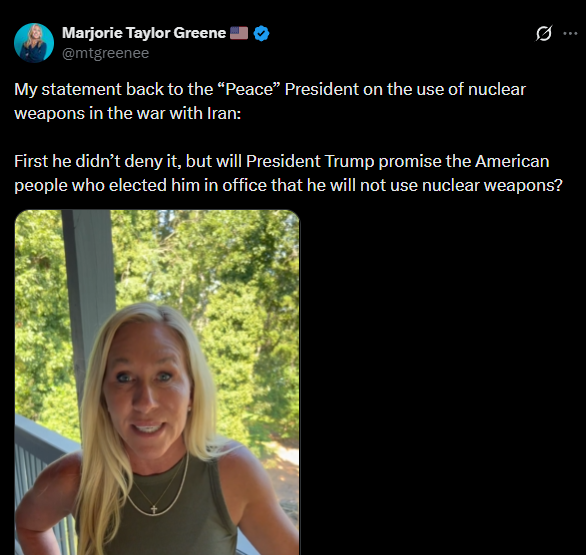
Let me make something very clear. The Neocons have been talking about using nukes forever. There are people in Israel also talking about using a tactical nuke on Iran’s nuclear facility because nothing else would reach it. These discussions are not using a major nuclear weapon like Hiroshima. This is a bit out of place. It is nothing new and I can tell you that the default with some of these people is to just nuke the opposition.
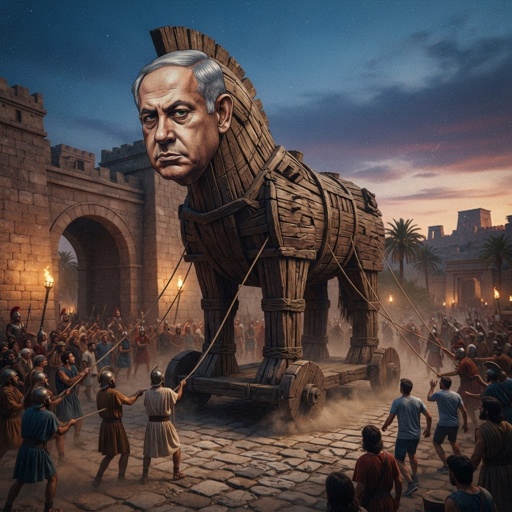
President Trump has been suckered into this war by the Neocons who escorted their Trojan Horse into the situation room, Netanyahu. Trump was against endless wars promoted by the Neocons like John Bolton. According to reports from The New York Times and other outlets, Netanyahu was “escorted” or “whisked” into the White House Situation Room on February 11th, 2026, by President Trump’s team for a highly classified presentation on Iran. Netanyahu was a foreign leader given rare access to the White House Situation Room. I believe he was the FIRST ever to enter that room, but I cannot definitively confirm that.
It is also not possible to definitively state that Jared Kushner escorted Netanyahu into the Situation Room during the February 11, 2026, meeting. However, I can at least confirm that he was present at a White House meeting with Netanyahu that same day. Netanyahu is obsessed with Iran and has been trying to get the United States to destroy Iran at least since 1996.
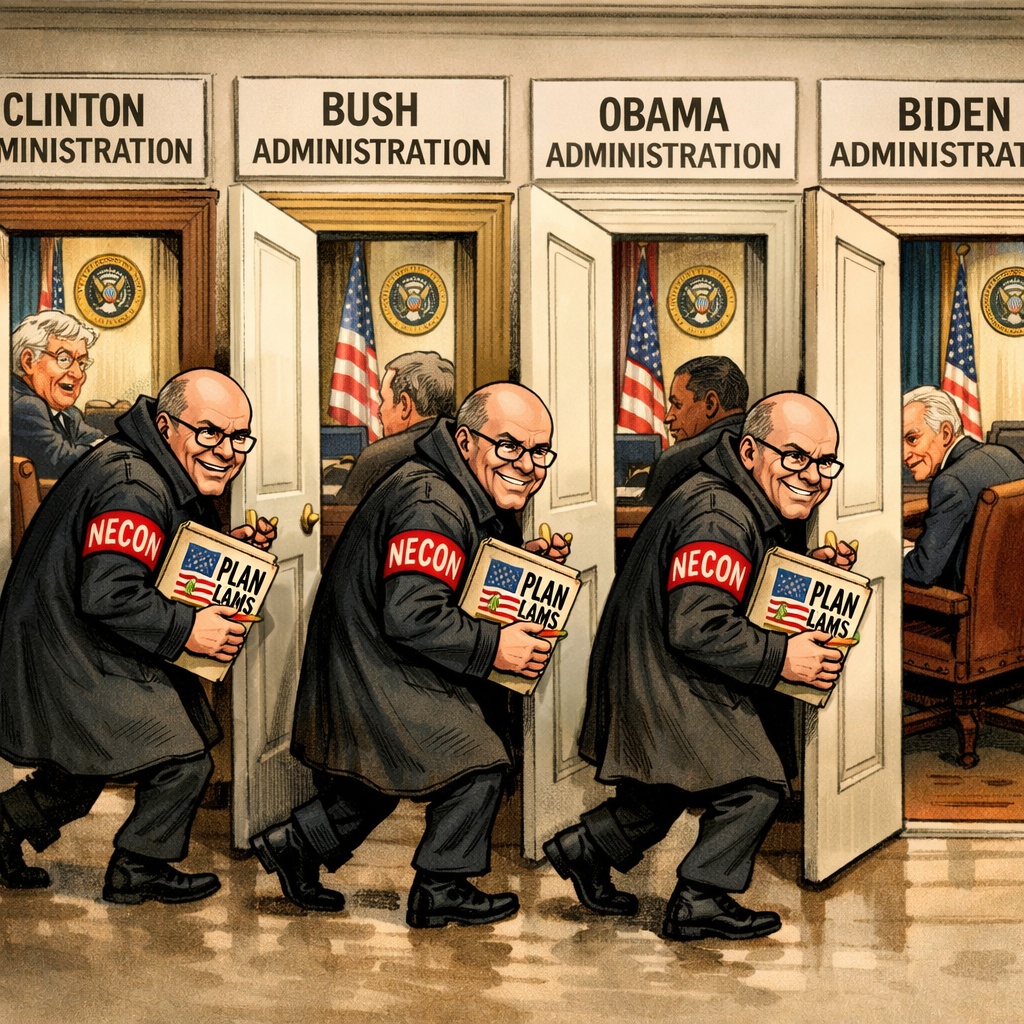
President Trump, I believe, was lied to and told that killing the Ayatollah on day one would win the war. That is ALWAYS a Neocon solution. They said the same about Saddam and I have head the very same bullshit that if they took out Putin, the Russian people would cheer and give them their fictional tickertape parade. These people have the same sales pitch and they are ruthless and claim to be for democracy yet infiltrade every administration to promote their endless wars.
These Neocons have justified regime changes around the world since World War II. The reason WHY Iran calls the USA the “Great Satan” is precisely this issue. The CIA, working alongside British intelligence (MI6), orchestrated the 1953 Iranian coup d’état to overthrow the democratically elected Prime Minister Mohammad Mossadegh. A primary motivation was to re-establish Western control over Iran’s oil industry for the benefit of British and American companies.
This operation, known as Operation Ajax (or TPAJAX), is a well-documented example of Cold War covert intervention. The crisis was triggered by Mossadegh’s decision to nationalize Iran’s oil industry, which had been controlled by the British-owned Anglo-Iranian Oil Company (the forerunner of BP).
These Neocons have usurped American foreign policy and claim that they are spreading “democracy” to the world when in fact they circumvent the Constitution and launch unilateral operations without any Congressional approval. This is no different from a dictatorship. The people are NEVER asked shall we overthrow a government or start a war.
I was told back in the ’90s that the US should overthrow all the dictators in the Middle East and that would secure Israel for the future. Here is a video of General Wesley Clark hearing the same thing after 9/11 in 2001. I heard that same idea about 5 years before in private discussions with a leading Neocon.
Saudi Arabia Is Borrowing to Preserve Vision 2030
Posted Ordinally on 21, 2026 by Martin Armstrong |
Saudi Arabia recorded a budget deficit of 125.7 billion riyals, approximately $33.5 billion, in the first quarter of 2026. That is almost as large as the $44 billion deficit the government projected for the entire year. Spending increased by 20% while oil revenue declined by 3%, creating the very contradiction Vision 2030 was intended to eliminate. The kingdom is spending enormous amounts of oil revenue and borrowed money to build an economy that will supposedly no longer depend upon oil.
The government approved financing needs of 217 billion riyals, or nearly $58 billion, for 2026. This includes 165 billion riyals to cover the projected budget deficit and another 52 billion to repay maturing debt. But the Q1 deficit has already consumed most of the amount projected for the entire year. The government may recover some ground if oil revenues rise, but this exposes the vulnerability of every state-directed economic transformation. The projections assume that politicians can control spending, oil prices, regional stability, and investor confidence simultaneously. History demonstrates that they can control none of them.
The war with Iran has accelerated the problem. Saudi military spending increased by 26% during the first quarter as the kingdom attempted to protect its population, oil facilities, shipping routes, and critical infrastructure. Government expenditure on goods and services increased sharply, subsidies rose, and capital spending was brought forward. This is the hidden cost of war even for a country attempting to remain outside the conflict. Saudi Arabia does not have to invade Iran to pay for the war. It must spend billions defending itself against missiles, drones, disrupted shipping, higher insurance costs, and the possibility that the Strait of Hormuz will remain unreliable.
Saudi Arabia’s Public Investment Fund is now scaling back and shifting toward phased projects tied more closely to profitability. The original plans for The Line, a 112-mile linear city, became the international symbol of Vision 2030, but symbols do not produce cash flow. Projects are being reevaluated while the kingdom redirects attention toward logistics, artificial intelligence, clean energy, religious tourism, utilities, and infrastructure connected to events such as Expo 2030 and the 2034 World Cup.
There is nothing inherently dangerous about Saudi Arabia borrowing money. Its debt burden remains far below that of the United States, Japan, or the major European governments. The issue is the direction of the trend and the productivity of the expenditure. Debt used to construct infrastructure that increases trade, tourism, energy capacity, and private investment may strengthen the economy. Debt used to maintain political prestige, absorb operating losses, or defend projects that cannot survive without government support becomes a permanent claim upon future revenue.
Vision 2030 was launched to diversify the Saudi economy away from oil, expand tourism, build new industries, and create private-sector employment for a young population. Those objectives are entirely rational. No government can assume that a single natural resource will finance the state indefinitely, particularly when Western governments are simultaneously regulating fossil fuels, subsidizing alternatives, and using energy policy as a geopolitical weapon. The problem is not the desire to diversify. The problem is the belief that diversification can be commanded from above through unlimited spending.
The danger emerges when government borrowing begins crowding out the private economy Vision 2030 was supposed to create. Saudi banks, contractors, and investors naturally prefer projects supported by the state because political backing appears to reduce risk. Capital then flows toward whatever the government has designated a national priority instead of toward enterprises responding to genuine market demand. This produces the illusion of private-sector growth while the entire system remains dependent upon public spending. If the state reduces expenditure, the supposed private boom disappears with it.
This pattern is not unique to Saudi Arabia. Japan attempted to support growth through enormous infrastructure spending after its 1990 asset bubble collapsed, leaving behind bridges, roads, and regional projects that could not restore private demand. China used state-directed credit to build cities, railways, and property developments on an unprecedented scale, but debt accumulated when economic returns failed to match political projections. Dubai itself experienced the limits of debt-financed development during the 2009 crisis and required assistance from Abu Dhabi. Governments always believe their current project is different because they cannot imagine the economic cycle turning against them.
Saudi Arabia’s advantage is that it still possesses enormous energy reserves, financial assets, and the ability to attract international capital. Its disadvantage is that this apparent wealth encourages the belief that every project can be completed regardless of cost. Oil revenues can conceal mistakes for decades, but they cannot transform an uneconomic project into a productive one. If the kingdom must continually borrow against future oil income to finance diversification, then oil dependency has not ended. It has simply been moved from the present budget onto the future balance sheet.
The regional war makes that contradiction more dangerous. Higher oil prices may increase revenue, but attacks on shipping and infrastructure can reduce export volumes and raise security expenses. Saudi Arabia can therefore receive more per barrel while still confronting a deteriorating fiscal position. This is why analyzing oil producers solely through the price of crude is foolish. Revenue depends upon price, volume, transportation, security, and the cost of maintaining the state. War can increase the first while damaging every other component.
Vision 2030 may ultimately produce valuable infrastructure and a more diverse Saudi economy. That outcome will depend upon whether the government is willing to abandon projects that cannot generate an economic return. The decision to scale back the most extravagant parts of Neom may be the first sign that reality is beginning to overcome political ambition. Continuing every project merely to avoid admitting error would transform Vision 2030 from an economic reform into a sovereign debt machine.
Categories
Tulsi Gabbard Provides an Update on Her Husband Abraham Battle With Cancer
Posted ordinally on August 20, 2026 | Sundance | 29 Comments
Tulsi Gabbard: “Earlier this year, my husband Abraham was diagnosed with a very rare bone cancer. This has been a challenging time for us and is hard to talk about. But so many of you have reached out asking how he’s doing and sharing your prayers and well wishes with us. We made this video to share a little about what this journey has been like, and to update you on his recovery. Mahalo for all of the love and support.”
Dear Lord and healer of all things created, we pray for complete healing for Abraham Williams from both cancer and surgery.
We ask that You remain guiding the hands of the doctors and caregivers. We pray for mercy and restoration of Abraham to full strength and health.
We ask Your mercy to intervene and mitigate pain in recovery, while pulling Tulsi, Abraham and those they love close to You. We pray for You to surround them with Your sense of peace.
Our Father who holds the stars and the eternal distance, we trust in Your universal power to heal, and we believe that You will hear our prayers and provide full restoration in Your glory. ~Amen.

Posted
President Trump Takes Media on Tour of White House Renovation and Repair
Posted originally on CTH on August 19, 2026 | sundance
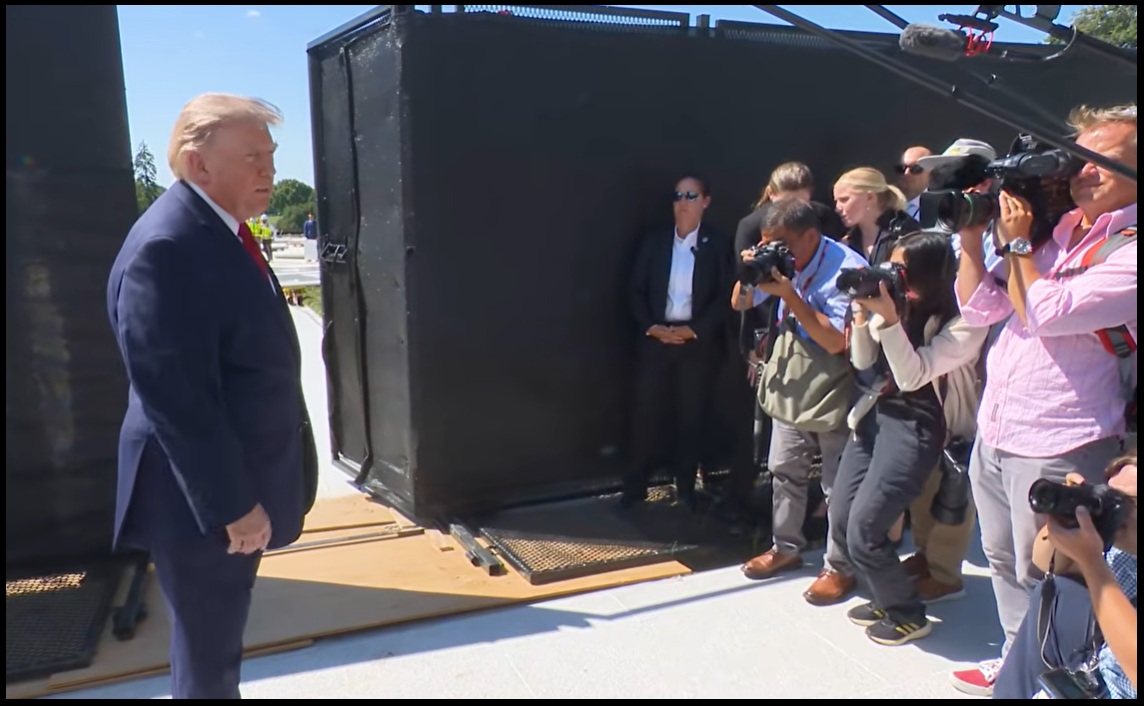
President Trump spoke at length about each aspect of the renovation and repair that is underway, giving specifics about the standards, measurements and systems that are being used in the process. You can tell President Trump is a builder and expert on the subject of construction. This really is quite fascinating to watch. WATCH:
.
.
Episode 5598: The Communist Left’s Plan To Destroy America
Posted originally on Rumble on Bannons War Room, on: 026 Aug 18, 2026
BANNON: We Must Have An Up-Armored ICE Presence At These Polling Booths! They Say, “Well, That’s Intimidation.” IT’S NOT INTIMIDATION IF YOU’RE A U.S. CITIZEN!
Posted originally on Rumble on Bannons War Room, on: 026 Aug 18, 2026
JESSICA M. VAUGHAN: The J-1 Visa Program Was Created For Cultural Exchange. Now More Than 75% Of These “Exchange” Visas Are Being Used As Cheap Labor For Employers
ted originally on Rumble on Bannons War Room, on: Aug 17, 2026
Trump Punishes South Korea for Refusing to Join the Iran War
Posted Ordinally on Aug 18, 2026 by Martin Armstrong |

10has ordered the Pentagon to reduce America’s joint military exercises with South Korea, but this is not simply about saving money or suddenly deciding that North Korea poses no threat.
Trump said that North Korea has been “unthreatening and respectful” toward the United States and argued that the exercises with South Korea are unnecessary and provocative given his relationship with Kim Jong Un. He instructed the Pentagon to “substantially reduce” the Ulchi Freedom Shield exercises, which began August 17 and were scheduled to involve approximately 18,000 South Korean troops. Trump has opposed these exercises before and suspended major drills after his 2018 summit with Kim, so his objection to them is certainly not new. What is different this time is that he publicly connected his anger toward South Korea to Iran.
Seoul has one of the most heavily militarized borders on Earth sitting directly in front of it, yet Washington apparently expects South Korea to become involved in another Middle Eastern war simply because America decided to become involved. When Seoul refused, Trump publicly complained about that refusal while ordering military exercises with South Korea reduced. Call it diplomacy if you want, but the message to every American ally is obvious: if you refuse to participate in Washington’s wars, do not assume Washington will treat your own security concerns the same way.
South Korea has been extremely careful regarding Iran from the beginning. Washington explored transferring Patriot missile systems connected to U.S. forces in South Korea to support the Iran war, creating obvious concerns in Seoul because those systems exist in Korea for a reason. South Korea later considered participating in efforts to protect navigation through the Strait of Hormuz, but Defense Minister Ahn Gyu-back made clear that Seoul was examining steps short of direct military participation. Reuters reported in May that Ahn had not discussed a South Korean military contribution with Defense Secretary Pete Hegseth. South Korea was willing to protect its economic interests and shipping, but it did not want to be dragged directly into America’s war.
The Iran war has already cost South Korea economically. Seoul’s parliament approved a 26.2 trillion won supplemental budget, about $17.7 billion, specifically to cushion its economy from the consequences of the conflict. South Korea is already paying for a war it did not start without volunteering its military to fight it.
South Korea has supported Ukraine politically, economically and through humanitarian assistance, but it has traditionally resisted directly supplying lethal weapons because it understood the consequences of inserting itself into the war. That position has become increasingly difficult as North Korea strengthen ties with Russia. Zelensky now claims that as many as 50,000 North Korean troops could be deployed in Russia and has been openly pressuring Seoul to provide Ukraine with additional air-defense capabilities and cooperate on drone technology.
North Korea is not some theoretical enemy thousands of miles away. It is sitting immediately across the border with nuclear weapons and ballistic missiles. Pyongyang fired another ballistic missile only days before the latest American-South Korean exercises, its 11th suspected missile test of the year. North Korea then denounced the exercises and warned that it would strengthen its nuclear deterrent.
This is what makes Trump’s decision so extraordinary. He is simultaneously telling the world that North Korea has been respectful toward America while expressing anger that South Korea will not help America fight Iran. The national interests of the United States and South Korea are not identical. A competent foreign policy recognizes that allies cooperate where their interests overlap rather than demanding obedience everywhere on Earth.
Trump is correct that the endless military exercises deserve scrutiny. He is also correct that constantly conducting war games while claiming to seek negotiations with North Korea sends contradictory signals. If there is an opportunity to negotiate with Kim Jong Un and reduce tensions on the Korean Peninsula, then by all means negotiate. Trump accomplished more by sitting across a table from Kim than generations of politicians accomplished by screaming threats at North Korea.
Yet America cannot demand that every ally join every American war. This is the same insanity that transformed NATO from a defensive alliance into a geopolitical machine operating far beyond its original purpose.
There is another problem Washington refuses to confront. The attack on Iran has almost certainly reinforced North Korea’s determination never to surrender its nuclear arsenal. So Washington bombs Iran, potentially reinforces North Korea’s conviction that nuclear weapons guarantee regime survival, becomes angry when South Korea refuses to participate in the Iran conflict, and then reduces exercises intended to deter the nuclear-armed North Korea sitting on South Korea’s border.
Support Washington’s war and Washington supports you. Refuse and perhaps the relationship changes. That does not strengthen alliances. It encourages every country to develop an independent military policy because eventually they will conclude that American protection comes with conditions unrelated to their own defense.

