The Other Half of the Story – CIA Director John Ratcliffe’s Visit to Moscow


Posted originally on the CTH on August 26, 2026 | Sundance |

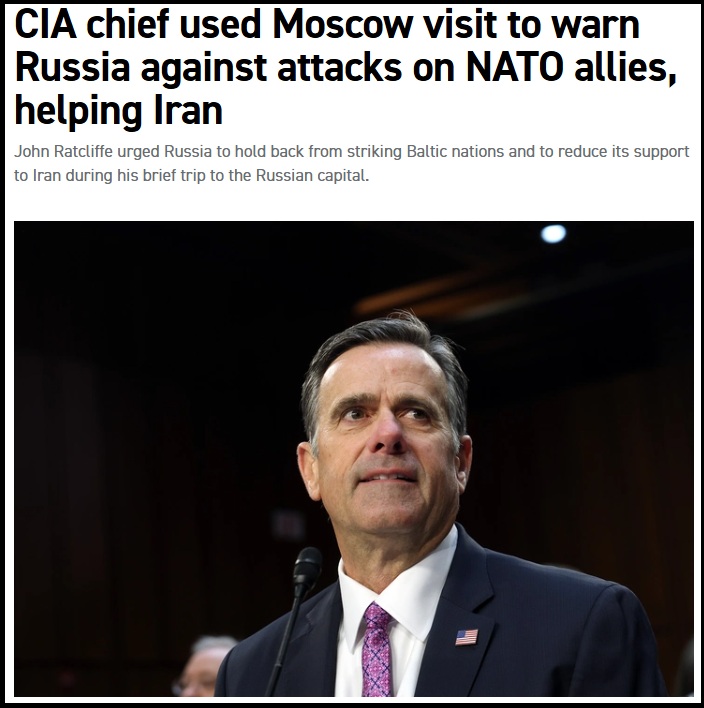
Western media are reporting that CIA Director John Ratcliffe traveled to Moscow, Russia, to warn his Russian counterpart Sergey Naryshkin, head of Russia’s Foreign Intelligence Service (SVR), about striking back against Baltic states. {CITATION} However, that’s only half of the story.

Director Ratcliffe wasn’t simply telling Naryshkin not to hit back; he was telling Naryshkin that European NATO provocations against the Russian enclave of Kaliningrad (between Poland and Lithuania) were not ‘fully’ sanctioned by the United States. {CITATION Aug 18}
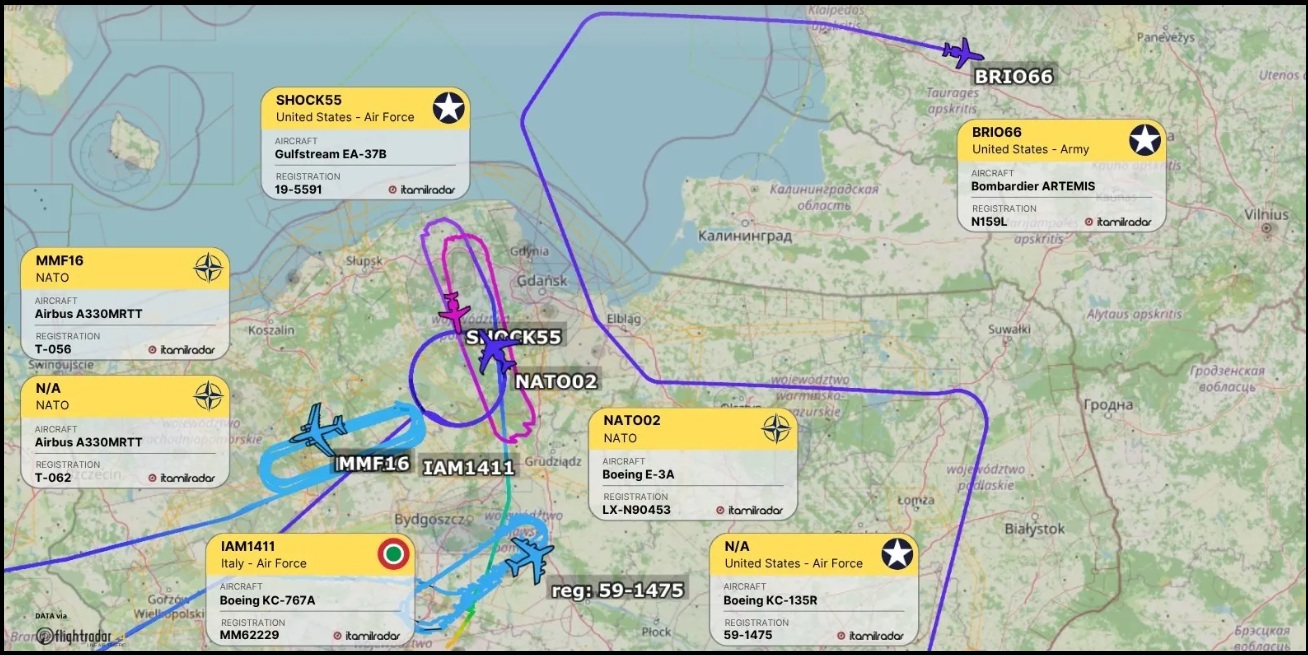
EU NATO members have been conducting provocative military operations and psychological warfare via NATO exercises all around Kaliningrad. They have been getting more aggressive with each series of maneuvers.  The Trump administration (DoW) recently removed the head of U.S-NATO operations over this background strategy. What the western media will not tell us is that Lt. Gen. Charles Costanza, commander of the Army’s V Corps, was removed from command over this planned operation {citation Aug 7}.

Apparently, European NATO is increasingly trying to provoke expanded conflict with Russia, while President Trump and CIA Director John Ratcliffe attempt to tamp down the problems being created.  This is all connected to the expanded drone activity recently reported in media (Germany – Leipzig airport and Romania citations}, which looks increasingly like covert Ukraine intelligence operations.  There are some reports that western intelligence linked Russia to the Leipzig airport drone, so perhaps Director Ratcliffe also carried that intelligence message.

The bottom line is there’s a lot of sketchy ‘fog of war’ stuff happening, and U.S. intelligence has a responsibility to the Trump administration to try and contain any significant issues involving escalation.  Hence, Ratcliffe’s message saying we are not trying to provoke you, so don’t put us in a situation where we end up defending NATO because you retaliate against all of this activity happening outside Ukraine’s borders.
Ukraine intelligence operations blew up the Nordstream pipeline {CITATION}, then dumped it in the lap of Joe Biden and walked away.  That hot mess ended up with weeks of the U.S. having to fabricate some alternative narrative that Russia bombed their own pipeline.  Ukraine intelligence services also carried out the bombing in Monaco {CITATION} then killed the Ukraine Intelligence asset to cover their tracks.  Ukraine intelligence also carried out the bombing in central Moscow {CITATION – Balzi Rossi}.

So, who or what is essentially Ukraine Intelligence?

That’s likely British intelligence (MI6), who have been conducting these covert operations using Ukrainian figures.  The same British intelligence that has now sanctioned Storm Shadow missiles for Ukraine to build {CITATION}. Again, more provocation and more urgent need for U.S. officials to try and avoid expanded conflict.  Who is the MI6 partner agency, that’s the CIA; that’s where Director John Ratcliffe comes in.

All of this is very alarming to say the least.  Europe is essentially doing everything they can to provoke Russia into a retaliatory posture, while the USA is telling Russia not to retaliate.  This is how wars get expanded.  However, Russia doesn’t pretend not to know things.

Simultaneous to this, Ratcliffe likely also discussed Iran and Syria from an intelligence and strategic U.S. policy position.

The day before Ratcliffe flew to Moscow, Treasury Secretary Scott Bessent explained that President Trump had launched several emissary missions around “Operation Economic Outcast”{CITATION}, obviously talks with Russia about the vulnerabilities of sanctioning targeting were a part of that strategic conversation.

In the hours after Ratcliffe departed Moscow, Secretary of State Marco Rubio announced: “Today, I authorized the formal rescission of Syria’s designation as a State Sponsor of Terrorism (SST), following the conclusion of the mandatory 45-day Congressional notification period.   I have also delisted Hay’at Tahrir al-Sham’s (HTS) designation as a Specially Designated Global Terrorist (SDGT). These actions represent another historic step by President Trump to give the Syrian people a path to prosperity.” {CITATION} Russia is a stakeholder in the outcome within Syria.

Yes, John Ratcliffe outlined how Russia should not attack NATO allies; how the U.S. would appreciate support in staying out of Iran, and how President Trump is trying to resolve overall Mideast peace vis-a-vis Syria and beyond.

That’s a more fulsome outline of the key areas of message relayed by CIA Director John Ratcliffe to SVR Head Sergey Naryshkin.

Or put another way, what President Trump calls “semi-routine,” but he acknowledged it was about bringing the war to a close. “I hate to disappoint people. We would like to see the war with Ukraine end,” he said. {CITATION}
Semi-related:  Within the Ukraine friction points CTH has previously noted we should pay close attention to both Moldova and Romania.  We should now add Finland to that list.  I am told that Finland is currently on alert for covert Ukraine “intelligence” operations using Finland as a launch region for increased drone attacks toward the St Petersburg region.

Saint Petersburg, Russia, is the fourth-most populous city in Europe, the most populous city on the Baltic Sea, and the world’s northernmost city of more than 1 million residents. As the former capital of the Russian Empire, and a historically strategic Baltic port, it is governed as a federal city.  Russian President Vladimir Putin is from there.
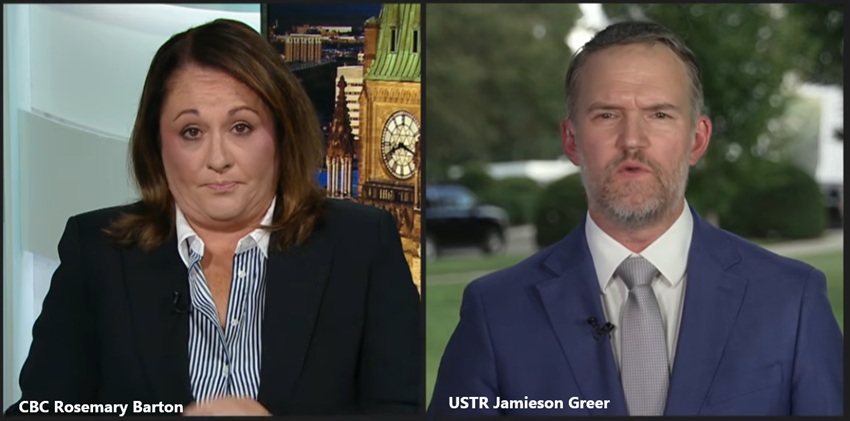
Must Watch: U.S. Trade Rep Jamieson Greer -vs- Canadian State Controlled Media Rosemary Barton


Posted originally on the CTH on August 26, 2026 | Sundance

This is a must watch interview.  Most Americans have no idea that Canadian media is controlled by the Canadian government; it’s what they call “cultural protection” where the rules and regulations of permissible speech are controlled by govt regulators and media are subsidized by govt.  The overall objective is to control information and censor viewpoints that might be averse to the interests of the Canadian govt. That’s why most Canadians have no concept of granular details on policy matters; they just don’t get the information.

In this interview with the Canadian Broadcasting Corporation (CBC), U.S Trade Representative Jamieson Greer is discussing the trade conflict and breakdown with Canada’s version of Baghdad Bob, Rosemary Barton.  I’m a little surprised the CBC would even entertain the discussion. However, as noted in the past few days there is increasing skepticism amid Canadians about who and what actually blew up the trade talks. Canadians are starting to show signs of suspicion; enter Ms. Barton on behalf of the Canadian government to try and control things.

USTR Jamieson Greer answers the questions in a most unfortunate manner; meaning, he told the truth.  Greer outlined exactly why he suspects the trade talks broke down, and it has nothing to do with economics or trade, it’s all politics on the Canadian side.  As Greer noted, there was no change to the trade agreement between President Trump and Prime Minister Carney’s lengthy phone call on Tuesday, and the Canadian decision to walk away on Friday.  Greer was being very diplomatic, but Barton started getting the vapors. WATCH:

Greer noted the Carney administration had requested “Fortress North America” a synergetic alignment of U.S-Canada trade principles.  Canada wanted a united North American continent against the world on trade.  Therefore, this talk of Canada being upset about joint collaboration and agreement on trade agreements with third countries, a point brought up by Carney in the walk-away just doesn’t make sense.

If you want a united trade policy for North America, then each nation in North America must hold the same baseline on terms and conditions with other nations.  That was the discussion. Those were the agreed principles; until all of a sudden Canada accused the U.S. of dictating terms.

Greer also swatted away the “French language” controversy, saying it wasn’t an issue for the USA at all.  Greer speaks French and no one cares about Canadians speaking French.  That issue has nothing to do with trade at all.  As to embedded programming in U.S. streaming services that allow Canadians to find their favorite television shows in French, Greer said the free market makes those decisions.   If it is important the market will respond to Canadian requests to search their devices using French.

On the subject of tariffs against Autos versus semi-trucks, Greer noted these are two entirely different categories within the trade agreement. The U.S. was willing to eliminate tariffs against Canadian autos, SUVs and light trucks, but Semi Trucks is another sector altogether.  It was Canada who put restrictions and quotas on the import of American autos, we did not limit Canadian exports.

Overall, this is likely the first time any Canadian has the opportunity to see the other side of the discussion.  Jamieson Greer did a great job outlining the situation and as to the memes or statements from President Trump, “that’s politics.”

Greer noted that political stuff is “not his lane,” he is focused only on the business of a trade agreement, the rest is politics.  However, by citing that example, Greer ended up emphasizing how, from the Canadian perspective, everything passes through the “political” prism.

As to next steps, Greer noted the Canadian government has ‘shut down’ all avenues of conversation.  So, we’re done – as is their choice.  The tariffs remain, and if Canada again retaliates, the U.S. will respond accordingly.

Ms. Barton was left in a very befuddled and verklempt state.

Posted in Auto Sector, Big Stupid Government, Canada, Cultural Marxism, Culture, Deep State, Dem Hypocrisy, Donald Trump, Economy, Election 2026, Fabian Socialists – Modern Progressives, media bias, NAFTA, President Trump, Professional Idiots, propaganda, Trade Deal, Typical Prog Behavior, Uncategorized, USA, USMCA

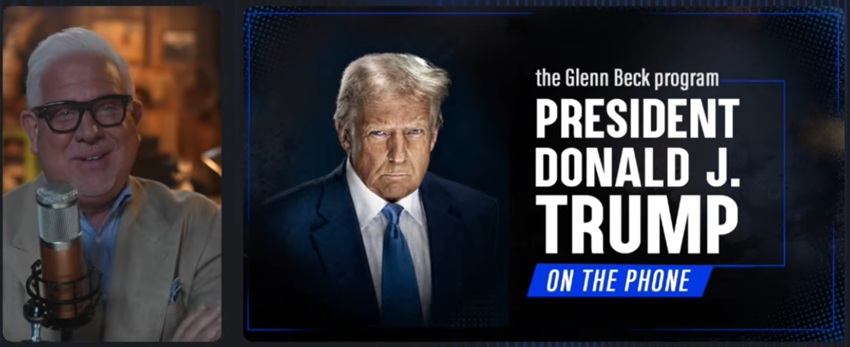
Glenn Beck Interviews President Donald Trump


Posted originally on the CTH on August 26, 2026 | Sundance 

I’m catching up on the latest information from the White House and President Trump, and this interview is well worth watching.

.

Barbara Boyd Outlines Canadian Prime Minister Mark Carney’s Role in EU and Ukraine Friction, With Planned Antagonism Against President Trump


Posted originally on the CTH on August 26, 2026 | Sundance |

|

Barbara Boyd does a solid job connecting the recent U.S-Canada trade friction to the globalist plans of Mark Carney in alignment with the European Union.  The goal is to create and maintain broad opposition to the geopolitical reset underway as an outcome of President Trump’s larger and nationalistic economic agenda.

This is worth the watch as many of the background happenings are interconnected, yet few people are putting it all together. Barbara Boyd argues that the most dangerous escalation is the proxy war with Russia, highlighting Russia’s warning that direct British involvement in strikes on Russian territory could make Britain a combatant.

She says the UK has long driven the ¹Ukraine conflict and that Trump has sought peace while Britain and Europe resist, relying on war production amid failing economies. The episode focuses on Canada’s Mark Carney as a key spokesman for a permanent-warfare economic strategy, detailing his global financial roles and Canada’s creation of a Defense Security and Resilience Bank to fund defense mobilization without citizen involvement.

Boyd also describes Carney’s actions against the U.S., including trade disputes, deeper EU alignment, and Arctic defense plans. She claims a coordinated “chaos” and “psychological warfare” campaign targets U.S. voters ahead of the midterms.  WATCH:

¹There is little doubt European NATO countries, led by the U.K, France and Germany, are stimulating and supporting increased direct military conflict against Russia.  We are beginning to see not-so-covert events happening in/around border nations with Russia -carried out by Ukraine- that continue to raise the stakes.

Moldova, Romania and now Finland are starting to become increasingly visible as launch regions for Ukraine drone attacks into Russia. Meanwhile the Russian enclave of Kaliningrad (between Lithuania and Poland) is surrounded by provocative NATO military activity. Keep watching.

Syria Is Converting a Russian Military Pier into a Trade Route


Posted  Originally on Aug 26, 2026 by Martin Armstrong |  

Map Map of Tartous port showing the infrastructure, based on a raster... |  Download Scientific Diagram

Syria has received its first shipments of wheat and cement at Berth No. 4 in the port of Tartous, a facility previously controlled by Russian forces. On the surface, this appears to be a minor logistical development involving a few cargo vessels. In reality, it symbolizes a major change in the balance of power following the collapse of Bashar al-Assad’s government. A military pier that once supported Russia’s projection of power across the Mediterranean and Africa is being absorbed into Syria’s civilian economy. The first cargoes reportedly arrived through Turkish ports. Military influence is retreating while trade and capital are moving in to replace it.

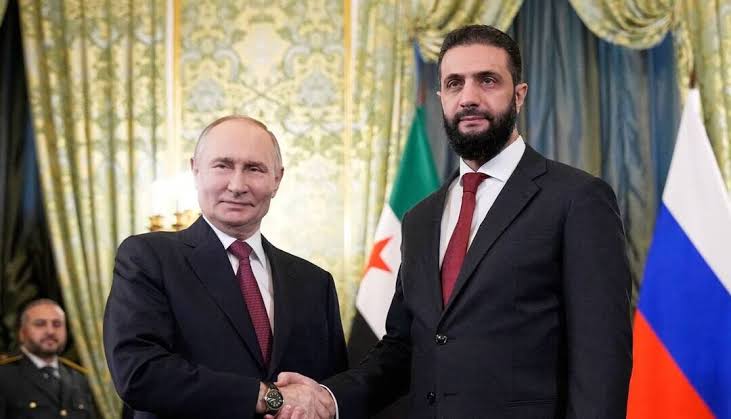
Russia and Syria reached an agreement after 18 months of negotiations over the future of Tartous and the Hmeimim air base. Syria will regain control of the civilian facilities, while the remaining military installations are expected to become joint training centers. Moscow therefore retains a reduced presence, but it no longer possesses the same unrestricted position it enjoyed under Assad. This is not a complete Russian withdrawal. It is the conversion of direct military control into a negotiated relationship with a government that is seeking investment from Turkey, the Gulf states, Europe, and the United States.

Tartous was never valuable merely because Russian ships could dock there. Its true strategic importance came from geography. It gave Russia a Mediterranean repair and replenishment point, supported military operations in Syria, and served as a staging route into Africa. Great powers have always fought to control ports because ports connect military force with economic power. Athens built its empire through maritime tribute, Venice became wealthy through Mediterranean trade, and Britain’s global influence rested upon ports and commercial routes long before economists began measuring power through GDP. Control the port and you influence the movement of food, energy, armies, and capital.

Tartus Port, Syria — August 14, 2026 Tartus Port's Berth No. 4, previously  under Russian control, is now under the control of the Syrian state.

Syria is now attempting to reverse that relationship by turning a military asset into a commercial one. DP World signed a 30-year concession to develop and operate Tartous and committed $800 million to modernize its infrastructure. The French shipping group CMA CGM reached a separate 30-year agreement involving approximately $260 million of investment in Latakia. Together, these projects could reconnect Syria with Southern Europe, Turkey, the Gulf, North Africa, and the wider Mediterranean economy after more than a decade of war and sanctions.

This is precisely how reconstruction begins. Politicians hold conferences, make speeches, and announce billions in theoretical aid, but an economy cannot recover without moving physical goods. Syria needs wheat, cement, machinery, fuel, construction materials, electrical equipment, and industrial components. It must also create the ability to export goods if it intends to obtain foreign currency without surviving indefinitely upon foreign assistance. A functional port does more for economic recovery than another international declaration because it lowers the cost of every imported input required to rebuild the country.

The arrival of wheat and cement is particularly symbolic. Wheat represents survival while cement represents reconstruction. Syria requires both before it can pretend to attract large-scale industry or tourism. The World Bank estimated the country’s reconstruction cost at approximately $216 billion. Saudi Arabia has announced billions in potential investment, while Turkish companies see opportunities across construction, logistics, manufacturing, telecommunications, and consumer goods. None of that capital will arrive on a meaningful scale unless investors believe contracts can be enforced, money can move through the banking system, and goods can enter and leave the country safely.

The removal of most American and European economic sanctions opened the door, but sanctions relief does not automatically create confidence. Syria still faces damaged infrastructure, fragmented political authority, armed groups, sectarian divisions, unresolved property claims, and a banking system isolated for years from international finance. Foreign investors will not commit capital merely because Washington changes a regulation. They will demand security, predictable taxation, enforceable contracts, and the ability to repatriate profits. Governments always assume that removing a legal barrier will cause money to rush in immediately, but capital remembers losses long after politicians have forgotten them.

syria russia.leaders

Turkey is in the strongest position to benefit because it shares a border, possesses an established industrial base, and already has companies familiar with Syrian markets. Turkish firms can supply cement, steel, food, machinery, household goods, and construction services more efficiently than distant competitors. The initial shipments through Turkish ports demonstrate how rapidly geography reasserts itself once political barriers weaken. Ankara does not need to occupy Syria to dominate parts of its reconstruction. Trade can accomplish what military force cannot by creating relationships that become increasingly expensive to break.

The Gulf states are approaching Syria through capital rather than troops. Saudi Arabia and the UAE can finance real estate, infrastructure, telecommunications, energy, and logistics. DP World’s investment in Tartous is therefore not simply a commercial transaction. It places an Emirati company at the center of Syria’s maritime recovery and gives Gulf capital influence over one of the eastern Mediterranean’s strategic gateways. Russia used the port to project military power. The UAE is using the same location to project commercial power.

Russia has not disappeared from the equation. Syria reportedly obtained approximately 85% of its imported wheat during the 2025–2026 season from Russia and Russian-controlled Crimea. Damascus cannot replace that relationship overnight, particularly when food security is involved. Moscow will therefore attempt to preserve influence through grain, energy, military training, debt, and technical cooperation even as its direct control declines. This is a transition from patronage under Assad to competition under the new government.

The mistake would be to interpret the agreement as a victory for one side and a total defeat for another. Syria is attempting to balance Russia, Turkey, the Gulf states, Europe, and the United States because accepting complete dependence upon any single power would merely replace one master with another. Smaller states survive by forcing larger powers to compete for access. The port becomes valuable not only because of the goods passing through it, but because several rival powers now have an interest in Syria remaining stable enough for commerce.

There is an important lesson here for the rest of the Middle East. Military occupation consumes capital while commerce attracts it. Russia spent enormous resources preserving Assad’s government and securing its bases, yet years of military investment could not guarantee permanent control. DP World entered with an $800 million commercial agreement and immediately acquired influence tied to Syria’s need for reconstruction. A military base remains valuable only as long as force can preserve it. A productive trade route creates its own constituency among workers, merchants, consumers, and governments.

The future of Syria will not be determined merely by who controls Damascus. It will be determined by whether capital returns, whether refugees believe they can rebuild their lives, and whether the country becomes a bridge for regional commerce instead of a battlefield for foreign armies. Tartous offers Syria an opportunity to replace military dependency with economic interdependence, but that will require the government to protect investment rather than simply divide it among political factions.

The first ships carried wheat and cement. What follows will reveal whether Syria is genuinely rebuilding an economy or merely auctioning strategic assets to a new collection of foreign patrons. Russia once measured its influence at Tartous by the warships tied to the pier. Syria will now measure its recovery by the cargo passing through it. That is the difference between controlling territory and creating wealth.

Categories:World Trade

The CBDC Ban Expires with the Economic Confidence Model in 2030


Posted  Originally on Aug 26, 2026 by Martin Armstrong |  

CBDC

The United States has become the first nation to prohibit its central bank from creating a central bank digital currency, but Congress quietly placed an expiration date on that protection. The prohibition covers both retail and intermediated CBDCs, yet it expires at the end of 2030. That means the door to a programmable government currency will reopen in 2031, precisely as the Economic Confidence Model reaches its major 2030 turning point.

President Trump prohibited federal agencies from pursuing a CBDC through executive order, and Congress has now reinforced that position legislatively. Nevertheless, executive orders can be reversed by the next president, and the statutory ban was deliberately written to disappear. Governments do not normally surrender power permanently. They postpone unpopular policies until the political and economic conditions make them easier to impose.

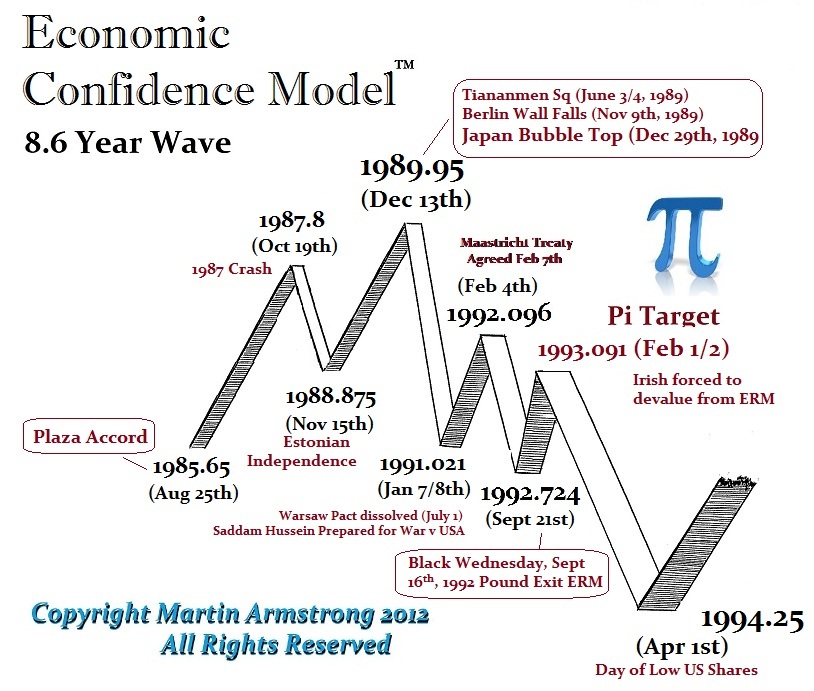
The timing is remarkable because the Economic Confidence Model has long pointed to 2030 as a profound turning point in the confidence of government. These dates are not predictions that one isolated event must occur on a specific day. They identify concentrations of political, economic, and monetary stress when capital shifts and confidence changes direction. The fact that Congress chose the end of 2030 for the expiration of the CBDC ban places this monetary question directly within that critical window.

A CBDC is not merely another electronic payment system. Most money already moves digitally through banks, credit cards, and payment applications. The difference is that a central bank digital currency can create a direct financial relationship between the citizen and the state. Depending on its design, government could gain the ability to trace transactions, impose expiration dates on money, restrict purchases, enforce negative interest rates, collect taxes automatically, or prevent funds from being transferred beyond approved limits. Physical cash provides privacy and allows people to transact when banks, governments, or computer systems fail. A programmable CBDC transforms money into a permit controlled by the issuer.

The War Cycle began accelerating in August 2026, with the next major geopolitical pressure building into 2027–2029 and a significant risk of conflict involving China appearing in 2029. This then converges with the Economic Confidence Model’s 2030.05 turning point, approximately January 18, 2030, as the Sovereign Debt Crisis intensifies. Congress allowed the CBDC prohibition to expire on December 31, 2030, meaning a new administration could reopen the door to programmable central-bank money beginning January 1, 2031. War increases borrowing, borrowing accelerates the debt crisis, and collapsing confidence encourages governments to impose surveillance, capital controls, and emergency financial restrictions. By the time this protection expires, the world and government as we know them may be radically altered, creating precisely the kind of crisis politicians will use to resurrect a CBDC in the name of national security and monetary stability.

CBDCs Controlling the Debt Market


Posted  Originally on Aug 26, 2026 by Martin Armstrong |  

Indian central bank in talks with 4-5 peers on cross-border CBDC- report

India is preparing to launch its first tokenized corporate bond in September, and this experiment exposes where the digital monetary system is ultimately heading. The bonds will be issued by REC, a state-owned power financier, in an offering worth less than 5 billion rupees, or approximately $57 million. The amount is small because this is a pilot program, but the structure is far more important than the size. India’s central bank digital currency will be used to purchase the bonds, which means the government is no longer merely testing digital money for ordinary payments. It is connecting CBDCs directly to the creation, ownership, and settlement of debt.

Reuters reports that investors will require two compatible digital accounts: a wholesale CBDC wallet supplied through a bank and a new electronic securities wallet known as DEMAT 2.0. The bonds will not trade through the conventional electronic book-provider system, and subsequent transactions can occur only between participants who possess both approved wallets. The initial investors will be selected, the bonds will have a three-month lock-in period, and a secondary market is expected to be developed by December. This creates a closed financial network in which the currency, security, investor, transaction, and settlement process are all identifiable and controlled within the same digital infrastructure.

The sales pitch will be efficiency, naturally. Tokenized securities can settle almost instantly. The same infrastructure that can settle a bond instantly can restrict who is permitted to buy it, determine where it may be traded, impose holding periods, monitor every transfer, and prevent capital from leaving the approved system. Once currency and securities exist inside compatible government-supervised wallets, compliance no longer depends on investigating a transaction afterward. The rules can be enforced before the transaction is even allowed to occur.

India is beginning with a corporate bond issued by a state-owned institution, but nobody constructs an entirely new financial architecture for a single $57 million experiment. If the pilot succeeds, the system can be expanded to corporate debt, municipal obligations, government securities, and eventually the savings of the broader population. Governments confronting a Sovereign Debt Crisis will need buyers for ever-increasing quantities of bonds. A CBDC provides the infrastructure to create captive demand by directing banks, pension funds, corporations, or individuals into approved debt instruments while making alternative uses of capital more difficult.

This is how capital controls will emerge in the modern era. There will be no official standing at the airport asking whether you are carrying gold or cash. The restrictions will be embedded inside the currency itself. A transaction can be rejected because the recipient lacks the proper wallet, the security is outside the approved platform, the funds crossed a prohibited jurisdiction, or the investor exceeded a government-imposed limit. Politicians will claim that this prevents fraud, money laundering, tax evasion, and financial instability, but every authoritarian financial restriction has always been introduced under the pretense of protecting the public.

The debt crisis is accelerating because governments have borrowed without any intention of repaying the principal. They perpetually roll over existing obligations while issuing new debt to cover interest, welfare promises, military expenditures, and the expanding cost of government itself. When private demand for sovereign debt weakens, interest rates rise and the fiscal situation deteriorates even faster. Rather than reduce spending, government invariably searches for methods to control capital and force the domestic economy to finance the state.

India is not yet forcing citizens to purchase government debt with digital rupees, and this pilot should not be misrepresented as though that has already occurred. Nevertheless, it demonstrates that the technical bridge between CBDCs and tokenized securities is being constructed now. Once that bridge exists, extending it from voluntary investment to regulatory compulsion requires only a political decision. The technology does not care whether participation is voluntary or mandatory.

India’s experiment should therefore be viewed as far more than a technological modernization of the bond market. It is a model for merging money and debt into one controlled digital ecosystem. The public will be promised speed and convenience, while government acquires the ability to see, approve, restrict, and eventually direct the movement of capital. CBDCs were never necessary simply to buy coffee more quickly. Their real value to government emerges when the state can connect programmable money to the debt it desperately needs someone to purchase.

Moscow & Secret US Plane Landing


Posted  Originally on Aug 26, 2026 by Martin Armstrong |  

Moscow 5

QUESTION: What is going on? You were on Russian TV again today, and now there’s a question about a U.S. military transport aircraft that, according to tracking data, secretly landed in Moscow. You’ve appeared on Russian TV twice within days. I saw the film Brink of War. I also remember attending a major conference you did for Bain & Co here in Sydney, where the press ran a full-page article on you claiming you were an advisor to Reagan. You predicted communism would fall by 1990, and in that film, Reagan says he was meeting to bring Russia down. For once, come clean: were you advising Reagan?

PL

ANSWER: I remember that article well. If you have a copy, I would genuinely like one. I actually called that journalist afterward, because he accused me of advising Reagan and attributed trickle-down economics to me. I told him he should have interviewed me first—it was Art Laffer who sold the trickle-down theory to President Reagan, not me. I also recall attending a cocktail party where someone called me a liar because I denied working in the White House. My response was simple: if I had been working there, I certainly couldn’t have denied it. That journalist, in my view, was a real socialist.

ECM 1989.95 Detailed R

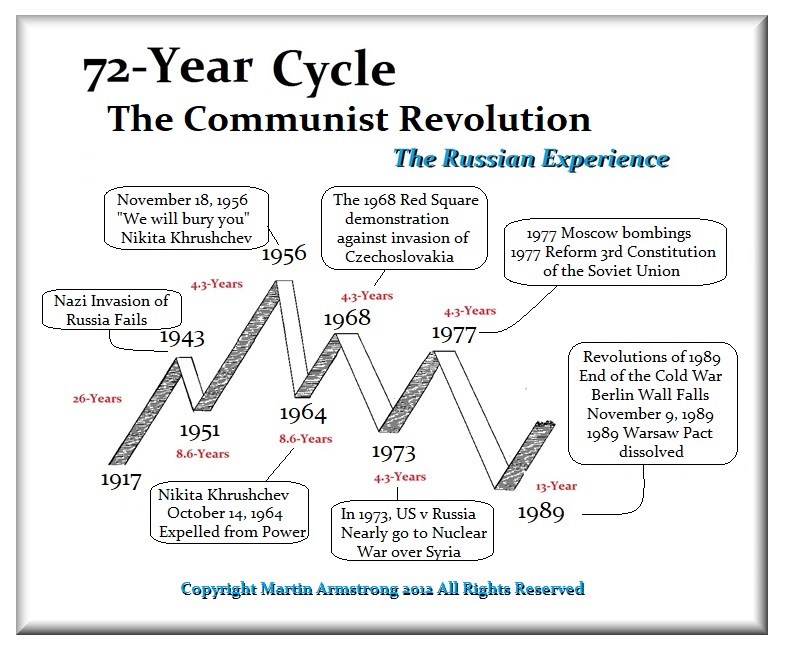
As for whether Reagan acted on our forecast that communism would collapse by 1989.95—the ECM turning point—I honestly have no idea. Yes, after the Plaza Accord of 1985, I was in contact with the White House. But beyond that, I cannot say what the President did or did not do with our analysis.

72 Russian Revolution 1917 1989

I have published the Revolution Cycle on everything from the USA and EU to Iran. This has been consistent. The target was always 1989. I cannot say if Regan took that report to heart. I did not speak to him about it.

Regarding the U.S. military plane landing in Moscow and my appearances on Russian TV last week and this week—the two are not connected. I go on Russian TV because few others have the courage to do so, and someone needs to show them that not all Americans think like Lindsey Olin Graham. The only path to avoiding war is through dialogue. The Neocons always advise never talking to the enemy—which ensures there will never be peace.

Bessent Manipulating The Bond Market & Tariffs


Posted  Originally on Aug 25, 2026 by Martin Armstrong |  

Bond Yields

QUESTION: Mr. Armstrong, I am new to your services and I attended the Tampa Conference. You have opened my eyes to see the world as a whole. A famous analyst just said and it is becoming a glaring issue that they are only domestically focused as you said blind to everything outside the United States. ________ said:

“We want long-term interest rates to go lower, but that’s only gonna happen if we can get inflation under control by reopening the Strait of Hormuz, and that’s a tall order,” _______ said. “The Treasury Department’s attempts to get this under control I think have only made investors more nervous.”

My question is with Trump’s tariff war and his war against Iran and we have Bessent imposing sanctions on Iran while trying to support the bond market, your track record record and computer puts everyone to shame. I am not an international hedge fund manager as you were. But I can see that they are trying to defend a view on tariffs, sanctions, and bonds that are a losing ticket. Why doesn’t Bessent call you in?

EK

FT June 27 1998

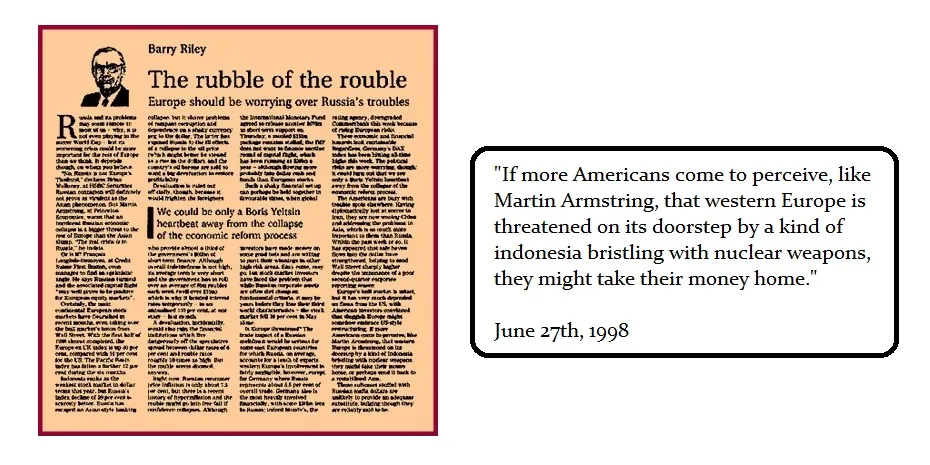
ANSWER: Besides the Neocons who try to keep me away from Trump and I believe are now intercepting my letters to him, then there is the old rumor that those who lost big on the Russia collapse and the failed regime change blackmailing Yeltsin and expecting the IMF would never allow Russia to collapse, are the ones who blamed me and told the CFTC we had to be shut down. I wrote to Bessent, but got no response. They say beware a woman scorned for she knows no limit to fury, that appears to apply to sore losers in high-stake finance. They never believe in my forecasting. They always claimed I had too much influence which was greater than all the influence that they could bribe for their guaranteed trades. When the forecast that Russia would collapse made the front page of the London Financial Times, that was the icing on the cake. It wasn’t that my computer was correct, it was I had too much influence and had to be taken down so they could manipulate markets without interference.

In August 1998, during Russia’s financial crisis (ruble devaluation and debt default), George Soros’s Quantum Fund / Soros Fund Management group lost approximately $2 billion in Russian markets. Contemporary reports (including The New York Times) attribute this to the fund under chief investment strategist Stanley Druckenmiller. The positions were described as mostly equities, with some exposure to Russian GKOs (short-term ruble Treasury bills) and dollar bonds. Druckenmiller publicly acknowledged the losses at the time.
Bessent’s role at Soros

Bessent joined Soros Fund Management in 1991 and worked there through roughly 2000 (first stint), including as head of the London office. He is well-documented as a key member of the team on the famous 1992 Black Wednesday trade that shorted the British pound and generated roughly $1 billion in profits for Soros. I was advising the British government then and warned them what the “club” was doing. So I believed in free markets, they believed in manipulating markets. Bessent later returned as Chief Investment Officer (2011–2015) and is credited with profitable trades such as shorting the Japanese yen.

Louvre Accord Plaza Accord

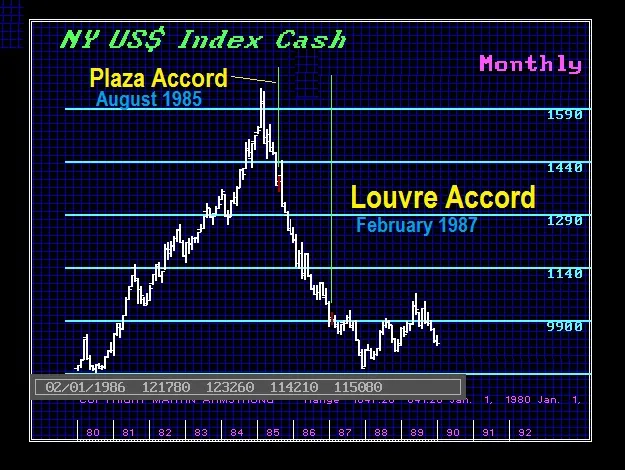
The danger here is that after stepping in and doubling the purchases, the risk is that new lows will shatter the confidence in Bessent and the ability of the government to manipulate the bond market. As I have said before, in February 1987, there was the Louvre Accord where they said that the dollar had fallen enough. When it continued to make new lows, that was it. Confidence in the central banks collapsed and that led to the 1987 Crash. That is the risk we now have. Rates will rise thanks to geopolitical chaos and there will be no way to prevent long-term rates from rising. Germany is already blaming the US for their own warmongering that sends rates higher.

Sanctions Chains

Bessent’s latest sanctions on Iran and going after any bank that has contact with Iran will fail. It just makes him look authoritative. Sanctions have NEVER worked even once the same as Marxist Communism/Socialism, which tries to eliminate the business cycle and create utopia void of any recession or depression. The US put sanctions on Cuba in 1960, they are still there. The sanctions on Russia did not end the Ukraine War against Russia.

Bond Yields Riising

Our computer has been projecting rising long-term rates since 2020. With the rising trend in geopolitical insanity with this need for war, there is no possible way that rates would decline long-term. This is far more that the Strait of Hormuz. The Madman Zelensky has attacked Russian energy to the point that they now must import refined products. Zelensky and Netanyahu belong in prison. Neither cares about the world and they only look at their own personal hatreds and to hell with the world.

WEC_Bond_Crisis_2023

Functional Unemployment in USA Reaches New High


Posted  Originally on Aug 25, 2026 by Martin Armstrong |  

Funny Job Application Stock Illustrations – 345 Funny Job Application Stock  Illustrations, Vectors & Clipart - Dreamstime

The government claims unemployment stands at 4.1%, yet a new analysis cited by CBS News found that 24.9% of American workers were functionally unemployed in July. Functional unemployment includes those who cannot find employment, people forced into part-time work because full-time jobs are unavailable, and workers earning less than $26,000 annually before taxes. Washington can call these people employed, but try paying rent, food, insurance, utilities, transportation, and medical expenses on barely $2,000 per month before the government takes its share.

The Bureau of Labor Statistics is not measuring whether people are prospering or even surviving. If you worked as little as one hour during the survey period, you can be classified as “employed.” If you have searched for months, become discouraged, and finally stop looking, the government simply removes you from the labor force. You did not find a job and your circumstances did not improve, but you cease to exist statistically. Politicians then point to the lower unemployment rate and claim their policies are working.

Functional unemployment has now risen for four consecutive months while workforce participation has moved lower. Employers reportedly eliminated 23,000 jobs in July, consumer prices rose 3.4% year over year, and wages increased only 3.2%. Therefore, the average worker lost purchasing power even after receiving a nominal raise. This is why people become angry when politicians lecture them about a strong economy. The statistics say they are employed, inflation is under control, and everything is wonderful, yet the paycheck no longer covers the monthly bills.

This is how the political establishment disguises economic decline. Inflation statistics do not reflect the actual cost of maintaining a household, GDP rises when government borrows and spends money it does not have, and unemployment declines when people surrender and stop searching for work. Every major statistic has been constructed to make government appear competent while the standard of living steadily deteriorates. They measure whether money changed hands, not whether society became wealthier.

Americans have been forced to replace income with debt. They have depleted savings, increased credit-card balances, postponed major purchases, and begun cutting necessities because discretionary spending was already eliminated. Consumer spending may represent roughly two-thirds of the economy, but consumers cannot continue spending indefinitely when prices rise faster than wages and employment becomes increasingly unstable. Credit can postpone the reckoning, but it cannot replace real economic growth.

Functional unemployment explains why Washington can proclaim prosperity while millions of Americans feel trapped in a personal recession. The economy has produced millions of positions that satisfy the government’s definition of employment but cannot provide an independent life. The political class counts the number of people receiving paychecks while refusing to ask what those paychecks can actually buy. That is poverty disguised by statistics.