🚨BREAKING: The European Union announces FULL CONTROL over crypto assets.
🇪🇺 Ursula von der Leyen: "For the first time, we will introduce a FULL third-country BAN for crypto asset services to make sure 🇷🇺 Russia can’t avoid sanctions." pic.twitter.com/8iDG87TcO6
The European Union has announced what may prove to be one of the most significant developments in the battle over financial freedom. European Commission President Ursula von der Leyen declared that the EU would introduce, for the first time, a “full third-country ban” on certain crypto-asset services as part of a new sanctions package against Russia. The official explanation is that Brussels wants to prevent Russia from using cryptocurrency-related services to evade sanctions. Most people will read that headline and move on. They should not.
What was actually said is far more important than many realize. The European Union is asserting the authority to prohibit crypto-asset service relationships involving entities outside its borders if Brussels determines those relationships undermine its sanctions regime. Today the target is Russia. Tomorrow it could be any country, institution, company, platform, or financial network that falls outside the political objectives of Brussels. Once governments establish the power to control access to financial infrastructure, the scope of that power rarely contracts.
I have warned for years that governments would eventually move against cryptocurrency if it became large enough to threaten their ability to monitor and control capital. The crypto community often assumed governments would embrace innovation. That was never how this would unfold. Governments do not like competition when it comes to money. Their power rests on controlling the financial system. Taxation, regulation, reporting requirements, sanctions, and monetary policy all depend on that control. A decentralized system operating beyond their direct authority was always going to create conflict.
The timing is no coincidence. Europe is drowning in debt. France’s debt has surpassed €3.3 trillion. Italy’s public debt exceeds €3 trillion. Numerous European governments are running chronic deficits while facing aging populations, declining birth rates, expanding pension obligations, and stagnant economic growth. The mathematics simply do not work. Politicians continue making promises while the bills continue piling up.
This is where history becomes important. Governments rarely impose capital controls during periods of prosperity. They impose them when confidence begins to decline. During the Great Depression, the United States confiscated gold. Argentina repeatedly restricted currency movements. Cyprus imposed depositor losses during its banking crisis. India invalidated large denominations of cash overnight. Throughout history, governments facing financial stress have always sought greater control over private capital.
The European Union is quietly constructing the infrastructure necessary for that control. They have implemented sweeping anti-money laundering regulations. They are expanding crypto reporting requirements. They are advancing digital identity initiatives. They are discussing the digital euro. They are creating centralized databases capable of tracking financial activity across member states. Each measure is presented as a reasonable response to a specific problem. When viewed together, however, the objective becomes much clearer.
What terrifies governments about cryptocurrency is not the technology itself. It is the possibility that capital can exist outside traditional financial institutions. Governments can regulate banks. They can pressure brokers. They can freeze accounts. They can monitor transactions. Cryptocurrency introduced a system that operates differently. From the perspective of heavily indebted governments, that represents a threat.
The argument will always be sanctions, crime, terrorism, money laundering, or national security. Those explanations change depending on the political circumstances of the day. The underlying objective remains remarkably consistent. Governments want visibility. They want oversight. They want the ability to determine where capital is located, where it is moving, and who controls it.
What concerns me most is that Europe continues moving in the direction of greater centralization precisely as economic conditions deteriorate. The European project was sold as a framework for cooperation and prosperity. It is increasingly evolving into a system where unelected bureaucrats accumulate authority over energy policy, migration policy, financial policy, digital policy, and now cryptocurrency. Every crisis becomes justification for expanding power.
The tragedy is that none of these measures solve the underlying problem. Restricting cryptocurrency will not reduce sovereign debt. Governments bought into the lie that they can tax the people out of their debt crisis. Politicians refuse to blame failed policies and instead blame the average person for holding onto wealth, which they feel belongs to the state. Governments are attempting to manage a debt crisis through regulation when the problem is fundamentally fiscal and structural.
Our models have warned repeatedly that Europe is entering a period of rising political and financial instability. The 2026 Panic Cycle year was never solely about markets. It was about confidence in government itself. As confidence declines, governments historically seek greater control over capital. Investors seek freedom while governments seek restrictions. That conflict has existed for thousands of years.
The announcement regarding cryptocurrency should therefore be viewed as far more than another sanctions measure. It is a glimpse into how governments behave when debt burdens become overwhelming and confidence begins to erode. History shows that the road from regulation to capital controls is often much shorter than people expect.
Posted originally on Jun 10, 2026 by Martin Armstrong |
The announcement by the Pentagon that Israel spies on the United States is being presented as some shocking revelation. Really? Jonathan Pollard stole massive quantities of classified intelligence for Israel and was convicted in 1987. The NSA reportedly caught Israeli officials discussing efforts to influence U.S. policy during the Obama administration. Even former CIA and FBI officials have repeatedly acknowledged that Israel conducts aggressive intelligence operations inside the United States. This is not a conspiracy theory. This is how nation-states behave.
What caught my attention was not the allegation but the timing. Washington is warning about Israeli intelligence activities at the exact moment the United States is becoming increasingly entangled in Middle Eastern affairs. The Iran conflict continues to escalate. Gaza was destroyed and forgotten, and now Lebanon is under a constant barrage. American military assets are spread across the region. Defense spending is approaching levels that would have been unthinkable a generation ago. Yet instead of reassessing these commitments, our AIPAC devout Congress wants even deeper integration.
The numbers are becoming absurd. Federal debt has surpassed $37 trillion. Interest payments are now among the largest items in the federal budget. The Pentagon budget is approaching $1 trillion annually. Yet the solution is always more spending, more deployments, more foreign obligations, and more promises that American taxpayers will ultimately be forced to finance.
The espionage issue exposes a deeper problem. If intelligence officials genuinely believe there is a serious security concern, why pursue greater integration? If greater integration is essential, then why raise alarms? The answer is that Washington no longer has a coherent strategy. Different factions are pulling in different directions while pretending there is a unified policy.
This is how empires decline. Rome reached the point where competing interests, foreign entanglements, military expenditures, and political factions overwhelmed any clear national purpose. The government became reactive rather than strategic. Looking around today, the similarities are becoming difficult to ignore.
My concern has never been whether Israel spies. Every country spies. China spies. Russia spies. Britain spies. France spies. The United States spies on allies and adversaries alike. The real issue is that Washington continually places itself in positions where it cannot distinguish between American interests and the interests of everyone else.
What we are witnessing is not a sudden discovery. It is the slow realization that decades of foreign entanglements, endless commitments, and political hypocrisy have created a system that no longer knows where its own interests begin and end. That is a far greater threat than any espionage operation.
Posted originally on Jun 10, 2026 by Martin Armstrong |
I have said countless times that the biggest problem in Europe is not Russia. It is the complete abandonment of national sovereignty by politicians who seem more interested in satisfying Brussels than representing their own people. Bulgaria’s decision tohalt further military aid to Ukraine is one of the first signs that some countries are beginning to recognize reality. After years of sending money, weapons, equipment, and resources into a war that has no military solution, there are finally voices asking the obvious question: When does this end?
The Ukrainian conflict has become Europe’s black hole. Hundreds of billions have been committed by Western governments while European economies struggle with stagnant growth, rising debt, housing shortages, inflation, and declining living standards. The European Union continues to demand sacrifices from ordinary citizens while finding endless resources for foreign wars. At some point, voters begin to realize that their governments have become more concerned with financing conflicts abroad than fixing problems at home.
Bulgaria is hardly alone. Public support for endless aid packages has been weakening across Europe. Governments in Hungary and Slovakia have openly challenged the prevailing narrative, while political opposition to continued military spending is growing in Germany, France, Italy, and throughout Eastern Europe. The reason is simple. People can see that every new shipment of weapons is followed by demands for even more weapons. Every funding package is followed by another request. Every promise that victory is just around the corner is replaced by a new justification for continuing the war.
What makes Bulgaria’s position particularly important is that it exposes the growing divide between European elites and the populations they claim to represent. The average citizen is worried about energy prices, food costs, taxes, housing, and economic security. Brussels is focused on military commitments, sanctions, and geopolitical ambitions. These priorities are no longer aligned.
From a cyclical perspective, this shift was inevitable. As economic conditions deteriorate, governments face increasing pressure to redirect resources inward. The 2026 Panic Cycle year was always likely to expose fractures within the European Union. The economic stress building across Europe is forcing governments to confront choices they have spent years avoiding. They can continue financing external conflicts while borrowing endlessly, or they can begin putting their own citizens first.
Bulgaria appears to be recognizing that prolonging the conflict indefinitely serves nobody’s interests. Whether other European governments follow remains to be seen, but this decision signals that the once-unquestioned consensus behind unlimited support for Ukraine is beginning to crack.
Posted originally on Jun 9, 2026 by Martin Armstrong |
Amsterdam’s decision to ban meat advertising should be viewed as part of a much broader trend that has been unfolding for years. Politicians insist this is about climate change. Every new restriction is presented as a noble sacrifice for to save the environment. Yet the target is almost always the same: farmers, ranchers, livestock producers, and regular people who are forced to sacrifice their health and livelihood for the globalist agenda.
The Netherlands has already spent years battling its own farming community through nitrogen regulations, forced buyouts, and restrictions that have pushed many family farms to the brink. Massive farmer protests erupted because people recognized that this was never merely about emissions. Agriculture was being redesigned from the top down. Now the campaign has moved beyond production and into culture itself. If citizens cannot be persuaded to abandon meat voluntarily, then governments will gradually make meat less visible, less available, more expensive, and increasingly stigmatized.
Many people dismissed concerns years ago when international organizations began discussing alternatives to traditional meat consumption. The World Economic Forum published articles exploring insects as a future protein source and repeatedly promoted dietary shifts away from actual meat. The argument was always framed around sustainability, carbon reduction, and environmental goals. They attempted to normalize chewing on bugs as an alternative to a steak. They claim it is our duty as global citizens to sacrifice essential nutrition to save the planet, despite knowing well that these measures would not make a meaningful dent in anything.
A tremendous amount of capital has flowed into synthetic foods, lab-grown proteins, precision fermentation, artificial dairy products, and engineered meat substitutes. Consumers are being told these products represent the future. Agriculture, now termed “traditional agriculture,” faces an ever-growing wall of regulations. The result is a food system that is composed of chemicals, cloned cells, and substances that are simply not safe for human consumption.
Food security has always been a cornerstone of national stability. Nations that lose control over their food production eventually become dependent on distant supply chains and centralized systems. That dependence creates vulnerabilities that cannot be solved by slogans or marketing campaigns. When domestic farmers disappear, replacing them is not as simple as passing another regulation.
The debate over meat is not really about environmental rights. It is about who gets to decide what people can and cannot eat. Consumers are no longer permitted to decide, and are often deceived by labeling and synthetic imitations. Europe is attempting to alter human behavior by banning the promotion of meat, and bit by bit, they will begin to normalize protein alternatives.
Citizens should pay close attention whenever politicians begin treating ordinary food as a social problem that must be managed. Once governments assume the authority to decide which foods deserve promotion and which deserve suppression, there is no obvious limit to where that philosophy ultimately leads. The long-term repercussions of poisoning civilization with synthetic food are unknown. They could theoretically put anything in the food supply to ultimately suppress the people, as a sick population is easier to control. Rest assured, the elites will continue eating real food that will become increasingly scarce in the years to come, especially as sovereign defaults begin one by one.
Posted originally on CTH on June 9, 2026 | Sundance
Tonight is another primary election in a batch of states including, Maine, South Carolina, Nevada and North Dakota.
One surprise I just noticed is the horrible fibber and gaslighter Nancy Mace failing miserably in her quest for South Carolina Governor. Nancy Mace is in fifth place.
Mace floated in/out of never-Trump world for a while in congress and generally pontificated about things while accomplishing very little. She eventually hung her credibility on the Epstein File stuff. It doesn’t look like that approach worked out too well for her.
If there are other races tonight that you are interested in, feel free to drop your comments and thoughts on the races that you might be watching from your perspective tonight.
Irish Police Request People Not Protest Their Beheading by Migrants Too Strongly
Posted originally on CTH on June 9, 2026 | Sundance
Following a very public display of horrific violence, the Irish police are asking citizens not to protest against their beheading too strongly. The last time migrant violence was highlighted, many people in Ireland were upset.
The police request follows a Sudanese migrant who was given asylum and then attacked a man on the street with a knife, slicing his face, neck and back, gouging his eyes and then attempting to use the kitchen knife to saw off his victim’s head.
Following video of the attack becoming viral the police are concerned that too many Irish people will protest against their beheading, and that could be disturbing to the sensitivity of unlawful migrants who may not support taking off the heads of the Irish people.
According to police, not all migrants participate in the stabbing and head chopping, but they do understand the general concern stabbing and head chopping may represent.
Unfortunately, Belfast, Northern Ireland, is up in flames after anti-beheading Irish protesters torched migrant houses and targets across the city. This is in response to the brutal knife attack on the street last night – defying government ministers’ calls for calm. (Daily Mail Article) Apparently, there is a calm way to disagree with the premise that your head can be removed by migrants.
The Irish government is very concerned about anti-migrant sentiment being fueled by the latest visible attack by another migrant. The police are asking people not to share information about the attack, and to support the legal rights of those who are doing the stabbing.
DAILY MAIL – […] Anti-immigrant unrest sprung up in several cities across the UK after Monday night’s attack. A 30-year-old man, described by police as a Sudanese asylum seeker who had been granted indefinite leave to remain, has been charged with attempted murder.
Multiple houses were set on fire in Belfast, along with numerous vehicles, rubble piles and street barricades. These continued to burn as night fell, attended by a vast force of firecrews.
Dramatic scenes came after protesters pushed a flaming bin into a Glider bus on the Newtownards Road soon after crowds first began to gather, burning it to a cinder.
In the Lower Newtownards Road area in east Belfast, around 100 masked men made their way down the street kicking in doors and smashing windows, saying they were ‘getting the foreigners out’, the BBC reported.
It was also reported that groups of locals had set up checkpoints and were checking passing cars for foreign nationals. (read more)
Hoe vaak moeten we dit soort gruwelijke beelden nog zien? Dit soort barbaren, en ja, dat zijn ze, komen overal in Europa binnen. Hoeveel meer lopen er nog rond? Ondertussen blijven menig politici en media maar druk bezig om iedereen die dit wil stoppen af te schilderen als rechts…
— 🌸Simone Juffermans (@SimoneSays123) June 9, 2026
The attempted beheading in Belfast should be used by everyone with a moral compass to berate politicians who do nothing but import violence. 💪 https://t.co/HpR3NXXvm5
Posted originally on CTH on June 9, 2026 | Sundance
The House Judiciary Committee held a hearing today on the topic of the Southern Poverty Law Center, operating a program to fund, organize and stimulate racist activity, just so the SPLC could fight against racism and fundraise over it.
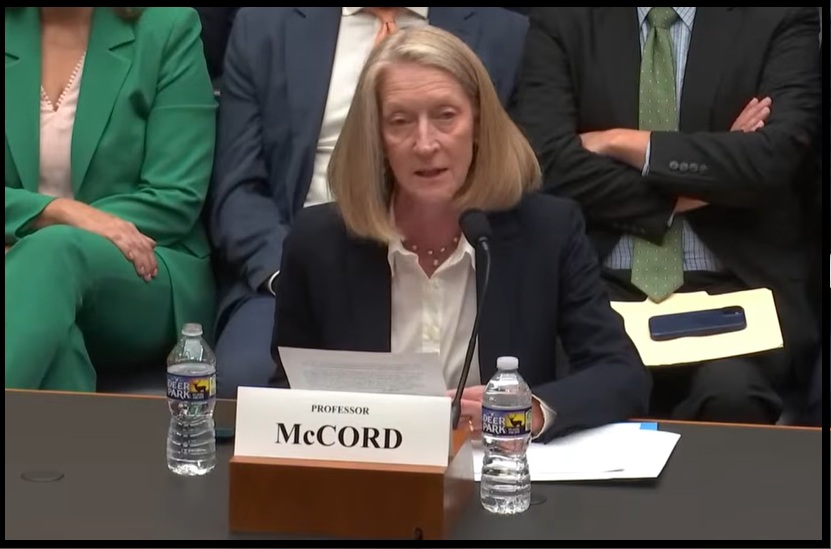
Amid the panel of voices presented to discuss the issue is the familiar Lawfare operative, Mary McCord. It makes sense for McCord to get invited by the HJC because McCord was lead staff for the HJC (Nadler/Schiff) during the impeachment effort. The relationship between Mary McCord and the HJC is lengthy.
McCord noted that law enforcement agencies routinely pay for operatives to infiltrate organizations in order to target them, so congress should not be too concerned with the SPLC funding white racists for the same purpose. What McCord carefully avoided, was noting how the SPLC is neither a law enforcement entity nor an investigative agency of the government.
I have not had time to watch the entire hearing, and I will provide more depth of review over the next few days once I have watched all of the discussion. In the interim, these hearings are usually ‘chaff and countermeasures.’
Posted originally on CTH on June 9, 2026 | Sundance
Articulate focus with specific intent can pay dividends. Sorry for my absence earlier today. I can confirm the first sentence, between the commas.
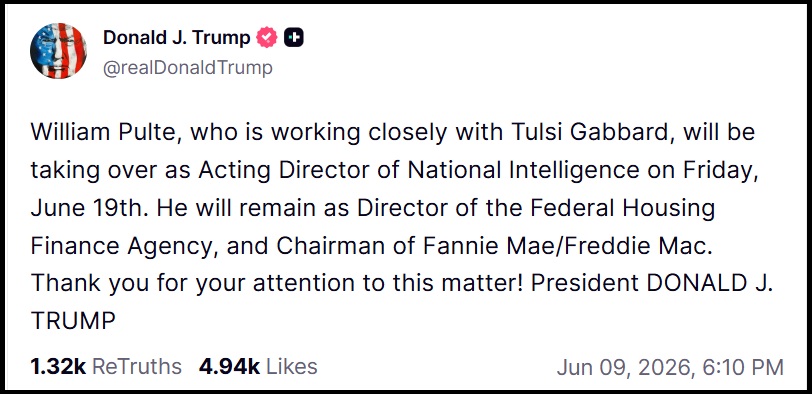
Against the backdrop of threats from various legislative branch members, President Donald Trump has doubled down and firmly announced that Bill Pulte will take the position of Acting DNI effective June 19th ( 😂 aka ‘Juneteenth’).
Delivering the message from his Truth Social account, President Trump has extended his plenary power and put Congress back into the position they hold in government. If Congress wants FISA (702), then reauthorize it. If they don’t want it, then don’t reauthorize it. The issue matters not to the overall national security dynamic.
Kash Patel better prepare to get busy. It’s time to put up or shut up. If the FBI carries out a false flag operation (they’d be stupid), or if the CIA attempts to undermine the domestic national security front (they won’t), there is going to be an intense response from Trump and Pulte.
Posted originally on CTH on June 9, 2026 | Sundance
er reading the umpteenth article [example here] from congressional voices talking about what President Trump needs to do in order for the legislative branch to reauthorize FISA (702), it’s worth reminding everyone how we accept goofy just because goofy has become the norm.
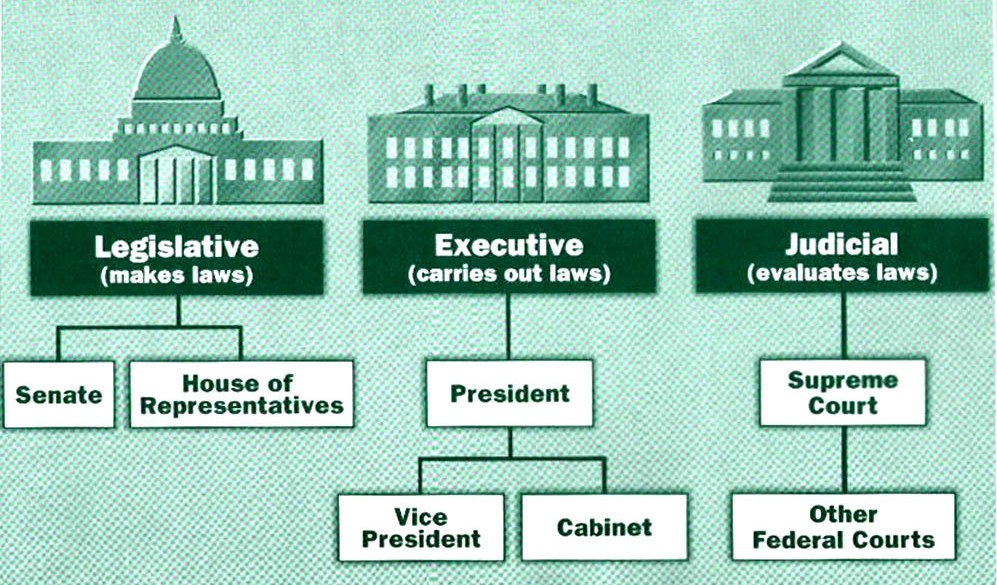
The FISA (702) issue belongs entirely to the legislative branch. It is their work product. It is their enacted law, albeit with an expiration date. The executive branch has nothing to do with the law. If congress doesn’t reauthorize a law they have enacted, that’s on the legislative branch – not the executive branch.
The legislative branch enacted a law; it could be unconstitutional and has never been tested in the Supreme Court. However, it is their law. If the same legislative branch allows the law to expire, that’s entirely their choice. The executive branch can do nothing to reauthorize a law that is entirely in the purview of the legislative branch.
President Trump should not accept the legislative branch dysfunction as if it is his problem to solve. It’s not his monkey.
Somehow the baseline of responsibility has been permitted to shift from the Legislative Branch to the Executive Branch, and the media are apparently clueless about how the separation of powers actually functions. Even if the Executive Branch wanted to reauthorize it, they can’t.
Somewhere in our modern discussions of things, we have lost sight of the roles and responsibilities within government.
As to the argument of whether or not to reauthorize it, personally I hope congress lets the FISA (702) legislation expire. However, that’s a distinctly moot point when overlaid against who has responsibility for it.
It’s time to teach civics again, and our nation would be well served if the people around President Trump simply reminded the media and by extension the American people, that FISA is a congressional responsibility. If they don’t want to reauthorize the law they enacted, then fine; but the issue is all theirs.
The problem of FISA (702) being carried out is multifaceted and complicated. However, the origin of the law and or extension therein, is entirely the responsibility of the Legislative Branch. It really is that simple.
WASHINGTON DC – […] Democrats have coalesced behind an ultimatum: They won’t support a reauthorization of Section 702 of the Foreign Intelligence Surveillance Act as long as Bill Pulte, an ally of President Donald Trump with no national security experience, remains acting director of national intelligence. The White House is standing by Pulte, at least publicly, while accusing Democrats of holding the spy power “hostage” and putting the country’s “national security at risk.” (read more)
I have created this site to help people have fun in the kitchen. I write about enjoying life both in and out of my kitchen. Life is short! Make the most of it and enjoy!
This is a library of News Events not reported by the Main Stream Media documenting & connecting the dots on How the Obama Marxist Liberal agenda is destroying America










 Centinel2012