HARNWELL: the UK Tories fear an election because Nigel Farage would replace them as the Opposition


Posted originally on rumble on Bannons War Room on: June 23, 2026

John Gardner: Manufacturing Is Booming—But There’s a Catch — Soaring Steel, Copper, and Aluminum Prices Threaten the Industrial Comeback


Posted originally on rumble on Bannons War Room on: June 22, 2026

Mike McCormick: Obama White House Content Erased — “95%” of What Was There for Years Is Now Gone


Posted originally on rumble on Bannons War Room on: June 23, 2026

Dr. Bradley Thayer: Cutting Off the CCP — Stop Chips, Stop Deals, Stop Recognition


Posted originally on rumble on Bannons War Room on: June 23, 2026

Mike Davis: The longer these judges are on the bench, the more delusional they get. They actually believe it’s their job to protect the American people from our duly elected president.


Posted originally on rumble on Bannons War Room on: June 22, 2026

LIVE: President Trump Delivers Remarks in PA…Posted originally on Rumble on Bright Bart News Network on: June 23, 2026LIVE: President Trump Delivers Remarks in PA…


Posted originally on Rumble on Bright Bart News Network on: June 23, 2026

MOMENTS AGO: DOJ Announces Charges in $6.5 Billion Health Care Fraud Scheme…


Posted originally on Rumble on Bright Bart News Network on: June 23, 2026

LIVE: Hearing to Examine the Affordability Agenda…


Posted originally on Rumble on Bright Bart News Network on: June 23, 2026

The Death of Homeownership for the Next Generation


Posted originally on Jun 24, 2026 by Martin Armstrong |  

Contract given to 'adult child' living at home sparks massive debate:  'Needs to grow up'

A new report from Realtor.com found that nearly one-third of employed young adults in the United States are now living with their parents. These are people with jobs. They are working, earning income, and still cannot afford to establish independent households. The politicians and economists who constantly celebrate employment statistics fail to understand that a job is meaningless if it no longer provides a path to basic economic independence.

For decades, homeownership was the foundation of the middle class. A young person could graduate, find employment, purchase a starter home, build equity, raise a family, and gradually accumulate wealth. That cycle created economic stability and social cohesion. Today that entire model is breaking down. Home prices have vastly outpaced wages. Insurance costs are rising. Property taxes continue climbing. Mortgage rates remain elevated compared to the era of artificially suppressed interest rates. The result is that millions of young adults are trapped in economic limbo despite doing everything society told them to do.

This trend is not isolated to the United States. We see the same pattern throughout Canada, Britain, Australia, and much of Europe. In some countries, the average home now costs seven, eight, or even ten times average household income. Historically, such ratios were considered unsustainable. Today, they are treated as normal. Young people are delaying marriage, delaying children, and delaying household formation because the economic foundation required to support those milestones has become increasingly unattainable.

What many fail to understand is that housing has become one of the most important confidence indicators in society. When people believe they can improve their lives through work and effort, social stability follows. When an entire generation concludes that homeownership is permanently out of reach, confidence begins to erode. That erosion eventually manifests itself politically, economically, and socially. Rising populism, declining trust in institutions, and growing generational resentment are all symptoms of the same underlying problem.

This is one reason why our recent Real Estate Report was so important. Real estate is not simply about housing prices. It is a reflection of confidence, capital flows, demographics, taxation, government policy, and economic opportunity. Many governments have treated housing as a financial asset to be inflated rather than a foundation for society. The consequences are now becoming impossible to ignore. Young adults are remaining with their parents longer than previous generations not because they want to, but because the economics increasingly leave them no choice.

Our long-term models continue to suggest that real estate will experience increasing regional divergence into the years ahead. An entire generation is losing confidence in the traditional path to economic security. That may prove to be one of the most significant social and economic developments of this decade. Yet another reason why it is paramount to hold this one-day conference next month on Understanding the World Economy to explain the new realities no one else is willing to discuss.

Japan: The First Domino in the Sovereign Debt Crisis?


Posted originally on Jun 24, 2026 by Martin Armstrong |  

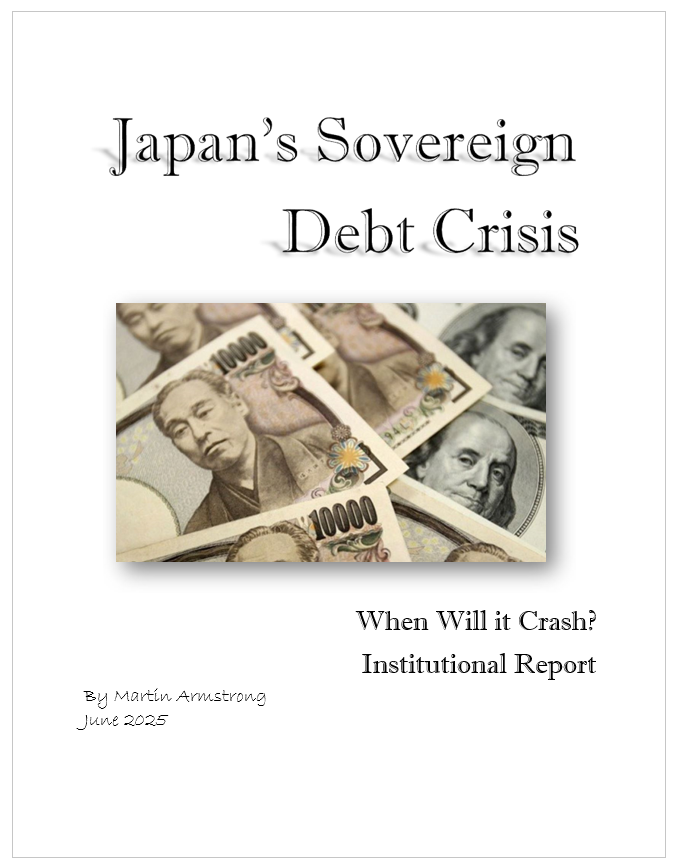
Japan_Debt_Crisis_2025 6 5 25

The Japanese government is now openly admitting what I have been warning about for years. Rising interest rates are beginning to dramatically increase the government’s debt-servicing costs. For decades, Japan survived by suppressing interest rates to nearly zero while endlessly rolling over debt. That strategy only works so long as rates remain artificially low. Once rates begin to rise, the mathematics become impossible to hide.

Japan’s government debt exceeds 230% of GDP, the highest ratio in the developed world. Politicians, academics, and central bankers have spent years arguing that Japan was different because most of the debt was held domestically. I repeatedly rejected that argument. Debt is debt and whether the creditor lives in Tokyo, London, or New York does not change the obligation. The real issue has always been confidence. Once investors demand higher yields to compensate for risk, interest expense explodes and governments enter the classic sovereign debt spiral.

The Bank of Japan has now raised rates to 1%, the highest level since 1995. That may sound insignificant compared to rates elsewhere, but Japan built its entire fiscal structure around the assumption that rates would remain near zero forever. The government became addicted to cheap money. Every welfare program, subsidy, and stimulus package rested on the ability to borrow endlessly at virtually no cost. That era is ending.

What many fail to understand is that sovereign debt crises never begin because governments run out of money overnight. They begin when interest costs consume an ever-larger share of tax revenue. Governments then borrow more simply to pay interest on previous borrowing. Japan crossed that line years ago. The entire system has been held together by the Bank of Japan purchasing enormous quantities of government debt. Once the central bank attempts to normalize policy, the market immediately begins questioning the sustainability of the entire structure.

This is why I have long argued that Japan would likely be the first major developed nation to face the sovereign debt crisis head on. The population is aging, the tax base is shrinking, and social obligations continue to rise. There is no realistic path to paying down the debt. Governments always believe they can borrow forever until suddenly they cannot. History has demonstrated this repeatedly, from ancient Rome to modern Europe.

The significance extends far beyond Japan. Every major government has followed the same path. The United States, Europe, Britain, and Canada all expanded debt under the assumption that central banks could permanently suppress rates. Japan simply arrived at the end of the road first because it accumulated debt faster than everyone else.

Our models continue to show that the period into 2032 remains the critical phase for sovereign debt. The crisis was never about private debt. Governments became the largest borrowers in history. The next monetary restructuring will emerge not because of banks or corporations, but because governments have accumulated obligations that can never realistically be honored in full. Japan is merely the first warning shot. The sovereign debt crisis has begun, and once confidence starts to crack, governments everywhere will discover that there is no such thing as endless borrowing.