Posted originally on the CTH on October 4, 2026 | Sundance |
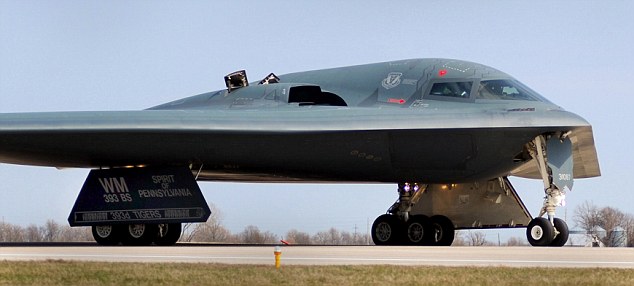
Media are now reporting the U.S. has removed all Air Force’s bombers, including B-1s, B-2s, and B-52s, on Sunday from RAF Fairford base in the U.K.
The bombers were redeployed back to their home bases in the United States, AP reported, initially citing a Pentagon official who was not authorized to discuss sensitive military movements and spoke on condition of anonymity. However, multiple news outlets are now reporting on official statements from the Pentagon.
SKY NEWS – […] “While operational security precluded us from confirming the movement of our assets and forces in real-time, we can acknowledge now that all US bombers that were deployed to RAF Fairford have redeployed to their home stations in the United States.
“The Airmen that operate America’s bomber force, including B-1s, B-2s, an to deliver precision global strike capabilities – including through operations that launch and recover from the continental United States – anywhere, anytime.”
BREAKING: The US Air Force has removed all of its bombers from RAF Fairford, the Pentagon has said.
Posted originally on the CTH on October 4, 2026 | Sundance |
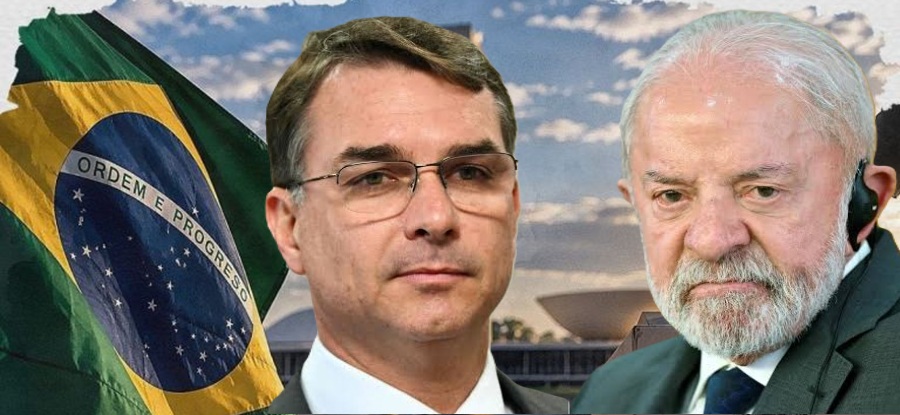
The polls closed at 5:00pm ET, and first results are beginning to come in. Incumbent President and Socialist, Lula da Silva, is up against challenger Flávio Bolsonaro, the son of the former president Jair Bolsonaro, who was imprisoned by da Silva loyalists in government.
In an era when USAID (CIA) funding for Latin-American socialists and communists has been curtailed by the Trump administration, the hope is that supporters for Bolsonaro (above left) can defeat the communist supporters for da Silva (above right). The race will likely be close.
The president in Brazil is directly elected by the people, and the winning candidate needs more than 50% of the vote to avoid a second round runoff.
The Guardian has a live update ongoing – SEE HERE.
17:45pm ET (25% reporting)
Flávio Bolsonaro 50.63%, Liberal party (PL) | 21,383,323 votes Luiz Inácio Lula da Silva 41.44%, Workers’ party (PT) | 19,903,245 votes
19:11pm ET (90% reporting)
Flávio Bolsonaro 48.19%, Liberal party (PL) | 50,654,815 votes Luiz Inácio Lula da Silva 43.88%, Workers’ party (PT) | 46,474,271 votes
Posted originally on the CTH on October 4, 2026 | Sundance |
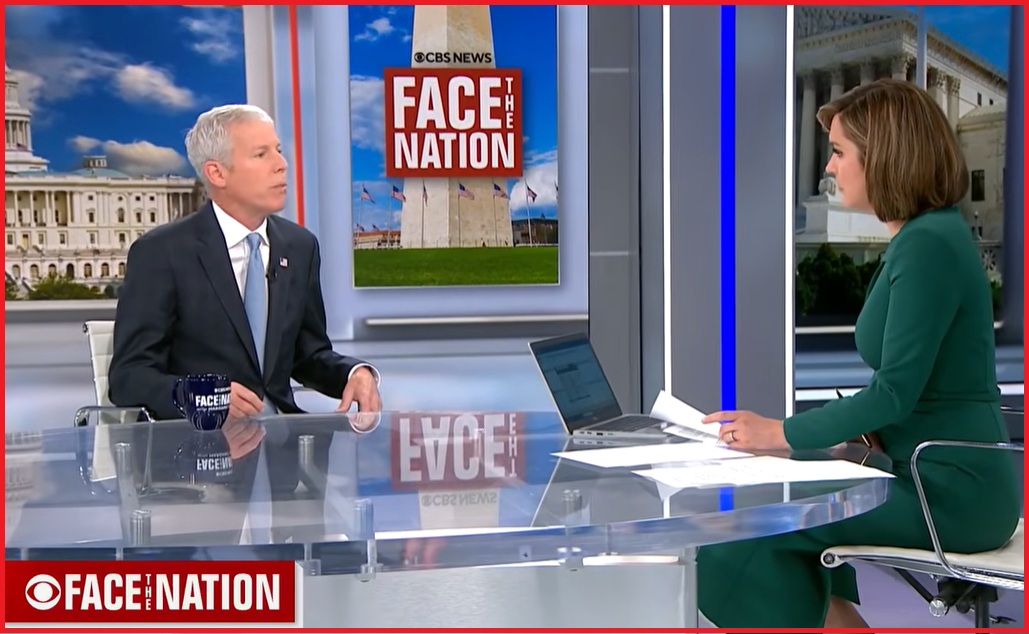
Margaret Brennan asks Energy Secretary Chris Wright to tell her about U.S. troop and military deployments to the Middle East, and whether President Trump is going to “escalate” military operations in the region. Yeah, she asked about that; as if the Energy Secretary would even talk about it on television if he knew.
Unfortunately, this remains the outlook of U.S. media. Energy Secretary Chris Wright told “Face the Nation with Margaret Brennan” that President Trump was “well aware of the risks to energy flows” before launching the Iran war, but he said the president said, “the world cannot sustain a nuclear-armed Iran, and I’m not going to do it.” WATCH:
[Transcript] – MARGARET BRENNAN: Good morning, and welcome to Face the Nation. We begin with one of the Trump administration officials tasked with working to lower those high gas and oil prices, Energy Secretary Chris Wright. Good morning to you.
SECRETARY OF ENERGY CHRIS WRIGHT: Good morning, Margaret.
MARGARET BRENNAN: So, it’s good to have you here. You said this past week that Americans can expect lower gasoline prices and diesel prices by election day. The Wall Street Journal editorial board has a piece outlining that the campaign to squeeze around financially is working, but they can still knock out significant Gulf energy infrastructure. They could be planning an October surprise before the U.S. midterms. We are still seeing Iranian attacks on ships now. I mean, how can you be so confident prices are headed down?
SEC. WRIGHT: Well, because we’ve got increasing supplies coming out of the Strait of Hormuz and they’ve continued to rise over the last months, over the last recent weeks. We’ve got U.S. gasoline production today at record high. We have demand for gasoline, as we come out of the summer driving scene, starting to go down. Similar stories with diesel. Diesel’s mostly been infected by the Russia-Ukraine war and also by China’s decision not to export diesel or gasoline into the marketplace. And of course, we’re living with two refineries that were recently closed, large refineries in California that Gavin Newsom forced the closure of. And frankly, 15 years of Democrat policies that have been energy subtraction, trying to close coal plants, close refineries, and shrink our capacity. Which means when you get in crisis, we’re just less resilient than we should be.
MARGARET BRENNAN: But you still think that in the next four weeks prices are going to go down?
SEC. WRIGHT: Absolutely. Diesel prices have been going down. Gasoline prices have been going down. I expect that to continue.
MARGARET BRENNAN: I want to talk about diesel in a minute, but I- I was reading that the U.S. was sending more defensive equipment to the Gulf countries to protect their oil infrastructure. I see there was a gathering of national security advisers at Camp David on Friday to talk about Iran and the conflict in Yemen. Can you share any outcome from that? I mean, is- is the U.S. about to escalate? We did just see a third carrier strike group get sent to the region.
SEC. WRIGHT: Look, the president has- has taken a strong stand that Iran, the world’s greatest terrorist regime- regime, cannot and will not have nuclear weapons. So, of course, we’re looking at every avenue to achieve that goal economically, to be prepared for what comes militarily. But we cannot pass to the next administration an Iran armed with nuclear weapons. Not only is that a threat to peace and stability–
MARGARET BRENNAN: Right.
SEC. WRIGHT: –that’s a massive long-term threat to energy prices.
MARGARET BRENNAN: Right, but he’s also said that they’re not seeking a nuclear weapon. He said that just the other day that they might have actually already stopped. But in the immediate sense of threats to our neighbors who have refinery and production capacity, how do you guarantee that there is no October surprise that sends those prices going the opposite direction?
SEC. WRIGHT: Hey, well, there’s no guarantees. There’s no guarantees in conflict. There’s no guarantees in life. But everything we’re doing is to grow the supply of diesel, to grow the supply of gasoline, and frankly, again, to reverse years of policies that have been directed exactly the opposite, to shrink our ability to produce, refine, and deliver hydrocarbons.
MARGARET BRENNAN: Can you say whether the president has decided he will escalate post-election day? That’s when that third carrier strike group will be arriving, mid-November.
SEC. WRIGHT: Oh, I’m definitely not going to get in front of presidents’ plans or policies. But remember–
MARGARET BRENNAN: He’d thrown that out there himself.
SEC. WRIGHT: He’s- he’s always planning for contingencies and he’s always negotiating. How you communicate, what you- what you lean in on, it sends a message to the other side. He’s been a master, a master at doing that.
MARGARET BRENNAN: So he’s got both tracks still going, diplomatic and military pressure?
SEC. WRIGHT: Of course, of course. At all times.
MARGARET BRENNAN: Okay, you talked about diesel. The world’s wealthiest countries, the G7, this past week agreed to release 100 million barrels of fuel over four months. They’re going to front load it with a lot of diesel in the next 20 days. I know you asked our friends and allies to consider doing this. How significant a price impact and for how long?
SEC. WRIGHT: It’s a big deal. It’s a big deal. Europe has very large diesel stores. They, you know, they don’t refine enough diesel to supply their own economies, so naturally they store a lot of diesel. They’re very keen to see American diesel continue to flow to Europe. They’ve got a lot of diesel in stores. Why not release some of that? This is what you store diesel for. When all the Russian exports of diesel are shut down, when the Chinese have said we’re not going to deliver any more diesel, and you still have a reduction of diesel flows coming out of the Gulf, but we’re restoring those, but that takes time. This is just common sense. This lowers diesel prices, not just in the United States, but it lowers them in Europe and around the world. But it will drive diesel prices down as those releases come. It’ll drive diesel down through the winter in the United States and around the world. And- and by then we’ll be in another place. We’ll have more refining capacity online. I- I suspect we’ll continue to see diesel decline as we go into next spring as well.
MARGARET BRENNAN: So below six bucks? Which is where it is.
SEC. WRIGHT: Yes.
MARGARET BRENNAN: Yeah. By post-midterms?
[CROSSTALK]
SEC. WRIGHT: It’s- it’s down a little over 20 cents so far.
MARGARET BRENNAN: Yeah.
SEC. WRIGHT: I think you’ll see it continue to go down. Yeah, you should see it below $6 before too long. But exactly when, I certainly don’t know that.
MARGARET BRENNAN: So the allies did this after President Trump said he was considering a diesel export ban. You had so many quotes where you were telling people, “This was not a good idea.” “Let’s not do a diesel export ban.” But the president kept saying it was a consideration. Has he completely ruled out an export ban at this point?
SEC. WRIGHT: Look, every day he’s throwing out ideas. He’s engaging with discussions with me, others in the administration–
MARGARET BRENNAN: Even when you’re saying it’s not a good idea?
SEC. WRIGHT: Absolutely. No, he- he- he’s–
MARGARET BRENNAN: But you’re the expert.
SEC. WRIGHT: –he says well- well, but there’s different ways to slice this cat. There’s different ways to look at it. He’s always looking, “How do I lower energy prices? How do I lower heating prices, electricity prices, gasoline prices, diesel prices?” In fact, I would say his constant communication of that may have been quite helpful in achieving- in achieving the deal we just struck.
MARGARET BRENNAN: Because people thought he might actually not listen to you and go ahead and do it?
SEC. WRIGHT: I–
MARGARET BRENNAN: That was the- the ploy, essentially?
SEC. WRIGHT: It wasn’t a ploy. It’s just a constant dialog about the many levers we have. How can we drive down diesel prices and drive down gasoline and other prices along with it?
MARGARET BRENNAN: So we checked, and it looks like because of this Lindsey Graham bill that gives the president more, sort of, powers to punish the buyers of Russian fuel, he has to make a decision by October the 18th as to whether he’s going to put tariffs on the biggest buyers. That would be China, and that would be India. Is he going to do that?
SEC. WRIGHT: Look, he- he leaves every decision till the end. He’ll evaluate the trade-offs. He has worked ceaselessly to try to end this war. Not only would end- would ending this war end the killing of- of tens and of thousands of people every month, it would dramatically lower energy prices. He’s wanted to end that conflict, yes, since before he was president. So, and- and there is constant, constant dialogs with both sides in that to try to bring that war to an end.
MARGARET BRENNAN: But at this point, like, what’s the direction here? You just had this big state visit. Are we actually in a position where the U.S. might put tariffs on China for buying Russian oil? Are we actually going to see that, and what impact would that have?
SEC. WRIGHT: Again, I won’t get in front of the president on that. We’re trying to have the best relations we can–
MARGARET BRENNAN: I’m sure you’ve looked at the projections on what it would do for pricing.
SEC. WRIGHT: Of course, we’re trying to have great relations with China and move that ball forward. I think things are going reasonably well there. But then the flip side is you’ve got to look at every leverage you’ve got to bring a murderous conflict to an end.
MARGARET BRENNAN: So he may and you would encourage him to?
SEC. WRIGHT: I’m not going to say- I’m not going to say on–
MARGARET BRENNAN: Okay.
SEC. WRIGHT: –either one of those. He’s- he’s looking to how to end that conflict and how to lower prices for Americans every day.
MARGARET BRENNAN: Yeah. Well, the date just stood out, you know, weeks before the midterms, doing something that could arguably push prices back up. And so, if it’s a national security decision versus a political one. Be interested to know your point of view.
[CROSSTALK]
SEC. WRIGHT: If his decisions were political he would have just kicked the can down the road and delivered a nuclear-armed Iran to the next president. You’ve got to respect that. That’s an incredible move to lean in and say I’m not going to let them become nuclear-armed. He knew it was going to elevate energy prices in the short run. He said, “I’m going to take a hit there, but I got to do the right thing.”
MARGARET BRENNAN: You did tell him that? That there would be a huge energy price spike when he made the decision.
SEC. WRIGHT: He- he was well aware of- of the risk to energy flows that were coming out of the Persian Gulf region. He said, “I simply cannot. The world cannot sustain a nuclear-armed Iran, and I’m not going to do it.”
MARGARET BRENNAN: Secretary Wright, thank you for your time today.
Posted originally on the CTH on October 4, 2026 | Sundance
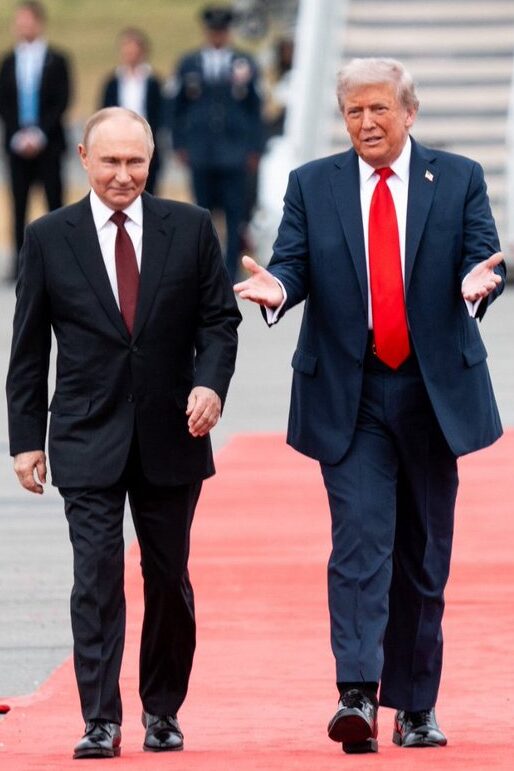
I don’t want to focus too much on this, because there are multiple angles still at work. However, against the backdrop of the non-coincidental coincidences that followed the August 2025 Alaska Summit, the Lukoil story looks strategically interesting.
The New York Times is looking at Lukoil from the perspective of President Trump organizing financial gains for people close to his administration, specifically Witkoff and Kusher. {GO DEEP}
That aspect is nonsense, total nonsense; however, if you pull back and look at the background story without the Trump derangement overlay, there’s a potential here for something very good to come out of it.
As the story is told, Russian President Vladimir Putin has inquired about the potential for the U.S. to remove sanctions against Lukoil, a quasi-private energy company based out of Russia. Before, getting too weedy about it, remind yourself of the statements that surfaced during the Trump-Putin summit in Alaska, August, 2025.
You might remember that both the U.S and Russia spoke of strategic partnerships surrounding the energy sector. Obviously, this makes sense when we consider the “west” is actually fractured on the topic of energy. There are two competing interests that overlap in the financial side of the issue, the ‘trillions at stake’ aspect.
On one side you have the “climate change” team, those who are fully invested (literally) in the financial mechanisms of the climate change, green new deal, build back better talking points. The Green Energy team in the west. The Paris Climate Treaty and carbon-trading proponents et al.
On the other side you have the pragmatic energy team in the west. These are the Trump-minded and aligned western perspectives that look at oil, natural gas (LNG), clean coal and nuclear technology. These are the “all the above” aligned voices in the more pragmatic view of low-cost energy production and development.
In the middle, between both sides of the fracture, are the banking and finance systems. This is the BIG MONEY play, with the Climate Change team supported by banking ideology inside the city of London, while the Carbon Use team is constantly having to assemble finance and insurance from outside the banking control mechanisms.
The Climate Change team have support based on ideology within the finance system. However, the Carbon Use team have the advantage of low-price outputs, global dependency and actual profits as leverage. This is a fight essentially inside the larger energy sector, and we are all very familiar with it because it has been happening for decades.
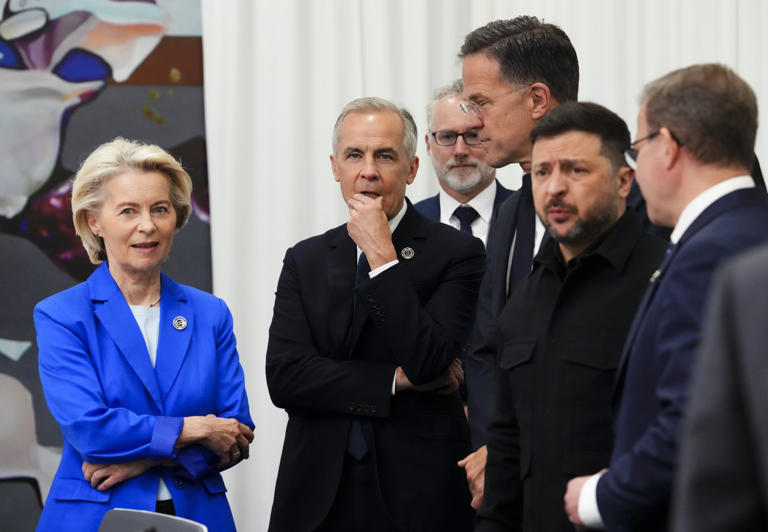
Canadian Prime Minister Mark Carney is currently the main tool deployed by the Climate Change team on behalf of the London finance system. Carney’s main opponent is U.S. President Donald Trump.
Now we enter the Lukoil storyline.
Lukoil, a Russian enterprise, has some pretty amazing holdings in oil fields, gas fields, refineries in Europe as well as retail outlets for gasoline and LNG sale, their distribution. The estimated worth is north of $28 billion. Those holdings have been the subject of on/off sanctions as a result of the Russian ownership/operations.
Let me share some of the holdings {SOURCE} as you read this, think about the recent headlines involving each of these nation states: Lukoil’s biggest foreign asset is a 75% stake in Iraq’s West Qurna 2, one of the world’s largest oilfields. Lukoil also owns 60% of Iraq’s Block 10 development, which includes the Eridu field west of Basra. In Egypt, the company holds a 50% stake in the West Esh El Mallaha (WEEM) oilfield. In the UAE, Lukoil owns 10% of the Ghasha concession, one of Abu Dhabi’s largest gas developments.
Central Asia – Lukoil holds 13.5% in Karachaganak and 5% in Tengiz – major Kazakh oil and gas projects operated by Western oil companies. It also has a 12.5% stake in the Caspian Pipeline Consortium, which exports oil from Kazakhstan to the Black Sea. Lukoil doesn’t have to sell these assets as the U.S. Treasury has allowed transactions involving Karachaganak, Tengiz and CPC.
The Russian firm also owns nearly 20% of the BP-operated Shah Deniz gas field in the Azerbaijani sector of the Caspian Sea. It also operates the South-West Gissar gas field in Uzbekistan and holds a 90% stake in the Kandym fields development near the country’s border with Turkmenistan.
Africa and Latin America – Lukoil has a 38% interest in the Deepwater Tano Cape Three Points block that includes the Pecan oilfield development off Ghana. It also has 25% in Eni-operated gas block Marine XII offshore Congo and 18% in Chevron-operated exploration block OML 140 off Nigeria. In Mexico, it partners with Eni in several offshore blocks and owns 50% of the Amatitlan block, operated by Petrolera de Amatitlan SAPI de CV.
REFINING ASSETS: In Bulgaria, Lukoil owns the 190,000 barrels per day Neftohim Burgas refinery, the largest in the Balkans. In Romania, Lukoil owns the 48,600 bpd Petrotel refinery, the country’s third-largest, and around 300 gas stations. Lukoil also owns exploration rights in the Romanian sector of the Black Sea, but drilling plans have been stymied by the sanctions. In the Netherlands, Lukoil holds 45% in the 180,000 bpd Zeeland refinery, operated by a joint venture with France’s TotalEnergies.
Lukoil also has retail gas stations in Finland, Romania, Moldova and the USA (northeast).
According to recent reports, Vladimir Putin has inquired about a strategic energy partnership with the U.S, and it would make sense that all of these assets could be part of a restructuring regime that would need U.S. Treasury Secretary Scott Bessent to approve given the current sanctions problem. That’s where the NYT report comes back in.
….”a different group emerged as the leading bidder: one led by Mr. Boehly, a billionaire supporter of Mr. Trump’s, alongside well-connected figures in the Middle East and the U.S. government itself. The members of the partnership were reported last week by The Financial Times.
Mr. Boehly is a co-owner of the Los Angeles Dodgers and donated $1 million to MAGA Inc., the Trump-aligned political committee, in December 2025. He gave another $1 million through his investment firm, Eldridge Industries, to Mr. Trump’s inauguration.
The U.S. government is taking a stake in the deal through the U.S. International Development Finance Corporation, an agency that invests in and lends to projects overseas. A D.F.C. official said in a statement that the potential Lukoil deal “would advance the Trump administration’s commitment to strengthen U.S. economic security, advance U.S. foreign policy and lower energy prices for everyday Americans.” (READ MORE)
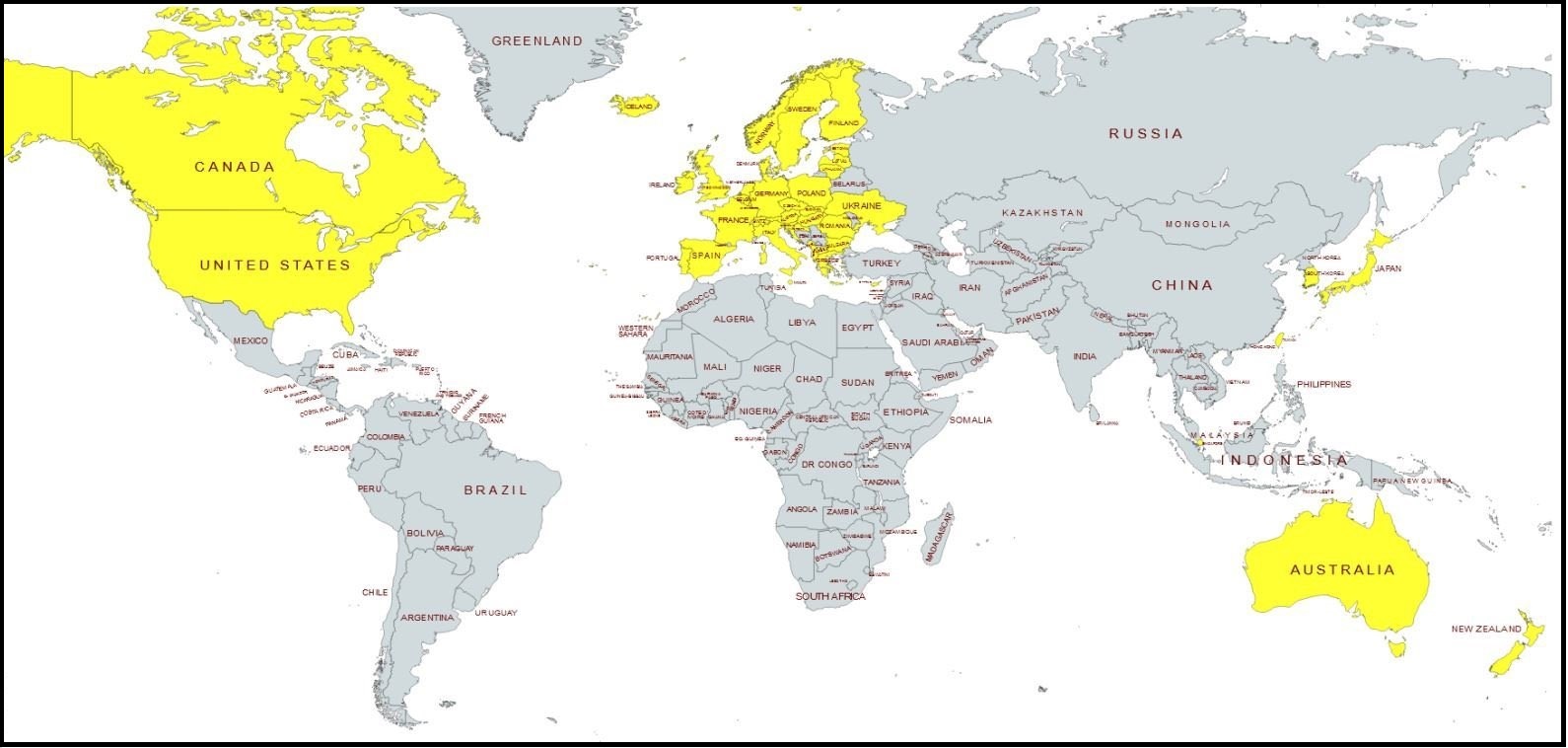
The British, European and Canadian climate change group (ideology, banking and finance), versus the USA, Mexico, South America, Russia, Central Asia and Middle East.
That’s an interesting geopolitical contest, no?
Is it accidental this global friction map makes an almost identical overlay to those interests opposed to President Donald Trump?
Perhaps looking at the Russian Sanctions map again might provide a visual reference:
Speculation, exchange trading, market pricing, etc. these are the reasons why the EU presented an increase in central bank interest rates to try and lower energy prices. The central bank approach has nothing to do with the price of the energy (oil/gas) and everything to do with the financial markets speculating on the prices of oil and gas and profiting from the speculation/trading itself.
As noted by Russian President Putin, allowing hedge funds, financial interests and inorganic market forces to set the prices of an item (London Banking) disconnects that item from the economic principle of supply and demand. The prices that people suffer for oil and gas are being driven by the mechanisms set up by western financial interests. This is manipulative and creates pain on the consumer and the people who have to pay more.
I have created this site to help people have fun in the kitchen. I write about enjoying life both in and out of my kitchen. Life is short! Make the most of it and enjoy!
This is a library of News Events not reported by the Main Stream Media documenting & connecting the dots on How the Obama Marxist Liberal agenda is destroying America