Marjorie Taylor Greene & Trump Using Nuclear Weapons


Posted originally on Aug 21, 2026 by Martin Armstrong |  
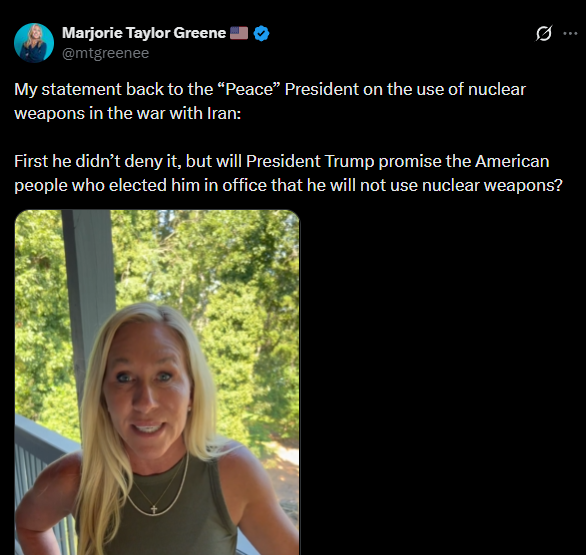
2026_08_20_09_54_23_7_Marjorie_Taylor_Greene_on_X_My_statement_back_to_the_Peace_Presiden

Let me make something very clear. The Neocons have been talking about using nukes forever. There are people in Israel also talking about using a tactical nuke on Iran’s nuclear facility because nothing else would reach it. These discussions are not using a major nuclear weapon like Hiroshima. This is a bit out of place. It is nothing new and I can tell you that the default with some of these people is to just nuke the opposition.
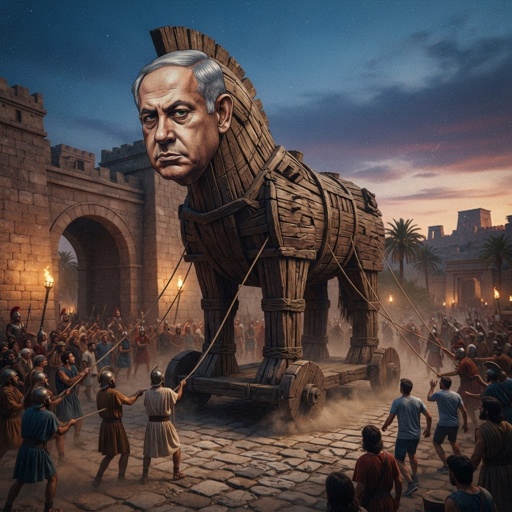
Netanyahu Trojan Horse

President Trump has been suckered into this war by the Neocons who escorted their Trojan Horse into the situation room, Netanyahu. Trump was against endless wars promoted by the Neocons like John Bolton. According to reports from The New York Times and other outlets, Netanyahu was “escorted” or “whisked” into the White House Situation Room on February 11th, 2026, by President Trump’s team for a highly classified presentation on Iran. Netanyahu was a foreign leader given rare access to the White House Situation Room. I believe he was the FIRST ever to enter that room, but I cannot definitively confirm that.

It is also not possible to definitively state that Jared Kushner escorted Netanyahu into the Situation Room during the February 11, 2026, meeting. However, I can at least confirm that he was present at a White House meeting with Netanyahu that same day. Netanyahu is obsessed with Iran and has been trying to get the United States to destroy Iran at least since 1996.
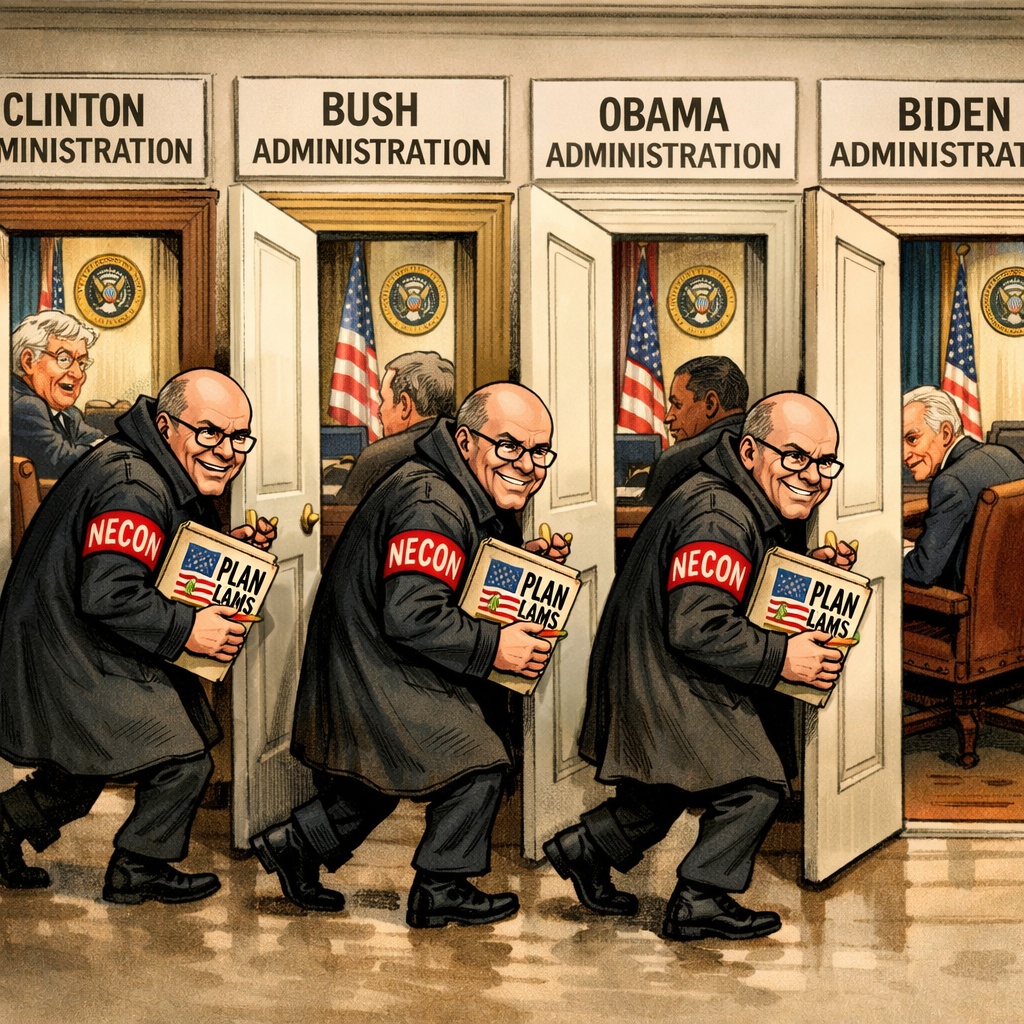
Nerocon Every Administration

President Trump, I believe, was lied to and told that killing the Ayatollah on day one would win the war. That is ALWAYS a Neocon solution. They said the same about Saddam and I have head the very same bullshit that if they took out Putin, the Russian people would cheer and give them their fictional tickertape parade. These people have the same sales pitch and they are ruthless and claim to be for democracy yet infiltrade every administration to promote their endless wars.

These Neocons have justified regime changes around the world since World War II. The reason WHY Iran calls the USA the “Great Satan” is precisely this issue. The CIA, working alongside British intelligence (MI6), orchestrated the 1953 Iranian coup d’état to overthrow the democratically elected Prime Minister Mohammad Mossadegh. A primary motivation was to re-establish Western control over Iran’s oil industry for the benefit of British and American companies.

This operation, known as Operation Ajax (or TPAJAX), is a well-documented example of Cold War covert intervention. The crisis was triggered by Mossadegh’s decision to nationalize Iran’s oil industry, which had been controlled by the British-owned Anglo-Iranian Oil Company (the forerunner of BP).

These Neocons have usurped American foreign policy and claim that they are spreading “democracy” to the world when in fact they circumvent the Constitution and launch unilateral operations without any Congressional approval. This is no different from a dictatorship. The people are NEVER asked shall we overthrow a government or start a war.

I was told back in the ’90s that the US should overthrow all the dictators in the Middle East and that would secure Israel for the future. Here is a video of General Wesley Clark hearing the same thing after 9/11 in 2001. I heard that same idea about 5 years before in private discussions with a leading Neocon.
The Strait of Hormuz Is Repricing the Entire World Economy


The

Posted Ordinally on Aug 21, 2026 by Martin Armstrong |  

Strait of Hormuz

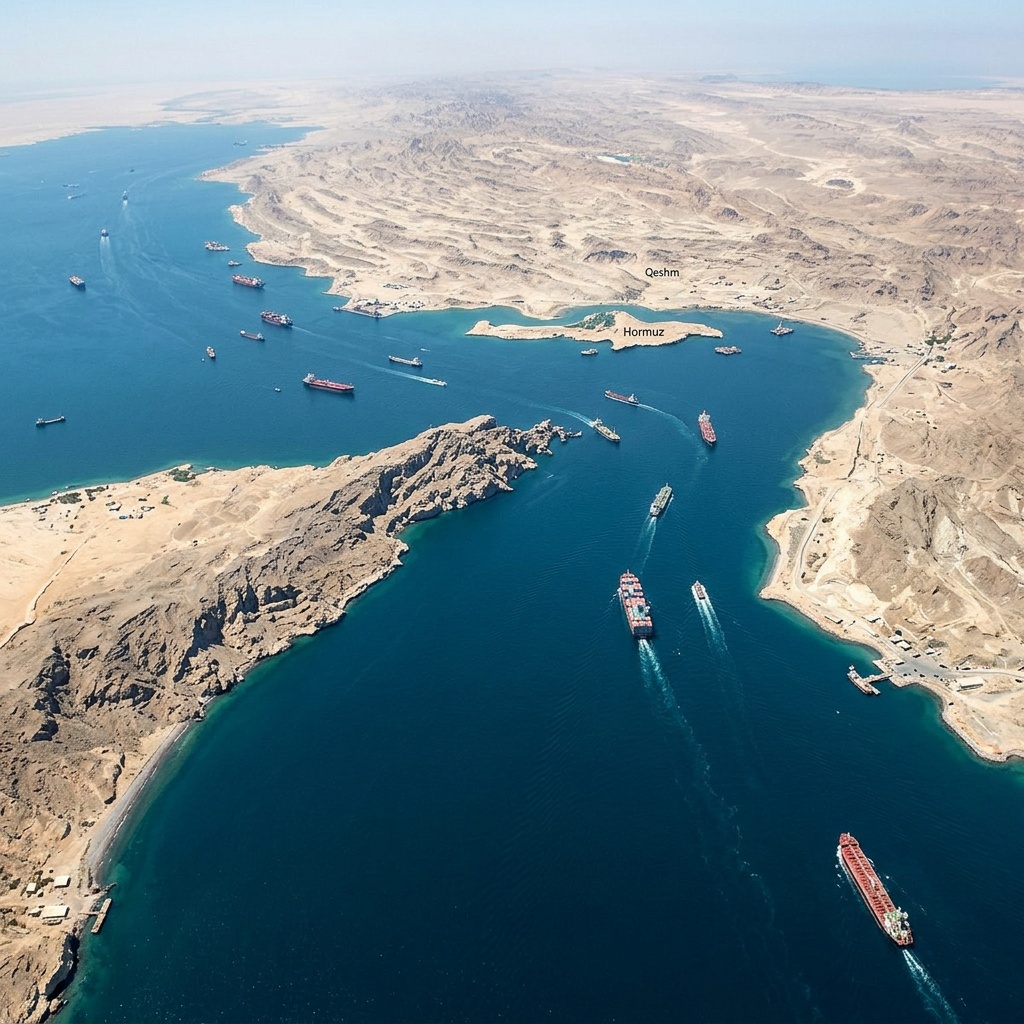
The politicians continue to speak about the Strait of Hormuz as though this were merely a regional dispute between Iran and its neighbors. That is complete nonsense. The strait is one of the most important arteries in the global economy, carrying roughly one-fifth of the world’s oil and gas shipments. Brent crude has moved above $91, but the headline price of oil is only the beginning. The real economic damage appears in shipping rates, insurance premiums, refinery margins, diesel prices, electricity costs, and ultimately government borrowing. War does not remain confined to the battlefield. It enters every household through inflation.

Washington claims the strait is open while Iran insists it remains closed. Both statements are political propaganda because it is the shipowners, insurers, and commodity traders who determine whether a waterway is commercially open. A tanker can theoretically pass through Hormuz, but that means nothing if the insurance premium becomes prohibitive or the crew refuses to accept the risk. Most politicians have never operated a business and do not understand that commerce depends upon confidence—not government declarations. Once confidence collapses, trade will retreat regardless of how many officials stand before cameras insisting that everything remains under control.

This is why the cost of the conflict cannot be measured solely by the number of barrels temporarily removed from the market. Every vessel delayed or redirected reduces available shipping capacity and increases freight rates elsewhere. Insurers must reprice the probability of a tanker being damaged, captured, or destroyed. Refineries must compete for alternative supplies, while countries dependent upon Gulf energy begin building precautionary inventories. Traders add a geopolitical premium because nobody knows whether the next missile will strike a ship, a refinery, a pipeline, or an export terminal. These costs compound through the entire system long before the average person notices the increase at the gasoline station.

Strait Hormuz

The more serious warning is coming from refined products, particularly diesel. Politicians obsess over crude because that is the price quoted every evening on television. Yet modern civilization runs on diesel. Trucks transport food and consumer goods, farmers operate machinery, construction companies run heavy equipment, and emergency generators protect hospitals and critical infrastructure. When diesel rises, the cost of virtually everything rises with it.

Governments will pretend that this inflation is temporary or caused by greedy corporations. They said the same thing after the monetary expansion of 2020. Inflation is never politically convenient because it exposes the true cost of government policy. A war financed through borrowing does not require politicians to present taxpayers with an immediate bill. The expense is transferred into sovereign debt, currency depreciation, and higher prices. The public pays through the destruction of purchasing power, while officials continue claiming that military operations can be conducted without domestic sacrifice.

Europe is particularly vulnerable. It has spent years undermining its own energy security while increasing sanctions, regulations, and military commitments. European governments are already struggling with weak growth, aging populations, expanding welfare obligations, and enormous debt. A sustained rise in energy prices will reduce industrial competitiveness and force governments to subsidize households once again. Those subsidies will require still more borrowing at precisely the moment bond yields are rising. This is the trap: war raises energy costs, energy raises inflation, inflation prevents central banks from reducing interest rates, and higher rates increase the cost of servicing government debt.

The bond market understands what politicians refuse to see. Long-term government yields are rising across Europe, the United States, and Japan because investors are beginning to question whether governments can continue borrowing without limit. The Middle East conflict is accelerating a sovereign-debt problem that already existed. Governments accumulated debt during the pandemic, borrowed again to subsidize energy after the war in Ukraine, and are now expected to finance another expanding conflict surrounding Iran. Each crisis is treated as temporary, but the debt is permanent.

This is how confidence collapses. The decline of an empire does not begin when it loses one battle. It begins when the cost of maintaining its military commitments exceeds the productive capacity of its economy. Rome debased its currency to pay the army and preserve the frontiers. Spain consumed the wealth of the New World financing wars across Europe. Britain emerged from two world wars victorious but financially exhausted, surrendering its position as the center of global capital to the United States. Military power is always dependent upon economic power, yet the warmongers imagine the relationship works in reverse.

Iran also understands that Hormuz is more valuable as a threat than as a permanently closed waterway. Completely stopping trade would damage Iran and alienate China, India, and other Asian customers dependent upon Gulf energy. Tehran does not need to seal the strait with an impenetrable naval blockade. It merely needs to create enough uncertainty that commercial traffic slows and the world pays a permanent risk premium. A missile landing near a tanker can accomplish economically what a fleet might fail to achieve militarily.

The United States may possess the naval power to escort ships, but it cannot force private capital to ignore risk. Nor can it guarantee that mines, drones, missiles, or small boats will never penetrate the security perimeter. Every escalation requires more ships, more aircraft, more personnel, and still more government spending. The attempt to protect the trade route therefore adds to the fiscal burden created by the disruption itself.

The Strait of Hormuz is becoming a tax imposed upon the entire world economy. It will appear in freight costs, food prices, utility bills, interest rates, government deficits, and eventually elections. Western leaders will blame Iran, corporations, speculators, or climate change before admitting that their endless wars carry an economic price.

Categories:World Trade

Saudi Arabia Is Borrowing to Preserve Vision 2030


Posted Ordinally on 21, 2026 by Martin Armstrong |  

Saudi Arabia recorded a budget deficit of 125.7 billion riyals, approximately $33.5 billion, in the first quarter of 2026. That is almost as large as the $44 billion deficit the government projected for the entire year. Spending increased by 20% while oil revenue declined by 3%, creating the very contradiction Vision 2030 was intended to eliminate. The kingdom is spending enormous amounts of oil revenue and borrowed money to build an economy that will supposedly no longer depend upon oil.

The government approved financing needs of 217 billion riyals, or nearly $58 billion, for 2026. This includes 165 billion riyals to cover the projected budget deficit and another 52 billion to repay maturing debt. But the Q1 deficit has already consumed most of the amount projected for the entire year. The government may recover some ground if oil revenues rise, but this exposes the vulnerability of every state-directed economic transformation. The projections assume that politicians can control spending, oil prices, regional stability, and investor confidence simultaneously. History demonstrates that they can control none of them.

The war with Iran has accelerated the problem. Saudi military spending increased by 26% during the first quarter as the kingdom attempted to protect its population, oil facilities, shipping routes, and critical infrastructure. Government expenditure on goods and services increased sharply, subsidies rose, and capital spending was brought forward. This is the hidden cost of war even for a country attempting to remain outside the conflict. Saudi Arabia does not have to invade Iran to pay for the war. It must spend billions defending itself against missiles, drones, disrupted shipping, higher insurance costs, and the possibility that the Strait of Hormuz will remain unreliable.

Saudi Arabia’s Public Investment Fund is now scaling back and shifting toward phased projects tied more closely to profitability. The original plans for The Line, a 112-mile linear city, became the international symbol of Vision 2030, but symbols do not produce cash flow. Projects are being reevaluated while the kingdom redirects attention toward logistics, artificial intelligence, clean energy, religious tourism, utilities, and infrastructure connected to events such as Expo 2030 and the 2034 World Cup.

There is nothing inherently dangerous about Saudi Arabia borrowing money. Its debt burden remains far below that of the United States, Japan, or the major European governments. The issue is the direction of the trend and the productivity of the expenditure. Debt used to construct infrastructure that increases trade, tourism, energy capacity, and private investment may strengthen the economy. Debt used to maintain political prestige, absorb operating losses, or defend projects that cannot survive without government support becomes a permanent claim upon future revenue.

Vision 2030 was launched to diversify the Saudi economy away from oil, expand tourism, build new industries, and create private-sector employment for a young population. Those objectives are entirely rational. No government can assume that a single natural resource will finance the state indefinitely, particularly when Western governments are simultaneously regulating fossil fuels, subsidizing alternatives, and using energy policy as a geopolitical weapon. The problem is not the desire to diversify. The problem is the belief that diversification can be commanded from above through unlimited spending.

The danger emerges when government borrowing begins crowding out the private economy Vision 2030 was supposed to create. Saudi banks, contractors, and investors naturally prefer projects supported by the state because political backing appears to reduce risk. Capital then flows toward whatever the government has designated a national priority instead of toward enterprises responding to genuine market demand. This produces the illusion of private-sector growth while the entire system remains dependent upon public spending. If the state reduces expenditure, the supposed private boom disappears with it.

This pattern is not unique to Saudi Arabia. Japan attempted to support growth through enormous infrastructure spending after its 1990 asset bubble collapsed, leaving behind bridges, roads, and regional projects that could not restore private demand. China used state-directed credit to build cities, railways, and property developments on an unprecedented scale, but debt accumulated when economic returns failed to match political projections. Dubai itself experienced the limits of debt-financed development during the 2009 crisis and required assistance from Abu Dhabi. Governments always believe their current project is different because they cannot imagine the economic cycle turning against them.

Saudi Arabia’s advantage is that it still possesses enormous energy reserves, financial assets, and the ability to attract international capital. Its disadvantage is that this apparent wealth encourages the belief that every project can be completed regardless of cost. Oil revenues can conceal mistakes for decades, but they cannot transform an uneconomic project into a productive one. If the kingdom must continually borrow against future oil income to finance diversification, then oil dependency has not ended. It has simply been moved from the present budget onto the future balance sheet.

The regional war makes that contradiction more dangerous. Higher oil prices may increase revenue, but attacks on shipping and infrastructure can reduce export volumes and raise security expenses. Saudi Arabia can therefore receive more per barrel while still confronting a deteriorating fiscal position. This is why analyzing oil producers solely through the price of crude is foolish. Revenue depends upon price, volume, transportation, security, and the cost of maintaining the state. War can increase the first while damaging every other component.

Vision 2030 may ultimately produce valuable infrastructure and a more diverse Saudi economy. That outcome will depend upon whether the government is willing to abandon projects that cannot generate an economic return. The decision to scale back the most extravagant parts of Neom may be the first sign that reality is beginning to overcome political ambition. Continuing every project merely to avoid admitting error would transform Vision 2030 from an economic reform into a sovereign debt machine.

Categories

FBI Seizes Devices Belonging to Eric Swalwell During Investigation of Rape and Sexual Misconduct


Posted originally on CTH on August 20, 2026 | Sundance

Generally speaking, when the FBI seizes devices it’s usually to bury them and protect affected interests in/around Washington DC. Rarely, if ever, does the confiscation of electronic devices result in any public awareness of the contents – unless the release runs in alignment with the interests of those in Washington DC.

EX. If it was the confiscation of electronic devices deemed adverse to the interest of DC (Donald Trump, Rudy Giuliani, Scott Perry, Mike Lindell, etc.) then the content of those devices is publicly exposed. However, most confiscations are to protect the guilty – therefore they are buried. SEE: Hunter Biden laptop, Huma Abedin laptop, Anthony Weiner cell phones, Hillary Clinton phone(s) and laptops; Awan Brothers laptops (4) and phones; Seth Rich phone and laptop; Jeffrey Epstein, phones, laptops, hard drives; Stephen Craig Paddock phones and laptops, Syed Rizwan Farook/Tashfeen Malik cell phones, Tamerlan and Dzhokhar Tsarnaev phones and laptops; Senator Bob Menendez, phones and laptops etc.

Therefore, accepting things as they are most likely – and not as we would prefer them to be – it is best to think of the recent story as one of protecting the downstream issues from Eric Swalwell, as they are associated during his tenure as a targeting conduit for the House Permanent Select Committee on Intelligence (HPSCI) and later as a Trump impeachment manager and J6 Committee official.

WASHINGTON (AP) — Federal agents seized electronic devices from former Rep. Eric Swalwell and searched his Washington home as part of an investigation into allegations of sexual misconduct by the ex-Democratic congressman from California, according to a person familiar with the matter.

Swalwell’s devices were seized at the San Francisco airport on Saturday and agents executed a search warrant at his home a day later, said the person, who was not authorized to publicly discuss an ongoing investigation and spoke on the condition of anonymity.

A message seeking comment was left Thursday with an attorney for Swalwell, who has denied allegations of sexual assault and misconduct. The Daily Mail first reported the seizure of Swalwell’s devices on Thursday.

Swalwell announced his resignation from Congress in April following allegations that Swalwell had sexually assaulted a woman twice, including when she worked for him. The San Francisco Chronicle, followed by CNN, first reported the allegations. CNN also reported that three other women alleged various kinds of sexual misconduct by Swalwell, including sending them unsolicited explicit messages or nude photos.

[…] A lawyer representing Lonna Drewes, a California woman who in April said she had been raped in 2018 by Swalwell, said his team was cooperating with all law enforcement agencies investigating the former congressman.

“We are encouraged to learn about the escalation of the FBI’s investigation into the allegations against Eric Swalwell,” attorney Arick Fudali said in a statement. (read more)

Tulsi Gabbard Provides an Update on Her Husband Abraham Battle With Cancer


Posted ordinally on August 20, 2026 | Sundance | 29 Comments

Tulsi Gabbard: “Earlier this year, my husband Abraham was diagnosed with a very rare bone cancer. This has been a challenging time for us and is hard to talk about. But so many of you have reached out asking how he’s doing and sharing your prayers and well wishes with us. We made this video to share a little about what this journey has been like, and to update you on his recovery. Mahalo for all of the love and support.

Dear Lord and healer of all things created, we pray for complete healing for Abraham Williams from both cancer and surgery.

We ask that You remain guiding the hands of the doctors and caregivers. We pray for mercy and restoration of Abraham to full strength and health.

We ask Your mercy to intervene and mitigate pain in recovery, while pulling Tulsi, Abraham and those they love close to You. We pray for You to surround them with Your sense of peace.

Our Father who holds the stars and the eternal distance, we trust in Your universal power to heal, and we believe that You will hear our prayers and provide full restoration in Your glory~Amen.

Posted

Boris Johnson said the Treasury told him to fill the UK with INVADERS or the economy would collapse


13on Rumble on Bannons War Room, on: 026   Aug 20, 2026

STEVE CORTES: Hyundai Is Massively Increasing Production In Georgia, Investing $26 BILLION In America And Nearly Doubling The Share Of Its U.S.-Sold Cars Made Here


Posted originally on Rumble on Bannons War Room, on: 026   Aug 20, 2026

WarRoom Battleground EP 1072: With Philip Pilkington, author of “The Collapse of Global Liberalism”


Posted originally on Rumble on Bannons War Room, on: 026   Aug 20, 2026

The West’s “Cultural Revolution” has been incredibly destructive — but most destructive for women


Posted originally on Rumble on Bannons War Room, on: 026   Aug 19, 2026

Pete Hegseth has a great appreciation for the concept of Conquest — he knows we are being conquered


Posted originally on Rumble on Bannons War Room, on: 026   Aug 19, 2026