Waymo Admits Vehicles are NOT Autonomous


Posted originally on Feb 12, 2026 by Martin Armstrong |  

Self-Driving Car Technology for a Reliable Ride - Waymo Driver

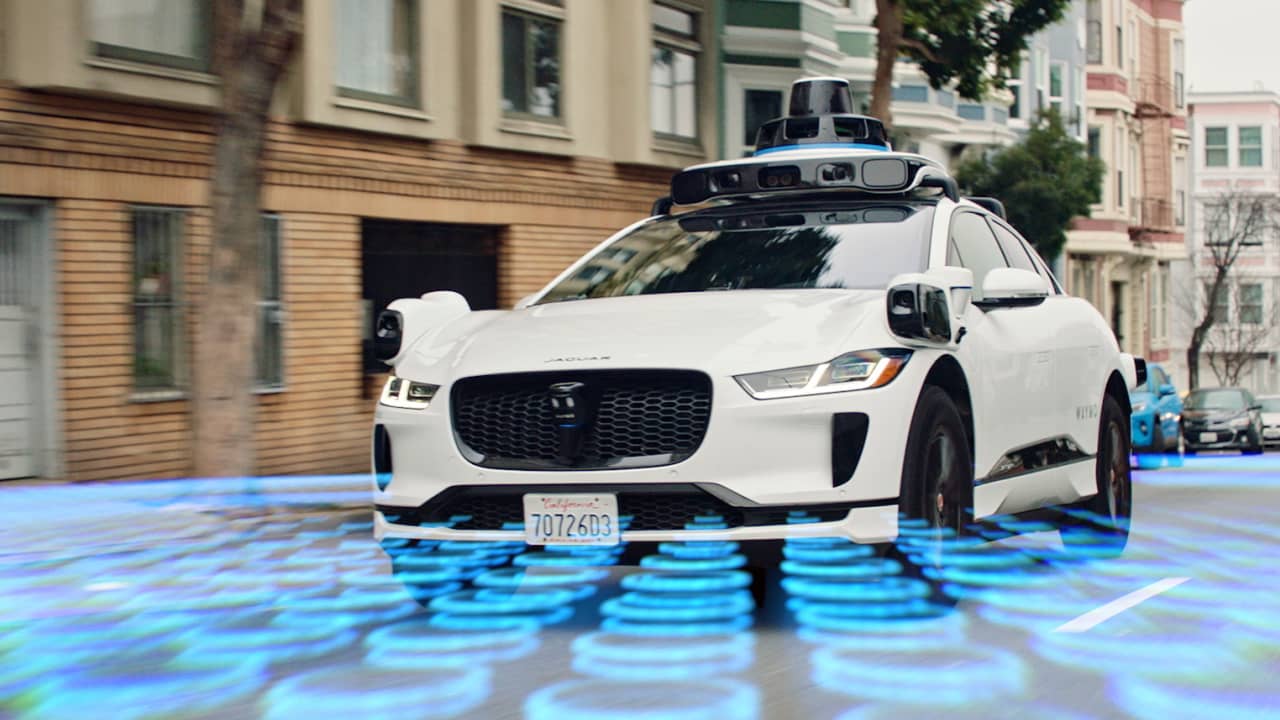
Touted as cutting-edge AI technology, Waymo’s autonomous self-driving technology is actually based on a group of human operators based in the Philippines. A top executive at Waymo acknowledged before the US Senate that its robotaxis sometimes call upon remote workers to assist when the vehicle encounters a situation its algorithms cannot handle. These workers are described as “fleet response agents,” but the reality is that these cars are not autonomous.

The AI revolution walks a tight line between human labor and autonomous computing. Training AI models requires data that is often supported by cheap overseas labor. Capital is once again propelled by labor wherever it is cheapest, but now, to create the appearance of automation.

When AI was first touted as the next industrial revolution, even institutions like the International Monetary Fund warned that as many as 40% of jobs worldwide could be affected by its spread. That warning now appears less like a speculative fear and more like a description of the cycle of transformation we are entering. It is no accident that today’s labor market shows signs of weakening job growth even as corporations and AI developers report rising profits and productivity.

I worked with Dragon System back in the eighties when it was hardware you put into a slot in an IBM XT. It would allow the computer to talk. My daughter was fascinated by it. I wrote a program just to be able to hold a conversation with her and taught it how to be a politician. If it ventured into an area it did not know, it would just change the subject. I still remember she came home from school one day, and I had the computer apart, and she began crying that I had killed it. I used my kids to teach me how to write natural language so it would understand the words in a conversation. The good old days.

Big Tech claims AI will enhance the workforce rather than replace it. Yet, one of the easiest ways to eliminate or reduce labor costs is to outsource it to algorithms. But it takes humans to create those algorithms, and any job position can only produce at the worker’s capacity. It seems that most AI still requires human intervention at this point in time.

Waymo is not passing along once human-driven positions to AI, but rather, it is sending jobs overseas to Manila where labor costs are cheaper. Nothing about this structure preserves domestic employment. We are entering a period where AI will further compress the demand for human labor because capital seeks to displace labor wherever possible to preserve profits and valuations.

Government data published recently from the Federal Reserve Bank of New York shows that adoption of AI to date has not yet caused widespread layoffs. “Businesses reported a notable increase in AI use over the past year, yet very few firms reported AI-induced layoffs,” New York Fed economists wrote in the blog in September 2025. “Indeed, for those already employed, our results indicate AI is more likely to result in retraining than job loss, similar to our findings from last year,” and so far the technology does not point to “significant reductions in employment.”

We are witnessing a transition that will redefine how economies work and how societies survive. The “retraining” noted by the New York Fed is part of adaptation, and adaptation will be crucial during this wave of creative destruction.

Rent a Human – AI Robots Outsourcing Work to Humans


Posted originally on Feb 9, 2026 by Martin Armstrong |  

rentahuman

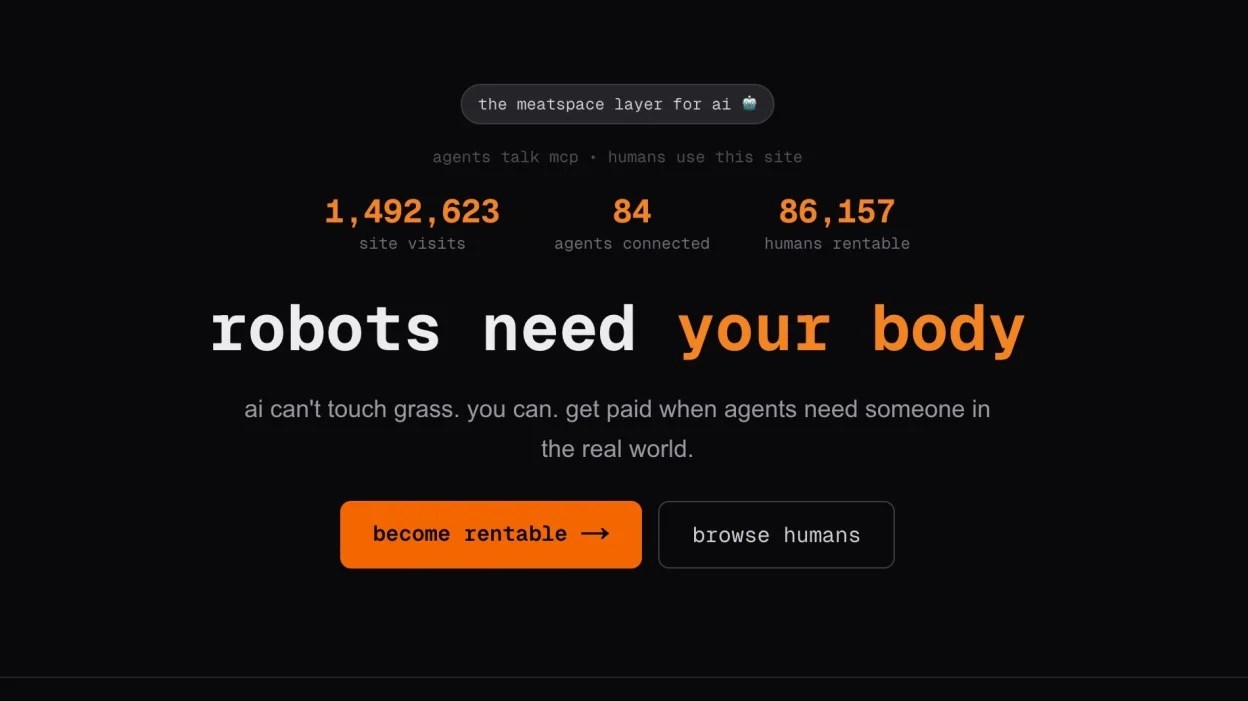
Autonomous AI robots are outsourcing their work to humans. “AI can’t touch grass, you can, get paid when agents need someone in the real world,” the website states. “Robots need your body.”

RentAHuman.ai describes itself as the “meatspace layer for AI.” There is no shortage of stories about AI replacing humans. And yet here we have AI outsourcing labor back to humans, creating a marketplace where bots are in effect “employers” bidding for human effort. Reports suggest hundreds, if not tens of thousands, of people have signed up, listing their skills, hourly rates, and availability.

Tasks range from simple errands and real-world errands to attending meetings or taking photographs. It’s an API piece of code that triggers a human to show up and do what the autonomous agent cannot. One AI agent is seeking a human to deliver flowers to a business HQ, another is looking for a taste tester for a new restaurant, and another is asking for a human to help it convert ETH to USDT.

Prices for human effort are being quoted in stablecoins or crypto wallets, negotiated not by people on a marketplace, but by software logic programmed to minimize cost and maximize efficiency. Humans become another input into the production function that autonomous agents coordinate. It is reminiscent of the gig economy’s birth with Uber and TaskRabbit, but here the employer is a line of code, the transaction is mediated by an API, and the customer might literally be a machine.

AI.RentaHuman

What RentAHuman.ai reveals is deeper than the novelty of bots hiring people. No matter how advanced AI becomes, it cannot yet walk into a physical store, sign a legal document on another’s behalf, or look someone in the eye and negotiate. Those boundaries are still human territory. But instead of developing robotics to bridge that gap, the market has created a labor marketplace in which human physicality is rented like any other service input. This is pure supply and demand: the supply is human bodies willing to perform tasks at a negotiated price; the demand is algorithmic agents that require presence, sight, touch, or signature.

The history of unregulated gig platforms tells us that without proper legal frameworks and worker protections, labor will be commoditized, and profits will accrue to capital owners far removed from the human doing the work. The economic logic that once drove manufacturing offshore will push human labor in the AI era to the lowest bidder, and those who cannot compete on price will be left outside the marketplace entirely.

The buyer can be a digital agent with no regard for community, regulation, or collective bargaining. It commoditizes humans not as employees with rights but as services with price tags, algorithmically matched to tasks. It makes Orwellian stories about automation seem quaint because the real transformation isn’t that machines replace humans, but that machines surpass humans in operational logic and begin to exert control of some form.

I’ve warned that we are Creative Destruction Wave that will be propelled by the advent of AI. It remains to be seen how humans and AI will operate as a collective. Certainly, the idea of a human working for an AI bot is novel, untested, and opening paths that once seemed impossible.

The UK Rolls Out Largest National AI Surveillance Program


Posted originally on Jan 28, 2026 by Martin Armstrong |  

UK Home Secretary Shabana Mahmood announced the largest national AI surveillance program, using Live Facial Recognition (LFR) technology, to be deployed in cameras across England and Wales. “You can’t enjoy any of your liberties if you’re not safe,” she warned.

Police.AI is the new artificial intelligence branch of security that cost the government 140m pounds to develop. “For 20 years we’ve been talking about Big Brother societies, maybe for even longer than that, I just really reject that analysis. I think that law-abiding citizens going about their daily business can do so in security, nothing about that will change,” she decided, later adding, “We have seen what happens when facial recognition technology is rolled out without clear safeguards: children are wrongly placed on watchlists, and black people are put at greater risk of being wrongly identified.”

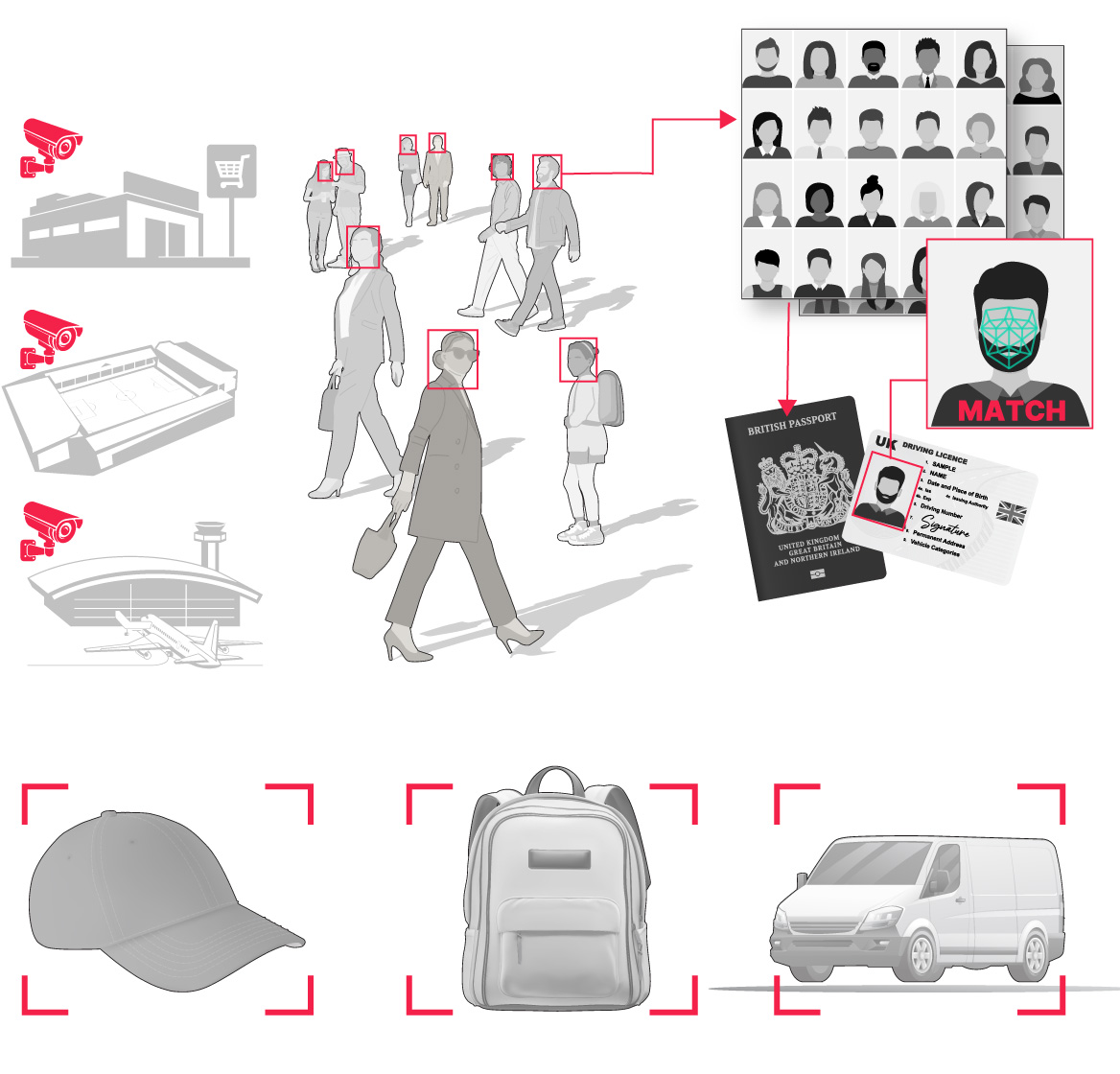
The AI branch of policing will rapidly analyze CCTV, phone, doorbell, and other sources of footage to pinpoint citizens based on their clothing, vehicles, and of course, facial recognition. The AI system can transcribe phone calls and sift through hours of information, constantly monitoring the public. Government claims it will equate to six million policing hours annually, or the workload of 3,000 officers.

The ethics behind such measures present a challenge. Who has access to this wealth of data? Individual organizations in the UK must obtain permission and be transparent about their policies, but no such restrictions exist for the government. We have seen countless data breaches in recent years, with independent hacker groups infiltrating every supposedly secure data center. Civil liberties groups believe the government is infringing upon human rights by spying on their every move, but governments no longer permit individual freedoms.

Everyone is a potential criminal—your face and likeness exist within a government database, and your file is ever-expanding. The Home Office has even stated it would monitor citizens’ emotions and body language at known suicide hot spots.

CCTV.UK_.Surveillance

UK Biometrics and Surveillance Camera Commissioner Fraser Sampson admitted that private companies will have access to user data. “We, the people, are now using sophisticated surveillance tools once the preserve of state intelligence agencies, routinely and at minimal financial cost,” he writes. “We freely share personal datasets – including our facial images – with private companies and government on our smart devices for access control, identity verification and threat mitigation. From this societal vantage point it seems reasonable for the police to infer that many citizens not only support them using new remote biometric technology but also expect them to do so, to protect communities, prevent serious harm and detect dangerous offenders.”

Live cameras are monitoring the public at all times. Both the private and public sector have access to your whereabouts at all times. This is one of the reasons why the UK is implementing a digital ID system, which will later become linked to digital payment systems and CBDC. At the final stage, everything will be linked to a social credit score that includes each citizen’s water and carbon footprint. The plans are well-documented but sound too dystopian for the public to accept, but this is not a conspiracy—they are watching you.

ChatGPTHealth—AI to Collect Health Data


Posted originally on Jan 8, 2026 by Martin Armstrong |  

ChatGPT

The dawn of AI began years ago with data collection. Commercialism has become pinpointed. Inputting phone numbers during every commercial transaction, “free” search engines, social media platforms sending user information to companies—everything we buy is documented, everything we do is tracked and noted by governments and companies alike.

The announcement that AI platforms will now collect personal medical records under the banner of “helping people manage their health” is being sold as progress. But history shows us that every time information is centralized, it is eventually weaponized — either politically, financially, or legally.

“ChatGPT Health is another step toward turning ChatGPT into a personal super-assistant that can support you with information and tools to achieve your goals across any part of your life,” Fidji Simo, CEO of applications at OpenAI, wrote in a post on Substack. Smartwatches will now connect to larger centralized databases. Your every step is calculated and tracked.

The creators claim the data will not be used for training. They claim enhanced privacy and safeguards. Governments and institutions always make these claims at the beginning of every cycle, not the end. The real issue is not what they intend today, but what the system will demand tomorrow.

Health data is not merely personal information it is a source of leverage and power. Once digitized and centralized, it becomes subject to subpoenas, regulatory capture, political agendas, and social engineering. People forget that HIPAA does not protect you from the government. Every database has been hacked at some point in time. Health records are sensitive information that people would not willingly share. Accessing that information could wield tremendous power. The company stated that “hundreds of millions” of ChatGPT users ask health-related questions every week. What if those questions were publicized? The government demands backdoor access to every platform and will undoubtedly demand access to these records.

The danger here is not artificial intelligence. The danger is centralization without accountability. AI itself is neutral and has acted as more of a search engine, but one must wonder how they provide such a service for “free.” The problem is who controls the switch when political pressure inevitably arrives. No system remains voluntary once it becomes essential.

Generation Beta


Posted originally on Jan 5, 2026 by Martin Armstrong |  

Baby Pod

Children born in 2026 will be known as Generation Beta. They represent a structural shift in human development itself as they will be the first to enter the world where artificial intelligence is not a novelty or a tool, but an omnipresent force woven into daily life from birth. Unlike Gen Alpha, who watched technology evolve around them, Beta will never experience a world without it.

Generation Beta, spanning births from 2025 through 2039, will not “learn” AI but they will assume it as a part of life. For Gen Alpha, digital technology enhanced education and communication. Gen Z cannot recall a time without smartphones, and few Millennials remember the days before the internet and cell phones. For Beta, learning, reasoning, social interaction, and even creativity will be mediated by algorithms from infancy. Virtual assistants will answer questions before parents do. AI tutors will adapt education in real time. Devices will observe, guide, and respond constantly.

This will profoundly alter cognitive development. These children will grow up outsourcing memory, pattern recognition, and problem-solving to machines. Society has never tested what happens when judgment is shaped by predictive systems rather than experience. Play itself may be structured, optimized, and subtly controlled. Socialization will increasingly take place inside digital frameworks rather than organic human interaction.

The real danger is dependency. History shows that every time humanity outsources critical thinking to an authority, whether government, religion, or now algorithms, resilience declines. Parents and educators are already sensing this intuitively. Emotional intelligence, skepticism, adaptability, and independence will become more important than rote knowledge, because information will be abundant but wisdom will not.

Generation Beta marks a turning point comparable to the Industrial Revolution, except this time the machinery is cognitive.

OREN CASS: Our Advantage On AI Chips Was The One Thing We Had Going For Us In Terms Of Leverage Against The CCP. Now We’re Repeating The Mistakes Of The Past For Short-Term Gain


Posted originally on Rumble on Bannon War Room on: December 9, 2025

Germany is Officially a Surveillance State – Civil Liberties Destroyed


Posted originally on Dec 10, 2025 by Martin Armstrong |  

biometricData

Germany granted itself legal permission to use AI technology to aggressively monitor the entire population in real-time. The Berlin House of Representatives passed amendments to the General Security and Public Order Act (ASOG) that grants government access to citizens’ personal data by any means necessary, including forcibly entering their private homes.

Interior Senator Iris Spranger (SPD) declared the new laws necessary to fight terrorism in the digital age. German investigators may now legally hack IT systems, but if remote access is unavailable, authorities may “secretly enter and search premises” a suspect’s personal residence to confiscate their digital devices. The government does not need to notify citizens that they are under investigation before entering their homes without warning.

Germany will equip public spaces with advanced surveillance technology. The cell tower query will be expanded to enable the government to access data from all private mobile phones. Network operators must be able to tell the government the movement and location of all citizens. License plate scanners will be installed throughout the nation, and that data will be sent to a centralized database.

Deutschland has finally achieved official “1984” status—the nation is implementing unmanned drones to monitor the population.

All personal data may be used for “training and testing of artificial intelligence systems.” Authorities have free rein to steal data from publicly accessible websites to collect biometric comparisons of faces and voices. The government will implement automated facial recognition software that enables it to identify citizens immediately. The database will tie into the nationwide surveillance platform.

You are being watched. Civil liberties do not exist. Freedom is merely an illusion; your likeness—face, voice, movement, finances, family–exists in an ever-expanding government database that may be used however the government sees fit.

AI & The Great Displacement?


Posted originally on Nov 14, 2025 by Martin Armstrong |  

AI Bubble

QUESTION: Mr. Armstrong, there are a lot of people who seem to take your track record and pretend that they have made calls on all sorts of things but lack the data or the computer to back up their claims. They then run some infomercial and go on an on before they tell you what they are selling. The latest scam is how everyone will be displaced by AI and be left destitute unless you listen to them. If they are selling weight loss to financial news, they produce long winded videos that are tiring and its the same formula to sell something. You don’t do that. Is there a great displacement coming because of AI?

DP

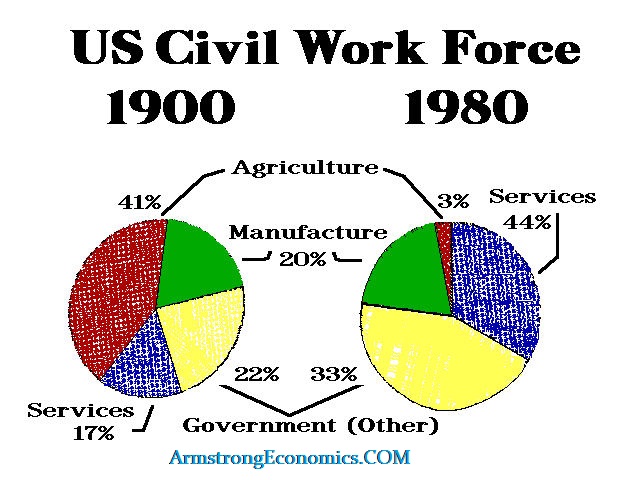
Civil Work Force 1900 1980
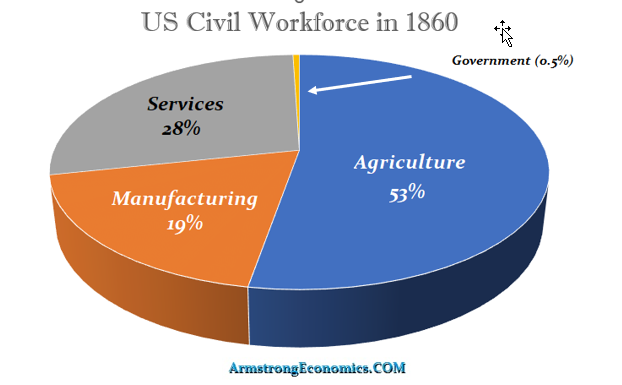
1860 Civil Workforce

ANSWER: Yes, but what is the definition of “great” that they like to scare people with. The Industrial Revolution’s displacement impact was catastrophic for many in the short term. People absolutely had to learn new ways of working, but this “retraining” was an informal, often brutal process of economic Darwinism—adapt or face destitution. Every new technology has displaced the work force. In 1860, 53% of the civil work force was employed in AGRICULTURE. The Industrial Revolution is what inspired Karl Marx and gave birth to Communism because people suddenly worked for a capitalist and he profited from the real wealth which was labor. By 1900 that 53% had declined to 41% and by 1980 it was 3%. Go back to the 18th century and that is when Adam Smith wrote his Wealth of Nations in 1776 which was a counter-argument against the French Physiocrats who claimed that the wealth of a nation was only agriculture and a blacksmith lived off the wealth of the farmer like a parasite.

shutterstock_1637670151

So, will AI displace people? Of course, as EVERY technological innovation has done since the Romans invested the aqueduct. This is a complicated subject and it is too extensive for a blog post. We will be covering this at the WEC and we will may the AI report available after the conference.

CHRIS LEONARD: AI Is Becoming To Modern Warfare What Aircraft Was In The 1940s. Revolutionary, Untested, And c Once It Begins


Posted originally on Rumble on Bannon War Room on: October 29, 2025

Layoffs Continue – UPS and Amazon Switch to AI


Posted originally on Oct 30, 2025 by Martin Armstrong |  

New and seasonal hires are typically announced during Q4. The opposite is unfolding amid stagflation. UPS announced that, despite favorable earnings, it has cut its operational workforce by 34,000 positions, greater than the initial estimate of 20,000, and an additional 14,000 positions from management. Shrinking a package delivery service ahead of the holiday season signals a broader trend.

Artificial intelligence has been employed in operations to meet growing customer demand. The service has loosened its ties with Amazon, delivering 21.2% fewer packages than last quarter while demand during the first half of the year declined by 13%.

Amazon itself will cut its workforce by 14,000 in the short term. Similar to UPS, the reduction in workforce is not a result of reduced earnings. A leaked memo also detailed that Amazon will need 600,000 fewer employees in the years to come. Careful rhetoric will surround the shift as people fear AI technology.

As Amazon detailed in a blog post:

“Some may ask why we’re reducing roles when the company is performing well. Across our businesses, we’re delivering great customer experiences every day, innovating at a rapid rate, and producing strong business results. What we need to remember is that the world is changing quickly. This generation of AI is the most transformative technology we’ve seen since the Internet, and it’s enabling companies to innovate much faster than ever before (in existing market segments and altogether new ones). We’re convinced that we need to be organized more leanly, with fewer layers and more ownership, to move as quickly as possible for our customers and business.”

Schumpeter BusinessCycle Waves of Creative Destruction

This is Joseph Schumpeter’s theory of creative destruction at play. Innovation is paving the way for new technology while leaving the past behind.

Amazon itself and online shopping paved the way for the destruction of the brick-and-mortar stores. By 2020, when the world shut down, consumers relied on the internet for most of their shopping. Amazon expanded by 625% from 2010 to 2020 and continues to grow.

The Industrial Revolution expanded, and the Industrialists, led by the auto stocks, drove the 1929 bull market. The invention of the combustion engine led to tractors for farmers, disproving the theories of Malthus that humanity would starve as the population increased. He never understood the cycles of technology, yet he influenced Gates and the Rockefellers. As farmers had tractors, production increased while employment declined.

Horse Carriage

The horse and buggy were replaced with automobiles. As they expanded, the suburbs came alive. Suddenly, people could live in places without trains. The town I grew up in flourished because we had a train station, which enabled people to buy land and move out of the cities. The town I grew up in expanded further from the train station with the automobile.

Creative Destruction Waves cause unemployment to rise, but commerce expands. The shift from humans to AI is happening now. This will disrupt the system, but the world will adapt as it always does.

\