
Posted originally on Jun 12, 2026 by Martin Armstrong |
People have become so conditioned to thinking in partisan terms that they miss the larger issue entirely. The question is not whether Bill Gates is a good person or a bad person. The question is why one individual continually appears at the center of industries that later become critical during periods of crisis.
Bill Gates became one of the most influential private figures in global vaccination programs long before COVID. Through the Gates Foundation, billions of dollars have been directed into vaccine development, distribution, and organizations such as Gavi. The foundation has committed more than $4 billion to Gavi alone over the years and remains one of the most influential private actors in global vaccine policy. During COVID, the Gates Foundation committed hundreds of millions more toward vaccine development, manufacturing, and distribution worldwide. Nobody can seriously dispute that Gates became one of the most powerful private forces in the vaccine industry. Yet when a global pandemic arrived, suddenly vaccines became one of the most profitable and politically protected industries on earth.
Then there is agriculture. Bill Gates spent years quietly acquiring farmland across the United States until he became America’s largest private farmland owner, accumulating roughly 250,000 to 275,000 acres spread across numerous states. While many dismissed concerns by arguing that farmland is simply another investment, the timing remains extraordinary. Food inflation exploded. Supply chains broke down. Fertilizer shortages emerged. Farmers found themselves squeezed from every direction. Food security suddenly became a national discussion. Once again, one individual sat at the center of a strategic industry during a period of crisis.
Now consider infant nutrition. Gates-backed investment funds supported BIOMILQ, a startup attempting to produce human breast milk in laboratories using cultured cells. This was not science fiction. It was a real venture designed to create lab-produced breast milk as a commercial product. Around the same period, America experienced one of the worst baby formula shortages in modern history. The shortage stemmed from manufacturing disruptions and supply chain failures coincidentally tied to COVID.

Gates infamously speaks on controlling the population. “If we do a really great job on new vaccines, health care, reproductive health services, we could lower that [population growth] by perhaps 10 or 15 percent,” he stated. When an influential billionaire who funds vaccine programs and bankrolls the World Health Organization buys vast amounts of farmland, finances alternative food technologies, and speaks about managing population growth all at the same time, people are going to ask questions. You cannot expect the public to ignore those connections.
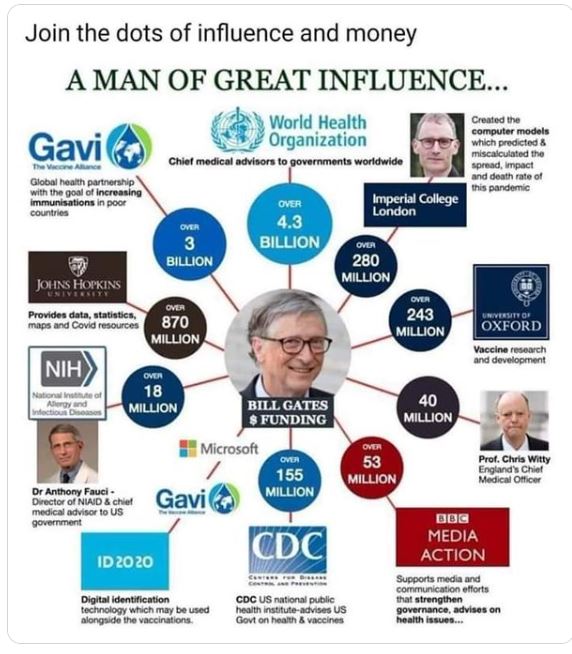
The establishment immediately labels anyone who notices these patterns a conspiracy theorist. That is how debate is shut down before it begins. Yet concentration of power has always been a legitimate concern. When banking became concentrated, governments eventually regulated it. When railroads became concentrated, governments intervened. When media became concentrated, concerns emerged over influence and control. Why should food, medicine, agriculture, and biotechnology be treated differently?
The same people who finance vaccines finance health policy. The same people buying farmland finance agricultural innovation. The same investors funding synthetic food products dictate the future of nutrition. All distinction between private influence and public policy has disappeared.
What concerns me is where this trend leads. We are moving toward a world where food production, healthcare, biotechnology, artificial intelligence, digital identity systems, and financial systems are increasingly controlled by a shrinking circle of institutions and individuals. That concentration creates systemic risk. If they are wrong, everyone suffers. If their interests diverge from the public’s interests, society has few alternatives.
History warns that whenever too much influence accumulates in too few hands, the public eventually pays the price. The issue is the system that allows any private individual to become influential across so many strategic sectors at the same time. That is the lesson people should be paying attention to, because concentration of power has never ended well, regardless of who holds it.

