Silk Road #7, Navigation


EXHIBIT SIGN:
Silk 21

WHAT WASN’T SAID:

1. That many people sailed the Indian Ocean, and other cultures’ accomplishments were ignored.

2. That the history of navigation in the Indian Ocean goes back about 4,000 years ago, during the days of Pharaohs, when the Egyptian seafarers sailed to the country of Punt, the coast of Somalia or the Mozambique coast of gold and incense; and the Sumerians and Jews who were traversing the Persian Gulf.

3. Maritime links between the ancient city of Lothal in India and Mesopotamia are known to have existed, and other traders in the Western Indian Ocean were the Phoenicians, Greeks, and Romans.

FACTS:

The results of human genetic and archaeological research provide us with indirect evidence for the early use of water transport around the Indian Ocean, showing they began to move out of Africa more than 100,000 years ago…a distinct stream of modern humans crossed from the Horn of Africa to the Arabian peninsula and then spread around the rim of the Indian Ocean, eventually reaching Australia, perhaps by 80,000 BP (before the present).

EXHIBIT SIGNS:

WHAT WASN’T SAID:

That the Jewish Talmud teaches that the earth is round and the astrolabe is a Jewish invention. To see a Jewish astrolabe click here Hebrew Astrolabe

Silk 23

FACTS:

1. Judaic savants were largely responsible for the invention and development of the instruments and astronomical tables that thereafter facilitated world-girdling sea voyages. The Zohar (Leviticus 1.3) was more specific about the earth’s rotating on its axis like a ball; Maimonides and other medieval Judaic scientists subscribed to that concept.

2. Intercontinental trade was pioneered by Persian Jews who pioneered the “Silk Route” to the heart of China in the 5th BCE. Augustus, first Roman emperor, is said to have commissioned “the first travel guide” from Isidore of Charax (a town on the Euphrates River estuary on the Persian Gulf). Centuries later, while the Europeans were still deep in the Dark Ages, Persian Rhadanite (Medieval Jewish merchants) scholar/travelers pioneered land and sea trade routes to the Far East.

3. “These merchants speak Arabic, Persian, Roman, Frankish, Spanish, and Slavonic,” wrote Ibn Khurdadhih in the ninth century CE, “They travel from East to West and from West to East by land as well as by sea.” They also spoke Hebrew and Aramaic.

4. Astronomical tables were similarly compiled by Joseph ben Wakkar at Toledo in 1396, and in Aragon by various Judaic specialists.   Other significant calculations were made by Emanuel ben Jacob (aka Bonfils de Tarascon).The tables were used along with an astrolabe, an instrument introduced into the Arab-speaking world by a remarkable Jewish genius, Mashala of Mosul, “the phoenix of his age.” The use of the astrolabe, an instrument for taking the altitude of heavenly bodies, in conjunction with the astronomical tables, helped determine a ship’s position at sea.

EXHIBIT SIGN:
Silk 24

WHAT WASN’T SAID:

1. That the advanced model designed by Rabbi Joseph bn Makhir was used by Copernicus and Kepler.

2. That the most notable cartographers were found among the Jews, and the most advanced cartographer was a Jew who was forced to convert to Christianity. Christopher Columbus’s cartographers and other companions may have been

FACTS:

1. The quadrant, another device important for navigation on the high seas, measured the right ascension (angle from the horizon) of the sun and stars. An advanced model, designed by Rabbi Joseph bn Makhir, became known as the Quadrant Judaicus. Rabbi Makhir compiled the calendar used by Dante, and was quoted as an authority, long after his passing, by Copernicus and Kepler.

2. Rabbi, Levi ben Gershom, in southern France, devoted 136 chapters to astronomy in his major work, The Wars of the Lord; it included an improved quadrant, Jacob’s Staff, that Renaissance explorers depended on for determining latitude and local hour.

3. The most notable cartographers could be found among the Jews. Geographic intelligence was a boon of Judaic dispersion into the Diaspora. Information gleaned by Judaic travelers, deposited with compatriots along their itinerary, was transmitted to other passing Judaic travelers. Geographic intelligence was likewise passed along through correspondence delivered by these travelers from region to region.

4. Majorca, midway between Africa and Europe, became a beehive of Judaic mapmaking; Majorcans were unrivaled seafarers and Jews became their cartographers par excellence. A Jew, Jehuda, forced to convert to Christianity, produced the most famous mapamundi (world map) of the Atlantic coasts and mysterious oceans beyond. He became the first director of the famous nautical observatory in Portugal. Another convert and cartographer authored another famous mapamundi, used by Amerigo Vespucci.

5. Abraham Zacuto (1452-1515) was the most reputable astronomer of the day (University of Salamanca) and possible voyages of Columbus, and instructed Columbus on the use of the perfected astrolabe, which also became the standard in subsequent voyages by all colonialist adventurers, including the ships of Vasco de Gama.

EXHIBIT SIGNS:

Silk 25

Silk 26

WHAT WASN’T SAID:

1. That Polynesians were the finest navigators of the time.

2. Vasco de Gama owed his successful voyages and fame to the astrolabe and the mapamundi.

3. That Marco Polo was the most famous, but not the first, European to reach China. Others had preceded him and were living under Mongol rule, some in servitude.

EXHIBIT SIGN:

Silk 27
WHAT WASN’T SAID:

That the Kemal was not the first or the only type of navigational device in use; sailors were quite ingenious:

  • The first seafarers kept in sight of land: follow the coast, lining up the landmarks.
  • The Greeks learned to navigate from one island to the next by following clouds, which form over land, or odors that carry far out to sea.
  • The Phoenicians looked to the heavens – the sun’s movement across a cloudless Mediterranean sky gave direction and quarter, meaning east and west, Asia and Europe. At night, they steered by the stars, finding fixed “heights” by measuring fingers laid horizontally one over the other.
  • Ionian sailors navigated by the Little Bear constellation 600 BC.
  • Norsemen watched the summer stars, and the behavior of birds.
  • Eskimos studied the snow and Polynesians, whose navigational feats arguably have never been surpassed, watched the waves.
  • Seafarers of the Marshall Islands built ingenious, elaborate maps of palm twigs and shells, denoting everything from the island to the prevailing direction of the swell.
  • Alexandrian astronomer Ptolemy created the first world atlas in 2 AD, plotting latitude and longitude lines; he was preceded by the Greeks, who described trading routes as far east as India.
  • By the 10th, Italian-made portolans supplied detailed directions, distances, depths, coastal description and, by the 13th c., sea maps with scale and bearings began to appear.
  • The greatest advance in navigation came with the Chinese compass; the Chinese knew about magnetism as early as the 3rd millennium BC. The first western compass was mentioned in 1187.
  • Indian traders rode the northeast monsoon to Africa and the southwest monsoon back to the subcontinent. Polynesians also hitched rides on prevailing winds.
  • Phoenicians to the Polynesians measured the height of the sun and stars over the horizon, using the gnomon.
  • The Arabians used the Kemal, as described, to determine latitude.
  • In the Middle Ages, sailors relied on the astrolabe.

EXHIBIT SIGN:

Silk 28

WHAT WASN’T SAID:

That the dhow is the generic name of a number of traditional sailing and trading vessels with more than one mast. Although some historians claim the dhow was invented by Arabs or Indians, the majority give credit to the Chinese, dating back to between 600 BC to 600 AD. Some claim the sambuk dhow may be derived from the Portuguese

EXHIBIT SIGNS:

Silk 29

Silk 30

WHAT WASN’T SAID:

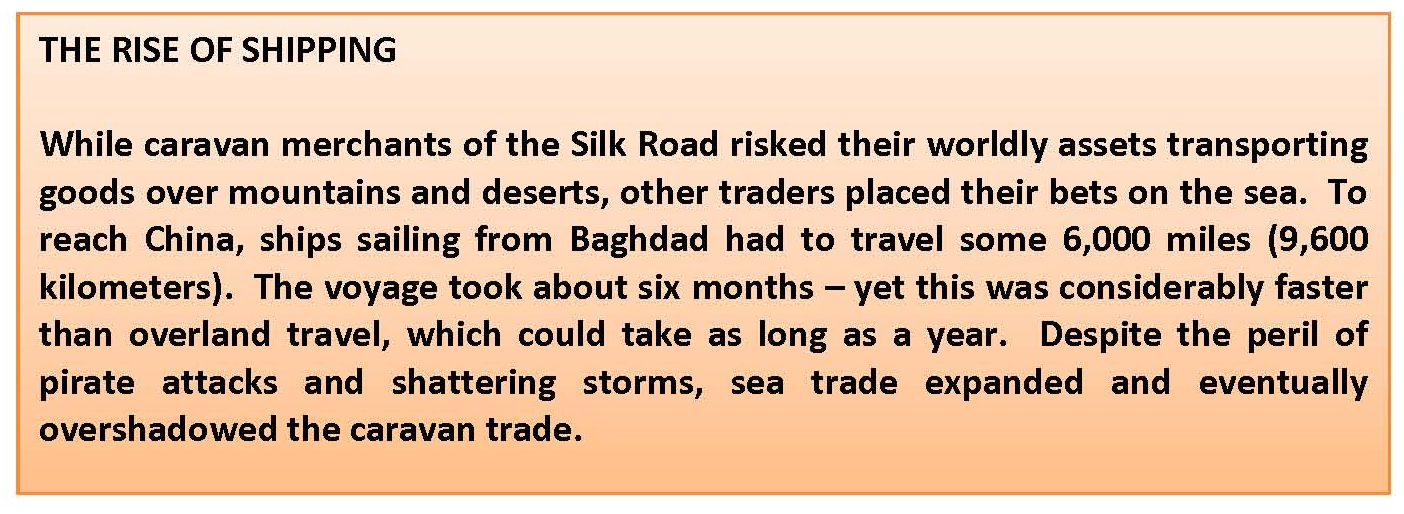
1. That the risk to caravan merchants of the Silk Road might have been the perils imposed by Muslims, known for their attacks, seizing ships, kidnapping, enslavement, and plunder for booty.

2. The First Barbary War (1801–1805), also known as the Tripolitan War or the Barbary Coast War, was the first of two wars fought between the United States and the Northwest African Berber Muslim states known collectively as the Barbary States.   They were fought because U.S. President Thomas Jefferson refused to pay the high tributes demanded by the Barbary States and because they were seizing American merchant ships and enslaving the crews for high ransoms. It was the first declared war that the United States fought on foreign land and seas.

3. The Tripoli Monument, the oldest military monument in the U.S., honors the heroes of the First Barbary War.

EXHIBIT SIGN:

Silk 31

WHAT WASN’T SAID:

That Timothy Severin replicated a voyage that was sailed by a man who never existed.


Silk Road #8, Islam


EXHIBIT SIGN:
Silk 32
WHAT WASN’T SAID:

1. That this exhibit is an indoctrinal, rather than educational, explanation of Muslim activity in this period, representing approximately 80 percent of the exhibit, and those who contrived it must have been aware of its nature, yet complicit in what we recognize as civilizational jihad.

2. That Judaism, Christianity, Buddhism, Hinduism and other religions are not represented with historic accuracy; and visiting viewers were lured to view a deceptive work.

FACTS:
1. Mohammed became the leader of the Arab people in the early 600s, after dreaming that he received messages from God.

2. He beheaded the Jewish men of Mecca; killed or enslaved men, women and children of Mecca and Medina (including Christians and idol worshippers), ethnically cleansed the cities and designated them “holy.” Thus he became the leader of the surviving converted to Islam.

3. Muslims or Mohammedans do today as they did in the early 600s: behead men and enslave and convert to Islam the surviving women and children.

4. “Spread” is an oft-used euphemism in today’s revisionist textbooks. The word, although never defined, refers to conquest and forced conversion.

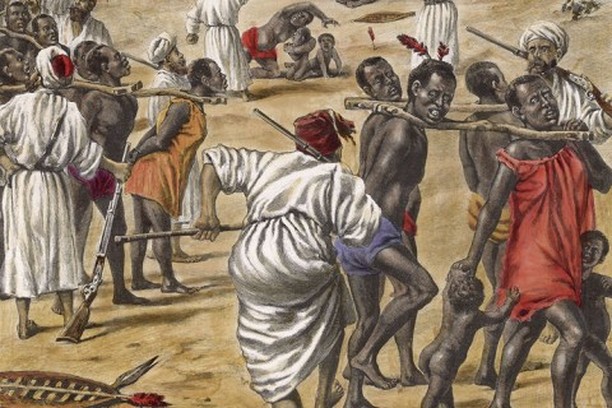
5. European and American historians assert that 10 to 18 million people were taken by Arab slave traders from Africa between the 8th and 19th century, and between one and 1.25 million Europeans from Italy, Spain, Portugal, France, England, the Netherlands, Ireland, and even Iceland, were captured and sold between the 16th and 19th centuries, by Barbary corsairs.


Silk Road #9, Slave Trade


EXHIBIT SIGN:
Silk 33

WHAT WASN’T SAID:

 That the Arab ship was heavily laden with human cargo.

FACTS:

1. Islam Watch: “The Arab slaved trade began and flourished around 800 CE, when it was virtually non-existent in Europe and female slaves often became wives. The Quran, hadith and sire support that Muhammad took, purchased, sold, and gave away both male and female slaves.” Ibn Qayyim al-Jawziyya – a great scholar, astronomer, chemist, philosopher, psychologist, scientist, theologian and Islamic historian – says – “Muhammad had many male and female slaves. He used to buy and sell them, but he purchased more slaves than he sold. He once sold one black slave for two. His purchases of slaves more than he sold.” [Zad al-Ma’ad, part 1, p.150] (Ibn Quayyim Al Jawziyyah’s (1292-1350 CE] Zad al-Ma’ad, translated as Provisions of the Hereafter, is rated as one of the finest books on the biography of Muhammad.)

Silk 34

2. Muhammad had a number of black slaves. One of them was named ‘Mahran’, whom Muhammad forced to do more labor than the average man. Whenever Muhammad went on a trip and he, or his people, got tired of carrying their stuff, he made Mahran carry it. Mahran said, “Even if I were already carrying the load of 6 or4 7 donkeys while we were on a journey, anyone who felt weak would throw his clothes or his shield or his sword on me so I would carry that, a heavy load.” Tabari and Jawziyya both record this, so Islam accepts tis as true.” (Behind the Veil)

3. On one occasion Muhammad’s cousin and son-in-law Ali whipped a female slave of Aisha’s in front of Muhammad to make her speak out about the adultery charges brought against Aisha. Muhammad did not say a word to protest Ali’s beating of the slave-girl. On another occasion, Umar beat a slave-girl for wearing the veil (veil is for free Muslim women only). It has been said in the previous article that Muhammad massacred 800 male Koreiza Jews and took their women and children, about 1200 heads, as slaves. He kept at least one Jewish female, named Rihana, as his concubine, and gave the rest away to his companions. He sent his disciple Sa’d bin Zayd with a portion of the captive women and children to Nejd to sell them for horse and weapons for organizing future jihad-raids.

4. All these incidents bear testimony to the fact that Muhammad was an enslaver and slave-trader. The names of many of Muhammad’s slaves are given in detail in Muslim writings and they can be found in “Behind the Veil.” Moreover, even under Muhammad, slaves were treated brutally as above examples make it clear, although some Muslims groundlessly claim that slaves under Islam were always treated fairly and kindly.

5. These may also bear testimony that Muhammad’s entourage and followers may not have traded honestly, but raped and looted.

EXHIBIT SIGN:
Silk 35

WHAT WASN’T SAID:

That it was an age of inhumane servitude for Jews and Christians, the People of the Book.

FACTS:

1. Jewish communities had always existed in the Middle East and were called People of the Book (the Bible). The Golden Age for Jews and Christians meant large-scale discrimination. They were given the status of Dhimmi, and afforded the ignominious honor to live in shame under Islamic rule.

2. Dhimmi is the Arabic term that refers to its non-Islamic-embracing population, as a distinctly subjugated, second-class, almost-slave non-citizen, who is subjected to dictatorial deprivation of any legal and human rights since he is a non-Muslim permanent resident in a Muslim state. Bat Ye’or’s book, Dhimmi (1971), describes the basis for development of dhimmitude in Islam, and its relationship to the jihad, the war to conquer territory for Islam.

3. Throughout the earliest Islamic history, the people conquered by Muslims were given the choice of conversion, death, or servitude to despotic masters. Jews and Christians had to pay taxes and tolls and give deference to Muslim neighbors and frenzied mobs.

4. Jews and Christians were allowed to continue cultivating land, but cede half the produce, with threat of expulsion at any time. Making and breaking agreements was the hallmark of the Muslim armies.

5. As the Muslims grew more powerful, their holy wars spread beyond Arabia. The jihad became a war of conquest subject to a code of eliminating infidels. Truces were made, but never a lasting peace, as happens today.

6. The jihad became a concept of dar al harab, territory of war, and dar al Islam, territory of Islamic reign. Jihad is a normal state of dar al harab that can only end with conversion of the world. Therefore, jihad became conquest of the world for Islam – forced conversions, killings, taking slaves, seizing property. This enriched the jihadists and brought wealth to Arab nations; participation was/is obligatory either by force or by betrayal from within.

7. The current ruler provided tolerance and security or fanaticism and pogroms.   Communities could be evicted, women raped, exorbitant ransoms paid on them, children abducted for conversion, mass murders of the dhimmis was condoned. There was no due process.

8. Discriminatory and restrictive dress and behavior codes were enacted to identify the dhimmi and severely enforced to reduce dhimmi into a state of despair and poverty. Dress codes included not wearing shoes or sandals, not using certain colors, wearing stars on their clothing, prohibitions against certain occupations, and even rules on how to ride a mule. Dehumanization was generally the rule, as were various forms of physical abuse. Non-enforcement of rules could result in severe beatings, even mortal wounding.

9. Islam was not a Golden Age for non-Muslims; Islam is intolerant, and it fosters and condones belligerent and aggressive actions toward people who choose not to embrace Islam.

10.  There were pogroms against the Jews since the 11th century: 1066 Granada massacre, the razing of the entire Jewish quarter in the Andalusian city of Granada. In North Africa, there were cases of violence against Jews in the Middle Ages, and in other Arab lands, including Egypt, Syria, and Yemen. Jewish population was confined to segregated quarters, or mellahs, in Morocco, walled-in ghettos, beginning from the 15th century. The Almohads, who had taken control of much of Islamic Iberia by 1172, treated the dhimmis harshly. Jews and Christians were expelled from Morocco and Islamic Spain. Faced with the choice of either death or conversion, some Jews, such as the family of Maimonides, fled south and east to the more tolerant Muslim lands, while others went northward to settle in the growing Christian kingdoms. In 1465, Arab mobs in Fez slaughtered thousands of Jews, leaving only 11 alive, after a Jewish deputy vizier treated a Muslim woman in an offensive manner. The killings touched off a wave of similar massacres throughout Morocco.

Silk Road #10, Medicine


EXHIBIT SIGN:
Silk 36

MEDICINE – FACTS

1.  The history of Arabic science is that the scientists were among the Jews who were forced to convert to Islam. The Arabs had no scientific traditions as they rampaged into the near East, Egypt, and Libya in 694. The Jews had been long established in North Africa; eight Berber tribes converted to Judaism and, under their heroic Queen Kahena, liberated Libya. The Arab troops of 60,000 prevailed; 50,000 Jews and Berbers were massacred, and the descendants of the converted (not of the illiterate invaders) became “Arabic” philosophers and scientists.

2.  A great physician, Isaac Israeli of Kairouan, was an Egyptian Jew who had immigrated to West
Africa, and brought his science with him. Known to Europe as Isaac the Jew, his surviving works include logic, On Definitions, and Aristolian physics, On the Elements; his work on Pharmacology, De Gradibus Simplicum, (translated into Latin) became the standard for medical history.

3. It was from Isaac Israeli that the greatest of “Arab” scientists, Avicenna (980-1037) drew inspiration. He was regarded as Arabic because he wrote in Arabic. He was known as the Aristotle of the East and became a vizier in Persia, but he was born near Bokhara, then heavily populated by Jews, and was probably of Jewish origin. Avicenna’s work reached Europe through translations by Jewish scholars in Spain, Italy, and Provence. The great physician Maimonides was an admirer of Avicenna, and recommended the Jews study his works in The Guide to the Perplexed. (at right)

Silk 37

http://en.wikipedia.org/wiki/File:Guide_for_the_Perplexed_by_Maimonides.jpg

4. Avenzoar was likewise a Moslem scientist of Jewish origin, “and may thus be included among the great Jewish physicians of history (Roth, 170). His great work, Taysir, was one of the most widely read medical treatises of the century, not least because it was translated early on into Hebrew, “the language of the author’s ancestors.” Johannes of Capua, a converted Jew, in collaboration with another physician from Padua, translated it into Latin in 1280. It was likewise at Padua that the great work of Avicenna, The Colliget (General Rules of health), was translated into Latin by the Jew Bonacosa. The book became a standard medical treatise; it continued to be published after the printing press was invented several centuries later … and there were others. Physicians who attended the lords and kings of Islam and Christendom were largely Jews, a convincing indication of the major role that Jews continued to play in the science of medicine.

DENTISTRY – FACTS

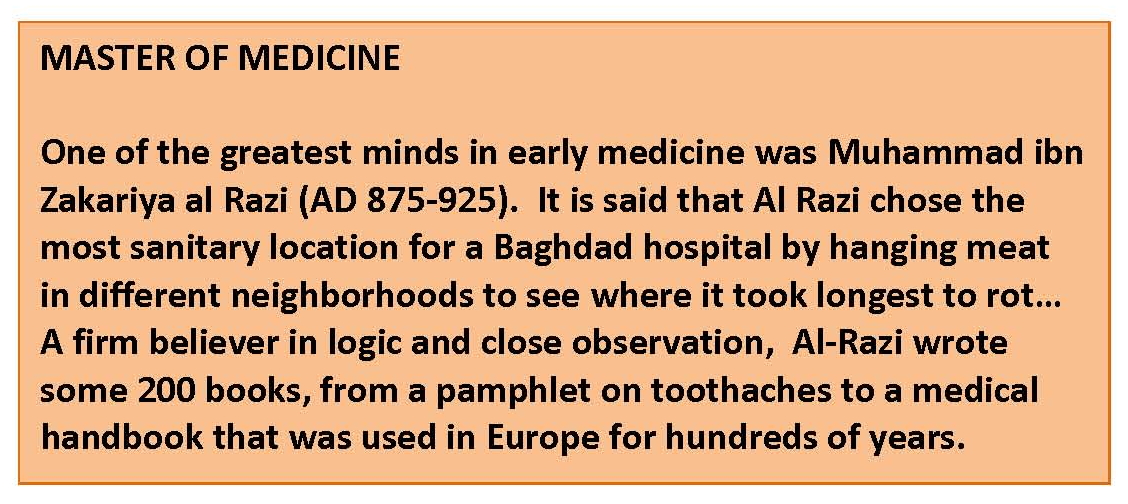
 5. The first known mention of tooth decay and toothache occurs on a Sumerian clay tablet now referred to as the “Legend of the worm.” Recovered from the Euphrates valley, it was written in cuneiform, and dates from around 5000 BC. The belief that tooth decay and dental pain were caused by “tooth worm” is found in ancient India, Egypt, Japan and China, and persisted until the Age of Enlightenment.

6. The word antisepsis comes from the Greek words, anti (against) and sepsis (decay). Antiseptics prevent infection and other changes in living tissue by destroying or slowing the growth of germs (microorganisms that cause disease). The nature and use of anti-septics was not fully understood until the discovery of bacteria.

7. Physicians and healers have been aware of the anti-infective and anti-spoilage properties of certain substances since ancient times. Egyptian embalmers (people who preserved and prepared bodies for burial) used resins (an organic substance taken from plants and trees), naphtha (a liquid hydrocarbon often used as a solvent or diluting agent), and liquid pitch, along with vegetable oils and spices. The effectiveness of this mixture is shown in the fine state of preservation of Egyptian mummies. Persian laws instructed people to store drinking water in bright copper vessels. The ancient Greeks and Romans recognized the antiseptic properties of wine, oil, and vinegar for dressing wounds, dating back to the Greek physician Hippocrates (460 – 377 BC).

8. Ancient China is responsible for contributing much to the modern world, including many innovations to dentistry, and methods of treating tooth diseases – treating toothaches with arsenic, AD 1000, and developing silver amalgam for fillings. They were advanced in the observation of the oral cavity, specifically to mastication and deglutition, systemic diseases and their connection to oral manifestations, such as early detection of measles. Other studies included tooth extraction, abscesses, tumor removal and repair due to trauma, early repair of cleft palates, lip and other congenital defects, and the instruments required to perform such tasks.

TCP We Know Light

Jones Day

Anne and Dan Palmer

RAV Financial

Margaret W Wong &Y Associat5es Co., LPA

Anthony Y Yen

Cleveland Asian Festival

ClevelandPeople.com

Confucius Institute at CSU

Discount Drug Mart

Federation of India Community Associa5tions of Northeast Ohio

Global Cleveland

In June 2014, UNESCO designated the Chang’an-Tianshan corridor of the Silk Road


MEET THE CURATORS

Mark Norell

Mark A Norell, curator and chair of the Division of Paleontology at the Museum, has been a team leader of the Joint American Museum of National History/Mongolian Academy of Sciences expeditions to the Gobi Desert, with interests and books written on invertebrate fossils and dinosaur species. I found nothing to suggest that he had any in-depth interest in or discoveries about the Silk Road.

Denise Leidy

Denise Leidy’s bio indicated a deep interest in Asian art and culture, and that she has traveled widely on the Silk Road. A specialist in Chinese sculpture and decorative arts in the Buddhist traditions, there was little or nothing of this included in the exhibit. The majority information focused on Islam. Further, if she curated several exhibitions of Glimpses of the Silk Road, is she not aware of the early stages and the cultures that were responsible for this massive development and progress that affected civilization? Surely some due diligence would have uncovered the facts that are available to all who are willing to delve for accurate attribution.

William Honeychurch

William Honeychurch’s expertise falls into the category of the archaeology of ancient nomadic politics of Mongolia, and the Silk Road of the Steppes region. There was no inclusion of the Silk Road into Mongolia. I question its exclusion and concentration on Islam.

Silk 38