
Posted Originally on Oct 2, 2026 by Martin Armstrong |
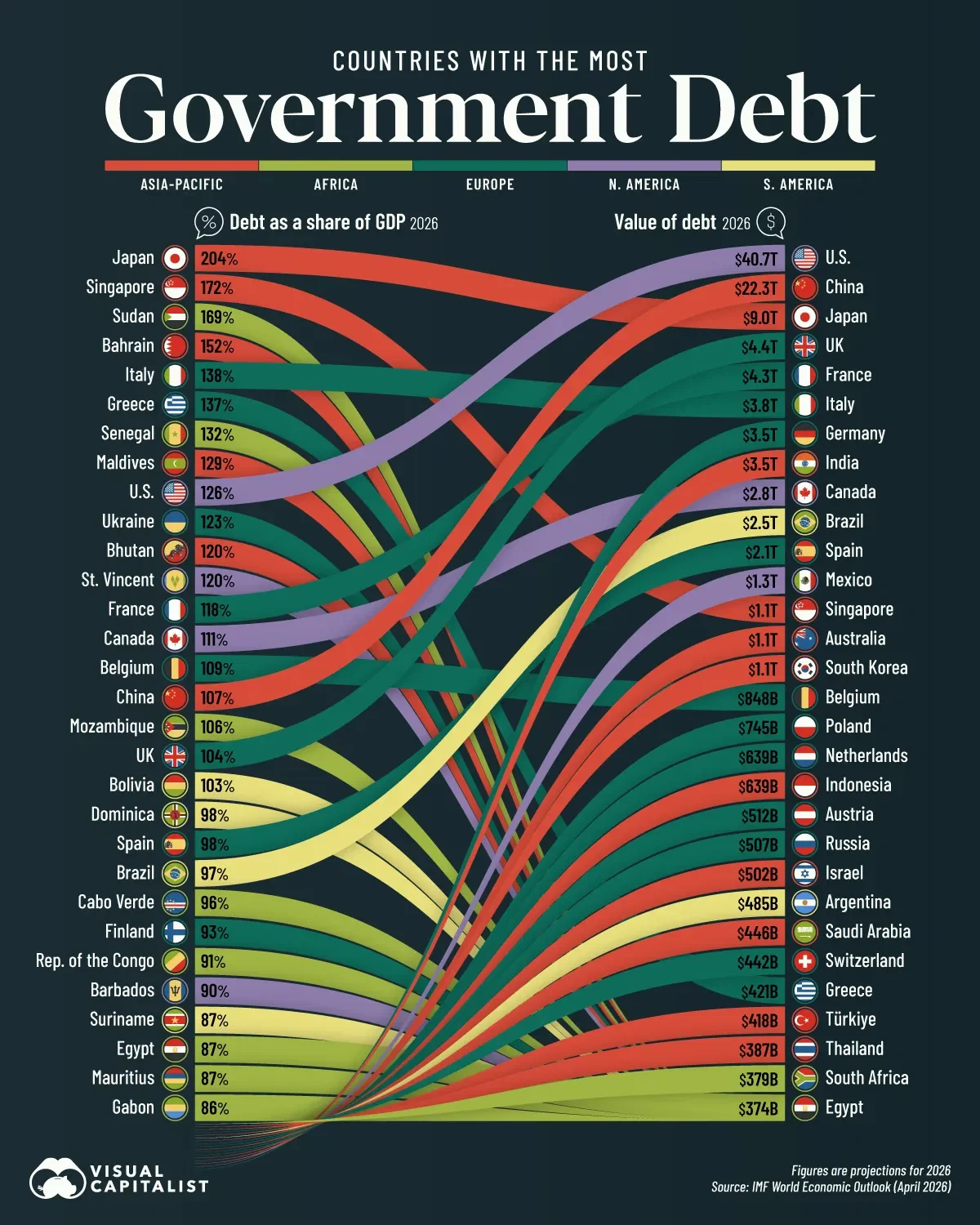
For decades, economists looked down on emerging markets whenever they ran chronic deficits, accumulated too much debt, and watched interest expense consume an increasing portion of government revenue. The developed world supposedly knew better. Now the Institute of International Finance is warning that the United States, France, Britain, and Japan face “persistently large deficits and rising interest expenses — challenges long associated with debt-distressed emerging market sovereigns.”
Welcome to the sovereign debt crisis. Global debt has now surpassed $365 TRILLION after increasing by more than $10 trillion during the first half of 2026. The problem is no longer merely the amount of debt. Governments accumulated enormous liabilities during an era when interest rates were artificially suppressed, and they became accustomed to refinancing those obligations at virtually no cost. That era is ending, and the bond market is beginning to demand a real return for financing governments that have absolutely no intention of balancing their budgets.
This is the part politicians never understand. Government debt does not disappear when the bond matures. They issue another bond to repay the old one. That works beautifully while rates are falling because governments continuously refinance yesterday’s debt at cheaper rates. But the entire mechanism reverses when rates rise. A bond issued years ago at 1% eventually matures and must be replaced with debt costing 4%, 5%, or perhaps more. The principal did not increase, but suddenly the cost of carrying it explodes.
That is precisely what is happening now. The IIF estimates that advanced economies paid more than $3.3 trillion in interest on internationally traded government bonds last year. The organization says mature-market governments are now spending more on interest than the world invests in AI, defense, or energy. Government is increasingly borrowing money not to build something productive but simply to finance obligations created by previous borrowing.
The United States has already crossed $40 trillion in national debt. The 10-year Treasury yield has now pushed above 5% and reached its highest level since 2002. France’s 10-year borrowing costs are approaching 5%, their highest since 2002, while Britain’s 30-year yield has crossed 6% for the first time since 1998. Japan, which spent decades suppressing interest rates near or below zero, is watching its own bond yields climb to levels not seen in decades. This is not one isolated country making a policy mistake. The bond market is repricing sovereign risk across the developed world.
The real problem is refinancing. OECD governments are expected to use roughly 78% of their borrowing this year merely to refinance existing debt rather than finance new spending. Think about that. Governments are going into the bond market primarily to roll over yesterday’s promises. As those bonds mature, the old low rates disappear and are replaced by today’s higher rates, causing interest expense to rise even if politicians never create another new program.
That creates a vicious cycle. Higher interest expense increases the deficit. The larger deficit requires additional borrowing. Additional borrowing increases the supply of government bonds that private investors must absorb. Investors then demand higher yields to compensate for inflation, fiscal risk, and the enormous supply of paper coming onto the market. Those higher yields increase interest expense again.
Central banks can attempt to suppress rates, but eventually they face the currency and inflation consequences of doing so. Japan demonstrated that for decades. The Bank of Japan could buy government bonds and manipulate the yield curve while inflation remained dormant. Once inflation returned and the yen weakened, that policy became increasingly difficult to maintain. The BOJ is now raising rates while Japan carries one of the largest government debt burdens relative to GDP in the developed world.
The United States faces a different version of the same problem. Washington needs enormous amounts of capital every year merely to finance deficits and refinance existing Treasury securities. Foreign governments once absorbed enormous quantities of American debt as part of their reserve systems, but the market has increasingly shifted toward private investors who care about PRICE. They will buy the debt, but only at a yield they consider worth the risk.
Governments then face choices politicians hate. Raise taxes, cut spending, allow interest expense to consume more of the budget, inflate away part of the obligation, or attempt to force domestic institutions to absorb government debt. None of those choices creates prosperity. They merely determine who ultimately absorbs the loss.
The developed world spent decades lecturing everyone else about fiscal discipline while constructing entitlement systems it could not finance, expanding governments it could not afford, fighting wars with borrowed money, rescuing financial systems with borrowed money, locking economies down with borrowed money, and pretending that zero interest rates had somehow eliminated the consequences.
Now the debt is being refinanced at higher rates, interest expenses are rising, and bond investors are beginning to demand compensation for the fiscal behavior governments once mocked emerging markets for displaying. The sovereign debt crisis does not require governments to announce default. It begins when the cost of maintaining the debt starts consuming the government itself, and that process is already underway across the developed world. Oct 2, 2026 by Martin Armstrong
For decades, economists looked down on emerging markets whenever they ran chronic deficits, accumulated too much debt, and watched interest expense consume an increasing portion of government revenue. The developed world supposedly knew better. Now the Institute of International Finance is warning that the United States, France, Britain, and Japan face “persistently large deficits and rising interest expenses — challenges long associated with debt-distressed emerging market sovereigns.”
Welcome to the sovereign debt crisis. Global debt has now surpassed $365 TRILLION after increasing by more than $10 trillion during the first half of 2026. The problem is no longer merely the amount of debt. Governments accumulated enormous liabilities during an era when interest rates were artificially suppressed, and they became accustomed to refinancing those obligations at virtually no cost. That era is ending, and the bond market is beginning to demand a real return for financing governments that have absolutely no intention of balancing their budgets.
This is the part politicians never understand. Government debt does not disappear when the bond matures. They issue another bond to repay the old one. That works beautifully while rates are falling because governments continuously refinance yesterday’s debt at cheaper rates. But the entire mechanism reverses when rates rise. A bond issued years ago at 1% eventually matures and must be replaced with debt costing 4%, 5%, or perhaps more. The principal did not increase, but suddenly the cost of carrying it explodes.
That is precisely what is happening now. The IIF estimates that advanced economies paid more than $3.3 trillion in interest on internationally traded government bonds last year. The organization says mature-market governments are now spending more on interest than the world invests in AI, defense, or energy. Government is increasingly borrowing money not to build something productive but simply to finance obligations created by previous borrowing.
The United States has already crossed $40 trillion in national debt. The 10-year Treasury yield has now pushed above 5% and reached its highest level since 2002. France’s 10-year borrowing costs are approaching 5%, their highest since 2002, while Britain’s 30-year yield has crossed 6% for the first time since 1998. Japan, which spent decades suppressing interest rates near or below zero, is watching its own bond yields climb to levels not seen in decades. This is not one isolated country making a policy mistake. The bond market is repricing sovereign risk across the developed world.
The real problem is refinancing. OECD governments are expected to use roughly 78% of their borrowing this year merely to refinance existing debt rather than finance new spending. Think about that. Governments are going into the bond market primarily to roll over yesterday’s promises. As those bonds mature, the old low rates disappear and are replaced by today’s higher rates, causing interest expense to rise even if politicians never create another new program.
That creates a vicious cycle. Higher interest expense increases the deficit. The larger deficit requires additional borrowing. Additional borrowing increases the supply of government bonds that private investors must absorb. Investors then demand higher yields to compensate for inflation, fiscal risk, and the enormous supply of paper coming onto the market. Those higher yields increase interest expense again.
Central banks can attempt to suppress rates, but eventually they face the currency and inflation consequences of doing so. Japan demonstrated that for decades. The Bank of Japan could buy government bonds and manipulate the yield curve while inflation remained dormant. Once inflation returned and the yen weakened, that policy became increasingly difficult to maintain. The BOJ is now raising rates while Japan carries one of the largest government debt burdens relative to GDP in the developed world.
The United States faces a different version of the same problem. Washington needs enormous amounts of capital every year merely to finance deficits and refinance existing Treasury securities. Foreign governments once absorbed enormous quantities of American debt as part of their reserve systems, but the market has increasingly shifted toward private investors who care about PRICE. They will buy the debt, but only at a yield they consider worth the risk.
Governments then face choices politicians hate. Raise taxes, cut spending, allow interest expense to consume more of the budget, inflate away part of the obligation, or attempt to force domestic institutions to absorb government debt. None of those choices creates prosperity. They merely determine who ultimately absorbs the loss.
The developed world spent decades lecturing everyone else about fiscal discipline while constructing entitlement systems it could not finance, expanding governments it could not afford, fighting wars with borrowed money, rescuing financial systems with borrowed money, locking economies down with borrowed money, and pretending that zero interest rates had somehow eliminated the consequences.
Now the debt is being refinanced at higher rates, interest expenses are rising, and bond investors are beginning to demand compensation for the fiscal behavior governments once mocked emerging markets for displaying. The sovereign debt crisis does not require governments to announce default. It begins when the cost of maintaining the debt starts consuming the government itself, and that process is already underway across the developed world.

